PERCEPTUAL AND NASOMETRIC ASSESSMENT OF
HYPERNASALITY AFTER INTRAVELAR VELOPLASTY
FOR SURGICAL MANAGEMENT OF VELOPHARYNGEAL
INSUFFICIENCY: LONG-TERM EFFECTS
Análise perceptiva e nasométrica da hipernasalidade
após a veloplastia intravelar para correção da insuiciência
velofaríngea: efeitos a longo prazo
Renata Paciello Yamashita(1), Andressa Sharllene Carneiro da Silva(2),
Ana Paula Fukushiro(3), Inge Elly Kiemle Trindade(4)
(1) Hospital for Rehabilitation of Craniofacial Anomalies at
University of São Paulo – HRAC-USP, Bauru, São Paulo, Brazil.
(2) Hospital for Rehabilitation of Craniofacial Anomalies at
University of São Paulo – HRAC-USP, Bauru, São Paulo, Brazil.
(3) Speech Language Department at Bauru School of
Dentis-try, University of São Paulo - FOB-USP and Laboratory of Physiology of the Hospital for Rehabilitation of Craniofacial Anomalies at University of São Paulo – HRAC-USP, Bauru, São Paulo, Brazil.
(4) Department of Biological Sciences at Bauru School of
Den-tistry, University of São Paulo - FOB-USP and Laboratory of Physiology of the Hospital for Rehabilitation of Craniofacial Anomalies at University of São Paulo – HRAC-USP, Bauru, São Paulo, Brazil.
This study was conducted at the Laboratory of Physiology at the Hospital for Rehabilitation of Craniofacial Anomalies, University of São Paulo (HRAC-USP) with grant from the Pro-Rectory of Research of USP.
Conlito de interesses: inexistente
ABSTRACT
Purpose: to investigate the long-term effect of intravelar veloplasty for surgical management of velopharyngeal insuficiency (VPI) on hypernasality of individuals with repaired cleft palate. Methods:
sixty patients with repaired cleft palate±lip and residual VPI, of both genders, aged 4 to 52 years were analyzed. The patients underwent secondary palatoplasty with intravelar veloplasty. A perceptual speech assessment was used to rate hypernasality using a 6 point-scale, where 1=absent and 6=severe hypernasality. Nasometry was performed for determining nasalance, the acoustic correlate of nasality, during the reading of a set of ive Brazilian Portuguese sentences containing only oral sounds, using a cutoff score of 27%. The assessments were done 4 days before and 16 months after surgery, on average, and the surgical success was analyzed based on reduction and elimination/ normalization of hypernasality and nasalance. Results: postoperative decreases of hypernasality and nasalance scores were observed in 75% and 52% of the patients, respectively. Lower percentages were observed when the criterion of analysis was elimination/normalization (32% of hypernasality elimination and 38% of nasalance normalization, respectively). Conclusion: intravelar veloplasty was shown to be an effective procedure in reducing the most important symptom of VPI in the long-term, and should be seen at as a irst approach for VPI management.
KEYWORDS: Cleft Palate; Velopharyngeal Insuficiency; Palate; Speech; Surgical Procedures,
Operative
INTRODUCTION
velopharyngeal insuficiency (VPI), on the hyperna-sality of individuals with repaired cleft palate.
METHODS
This study was conducted at the Laboratory of Physiology at the Hospital for Rehabilitation of Craniofacial Anomalies, University of São Paulo (HRAC-USP), and was approved by the Institutional Review Board (n. 295/2009).
The study was conducted on 60 individuals with repaired cleft palate, with or without cleft lip, aged 4to 52 years (mean 17 years). The individuals were selected among those with indication for surgical management of VPI, routinely assisted at the hospital, in a two-year period. All individuals presented residual VPI and had indication for secondary palatoplasty with intravelar veloplasty, according to the perceptual and nasopharyngo-scopic analysis performed by the speech-language pathologist and plastic surgeon. Individuals with syndromes and/or evident neurological disorders, residual palatal istulas and acute allergic respi -ratory symptoms that might cause nasal congestion during the examination were excluded.
All individuals or legal responsible parties signed an informed consent form. In the average, the individuals were submitted to perceptual and nasometric analysis of speech four days before surgery (preoperative evaluation – PRE) and 16 months after surgery (postoperative evaluation – POST). Intravelarveloplasty was performed by the Furlow technique, von Langenbeck technique or secondary posterior palatoplasty with Braithwaite procedure.
The individuals were submitted to perceptual speech assessment, which is routinely performed at the Laboratory of Physiology of HRAC-USP, and this study employed the hypernasality outcomes. The pre- and postoperative perceptual speech assess-ments were performed face to face, as described in the literature20,by a single examiner with more than
20 years of experience with cleft lip and palate. Hypernasality was classiied during spontaneous conversation and repetition of a list of vocables and sentences containing exclusively oral phones, using a six-point scale, as follows: 1=absent, 2=mild, 3=mild to moderate, 4=moderate, 5=moderate to severe and 6=severe. Only individuals presenting at least mild hypernasality (score=2) were included in the study.
The individuals were also submitted to nasometry for nasalance assessment. Nasalance was determined using a Nasometer (model 6200-3 IBM, software version 30-02-3.22, Kay Elemetrics, Lincoln Park, NJ)21during reading of a set of ive
palate, thus impairing the integrity of the muscle sling required for velopharyngeal closure1-3.
The primary surgeryaims to repair the palate both anatomically and functionally, thus allowing adequate velopharyngeal closure, fundamental for the normal speech production4,5. However, in many cases, even after primary palatoplasty, the characteristic speech symptoms of velopharyngeal insuficiency (VPI) such as hypernasality, nasal air emission, weak intraoral pressure and compensatory articulation, may persist6-8. This occurs because,
even though the palate may be completely closed and present long extent, the insertion of levator palatini muscles remains anteriorly displaced. In these cases, secondary surgical managementof the palate is necessary9.
Among the different surgeriesfor VPI correction, the procedure known as intravelar veloplasty is based on total release of the palatal musculature and posterior displacement of the muscle bundle, so that the ibers may reach a more transverse position and favor the velum mobility, consequently promoting the velopharyngeal closure10-12. The technique was
initially described by Braithwaite and Maurice13 and
later by Kriens14as an anatomic-functional surgical
procedure used for primary closure of the soft palate cleft15. Since then, the procedure became popular and was incorporated to several surgical techniques, both for primary palatal repair and for correction of residual VPI.
The main criterion for indication of intravelar veloplastyis the anterior insertion of the palatal musculature. The intravelar veloplastyis mainly indicated in cases presenting good extent and mobility of the palate and small failure in velopha-ryngeal closure8,16-18.
Since surgery aims to restore the normal anatomy or modify the existing anatomy to improve the velopharyngeal function1, it is expected that the
use of this procedure, also in individuals presenting medium to large failures in velopharyngeal closure, may improve the speech symptoms.
A recent study conducted at our laboratory19
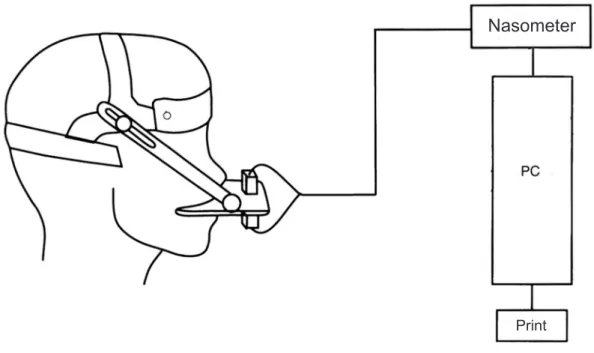
observation, in which 95% of serial nasalance measurements did not vary more than 8%in healthy individuals, tested and retested on the same day at intervals of 1,6 and 12 months (I.T., personal communication, 2010). Figure 1 schematically displays the system coniguration.
Brazilian Portuguese sentences containing only oral sounds22.The cutoff score adopted was 27%,
i.e. values higher than 27% were considered suggestive of hypernasality23. Individual changes
were considered clinically signiicant when greater than eight percent points, compared to a previous
Source: Trindade IEK, Yamashita RP, Bento-Gonçalves CGA. Diagnóstico instrumental da disfunção velofaríngea. In: Trindade IEK, Silva Filho OG, coordenadores. Fissuras labiopalatinas.
Figure 1 –Schematic representing the instrumentation for nasalance assessment (Nasometer 6200-3 IBM, Kay Elemetrics Corp. Lincoln Park, NJ, USA)
Nasometer
RESULTS
The 60 individuals analyzed present hyper-nasality scores equal to or greater than 2 before surgery. Table 1 demonstrates that, according to the perceptual speech assessment, there was reduction in the degree of hypernasality in 75% (45/60) of cases; in 20% (12/60) there was no change, and in 5% (3/60) there was increase. The statistical analysis revealed statistically signiicant preva -lence of score reduction. Table 2 demonstrates that complete elimination of hypernasality was observed in 32% (19/60) of individuals.
All individuals presented mean nasalance scores greater than 27% before surgery. After surgery, the mean nasalance score was signiicantly reduced from 41±8% to 33±15% (Table 3).
The surgical success was analyzed according to the following postoperative observations24.
Hypernasality: 1) reduction, deined as a
reduction of one or more points in the hypernasality score compared to the preoperative assessment, including cases of elimination; 2) elimination, deined as a reduction of hypernasality up to score 1 (absence of hypernasality).
Nasalance: 1) reduction, deined as a reduction
of at least eight percent points in the nasalance score compared to the preoperative evaluation, including cases of normalization; 2)normalization, deined as a reduction of nasalance score up to the normal value (nasalance ≤27%).
The statistical signiicance of pre- and postop-erative differences was investigated by the Student t test for paired samples. Perceptual differences were analyzed by the Wilcoxon test. All tests considered a signiicance level of p<0.05.
Table 1 – Result of intravelar veloplasty according to the perceptual speech assessment (hypernasality) and instrumental evaluation (nasalance). The values represent the percentage (number) of individuals with positive result (reduction/improvement), negative result (increase/worsening) and without alteration in the postoperative evaluation (POST)
VARIABLES Postoperative outcome % (n) Patients POST HYPERNASALITY
(n=60)
Reduction 75 (45)*
Worsening 5 (3)
No alteration 20 (12)
NASALANCE (n=60)
Reduction 52 (31)*
Worsening 10 (6)
No alteration 38 (23)
*p < 0.05 statistically signiicant difference –Wilcoxon test
Table 2 –Results of resolution of intravelar veloplasty according to the perceptual speech assessment of speech (hypernasality) and instrumental evaluation (nasalance). The values represent the percentage (number) of individuals with positive results (elimination/normalization) in the postoperative evaluation (POST)
VARIABLES % (n) Patients POST HYPERNASALITY
(n=60) 32 (19)
NASALANCE
(n=60) 38 (23)
Table 3 –Mean and standard deviation of nasalance values obtained on the nasometric evaluation, performed before (PRE) and after (POST) intravelar veloplasty
PRE PÓS NASALANCE
(n=60) 41±8 33±15*
of elimination of hypernasality were reported in the literature25. Conversely, other authors11
ob-served 39% of elimination of hypernasality, similar proportion to the present study, nearly 14 months after surgery in a study that, similar to this study, also included individuals with large gaps in the sample. It should be considered that perceptual speech assessment in this study was performed face to face and by a single examiner with more than 20 years of experience in the treatment of individuals with cleft lip and palate. This may be a limitation of this study, since notwithstanding the large examiner’s experience, such studies increasingly require the participation of more than one examiner for classiication of speech symptoms. Currently, other studies are being conducted at the Laboratory of Physiology, using recorded speech samples and perceptual analysis by at least three examiners for speech assessment.
The effect of intravelar veloplasty on the speech of individuals was also analyzed using an instrumental methodology. The results demonstrated that, even though the nasalance score did not reach the cutoff point after surgery in the average, the observed reduction was statistically signiicant. Individually, it was observed that surgeryled to reduction of nasalance in 52% of cases and normalization in 38%. Higher percentages, of 87% of reduction and 58% of normalization of nasalance, have been reported in the literature9.However, the differences
between these results may be related to the speech sample used by the investigators, which comprised isolated emission of high vowel and syllable containing high vowel. It should be mentioned that the proportion of normalization observed by the instrumental examination conirmed the indings of perceptual assessment, even though the latter was conducted by a single examiner.
Since nasoendoscopy is part of the preop-erative evaluation routinely performed for these individuals, separate analysis of individuals in this study presenting small velopharyngeal gap(29/60) revealed greater proportion of surgical success. In these cases, hypernasality improved in 83% of individuals and the symptom was eliminated in 55% of cases. Nasometry demonstrated 66% of reduction and 52% of normalization of nasalance in these individuals. However, in individuals with large gaps, there was 67% of improvement of hyperna-sality and only 10% of elimination of symptoms, while the nasometry revealed 40% of reduction and 23% of normalization of nasalance scores. These indings conirm the greater effectiveness of intravelar veloplasty in individuals with small velopharyngeal gaps, as observed in the short term in other studies16,19.
The individual analysis of data demon-strated that, after surgery, there was reduction of nasalance in 52% of individuals (31/60), suggesting improvement; in 38% (23/60) there was no signiicant alteration, and in 10% (6/60) there was increase of nasalance, suggesting worsening. The statistical analysis demonstrated that the reduction observed was statistically signiicant. Among all individuals analyzed, 38% (23/60) presented normal nasalance values after surgery.
DISCUSSION
Intravelar veloplasty has been increasingly used for correction of residual VPI, because it provides a more favorable condition for velopharyngeal mobility with lower risk of morbidity compared to other secondary surgeries, such as pharyngeal lap and sphincteroplasty25. During the years,
intravelar veloplasty has undergone changes and adaptations and has been incorporated to different surgical techniques, such as the von Langenbeck and Furlow, used in this study. Selection of the surgical technique depends on the velopharyngeal conditions identiied on the preoperative evaluation and the plastic surgeon’s preferences10,17. In fact,
there is considerable variation in interpretation of the term intravelar veloplasty, which has been used to describe any degree of muscle dissection, from partial release of muscles up to the most radical forms of dissection and posterior displacement of the velar musculature10,12,26. The surgical procedure
also varies between surgeons and, to some extent, between surgeries performed by the same surgeon.
In fact, the literature unanimously agrees that intravelar veloplasty is the procedure of choice in cases with small velopharyngeal gap. However, studies have suggested that this procedure is also effective in the presence of severe VPI8,19. This
study was conducted on 60 individuals with gaps of variable extents, eligible for intravelar veloplasty. In general, it was observed that surgery improved the hypernasality (reduction of scores) in the long term, in a signiicant part of individuals analyzed (75%). These results were similar to reports in the liter-ature, which ranged between 75% and 85%9,10,18,26.
Recently, better long-term results were also reported in an individual with repaired cleft lip and palate with severe VPI, who obtained signiicant improvement of hypernasality after intravelar veloplasty, leading to complete elimination of the symptom 18 months after surgery27.
considered as surgical failure, since there was a high proportion of improvement in hypernasality. It is believed that these individuals may be submitted to less aggressive subsequent interventions, e.g. avoiding the indication of very large laps and their undesirable effects8,16. It should be emphasized
that the indication of intravelar veloplasty in these cases is based on the preoperative velopharyngeal conditions, especially anterior insertion of the velar musculature and the presence of diastasis of the palatal musculature. Under different conditions, other surgical procedures as pharyngeal lap, sphincteroplasty or adaptation of palatal prosthesis may be indicated following the criteria deined in the literature. However, factors as age, severity of preoperative symptoms, size of velopharyngeal gap, failure in preoperative diagnosis, surgical technique, surgeon’s skills or even tissue repair problems may negatively inluence these results24.
CONCLUSION
Based on the present study, the perceptual and instrumental evaluation of speech demonstrated that intravelar veloplasty had a positive long-term effect in improving the main speech symptom caused by VPI, which lead us to agree with reports in the literature that advocate the accomplishment of intravelar veloplasty as a irst attempt for VPI correction.
Conversely, intravelar veloplasty was less effective in reduction of nasalance than the pharyngeal lap surgery performed for the surgical management of VPI7,24,28,29. However, some studies
also observed that the pharyngeal lap led to the appearance of hyponasality and subnormal nasalance scores in the production of nasal sounds as a consequence of hypercorrection7, and this
effect was not expected in individuals submitted to intravelar veloplasty, due to the characteristics of this technique. Recently, a comparative study between the two techniques conducted at our laboratory conirmed the superior results of pharyngeal lap for VPI correction, concerning the elimination of hypernasality30.
In summary, the present results demonstrated that, in the long term, intravelar veloplasty was successful in improving the speech resonance of a considerable part of individuals. Even individuals without complete resolution of speech symptoms were beneited from surgery. These indings reinforce the statement that repositioning of the palatal musculature favors the velar movement, reducing the symptoms and enhancing the speech intelligibility, even without achieving complete velopharyngeal closure11,26. Even though the
nasometric speech assessment. Braz J Dysmorphol Speech Dis. 1998;2:31-42.
8. Sie KCY, Tampakopoulou DA, Sorom JBA, Gruss JS Eblen LE. Results with Furlow palatoplasty in management of velopharyngeal insuficiency. Plast Reconstr Surg. 2001;108(1):17-25.
9. Nakamura N, Ogata Y, Kunimitsu K, Suzuki A, Sassaguri M, Ohishi M. Velopharyngeal morphology of patients with persistent velopharyngeal incompetence following repushback surgery for cleft palate. Cleft Palate Craniofac J. 2003;40(6):612-7. 10. Noorchashm N, Dudas JR, Ford M, Gastman B, Deleyiannis F W-B, Vecchione L et al. Conversion Furlow palatoplasty salvage of speech after straight-line palatoplasty and “incomplete intravelar veloplasty”. Annals of Plastic Surgery. 2006;56(5):505-10.
11. Sie KC, Chen EY. Management of velopharyngeal insuficiency: development of a protocol and modiications of sphincter pharyngoplasty. Facial Plast Surg. 2007;23(2):128-39.
12. Andrades P, Espinosa-de-los-Monteros A, Shell DH 4th, Thurston TE, Fowler JS, Xavier ST, Ray
PD, Grant JH. The importance of radical intravelar veloplasty during two-lap palatoplasty. Plast Reconstr Surg. 2008;122(4):1121-30.
REFERENCES
1. Huang MHR, Lee ST, Rajendran K. Anatomic basis of cleft palate and velopharyngeal surgery: implications from a fresh cadaveric study. Plast Reconstr Surg.1998;101(3):613-27.
2. Chait L, Gavron G, Graham C, Noik E, De Aguiar G. Modifying the two-stage cleft palate surgical correction. Cleft Palate Craniofac J. 2002;39(2):226-32.
3. Yamashita RP, Oliva TRT, Fukushiro AP, Brustello CMB, Trindade IEK.Efeito da veloplastia intravelar sobre o fechamento velofaríngeo avaliado por meio da técnica luxo-pressão. Rev Soc Bras Fonoaudiol. 2010;15(3):362-8.
4. Brown AS, Cohen MA, Randall P. Levator muscle reconstruction: does it make a diferrence? Plast Reconstr Surg.1983;72(1):1-8.
5. Dumbach J. Reinements of intravelar veloplasty. Scand J Plast Reconstr Surg. 1987;21(1):103-7. 6. Witzel MA. Communicative impairment associated with clefting. In: Shprintzen RJ, Bardach J, editor. Cleft palate speech management: a multidisciplinary approach. St Louis,1995. P. 137-66.
7. Zuiani TBB, Trindade IEK, Yamashita RP, Trindade Junior AS. The pharyngeal lap surgery in patients with velopharyngeal insuficiency: perceptual and
RESUMO
Objetivo: investigar o efeito, a longo prazo, da veloplastia intravelar realizada para a correção cirúr -gica da insuiciência velofaríngea (IVF) residual, sobre a hipernasalidade de indivíduos com issura de palato reparada. Métodos: foram avaliados 60 pacientes com issura de palato±lábio operada e
IVF residual, de ambos os sexos, com idade entre 4 e 52 anos, os quais foram submetidos à palato -plastia secundária com velo-plastia intravelar. A avaliação perceptivo-auditiva da fala foi realizada para classiicação da hipernasalidade, durante a conversação espontânea e a repetição de vocábulos e frases, utilizando-se escala de 6 pontos, onde 1=ausência e 6=hipernasalidade grave. A nasometria foi utilizada para determinação do escore de nasalância (correlato acústico da nasalidade), durante a leitura de 5 sentenças contendo sons exclusivamente orais, utilizando-se como limite de normalidade o escore de 27%. As avaliações foram realizadas 4 dias antes e 16 meses, em média, após a cirurgia e o sucesso cirúrgico foi analisado com base na proporção de redução e eliminação/normalização da hipernasalidade e da nasalância. Resultados: veriicou-se, após a cirurgia, redução da hiper -nasalidade e da nasalância em 75% e 52% dos pacientes, respectivamente. Proporções menores foram identiicadas quando utilizado o critério mais rigoroso de análise (eliminação/normalização), ou seja, 32% de eliminação da hipernasalidade e 38% de normalização da nasalância, respectivamente.
Conclusão: aveloplastia intravelarmostrou ser um procedimento efetivo, a longo prazo, na redução
do sintoma mais signiicante da IVF residual e deve ser considerada como uma primeira opção no tratamento cirúrgico da IVF residual.
DESCRITORES: Fissura Palatina; Insuiciência Velofaríngea; Palato; Fala; Procedimentos Cirúrgicos
23. Trindade IEK, Yamashita RP, Gonçalves CGAB. Diagnóstico instrumental da disfunção velofaríngea. In: Trindade IEK, Silva Filho OG, organizador. Fissuras labiopalatinas: uma abordagem interdisciplinar. São Paulo: Editora Santos, 2007. P. 123-43.
24. Fukushiro AP, Trindade IEK. Nasometric and aerodynamic outcome analysis of pharyngeal lap surgery for the management of velopharyngeal insuficiency. J Craniofac Surg. 2011;22(5):1736-42. 25. Hudson DA, Grobblaar AO, Fernandes DB, Lentin R. Treatment of velopharyngeal incompetence by the Furlow Z-plasty. Ann Plast Surg. 1995;34(1):23-6.
26. Sommerlad BC, Mehendale FV, Birch MJ, Sell D, Hattee C, Harland K. Palate re-repair revisited. Cleft Palate Craniofac J. 2002;39(3):295-307. 27. Smolka K, Seifert E, Eggensperger N, Iizuka T, Smolka W. Reconstruction of the palatal aponeurosis with autogenous fascia lata in secondary radical intravelar veloplasty: a new method. Int. J. Oral Maxillofac. Surg. 2008;37(8):756-60.
28. Abyholm F, D’Antonio L, Ward SLD, KjØll L, Saeed M, Shaw W et al. Pharyngeal lap and sphincterplasty for velopharyngeal insuficiency have equal outcome at 1 year postoperatively: results of a randomized trial. Cleft Palate Craniofac J. 2005;42(5):501-10.
29. Sullivan SR, Marrinan EM, Mulliken JB. Pharynageal lap outcomes in nonsyndromic children with repaired cleft palate and velopharyngeal insuficiency. Plast Reconstr Surg. 2010;125(1):290-8.
30. Barbosa DA. Resultados de fala e de função velofaríngea do retalho faríngeo e da veloplastia intravelar na correção da insuiciência velofaríngea: estudo comparativo [Dissertação] Bauru (SP): Hospital de Reabilitação de Anomalias Craniofaciais, Universidade de São Paulo; 2011.
13. Braithwaite F, Maurice DG. The importance of the levator palate muscle in the cleft palate closure. Br J Plast Surg. 1968;21(1):60-2.
14. Kriens O. An anatomical approach to veloplasty. Plast Reconstr Surg. 1969;43(1):29-41.
15. Bütow KW, Jacobs F.J. Intravelar veloplasty: surgical modiication according to anatomical defect. Int J oral maxillofac Surg. 1991;20(5):296-300. 16. Chen PTK, Wu JTH, Chen YR, Noordhoff S. Correction of secondary velopharyngeal insuficiency in cleft palate patients with the Furlow palatoplasty. Plast Reconstr Surg. 1994;94(7):933-41.
17. Perkins JA, Lewis CW, Gruss JS, Elben LE, Sie KC. Furlow palatoplasty for management of velopharyngeal insuficiency: a prospective study of 148 consecutive patients. Plast Reconstr Surg. 2005;116(1):72-80; discussion 81-4.
18. Dailey SA, Karnell MP, Karnell LH, Canady JW. Comparison of resonance outcomes after pharyngeal lap and Furlow double-opposing z-plasty for surgical management of velopharyngeal incompetence. Cleft Palate Craniofac J. 2006;43(1):38-43.
19. Yamashita RP, Carvalho ELL, Fukushiro AP, Zorzetto NL, Trindade IEK. Efeito da veloplastia intravelar sobre a nasalidade em indivíduos com insuiciência velofaríngea. Rev CEFAC. 2012;14(4):603-9.
20. Genaro KF, Yamashita RP, Trindade IEK. Avaliação clínica e instrumental da fala na issura labiopalatina. In: Fernandes FDM, Mendes BCA, Navas ALPGP, editores.Tratado de fonoaudiologia. São Paulo:Roca;2010, p.488-503.
21. Dalston RM, Warren DW, Dalston ET. Use of nasometry as a diagnostic tool for identifying patients with velopharyngeal impairment. Cleft Palate Craniofac J. 1991;28(2):184-8.
22. Trindade IEK, Genaro KF, Dalston RM. Nasalance scores of normal Brazilian Portuguese speakers. Braz J Dysmorphol Speech Disord. 1997;1:23-34.
Received on: May 29, 2013 Accepted on: September 18, 2013
Mailing address:
Renata Paciello Yamashita
Laboratório de Fisiologia, Hospital de Reabilitação de Anomalias Craniofaciais Universidade de São Paulo
Rua Silvio Marchione 3-20 Bauru, São Paulo, Brasil CEP: 17012-900