LANGUAGE DEVELOPMENT PROFILE
OF CHILDREN IN BELEM, ACCORDING TO DENVER
DEVELOPMENTAL SCREENING TEST
Perfil do desenvolvimento da linguagem de crianças no município
de belém, segundo o teste de triagem de denver ii
Elson Ferreira Costa (1), Lilia Iêda Chaves Cavalcante (1), Débora Dalbosco Dell’Aglio (2)
(1) Universidade Federal do Pará – UFPA, Belém, Pará, Brasil. (2) Universidade Federal do Rio Grande do Sul – UFRGS,
Porto Alegre, Rio Grande do Sul – Brasil.
Financial support: This manuscript is part of a master’s degree project whose student received scholarship from Coordenação de Aperfeiçoamento de Pessoal de Nível Superior – CAPES.
Conlict of interest: non-existent
gestational history, biological characteristics, the family’s socio-economic conditions 3-5, exposure to
contextual factors 6-9, besides stressful events at
early ages 10,11. That means to say that these factors
can lead to changes in the development, hence, may facilitate or impair the language acquisition.
Hof 12 states that language is the systematic
and conventional use of sounds and symbols for communication or self-expression. In the same direction Puyelo 13 points out that language is the
communication means of human beings, and it works as a means for transmission, categorization, association, and synthesis of complex information between people. Therefore, it is an essential capacity for socialization, learning, and integration to the interlocutor’s culture. The linguistic development gathers biological conditions 12, though it depends
on the inluence of environmental and social factors that are present in the primary context people are inserted in, such as the family, the day care center, and shelters 8,14,15.
The elements from the physical and social environment in which the child is inserted are
INTRODUCTION
The human development is characterized by constant changes in physical aspects, and in neuro-logical, behavioral, cognitive, and social maturation. This phenomenon takes place gradually along the cycle of life, and its outcome is to make the human being competent to attend its own necessities and those from the environment 1,2. During childhood a
continuous and progressive process of acquisition of skills happens. These aspects, however, may be inluenced by a set of factors 2, nonetheless, the
developmental process doesn’t happen the same way for children who were subjected to diferent socio-cultural contexts due to multiple causes as:
ABSTRACT
Purpose: to evaluate the development of language, according to the Denver Developmental Screening Test, of children enrolled in elementary schools in Belém. Methods: the association between language development and family background, environmental and personal characteristics was tested. This study is cross-sectional and exploratory descriptive. A questionnaire was applied to parents to collect personal, contextual and family data. The socioeconomic level was measured using an instrument specially designed for poor families. Results: from the 319 children assessed, 59.2% presented result of potential delay in language. The variables that showed a statistically signiicant association with language development were paternal education (p=0.003), maternal age (p=0.03) and family poverty level (p=0.003). Conclusion: this study highlights the importance of implementing stimulation and systematic monitoring programs, and it alerts to the negative interference of the risk factors in this process.
possible connections between the outcome and their family’s environmental and personal characteristics.
METHODS
This research was authorized by the Education State Secretary (SEMEC) and approved by the Ethics Committee on Human Research from the Tropical Medicine Center (NMT/UFPA), by the protocol No. 167.271/2012. The procedures used obeyed the recommendations of the Resolution No. 196/96 from the National Health Council and National Committee of Ethics in Research, in agreement with the Resolution 466/2012. Only the children whose mothers or legal representative accepted to partake in the research and signed the Consent Form were included in the study. In addition, a pilot project was performed with the ive diferent applications of each tool, which enabled to have the same conditions of this study and the training sessions of the research team that was composed by three master’s students and seven graduate students.
This consists in a descriptive exploratory and transversal study. 319 children that attended the YCEU from Belém were assessed from August to December, 2012, from which 56% (178) were boys and 44% (141) were girls with ages that varied from 36 to 48 months. The cluster sampling method was used. The margin of error for the sample size calcu-lation was 5% and the level of conidence repre -sented 95%. The YCEUs involved in the research were sorted according to the total number in each district and according to the amount of children in each researched age. Therefore, this study gathered 19 YCEUs out of 35 in the district. Some children were not selected to take part for presenting disorders that afected speech, sensory alterations, sequelae from impairments in the central nervous system, and malformations.
DDST-II 25 was used In order to assess the NPMD,
which comprises the ages from 0 to 6. The protocol is composed by 125 tasks, subdivided in four areas: personal-social contact, ine motricity, language, and gross motricity. The test was performed based on the examiner’s observation of the child, however some data may be rated based on the parents or caretakers report.
As regards the interpretation of the test, at irst the individual data were analyzed, then the test as a whole. Individual items are interpreted as “passed”, “failed”, “no opportunity available”, and “refusal”. Afterwards four indicators are created: “Normal” when there is no delay or only one area ranked as caution; “Risk” for two or more cautions and/or delay in at least one area; “Delay” when there are two or more delay items, indicating that the child might have important for the lexical and phonologic
devel-opment, in other words, in an stimulating and enabler environment, language may progressively develop
12,16,17. On the other hand, if the child lives in an
environment that doesn’t motivate the use commu-nication or its expression in diferent forms, linguistic dysfunction or delays may occur. Therefore, children that present deicits in comprehension and verbal expression have the tendency to demonstrate dii-culties in psychosocial and cognitive aspects, even after they became adults 17.
Studies have shown that linguistic development may present meaningful changes due to biological risk factors 18,19 in addition to socio-environmental
ones 8,20-22, which may cause delays in this area.
Among the several language damages here are highlighted the simple delay, phonological delays, speciic disorder, diiculties in luency, and semantic-pragmatic changes, which interfere in the intel-lectual and academic ields 22. Impairments in this
ield represent socio-economic problem both for the individual and society because it may increase the years of schooling, decrease professional insertion, and lead to extra expenses on special education or interventions 8,23. Therefore, it is observed the need
to assess and follow the broad development of language, mainly in emergent countries.
There are several strategies mentioned in the literature to detect problems that might appear in early childhood, such as triage and assessments. According to Sigolo and Aiello 24, triage consists in
applying tests at a population of children at diferent ages and it aims at tracking those that might have risks of development delay. Among the triage tools the Denver Developmental Screening Test II (DDST-II) is one of the most used ones, even in clinical and epidemiological researches. This test was developed by Frankenbug and Dodds in 1967 and readapted in 1992 25.It is among the
most common in Brazil and several countries. It is important to mention that DDST-II is a screening test, hence it is not a deinite predictor tool of adaptative or intellectual skills 25. Then, its results cannot be
used for diagnostic purposes.
to obtain an appropriate measure to assess its variability, not limited to the family’s income. It is composed by 13 items that gathers some variables recognized in the literature as factors that have inluence on the child’s development. The scores in each item vary in a scale from zero to four, the total minimum possible is seven and the maximum 52 points. The total sum of each item establishes the level of urban poverty of the family. For statistical purposes it is recommended to divide the population studied in quartiles, according to the score obtained in the level of poverty rank. Each quartile is equiv-alent to 25% of the data distribution.
The data obtained by the instruments were added in a database through SPSS 19. Due to the nature of the variables it was performed descriptive and inferential statistical analyses. The dependent variable of the study was the development score obtained by DDST-II, which was dealt as a dicho-tomic outcome variable (normal or suspected delay). The independent variables were obtained through other instruments. To verify the associa-tions between the outcome – normal, or suspected of language delay – and the independent variables it was used the Qui-Squared test, considering the level of signiicance at 5% (p-value <0.05). As it was the same database used in Guerreiro’s study27, only
the results from the language area were analyzed and discussed, for it was found a great level of cases of suspected delay.
RESULTS
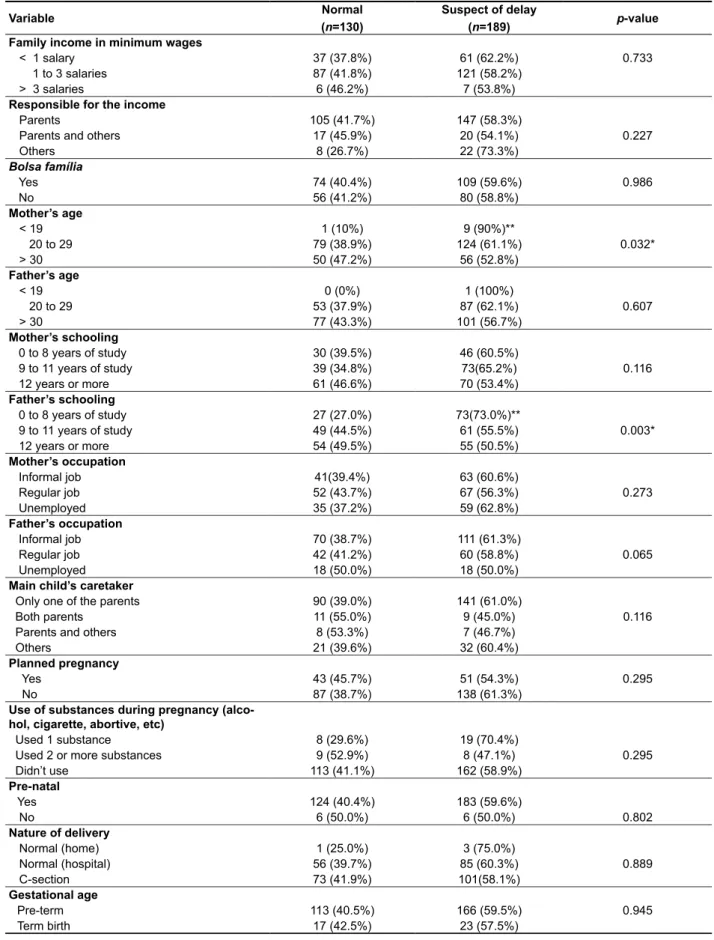
Among the 319 participants assessed in this study the majority of the children had suspected delay in the language development, which corre-sponded to 59.2% (189), from which 62.4% (111) were boys and 55.3% (78) were girls. Table 1 presents the frequency and percentage of the main variables, according to the results of the DDST-II in the language area.
alterations on its development; and “Non-testable” if there is any register of refusal in one or more items that must already be part of the child’s repertoire.
The validity of the DDST-II is established by the precision each item and subgroup was determined by crossing the data between ages and percentage of correct answers in the test that can be of 25%, 50%, 75%, and 90% of precision. Therefore, each item would be ranked “normal” when the child would pass or fail between the variation limits from 25% to 75% of right answers for the reference population; “precaution” when the failure would be between 75-90%; and delay when the failures surpassed 90%. Based on the test, the outcomes would be threefold: delay, at risk, or normal. However, in this study a diferent setting was used, taking into consideration the children at risk or with delay being called suspicious of developmental delay in order to perform the inferential statistical analysis and basing on diferent studies.
In order to verify family, personal, and environ-mental characteristics of the children it was used the Biopsychosocial Characteristics of Children Questionnaire (Questionário de Características Biopsicossociais da Criança – QCBC) created for this study (Attachment 1). This instrument was based on the literature about the determinant factors for the development. It is composed by 48 questions (19 open-ended and 29 closed-ended) structured from the following categories: children and parents identiication; pre-, peri-, and post-natal history; Socioeconomic and environmental conditions; and play environment. However, this instrument was used only for characterization purpose, it was not validated.
To measure the level of poverty of the family it was used the Instrument to Measure the Level of Poverty 26 (Attachment 2) translated and adapted in
Brazil by Issler and Giugliani 5, which enables the
Table 1 – Frequency and association of personal and family variables according to the results of the language development (DDST-II)
Variable Normal (n=130)
Suspect of delay
(n=189) p-value Family income in minimum wages
< 1 salary 37 (37.8%) 61 (62.2%) 0.733
1 to 3 salaries 87 (41.8%) 121 (58.2%) > 3 salaries 6 (46.2%) 7 (53.8%)
Responsible for the income
Parents 105 (41.7%) 147 (58.3%)
Parents and others 17 (45.9%) 20 (54.1%) 0.227 Others 8 (26.7%) 22 (73.3%)
Bolsa família
Yes 74 (40.4%) 109 (59.6%) 0.986
No 56 (41.2%) 80 (58.8%)
Mother’s age
< 19 1 (10%) 9 (90%)**
20 to 29 79 (38.9%) 124 (61.1%) 0.032* > 30 50 (47.2%) 56 (52.8%)
Father’s age
< 19 0 (0%) 1 (100%)
20 to 29 53 (37.9%) 87 (62.1%) 0.607 > 30 77 (43.3%) 101 (56.7%)
Mother’s schooling
0 to 8 years of study 30 (39.5%) 46 (60.5%)
9 to 11 years of study 39 (34.8%) 73(65.2%) 0.116 12 years or more 61 (46.6%) 70 (53.4%)
Father’s schooling
0 to 8 years of study 27 (27.0%) 73(73.0%)**
9 to 11 years of study 49 (44.5%) 61 (55.5%) 0.003* 12 years or more 54 (49.5%) 55 (50.5%)
Mother’s occupation
Informal job 41(39.4%) 63 (60.6%)
Regular job 52 (43.7%) 67 (56.3%) 0.273 Unemployed 35 (37.2%) 59 (62.8%)
Father’s occupation
Informal job 70 (38.7%) 111 (61.3%)
Regular job 42 (41.2%) 60 (58.8%) 0.065 Unemployed 18 (50.0%) 18 (50.0%)
Main child’s caretaker
Only one of the parents 90 (39.0%) 141 (61.0%)
Both parents 11 (55.0%) 9 (45.0%) 0.116 Parents and others 8 (53.3%) 7 (46.7%)
Others 21 (39.6%) 32 (60.4%)
Planned pregnancy
Yes 43 (45.7%) 51 (54.3%) 0.295
No 87 (38.7%) 138 (61.3%)
Use of substances during pregnancy (alco-hol, cigarette, abortive, etc)
Used 1 substance 8 (29.6%) 19 (70.4%)
Used 2 or more substances 9 (52.9%) 8 (47.1%) 0.295 Didn’t use 113 (41.1%) 162 (58.9%)
Pre-natal
Yes 124 (40.4%) 183 (59.6%)
No 6 (50.0%) 6 (50.0%) 0.802
Nature of delivery
Normal (home) 1 (25.0%) 3 (75.0%)
Normal (hospital) 56 (39.7%) 85 (60.3%) 0.889 C-section 73 (41.9%) 101(58.1%)
Gestational age
Pre-term 113 (40.5%) 166 (59.5%) 0.945 Term birth 17 (42.5%) 23 (57.5%)
the suspected delay (X²= 13.83; gl= 3; p= 0.003), the higher risk was noted among the participants that had fathers that studied ≤ 8 years.
Table 2 shows the scores of language with normal development and those with suspected delay in relation to the level of poverty. The children who lived in less fortunate environments presented higher percentage (19.7%) of suspected delay in this area, and a signiicant statistical association among the variables (X2=8.588; gl=1; p<0.003).
According to Table 1 there was a signiicant statistical associations between the results of the language development, according to DDST-II, and the following variables: mother younger than 19; and the father’s schooling under eight years. Regarding the mothers’ age, there was a signiicant statistical correlation (X²= 8.78; gl= 3; p= 0.03) to the outcome studied, it was observed that the mothers aging ≤ 19 were the ones with greater suspected language delay. Regarding the fathers’ schooling it was identiied that this variable was also linked to
Table 2 – Percentage of poverty level distribution correlated to the results in the language area
DDST-II
Level of Poverty
p-value
Inferior Quarter
% (n)
Other Quarters
% (n)
Total
% (n)
Language Score
Normal 7.5 (24) 33.2 (106) 40.8 (130)
0.003* Suspected of delay 19.7 (63) 39.5 (126) 59.2 (189)
Note: Qui-Squared Test (p<0.05*)
DISCUSSION
Language development proile according to the DDST-II
The language development analysis showed that 59.2% from the 319 participants presented results that suggested delay. In less economically fortunate populations the YCEUs are vital option for the care of children and may be environments that facilitate a healthy development 6,28,29. When considering the
YCEUs from Belém it was seen that many children are in extreme poverty and at social risk, however, they spend most of their time under the care of the institution. Therefore, the educator’s actions work as protection mechanisms for they are considered important communicative reference for those that attend these places 14-16. Nonetheless, in this study
the relationship caretaker-child wasn’t investigated.
Personal and environmental proile characteristics
The connection between the low socioeconomic condition and the impairments in the child devel-opment is known in the literature 10,11. In this sense,
most participants were members of families with an income lower than the minimum wage. However, the income variable was not signiicantly linked to the studied outcome. As a result, the socioeconomic situation cannot be reduced only to the income, but
other variables should be considered such as the parents’ education and occupation.
On the subject of poverty, the results about the ecologic context in which the children were inserted were demonstrated to be unfavorable for the linguistic development. Data from Guerreiro 27
reveal that poverty is disseminated throughout the city of Belém. Such evidences may have contributed for strengthening the hypothesis that a condition of misery lived by the families may have increased the chances of suspected language delay. Nonetheless, an expressive number of participants (57%) was receiving beneits from the government by the Bolsa Família.
There are severe consequences to the child development occasioned by an unfavorable socio-economic environment, especially for the language. When compared to their peers with a better economic situation, those children in a poverty situation were facing disparities that dealt with the family, the school, and the community they belonged to 5,10.
The level of poverty experienced in childhood is one of the main risk factors to reach the family and the neurodevelopment. This variable may take place or aggravate multiple risk factors, besides generating the deprivation of opportunities that enable the potential growth 11. In this study, the level of poverty
A higher degree of the parents’ education enables a quality stimulation of the children, even if sometimes the amount of time dedicated to this interaction is smaller. Besides, they are the primary communicative peers, and through this relation the irst forms of language take place 15,18. When
the child is inserted in an educative and caring environment the caretakers are the main reference and the stimulators of this domain. This enables the children to learn new words and their meanings, in addition to perceiving how adults organize the information from their physical and social environment 16,20.
However, depending on the level of education and socioeconomic condition of these professionals they may use simpler and poorer linguistic styles 15.
Other characteristics that interfere in the quality of these institutions and the language stimulation in these environments are the proportion caretaker-children, qualiication and continuous improvement of the professionals, and interpersonal respon-siveness 15,29. The caretaker-children proportion is
predicted by the National Curricular Parameters for Child Education 36. For that reason it is a necessary
data for the analysis of language development, for the educator need to interact with the child in a peculiar way. In this study, these variables were not investigated, however they should, in future researches.
It must be highlighted that most YCEUs involved in the research are placed in suburban areas, where social problems may be noted everywhere. Even though some units presented good structure most of them were damaged and lacked physical and educational resources, possibly interfering on the linguistic abilities. Despite that, these places might work as protective factors of the development, for the children spend most of their time there and establish relationships and interactions outside the family circle.
The varied type of job occupation the fathers had showed a connection slightly signiicant in relation to the results suspected to have delay in the language area. Such result may be in agreement with the hypothesis that a higher education level may lead to a better job for the father, providing greater opportu-nities and better developmental stimulation.
Through the analysis and interpretation of the results it was possible to assess the high prevalence of suspected delay in the participant’s language. It is emphasized that the DDST-II test is a triage test, in other words, it doesn’t make a clinical diagnosis. Therefore, the participants with altered performance should be reassessed, and if the results persist they Regarding the age of the parents, the mother’s
age variable (inferior to 19) showed statistical signiicance with the outcome. In fact, other studies showed that adolescent mothers had children with inferior development when considering growth and neurodevelopment 3,29. Therefore, some questions
are raised about the anticipation of sexual relations and motherhood, the presence or absence of a spouse, and family negligence. To Figueiras 2,
teenage pregnancy may lead to risks in the child development. Adolescent mothers compared to the adult ones are less interactive and communicative with their children. These characteristics may be related to the possible explanations of the results of previous studies, which relate the inluence of social factors to the lack of stimulation or interaction of the mother and the child suspected of language delay.
Some studies support the idea that the level of education of mothers works as a protective factor for the child development 8,20,31. In the present
study there were no statistical signiicance in the correlation between the mothers’ level of education and the language area score. Maybe that has happened due to the nature of the sample, which was composed by children who studied in public institutions that attend mostly families with low socioeconomic levels.
However, paternal schooling equal or inferior to eight years was shown to have inluence on the children’ language. A higher level of the father’s education may lead to better conditions of employment and increase the family’s income, and improve the quality of adequate stimulus to the development 9,21. Studies suggest that parents or
caretakers with a better socioeconomic level and higher education are more communicative with their children, using broad and varied vocabulary in the interactions 15,21,35. On the other hand, those that
have unfavorable socioeconomic and educational conditions, as in the studied sample, are likely to use a less diversiied language pattern and to read less to their children, depriving them of complex verbal strategies 18,35.
In fact, the parents’ schooling is shown to be a protective factor. It is understood that a better education is associated to the parents cognitive skills used to stimulate the children. Besides, this variable tends to increase the chances of a better education to children, conditioned to the care practices and to the ecologic environment provided to the children. This context may amplify the physical and socio-cultural experiences in childhood, motivating a better adjustment 9,21. However, it is necessary to
CONCLUSION
The results from the present study draw attention to the necessity of promoting improvements in the ecological conditions of the children assessed along with their families, reducing the threats to the development they are exposed to. This type of research and hence its discussion are necessary and essential to contribute to the adaptation of public policies related to the children’s education and health in the city of Belém, in addition to support and motivate follow-up programs and vigilance of the development by a multidisciplinary team. It is suggested that new longitudinal studies with bigger sample, and diferent age range are carried out in order to investigate more precisely the indings. Other assessment tools may also be used, including ones to assess the inluence of the care environment and the caretakers have on the child’s development, in addition to qualiication courses for these professionals.
should be lead to speciic evaluation. The character-istics identiied as predictors of suspected delay in the language development were: children who live in poverty; their mothers were 19 years old or younger; and the father’s schooling period was less than eight years. In other words, children with this proile are exposed to risk factors and vulnerability that might bring negative efects for their development.
The DDST-II was shown to be a good tool to screen the child development through simple methodology, low cost, and easily applied by profes-sionals from the ields of education and health. In addition to being an important mean of early detection of disorders. Likewise, the instrument used to assess the level of poverty of the families was able to identify and link the data about ecological conditions present in the family environment of the researched children. Therefore, it is considered that the suspected delay in the language development has a multi-factor character.
RESUMO
Objetivo: avaliar o desenvolvimento da linguagem, segundo o Teste de Triagem de Denver II, de crianças que frequentavam a educação infantil em Belém e veriicar fatores associados do desfecho com as características familiares, ambientais e pessoais. Métodos: trata-se de uma pesquisa trans-versal e de caráter descritivo exploratório. Foi aplicado um questionário aos genitores para coletar os dados pessoais, contextuais e familiares e um instrumento para medição do nível de pobreza familiar. Resultados: das 319 crianças avaliadas, 59,2% apresentaram resultado suspeito de atraso na linguagem. As variáveis que mostraram associação estatisticamente signiicante com o nível de desenvolvimento da linguagem foram escolaridade paterna (p=0,003), idade materna (p=0,03) e o nível de pobreza urbana (p=0,003). Conclusão: destaca-se a importância de implementar programas de estimulação e monitoramento sistemático, além de alertar para a interferência negativa dos fatores de risco nesse processo.
DESCRITORES: Desenvolvimento Infantil; Linguagem; Fatores de Risco
REFERENCES
1. Bronfenbrenner U. Bioecologia do desenvolvimento humano: tornando os seres humanos mais humanos. Porto Alegre: Artmed. Carvalho-Barreto, A. Trad.; 2011.
2. Figueiras AC, Souza ICN, Rios VG, Benguigui Y. Manual para vigilância do desenvolvimento infantil no contexto do AIDPI. Washington: Organização Pan Americana de Saúde; 2005.
3. Gallo PR, Leone C, Amigo H. Tendência de crescimento de ilhos de mães adolescentes.
Rev Bras Crescimento Desenvolv Hum. 2009;19(2):297-305.
em crianças de dois a cinco anos. Rev Saúde Publ. 2005;39(5):725-30.
21. Richels CG, Johnson KN, Conture EG. Socioeconomic status, parental education, vocabulary and language skills of children who stutter. J Commun Disord. 2013;46(4):361-74.
22. Mousinho R, Schmid E, Pereira J, Lyra L, Mendes L, Nóbrega V. Aquisição e desenvolvimento da linguagem: diiculdades que podem surgir neste percurso. Rev Psicopedagogia. 2008;25(78):297-306.
23. Isotani SM, Azevedo MF, Chiari BM, Perissinoto J. Linguagem expressiva de crianças nascidas pré-termo e termo aos dois anos de idade. Pró-Fono R Atual Cient. 2009;21(2):155-60.
24. Sigolo ARL, Aiello ALR. Análise de instrumentos para triagem do desenvolvimento infantil. Paidéia (Ribeirão Preto). 2011;21(48):51-60.
25. Frankenburg WK, Dodds J, Archer P, Shapiro H, Bresnick B. The Denver II: a major revision and restandardization of the Denver Developmental Screening Test. Pediatrics. 1992;89:91-7.
26. Alvarez ML, Muzzo S, Ivanovic D. Escala para medición del nível socioeconómico, en el área de la salud. Rev Med Chile. 1985;113(3):243-9.
27. Guerreiro TBF. Desenvolvimento neuropsicomotor de crianças de Belém: associação com características pessoais e variáveis do seu ambiente ecológico [Dissertação]. Belém, PA: Universidade Federal do Pará; 2013.
28. Rodovalho JC, Braga AKP, Formiga CKMR. Diferenças no crescimento e desenvolvimento neuropsicomotor de crianças em centros de educação infantil de Goiânia/GO Rev Eletrônica Enf. 2012;14(1):122-32.
29. Braga AKP, Rodovalho JC, Formiga CKMR. Evolução do crescimento e desenvolvimento neuropsicomotor de crianças pré-escolares de zero a dois anos do município de Goiânia (GO). Rev Bras Crescimento Des Hum. 2011;21(2):230-9. 30. Biscegli TS, Polis LB, Santos LM, Vicentin M. Avaliação do estado nutricional e do desenvolvimento neuropsicomotor em crianças frequentadoras de creche. Rev Paul Pediatr. 2007;25(4):337-42. 31. Brito CML, Vieira GO, Costa MCO, Oliveira NF. Desenvolvimento neuropsicomotor: o teste de Denver na triagem dos atrasos cognitivos e neuromotores de pré-escolares. Cad Saúde Pública. 2011;27(7):1403-14.
32. Sabatés AL, Mendes LC. Peril do crescimento e desenvolvimento de crianças entre 12 e 36 meses de idade que frequentam uma creche municipal da cidade de Guarulhos. Cienc Cuid Saúde. 2007;6:164-70.
33. Saccani R, Brizola E, Giordani AP, Bach S, Resende TL, Almeida CS. Avaliação do motor de crianças de quatro creches públicas de
Recife, Brasil. Rev Paul Pediatr. 2009;27(3):282-8. 7. Ribeiro DG, Perosa GB, Padovani FHP. Fatores de risco para o desenvolvimento de crianças atendidas em Unidades de Saúde da Família, ao inal do primeiro ano de vida: aspectos sociodemográicos e de saúde mental materna. Cien Saude Colet. 2014;19(1):215-26.
8. Cachapuz RF, Halpern R. A inluência das variáveis ambientais no desenvolvimento da linguagem em uma amostra de crianças. Rev AMRIGS. 2006;50(4):292-301.
9. Maria-Mengel MRS, Linhares MBM. Fatores de risco para problemas de desenvolvimento infantil. Rev Latino-Am Enfermagem. 2007;15:837-42. 10. Evans GW, Kim P. Childhood poverty and young adults’ allostatic load: the mediating role of childhood cumulative risk exposure. Psychol Sci. 2012;23(9):979-83.
11. Grantham-McGregor S, Cheung YB, Cueto S, Glewwe P, Ricter L, Strupp B. Developmental potential in the irst 5 years for children in developing countries. Lancet. 2007;369(9555):60-70.
12. Hof E. Language Development. Belmont: Wadsworth/Cengage Learning; 2014.
13. Puyelo M. Comunicação e Linguagem: desenvolvimento normal e alterações no decorrer do ciclo vital. In: Puyelo M, Rondal JA. (Eds.), Manual do desenvolvimento e alterações da linguagem na criança e no adulto. Porto Alegre: Artmed; 2007. P. 87-99.
14. Nóbrega JN, Minervino CASM. Análise do nível de desenvolvimento da linguagem em crianças abrigadas. Psicol Argum. 2011;29(65):219-26. 15. Ramos DD, Salomão NMR. Interação educadora-criança em creches públicas: estilos linguísticos. Psicol Estud. 2012;17(1):15-25.
16. Schmitt BM, Pentimonti JM, Justice LM. Teacher–child relationships, behavior regulation, and language gain among at-risk preschoolers. J Sch Psychol. 2012;50(5):681-99.
17. Schoon I, Parsons S, Rush R, Law J. Children’s language ability and psychosocial development: a 29-year follow-up study. Pediatrics. 2010;126(1):73-80.
18. Song L, Spier ET, Tamis-Lemonda CS. Reciprocal inluences between maternal language and children’s language and cognitive development in low-income families. J Child Lang. 2014;41(51):305-26.
pré-escolares. Rev Bras Crescimento Desenvolv Hum. 2011;21(2):259-68.
35. Hof E. How social contexts support and shape language development. Dev Rev. 2006;26(1):55-88. 36. Brasil. Parâmetros Nacionais de Qualidade para a Educação Infantil. Brasília: MEC/SEB/DPE/ COEDI; 2006.
desenvolvimento neuropsicomotor em crianças de um bairro da periferia de Porto Alegre. Sci Med. 2007;17(3):130-7.
34. Torquato JA, Paes JB, Bento MC, Saikai GMPN, Souto JN, Lima EAM, Abreu LC. Prevalência de atraso do desenvolvimento neuropsicomotor em
Received on: October 30, 2014 Accepted on: January 29, 2015
Mailing address: Elson Ferreira Costa Rua Lauro Sodré, 1986 Abaetetuba – Pará – Brasil CEP: 68440-000
ATTACHMENT 1
BIOPSYCHOSOCIAL CHARACTERISTICS OF CHILDREN QUESTIONNAIRE (QCBC)
1. Identiication of the child: Name: Date of birth / / Age: Gender: ( ) M ( ) F Address:
Institution: Grade:
Entrance date in the institution:(month/year):
Informer:
Teachers: Level of Education: 2. Parents identiication:
2.1. Mothers’ Name:
Age: Level of education: ES ( ) EMC ( ) EMI ( ) EFC ( ) EFI ( ) A ( ) Job title
2.2. Father’s Name:
Age: Level of education: ES ( ) EMC ( ) EMI ( ) EFC ( ) EFI ( ) A ( ) Job title
3. History about pre-, peri- and postnatal period of the child:
▪ Planned Pregnancy (if not, indicate if it was well accepted):
( ) yes ( ) no
▪ Use of alcohol and other drugs during pregnancy:
( ) alcohol ( ) cigarette ( ) abortive drugs ( ) other drugs________ ( ) NOTA
▪ Prenatal Medical Appointment and exams:
( ) yes. No. of appointments:______________ ( ) no
▪ Type of delivery:
( ) normal at home; ( ) normal at the hospital; ( ) forceps; ( ) C-section; ( ) others. Which one?
▪ Gestational age:
( ) term; ( ) pre-term
▪ System in which the child has presented pathology:
( ) breathing; ( ) gastrointestinal ( ) hematopoietic ( ) others. Which one? _____________
4. Socioeconomic and environmental conditions:
▪ Family income
( ) < 622.00 Reais; ( ) 622.00 to 1244.00 Reais; ( ) 1244.00 to 1866.00 reais ( ) > 1866.00
▪ Person responsible for the family income
( ) father ( ) mother ( ) both parents ( ) others____________
▪ Family income complemented by any social beneit:
( ) no ( ) yes Which one?________________________________
▪ Marital status:
( ) Married parents ( ) Separated parents. Bond with the father_________________________
( ) Single mother, bond with father____________________________ ( ) others. Which one? ________
▪ Main caretaker of the child:
( ) mother ( ) father ( ) grandmother ( ) grandfather ( ) sister ( ) brother ( ) Others. Who?________
▪ Number of children that live in the same house:
( ) 1 ( ) 2 ( ) 3 ( ) 4 ( ) more than 4
▪ Number of people that live in the same house : Indicate precise number:
( ) 1 to 3 ( ) 4 to 6 ( ) 7 to 9 ( ) more than 10
▪ Number of siblings (Do they live in the same house?)
( ) 1 ( ) 2 ( ) 3 ( ) 4 ( ) more than 4
▪ Type and number of places to sleep: (double bed : 2 places)
▪ Number of rooms in the house:
( ) 1 ( ) 2 ( ) 3 ( ) more than 3
▪ Independent kitchen (from the other rooms):
( ) yes ( ) no
▪ Situation of the house:
( ) own/leasing ( ) rented ( ) borrowed/fruition ( ) occupation ( ) living in favor
▪ Type of construction of the house:
( ) wood ( ) brick ( ) brick and wood ( ) others. Which one? __________
▪ Household goods:
( ) radio ( ) television ( ) computer ( ) telephone ( ) cell phone ( ) internet ( ) refrigerator ( ) stove ( ) washing machine ( ) microwave oven.
▪ Type of pavement:
( ) wood ( ) unpaved ( ) cement ( )ceramic ( ) Other. Which one?__________
▪ Electricity
( ) own register ( ) shared register ( ) illegal connection ( ) there is none
▪ Bathroom:
( ) own indoor ( ) own outdoor ( ) communitarian ( ) there is none
▪ Water supply:
( ) tapped water inside the house ( ) tapped water in the site ( ) brought from the neighbor’s well
▪ disposal of excretion:
( ) lush connected to the sewer or cesspool ( ) cesspit ( ) there is none (open ield)
▪ Garbage disposal:
( ) home collection ( ) public can ( ) burn or bury it ( ) thrown in open ield 6 . Play environment:
▪ Type of place used by the child to play on a daily basis:
( ) house ( ) sidewalk ( ) garden ( ) yard ( ) park ( ) square ( ) others. Which one?
▪ Type of toy most commonly used by the child:
( ) ball ( ) female doll ( ) male doll ( ) means of transportation ( ) games ( ) others. Which one? ____
▪ Type of play most common to the child on a daily basis:
( ) motor play ( ) make--believe ( ) with objects (toys)
Interviewer:
ATTACHMENT 2
INSTRUMENT TO MEASURE THE LEVEL OF POVERTY*
1. Number of people that eat and sleep in the house 1-4 people...4 points 5-8 people...3 points 9-12 people...2 points 13-15 people...1 point More than 15 people ...0 point
2. Father abandonment
No abandonment ...4 points Partial abandonment ...2 points Full abandonment ...0 point
3. Parents education (the highest was considered when there was diference) Up to the 8th grade or more ...4 points
5 th to 7 th grade ...3 points
Up to 4 th grade ...2 points
1st to 3rd grade ...1 point
Illiterate, never studied ...0 point
4. Parents activity (the highest was considered when there was diference) Owner of a small store or business ...4 points
Regular job ...3 points Works on demand ...2 points Unemployed, receiving insurance or retired ...1 point
5. Relation to the house
Own house, being paid for...4 points Rented house ...3 points Borrowed / fruition ...2 points Occupation ...1 point Living in favor ...0 point
6. Type of construction
Brick layer ...4 points Wood or mixed ...3 points Simple house, more than 2 rooms...2 points Simple house, 1 or 2 rooms ...1 point
7. Number of people that sleep in the house and places to (double bed equal to two places) (No. of people) – (No. of beds) < 2 ...4 points
(No. of people) – (No. of beds)) > 2 ...1 point
8. Water supply
Tapped water inside the house ...4 points Tapped water in the land ...2 points Water brought from the neighbor, public fountain ...1 point
9. Disposal of excrements
10. Garbage collection
Home collection ...4 points Public container ...3 points Burned or buried ...2 points Thrown in open ield ...1 point
11. Electricity
Own registry ...4 points Shared registry ...3 points No electricity ...0 point
12. Independent kitchen
Yes ...4 points No ...1 point
13. Household goods
Refrigerator ...8 points Television ...4 points Stove ...2 points Radio ...1 point
Sum of the items (question 13)
15 points ...4 points 10-14 points ...3 points 4-9 points ...2 points 1-3 points ...1 point 0 point ...0 point