REVISTA
BRASILEIRA
DE
ANESTESIOLOGIA
OfficialPublicationoftheBrazilianSocietyofAnesthesiologywww.sba.com.br
SCIENTIFIC
ARTICLE
Adding
75
mg
pregabalin
to
analgesic
regimen
reduces
pain
scores
and
opioid
consumption
in
adults
following
percutaneous
nephrolithotomy
Harun
Aydo˘
gan
a,∗,
Ahmet
Kucuk
a,
Hasan
Husnu
Yuce
a,
Mahmut
Alp
Karahan
a,
Halil
Ciftci
b,
Mehmet
Gulum
b,
Nurten
Aksoy
c,
Saban
Yalcin
aaDepartmentofAnesthesiologyandReanimation,HarranUniversityMedicalFaculty,Sanliurfa,Turkey bDepartmentofUrology,HarranUniversityMedicalFaculty,Sanliurfa,Turkey
cDepartmentofClinicalBiochemistry,HarranUniversityMedicalFaculty,Sanliurfa,Turkey
Received11June2013;accepted19August2013 Availableonline25October2013
KEYWORDS
Pregabalin; Opioidanalgesics; Percutaneous nephrolithotomy
Abstract
Backgroundandobjectives: Addingnoveladjunctivedrugslikegabapentinoidstomultimodal analgesicregimenmightbereasonableforlesseningpostoperativepainscores,totalopioid con-sumptionandsideeffectsafterpercutaneousnephrolithotomy.Weaimedtoevaluatetheeffect ofpregabalinonpostoperativepainscores,analgesicconsumptionandrenalfunctionsexpressed bycreatinineclearance(CrCl)andbloodneutrophilgelatinase-associatedlipocalin(NGAL)and cystatinC(CysC)levelsinpatientsundergoingpercutaneousnephrolithotomy(PCNL). Methods:60patientsundergoingelectivePCNLwereenrolledinthestudy.Patientswere ran-domizedtooralsingledose75mgpregabalingroupandacontrolgroup.VisualAnalogScalepain scores(VAS),postoperativeintravenousmorphineconsumptionduringthefirst24postoperative hours,serumNGAL,CysClevelsandcreatinineclearance(CrCl)wasmeasuredpreoperatively andpost-operativelyat2ndand24thhour.
Results:PostoperativeVASscoresweresignificantlydecreasedinthepregabalingroupatthe postoperative 30th min,1st, and2ndhour(p=0.002,p=0.001 andp=0.027,respectively). Postoperativemeanmorphineconsumptionwasstatisticallysignificantlydecreasedforalltime intervals inthepregabalingroup (p=0.002,p=0.001,p=0.001,p=0.001,p<0.001, respec-tively).Nostatisticallysignificantdifferenceswerefoundbetweenthetwogroupswithregard toCrCl,orCysCatpreoperativeandpostoperative2ndand24thhour.Postoperative24thhour NGALlevelsweresignificantlydecreasedinthepregabalingroup(p=0.027).
∗Correspondingauthor.
E-mail:[email protected](H.Aydo˘gan).
Conclusions:Oralsingle-dosepreemptive75mgpregabalinwaseffectiveinreducingearly post-operative painscores andtotalanalgesic consumption inpatientsundergoing PCNLwithout leadingtohemodynamicinstabilityandsideeffects.
©2013SociedadeBrasileiradeAnestesiologia.PublishedbyElsevier EditoraLtda.Allrights reserved.
PALAVRAS-CHAVE
Pregabalina;
Analgésicosopiáceos; Nefrolitotomia percutânea
Adic¸ãode75mgdepregabalinaaoregimeanalgésicoreduzescoresdedore
consumodeopiáceosemadultosapósnefrolitotomiapercutânea
Resumo
Justificativaeobjetivos: A adic¸ão de novos medicamentosadjuvantes, como os gabapenti-noides,ao regime analgésicomultimodalpodeserrazoávelpara diminuiros escoresdedor nopós-operatório,oconsumototaldeopiáceoseosefeitoscolateraisapósnefrolitotomia per-cutânea.Nossoobjetivofoiavaliarduranteoperíodopós-operatóriooefeitodepregabalinanos escoresdedor,consumodeanalgésicosefunc¸õesrenaisexpressasporclearancedecreatinina (ClCr)eníveisséricosdecistatina-C(Cis-C)elipocalinaassociadaàgelatinasedeneutrófilos (LAGN)empacientessubmetidosànefrolitotomiapercutânea(NLPC).
Métodos: SessentapacientessubmetidosàNLPCeletivaforamincluídosnoestudo.Ospacientes foramrandomizadosparareceberpregabalinaoralemdoseúnicade75mg---grupopregabalina egrupocontrole.OsescoresdedormedidospelaEscalaVisualAnalógica(EVA),oconsumode morfinaintravenosanasprimeiras 24horasdepós-operatório,LAGNsérico, níveisdeCis-Ce clearancedecreatinina(ClCr)forammensuradosnopré-operátorioenasegundae24ahoras depós-operatório.
Resultados: OsescoresEVAnopós-operatórioforamsignificativamentemenoresnogrupo pre-gabalinanostemposde30min,1e2horas(p=0,002,p=0,001ep=0,027,respectivamente). Amédiadoconsumodemorfinanopós-operatóriofoiestatisticamentesignificantemenorem todososintervalosdetempo nogrupo pregabalina(p=0,002,p=0,001,p=0,001,p=0,001, p<0,001,respectivamente).Nãohouvediferenc¸aestatisticamentesignificanteentreosdois grupos em relac¸ão ao ClCr ou Cis-C no pré-operatório e na segunda e 24a horas de pós-operatório.OsníveisdeLAGNna24ahoradepós-operatórioforamsignificativamentemenores nogrupopregabalina(p=0,027).
Conclusões:Adoseúnicade75mgdepregabalinaoraladministradaprecocementefoieficaz nareduc¸ãodosescoresdedornopós-operatórioimediatoeoconsumototaldeanalgésicosem pacientessubmetidosàNLPC,semcausarinstabilidadehemodinâmicaeefeitoscolaterais. ©2013SociedadeBrasileiradeAnestesiologia.PublicadoporElsevierEditoraLtda.Todosos direitosreservados.
Introduction
Percutaneousnephrolithotomy(PCNL)isacommonsurgical method usedfor the treatment of renal calculi.1
Postop-erative pain due to dilatation of the renal capsule, the parenchymaltract,andperitubaldistressingofthe nephros-tomytube2,3isoneofthecomplexpainconditionsinurology.
Multimodalpostoperativepainmanagementmaydecrease theincidenceofcomplications,therequirementfor hospi-talization,anddecreaserecoverytimesandhealthcosts.4
Opioids have an important role in postoperative pain management despite important side-effects5 that might
havesignificantimpactonpatientrecoveryaftersurgery.6
Thus, multimodal postoperative pain management might also be valuable in reducing opioid-related side-effects.7
Addingnoveladjunctivedrugslikegabapentinoidstoa mul-timodal analgesic regimen, which has been shown to be effectiveinpostoperativeanalgesiaindifferentprocedures, mightbereasonableforlesseningpostoperativepainscores,
total opioid consumption and side effects after percuta-neousnephrolithotomy.8---11
Pregabalinis a structuralanalog ofthe inhibitory neu-rotransmittergaba-aminobutyricacid,withanticonvulsant, anti-hyperalgesic,andanxiolyticpropertieslikegabapentin, but with a more favorable pharmacokinetic profile.12,13
It was proven to be valuable in different postoperative painsituations,includingdentalandspinalsurgery, laparo-scopic hysterectomy, and cholecystectomy with different dosage regimens, besides the success in neuropathic pain management.14---19
(NGAL)andcystatinC(CysC)levelsinpatientsundergoing PCNL.
Materials
and
methods
Patientselection
This prospective, randomized, study was started after InstitutionalEthicsCommitteeapproval(HarranUniversity MedicalFaculty Ethicscommittee no: 12-01-24)and after obtainingwritten informedconsentfromallpatients.The studywasconductedaccordingtothemostrecentversion oftheDeclarationofHelsinki.60patientsbetweentheages of18and60yearswithASAI-IIphysicalstatuswho under-wentelectivePCNLundergeneralanesthesiawereenrolled inthestudy.Patientswererandomizedtopregabalin75mg andacontrolgroupwithasealedenvelopetechnique. Pre-gabalinwasgivenorally,1hpriortosurgerybyastaffnurse whowasnotincludedinthestudy (Fig.1). Anaesthesiolo-gists,surgeonsandbiochemistswereblindedtothegroups. A physician,who wasnot amember of the anesthesiaor surgicalteam,recordedthestudydata.
Exclusioncriteria
Patientswithahistoryofdrugoralcoholabuseandpatients withchronicpainordailyintakeofanalgesics,uncontrolled diabetes mellitus and/or hypertension, atherosclerotic heartdisease,seizures,impairedkidneyorliverfunctions, body massindex ≥35kg/m2,and whom couldnot control
apatient-controlledanalgesia(PCA)devicewereexcluded fromthestudy.
Anestheticmanagementandoperation
Standard monitoring comprised of non-invasive arterial pressure,electrocardiography,andpulseoximetrywas per-formed. A Bispectral Index (BIS) A 2000 monitor (Aspect Medical Systems, Natick, MA, USA) was also employed and baseline values for all variables were obtained. The values of MAP, HR and SpO2 were recorded at baseline,
5, 10, 15, 20, 25, 30, 60 and 120min during the oper-ation. The anesthesia technique was uniform in all the groups. Patientswere induced withremifentanil1gkg−1
and propofol 2mgkg−1; orotracheal intubation was
facili-tatedbyrocuronium0.6mgkg−1.Anesthesiawasmaintained
with 2---3% sevoflurane, 50% nitrous oxide in oxygen and with0.15gkg−1min−1 remifentanilinfusion. Atarget BIS
rangeof 40---55wasusedtoguidesevoflurane administra-tion.
Patientcontrolledanalgesiaandpainscores
Attheendofsurgery,residualneuromuscularparalysiswas antagonized with neostigmine 0.04mgkg−1 and atropine
0.02mgkg−1. The patientswere connectedtoa morphine
patientcontrolled analgesia(PCA) pump onarrival at the PACU.The PCApump wassettodelivera loadingdoseof 2.5mgandanincrementaldoseof2.5mgatalockout inter-val of eight minutes and a four-hour limit of 50mg. The
incrementaldosewasincreasedto3mg,thelockoutinterval decreasedtosixminutesandthefour-hourlimitincreased to60mg,whenevertheanalgesiawasinadequateafterone hour. Before the operation, the patients were trained on howtousethePCApump.
Theywerealsotaughthowtoexpressthelevelofpain they experienced using an 11-point Visual Analog Scale (VAS),with0indicatingnopainand10indicatingtheworst probablepain.Vitalsigns,painscores,morphine consump-tionandadverseeffectssuchasnausea,vomiting,pruritus, urinaryretention,somnolence,dizziness,vision abnormal-ities (double or blurred) and headache were recorded. Intravenous tenoxicam 20mg was used as a rescue anal-gesic.
Bloodsampling
Preoperative and post-operative blood samples were col-lectedformeasurementsof CysC,NGAL, BUN,creatinine (Cr),sodiumandpotassiuminthepreoperativeperiodinthe operatingroomandinthepostoperative2ndand24thhour. CrClwascalculatedwiththeCockroft---GaultFormula.20
Biochemicalanalysis
Serum Cys C [ALX-850-292-KI01 Cys C (human) Elisa Kit, BioVendor, Lorrrach, Germany] and NGAL (RD191102200R Human Lipocalin-2/NGAL Elisa Kit, BioVendor trademark, Heidelberg, Germany) levels were analyzed using ELISA kits.
Statisticalanalysisandstudysamplesize calculation
Statistical analysis was performed using SPSS for Win-dows, version 11.5 (SPSS, Chicago, IL, USA). Distribution ofcontinuousvariableswasanalyzedwiththeone-sample Kolmogorov---Smirnov test, and all data were distributed normally.Comparisonsamonggroupswithrespectto demo-graphicdatawereevaluatedusingChi-square;painscores, morphineconsumptionandbiochemicalvalueswere evalu-atedusingindependentt-tests.Repeated-measuresANOVA withBonferroni post hoc test wasused tocompare base-line and follow-up HR and MAP measurements in each group and independent sample t-test was used to com-parethesehemodynamicsbetweengroupsindifferenttime intervals. The results were expressed as mean and SD or medianandrangewhereappropriate.Atwotailedp-value less than 0.05 was considered to be statistically signifi-cant.
68 patients screened for eligibility
Excluded (n = 4)
♦ Patients not eligible: (n = 3) ♦ Patients refused: (n = 1)
Analyzed (n = 30) Protocol violation
(n = 2) Placebo (n = 32)
♦ Received allocated intervention (n = 32)
Protocol violation (n = 2) Pregabalin 75 mg (n = 32) ♦ Received allocated intervention (n = 32)
Analyzed (n = 30) Allocation
Analysis Follow - Up Randomized (n = 64) Enrollment
Figure1 Flowdiagramofthestudy.
Results
Atotalof68patientswereassessedforeligibilityandfour caseswereexcluded.Ofthe64subjectsreceiving medica-tionafterrandomization,60subjectscompletedthestudy (2 patients in each group were excluded due to protocol violation).Ofthe60patientswhocompletedthestudy,30 receivedpregabalin(Fig.1).
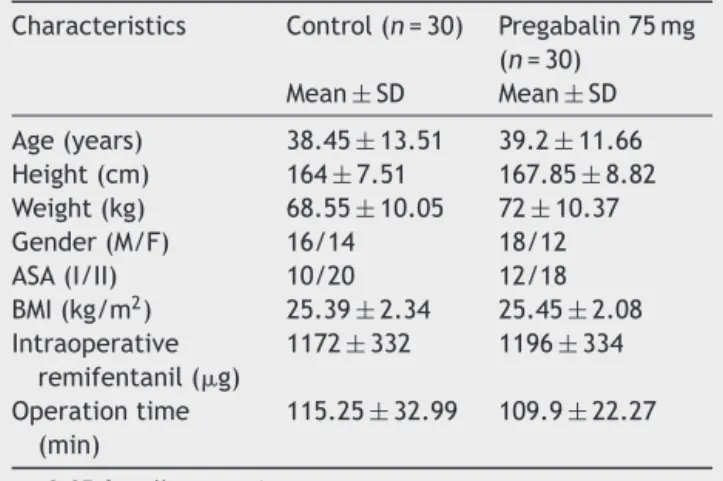
There were no statistically significant differences betweenthe groups regardingage, sex, bodymass index, operationtime,and intraoperativeremifentanil consump-tion(Table1).
Postoperative VAS scores of patients were significantly decreased in the pregabalin group at the postoperative 30th min, 1st, and 2nd hour when compared with the
Table1 Demographicandclinicaldataforeachgroupand
intraoperativedoseofremifentanil.
Characteristics Control(n=30) Pregabalin75mg (n=30)
Mean±SD Mean±SD
Age(years) 38.45±13.51 39.2±11.66 Height(cm) 164±7.51 167.85±8.82 Weight(kg) 68.55±10.05 72±10.37
Gender(M/F) 16/14 18/12
ASA(I/II) 10/20 12/18
BMI(kg/m2) 25.39±2.34 25.45±2.08 Intraoperative
remifentanil(g)
1172±332 1196±334
Operationtime (min)
115.25±32.99 109.9±22.27
p>0.05forallcomparisons.
control group (p=0.002, p=0.001 and p=0.027, respec-tively, Table 2). However, there were no statistically significantdifferencesbetweenpostoperativeVASvaluesat the6th,12th,and24thhours,betweengroups(p>0.05,for allcomparisons,Table2).
Postoperative mean morphine consumption was sta-tistically significantly decreased for all time intervals in the pregabalin group compared to the control group (p=0.002,p=0.001,p=0.001,p=0.001,p<0.001, respec-tively, Table 3). None of the patients need tenoxicam as rescueanalgesic.
The hemodynamic data, including MAP, HR, and SpO2,
were notdifferent between thegroups at anytime point (p>0.05inalltimeintervals).
Themostfrequentadverse effectswerePONV,pruritus andurinaryretentionduringthefirst24haftersurgery. Inci-dence of PONV, pruritus and urinary retention, dizziness, visionabnormalities,andheadacheweresimilaramongthe groups (p>0.05; for all comparisons, Table 4). No other adverseeffects,suchasrespiratorydepressionand somno-lence,wererecordedinanypatientfromeithergroup.
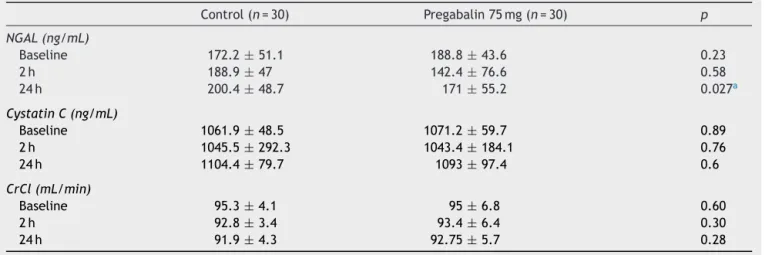
No statistically significant differences were found betweenthetwogroupswithregardtorenalfunction,CrCl, or Cys C at preoperative and postoperative 2ndand 24th hour. Postoperative NGAL levels in the pregabalin group were not significantly different in preoperative and post-operative2ndhourwhereaspostoperative24thhourNGAL levelsweresignificantlydecreasedinthepregabalingroup (p=0.027,Table5).
Discussion
Table2 MeanVisualAnalogScalepainscores.
PainintensityVAS Control(n=30) Pregabalin75mg(n=30) p
30min 5.65±0.67 4.95±0.6 0.002a
1h 3.85±1.18 2.95±0.39 0.001a
2h 2.4±0.94 1.85±0.81 0.027a
6h 1.25±0.71 1.25±0.85 0.616
12h 0.9±0.3 1.05±0.75 0.671
24h 0.8±0.41 1±0.79 0.484
VAS,VisualAnalogScale. Valuesaremeans±SD.
a p0.05whencomparingwiththecontrolgroup.
Table3 Meanmorphineconsumptionofgroups(mg).
Hour Control(n=30) Pregabalin75mg(n=30) p
1h 1.8±0.62 1.2±0.57 0.002a
2h 3.5±0.90 2.5±0.94 0.001a
6h 7.02±2.5 4.55±1.42 0.001a
12h 9.6±4 6.02±2.56 0.001a
24h 12.1±5.4 7.07±2.7 <0.001a
Valuesaremeans±SD.
a p<0.05.
Table4 Sideeffectsamonggroups.
Sideeffect Control(n=30) Pregabalin75mg(n=30) Chi-squarep
Nauseaandvomiting(n) 3(10%) 1(3%) NS
Pruritus(n) 2(6.6%) 0 NS
Urinaryretention(n) 2(6.6%) 0 NS
Respiratorydepression(n) 0 0 NS
Somnolance(n) 0 0 NS
Dizziness(n) 0 1(3%) NS
Visionabnormalities(n) 0 1(3%) NS
Headache(n) 0 1(3%) NS
SideeffectsamonggroupswereevaluatedusingtheChi-squaretest. NS,notsignificant.
Table5 Laboratoryevaluationamonggroupsofpatients.
Control(n=30) Pregabalin75mg(n=30) p
NGAL(ng/mL)
Baseline 172.2±51.1 188.8±43.6 0.23
2h 188.9±47 142.4±76.6 0.58
24h 200.4±48.7 171±55.2 0.027a
CystatinC(ng/mL)
Baseline 1061.9±48.5 1071.2±59.7 0.89
2h 1045.5±292.3 1043.4±184.1 0.76
24h 1104.4±79.7 1093±97.4 0.6
CrCl(mL/min)
Baseline 95.3±4.1 95±6.8 0.60
2h 92.8±3.4 93.4±6.4 0.30
24h 91.9±4.3 92.75±5.7 0.28
Valuesaremeans±SD.
preoperatively would have effect(s) on postoperative pain scores, morphine consumption, renal function, and hemodynamicparametersinpatientsundergoingPCNL.We haveshownthat(1)VASscoreswerestatisticallydecreased inthefirst2 postoperativehoursinthepregabalingroup, (2) morphine consumption was significantly decreased at postoperative 24h in all time intervals in the pregabalin group,(3) postoperative24th hour NGAL levelswere also significantlydecreasedinthepregabalingroup(4)andboth groups have similar hemodynamic effects, with a similar sideeffectprofile.
Several techniques have been reported to provide postoperativeanalgesiaforpercutaneousnephrolithotomy, including paravertebral, spinal and epidural block, local analgesicinfiltration,andsystemicanalgesictherapy modal-ities,suchasnonsteroidalanalgesicdrugsandopioids.21---25
Therehasbeennostudyfocusingonpreemptivesingledose pregabalinadministrationinPCNL.
The use of pregabalin in acute postoperative painhas been assessed in recent studies. Ameta-analysis focusing onperioperative pregabalin in the management of acute postoperativepainrevealeddecreasedopioidconsumption andopioid-relatedadverse effectsaftersurgery;however, postoperativepainintensitywasnotfoundtobedecreased by pregabalin.26 In another meta-analysis, administration
ofpregabalinduringashortperioperative periodprovides additionalanalgesia in the short term but at the cost of additional adverse effects, and they reported the lowest effectivedoseas225---300mg/d.27
Numerousstudiesontheefficacyofpregabalinfor post-operativepainhaverevealedcontradictoryresults,probably duetodifferencesindosage,dosingregimen,orthe char-acteristics of the surgical procedures.26,28---33 There were
only three studies that emphasized preoperative single dose75mgoralpregabalinasbeingeffectiveindecreasing postoperativepainscoresindifferentclinicalsettings,such asseptoplasty,laparoscopiccholecystectomyand mammo-plasty,whereas50mgwasshownnottobeeffectiveinpain controlin laparoscopic cholecystectomy. Inthis study,we triedtoadministerthelowestdosethathasbeenprovento beeffectiveina postoperativepainsetting,soweuseda preoperativesingledose 75mgpregabalininPCNL.Inthis study,wewereabletodemonstratesuperioranalgesiawith 75mgofpregabalinovercontrolintheearlypostoperative period(firsttwohours)withoutanincreaseinside-effects afterPCNL.Atthe6th,12th,and24thhour,nodifferences wereobservedinVASlevels.
Preemptive pregabalin administration has also been shown to decrease opioid consumption in several post-operative settings (mammoplasty, hysterectomy, lum-bar spinal fusion surgery, gynecological laparoscopic surgery, laparoscopic sleeve gastrectomy, laparoscopic cholecystectomy).17---19,31,32,34 We alsofoundmorphine
con-sumptiontobedecreasedfor alltimeintervalsduringthe postoperative24h.Increasedmorphineconsumptioninthe controlgroupmightbethereasonforsimilarVASscoresafter thefirsttwohoursofthepostoperativeperiod.
In a clinical setting with PCNL patients, postopera-tive renal functions might also be in the consideration of clinicians. The surgery itself, underlying disease, and medicationsin thepreoperative andpostoperative period mightallalterrenalfunctions.Inthisstudy,oursecondary
outcomes weretocompare CrCl and blood NGAL and Cys Clevelsinpre-andpostoperativeperiodsinthegroupsto assessrenalfunctions.CysC,whichisa13-kDcysteine pro-teinaseinhibitorprotein,wasshowntopredictacutekidney injury(AKI)earlierthanotherbiomarkers35whereasN-GAL
wasshowntobeoneofthemostpromising biomarkersof kidneyinjury,whichcouldpredictAKI24---72hbeforea diag-nostic creatinine increment.36---40 Patients with increased
serumNGAL andCysC areatgreater risk ofadverse out-comes both in the presence or absenceof an increase in serumcreatinine.41 InthisstudyCrClandserumCysC
lev-els were similar in the two groups in all measurements, aswell aspostoperative NGAL levelsat preoperative and postoperative 2nd hour. However, NGAL was significantly decreased at the 24th hour in the study group compared tothecontrolgroup.Theseresultsindicatethatpregabalin didnothave aconsiderable harmful effectonrenal func-tion, either clinically or biochemically, especially in this clinical setting. Preemptive pregabalinwas alsoshown to significantly alter hemodynamic dataduring operations in different clinical settings.42,43 In this study the MAP and
HR were also similar between groups for any time inter-val.
The common adverse effects of pregabalin are dose-dependent drowsiness and dizziness16,33 and the possible
advantages ofpregabalinmaybemitigated bythese trou-blesome side-effects; thus, it is crucial todetermine the lowestoptimaldoseofpregabalinforanalgesicusewithout the adverse outcomes.Wedidnot observeanysignificant increaseinsideeffects,includingPONV,sedation,dizziness, headache, visual disturbance, pruritus, urinary retention, respiratory depression, somnolence, dizziness and vision abnormalitiesduringthefirst24haftersurgeryinthe pre-gabalin group comparedto the control group. This might be attributedtothe single low dose of pregabalinin this study.
Severallimitationsofthepresentstudyshouldbenoted. Thepotentiallimitationsaretheabsenceofaplacebogroup and the absenceof long-term clinical follow-up. Further-more, the majority of our pregabalin and control group patients were in the middle age group. Different results might be obtained withchildren or a geriatric population duetopossiblealteredpharmacodynamicsand pharmacoki-neticsofpregabalin.
Inconclusion,oralsingle-dosepreemptive75mg prega-balin was effective in reducing postoperative painscores and total analgesic consumption in patients undergoing PCNLwithout leadingtohemodynamic instabilityandside effects.
Conflicts
of
interest
Theauthorsdeclarenoconflictsofinterest.
References
1.Fernstrom I, Johnson B. Percutaneous pyelolithotomy. A new extraction technique. Scand J Urol Nephrol. 1976;10: 257---9.
nephrolithotomy---a prospectiverandomizedstudy.J Anaes-thesiolClinPharmacol.2011;27:481---4.
3.DalelaD,GoelA,SinghP,etal.Renalcapsularblock:anovel methodfor performing percutaneous nephrolithotomy under localanesthesia.JEndourol.2004;18:544---6.
4.McHugh GA. The management of pain following day-case surgery.Anesthesiology.2002;57:270---5.
5.KehletH.Postoperativeopioidsparingtohastenrecovery:what aretheissues?Anesthesiology.2005;102:1083---5.
6.Khademi S, Ghaffarpasand F, Heiran HR, et al. Intravenous andperitonsillarinfiltrationofketamineforpostoperativepain after adenotonsillectomy: a randomized placebo controlled clinicaltrial.MedPrincPract.2011;20:433---7.
7.Kehlet H, DahlJB. The valueof ‘multi-modal’ or ‘balanced analgesia’ in postoperative pain treatment. Anesth Analg. 1993;77:1048---56.
8.Ho KY, Gan TJ, Habib AS. Gabapentin and postoperative pain----asystematicreviewofrandomizedcontrolledtrials.Pain. 2006;126:91---101.
9.Tiippana EM, Hamunen K, Kontinen VK, et al. Do surgical patients benefit from perioperative gabapentin/pregabalin? A systematic review of efficacy and safety. Anesth Analg. 2007;104:1545---56.
10.Mathiesen O, Jørgensen DG, Hilsted KL, et al. Pregabalin and dexamethasone improves post-operative pain treat-mentaftertonsillectomy. Acta Anaesthesiol Scand.2011;55: 297---305.
11.OzgencilE,YalcinS,TunaH,etal.Perioperative administra-tionofgabapentin1,200mgday-1andpregabalin300mgday-1 forpainfollowinglumbarlaminectomyanddiscectomy:a ran-domised,double-blinded,placebo-controlledstudy.Singapore MedJ.2011;52:883---9.
12.Guay DR. Pregabalin in neuropathic pain: a more ‘pharma-ceutically elegant’ gabapentin? Am J Geriatr Pharmacother. 2005;3:274---87.
13.FramptonJE,FosterRH.Pregabalin:inthetreatmentof pos-therpeticneuralgia.Drugs.2005;65:11---8,discussion9---20. 14.Peng PW, Li C, Farcas E, et al. Use oflow-dose pregabalin
in patients undergoing laparoscopic cholecystectomy. Br J Anaesth.2010;105:155---61.
15.HillCM,BalkenohlM,ThomasDW,etal.Pregabalininpatients withpostoperativedentalpain.EurJPain.2001;5:119---24. 16.JokelaR,AhonenJ,TallgrenM,etal.Arandomizedcontrolled
trialofperioperativeadministrationofpregabalinforpainafter laparoscopichysterectomy.Pain.2008;134:106---12.
17.AgarwalA, GautamS, GuptaD,et al.Evaluationofa single preoperativedoseofpregabalinforattenuationof postopera-tivepain after laparoscopic cholecystectomy. Br J Anaesth. 2008;101:700---4.
18.Jokela R, Ahonen J, Tallgren M, et al. Premedication with pregabalin75or150mgwithibuprofento controlpainafter day-case gynaecological laparoscopic surgery. Br J Anaesth. 2008;100:834---40.
19.CabreraSchulmeyerMC,de laMazaJ,OvalleC,et al. Anal-gesic effects of a single preoperative dose of pregabalin after laparoscopic sleeve gastrectomy. Obes Surg. 2010;20: 1678---81.
20.LeveyAS,BoschJP,LewisJB,etal.Amoreaccuratemethod to estimate glomerular filtration rate from serum creati-nine:a new predictionequation. Ann InternMed. 1999;130: 461---70.
21.Singh V, Sinha RJ, Sankhwar SN, et al. A prospective randomized study comparing percutaneous nephrolithotomy under combined spinal-epidural anesthesia with percuta-neous nephrolithotomy under general anesthesia. Urol Int. 2011;87:293---8.
22.Karacalar S, Bilen CY, Sarihasan B, et al. Spinal-epidural anesthesia versus general anesthesia in the management
of percutaneous nephrolithotripsy. J Endourol. 2009;23: 1591---7.
23.ChenY,ZhouZ,SunW,etal.Minimallyinvasivepercutaneous nephrolithotomyunderperituballocalinfiltrationanesthesia. WorldJUrol.2011;29:773---7.
24.Aravantinos E, Kalogeras N, Stamatiou G, et al. Percuta-neousnephrolithotomyunderamultimodalanalgesiaregime. JEndourol.2009;23:853---6.
25.AkK,GursoyS,DugerC,etal.Thoracicparavertebralblockfor postoperativepainmanagementinpercutaneous nephrolitho-tomypatients:arandomizedcontrolledclinicaltrial.MedPrinc Pract.2013;22:229---33.
26.Zhang J, Ho KY, Wang Y. Efficacy of pregabalin in acute postoperativepain:ameta-analysis.Br JAnaesth.2011;106: 454---62.
27.Engelman E, Cateloy F. Efficacy and safety of perioper-ative pregabalin for post-operative pain: a meta-analysis of randomized-controlled trials. Acta Anaesthesiol Scand. 2011;55:927---43.
28.SagitM,YalcinS,PolatH,etal.Efficacyofasinglepreoperative doseofpregabalinforpostoperativepainafterseptoplasty.J CraniofacSurg.2013;24:373---5.
29.Nimmaanrat S, Tangtrakulwanish B, Klabklay P, et al. Peri-operativeadministrationofpregabalininpatientsundergoing arthroscopic anterior cruciate ligament reconstruction: does it help to relieve postoperative pain? J Med Assoc Thai. 2012;95:1297---301.
30.ChaparroLE,ClarkeH,ValdesPA,etal.Addingpregabalinto a multimodalanalgesicregimendoes notreducepainscores following cosmetic surgery: a randomized trial. J Anesth. 2012;26:829---35[Epub2012July14].
31.KimJC,ChoiYS,KimKN,etal.Effectivedoseofperi-operative oral pregabalin as an adjunct to multimodal analgesic regi-men in lumbar spinal fusion surgery. Spine (Phila Pa 1976). 2011;36:428---33.
32.Przesmycki K, Wiater-Kozioł E, Kotarski J, et al. Effect of pre-emptivepregabalinonpainintensityandmorphine require-ment after hysterectomy. Anestezjol Intens Ter. 2011;43: 14---7.
33.White PF, Tufanogullari B, Taylor J, et al. The effect of pregabalinonpreoperativeanxietyandsedationlevels:a dose-rangingstudy.AnesthAnalg.2009;108:1140---5.
34.Freedman BM, O’Hara E. Pregabalin has opioid-sparing effectsfollowingaugmentationmammaplasty.AesthetSurgJ. 2008;28:421---4.
35.DharnidharkaVR,KwonC,StevensG.SerumcystatinCis supe-rior to serum creatinine as a marker of kidney function: a meta-analysis.AmJKidneyDis.2002;40:221---6.
36.Mishra J, Dent C, Tarabishi R, et al. Neutrophil gelatinase-associatedlipocalin(NGAL)asabiomarkerforacuterenalinjury aftercardiacsurgery.Lancet.2005;365:1231---8.
37.Cruz DN, de Cal M, Garzotto F, et al. Plasma neutrophil gelatinaseassociatedlipocalinisanearlybiomarkerforacute kidneyinjuryinanadultICUpopulation.IntensiveCareMed. 2010;36:444---51.
38.Haase-FielitzA,BellomoR,DevarajanP,etal.Noveland con-ventionalserumbiomarkers predictingacutekidneyinjuryin adult cardiac surgery----aprospective cohortstudy. Crit Care Med.2009;37:553---60.
39.DentCL,MaQ,DastralaS,etal.Plasmaneutrophilgelatinase associatedlipocalinpredictsacutekidneyinjury,morbidityand mortalityafterpediatriccardiacsurgery:aprospective uncon-trolledcohortstudy.CritCare.2007;11:R127.
40.BennettM,DentCL,MaQ,etal.UrineNGALpredictsseverityof acutekidneyinjuryaftercardiacsurgery:aprospectivestudy. ClinJAmSocNephrol.2008;3:665---73.
acutekidneyinjury:amulticenterpooledanalysisof prospec-tivestudies.JAmCollCardiol.2011;57:1752---61.
42.Eren G, Kozano˘glu B. Pregabalin laringoskopi ve trakeal entübasyonakardiyovaskülercevabıbaskılar.TürkiyeKlinikleri AnesteziyolojiReanimasyonDergisi.2009;7:82---7.