Pregnancy outcomes in
contaminated areas, SP, Brazil
Desfechos relacionados à gravidez
em áreas contaminadas, SP, Brasil
Mariana Tavares Guimarães
I,IIMichele Granato Cunha
II,
Daniele Pena Carvalho
ITatyana Sampaio
I,IIAlfésio L.F. Braga
I,IILuiz Alberto Amador Pereira
I,III Department of Pathology – NEEA, University of São Paulo Faculty of Medical
Sciences.
II Catholic University of Santos – UNISANTOS.
Trabalho realizado pela Universidade Católica de Santos – UNISANTOS. Conlito de interesse: (nada a declarar).
Financiamento: This work was part of a larger project entitled “ Epidemiological study on resident population in metropolitan area of Santos – Santos Estuary: Evaluation of efect and exposure indi-cators to environmental contaminants” funded by The National Council for Scientiic and Techno-logical Development – CNPq (50/2005 – number 402663/2005-5).
Correspondência: Mariana Tavares Guimarães. Alameda Itu, 395 Apto. 81 – Jardim Paulista – São Paulo, SP CEP 01421-000. Email: [email protected]
Abstract
Objective: Estimate and compare prevalence of events related to pregnancy (pregnancy, low birth weight, premature delivery, spon-taneous abortion, stillbirth, congenital malformation, and multiple births) in populations exposed and non-exposed to environmental contaminants in Santos and São Vicente Estuary. Methods: This study was part of a large project financed by CNPq, which aimed to estimate health effects associated with environmental area, con-taminants exposure among individuals of the Baixada Santista region. This cross-sectional study evaluated two neighborhoods of São Vicente near a contaminated area, and one neighborhood of Bertioga, the control area. A structured and previously tested questionnaire was applied at 236 house-holds in São Vicente and 251 househouse-holds in Bertioga in order to obtain the data. The chi-square test or Fisher’s exact test were used to evaluate associations between area and qualitative variables; Student’s t test or two proportion comparison test were used to evaluate differences between variables; and a significance level of 5% adopted. Results:
There was significant association between living in Bertioga (p = 0.01) and number of pregnancies in the past five years. In São Vicente, 64 (28.3%) childbearing age women became pregnant whereas in Bertioga there where 109 (38.8%). There were no statistical significant associations between living in any area and others pregnancy outcomes evalu-ated. Conclusion: Although nosignificant association was found, prevalence of low birth weight, preterm delivery and spontane-ous abortion and prevalent odds ratio were higher in contaminated area. This study’s evidence of a reduced number of pregnan-cies in contaminated area strengthens the need for additional more in-depth studies in Santos and São Vicente Estuary.
Resumo
Objetivo: Estimar e comparar a prevalência dos eventos relacionados à gravidez (engravi-dar, baixo peso de nascimento, parto prema-turo, aborto espontâneo, natimortalidade, malformações congênitas e gemelaridade) em populações exposta e não-exposta aos contaminantes ambientais na região do estuário de Santos e São Vicente. Métodos:
O estudo fez parte de um amplo projeto financiado pelo CNPq, que teve como ob-jetivo estimar os efeitos à saúde associados à exposição aos contaminantes ambientais entre os moradores da Baixada Santista. O estudo transversal avaliou dois bairros do município de São Vicente, próximos a uma área contaminada, e um bairro no município de Bertioga, área controle. Para a obtenção dos dados foi aplicado um ques-tionário estruturado e pré-testado em 236 domicílios em São Vicente e 251 domicílios em Bertioga. Para avaliar associações entre a área e as variáveis qualitativas utilizou-se o teste qui-quadrado ou teste exato de Fisher; para avaliar as diferenças entre as variáveis, o teste t de Student ou o teste de comparação de duas proporções, e adotado nível de significância de 5%. Resultados:
Houve associação significativa entre morar em Bertioga (p = 0,01) e o número de gesta-ções ocorridas nos últimos cinco anos. Em São Vicente, 64 (28,3%) mulheres em idade fértil engravidaram, enquanto em Bertioga foram 109 (38,8%). Não houve associações estatísticas significativas nas áreas com os demais desfechos da gravidez avaliados.
Conclusões: As prevalências e as razões de chances prevalentes de baixo peso ao nascer, nascimentos prematuros e abortos espontâ-neos foram maiores nas áreas contaminadas, sem associações significativas. A evidência do estudo de diminuição do número de gestações na área contaminada reforça a necessidade de aprofundamento de estudos na região do estuário de Santos e São Vicente.
Palavras-chave: Gravidez. Poluição ambien-tal. Compostos organoclorados. Metais pesa-dos. Baixo peso ao nascer. Prematuridade.
Background
The industrial development provided a quality of life never reached by the human being which, associated to a distinguish-ing occupation of the urban space, para-doxically increased the risk of exposition to chemical substances potentially deleterious to the human health1
According to the Environmental State Agency – CETESB2 in Brazil, Santos and São
Vicente estuaries are examples of environ-mental degradation caused by the strong pressure on these fragile ecosystems, consequence of the intense occupation that coastal regions tend to present in a general way.
During the 50’s, in the metropolitan area of Baixada Santista, the local availabil-ity of a developed road infrastructure, rail and ports, water and electricity, combined with the proximity of the metropolitan area of São Paulo led to the implantation of several basic industries (steel, petro-chemicals, fertilizers) throughout the extensive network of estuarine canals and extensive mangroves, confined between the Atlantic Ocean and the Serra do Mar. This potentially highly pollutant industrial activity, often not accompanied by control measures, made the estuaries of Santos and São Vicente major recipients of toxic wastes and contaminated effluents, mainly with dust, heavy metals, organochlorines, polychlorinated biphenyls (PCBs), polycy-clic aromatic hydrocarbons (PAHs), dioxins and furans. Industrial pollutants, along with waste and wastewater from the Port of Santos and other cities in the region, cause a severe environmental contamina-tion with significant impacts in the social area and public health2.
There is a growing concern in the sci-entific community about the effects from exposure to chemicals on the reproductive system of pregnant women. Several studies provide evidence that fetuses and babies are likely to be more sensitive than adults to the varieties of toxic substances in the environmental4.
In worldwide literature and especially in Brazil there are few studies evaluating the risks to health arising from the embryo-fetal environmental contamination1.
Identification of potentials risk factors for the pregnant and fetus is imperative for reducing morbidity and mortality, fetal and neonatal.
A recent review made by Shirangi and colleagues (2011), produced evidence that suggested an association between exposure to pesticides near homes and an increase in adverse outcomes of the reproductive sys-tem. Among the outcomes, the congenital malformations had presented a strong force of association. Other outcomes like low birth weight (LBW), prematurity and abor-tion, while presenting weaker associations, deserve new inquiries5.
As a contribution to a preliminary approach to the theme, this study aimed to estimate and compare the prevalence of events related to pregnancy (low birth weight, premature birth, miscarriage, stillbirth, congenital malformations, and multiple births) in neighborhoods of two cities (São Vicente and Bertioga) in the region of the estuary of Santos and São Vicente.
Methods
This is a cross sectional study which was part of a larger project entitled “Epi-demiological study on resident population in metropolitan area of Santos – Santos Estuary: Evaluation of effect and exposure indicators to environmental contami-nants” whose objective was to estimate the effects on health associated with exposure to environmental contaminants among the residents of metropolitan area of Santos -
Santos and São Vicente Estuary, this proj-ect was funded by the National Research Council - CNPq.
Identification of contaminated areas used in this study was done based on the report “Santos and São Vicente Estuarine System”2 of CETESB, which aimed to
evalu-ate the contamination of wevalu-ater, sediments and aquatic organisms of the estuarine system of Santos and São Vicente and Santos Bay, relating it to potential contaminants sources in the region.
After the areas were identified, exposed and non-exposed population samples were calculated based on the prevalence of con-genital malformations in Brazil and the 2000 Brazilian resident population census classi-fied by the Brazilian Institute of Geography and Statistics – IBGE.
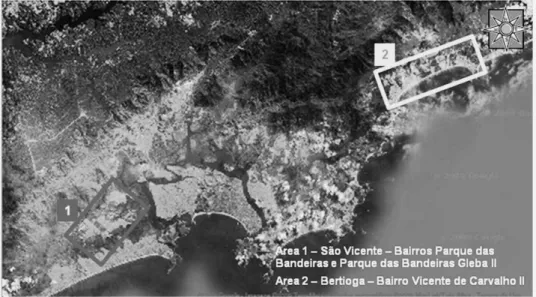
In this preliminary study three neigh-borhoods were selected in two distinct areas (Figure 1). Two of them, Parque das Bandeiras e Parque das Bandeiras Gleba II, located in São Vicente (Área 1) inthe con-tinental portion, in a radius up to 1.5 km away from industrial contaminants identi-fied by CETESB (2001)2. These deposits,
dating from the mid-1960, contain heavy metals (particularly mercury and zinc) and organochlorine (hexachlorobenzene)2, with
the soil, water and air as possible complete routes of exposure according to ATSDR criteria6. As a region of contrast in relation
to environmental contamination, but with socio-economic characteristics of the region near Santos, = Jardim Vicente de Carvalho Ii was chosen, located in Bertioga (Area 2), along the Rio-Santos highway. 193 families were selected in Parque das Bandeiras, 43 no Parque das Bandeiras Gleba II and 251 in Jardim Vicente de Carvalho II, a total of 487 domiciles.
conducted during the weekends (between March and December 2007) and, in cases where besides the informant, the other residents were at home, they collaborated with their personal information. The study was approved by the Ethics Committee in Research. After data collecting, a descrip-tive analysis was made of childbearing age women, between 15 and 49 years according to the classification of the IBGE. To assess pregnancy outcomes (low birth weight - live birth weighing less than 2500g; pre-maturity - live births with gestational age less than 37 weeks, spontaneous abortion - pregnancy loss under 20 weeks, stillbirth - 20 weeks of pregnancy loss or more, con-genital malformations and multiple births) data of women who became pregnant in the last five years was used.
To test association between qualitative variables, chi-square test or exact Fisher’s test was used. We also adopted the test to compare two proportions7. To test
dif-ferences between quantitative variables we used Student’s t test8. Prevalence rates
were also calculated for each outcome of pregnancy by area and odds ratios prevalent (ORP) between areas.
Questionnaires containing errors, in blank, or when the respondent could not answer were excluded from the analysis.
SPSS (version 13.0) and significance level of 0.05 were used.
Results
Among the 450 women living in two neighborhoods of São Vicente and the 508 women in the neighborhood of Bertioga, 226 and 281, respectively, were within the fertile-age women group.
The average age of fertile-age women was 31.70 years in São Vicente area, where 75% were 40 years or less. In Bertioga area the average age of fertile-age women was 29.39 years, where 75% of these women were 36 years or less. Statistically significant difference was showed between mean ages of the sample between the two areas based on t test (p=0.02).
Table 1 shows demographic character-istics of fertile-age women in the analyzed areas. In both areas more than 50% of these women were married or living with a partner. No significant association between place of residence and women marital status was found (p=0.37).
Considering education, there was an association with place of residence by the chi-square test (p=0.00). In Bertioga area 53.1% of interviewed had completed basic education, while in São Vicente area 36.9%.
Figure 1 - Areas analyzed in the Estuary region of Santos and São Vicente
Table 1 - Socio-demographic characteristics of women according to areas analyzed
Tabela 1 - Características sociodemográicas das mulheres em idade fértil segundo as áreas analisadas
Áreas – N (%)
TOTAL São Vicente* Bertioga*
Marital status
Married 141 (56.2) 157 (53.4) 298 (54.7)
Divorced 13 (5.2) 23 (7.8) 36 (6.6)
Never married 91 (36.3) 111 (37.8) 202 (37.1)
Widowed Total
6 (2.4) 251 (100.0)
3 (1.0) 294 (100.0)
9 (1.7) 545 (100.0)
School enrollment
Illiterate*2 5 (2.0) 18 (6.3) 23 (4.3)
Elementary 92 (36.9) 152 (53.1) 244 (45.6)
High School 131 (52.6) 107 (37.4) 238 (44.5)
College Total
21 (8.4) 249 (100.0)
9 (3.1) 286 (100.0)
30 (5.6) 535 (100.0)
Work
Yes 115 (45.8) 145 (49.7) 260 (47.9)
No Total
136 (54.2) 251 (100.0)
147 (50.3) 292 (100.0)
283 (52.1) 543 (100.0)
Occupational exposure
Yes 12 (10.8) 11 (7.7) 23 (9.1)
No Total
99 (89.2) 111 (100.0)
132 (92.3) 143 (100.0)
231 (90.9) 254 (100.0)
Past work
Yes 106 (45.1) 151 (53.7) 257 (49.8)
No Total
129 (54.9) 235 (100.0)
130 (46.3) 281 (100.0)
259 (50.2) 516 (100.0)
Past occupational exposure
Yes 7 (7.1) 7 (5.4) 14 (6.1)
No Total
92 (92.9) 99 (100.0)
122 (94.6) 129 (100.0)
214 (93.9) 228 (100.0)
Use of tobacco
Yes 26 (10.4) 58 (19.7) 84 (15.5)
No Total
223 (89.6) 249 (100.0)
236 (80.3) 294 (100.0)
459 (84.5) 543 (100.0)
Past use of tobacco
Yes 26 (10.5) 38 (13.0) 64 (11.9)
No Total
221 (89.5) 247 (100.0)
255 (87.0) 293 (100.0)
476 (88.1) 540 (100.0)
Alcohol consume
Yes 34 (13.7) 59 (20.1) 93 (17.2)
No Total
214 (86.3) 248 (100.0)
235 (79.9) 294 (100.0)
449 (82.8) 542 (100.0)
Past alcohol consume
Yes 6 (2.5) 20 (6.9) 26 (4.9)
No Total
238 (97.5) 244 (100.0)
271 (93.1) 291 (100.0)
509 (95.1) 535 (100.0)
* São Vicente = Parque das Bandeiras and Parque das Bandeiras Gleba II neighborhoods; Bertioga = Vicente de Carvalho II neighborhood. ** Functional Illiteracy: Those who declared themselves illiterate and those with up to 2nd year of elementary school schooling.
* São Vicente = bairros Parque das Bandeiras e Parque das Bandeiras Gleba II; Bertioga = bairro Vicente de Carvalho II.
With more studies years (between high school and college) there was a greater percentage in São Vicente area (61%) over Bertioga area (40.4%) (Table 1).
There was no statistical association between area and working status of fertile age women who were working at the time of the study (45.8% in São Vicente and 49.7% in Bertioga) by Fischer’s exact test (p=0.46). Women who were currently working had little contact with chemicals at the work-place, only 10.8% in São Vicente area and 7.7% Bertioga area (Table 1). No significant association between living areas and con-tact with chemicals at the workplace was found. (Fisher’s exact test with p=0.66).
In São Vicente, 45.1% of fertile-age women reported previous employment and in Bertioga this percentage was 53.7% (test for comparing two proportions with p=0.44). Out of those women, only 7.1% in São Vicente area and 5.4% in Bertioga area that reported previous employment had contact with chemicals at work (Table 1). No significant association between living areas and previous chemical contact at the workplace was found (Fisher’s exact test with p=0.08).
The proportion of fertile-age women that reported smoking in Bertioga (19.7%) was higher than those in São Vicente (10.4%) (test for comparing two proportions with p=0.01). In relation to previous smoking habits, there was no statistical difference (test for comparing two proportions with p=0.39) between São Vicente (10.5%) and Bertioga (13%).
Few women reported drinking alcohol in both areas and there was no statistical difference between those from São Vicente (13.7%) and from Bertioga (20.1%). There was statistically significant difference be-tween the percentage of fertile-age women from São Vicente (2,5%) and from Bertioga (6.9%) that reported previous alcohol con-sumption by the comparing two propor-tions test (p=0.03) (Table 1).
In São Vicente area almost 30% of the fertile-age women conceived in the last 5 years while in Bertioga this percentage was
1/3 higher (Table 2). There was an statisti-cally significant difference between these two groups (test for comparing two propor-tions p=0.01).
In addition to a greater number of preg-nant women in the last five years, Bertioga area also presented a greater number of pregnancies when compared to São Vicente area. The 64 women that conceived in São Vicente area had 82 pregnancies in the last five years, while the 109 fertile-age women in Bertioga area had 155 pregnancies in the period. The pregnancy average per woman over the past five years in São Vicente area was 1.28 (SD=0.57) and in Bertioga area 1.42 (SD=0.72) without statistically significant difference (t test p=0.06) (Table 2).
There was no statistically significant association between living area and receiv-ing prenatal care (Fisher’s exact test p=0.65) (Table 3).
Table 3 also shows adverse pregnancy outcomes among women that conceived in the last five years in the studied areas. São Vicente area had a higher percentage of miscarriages than Bertioga area, but without statistically significant difference (test for comparing two proportions p=0.24).
São Vicente area had a higher percentage of premature babies (8.1%) than Bertioga area (5.7%). ORP showed 1.42 times more occurrence of premature births in São Vicente area than Bertioga area, but the dif-ference was not statistically significant (test for comparing two proportions p=0.78). In São Vicente area 4 women (6.9%) had low birth weight newborns while in Bertioga area there were 5 women (4.7%) (Table 3). ORP showed 1.47 times more likely to occur low birth weight in São Vicente area than Bertioga area but the difference was not statistically significant (test for comparing two proportions p=0.82).
malforma-tions, a case in São Vicente area (1.6%) and three cases in Bertioga area (2.8%).
Discussion
Bertioga area presented a higher per-centage of fertile-age women who were pregnant in the last five years in relation to São Vicente area, with a significant sta-tistical difference. In relation to pregnancy average per woman that conceived in the last five years, no statistically significant difference was found. Brazil has a tendency to fertility decline in recent demographic census. In the country, fertility transition is close to population replacement level. However, there are internal differences in fertility rates, once they are negatively cor-related with socioeconomic factors such as income and education status9. These factors
had a worse level in Bertioga area than in São Vicente area in this study.
Male and female reproductive systems
are susceptible to environmental factors, impacting tissue development and also adults’ reproductive functions resulting in men and women fertility decrease10, 11.
Evi-dence between exposure to environmental pollutants and human fertility is controver-sial and the results have little consistency12.
However, experimental studies have shown that association13. Guillette & Edwards
(2008) reported that environmental con-taminants, including pesticides, pharma-ceuticals and industrial pollutants play roles as endocrine disruptors, altering reproduc-tive performance of wild populations of fish, amphibians, reptiles and birds13.
Association between environmental contaminants and pregnancy outcomes such as miscarriages, premature birth and low birth weight has been investigated by several authors. A review done by Windham & Fenster14 was associated with increased
risk for air pollution, heavy metals, cides and others. For organochlorine
pesti-Table 2 - Number of pregnant women and pregnancies in the past ive years according to areas analyzed
Tabela 2 - Distribuição das mulheres que engravidaram e do número de gestações nos últimos cinco
anos segundo as áreas analisadas
Areas – N (%)
São Vicente* Bertioga*
Pregnant
Yes 64 (28.3) 109 (38.8)
No 162 (71.7) 172 (61.2)
Total 226 (100.0) 281 (100.0)
Pregnancies mean 1.28 1.42
Standard deviation 0.57 0.72
Minimum 1 1
Maximum 4 5
25% 1.00 1.00
50% 1.00 1.00
75% 1.00 2.00
* São Vicente: Parque das Bandeiras and Parque das Bandeiras Gleba II neighborhoods; Bertioga: Vicente de Carvalho II nei-ghborhood.
cides, the authors reported a dose-response relationship between increasing levels of dichloroethylene (DDE) and prematurity.
Knowledge about organochlorines effects on human health is limited and results are usually conflicting10. Authors
reported an extensive review of epidemio-logical studies where populations exposed to higher concentrations of PCBs or DDE exhibited reproductive abnormalities, in-cluding spontaneous abortions and reduced birth weight. They also reported that other studies, with exposure to medium and low concentrations of PCBs or DDE, found no associations with these same adverse preg-nancy outcomes.
Another review analyzed studies be-tween exposure to Dichloro-Diphenyl-Trichloroethane (DDT) and/or DDE and ad-verse pregnancy outcomes and also found conflicting results14. The authors reported
that some studies have shown associations between organochlorine pesticides with increased preterm delivery and reduced birth weight and also studies that showed no association with the same adverse preg-nancy outcomes.
Abortions, premature births and low birth weight showed greater prevalence and ORP in São Vicente area than in Bertioga area, although no significant differences were found.
Table 3 - Prenatal care and pregnancy outcomes among women who became pregnant in the past ive years according to areas analyzed
Tabela 3 - Acompanhamento pré-natal e desfechos da gravidez entre as mulheres que icaram
grávidas nos últimos cinco anos segundo as áreas analisadas
Areas (N (%)
TOTAL São Vicente* Bertioga*
Prenatal care
Yes 62 (96.9) 103 (95.4) 165 (95.9)
No 2 (3.1) 5 (4.6) 7 (4.1)
Total 64 (100.0) 108 (100.0) 172 (100.0)
Miscarriage
Yes 14 (23.3) 15 (14.7) 29 (17.9)
No 46 (76.7) 87 (85.3) 133 (82.1)
Total 60 (100.0) 102 (100.0) 162 (100.0)
Prematurity
Yes 5 (8.1) 6 (5.7) 11 (6.6)
No 57 (91.9) 99 (94.3) 156 (93.4)
Total 62 (100.0) 105 (100.0) 167 (100.0)
Low birth weight
Yes 4 (6.9) 5 (4.7) 9 (5.5)
No 54 (93.1) 101 (95.3) 155 (94.5)
Total 58 (100.0) 106 (100.0) 164 (100.0)
* São Vicente: Parque das Bandeiras and Parque das Bandeiras Gleba II neighborhoods; Bertioga: Vicente de Carvalho II nei-ghborhood.
These results can be considered relevant since in the contaminated area there were no associations with other factors that may interfere with pregnancy, such as prenatal care, occupational exposure, alcohol con-sumption and smoking.
The main goal of prenatal care is to look after the well-being of the women and the fetus since the beginning of the pregnancy, ensuring the birth of a healthy child, mater-nal well-being and neonatal care, in ways that integrate all levels of health attention15.
Poor prenatal care is an important risk factor for perinatal mortality16, premature birth
and low birth weight17. Laurenti & Buchalla18
have shown that mothers who received seven or more prenatal visits had a lower perinatal mortality. SEADE Foundation data showed a large percentage difference between the cities, São Vicente (70.86%) and Bertioga (34.05%) when comparing the number of mothers who had seven or more prenatal consultations. Almost all women that conceived in the last five years in both areas had prenatal care, but the question-naire used in this study did not evaluate the number of queries, where the treatments were performed or quality of care.
In contrast to non-occupational en-vironmental contamination in pregnant women, occupational exposure is an im-portant factor that should be controlled1.
Occupational exposure to chemicals has been reported as an important risk factor in pregnancy, interfering in perinatal mor-bidity and mortality12. In the present study
few women were exposed to chemicals at work in both investigated areas thus were not a relevant factor in association between outcomes and analyzed areas.
Bertioga area presented a higher per-centage of fertile-age women with current and past exposure to alcohol with a signifi-cant difference to São Vicente area, although it was not possible to investigate whether consumption occurred during pregnancy. Alcohol is a substance with a significant teratogenic effect, which interferes in fetal development. Freire and co-authors19 found
that alcohol use during pregnancy was
as-sociated with fetal growth restriction and fe-males appear more susceptible to its effects. The authors reported that 10% of children born with restricted intrauterine growth in the U.S. had fetal alcohol exposure, and also that 11% of patients with mental disabilities suffered alcohol teratogenic effects.
Pregnant woman who smoke cause harm to their own health and to the health of the fetus. Effects of smoking during preg-nancy include: low birth weight, premature births and miscarriage20. Passive exposure
to tobacco smoke should also be consid-ered, since studies have showed a small but consistent effect in birth weight reduction and the occurrence of preterm delivery14.
Bertioga area presented a higher percentage of fertile age women with current and past smoking habits, although it was not possible to establish whether consumption occurred during pregnancy.
Studies have shown association between environmental contaminants exposure and miscarriage21, natimortality22, congenital
malformations23 and multiple births24,
however in this work it was not possible to assess these outcomes because of lack of data during the studied period.
In all related pregnancy outcomes, information loss never surpassed 20%. In-formation loss, by variable, was considered of little significance: prenatal care analysis (0.58%), pregnancy number per woman (5.20%), twin (2.31%), miscarriage (6.36%), low birth weight and stillbirth (5.20%), premature births (3.47%), and congenital malformations (2.89%).
Retrospective studies are more suscep-tible to memory bias25, although in the
pres-ent study, pregnancy outcomes had been investigated in a short period, less than five years. In addition, more than 63% of house-holds women interviewed answered about themselves, which reduced recall bias.
tetrachloride and perchlorethylene2.
However, contaminant presence in the environment is not sufficient to character-ize contamination or exposure of a given population. The contact is crucial in order to define the presence of a contamination route. Moreover, concentration in envi-ronmental compartments and duration of contact with these substances are essential to determine the risk of adverse manifesta-tions in exposed individuals.
Conclusions
Prevalence and ORP of low birth weight, premature births and miscarriages were higher in contaminated areas although no significant associations were found. Although study design did not allow causal inferences, there are sufficient evidence of pregnancy decline in contaminated areas, reinforcing the necessity for further stud-ies in the region of Santos and São Vicente Estuary.
References
1. Leite JCL, Schüller-Faccini L. Defeitos congênitos em
uma região de mineração de carvão. Rev Saúde Pública.
2001; 35(2): 136-41.
2. CETESB. Sistema Estuarino de Santos e São Vicente.
Relatório Técnico. São Paulo; 2001. 141p.
3. Castilla EE, Campaña H, Camelo JS. Economic activity and congenital anomalies: an ecologic study in
Argenti-na. ECLAMC ECOTERAT Group. Environ Health Perspect
2000; 108(3): 193-7.
4. Thakur JS, Prinja S, Singh D, Rajwanshi A, Prasad R, Par-wana HK, et al. Adverse reproductive and child health outcomes among people living near highly toxic waste
water drains in Pujab, India. J Epidemiol Community
Health 2010; 64: 148-54.
5. Shirangi A, Nieuwenhuijsen M, Vienneau D, Holman CDJ. Living near agricultural pesticide applications and the risk of adverse reproductive outcomes: a review of
the literature. Paedriatic and Perinatal Epidemiology
2011; 25: 172-91.
6. ATSDL – Agency for Toxic Substances & Disease Registry. Public Health Assessment Guidance Manual [Internet].
Atlanta: Public Health Assessment Guidance Manual;
2005. Disponível em http://www.atsdr.cdc.gov/hac/ PHAManual/toc.html. [Acessado em 20 de julho de 2011]
7. Spiegel S. Estatística não paramétrica. São Paulo: Editora
McGraw-Hill do Brasil; 1981.
8. Calleri-Jacques SM. Bioestatística: Princípios e
Aplica-ções. Porto Alegre: Ed. ARTMED; 2003.
9. Berquó E, Cavenaghi S. Fertility in decline: a brief note
on the decrease in the number of births in Brazil. Novos
Estud – CEBRAP 2006; 74: 11-5.
10. Toft G, Hagmar L, Giwercman A, Bonde JP. Epidemio-logical evidence on reproductive effects of persistent
organochlorines in humans. Reproductive Toxicology
2004; 19: 5-26.
11. Woodruff TK, Walker CL. Fetal and early postnatal envi-ronmental exposures and reproductive health effects in
the female. Fertility and Sterility 2008; 89(S1): 47-51.
12. Younglai EV, Holloway AC, Foster WG. Environmental and occupational factors affecting fertility and IVF
suc-cess. Hum Reprod Update 2005; 11(1): e43-57.
13. Guillette Jr LJ, Edwards TM. Environmental influences on fertility: can we learn lessons from studies of wildlife?
Fertility and Sterility 2008; 89(S1): e21-4.
14. Windham G, Fenster L. Environmental contaminants
and pregnancy outcomes. Fertility and Sterility 2008;
89(S1): e111-6.
15. Brasil. Ministério da Saúde. Secretaria de Atenção à Saúde. Departamento de Ações Programáticas
Estra-tégicas. Área Técnica de Saúde da Mulher. Pré-natal e
Puerpério: atenção qualificada e humanizada – manual
técnico. Série A. Normas e Manuais Técnicos. Brasília;
2005. 163p.
16. De Lorenzi DRS, Tanaka ACA, Bozzetti MC, Ribas FE, Weissheimer L. A natimortalidade como indicador de
saúde perinatal. Cad Saúde Pública 2001; 17(1): 141-6.
17. Belford P. Medicina Preventiva: Assistência Pré-natal.
In: Rezende J (Org.). Obstetrícia. 10. ed. Rio de Janeiro:
Guanabara-Koogan; 2005. p. 268-86.
18. Laurenti R, Buchalla CM. Estudo da morbidade e da mortalidade perinatal em maternidades: II Mortalidade perinatal segundo peso ao nascer, idade materna,
as-sistência pré-natal e hábito de fumar da mãe. Rev Saúde
Pública 1985; 19: 225-32.
19. Freire TM, Machado JC, Melo EV, Melo DG. Efeitos do
consumo de bebida alcoólica sobre o feto. Rev Bras
Ginecol Obstet 2005; 27(7): 376-81.
20. Leopércio W, Gigliotti A. Tabagismo e suas
peculiari-dades durante a gestação: uma revisão crítica. J Bras
21. Smrcka V, Leznarova D. Environmental pollution and the occurrence of congenital defects in a 15-year period in a
south Moravian district. Acta Chir Plast 1998; 40(4):
112-4.
22. Pereira LAA, Loomis D, Conceição GMS, Braga ALF, Arcas RM, Kishi HS, et al. Association between air pol-lution and intrauterine mortality in São Paulo, Brazil.
Environ Health Perspect 1998; 106(6): 325-9.
23. Gilboa SM, Mendola P, Olshan AF, Langlois PH, Savitz DA, Loomis D et al. Relation between ambient air qual-ity and selected birth defects, seven county study, Texas,
1997-2000. Am J Epidemiol 2005; 162(3): 238-52.
24. Obi-Osius N, Misselwitz B, Karmaus W, Witten J. Twin frequency and industrial pollution in different regions of
Hesse, Germany. Occup Environ Med 2004; 61(6): 482-7.
25. Schoeps D, Almeida MF, Alencar GP, França Jr I, Novaes HMD, Siqueira AAF et al. Fatores de risco para
mortali-dade neonatal precoce. Rev Saúde Pública 2007; 41(6):
1013-22.