962
RESUMO: “Avaliação das atividades anti-inflamatória e antioxidante do extrato etanólico das folhas da Hyptis fruticosa Salzm. ex Benth., Lamiaceae”. Várias espécies do gênero Hyptis são utilizadas na medicina popular para tratar processos inflamatórios. Para avaliar as ações anti-inflamatória e antioxidante da Hyptis fruticosa Salzm. ex Benth., Lamiaceae, utilizou-se extrato etanólico (EE) das folhas desta planta e suas partições n-C6H14, CHCl3, AcOEt e MeOH/H2O. O tratamento oral com o EE das folhas da H. fruticosa (100, 200 e 400 mg/kg) ou suas partições n-C6H14, AcOEt e MeOH/H2O (50, 100 e 200 mg/kg) apresentou atividade inibitória sobre a formação de edema e migração leucocitária para a cavidade peritoneal induzidas pela carragenina em ratos (p<0,05). Entretanto, a partição CHCl3 não causou nenhum efeito sobre a formação de edema e migração de células peritoneais. O EE bruto e a partição AcOEt apresentaram alto potencial antioxidante (IC50 = 35,00±1,01 e 36,67±2,65 μg/mL DPPH, respectivamente), similar ao composto referência (IC50 = 16,67±1,21 μg/mL). Em conclusão, demonstrou-se que a H. fruticosa apresenta atividades anti-inflamatória e antioxidante.
Unitermos: Anti-inlamatória, antioxidante, edema, Hyptis fruticosa, Lamiaceae, migração celular.
ABSTRACT: Various species of Hyptis are used in folk medicine as anti-inflammatory. In order to evaluate the actions of Hyptis fruticosa Salzm. ex Benth., Lamiaceae, studies were performed on anti-inflammatory and antioxidant activities. The ethanol extract (EE) of H. fruticosa leaves and its n-C6H14, CHCl3, EtOAc, and MeOH/H2O partitions were used in the following experiments. Oral treatment with the EE of H. fruticosa leaves (100, 200, and 400 mg/kg) or its n-C6H14, EtOAc, and MeOH/H2O partitions (50, 100, and 200 mg/kg) elicited inhibitory activity (p<0.05) on carrageenan-induced oedema formation and leukocyte migration into the peritoneal cavity in rats. However, the CHCl3 partition did not show any inhibitory effect on paw oedema and peritonitis experimental models. The EE and EtOAc partition present the highest antioxidant potential (IC50 = 35.00±1.01 and 36.67±2.65 μg/ mL DPPH, respectively), similar to the reference compound (IC50 = 16.67±1.21 μg/mL). In conclusion, H. fruticosa shows anti-inflammatory and antioxidant activities.
Keywords: Anti-inlammatory, antioxidant, cellular migration, Hyptis fruticosa, Lamiaceae, oedema.
20(6): 962-968, Dez. 2010
Article
Received 23 Feb 2010; Accepted 26 Apr 2010; Available online 29 Oct 2010.
Preliminary study on the anti-inlammatory and antioxidant
activities of the leave extract of
Hyptis fruticosa
Salzm.
ex Benth., Lamiaceae
Alexandre M. Andrade,
1Juliana P. R. Oliveira,
1André L. L. M. Santos,
2Clóvis R. P. Franco,
3Ângelo R. Antoniolli,
3Charles S. Estevam,
2Sara M. Thomazzi
*,11Laboratório de Farmacologia da Inlamação, Departamento de Fisiologia, Centro de Ciências Biológicas e da
Saúde, Universidade Federal de Sergipe, Av. Marechal Rondon s/n, 49100-000 São Cristóvão-SE, Brasil,
2Laboratório de Bioquímica, Departamento de Fisiologia, Centro de Ciências Biológicas e da Saúde, Universidade
Federal de Sergipe, Av. Marechal Rondon s/n, 49100-000 São Cristóvão-SE, Brasil,
3Laboratório de Farmacologia da Dor, Departamento de Fisiologia, Centro de Ciências Biológicas e da Saúde,
Universidade Federal de Sergipe, Av. Marechal Rondon s/n, 49100-000 São Cristóvão-SE, Brasil.
*E-mail: [email protected]. Tel: +55 79 2105 6640, Fax: +55 79 2105 6474.
INTRODUCTION
The use of natural products with therapeutic
properties is as ancient as human civilization (Esquenazi
in traditional medicine (Calixto, 2005).
The genus Hyptis contains about 400 species distributed mainly at the central states of Brazil (Harley, 1988). Various species are used in folk medicine as
anti-inlammatory, antinociceptive, anticonvulsant,
and antiulcerogenic (Barbosa & Ramos, 1992; Akah & Nwambie, 1993; Kuhnt et al., 1995; Bispo et al., 2001).
The aqueous extract and volatile oil of Hyptis pectinata
showed antiedematogenic and antinociceptive activities in animal models (Bispo et al., 2001; Arrigoni-Blank et al., 2008).
Hyptis fruticosa Salzm. ex Benth., Lamiaceae, popularly known as “alecrim-de-tabuleiro” is an aromatic sub-bush plant which grows up to 1.5 m found on the Brazilian northeast coast. Previous studies have demonstrated that the essential oil from H. fruticosa
presents antinociceptive peripheral and hypotensive activities (Menezes et al., 2007; Santos et al., 2007). Silva
et al. (2006) have demonstrated that the aqueous extract
from H. fruticosa presents antinociceptive activity. Although H. fruticosa is popularly described
as an anti-inlammatory, the potential in vivo
anti-inlammatory activity of the extracts from H. fruticosa
leaves has not been investigated. The goal of the
present study was to evaluate the anti-inlammatory and
antioxidant effects of the crude ethanol extract (EE) and various solvent partitions from Hyptis fruticosa leaves.
MATERIALS AND METHODS
Plant material, extraction of Hyptis fruticosa leaves and partitioning
Aerial parts of Hyptis fruticosa Salzm. ex Benth., Lamiaceae, were collected in the municipality of São Cristóvão, Sergipe State, Brazil, in January 2007 (11º01’47”S, 37º20’64”W). The plant was authenticated
by Professor Clovis R. Franco, Department of Biology,
Federal University of Sergipe, and a voucher specimen deposited in the Federal University of Sergipe Herbarium (voucher number ASE 10.922). The dried leaves (1300 g) of H. fruticosa at 40 ºC in a forced air oven for 48 h were powdered and submitted to extraction at ambient
temperature (25-28 °C) with 90% ethanol (8 L) for ive days. After iltration, the solvent was removed with
rotary evaporator under reduced pressure (45 °C). The percentage of yield of the leaves EE was 15.0% (195.0 g). The components of the crude EE were partitioned in a
Soxhlet apparatus sequentially with solvents of increasing
polarity. The crude EE (150.0 g) was suspended in a mixture of water:methanol (3:2, v/v) and extracted with hexane (n-C6H14, 4x 250 mL), chloroform (CHCl3, 4x 250 mL), and ethyl acetate (EtOAc, 4x 250 mL), successively. After the solvent removal under reduced pressure on a rotatory evaporator, hexane (9.4 g), chloroform (26.2 g), ethyl acetate (38.3 g), and hydromethanolic (MeOH/H2O,
45.3 g) partitions were obtained.
Phytochemical screening
The methods of Harbone (1984) were used to screen the EE of H. fruticosa leaves used in this study for its chemical constituents.
Chemicals and drugs
The following chemicals and drugs were
used: acetylsalicylic acid (ASA), carrageenan,
dexamethasone, 2,2-diphenyl-1-picrylhydrazyl (DPPH),
and (-)-epigallocatechin from Sigma Chemical Co. (St. Louis, MO, USA). Solvents from Vetec (Rio de Janeiro, RJ, Brazil). All substances used were dissolved in 0.2% Tween 80 in 0.9% NaCl solution, with the exceptions of
DPPH and (-)-epigallocatechin that were dissolved in methanol. The inal concentration of Tween 80 did not
exceed 0.2% and did not cause any effect per se.
Animals
Wistar rats (120-180 g) of both sexes were obtained from the Central Biotery of the Federal University of Sergipe (São Cristóvão, Brazil). Animals were maintained in plastic boxes at controlled room temperature (21±2 °C) with free access to food and water, under a 12:12 h light/dark cycle. All the experimental procedures were carried out during the light period of the day (8 a.m. to 5 p.m.) and complied with the guidelines on animal care of the Federal University of Sergipe Ethics Committee for Animal Use in Research (CEPA/ UFS 25/07).
Measurement of paw oedema
The anti-inlammatory activity was evaluated
using the paw oedema model induced by 1% carrageenan, administrated at volume of 0.1 mL/animal into the subplantar region of the rat right hindpaw (Winter et al., 1962). Paw oedema was measured plethysmographically (model 7150, Ugo Basile, Varese, Italy), at the time 0 and the intervals of 1, 2, 3, and 4 h immediately after the subplantar injection of carrageenan.
The EE of H. fruticosa leaves (100-400 mg/kg), its partitions (50-200 mg/kg), acetylsalicylic acid (ASA, 300 mg/kg), or vehicle (5 mL/kg) were administrated orally (p.o.) 1 h before the oedematogenic agent (n = 6/
group). Data obtained for the various groups were reported
964 Rev. Bras. Farmacogn.
Leukocyte migration into the peritoneal cavity
The leukocyte migration was induced by intraperitoneal (i.p.) injection of carrageenan (500 μg/
cavity, 500 μL) into the peritoneal cavity of rats 1 h after
administration of the EE of H. fruticosa leaves (100-400 mg/kg, p.o., n=6), its partitions (50-200 mg/kg, p.o., n=6), dexamethasone (2 mg/kg, s.c., n=6), or vehicle as previously described by Thomazzi et al. (2010). The animals were anesthetized with sodium pentobarbital (50 mg/kg, i.p.) and were euthanized by cervical dislocation 4 h after carrageenan injection. Shortly after, saline
containing EDTA (1 mM, i.p., 10 mL) was injected into the peritoneal cavity. The total cells were counted in a Neubauer chamber, under optic microscopy. The results were expressed as the number of leukocytes/mL. The inhibition percentage of the leukocyte migration was
calculated according the equation: (1 - T/C) x 100, where T and C represent the treated and control group leukocyte counts, respectively.
Quantitative assay of antioxidant activity
The quantitative analysis of antioxidant activity
was based on the method described by Brand-Williams
et al. (1995), with minor modiications. The scavenging of 2,2-diphenyl-1-picrylhydrazyl (DPPH) radical was
followed by monitoring the decrease in absorbance at 515 nm, which occurred due to reduction by the antioxidant.
The calibration curve was established by
preparing dilutions of a DPPH radical stock solution (40 µg/mL) to obtain inal concentrations of 1, 5, 10, 15, 20, 25, 30, and 35 μg/mL. The absorbance of each standard
concentration was then monitored in a spectrophotometer (UV BEL Photonics 1105) at 515 nm. The measures were carried out in triplicate with intervals of 1 min. The
equation of the concentration x absorbance calibration curve for the DPPH radical was C=110.547-0.02804A, where C is the concentration of the DPPH radical in medium, A is the absorbance at 515 nm. The correlation
coeficient was r=0.9983.
Solutions containing 500 μg/mL of Hyptis fruticosa leaves EE and its partitions were prepared in methanol, and diluted in concentrations of 1, 5, 10, 15,
20, 25, 30, and 35 µg/mL. The disappearance of DPPH
radical was monitored by the decrease in absorbance at 515 nm, which was recorded after 0, 1, 5, and 10 min, and
subsequently every 10 min up to 1 h. The negative control
was pure methanol used for dissolving the samples, while the positive control was the (-)-epigallocatechin dissolved in methanol in concentrations of 1, 5, 10, 15, 20, 25, 30, and 35 µg/mL. The mixture of methanol and sample was used as blank.
The concentration of the DPPH radical in the
reaction mixture was calculated based on calibration curve,
where [DPPH] is expressed in μg/mL. The percentage of
remaining DPPH (%DPPHREM) was calculated as follows: %DPPHREM = [DPPH]T/[DPPH]T0 x 100, where T is the
time when absorbance was determined (1-60 min) and T0 is the time zero. The amount of antioxidant necessary
to decrease the initial concentration of DPPH radical by 50% (IC50) was calculated by plotting the %DPPHREM at time of 50 min (25 μg/mL). The results were expressed as μg antioxidant/mL DPPH±standard deviation.
Statistical analysis
The results of anti-inlammatory activity are
presented as the mean±s.e.m. of n animals per group. The values of antioxidant effect are demonstrated as the mean±standard deviation (triplicate). Statistical evaluation of the data was performed using one-way analysis of variance (ANOVA) followed by Tukey’s test.
p values less than 0.05 were considered signiicant.
RESULTS
Phytochemical screening
Phytochemical screening of the EE of H. fruticosa leaves showed that the crude EE contain large
amounts of chalcones, lavones, lavonols, phenols,
saponins, steroids, tannins, triterpenes, and xanthones. The n-C6H14 partition exhibited large amounts of steroids and triterpenes, and the CHCl3 partition exhibited large amounts of chalcones and triterpenes. Furthermore, the EtOAc and MeOH/H2O partitions presented signiicant
quantities of lavones, lavonols, phenols, saponins,
tannins, and xanthones.
Carrageenan-induced paw oedema in rats
The anti-inlammatory effect of the EE of H. fruticosa leaves (100-400 mg/kg) was evaluated by the paw oedema model (n=6/group). As observed in Figure 1, the single oral treatment of rats with the EE of H. fruticosa leaves at 100, 200, and 400 mg/kg was capable of reducing (p<0.05) the oedema formation
induced by carrageenan (1%, 100 μL/paw), an effect
observed at 3 h after the administration of this phlogistic agent. Additionally, the EE at 100 and 400 mg/kg (p.o., 1 h beforehand) reduced (p<0.05) the oedema formation induced by carrageenan at 2 and 4 h. Likewise, ASA (300 mg/kg, p.o., 1 h beforehand, n=6) signiicantly
inhibited (p<0.001) the oedematogenic response evoked by carrageenan in rats, at 2, 3, and 4 h (Figure 1).
Table 1 shows that the n-C6H14 and MeOH/H2O partitions of H. fruticosa EE at 50, 100, and 200 mg/kg (p.o., 1 h beforehand) were capable of reducing (p<0.01) the oedema formation induced by carrageenan (1%, 100
μL/paw). The EtOAc partition of H. fruticosa EE was capable of reducing (p<0.001) the paw oedema formation at 50 mg/kg (p.o., 1 h beforehand). However, the CHCl3 partition (50, 100, and 200 mg/kg, p.o., 1 h beforehand) presented no activity on oedema formation induced by carrageenan. The partitions of the EE reduced the oedema formation induced by carrageenan at 2 and 4 h (data not show).
0.0 0.2 0.4 0.6 0.8 1.0 1.2 1.4
EE 100 mg/kg EE 200 mg/kg EE 400 mg/kg ASA 300 mg/kg
Oedema (mL)
0 1 2 3 4 time (h) Control
***
** **
***
*** *
***
* **
Figure 1. Effect of Hyptis fruticosa leaves EE on paw oedema. Rats were pre-treated (p.o., n=6/group) with vehicle (control), acetylsalicylic acid (ASA, 300 mg/kg), or EE (100-400 mg/kg) 1 h before carrageenan (1%, 100 μL). Each value represents the mean±s.e.m. *p<0.05, **p<0.01, and ***p<0.001, in relation to control group. ANOVA followed by Tukey’s test.
Carrageenan-induced peritonitis in rats
Carrageenan (500 μg/cavity) induced leukocyte
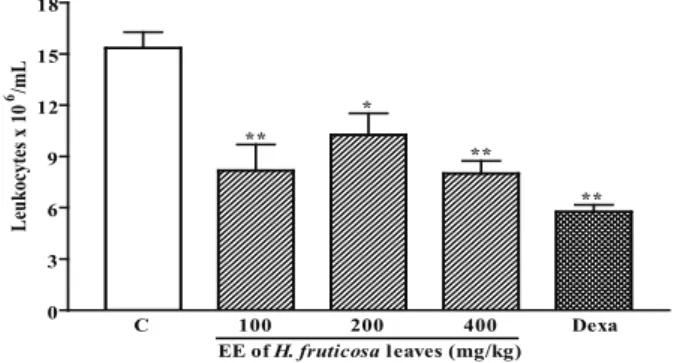
migration into the peritoneal cavity 4 h after stimulus. Figure 2 shows the inhibitory effect of the EE of H. fruticosa leaves (46.7, 33.1, and 47.8% at 100, 200, and 400 mg/kg, respectively, p<0.05) on the carrageenan-induced response. The control drug dexamethasone (2 mg/kg, s.c., 1 h beforehand) inhibited (62.5%, p<0.001) the carrageenan-induced leukocyte migration into the peritoneal cavity.
Table 2 shows that the n-C6H14, EtOAc, and MeOH/H2O partitions of H. fruticosa EE at 50, 100, and 200 mg/kg (p.o., 1 h beforehand) were capable of reducing (p<0.01) the carrageenan-induced leukocyte
migration into the peritoneal cavity (500 μg/cavity, 4 h
after). However, the CHCl3 partition (50, 100, and 200 mg/kg, p.o., 1 h beforehand) presented no activity on leukocyte migration into the peritoneal cavity induced by carrageenan.
Antioxidant activity
According to the IC50 values, the antioxidant concentration needed to decrease by 50% the initial
concentration of DPPH radical is the highest for the
n-C6H14, CHCl3, and MeOH/H2O partitions, as compared with the reference compound (-)-epigallocatechin (triplicate, p<0.05, Table 3). The IC50 values for EE and EtOAc partition (triplicate) were similar to IC50 value of the reference compound.
Table 1. Inhibitory effects of the partitions of Hyptis fruticosa leaves EE on rat paw oedema induced by carrageenan based on the area under the curves (AUC) after 4h.
MeOH/H20 EtOAc n-C6H14 CHCl3
Dose (mg/kg) Oedema* (mL x h)
Inhibition (%)
Oedema* (mL x h)
Inhibition (%)
Oedema* (mL x h)
Inhibition (%)
Oedema* (mL x h)
Inhibition (%)
0 2.81±0.15 - 2.65±0.03 - 2.68±0.05 - 2.45±0.16
-50 1.89±0.13b 32.7 2.13±0.08b 19.6 2.18±0.06b 18.7 2.84±0.08
-100 1.76±0.19b 37.4 2.52±0.10 4.9 2.16±0.07b 19.4 3.11±0.14
-200 1.93±0.08b 31.3 2.51±0.07 5.3 2.34±0.08a 12.7 2.93±0.11
-ASA 1.12±0.08b 60.1 1.77±0.08b 33.2 1.71±0.05b 36.2 1.54±0.11b 37.1 n=6. Small letters denote statistical signiicance, ap<0.01 and bp<0.001 in relation to control group. * mean±s.e.m.
Table 2. Inhibitory effects of the partitions of Hyptis fruticosa leaves EE on carrageenan-induced leukocyte migration into the peritoneal cavity after 4 h.
MeOH/H20 EtOAc n-C6H14 CHCl3
Dose (mg/kg) Cell x 106/ mL*
Inhibition (%)
Cell x 106/ mL*
Inhibition (%)
Cell x 106/ mL*
Inhibition (%)
Cell x 106/ mL*
Inhibition (%)
0 16.3±1.0 - 13.4±0.9 - 16.3±1.0 - 15.8±0.7
-50 10.1±0.4b 38.4 5.8±1.1b 56.9 11.6±0.8a 28.6 18.0±1.6
-100 7.5±0.8b 54.4 5.5±0.5b 58.9 7.4±0.9b 54.7 11.8±1.4 24.9
200 7.2±0.8b 56.0 5.9±1.0b 55.9 5.6±0.5b 65.4 14.4±0.8 8.6
Dexa 5.3±0.3b 67.6 4.5±0.2b 66.1 5.7±0.3b 64.8 6.2±0.3b 61.0
966 Rev. Bras. Farmacogn.
D
ISCUSSIONThis study demonstrated that Hyptis fruticosa EE and its n-C6H14, EtOAc, and MeOH/H2O partitions present inhibitory activities in experimental models of paw oedema and cell migration. In addition, the data presented herein show that the EE and its EtOAc and MeOH/H2O partitions present antioxidant potential.
Initially, we observed that the previous oral treatment with the EE of H. fruticosa leaves or its
n-C6H14, EtOAc, and MeOH/H2O partitions was effective in reducing the oedematogenic response evoked by carrageenan in rats between the second and fourth hours after the injection. Paw oedema formation is a result of a
synergism between inlammatory mediators that increase blood low and microvascular permeability (Ialenti et
al., 1992). The carrageenan-induced rat paw oedema is characterized by an early phase (1 h) caused by the release of histamine, 5-hydroxytryptamine, and bradykinin followed by a late phase (2 h) mainly sustained by nitric oxide and prostaglandin release which causes oedema
dependent on mobilization of neutrophils (Di Rosa et al.,
1971; Salvemini et al., 1996).
To gain further insight into the anti-inlammatory
effect induced by EE of H. fruticosa, we evaluated its
effect in other experimental model of inlammation. Cell recruitment during inlammation depends on
the orchestrated release of local mediators which are responsible for local vascular and tissue changes as well as for the recruitment of host defense cells (Luster et al., 2005). The leukocyte migration induced by i.p. injection of carrageenan involves many mediators, including eicosanoids, cytokines, and chemokines (Ogino et al., 1996; Fröde et al., 2001). The EE and its n-C6H14, EtOAc, and MeOH/H2O partitions inhibited leukocyte migration induced by i.p. injection of carrageenan (in peritonitis model).
Previous study has demonstrated that the
aqueous leaves extract of H. pectinata and several extracts of Hyptis verticillata shown anti-inflammatory activity (Kuhnt et al., 1995; Bispo et al., 2001). In
fact, various species of the family Lamiaceae has been reported to contain anti-inflammatory activity, e.g. Plectranthus amboinicus, Clinopodium vulgare, and
Lamium garganicum (Akkol et al., 2008; Burk et al., 2009; Gurgel et al., 2009). The present study shown that H. fruticosa markedly inhibited the local and acute manifestations in experimental models of inflammation. A putative mechanism associated with this activity may be inhibition of the synthesis of many inflammatory mediators whose involvement in the oedema and cell migration is well-established. However, these possibilities remains to be tested in future studies.
The antioxidant capacity of many substances
confers a therapeutic potential with anti-inlammatory
property (Li et al., 2002; Librowski et al., 2005). In our work demonstrated that the EE and EtOAc partition have highest antioxidant potential, and the MeOH/H2O partition has moderate antioxidant potential. However, the n-C6H14 and CHCl3 partitions are poor sources of antioxidants. Some studies have demonstrated that the extracts of Hyptis fasciculate shown to be active as DPPH radical scavengers
(Silva et al., 2005, 2009) and others Lamiaceae plants (e.g. some Salvia species, Gontscharovia popovii) represent good potential sources of natural antioxidants useful for either prevention or treatment of oxidative stress-related diseases (Firuzi et al., 2010).
The phytochemical study of H. fruticosa
leaves detected large amounts of phenolic compounds in the EE, as well as, EtOAc and MeOH/H2O partitions. Xanthones, a widespread polyphenolic compound in plants, have extensive pharmacological activities such as antioxidant, antihypertensive, inhibition of platelet
aggregation, antiulcer, and anti-inlammatory (Peres et al.,
2000; Librowski et al., 2005). Flavonoids are the major secondary metabolites class with several descriptions of antioxidant property which confers a therapeutic potential
with anti-inlammatory effect (Rajendran et al., 2000; Li
et al., 2002; Matsuda et al., 2003). Flavonoids have been
Table 3. IC50 values of H. fruticosa leaves EE and its partitions determined by DPPH method.
Samples IC50 (μg/mL DPPH)*
EE of leaves 35.00±1.01ab
n-C6H14 partition 78.67±2.90c
CHCl3 partition 91.33±2.18c
EtOAc partition 36.67±2.65ab
MeOH/H2O partition 50.67±2.29b
(-)-Epigallocatechin 16.67±1.21a
Different small letters means signiicantly different at p<0.05 (triplicate). * IC50 values of extracts (25 μg/mL) were calculated at 50 min.
Figure 2. Effect of Hyptis fruticosa leaves EE on leukocyte migration. Rats were pre-treated with vehicle (C, p.o.), dexamethasone (Dexa, 2 mg/kg, s.c.), or EE (100-400 mg/kg, p.o.) 1 h before carrageenan (500 μg, i.p.). Cell counts were performed at the time 4 h after the carrageenan. Each value represents the mean±s.e.m. *p<0.05 and **p<0.001, in relation to control group. ANOVA followed by Tukey’s test (n=6/group).
0 3 6 9 12 15 18
400 200
C
EE ofH. fruticosa l eaves (mg/kg)
Dexa **
100 *
** **
Leukocytes x 10
shown to inhibit the inducible isoforms of cyclo-oxygenase (COX-2) and nitric oxide synthase (iNOS), lipooxygenase, microsomal monooxygenase, glutathione S-transferase, and nicotinamide adenine dinucleotide phosphate
(NADPH)-oxidase, all involved in reactive oxygen species
generation (Odontuya et al., 2005; Soobrattee et al., 2005).
Others anti-inlammatory properties of lavonoids are their
suggested ability to inhibit neutrophil degranulation and reduce complement activation, thereby decreasing the
adhesion of inlammatory cells to the endothelium (Nijveldt
et al., 2001). It has been demonstrated that tannins are also able to inhibit COX-2 and/or iNOS enzymes, as well as
other mediators of the inlammatory process (Carvalho,
2004). A number of saponins have been previously
reported to have anti-inlammatory effects. For example,
soybean saponins were reported to suppress the release of
proinlammatory mediators by peritoneal macrophages,
saponins from Platycodon grandilorum were reported to inhibit expression of iNOS and COX-2, and ginsenosides were reported to inhibit COX-2 expression (Ahn et al., 2005; Kang et al., 2005; Lee et al., 2005). These previous
studies conirm our dates in this work that demonstrated the presence of lavonoids, saponins, tannins, and xanthones
in the EE, and EtOAc and MeOH/H2O partitions with
anti-inlammatory and antioxidant effects.
In addition, steroids have been reported as potent
anti-inlammatory agents (Mencarelli et al., 2009). In our
work demonstrated that the n-C6H14 partition contains
steroids and its shows anti-inlammatory activity and poor
antioxidant action. The CHCl3 partition did not show
anti-inlammatory and antioxidant activities, which is destitute of lavonoids, saponins, tannins, xanthones, and steroids.
In conclusion, H. fruticosa shows
anti-inlammatory and antioxidant activities. The identiication
and isolation of such bioactive components are in progress,
which could elucidate the anti-inlammatory property of
this plant.
ACKNOWLEDGEMENTS
This study was supported by Conselho Nacional
de Desenvolvimento Cientíico e Tecnológico (CNPq - PIBIC/CNPq/UFS).
REFERENCES
Ahn KS, Noh EJ, Zhao HL, Jung SH, Kang SS, Kim YS 2005. Inhibition of inducible nitric oxide synthase and cyclooxygenase II by Platycodon grandilorum saponins via suppression of nuclear factor-kappaB activation in RAW 264.7 cells. Life Sci 76: 2315-2328.
Akkol EK, Yalçin FN, Kaya D, Caliş I, Yesilada E, Ersöz T 2008. In vivo anti-inlammatory and antinociceptive actions of some Lamium species. J Ethnopharmacol 118: 166-172. Akah PA, Nwambie AI 1993. Nigerian plants with anti-convulsant
property. Fitoterapia 64: 42-44.
Arrigoni-Blank MF, Antoniolli AR, Caetano LC, Campos DA, Blank AF, Alves PB 2008. Antinociceptive activity of
the volatile oils of Hyptis pectinata L. Poit. (Lamiaceae) genotypes. Phytomedicine 15: 334-339.
Barbosa PPP, Ramos CP 1992. Studies on the antiulcerogenic activity of the essential oil of Hyptis mutabilis Briq in rats. Phytother Res 6: 114-115.
Bispo MD, Mourão RH, Franzotti EM, Bomim KB, Arrigoni-Blank MF, Moreno MP, Marchioro M, Antoniolli AR 2001. Antinociceptive and antiedematogenic effects of the aqueous extract of Hyptis pectinata leaves in experimental animals. J Ethnopharmacol 76: 81-86. Burk DR, Senechal-Willis P, Lopez LC, Hogue BG, Daskalova
SM 2009. Suppression of lipopolysaccharide-induced inlammatory responses in RAW 264.7 murine macrophages by aqueous extract of Clinopodium vulgare
L. (Lamiaceae). J Ethnopharmacol 126: 397-405. Brand-Williams W, Cuvelier ME, Berset C 1995. Use of a
free radical method to evaluate antioxidant activity.
Lebensmittel Wissenschaft Technologie 28: 25-30.
Calixto JB 2005. Twenty-ive years of research on medicinal plants in Latin America: a personal view. J Ethnopharmacol 100: 131-134.
Carvalho JCT 2004. Fitoterápicos antiinlamatórios: aspectos
químicos, farmacológicos e aplicações terapêuticas.
Ribeirão Preto: Tecmedd Editora.
Di Rosa M, Giroud JP, Willoughby DA 1971. Studies on the mediators of the acute inlammatory response induced in rats in different site by carrageenan and terpentine. J Pathol 104: 15-21.
Esquenazi D, Wigg MD, Miranda MMFS, Rodrigues HM, Tostes JBF, Rozental S, Silva AJR, Alviano CS 2002. Antimicrobial and antiviral activities of polyphenolics from Cocos nucifera Linn (Palmae) husk iber extract.
Res Microbiol 153: 647-652.
Firuzi O, Javidnia K, Gholami M, Soltani M, Miri R 2010. Antioxidant activity and total phenolic content of 24 Lamiaceae species growing in Iran. Nat Prod Commun
5: 261-264.
Fröde TS, Souza GE, Calixto JB 2001. The modulatory role played by TNF-alpha and IL-1 beta in the inlammatory responses induced by carrageenan in the mouse model of pleurisy. Cytokine 13: 162-168.
Gurgel AP, da Silva JG, Grangeiro AR, Oliveira DC, Lima CM, da Silva AC, Oliveira RA, Souza IA 2009. In vivo study of the anti-inlammatory and antitumor activities of leaves from Plectranthus amboinicus (Lour.) Spreng (Lamiaceae). J Ethnopharmacol 125: 361-363.
Harbone JB 1984. Phytochemical Methods. In: A Guide to
Modern Techniques of Plant Analysis. London: Chapman
and Hall, p. 324.
Harley RM 1988. Revision of generic limits in Hyptis Jacq (Labiatae) and its allies. Bot J Linn Soc 98: 87-95. Ialenti A, Ianaro A, Moncada S, Di Rosa M 1992. Modulation
of acute inlammation by endogenous nitric oxide. Eur J
Pharmacol 211: 177-182.
Kang JH, Sung MK, Kawada T, Yoo H, Kim YK, Kim JS, Yu R 2005. Soybean saponins suppress the release of proinlammatory mediators by LPS-stimulated peritoneal macrophages. Cancer Lett 230: 219-227.
Kuhnt M, Probstle A, Rimpler H, Bauer R, Heinrich M 1995. Biological and pharmacological activities and further constituents of Hyptis verticillata. Planta Med 61: 227-232.
968
YJ 2005. Anti-tumor promotional effects of a novel intestinal bacterial metabolite (IH-901) derived from the protopanaxadiol type ginsenosides in mouse skin.
Carcinogenesis 26: 359-367.
Li DW, Lee EB, Kang SS, Hyun JE, Whang WK 2002. Activity guided isolation of saponins from Kalopanax pictus with anti-inlammatory activity. Chem Pharm Bull 50: 900-903.
Librowski T, Czarnecki R, Czekaj T, Marona H 2005. New xanthone derivatives as potent anti-inlammatory agents. Medicina (Kaunas) 41: 54-58.
Luster AD, Alon R, von Andrian UH 2005. Immune cell migration in inlammation: present and future therapeutic targets.
Nat Immunol 6: 1182-1190.
Matsuda H, Morikawa T, Ando S, Toguchida I, Yoshikawa M 2003. Structural requirements of lavonoids for nitric oxide production inhibitory activity and mechanism of action. Bioorg Med Chem 11: 1995-2000.
Mencarelli A, Renga B, Palladino G, Distrutti E, Fiorucci S 2009. The plant sterol guggulsterone attenuates inlammation and immune dysfunction in murine models of inlammatory bowel disease. Biochem Pharmacol 78: 1214-1223.
Menezes IA, Marques MS, Santos TC, Dias KS, Silva AB, Mello IC, Lisboa AC, Alves PB, Cavalcanti SC, Marcal RM, Antoniolli AR 2007. Antinociceptive effect and acute toxicity of the essential oil of Hyptis fruticosa in mice.
Fitoterapia 78: 192-195.
Nijveldt RJ, Nood E, Hoorn DEC, Boelens PG, Van-Norren K, Van-Leeuwer PAM 2001. Flavonoids: a review of probable mechanisms of action and potential applications. Am J Clin Nutr 74: 418-425.
Odontuya G, Hoult JRS, Houghton PJ 2005. Structure-activity relationship for anti-inlammatory effect of luteolin and its derived glycosides. Phytother Res 19: 782-786. Ogino M, Majima M, Kawamura M, Hatanaka K, Saito M, Harada
Y, Katori M 1996. Increased migration of neutrophils to granulocyte-colony stimulating factor in rat carrageenin-induced pleurisy: roles of complement, bradykinin, and inducible cyclooxygenase-2. Inlamm Res 45: 335-346. Peres V, Nagem TJ, De Oliveira FF 2000. Tetraoxygenated
naturally occurring xanthones. Phytochemistry 55: 683-710.
Rajendran NN, Thirugnanasambandam P, Viswanathan S, Parvathi V, Ramasamy S 2000. Antinociceptine pattern of lavone and its mechanism as tested by formalin assay.
Indian J Exp Biol 38: 182-185.
Salvemini D, Wang ZQ, Wyatt PS, Bourdon DM, Marino MH, Manning PT, Currie MG 1996. Nitric oxide: a key mediator in the early and late phase of carrageenan-induced rat paw inlammation. Brit J Pharmacol 118: 829-838.
Santos MR, Carvalho AA, Medeiros IA, Alves PB, Marchioro M, Antoniolli AR 2007. Cardiovascular effects of Hyptis fruticosa essential oil in rats. Fitoterapia 78: 186-191. Silva ABL, Dias KS, Marques MS, Menezes IAC, Santos TC,
Mello ICM, Lisboa ACCD, Cavalcanti SCH, Marçal RM, Antoniolli AR 2006. Avaliação do efeito antinociceptivo e da toxicidade aguda do extrato aquoso da Hyptis fruticosa Salmz. ex Benth. Rev Bras Farmacogn 16: 475-479.
Silva CG, Herdeiro RS, Mathias CJ, Panek AD, Silveira CS, Rodrigues VP, Rennó MN, Falcão DQ, Cerqueira DM,
Minto ABM, Nogueira FLP, Quaresma CH, Silva JFM, Menezes FS, Eleutherio ECA 2005. Evaluation of antioxidant activity of Brazilian plants. Pharmacol Res
52: 229-233.
Silva CG, Raulino RJ, Cerqueira DM, Mannarino SC, Pereira MD, Panek AD, Silva JFM, Menezes FS, Eleutherio ECA 2009. In vitro and in vivo determination of antioxidant activity and mode of action of isoquercitrin and Hyptis fasciculata.Phytomedicine 16: 761-767.
Soobrattee MA, Neergheen VS, Luximon-Ramma A, Aruoma OI, Bahorun T 2005. Phenolics as potential antioxidant therapeutic agents: mechanism and actions. Mutat Res
579: 200-213.
Thomazzi SM, Silva CB, Silveira DCR, Vasconcellos CLC, Lira AF, Cambuí EVF, Estevam CS, Antoniolli AR 2010. Antinociceptive and anti-inlammatory activities of
Bowdichia virgilioides (sucupira). J Ethnopharmacol
127: 451-456.
Winter CA, Risley EA, Nuss GW 1962. Carrageenin-induced edema in hind paw of the rat as an assay for anti-inlammatory drugs. Proc Soc Exp Biol Med 111: 544-547.