Introduction
Physical evaluation has been of great use for swimmers as the results contribute to guiding intensity, duration, and objectives to be achieved during physical exercise, whether for competition or health purposes1,2,3.In this sense, there is a trend to conduct research in order to evaluate the swimmers’ cardiorespiratory itness, and it is imperative that the choice of test is the closest possible to their sport reality. Thus, the design or adaptation of swimming tests require caution to meet the criteria of scientiic authenticity, providing greater precision through their consistency (reproducibility), au-thenticity (validity), and association to real-life situations (applicability)4,5.
There is a solid set of evidence that the 400 meters freestyle swimming test is closely related to the VO2max (ml/kg.min−1) of high-performance swimmers when evaluated in a laboratory setting6. Speciically, Ribeiro evaluated the ability of different metabolic indexes to predict the swimming performance in the 400 meters freestyle, noting 85% of the VO2max (ml/ kg.min−1) and the concentration of 4 mmol/l blood lactate
are signiicant predictors for mid-distance events7. Another study measured the time to exhaustion at the minimum speed that matches the VO2max of high-performance swimmers (in swimming conditions through direct oximetry) and showed the average time with values of 260.20 ± 60.73 s, demonstrating the relationship of VO2max (ml/kg.min−1) and mid-distance tests8. Further, when investigating the anthropometric and physiological characteristics of young competitive swimmers in relation with their swimming performance, Oliver Hue, selected the 400 meters freestyle test as a reference9.
Recently, the previous test proposed by Léger and Boucher was adapted10, developed, and validated for the aquatic envi-ronment, and was coined the Progressive Swim Test (PSwT), which has the purpose of determining the VO2max (ml/ kg.min−1) based upon the greater number of laps in a 25-meter swimming pool, with phased intensity established by sound signals at each 50 meters11. Through the reproducibility ob-tained in the test, it was possible to see that the number of laps swum during the test (NLP) may determine the physical conditioning of non-expert swimmers, due to the distances with pre-determined time (r and ICC > 0.90, p < 0.01)11. Original article (short paper)
Applicability of an Indirect VO2max Test:
Its Association with the 400 Meters Freestyle
Performance
Adalberto Veronese da Costa
Universidade do Estado do Rio Grande do Norte, Rio Grande do Norte, RN. Brasil Universidade de Trás-os-Montes e Alto Douro, Vila Real. Portugal
Manoel da Cunha Costa
Jorge Luiz de Brito Gomes Fernando José de Sá Pereira Guimarães
Universidade de Pernambuco, Recife, PE, Brasil
Tiago Manuel Barbosa
National Institute of Education, Nanyang Technological University, Singapore
Abstract – The aim of this study was to evaluate the VO2max using a previously validated indirect test for non-expert adult swimmers and to verify its connection with the 400 meters freestyle test. A total of 17 non-expert male swimmers (21.5 ± 3.12 years) were evaluated. Body composition measurements included body weight (74 ± 9.41 kg), height (172.9 ± 5.21 cm) and body fat percentage (15.2 ± 4.15 %). Two tests were conducted on different days; the 400 meters freestyle (400 MF) and the Progressive Swim Test (PSwT), respectively. The participant’s heart rate frequency before and after the test (BHR and AHR) was analyzed, as well as the subjective perception of effort (RPE), the number of laps covered (NLP), and the time of test execution measured in minutes. Signiicant differences were identiied in all variables (p < 0.05) with the exception of BHR. An inverse correlation (r > – 0.60) was found between AHR and
execution time (r > – 0.70), as well as between the VO2max estimated by the PSwT and the 400 MF performance test (r > – 0.70). The Bland-Altman Plot showed that the values discovered were within the established concordance limits
of 95% (±1.96 SD). A negative correlation between a swimming test and a test that estimates the VO2max occurred, and the PSwT showed results of greater approximation of the aerobic power of non-expert swimmers. In conclusion, the PSwT is applicable for non-expert adult swimmers.
In addition, a prediction equation was created from its validation, which could estimate the VO2max of non-expert swimmers where the mean value was within the 45 ml.kg−1min−1. These results are in accordance with other studies that evaluated the VO2max at the end of the 400 meters freestyle in maximum speed by elite swim-mers, which showed results between 45 and 62 ml.kg−1min−1 12. Following the adaptation, design reproducibility, and validity stages of PSwT 11,12, the next step should be its application in order to verify its sensibility and its use as a source of information regard-ing the cardiorespiratory aptitude of swimmers.
Since there is a strong connection between the performance in the 400 meters freestyle test and VO2max, there is a good chance to verify whether or not the VO2max estimated with the PSwT is also related to this test. Therefore, the study hy-pothesis contends there is a signiicant connection between the estimated VO2max and the performance in the 400 meters freestyle test. Thus, the purpose of this study was to evaluate VO2max through a previously validated indirect test for non-expert adult swimmers and to establish its connection with the 400 meters freestyle test.
Methods
Participants
The size of the sample in relation to the local swimming schools was estimated using the GPower 3.0.10. software13. Thus, in a pilot study conducted under the same conditions of the validation experiment, we attempted to verify the extent of the effect size (ES) of preliminary analysis. Therefore, while examining the high correlation that exists between VO2max and the distance swum, an ES of 0.75 was observed. Accordingly, taking into account the great power of analysis from 0.8 and a corresponding alpha error of 0.05, we reached a minimum sample of 11 swimmers for this investigation. However, 17 non-expert male swimmers with ages between 18 and 30 years participated in the study (age: 21.5 ± 3.12 years; body mass: 74 ± 9.41 kg; height: 172.9 ± 5.21 cm and body fat percentage: 15.2 ± 4.15 %), submitting to two tests on different days. On the irst day, the 400 meters freestyle (400 MF) was simulated and on the following day (24 hours later), the Progressive Swim Test (PSwT) was performed.
The criteria for participation in this study were as follows: a) swimmers with accurate technique for crawl style; b) taking swimming lessons three times a week with a duration of one hour per session; c) the ability to swim 800 meters uninter-rupted; d) swimmers who have eaten three hours before the test; e) who have not taken any type of food supplements; f) who have not ingested any alcohol, carbonated drinks or caffeine, and who have not smoked or taken drugs; g) have not performed any type of moderate to vigorous physical activity 24 hours prior to testing. Excluded from this study were: a) elite swimmers, afiliated with the National Swimming Federation or athletes who have been afiliated in the three years prior to the survey; b) non-expert swimmers that have responded negatively to one of the questions in the Physical Activity Readiness Questionnaire – PAR-Q14; c) who performed the
test in less than four minutes (1,15,16); d) visibly presenting any kind of infection that would compromise their musculo-skeletal condition.
All procedures followed the guidelines of the Declaration of Helsinki, which deals with the ethics of experiments involving human beings. This study was approved by the ethics committee of the University of Pernambuco / PROPEGE / UPE, Brazil – Protocol 035/2012. Prior to beginning the test, all participants signed a Statement of Informed Consent.
Procedures
The body composition of the subjects was assessed by weight (Finizola Weighing-machine, São Paulo, Brasil – accuracy 100 g), stadiometer (Sanny, São Paulo, Brasil – accuracy 1 mm) and to determine the percentage of fat, the Jackson e Pollock proto-col of tree skin fold (adipometer Lange Skinfold Caliper, Beta Technology, California, United States of America – accuracy 1 mm) was employed17,18.
In order to the perform tests (400 MF and PSwT) under the same conditions, both were conducted in a 25-meter swimming pool, with a mean water temperature of 27 ±1 °C, without jumping from the block, leaning against the side with one foot placed on the wall, and executed at the same hour. A chronometer (Casio HS3, São Paulo, Brasil–accuracy in hundredths of seconds) was used to verify the execution time of the 400 MF. A heart rate monitor (Model Polar FT1, Polar Electro Oy, Kempele, Finland) was used before each test to identify the condition of the swimmer when at rest (BHR), using values below 90 bpm for starting criteria. The heart rate after the test (AHR) was also measured to verify the maximum reached, as well as the rate of perceived exertion (RPE) through the Borg’s Category Ratio-Scale – CR-10 was applied at the end of the test19,20. Also tested were the number
of laps performed (NLP) and the duration of the performance in each of the tests, measured in minutes. During the simulated 400 MF test, swimmers were asked to execute it in the least amount of time possible.
In the PSwT protocol, swimmers used an underwater MP3 which was attached to the their glasses (SwiMP3 V2, Finis Inc., Livermore, CA) and the evaluators used a 50/60 Hz (18W) Micro System, to ensure that all subjects could hear the audio sounds recorded during the test. The PSwT was applied according to the protocol of Veronese da Costa12, which cor-responds to an increase of swimming intensity of one second for every two laps (meaning every 50 meters). The test ends when the swimmer cannot arrive at the distance which marks the irst or last ive meters of the swimming pool twice in a row. From the application of the PSwT12, it was possible to estimate the VO2max of non-expert adult swimmers through the following equation:
VO2max (ml.kg−1.min−1) = 14.085 + 1.858[NLP]–0.192 [BM(kg)] + 0.111[AHR]
Analysis
The Shapiro-Wilk and Levene tests were conducted to test the normality and homogeneity of the data and whether the presuppositions of parametric statistics were met. The results are presented in mean and standard deviation. To compare the variables, the paired t-test was selected. To verify the associa-tion between the tests, the Pearson linear correlaassocia-tion (r) was computed between the variables BHR–Before Heart Rate; AHR – After Heart Rate; RPE – Rate of Perceived Exertion (Scale from 1 to 10); NLP – Number Laps Performed; bpm – beats per minute; min–time in minutes, as well as between the equation which uses time in minutes to estimate the VO2max of the PSwT and 400 MF. The coeficient of varia -tion (CV = standard devia-tion / mean x 100) was assessed in each individual between the two tests so the CV general mean and the Standard Error of Measurement (SEM) could be calculated. Thus, it was considered that the greater the R and smaller the CV and SEM percentages, the greater the test applicability levels would be11. The limits of agreement and bias
of the variables between the two tests were analyzed using the Bland-Altman Plot, and taking as satisfactory that 80% of the plots are within a conidence interval of 95% (± 1.96 SD)21,22.
The data was analyzed using the SPSS for Windows statistical package (v 17.0, SPSS, Inc., Chicago, IL) and MedCalc for Windows (v 12.2.1.0, Mariakerke, Belgium). In all analyses, the signiicance level was 5%.
Results
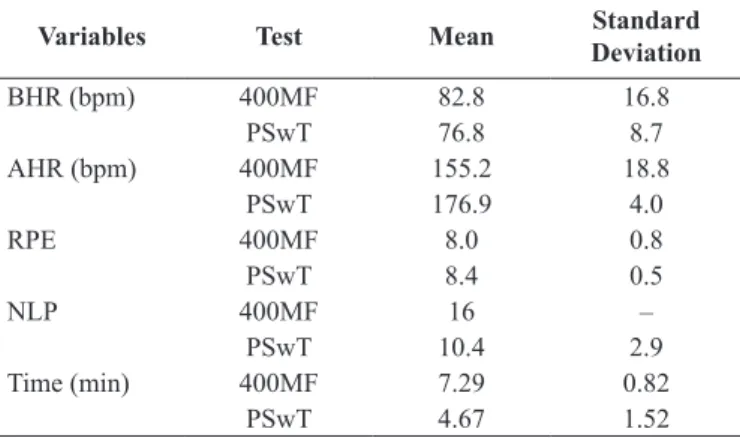
Table 1 presents the descriptive data between the simulated 400 MF test and the PSwT. It was observed that all swimmers began the tests with their BHR at less than 90 bpm, the AHR displayed larger values in the PSwT than 400 MF, the RPE was classiied as very strong, and the NLP mean in the PSwT was inferior to the 400 MF in terms of time and distance (difference of 140 meters).
Table 1. Descriptive data between the distance of the 400 meters free-style and Progressive Swim Test
Variables Test Mean Standard
Deviation
BHR (bpm) 400MF 82.8 16.8
PSwT 76.8 8.7
AHR (bpm) 400MF 155.2 18.8
PSwT 176.9 4.0
RPE 400MF 8.0 0.8
PSwT 8.4 0.5
NLP 400MF 16 –
PSwT 10.4 2.9
Time (min) 400MF 7.29 0.82
PSwT 4.67 1.52
Abbreviation: BHR – Before Heart Rate; AHR – After Heart Rate; RPE
– Rate of Perceived Exertion (Scale from 1 to 10); NLP – Number Laps
Performed; bpm – beats per minute; min–time in minutes (Test Duration).
Table 2 shows an inverted correlation in AHR and in the ex -ecution times between the simulated 400 MF test and the PSwT. We also observed signiicant differences in the paired t-test, a coeficient of variation, and a standard error of measurement smaller than 10% in most variables.
Table 2. Statistical analyses between the 400 meters freestyle and Progressive Swim Test
Variables r t-test SEM CV (%)
BHR (bpm) 0.50 0.16 3.87 14%
AHR (bpm) -0.67* <0.01** 3.99 9%
RPE 0.32 0.05** 0.20 6%
NLP – <0.01** 0.76 12%
Time (min) -0.79* <0.01** 0.54 8%
Note: * Signiicant correlation (p ≤ 0.05); ** Signiicant difference in t-test
(p ≤ 0.05).
Abbreviation: r – Pearson linear correlation; SEM – Standard Error of
Measurement; CV (%)–Coeficient of Variation; BHR – Before Heart Rate; AHR – After Heart Rate; RPE – Rate of Perceived Exertion (Scale from 1 to 10); NLP – Number Laps Performed; bpm – beats per minute; min–time in
minutes (Test Duration).
Figure 1 shows the limits of agreement between the 400 MF and PSwT. It was observed that most plots were above the 80% considered to be satisfactory and within the IC limits of 95%.
Figure 2 presents the relation between the VO2max estimated by the PSwT and the simulated 400 MF test, highlighting an inverse correlation between the variables.
Discussion
The aim of this study was to verify the existence of an associa-tion between the estimated VO2max for non-expert swimmers test (PSwT) and the swimming performance in the simulated 400 meters freestyle test. It was observed, in fact, a connection occurred between the two tests, and we can state that the PSwT is a test with applicability for non-expert adult swimmers.
The BHR, AHR, RPE, and NLP variables (adding the time for conducting the tests) were necessary to the standardization with previous studies regarding the PSwT, since these presented security and consistency in the reproducibility and validity veriication11,12. These variables were essential to determine
the physical condition of these swimmers, and especially HR and RPE, were important in the veriication of the state of the swimmers immediately before and after the tests5,19, in the
veriication of the longest distance incrementally swum by the swimmer in the PSwT11, and in the least amount of time in the simulated 400 MF test1,23.
in a certain distance. A swimming test can be a good tool to evaluate competitive swimmers rather than recreational swim-mers or for health purposes11,25-27.
While verifying the reproducibility of the PSwT, Veronese da Costa, Costa, Carlos, Guerra, Silva, Barbosa11 regarded the
NLP as a predictor of the physical conditioning of the non-expert swimmers due to the fact the distance over a predetermined time was used as a criterion for exercise intensity in swimming11.By validating the equation which estimates the VO2max using the results obtained in the PSwT (i.e., through NLP, BM in kg and AHR), the test was found to be appropriate for non-expert adult swimmers as a way of assessing physical conditioning12.
In the simulated 400 MF, it was observed that, even demand-ing the maximum performance possible, there were alterations in swimming intensity over the course of the test. This also occurred with Lafite, Vilas-Boas, Demarle, Silva, Fernandes, Louise Billat29. while analyzing the metabolic and technical parameters during the 400 MF test, noting that trained swim-mers, even when controlled by a visual light pacer failed to remain stable, and to compensate for the decrease in stroke length (SL), increased their stroke rate (SR) in the last 100
meters29. In the PSwT this did not occur, for at any given mo-ment, when the swimmer reached their threshold, they sought to keep performing at their best until they could not keep up with the increased intensity of the required protocol11. This can
also be observed when comparing AHR in the 400 MF and the PSWT (p < 0.01), where non-expert swimmers reached
Figure 1–Plot of the bias (average of differences) and limits of
agree-ment (± 1.96, IC 95%) between the variables analyzed from the simu -lation of the 400 meters freestyle test and the Progressive Swim Test,
according to the Bland Altman analysis. Numbers between brackets
represent the amount of overlapping results.
Plot of the bias (average of differences) and limits of agreement
(± 1.96, IC95%) between the variables analyzed from the simulation of the
400 meters freestyle test and the Progressive Swim Test, according to the
Bland Altman analysis. Numbers between brackets represent the amount of
overlapping results.
Figure 2–Relation between the VO2max estimated through the Pro -gressive Swim Test and the performance in the 400 meters freestyle test. *p < 0.01.
Relation between the VO2max estimated through the Progressive
78% and 89% of HRmax respectively, whereas the swimmer
had to be at least at 85% of their HRmax taking the VO2max as a parameter7,28. This was achieved in the PSWT by verifying the equation for estimating VO2max, with a mean value of 45.59 ± 9.32 ml/kg.min−112.
In regards to the connection between the variables of the 400 MF test and the PSwT, it was not possible to correlate the distance of the simulated test with the NLP due to the fact that the 400 MF is predetermined (i.e., 16 swimming pools), whereas the NLP depends upon the physical conditioning of the swim -mer in doing the maximum possible laps in progression11,30,31.
In the AHR and the performance duration, values greater than
r = −0.60, CV and SEM below 10% demonstrated that there
was a correlation between the variables at the end of the tests and the values which occurred in the Bland Altman plot were within the level of magnitude demanded. However, the results between the 400 MF and the PSwT were inversely proportional, since to perform a simulated test in a shorter time, the non-expert swimmers exacted a level of effort which demanded their anaerobic capacity. At one point in the test, this led to the swimmers presenting a greater capacity for sustaining than the intensity through exercise, causing AHR to not be kept at its maximum1,24. During the PSwT, when the swimmer achieved their maximum performance, the test was completed, provid-ing values in AHR and NLP consistent to what we intend to measure, the VO2max. The results obtained in continuous tests (in this case, the simulated 400 MF test) were a major concern in the development of the PSwT, where it was noted the tests which control the intensity of the swim would be advisable for non-expert swimmers11,12.
As for the connection between the VO2max estimated through the PSwT and the performance in the simulated 400 MF test, the meaningful correlation presented between the variables (r = −0.79; p < 0.01) conirms the aforementioned
test likely offers the same exercise physiological conditions for swimming, corresponding to the VO2max1,22, with the par-ticularity of accompanying the scaled intensity employed in the non-expert swimmers test11,12. Thus, the PSwT was proven reli-able when evaluated on different days by different evaluators, presenting possibilities of application in the aquatic environ-ment to be associated with a swimming test11. Additionally, it was compared to a direct oximetry method showing the same performance connection12, and inally its equation was applied to a practical situation through the 400 MF test where using HR, distance, and time to determine the aptitude of non-expert swimmers, both obtained a high association12,32,33.
The following were considered to be limitations of the study: (i) it was not possible to evaluate the biomechanical aspects during both tests, since when swimmers reached their maximum performance, they suffered alterations in the length and number of strokes; (ii) the results described here are valid only for non-expert swimmers, which means another researcher should refrain from applying this test to elite swimmers; (iii) it was not possible to evaluate the test’s sensibility through an exercise program which could then utilize the test to verify aerobic power.
Conclusion
According to these data, the authors determined there is a negative association between a swimming test and a test which estimates the VO2max by verifying that the PSwT presented results of better approximation to the aerobic power of non-expert swimmers. Thus, the Progressive Swim Test is applicable for non-expert adult swimmers, becoming a new assessment tool which will contribute to the creation of more eficient training programs for seeking better physical conditioning of these participants.
References
1. Fernandes R, Vilas-Boas J. Time to Exhaustion at the VO2max
Velocity in Swimming: A Review. J Hum Kinet. 2012; 32: 121–34.
2. Raffaelli C, Galvani C, Lanza M, Zamparo P. Different methods for monitoring intensity during water-based aerobic exercises.
Eur J Appl Physiol. 2012; 112(1): 125–34.
3. Roschel H, Tricoli V, Ugrinowitsch C. Physical Training:
Scientiic and Practical Considerations. Rev Bras Educ Física e Esporte. 2011; 25: 53–65.
4. Corazza ST, Katzer JI. Creating and Validating a Test for Measuring Motor Performance of the Crawl Swimming Style.
Eur J Cardiothorac Surg Off J Eur Assoc Cardiothorac Surg.
2000; 73(5): 73–8.
5. Michele R Di, Gatta G, Leo A Di, Cortesi M, Andina F, Tam E,
et al. Estimation of the Anaerobic Threshold from Heart Rate
Variability in an Incremental Swimming Test. J Strength Cond
Res . 2012; 26(11): 3059–66.
6. Wakayoshi K, Yoshida T, Udo M, Kasai T, Moritani T, Mutoh Y, et al. A simple method for determining critical speed as swimming fatigue threshold in competitive swimming. Int J Sports Med. 1992; 13(5): 367–71.
7. Ribeiro JP, Cadavid E, Baena J, Monsalvete E, Barna A, De Rose
EH. Metabolic predictors of middle-distance swimming perfor
-mance. Br J Sports Med. 1990; 24(3): 196–200.
8. Fernandes RJ, Cardoso CS, Soares SM, Ascensão A, Colaço PJ,
Vilas-Boas JP. Time limit and VO2 slow component at intensities
corresponding to VO2max in swimmers. Vol. 24, International journal of sports medicine. 2003.
9. Hue O, Antoine-Jonville S, Galy O, Blonc S. Anthropometric and physiological characteristics in young afro-Caribbean swimmers. A preliminary study. Int J Sports Physiol Perform. 2013;(3):71–8. 10. Léger L, Boucher R. An indirect continuous running multistage
ield test: the Université de Montréal track test. Can J Appl Sport
Sci J Can Des Sci Appl Au Sport. 1980; 5(2): 77–84.
11. Veronese da Costa A, Costa M, Carlos D, Guerra L, Silva A,
Barbosa T. Reproducibility of an aerobic endurance test for non -expert swimmers. J Multidiscip Healthc. 2012; 5: 215.
12. Veronese da Costa A, Costa M, Oliveira S, Albuquerque F,
Guimarães F, Barbosa T. Validation of an equation for estimating
13. Faul F, Erdfelder E, Lang A-G, Buchner A. G*Power 3: a lexible statistical power analysis program for the social, behavioral, and
biomedical sciences. Behav Res Methods. 2007; 39(2): 175–91.
14. Thomas S, Reading J, Shephard RJ. Revision of the Physical
Activity Readiness Questionnaire (PAR-Q). Can J Sport Sci J
Can des Sci du Sport. 1992; 17(4): 338–45.
15. Montpetit R, Smith H, Boie G. Swimming economy: How to
standardize the data to compare swimming proiciency. J Swim Res. 1988; 4(1): 5–8.
16. Silva AJ, Machado Reis V, Marinho D, Carneiro AL, Novaes G, Aidar FJ. Swimming economy: determinant factors and
assess-ment issues. Brazilian J Kinanthropometry Hum Perform. 2006;
8(3): 93–9.
17. Jackson AS, Pollock ML. Generalized equations for predicting
body density of men. Br J Nutr. 1978; 40(3): 497.
18. Nevill AM, Metsios GS, Jackson AS, Wang J, Thornton J,
Gallagher D. Can we use the Jackson and Pollock equations to
predict body density/fat of obese individuals in the 21st century?
Int J Body Compos Res. 2008;
19. Borg G, Ljunggren G, Ceci R. The increase of perceived exer -tion, aches and pain in the legs, heart rate and blood lactate
dur-ing exercise on a bicycle ergometer. Eur J Appl Physiol Occup
Physiol. 1985;4(4):43–9.
20. Wallace LK, Slattery KM, Coutts AJ. The ecological validity and
application of the session-RPE method for quantifying training loads in swimming. J Strength Cond Res. 2009 J;23(1): 33–8.
21. Bland JM, Altman DG. Statistical methods for assessing agree -ment between two methods of clinical measure-ment. Vol. 1,
Lancet. 1986.
22. Morais JE, Costa MJ, Mejias JE, Marinho DA, Silva AJ, Barbosa TM. Validation of predictive equations of the cross-sectional area
of the human trunk. Rev Bras Cineantropometria Desempenho
Hum. 2011; 13: 461–7.
23. Costill DL, Kovaleski J, Porter D, Kirwan J, Fielding R, King
D. Energy expenditure during front crawl swimming: predicting
success in middle-distance events. Int J Sports Med. 1985; 6(5): 266–70.
24. Fernandes RJ, Keskinen KL, Colaço P, Querido AJ, Machado LJ, Morais PA, et al. Time limit at V̇O2max velocity in elite crawl swimmers. Int J Sports Med. 2008; 29(2): 145–50.
25. Barbosa TM, Fernandes RJ, Keskinen KL, Vilas-Boas JP. The
inluence of stroke mechanics into energy cost of elite swimmers. Eur J Appl Physiol. 2008; 103(2): 139–49.
26. Deminice R, Papoti M, Zagatto AM, Prado MV do. Validity of 30 minutes test (T-30) in aerobic capacity, stroke parameters and
aerobic performance determination of trained swimmers. Rev Bras Med do Esporte. 2007; 13: 195–9.
27. Figueiredo P, Zamparo P, Sousa A, Vilas-Boas JP, Fernandes
RJ. An energy balance of the 200 m front crawl race. Eur J Appl
Physiol. 2011; 111(5): 767–77.
28. Castro FA de S, Franken M, Silveira RP, Mota CB. Oxygen con -sumption in swimming: different methodologies and application
possibilities. Brazilian J Sci Mov. 2010; 18(3): 88–93.
29. Lafite LP, Vilas-Boas JP, Demarle A, Silva J, Fernandes R, Louise
Billat V. Changes in Physiological and Stroke Parameters During a Maximal 400-m Free Swimming Test in Elite Swimmers. Can
J Appl Physiol. 2004; 29(S1): S17–31.
30. Dekerle J, Sidney M, Hespel JM, Pelayo P. Validity and reliabil-ity of critical speed, critical stroke rate, and anaerobic capacreliabil-ity in relation to front crawl swimming performances. Int J Sports Med. 2002; 23(2): 93–8.
31. Toubekis AG, Drosou E, Gourgoulis V, Thomaidis S, Douda H, Tokmakidis SP. Competitive performance, training load and physiological responses during tapering in young swimmers. J Hum Kinet. 2013; 8: 125–34.
32. Barbosa TM, Fernandes R, Keskinen KL, Colaço P, Cardoso C,
Silva J, et al. Evaluation of the energy expenditure in competi -tive swimming strokes. Int J Sports Med. 2006; 27(11): 894–9. 33. Zacca R, Wenzel BM, Piccin JS, Marcilio NR, Lopes AL, de Souza
Castro FA. Critical velocity, anaerobic distance capacity, maximal instantaneous velocity and aerobic inertia in sprint and endurance
young swimmers. Eur J Appl Physiol. 2011; 110(1): 121–31.
Corresponding author
Adalberto Veronese da Costa
Physical Education College, BR 110,Km 48 (Campus, UERN), Costa e Silva Area, Mossoró, RN, Brazil
E-mail: [email protected]
Manuscript received on November 05, 2015 Manuscript accepted on June 02, 2016
Motriz. The Journal of Physical Education. UNESP. Rio Claro, SP, Brazil