Application of Hospital Information
Systems-Construction of an Incident Reporting System
Yii-Ching Lee
1, Hsin-Hung Wu
2, Shao-Jen Weng
3, Ya-Chun Huang
4,
Wan-Lin Hsieh
5, Chih-Hsuan Huang
61
Department of Medical Quality Management, Cheng Ching General Hospital-Chung Kang Branch,Taichung City, Taiwan 407
1
Department of Health Business Administration, Hung Kuang University, Taichung City, Taiwan 1
The School of Health Policy and Management, Chung Shan Medical University, Taichung City, Taiwan 2
Department of Business Administration, National Changhua University of Education, Changhua, Taiwan 3
Department of Industrial Engineering and Enterprise Information, Tunghai University, Taichung City, Taiwan 4
Department of Medical Quality Management, Cheng Ching General Hospital-Chung Kang Branch,Taichung City, Taiwan
5
Department of Industrial Engineering and Enterprise Information, Tunghai University, Taichung City, Taiwan 6
School of Business Administration, Hubei University of Economics, Wuhan City, China
Abstract –This study depicts hospitals’ need to establish an incident reporting system to avoid disputes and enhance reporting intention. A series of implement are provided, including an RCA team is partied to make improvements based on the root cause of a case, a reward system needs to be provided to encourage the employees’ intentions to report incident events, and the
root causes are analyzed to deliver the
improvement measures. In addition, Medical
Quality and Patient Safety Committee should be organized to promote better medical quality and patient safety. Last, the promotion of patient safety
culture should pay more attention to the
implement process, rather than separate strategies.
Keywords –Incident reporting system, Patient safety, Medical quality, Hospital information systems
1. Introduction
The US Institute of Medicine (IOM) reported in 1999 the research on reducing the occurrence and harm of medical errors and adverse events, and further mentioned that 53%-58% medical injuries were caused by avoidable medical errors. Additionally, approximately 44,000~98,000 patients
DOI: 10.18421/TEM54-18
https://dx.doi.org/10.18421/TEM54-18
Corresponding author: Hsin-Hung Wu,
Department of Business Administration, Taiwan
Email:[email protected]
© 2016 Yii-Ching Lee et al. Published by UIKTEN.
This work is licensed under the Creative Commons Attribution-NonCommercial-NoDerivs 3.0 License. The article is published with Open Access at
www.temjournal.com
died from medical errors every year [1]. The report induced the emphasis of various countries in the world to conduct researches on patient safety. Patient safety refers to preventing a patient from accidents or medical errors resulted from healthcare [1]. In other words, the medical personnel should take actions to prevent and improve the adverse events and injuries caused in the healthcare process [2]. In this case, a patient has the right to accept safe care, and medical institutes and the medical personnel are responsible for safe care. Thus, medical institutes should actively establish safe healthcare environments and complete healthcare management systems, and build the organizational culture of patient safety, to stimulate the employees to pay more attention to patient safety and make efforts to the safe care [3],[4],[5],[6].
2. Importance of incident reporting systems in hospitals
healthcare system, including (1) providing review of clinical results and quality improvement, (2) providing managers with a reference for decision making, and (3) offering the references data for nursing managers to evaluatecare results and for risk managers to evaluate quality.
Moreover, researches also indicated that good patient safety culture could not positively affect the incident reporting results [10], and there was no causal relationship between incident reporting conditions and patient safety culture, but collecting information in the incident reporting process and utilizing the composite action plan could enhance the patient safety culture [11],[12]. In this case, an organization or a committee related to patient safety could be established to overall plan the information collection and analysis of national medical adverse events (adverse results or injuries, including error, deviation, and accident), reduce the re-occurrence of medical errors through education and training and improvement activities [13], and enhance the patient safety culture in a hospital. More importantly, a hospital with a complete and accessible incident reporting system allows the managers to review definite data and proceed relevant improvements [14].
3. Construction of a hospital incident reporting system
A successful incident reporting system should take reporting personnel and information sharing into account along with the following characteristics [9]: non-punitive, confidential, independent, expert analysis, timely, system-oriented, and responsive. Aiming at hospitals proceeding incident reporting in the future, the following opinions are proposed in this study, containing Defining Incident Reporting, Determining Incident Reporting Category, Establishing Incident Reporting System, Constructing Organizational Review and Improvement Scheme, and Improving Operation Process and Feedback. Finally, Operation for Monitoring and Management of a hospital is also introduced.
3.1 Defining hospital incident reporting
Medical incidents refer to unplanned events. Patients are likely injured when the standards of professional patient care or organizational policy and procedure are inconsistent [15]. Even though patients might not be caused immediate injuries, professional medical staff should report medical problems which are not in reasonable range, practice in-hospital patient safety reporting standard procedures, and further analyze the root causes of major events to establish the incident reporting process system [16]. The data collected from the above reporting process
are analyzed, reviewed, and improved for the learning of medical personnel so as to prevent mistakes from re-occurrence and further establish a safe medical environment.
3.2 Determining incident reporting category
Institute of Medicine clearly indicated in 1999 that medical adverse events were one of the medical management problems. Taiwan competent health authorities started to establish Taiwan Patient Safety Reporting System (TPR) in 2006, aiming to enhance patient safety and create safe medical culture as well as to facilitate the experience sharing and common learning among hospitals, conforming to the aims of anonymous, voluntary, confidential, unaccountable, and common.
Generally speaking, common incidents are divided into medical error, medical adverse event, and sentinel event and medication error [17] (referred to the classification of medical events in Figure 1). Domestic and international hospitals currently classify incident reporting contents into medical adverse event, sentinel event, near miss event, no harm event, and major event, and the above events should be reported.
Figure 1. Classification of medical events
(1) Medical adverse event
Injuries are not resulted from the existing disease, but a patient being physically injured, extended stay in the hospital, or appearing certain degree of disability, or even death, caused by medical behaviors when leaving the hospital.
(2) Sentinel event
It refers to the loss of permanent functions in an unexpected death and non-natural course of disease of a case, or the events of patient suicide, stealing infants, blood transfusion, and use of incompatible plasma components resulting in hemolysis, wrong recognition of patients or surgery parts, comorbidities during and after surgery, inadequate treatment, or giving a wrong baby to a family.
(3) Near miss
accidental or immediate interference. (4) No harm event
Injuries are not occurred, but errors or incidents do have an impact to a patient.
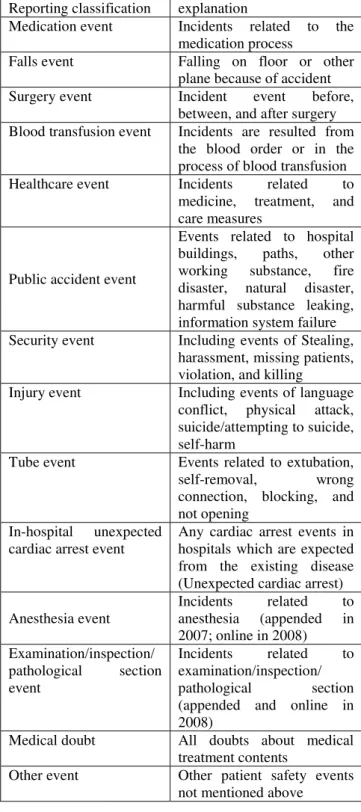
Based on event characteristics, Taiwan Joint Commission on Hospital Accreditation (TJCHA)
(hereinafter referred to as ‘TJCHA’) classifies 13
events, including medication, falls, surgery, blood transfusion, healthcare, public accident, security, injury, tube, cardiac arrest, anesthesia, examination/inspection/pathological section, and others (as below).
Table 1. Categories of adverse reporting events
Reporting classification explanation
Medication event Incidents related to the medication process
Falls event Falling on floor or other plane because of accident Surgery event Incident event before,
between, and after surgery Blood transfusion event Incidents are resulted from
the blood order or in the process of blood transfusion Healthcare event Incidents related to
medicine, treatment, and care measures
Public accident event
Events related to hospital buildings, paths, other working substance, fire disaster, natural disaster, harmful substance leaking, information system failure Security event Including events of Stealing,
harassment, missing patients, violation, and killing
Injury event Including events of language conflict, physical attack, suicide/attempting to suicide, self-harm
Tube event Events related to extubation, self-removal, wrong connection, blocking, and not opening
In-hospital unexpected cardiac arrest event
Any cardiac arrest events in hospitals which are expected from the existing disease (Unexpected cardiac arrest) Anesthesia event
Incidents related to anesthesia (appended in 2007; online in 2008) Examination/inspection/
pathological section event
Incidents related to examination/inspection/ pathological section (appended and online in 2008)
Medical doubt All doubts about medical treatment contents
Other event Other patient safety events not mentioned above
3.3 Establishing an incident reporting system
3.3.1 Constructing an incident reporting platform and rewards and punishments measures
An incident reporting platform being constructed in a hospital through the internet allows the organizational employees (reporters) to complete online reporting anytime and anywhere; and, the reporting classification and contents are referred to the above classification. Besides, the platform should provide online data inspection, event statistical analysis, and feedback of management and improvement measures, and the administrative authority of a hospital should establish rewards and punishments measures as follows.
(1) Personal encouragement. Medical Quality and Patient Safety Unit in a hospital should integrate and report to the hospital for rewards. (Note: The reporting principle: An employee finds out an error possibly resulted from different system levels in the medical process and immediately stops or proposes revision to prevent the incident from re-occurrence.) (2) Personal reward. A person can receive bounty from the hospital for each reporting case. (Note: The same event or the one rejected by the authority is not counted.)
(3) Unit reward. Based on seasons, top three units/employees reporting the most cases are announced in the hospital to encourage the colleagues reporting incident cases.
(4) Responsibility diminishing or impunity is based on the reward regulations formulated by Human Resource Office in a hospital.
(5) A person who should report but does not should be punished according to the regulations formulated by Human Resource Office in a hospital.
3.3.2 Confidential measures for the incident reporting system
reporting database to protect the reporting data privacy [18].
3.3.3 Application of incident reporting big data
In addition to the incident reporting function, a web platform in a hospital should be able to classify the reporting incidents for the administrative authority. The classified incident groups are further demonstrated the similarity and specialty as well as the existence of some common variation so that the hospital could improve the system to prevent similar events from repeated occurrence. The currently available statistics contain statistics, data mining, optimization, time series analysis, and simulation [19], [20].
Furthermore, a hospital needs to realize the trend of incident cases as well as to discuss the root causes (risk factors). Since an incident case is resulted from a root cause, such an incident case is simply a representation. When the incident case is improved, but not the root cause, other similar incidents are likely to occur. For this reason, a hospital, after realizing such trends, should take preventive measures to stop the expansion of harm and have the system return to the safe range. Currently available analysis statistics include regression analysis, decision making trail and evaluation laboratory, and semantic structure analysis [19], [21], [22], [23].
3.3.4 Incident reporting steps
When the incident event takes place, the reporting steps for emergent or major events is as follows: (1) Emergent or major events, including sudden death or serious complication of patients resulted from medical treatment and administrative incidents resulting in serious results or requiring emergent processing. Reporting procedure: Immediately
reporting Head of unit → Director of the department → Medical dispute team, Deputy Superintendent → Superintendent.
(2) General events. Reporting Head of unit and
Patient Safety Event Reporting System → Director
of department → Deputy Superintendent → Superintendent.
(3) Reporters. The employee (or the party concerned) in the hospital is responsible for incident reporting; a third party should also report the incident when discovering.
(4) Reporting methods. Enter Add Patient Safety Event Reporting from Patient Safety Event Reporting System for reporting. An incident reporter should fill in the columns of Reporting Event Data, Event Content, and Immediate Process after Incident, while
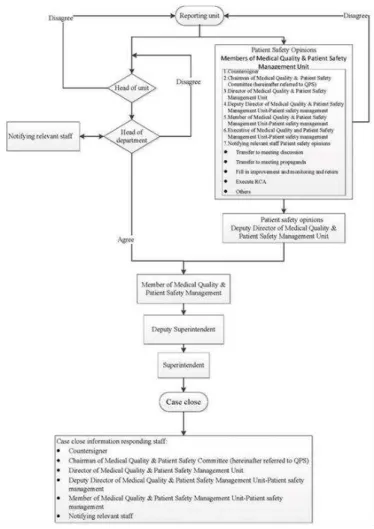
Head of unit should fill in the columns of Measure or Method to Prevent Such Incident from Re-occurrence, Possible Situation of Such Incident Re-occurring, and Others: Head Opinions. The information system would automatically transfer the data to Head of department, who would countersign relevant Heads of departments, who could respond (like explain, review, or report improvement), according to the case contents. After Deputy Superintendent and Superintendent review the contents, members of Medical Quality and Patient Safety Management Unit would report the responses and notify relevant units, or instruct relevant units to make improvements. The incident reporting and inspection procedure are suggested as below (Figure 2).
Figure 2. The incident reporting and inspection procedure
3.4 Constructing an organizational review and improvement scheme
3.4.1 A trans-departmental and credible Medical Quality and Patient Safety Committee is established
policies. The medical adverse events and patient accidents are reduced by enhancing the medical service quality. In this case, the members in the committee and the tasks are regulated in the following way.
(1) Necessary members
a. Superintendent Office, including 2 Deputy Superintendents and a Chief Secretary.
b. Medical units, containing General Medicine, General Surgery, Gynecology and Obstetrics, Pediatrics, Emergency Medicine, Critical Care Medicine, Anesthesiology, Infectious Diseases, and Respiratory Intensive Care Center Head of department.
c. Medical care units, covering Radiology, Rehabilitation Therapy, Pharmacy, Laboratory, and Nutrition Head of department.
d. Nursing units, taken on by Head of Nursing. e. Administrative units, taken on by Heads of Medical Service Office, General Affairs Office, Medical Engineering Office, Information Management Office, Human Resource Office, Insurance and Medical Record Office, Purchasing Office, Social Service Section, and Medical Quality and Patient Safety Management Unit.
f. Out of hospital committee members, taken on by 5 non-Medicare representatives.
(2) Major tasks
a. Review and evaluate medical quality management and patient safety.
b. Review the standard procedure of medical quality and patient safety, conduct inspection, and monitor various quality improvement performance.
c. Plan and establish an in-hospital incident reporting system and review the analyses.
d. Review medical adverse event cases.
e. Review service quality strategies and promotion plans provided by relevant units to offer the most proper medical care for patients.
f. Discuss and formulate in-hospital medical quality and patient safety regulations to conform to the policy and the assessment requirements.
g. Formulate and practice patient rights and obligation.
h. Regularly review the quality management items and performance of medicine, nursing, medical affairs, and administration in the hospital.
i. Create patient safety culture, conduct in-hospital patient safety culture survey, and complete analyzing and reviewing reports.
3.4.2 Establishment of an root cause analysis (RCA) team
To avoid repetition of similar emergent or major incidents, the establishment of RCA aims to formulate proper and specific improvement measures
throughknowledge and information exchange among cross-departmental members and stresses on the risks and drawbacks of operation process and system design, rather than personal responsibilities.
RCA members are task-oriented, that it is established when cases occur. The RCA members (task team) should include a supervisor, several seed members, and employees directly related to the unit. A supervisor or a seed member should receive at least 8-hour professional education and training courses and pass the examination. The number of members is not restricted, but depends on the demands of a hospital. In general, RCA members normally include 10 supervisors, twice number of seed members in a medical institute with 500-1000 sickbeds, and an executive secretary to deal with case conditions. The start principle and timing of RCA are introduced as below.
(1) Start principle
a. Medical Adverse Event. Injuries are not resulted from the existing diseases, but physical injuries of patients, extension of stays, or certain disability when leaving the hospital, and even death caused by medical behaviors.
b. Sentinel Event. Including unexpected death, permanent function loss in non-natural process, or patient suicide, stealing babies, use of blood transfusion or incompatible plasma components resulting in hemolysis, wrong recognition of patients or surgery part, comorbidities during and after surgery, inadequate treatment, giving wrong baby to the family.
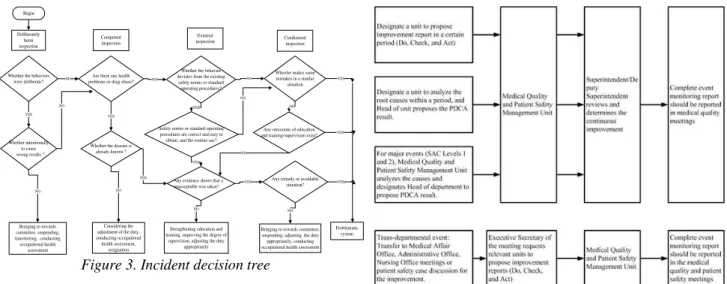
c. Analysis of incident severity and re-occurrence according to Severity Assessment Code (SAC) (Table 2). Events of SAC levels 1 and 2 are considered to immediately take improvement actions, while SAC levels 3 and 4 are continuously monitored. d. Judging with incident decision tree (IDT) (Figure 3) to ensure the event caused by the system.
e. In addition, for special events, Deputy Director of Medical Quality and Patient Safety Management Unit, and Executive Secretary of RCA team report upwards for the agreement of Superintendent and Deputy Superintendent, or Head of department to start the root cause analysis.
Table 2. Severity assessment code (SAC)
Seriousness
F
re
que
nc
y
Death Extremely serious
Serious Medium Mild No harm
Several weeks
1 1 2 3 3 4
Several times a year
1 1 2 3 4 4
Once every 1-2 years
1 2 2 3 4 4
Once every 2-5 years
1 2 3 4 4 4
More than 5 years
2 3 3 4 4 4
01. Death-resulting in patient death.
02. Extremely serious-causing permanent disability or dysfunction of a patient, such as physical disability and brain damage.
03. Serious-events resulting in patient injuries, which require additional visit, evaluation, and observation as well as operation, hospitalization, or extending stays in the hospital, such as broken bones or pneumothorax.
04. Medium-events resulting in patient injuries, which require additional visit, evaluation, observation, or processing, such as measuring blood pressure, pulse, and blood sugar more than ordinal, and X-ray, drawing blood, urine analysis, or dressing, stitching, hemostatic therapy, 1~2 dose medication. 05. Mild-events causing injuries, but do not need or require slight treatment, without additional care, such as red skin, scratch, and bruise.
06. No harm-events occurring on patients, but not resulting in any injuries.
Begin
Deliberately harm inspection
Competent inspection
External
inspection Conditionalinspection
Whether the behaviors were deliberate?
Whether intentionally to cause wrong results ?
Are there any health problems or drug abuse?
Whether the disease is already known ?
Whether the behavior deviates from the existing
safety norms or standard operating procedures?
Safety norms or standard operating procedures are correct and easy to obtain, and the routine use?
Any evidence shows that a unacceptable was taken?
Whoelse makes same mistakes in a similar
situation
Any omissions of education and training/supervision exist?
Any remedy or avoidable situation?
Bringing to rewards committee, suspending, transferring, conducting occupational health
assessment
Considering the adjustment of the duty, conducting occupational health assessment,
resignation
Strengthening education and training, improving the degree of
supervision, adjusting the duty appropriately
Bringing to rewards committee, suspending, adjusting the duty appropriately, conducting occupational health assessment
Problematic system NO
YES YES
NO
YES
NO NO
NO
NO
YES
NO NO YES
NO
YES
YES YES
NO
NO
YES
Figure 3. Incident decision tree
(2) Start timing
a. Superintendent level, Deputy Director of Medical Quality and Patient Safety Management, or Executive Secretary of RCA team, according to the root cause analysis, select events with High Severity, High Frequency, or Necessary for Overall Investigation for the root cause analysis and improvement.
b. When an event is sure for RCA, Director of Medical Quality and Patient Safety Management Unit would organize an RCA team according to the event contents.
c. The RCA team should interview the employee directly related to the event in the incident unit within 7 days after confirming the root cause, and observe the environment, equipment, document, and operation procedure for the analysis evidence.
3.5 Improving operation processes and responses
After the incident being authorized by Superintendent, the following procedures are determined by Medical Quality and Patient Safety Committee based on the frequency and severity of incident events.
(1) Incident reporting kept in the original unit. (2) Designate a unit to propose improvement report in certain period (Do, Check, Act).
(3) Designate a unit to analyze the root cause within a period, and Head of unit proposes the PDCA result. (4) For major events (SAC Levels 1 and 2), Medical Quality and Patient Safety Management Unit analyzes the cause and designates Head of department to propose the PDCA result.
(5) Cross-departmental event: Transfer to Medical Affair Office, Administrative Office, Nursing Office meetings or patient safety case discussion for the improvement.
Figure 4. Improvement and responses of operation processes
Medical Quality and Patient Safety Management Unit have to upload incident events to Taiwan Patient Safety Reporting System (TPR) in TJCHA every
month for peer hospitals’ comparison. Patient safety
event statistical analysis should be conducted every season, reported in the meeting after being authorized, and notified the colleagues in the hospital.
3.6 Operations for monitoring and management
Head of unit should submit Improvement and Monitoring Report to Executive Secretary Office every month and report the statement of improvement to Medical Quality and Patient Safety Committee in seasonal meetings. Additionally, Head of unit could make the supplement if necessary.
Events being completed in the improvement performance meeting are closed and do not need to be monitored and reported in meetings again. For events not being completed in the improvement performance meeting, Head of unit for the improvement should hand in Improvement and Monitoring Report every month and continuously monitor in the next Medical Quality and Patient Safety Committee till the completion.
4. Conclusions
It is essential to establish an incident reporting system in a hospital. Either the government or medical institute managers should collect and analyze the information in the system, reduce the re-occurrence of medical errors through education and training and improvement activities, and enhance the patient safety culture of the hospital. In addition to seven characteristics for a successful incident reporting system, proposed by Leape [9], including non-punitive, confidential, independent, expert analysis, timely, system-oriented, and responsive, it is suggested in this study that a hospital should particularly pay more attention to the confidentiality of case data in the system, when establishing an incident reporting system, to avoid disputes and enhance reporting intention. Moreover, big data collected in a system should follow the trend of incident cases and various statistics (including various statistical trend analyses) should be utilized for realizing the current patient safety conditions in the hospital. It is especially worth noticing the trend of the root cause (risk factor) of an incident. A hospital should establish an RCA team to make improvements based on the root cause of a case since the occurrence of an incident is resulted from the root cause. More importantly, the incident events might occur again without improving or dealing with the root cause carefully. Consequently, a hospital should establish a reward system, encouraging the employees to report and analyze the root cause and the improvement measures to share the case in the hospital for the common learning as well as to remind the medical personnel of not making the same mistakes. Moreover, it is essential to establish a trans-departmental and credible Medical Quality and Patient Safety Committee, as it is a unit to promote medical quality and patient safety in a hospital as
well as to monitor the improvement process of medical quality and patient safety. Finally, monitoring the improvement and monitoring management system is a key in promoting the incident reporting system and could make the incident improvement more effective and efficient.
The promotion of patient safety culture should pay more attention to the implement processes, rather than separate strategies; building the patient safety culture climate and reporting safety incidents are two strategies in the promotion of patient safety. A hospital should not merely focus on the outcome of such two strategies. It is suggested in this study to draw up more promotion strategies or improvement projects, including medical institute managers propagating patient safety to be the responsibility of all members in the organization, creating a partnership environment with employee concern, constructing the common mental model in the hospital to shorten the cognition of patient safety, and regularly inspecting or re-designing the medical system in the hospital (including procedure and manpower allocation).
References
[1].Kohn, L.T., Corrigan, J.M., & Donaldson, M.S. (2000). To err is human: Building a safer health
system. Washington, DC: National Academies Press.
[2].Shih, C.L., & Liao, H.J. (2009). The results and prospects of the government to promote patient safety.
Journal of Healthcare Quality, 3(2), 9-12.
[3].Wu, L.L. (2007). The cognition, attitude and behavior of the hospital employees to the non-punished medical incident event reporting system: A case study of a regional public hospital in Taipei. Unpublished master thesis, National Taipei University of Nursing and Health Sciences, Taipei.
[4].Lee, Y.-C., Weng, S.-J., Huang, C.-H., Hsieh, W.-L., & Wu, H.-H. (2016). Analyzing emotional exhaustion from viewpoints of physicians and nurses – A case of a regional teaching hospital. TEM Journal, 5(2), 231-235.
[5].Lee, Y.-C., Weng, S.-J., Stanworth, J.O., Hsieh, L.-P., & Wu, H.-H. (2015). Identifying critical dimensions and causal relationships of patient safety culture in Taiwan. Journal of Medical Imaging and Health Informatics, 5(5), 995-1000.
[6].Lee, Y.-C., Weng, S.-J., Hsieh, L.-P., & Wu, H.-H. (2015). Identifying critical dimensions of the Chinese version of hospital survey on patient safety culture in Taiwan from a systematic viewpoint. Journal of Medical Imaging and Health Informatics, 5(7), 1420-1428.
[7].Barach, P., & Small, S.D. (2000). Reporting and preventing medical mishaps: Lessons from non-medical near miss reporting systems. BMJ,
[8].Elnitsky, C., Nichols, B., & Palmer, K. (1997). Are hospital incidents being reported? Journal of Nursing Administration, 27(11), 40-46.
[9].Leape, L.L. (2002) “Reporting of adverse events. The New England Journal of Medicine, 347(20), 1633-1638.
[10].Huang, P.Y. (2011). The impact of nursing staffs patient safety cognitive and patient safety cultural cognitive to the medical incident reporting: A case study of two department of health Hospitals. Unpublished master thesis, Kaohsiung Medical University, Kaohsiung.
[11].Kuo, T.C., Lee, Y.C., Juang, R.R., Hsieh, L.P., & Huang, Y.C. (2012). The intervention abnormal event notification by using compound action program for patient safety and patient safety culture among the climate-related research in a Teaching hospital. 2012 Cross-Strait Hospital Forum, April, 27-28.
[12].Toyabe, S. (2016). Characteristics of inpatient falls
not reported in an incident reporting system. Global Journal of Health Science, 8(3), 17-25.
[13].Taiwan Joint Commission on Hospital Accreditation. (2014). Patient safety in Taiwan. Retrieved 09/21,
2014, from
http://www.patientsafety.mohw.gov.tw/big5/content/ Content.asp?cid=15.
[14].Mitchell, I., Schuster, A., Smith, K., Pronovost, P., & Wu, A. (2016). Patient safety incident reporting: a qualitative study of thoughts and perceptions of experts 15 years after ‘To Err is Human’. BMJ Quality & Safety, 25(2), 92-99.
[15].Dunn, D. (2003). Incident reports-correcting processes and reducing errors. AORN Journal, 78(2), 211-233.
[16].Shih, C.L., Hou, S.M., Hsueh, Y.S., Chung, K.P., Su, S., & Liao, H.H. (2005). Incidents reporting system and reporting barriers. Formosan Journal of Medicine, 9(1), 63-70.
[17].Taiwan Joint Commission on Hospital Accreditation. (2013). The definitions of patient safety. Retrieved 09/01, 2014, from
http://www.patientsafety.mohw.gov.tw/upfile/www/2 013/20131206/2013%E5%90%8D%E8%A9%9E%E5 %AE%9A%E7%BE%A9%E5%85%AC%E5%91%8
A(pdf)1203.pdf.
[18].Lin, C.C. (2005). Building a web-based patient safety reporting system. Ministry of Health and Welfare, Taipei.
[19].Manyika, J., Chui, M., Brown, B., Bughin, J., Dobbs, R., Roxburgh, C., & Byers, A.H., (2011). Big data: The next frontier for innovation, competition, and productivity, McKinsey Global Institute.
[20].García, A.O., Armenteros, O.U.L., Ramírez, Y.E.P., & Alfonso, D.P. (2016). Inductive visual miner plugin customization for the detection of eventualities in the processes of a hospital information system. IEEE Latin America Transactions, 14(4), 1930-1936. [21].Shieh, J.I., Wu, H.H., & Huang, K.K. (2010). A
DEMATEL method in identifying key success factors of hospital service quality. Knowledge-Based Systems,
23(3), 277-282.
[22].Shieh, J.I., Wu, H.H., & Liu, H.C. (2014). Analysis of the threshold values of semantic structure analysis in identifying causal relationships. Communications in Statistics-Simulation and Computation, 43(7), 1543-1551.