IIIB Explain Its Preference for m
7
GMP
Thomas Monecke1*, Juliane Buschmann2, Piotr Neumann1, Elmar Wahle2, Ralf Ficner1
1Abteilung fu¨r Molekulare Strukturbiologie, Institut fu¨r Mikrobiologie und Genetik, Go¨ttinger Zentrum fu¨r Molekulare Biowissenschaften, Georg-August-Universita¨t Go¨ttingen, Go¨ttingen, Germany,2Institut fu¨r Biochemie und Biotechnologie, Martin-Luther-Universita¨t Halle-Wittenberg, Halle (Saale), Germany
Abstract
59-nucleotidases catalyze the hydrolytic dephosphorylation of nucleoside monophosphates. As catabolic enzymes they contribute significantly to the regulation of cellular nucleotide levels; misregulation of nucleotide metabolism and nucleotidase deficiencies are associated with a number of diseases. The seven human 59-nucleotidases differ with respect to substrate specificity and cellular localization. Recently, the novel cytosolic 59-nucleotidase III-like protein, or cN-IIIB, has been characterized in human and Drosophila. cN-IIIB exhibits a strong substrate preference for the modified nucleotide 7-methylguanosine monophosphate but the structural reason for this preference was unknown. Here, we present crystal structures of cN-IIIB fromDrosophila melanogaster bound to the reaction products 7-methylguanosine or cytidine. The structural data reveal that the cytosine- and 7-methylguanine moieties of the products are stacked between two aromatic residues in a coplanar but off-centered position. 7-methylguanosine is specifically bound throughp-p interactions and distinguished from unmodified guanosine by additional cation-pcoulomb interactions between the aromatic side chains and the positively charged 7-methylguanine. Notably, the base is further stabilized by T-shaped edge-to-face stacking of an additional tryptophan packing perpendicularly against the purine ring and forming, together with the other aromates, an aromatic slot. The structural data in combination with site-directed mutagenesis experiments reveal the molecular basis for the broad substrate specificity of cN-IIIB but also explain the substrate preference for 7-methylguanosine monophosphate. Analyzing the substrate specificities of cN-IIIB and the main pyrimidine 59-nucleotidase cN-IIIA by mutagenesis studies, we show that cN-IIIA dephosphorylates the purine m7GMP as well, hence redefining its substrate spectrum. Docking
calculations with cN-IIIA and m7GMP as well as biochemical data reveal that Asn69 does not generally exclude the turnover
of purine substrates thus correcting previous suggestions.
Citation:Monecke T, Buschmann J, Neumann P, Wahle E, Ficner R (2014) Crystal Structures of the Novel Cytosolic 59-Nucleotidase IIIB Explain Its Preference for m7GMP. PLoS ONE 9(3): e90915. doi:10.1371/journal.pone.0090915
Editor:Petri Kursula, University of Oulu, Finland
ReceivedDecember 3, 2013;AcceptedFebruary 4, 2014;PublishedMarch 6, 2014
Copyright:ß2014 Monecke et al. This is an open-access article distributed under the terms of the Creative Commons Attribution License, which permits unrestricted use, distribution, and reproduction in any medium, provided the original author and source are credited.
Funding:Synchrotron data collection was supported by the Helmholtz-Zentrum Berlin. The authors acknowledge support by the Open Access Publication Funds of the Go¨ttingen University, and EW acknowledges support by the DFG. The funders had no role in study design, data collection and analysis, decision to publish, or preparation of the manuscript.
Competing Interests:The authors have declared that no competing interests exist.
* E-mail: [email protected]
Introduction
Nucleoside monophosphate phosphohydrolases or 59 -nucleotid-ases (EC 3.1.3.5) are enzymes catalyzing the hydrolytic dephos-phorylation of nucleoside monophosphates to nucleosides and orthophosphate (nucleoside monophosphate+H2ORnucleoside+
PO4 3–
) [1]. As catabolic enzymes, nucleotidases participate in the regulation of nucleotide levels in living cells [2,3]. In humans, seven different 59-nucleotidases have been characterized differing with respect to their substrate specificity, subcellular localization, oligomerization state and size [4]. Five of them, namely cytosolic 59-nucleotidase IA (cN-IA), cytosolic 59-nucleotidase IB (cN-IB), cytosolic 59-nucleotidase II (cN-II), cytosolic 59-nucleotidase IIIA (cN-IIIA; previously called cN-III) and cytosolic 59(39 )-deoxyribo-nucleotidase (cdN) are located in the cytosol whereas one is mitochondrial (mitochondrial-59(39)-deoxyribonucleotidase, mdN) and one is an extracellular enzyme (ecto-59-nucleotidase, eN). Crystal structures are available for five of the seven nucleotidases including the mitochondrial (mdN) [5–7] and the extracellular nucleotidase (eN) [8,9] as well as the cytosolic nucleotidases cdN [7], cN-II [10–12] and cN-IIIA [13,14]. Although the intracellular
59-nucleotidases generally share a low sequence similarity, all enzymes are magnesium-dependent and belong to the haloacid dehalogenase (HAD) superfamily [15]. They are characterized by a modular architecture, containing a structurally conserved HAD core domain, which contains the catalytic residues, and an enzyme-specific cap domain consisting of one or more cap insertions. The various substrate specificities of intracellular 59 -nucleotidases are mainly achieved by different cap domains, which contain the substrate specificity motif S, while the catalytic platform is provided by the conserved HAD core domain [15].
threonine residue from motif II (WWW[S/T]), preceded by 3 hydrophobicW-residues, interacts with the phosphate group and stabilizes the pentavalent phosphate transition state. The con-served catalytic motif III (K(X)xD(X)0–4D) contains a lysine and
two aspartate residues that stabilize the phosphorylated interme-diate and coordinate the magnesium ion, respectively [5]. Although the catalytic mechanism of 59-nucleotidases has been characterized in detail due to a number of available crystal structures and biochemical data, the structural basis for substrate recognition and discrimination remains elusive for some of them. Recently, a novel member of the family of cytosolic 59 -nucleotidases, the cytosolic 59-nucleotidase III-like protein, has been characterized in humans and in Drosophila [21] and subsequently renamed cN-IIIB (UniProt IDs Q969T7 and Q9W197). Human cN-IIIB (HscN-IIIB) exhibits a sequence identity and similarity of 59% and 80% to the human cytosolic 59-nucleotidase IIIA (HscN-IIIA). Interestingly, although both enzymes share significant sequence similarity they appear to have different substrate specificities [21]. HscN-IIIA is the main pyrimidine 59-nucleotidase in erythrocytes; its activity was thought to be restricted to (d)CMP, (d)UMP and dTMP [22]. A lack of this enzyme in human erythrocytes results in hemolytic anemia, which probably is due to the accumulation of pyrimidine nucleotides and precipitation of unhydrolyzed ribosomal RNA [23–25]. In contrast to human cN-IIIA, human cN-IIIB has a broad substrate specificity, efficiently converting CMP and UMP and, with significantly lower efficiency, GMP and AMP [21]. Remarkably, cN-IIIB dephosphorylates the modified purine 7-methylguanosine monophosphate (m7GMP) with the lowestKmamong all substrates
tested. Due to the presence of the mRNA cap structure, 7-methylguanosine nucleotides are released during degradation of all eukaryotic mRNAs: Either Dcp2 and related enzymes cleave off m7GDP, which is further converted to m7GMP, or m7GMP is released directly by the scavenger decapping enzyme DcpS [26– 28]. Additionally, 7-methylguanosine was shown to be present in several tRNA and rRNA species of archaea, bacteria and eukarya [29]. Until recently, it was not known by which enzymatic activity m7GMP is further degraded after RNA decay. As a potential alternative to decay, accumulation of m7GMP in the cytosol and subsequent incorporation into nucleic acids seems possible but biologically highly undesirable [26,30–32].
To gain insight into the broad substrate specificity of cN-IIIB and especially its unusual preference for m7GMP, we determined crystal structures of Drosophila melanogaster cN-IIIB (DmcN-IIIB) bound to different reaction products. The overall structure of
Dm
cN-IIIB is similar to cN-IIIA, however, critical residues conferring substrate specificity and determining the size of the substrate-binding pocket are different. The co-crystallized reaction product, 7-methylguanosine or cytidine, is bound in a deep cavity formed by the cap domain and the HAD core domain and is surrounded by three aromatic amino acids forming an aromatic slot. The structures explain why cN-IIIB prefers m7GMP over GMP as substrate but also efficiently converts pyrimidines. In combination with biochemical data from mutagenesis experiments of cN-IIIA and cN-IIIB and molecular docking calculations we define the structural basis for m7GMP dephosphorylation by 59 -nucleotidases.
Results and Discussion
Crystallization and Structure Determination ofDmcN-IIIB
Dm
cN-IIIB was crystallized in the presence of the reaction products 7-methylguanosine (m7G) or cytidine, and a mixture of AlCl3and NaF. The crystallographic phase problem was solved by
means of molecular replacement using the crystal structure of mouse cN-IIIA as starting model [13] (PDB ID 2G08). The structure model of DmcN-IIIB bound to m7G was refined at a resolution of 1.65 A˚ to R and Rfreevalues of 15.9% and 19.4%,
respectively. Diffraction data and refinement statistics are sum-marized inTable 1.
The final model of the DmcN-IIIB m7G complex contains two molecules in the asymmetric unit with one continuous segment encompassing residues 13–311 of molecule A as well as residues 13–312 of molecule B, both superposing with a root mean square deviation (rmsd) of 0.86 A˚ for 288 common Caatoms (residues
13–103 and 115–311). After all amino acids had been placed, additional density was observed in the active center, which, based on its shape, could be assigned as an octahedrally coordinated magnesium ion, the co-crystallized product nucleoside m7
G as well as a metal fluoride transition state analog. It was shown that for pH values higher than 7.0, enzyme-MgF3complexes rather than
enzyme-AlF3complexes are formed [33,34]. Since both aluminum
and magnesium were present during crystallization, we interpreted the density as MgF3–.
Overall Structure ofDmcN-IIIB
The overall structure ofDmcN-IIIB consists of two domains: the globular core domain and a smaller cap domain. The globular core domain is a haloacid dehalogenase domain (HAD domain) and resembles a Rossmannoid-like a/b structure with a central seven-stranded b-sheet exhibiting the topology
b1Qb9qb8qb7qb2qb3qb4q (Figure 1). Between two consecutiveb-strands, one or morea-helices build right-handed crossover connections generating ab-sheet flanked by several a -helices on either side. Theb-sheet is twisted in a way that the two outermost strands are arranged in an almost perpendicular orientation with respect to each other. The HAD core is distinguished from other Rossmannoid folds by two additional structural key features. The ‘‘squiggle’’ (amino acids Phe56-Thr61,
Figure S1) is a single helical turn (in some structures resembling a
p-helix) located immediately downstream of the first coreb-strand (b2) and is followed by the ‘‘flap’’ – a shortb-turn (amino acids Thr65-Gly68). Both structural motifs provide the structural flexibility required for nucleotidases to switch between open (substrate binding) and closed (catalytically active) conformations. The sequence of the HAD domain in DmcN-IIIB includes two insertions, the caps, at two distinct sites. The first one lies between
b2 anda-helix 9 and, due to its location, is termed C1-type cap [15]. It comprises the a-helices 5–8 (amino acids 74–143) (Figure 1). The second insertion is named C2-type cap, compasses b5 and b6 (amino acids 195–216) and is positioned betweenb4 anda-helix 11. These two insertions protrude from the a/b Rossmannoid core of the structure and form the cap domain, which serves as a movable lid for the active site of the enzyme as suggested by different orientations of the domain in crystal structures of cN-IIIA [13,14] and cN-IIIB (reported here). Moreover, it represents the main substrate specificity determinant of cN-IIIB as it harbors critical residues for substrate binding (see below).
Catalytic Motifs and Active site ofDmcN-IIIB
Dm
cN-IIIB contains all canonical sequence motifs typically present in cytosolic 59-nucleotidases, namely motifs I, II, III as well as motif S. A sequence alignment of the canonical catalytic motifs for all intracellular 59-nucleotidases completed by the new member cN-IIIB is shown inFigure 2. Motif I (55DFDYTI60inDmcN-IIIB) is located in the loop connecting b-strand 2 and a-helix 5 (Figure 1and Figure S1) and contains two aspartate residues
separated by a hydrophobic amino acid. In homologous enzymes, the first aspartate was shown to be the nucleophile responsible for the in-line attack on the a-phosphate of the bound nucleoside monophosphate. In the reaction, the cleaved-off phosphate is transferred to this aspartate, initially generating a pentavalent transition state and, later, a covalent phosphoenzyme intermedi-ate. During subsequent hydrolysis of the phosphoenzyme inter-mediate, the side chain carboxyl of Asp57 is likely to be involved in donation of a proton to the bound phosphate, thus acting as the general acid-base residue in this reaction [13]. In fact, this state is represented in the crystal structures with the transition state analog MgF3
–
coordinated by Asp55 and the attacking water occupying the second apical coordination site (Figure 3). The transferred proton may originate from the water molecule, which is further bound by the side chains of Asp57 (motif I) and Ser171 belonging
to motif II in the crystal structure (see below). Alternatively, the proton may stem from the 59-hydroxyl of another bound nucleoside, which results in a phosphotransferase activity observed in some members of the cytosolic 59-nucleotidase family [22,35]. Motif II is a four amino acid stretch with the sequence168LVFS171 and is located inb-strand 3 ofDmcN-IIIB (Figure 1). Motif III is of variable length in the different nucleotidases and includes a highly conserved lysine residue as well as two invariant aspartates (219K(X)25DSIGD249inDmcN-IIIB).
In the crystal structure of DmcN-IIIB bound to m7G, the
magnesium ion is octahedrally coordinated by the side chain carboxyls of Asp55 and Asp245 (motif I and III) as well as by a water molecule and a fluorine atom occupying the four equatorial positions (Figure 3). The two apical coordination sites are occupied by one water molecule and the main chain carbonyl of
Table 1.X-ray diffraction data and structure refinement statistics ofDrosophila melanogastercN-IIIB bound to different reaction products.
Crystal cN-IIIB+m7Guanosine
+MgF3– cN-IIIB
+cytidine
Data collection
Space group P21 P21
Cell dimensions
a, b, c (A˚) 46.67, 99.11, 74.12 46.60, 99.35, 72.81
a,b,c(u) 90.00, 90.99, 90.00 90.00, 92.46, 90.00
Wavelength (A˚) 0.920 0.918
X-ray source BL14.1, BESSY (Berlin) BL14.1, BESSY (Berlin)
Resolution range (A˚) 46.67–1.65 (1.75–1.65) 35.88–2.05 (2.15–2.05)
No. of reflections 240166 (28865) 112476 (15349)
Completeness (%) 94.5 (81.7) 96.5 (97.1)
Rmerge(%) 5.3 (54.7) 8.3 (49.2)
Average I/s 15.5 (2.2) 11.1 (2.4)
Redundancy 3.1 (2.7) 2.8 (2.9)
Refinement
Resolution (A˚) 41.19–1.65 35.87–2.05
Molecules per a.u. 2 2
No. of atoms
Protein 4980 4733
Ligands and ions 83 36
Waters 584 297
Rwork(%) 15.91 22.24*
Rfree(%) 19.42 25.47*
Average B factors (A˚2
)
Protein 20.35 28.85
Ligands and ions 20.42 31.40
Waters 30.87 28.73
RMS deviations
Bond lengths (A˚) 0.012 0.006
Bond angles (u) 1.4 1.0
Ramachandran statistics (%)
Favored 97.4 96.7
Allowed 2.6 3.3
Outliers 0.0 0.0
Values in parentheses indicate the specific values in the particular highest resolution shell. * Twinned refinement: twin law = h,-k,-l; twin fraction = 0.10.
Asp57, respectively. The magnesium ion of MgF3– makes an
apical contact to the remaining oxygen of the Asp55 carboxyl group confirming the predicted role of this amino acid in the reaction (Figure 3). The three fluoride ions are in contact with the side chains of Ser171 of motif II, Lys219 of motif III and the magnesium ion, respectively. The position and function of Lys219 ofDmcN-IIIB is reminiscent of the basic residues termed arginine fingers that stabilize the negative charge on reaction intermediates in many other phosphohydrolases [15]. Finally, the invariant residues Asp245 and Asp249 of motif III coordinate the magnesium ion (see above).
7-methylguanosine Binding byDmcN-IIIB
It has recently been shown that the Michaelis constant (Km) for
the DmcN-IIIB-mediated dephosphorylation of m7GMP (Km= 13mM) is significantly lower than for AMP (32mM), CMP
(48mM), UMP (91mM) and GMP (102mM). For the human orthologHscN-IIIB, the preference for m7GMP in terms of theKm
value is even more pronounced [21]. At least to some extent, this also reflects a higher binding affinity for m7GMP compared to the unmodified purines and pyrimidines. However, the structural basis for this preference, unusual among 59-nucleotidases, and the broad substrate specificity in general has so far been unknown.
Overall, the C1-type cap containing the substrate specificity motif (motif S) together with the HAD core domain generates a
Figure 1. Overall structure ofDrosophila melanogastercN-IIIB.Dm
cN-IIIB consists of the conserved central HAD core domain (greyb-strands and whitea-helices) and a cap domain. The cap domain packs against the top of the HAD core and is composed of two regions, a C1-type cap (red) and a C2-type cap (blue). The ‘‘squiggle’’ and the ‘‘flap’’, both structural key features of 59-nucleotidases, are marked with an asterisk and a black star, respectively. Secondary structure elements as well as termini and the bound magnesium ion (green sphere) are labeled. The co-crystallized reaction product 7-methylguanosine (m7G) is bound between the cap domain and the HAD core and is represented as stick model (carbon in yellow, nitrogen
in blue, oxygen in red). The lower panel shows a schematic representation ofDm
cN-IIIB with the canonical 59-nucleotidase motifs I-III and S as well as the positions of the cap insertions highlighted as boxes and labeled.
doi:10.1371/journal.pone.0090915.g001
substrate-binding pocket which neatly accommodates the bound 7-methylguanosine in a deep binding cleft (Figure 1). Both the base and the ribose moiety of m7G are in contact with diverse protein residues. In detail, the 7-methylguanine moiety of the
nucleoside is stacked in a parallel displaced orientation between the aromatic side chains of Trp120 and Phe75, bridging typical stacking distances of 3.5 A˚ between the side chains and the base (Figure 4A). Besides ap-pstacking interaction resulting from the parallel orientation of thep-electron systems of the purine ring and the aromatic amino acid side chains, there is also a cation-p
stacking coulomb interaction between the side chainp-electrons of Trp120 or Phe75 and the positive charge of m7G. It has been shown that the positive charge of m7G mainly localizes to nitrogen 7 [36], which interestingly is positioned above the center of the indole ring of the stacking Trp120. The cation-p stacking thus seems to be a major contribution and one of the structural reasons for the high affinity ofDmcN-IIIB for the monomethylated m7GMP and the discrimination against the unmethylated GMP. Notably, the binding pocket is completed by another aromatic side chain of Trp121, which packs by T-shaped edge-to-face stacking perpen-dicular against the methylated purine ring, bridging a distance of 3.8 A˚ between the methyl group of m7G and the plane of Trp121. This binding pattern results in the formation of an aromatic slot by Trp120, Phe75 and Trp121 neatly enclosing the base and shielding it from surrounding charged amino acids and water molecules (Figure 4Aand5A). This binding mode is reminiscent of 59-cap dinucleotide binding by the nuclear import adapter Snurportin 1 [37], where the hypermethylated 59-guanine of the snRNA is stacked between a tryptophan side chain and the second RNA base while it is shielded from the aqueous surrounding by a second tryptophan. Moreover, inDmcN-IIIB the residues Ser124, Phe209, Trp120, Trp121 and Phe75 form a cavity that harbors the N7-methyl group of the modified base (Figure 5A). In addition, residues Phe78, Thr128, Leu199, Phe209 and Leu174 form a deep and elongated second cavity near O6 of the m7G, which would be able to accommodate diverse alkylated adenine nucleotides such as N6-isopentyladenosine, N6-glycinylcarbamoy-ladenosine or N6-N6-dimethyN6-glycinylcarbamoy-ladenosine that have been found in different RNA species [29]. Thus, cN-IIIB may not only convert m7GMP but also a number of additional modified or alkylated nucleotides derived from the degradation of various RNA species. In addition to the base, the 29 and 39 hydroxyls of the ribose make polar contacts to the carboxyl group of Glu103 (Figure 4A). The ribose 59 hydroxyl makes contacts with the side chain of Asp57 as well as two water molecules, one of which would be in the position for the in-line attack on the phospho-aspartate 55 (see above). Moreover, O6 of the purine ring is in close contact with Ser124 of motif S as well as with two conserved water molecules. Furthermore, nitrogens N1, N2 and N3 of the base are in contact with several water molecules coordinated by protein residues.
In summary, m7GMP is converted with a ,10-fold lowerKm
compared to GMP forDmcN-IIIB and with a 45-fold lowerKmfor
the human ortholog. The different Km values for GMP and
m7GMP underline the importance of the contribution of the cation-p interaction between the methylated base and the aromatic side chains. Moreover, the slightly higher affinity of human cN-IIIB for m7GMP compared to DmcN-IIIB could be explained by the fact that one of the stacking residues in the
Drosophilaprotein, Phe75, is replaced by a tyrosine (Tyr60) in the human counterpart (Figure S1). It has been shown for a viral m7G-cap binding methyltransferase (VP39) that the exchange of such a stacking tyrosine in the binding pocket by phenylalanine reduces the affinity for the m7G-cap by a factor of four [38]. Whereas the human enzyme, compared toDmcN-IIIB, has a 2-fold higher apparent affinity for m7G, it shows reduced affinities for the substrates CMP (2-fold higherKm), GMP (4-fold higherKm), AMP
(14-fold higherKm) and UMP (5-fold higherKm). This may, at least
in part, be a result of hydrogen bonding between the nucleobase
Figure 2. Conserved catalytic sequence motifs of the intracel-lular human 59-nucleotidases and cN-IIIB.Sequence conservation of catalytic motifs of 59-nucleotidases completed by the new member cN-IIIB. The respective motifs of Hs
cN-IIIB and Dm
cN-IIIB have been deduced from the crystal structure and sequence analyses. Shading indicates the different degrees of conservation from absolutely conserved (black) to partly conserved (grey). Motif I, II and III contain conserved catalytic residues and motif S contains residues involved in substrate recognition. Amino acids are numbered and consensus sequences are given above the alignment.
and Ser124 of DmcN-IIIB; this serine residue is replaced by an alanine in the human protein.
Cytidine Binding byDmcN-IIIB
In contrast to other cytosolic 59-nucleotidases, cN-IIIB dephos-phorylates both pyrimidines and purines (see above). To compare binding of purines and pyrimidines and explain this broad substrate specificity, we crystallized DmcN-IIIB in complex with cytidine and solved the crystal structure by means of molecular replacement using the structure of theDmcN-IIIB m7G complex as starting model. Remarkably, there was no density for MgF3–in the
active site of the cytidine bound structure. The overall conforma-tion ofDmcN-IIIB in complex with cytidine is highly similar to the m7G-bound structure with an rmsd of 0.32 A˚ for 293 common Ca
atoms of the molecules A. Differences between both structures are mainly restricted to the flap (amino acid Thr65-Gly68), which is not defined in the cytidine bound structure and thus most likely disordered. In contrast to the m7G-bound structure, several amino acids in the C1-type cap have poorly defined side chains, however all main chain atoms as well as the important residues for substrate binding are well defined in the electron density map.
Dm
cN-IIIB binds cytidine in a similar fashion as m7G, using the same substrate-binding pocket, however the hydrogen-bonding pattern is different (Figure 4B). The pyrimidine ring is stacked in an almost coplanar fashion between Phe75 and Trp120, bridging
plane distances of 3.5 and 3.4 A˚ , respectively. The side chain of Trp121 packs in an edge-to-face fashion with a distance of 3.5 A˚ to the C5 atom of cytidine. When superimposed to m7G, the centroid of the pyrimidine ring is in close proximity to the methylated nitrogen 7 of the guanine base, thus the cytosine ring captures the position of the 5-membered imidazole ring of m7G.
Besides the described stacking interactions, the cytidine makes only one direct hydrogen bond to Ser124, which is in contact to the N4 of the base (Figure 4B). Consequently, the water-mediated interactions of Asn79, Thr92, Trp120 and Ser171 of
Dm
cN-IIIB bound to m7G are missing in the cytidine-bound structure, partly explaining the lower affinity of the enzyme for pyrimidines.
Comparison of Open and Closed States of IIIB and cN-IIIA
Although all cytosolic 59-nucleotidases share similar HAD core folds, overall the structures are different due to the structural variability of their cap domains, which confer substrate specificity (Figure S3). The modular architecture of nucleotidases, with the conserved HAD core domain as catalytic platform and the structurally variable cap domain, allows different substrate specificities while maintaining catalytic efficiency. The closest nucleotidase homolog to cN-IIIB is the cytosolic 59-nucleotidase IIIA (former cN-III, sequence alignment inFigure S2), which has
Figure 3. Organization of the catalytic center ofDmcN-IIIB.The magnesium ion (green sphere) is octahedrally coordinated by several residues ofDm
cN-IIIB shown as stick model (carbon in yellow, nitrogen in blue, oxygen in red) as well as several water molecules (red). One equatorial coordination position of Mg2+is occupied by a fluorine atom of the co-crystallized metal fluoride MgF
3–(magnesium in green; fluorine in light blue).
MgF3–is coordinated by Asp55, Asp57, Lys219, Ser171 as well as water molecules. Note that the coordination of MgF3–represents the pentavalent
phosphate transition state in the nucleotidase reaction cycle. Contacts are represented by dashed lines and the model is defined by a representative 2 mFo– DFcelectron density map (blue mesh) contoured at a sigma level of 2.0.
doi:10.1371/journal.pone.0090915.g003
been structurally and functionally characterized in detail [13,14].
Hs
cN-IIIA (originally called pyrimidine-specific 59-nucleotidase 1) catalyzes the hydrolysis of CMP and UMP [25]. Several crystal structures of cN-IIIA in complex with the substrate UMP [14] or representing different states of the reaction mechanism [10,13] have been solved showing the molecular basis for substrate binding and catalysis. Superposition of the HAD core domains of cN-IIIA and cN-IIIB shows that the orientation of the cap domains with respect to the HAD core are slightly different (Figure 6). The crystal structures of the cN-IIIA UMP complex and the cN-IIIB m7G complex superpose with an rmsd of 1.19 A˚ for 218 common Caatoms. In the crystal structure of the cN-IIIA UMP complex,
the enzyme completely encloses the substrate in a deep cavity between the HAD core and the cap domain [14]. In contrast, in cN-IIIB bound to m7G, the tip of the cap domain (loop betweena -helices 6 and 7) is shifted by 4 A˚ away from the HAD core representing a more open state (Figure 6and Movie S1). This structural difference in the orientation of the cap domain relative to the HAD core may be due to the fact that cN-IIIA is bound to the reaction substrate including the phosphate (UMP), while cN-IIIB is bound to a reaction product missing the phosphate (7-methylguanosine). Notably, there are several direct contacts of the UMP phosphate with Lys213, Ser164 and Asp51 of the HAD core domain as well as with the active site magnesium ion, which stabilize the closed conformation of cN-IIIA. Instead, the corresponding residues Ser171, Lys219 and Asp55 in cN-IIIB are in direct contact with the transition state analog MgF3–, which
mimics the phosphate moiety already transferred to Asp55 (Figure 3). As a consequence, bond cleavage between the a -phosphate, coordinated in part by the HAD core, and the nucleoside, which is tightly bound by the cap domain, allows both domains to move away from each other and to subsequently release the reaction products (Movie S1).
Substrate Specificities of cN-IIIA and cN-IIIB
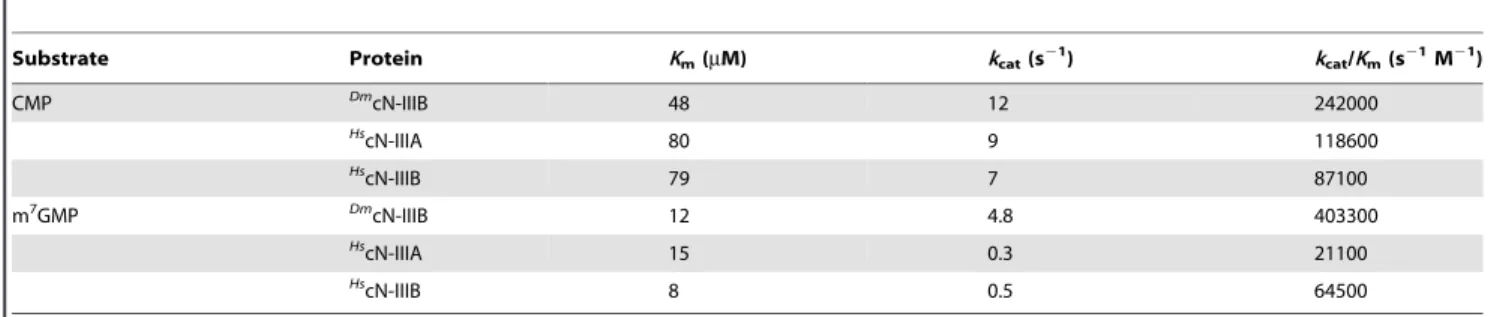
On the basis of structural data and mutagenesis experiments, it was suggested that the substrate-binding pocket of cN-IIIA is too small to accommodate purines and Asn69 would sterically clash with such substrates (Figure 5B), thus limiting the substrate spectrum of cN-IIIA to pyrimidine nucleotides [14]. To charac-terize the different substrate specificities of cN-IIIA and cN-IIIB and to explain them by structural data we performed mutagenesis studies and activity assays. Our preliminary experiments with a SUMO-tagged version ofHscN-IIIA were hampered by solubility problems, but suggested that m7GMP could be dephosphorylated, although with a much lower efficiency compared to CMP [21]. With a modified purification procedure, we have now been able to obtain soluble untagged full-length HscN-IIIA, and steady-state kinetic parameters for the dephosphorylation of CMP and m7GMP could be determined (Table 2). While CMP was the preferred substrate, m7GMP was converted with a surprisingly high efficiency, withkcat/Kmonly 6-fold lower than the specificity
constant for CMP. TheKmfor m 7
GMP was about 5-fold lower than for CMP and only about 2-fold higher than theKmofHs
cN-IIIB. Overall, the substrate specificities ofHscN-IIIA and -B are more similar than previously thought, especially with respect to the efficient conversion of m7GMP by both enzymes.
The ability ofHscN-IIIA to dephosphorylate m7GMP with high efficiency is inconsistent with the proposed role of Asn69 in preventing binding of purine nucleotides [14]. This proposal was further tested by mutagenesis studies. For the enzyme variants, the following code was used: Amino acids Phe75-Gly76-Trp120-Trp121 of DmcN-IIIB, forming the binding pocket for the nucleobase, are abbreviated FGWW (Figure 5). Asn69 inHs
cN-Figure 4. Detail view on the substrate-binding pocket ofDm cN-IIIB. (A) The co-crystallized reaction product 7-methylguanosine is shown in ball-and-stick mode (carbon in grey, nitrogen in blue, oxygen in red) and is defined by an mFo– DFcomit-electron density map (blue
mesh) contoured at a sigma level of 3.0. m7G is stacked in a coplanar
but off-centered fashion by Phe75 and Trp120 (colors as inFigure 3). Trp121 packs by T-shaped edge-to-face stacking against the bound product and binding is additionally supported by numerous direct or water-mediated hydrogen bonds (dashed lines with distances) to various protein residues ofDm
cN-IIIB. (B) Binding of the reaction product cytidine byDm
cN-IIIB. In contrast to m7G, the nucleobase moiety of
IIIA corresponds to Gly76 inDmcN-IIIB, and the amino acids of
Hs
cN-IIIA corresponding to the FGWW motif were abbreviated HNWY (His68-Asn69-Trp113-Tyr114). When Gly76 of the
Drosophilaenzyme was replaced by an asparagine (variant FNWW), the specificity constants for CMP and m7GMP changed very little, but the apparent affinity for m7GMP was increased rather than
decreased (Table 3). Introduction of the entire HNWY motif into
Dm
cN-IIIB had modest effects, partially converting the substrate preferences of the Drosophila enzyme to those of its human counterpart. When, in this context, Asn was replaced by Gly (variant HGWY), the Km for both CMP and m7GMP was
decreased and kcat/Km was strongly increased only for m7GMP
Figure 5. Structural comparison ofDmcN-IIIB andMmcN-IIIA.Detail view on the substrate-binding pockets ofDm
cN-IIIB bound to m7guanosine
in red (A) andMm
cN-IIIA bound to UMP in dark blue (B). The left panel shows the binding pocket with labeled residues and substrates represented as sticks. Note that Phe75 ofDm
cN-IIIB is replaced by a histidine inHs
cN-IIIA while the Trp121 ofDm
cN-IIIB is replaced by a tyrosine inHs
cN-IIIA. In the right panel the substrate-binding pockets are shown as surfaces, which were calculated using a probe radius of 1.65 A˚ and for clarity reasons were clipped at the level of the nucleobases. Note that the substrate-binding pocket for m7G (cN-IIIB, red surface) is significantly larger than the UMP binding
pocket of cN-IIIA (blue surface), which was thought to be the structural reason for its purine substrate exclusion. (C) Orientation of substrate binding residues and the corresponding pocket after docking m7GMP toMm
cN-IIIA (light blue). Note that Asn69 (marked by an asterisk) rotates by 180 degrees in comparison to (B) and adopts another common rotamer thus enlarging the binding pocket and neatly accommodating the m7GMP.
doi:10.1371/journal.pone.0090915.g005
due to different effects on kcat (Table 3). In a comparison of
FNWY and FGWY, the glycine variant loweredKmand increased
kcat for both substrates, leading to a preference for m7GMP
(Table 3). Thus, the effect of the amino acid occupying the position corresponding toHscN-IIIA Asn69 is context-dependent; a general function of this asparagine in this position to exclude purine substrates is not supported by the data.
To further test the hypothesis that Asn69 of cN-IIIA does not discriminate against purine substrates and explain the ability of cN-IIIA to convert m7GMP, molecular docking calculations were
performed. The crystal structure ofMus musculuscN-IIIA (PDB ID 4FE3) was used to dock the potential substrate m7GMP as well as UMP into the ‘‘side-chain flexible’’ substrate-binding pocket, while UMP served as a control of the docking procedure since it is the co-crystallized substrate (see Materials and Methods for details). As expected, docking of UMP toMmcN-IIIA led to a model that was virtually identical to the one revealed by the complex crystal structure. It had been suggested previously that Asn69 of cN-IIIA prevents binding of purine substrates for sterical reasons because it restricts the size of the substrate-binding pocket. However, when m7GMP was docked into the substrate-binding pocket of cN-IIIA, the side chain of Asn69 rotated by 180 degrees, adopting the conformation of another common rotamer (Figure 5C). Due to this movement, the size of the binding pocket was significantly increased, neatly accommodating the purine ring of m7GMP. Taken together, the results from activity assays and the docking analyses strongly suggest that Asn69 of cN-IIIA is not discrimi-nating against purine nucleotides.
A second important residue in the substrate-binding pocket of cN-IIIB is Phe75, which is one of the aromates stacking against the nucleobase. Phe75 is replaced by a histidine (His68) in cN-IIIA decreasing the contribution of the p-p stacking interaction significantly although this position is occupied by a tyrosine or histidine in cN-IIIB orthologs of other species as well. Our set of mutants contains three pairs differing in the presence of phenylalanine or histidine at this position: FGWW versus HGWW; FGWY versus HGWY; and FNWY versus HNWY. In all three pairs, and with both CMP and m7GMP as substrates, the apparent affinities were consistently higher with the variants containing a phenylalanine at this position (Table 3). This fact underlines the importance ofp-pstacking in substrate binding by 59-nucleotidases and may explain in part the generally lower affinities of cN-IIIA for its substrates.
Materials and Methods
Protein Expression and Purification for Crystallization
The cDNA of Drosophila melanogaster cytosolic 59-nucleotidase IIIB (DmcN-IIIB) (CG3362 on www.flybase.org) encoding the full-length protein (amino acids 1–319) was cloned into the pET-SUMOadapt vector as described [21]. The SUMO-DmcN-IIIB fusion construct was expressed inEscherichia coli Rosetta 2(DE3) (Merck) at 24uC in kanamycin- and chloramphenicol-containing 2YT-medium. Expression was induced at an OD600 of 1.0 by
addition of 0.6 mM IPTG. The cells were harvested after 4 hours of induction (5,0006g, 20 min, 4uC) and resuspended in lysis
buffer (300 mM NaCl, 50 mM Tris/HCl pH 7.5, 10 mM imidazole, 5 mM MgCl2 and 2 mM b-mercaptoethanol). Cells
were disrupted using a microfluidizer 110S (Microfluidics) and the lysate, which was clarified by centrifugation (30,0006g, 30 min,
4uC), was loaded onto a HisTrap column (GE Healthcare) equilibrated with lysis buffer. The column was washed with 2 column volumes (CV) of lysis buffer and eluted with a linear gradient of lysis buffer containing 500 mM imidazole. Afterwards, imidazole was removed from the solution by passing the eluate over a 50 ml desalting column (GE Healthcare) equilibrated in desalting buffer (300 mM NaCl, 50 mM Tris/HCl pH 7.5, 5 mM MgCl2 and 2 mM b-mercaptoethanol). For cleavage, the
SU-MO-DmcN-IIIB fusion-protein was incubated with SUMO prote-ase (Invitrogen) overnight at 4uC and in a 1: 100 molar ratio of protease : fusion protein. In order to remove the His6-SUMO tag
as well as the protease, the solution was passed through a second HisTrap column. The flow through of this column, mainly containingDmcN-IIIB, was finally purified using a Superdex S75 (26/60) gel filtration column (GE Healthcare) in a buffer containing 150 mM NaCl, 20 mM Tris/HCl pH 7.5, 5 mM MgCl2 and 2 mM b-mercaptoethanol. The pure protein was
concentrated to 15 mg/ml using Millipore concentrators with a molecular weight cut-off of 10,000 Da (Merck) and aliquots were frozen in liquid nitrogen and stored at280uC.
Crystallization and Structure Determination
Full-lengthDmcN-IIIB (amino acids 1–319) was crystallized by vapor diffusion in 24-well sitting drop crystallization plates at 20uC. Plate-shaped crystals were obtained in a condition containing 26% (w/v) PEG 4,000, 0.1 M HEPES/NaOH pH 7.5 and 0.2 M NaCl at a protein concentration of 12 mg/
Figure 6. Overall structural comparison ofDmcN-IIIB bound to m7G withMmcN-IIIA bound to UMP.
Superposition ofDm
cN-IIIB (HAD core in white; cap domain in red) and cN-IIIA (HAD core in grey; cap domain in blue) showing the overall structural similarity of both enzymes. Note that the cap domain of cN-IIIB is shifted by 4 A˚ when the structures are superposedviatheir the HAD core. Thus, the substrate-bound cN-IIIA adopts a closed conformation while the product-bound cN-IIIB represents an open conformation. A movie of the trajectory from the open-to-closed state is shown inMovie S1.
doi:10.1371/journal.pone.0090915.g006
Table 2.Kinetic properties of the cytosolic 59-nucleotidases IIIA and IIIB.
Substrate Protein Km(mM) kcat(s21) kcat/Km(s21M21)
CMP Dm
cN-IIIB 48 12 242000
Hs
cN-IIIA 80 9 118600
Hs
cN-IIIB 79 7 87100
m7GMP Dm
cN-IIIB 12 4.8 403300
HscN-IIIA 15 0.3 21100
Hs
cN-IIIB 8 0.5 64500
doi:10.1371/journal.pone.0090915.t002
ml and when the protein was previously mixed with 5 mM AlCl3,
30 mM NaF and with a 15-fold molar excess of m7G or cytidine, respectively. The crystals belong to space groupP21and were flash
cooled in liquid nitrogen after soaking in reservoir solution containing additionally 8% (w/v) PEG 4,000 as cryo protectant. Diffraction images from crystals containing m7G or cytidine were collected at the beamline BL14.1 of the Berliner Elektronenspei-cherring-Gesellschaft fu¨r Synchrotronstrahlung (BESSY II, Berlin) [39]. The datasets were integrated, scaled and merged usingXDS
and XSCALE [40], respectively. The structure of the DmcN-IIIB m7G complex was solved by means of molecular replacement usingMOLREP[41] as implemented inCCP4[42] and the crystal structure of mouse pyrimidine 59-nucleotidase type 1 (P5N-1 = cN-IIIA, PDB ID 2G08) as starting model [13]. Full-length mouse cN-IIIA andDmcN-IIIB possess a sequence identity and similarity of 33% and 54%, respectively. Atomic coordinates of magnesium trifluoride as well as solvent molecules and the co-crystallized product 7-methylguanosine were added to the model, which was refined by iterative cycles ofPHENIX[43] and manual building in
Coot[44] to R and Rfreevalues of 15.91% and 19.42%. The crystal
structure of the DmcN-IIIB cytidine complex was solved by molecular replacement (MOLREP) using the previously solved
Dm
cN-IIIB m7G complex structure as starting model but with the nucleoside and MgF3–omitted. Interestingly, there was no density
for MgF3–in this crystal structure, thus it was not modeled. Atomic
coordinates of the cytidine were added to the model and the structure was refined (PHENIX) to R and Rfreevalues of 22.24%
and 25.47% (seeTable 1).
Structure figures were generated using PyMOL (DeLano, W.L. The PyMOL Molecular Graphics System (2002), DeLanoScien-tific, USA) or Chimera 1.8 [45].
Site-directed Mutagenesis
The expression plasmid coding forDmcN-IIIB [21] was mutated by site-directed mutagenesis (Stratagene QuikChange protocol) with specific oligonucleotides listed inTable S1. Mutations were
verified by sequencing and by MALDI-TOF mass-spectrometric analysis of the purified proteins.
Purification of Proteins for Enzyme Assays
The expression clone containing the cDNA of HscN-IIIA (transcript variant 1; NM_001002010.2) in a pET-SUMOadapt expression vector [46] has been described [21]. Escherichia coli
Rosetta 2(DE3) cells (Novagen) were transformed with the plasmid and cultured in 800 ml TB medium [47] including kanamycin (30mg/ml) at 37uC to an OD600of 0.9. Expression was induced by
mixing the culture with 800 ml ice-cold TB medium including kanamycin (30mg/ml) and IPTG (1 mM), and incubation was continued at 16uC for 5 hours. After harvesting, cells were resuspended in 25 ml lysis buffer (20 mM potassium phosphate buffer pH 7.6, 20 mM imidazole, 500 mM KCl, 2 mM MgCl2,
5% (w/v) glycerol) and incubated for 1 h at 8uC with 10 mg of lysozyme, 5 mg of DNase I and 30 mg PMSF. The cells were disrupted twice with a French Press and centrifuged at 30,0006g for 75 minutes. The supernatant was loaded onto a 2 ml Ni2+
-NTA-agarose column (Qiagen) equilibrated in lysis buffer. After washing with lysis buffer, including a step with lysis buffer containing 2 M KCl, bound protein was eluted stepwise with lysis buffer containing increasing concentrations of imidazole (50– 500 mM). Fractions containing His6-SUMO-cN-IIIA were
iden-tified by SDS-PAGE analysis and pooled. For SUMO-cleavage, 1.5 mg recombinant Ulp1 protease (expression plasmid obtained from Christopher D. Lima [48]), 5 mM DTT and 1 mM EDTA were added, and the mixture was dialysed for 4 h at 0uC against lysis buffer containing 10% (w/v) sucrose instead of glycerol. Cleaved protein was again applied to a Ni2+-NTA-agarose
column, and the flow-through fraction was loaded onto a Heparin column (GE Healthcare) equilibrated in buffer A (20 mM potassium phosphate buffer pH 7.6, 75 mM KCl, 10% (w/v) sucrose). Bound proteins were eluted with 7 CV of a linear gradient from buffer A to buffer B (as buffer A, but containing 2 M KCl). Fractions containing HscN-IIIA were identified by SDS-PAGE analysis and pooled for dialysis against 20 mM HEPES
Table 3.Kinetic properties of the cytosolic 59-nucleotidases IIIA, IIIB and variants ofDmcN-IIIB.
Substrate Protein Km(mM) kcat(s21) kcat/Km(s21M21)
CMP FGWW (Dm
cN-IIIB) 48 12 242000
FNWW 51 8 166300
HGWW 490 8 16000
FGWY 14 6 410200
HGWY 93 3 32500
FNWY 70 5 77800
HNWY 315 9 28800
HNWY (Hs
cN-IIIA) 80 9 118600
m7GMP FGWW (Dm
cN-IIIB) 12 4.8 403300
FNWW 2 1.1 545300
HGWW 40 4.2 105800
FGWY #1 1.9 $1874000
HGWY 2 1.5 755400
FNWY 8 0.3 37800
HNWY 11 0.5 49500
HNWY (HscN-IIIA) 15 0.5 21100
pH 7.6, 200 mM potassium acetate, 3 mM magnesium acetate and 10% (w/v) sucrose. Aliquots were frozen in liquid nitrogen and stored at –80uC. Protein concentration was determined by densitometry of a coomassie-stained SDS-polyacrylamide gel compared to a BSA calibration curve.
Dm
cN-IIIB variants were purified as described [21].
Biochemical Analysis and Colorimetric Activity Assay of cN-IIIB and cN-IIIA
Colorimetric nucleotidase assays were performed as reported [21]. Substrates were from Jena Bioscience (m7GMP) and Sigma Aldrich (CMP). Substrate concentrations were varied between 1mM and 2 mM. Human enzymes were assayed at 37uC,
Drosophila enzymes at 25uC. In the case of HscN-IIIA and Hs cN-IIIB, enzymes were preincubated with 5 mM DTT for 5 minutes at room temperature. The reaction was started by enzyme addition and stopped by mixing an aliquot (2.5–100ml per time point) with malachit green oxalate/ammonium molybdate re-agent. A calibration curve with phosphate concentrations from 1– 30mM was used to estimate orthophosphate released in the enzymatic reaction. Enzymatic steady state parameters were determined as described [21]. The measurements were repeated twice, with kinetic constants varying by up to622%. R-values for the hyperbolic Michaelis-Menten fit ranged from 0.9703–0.9962 with 8–16 points per fit.
Molecular Docking Calculations
Protein and ligand preparation was done using AutoDockTools 1.5.6[49] and molecular docking studies were carried out with
AutoDock Vina[50]. The substrates m7GMP and UMP were docked to the active site of the crystal structure ofMus musculuscN-IIIA (PDB ID 4FE3). Water molecules and the substrate UMP were omitted and polar hydrogens as well as Gastiger charges were added prior to docking calculations for both docked molecules and the receptor. The charge of the active site magnesium ion was set to+1.2. Calculations were done using a box size of 18622622 A˚ encompassing the ligand binding site as well as all residues that were kept flexible during docking (Thr66, His68, Asn69, Lys89, Trp113, Tyr114, Ser117). Exhaustiveness and energy range of the calculations were set to 1000 and 4, respectively, and docking calculations were repeated twice in order to verify reproducibility of results.
Accession Numbers
Coordinates and structure factors of the crystal structures of
Dm
cN-IIIB bound to 7-methylguanosine or cytidine have been deposited within the protein data bank (PDB) with the PDB IDs 4NV0 and 4NWI, respectively.
Supporting Information
Figure S1 Multiple sequence alignment of cytosolic 59 -nucleotidase IIIB fromDrosophila melanogaster, Xeno-pus laevis,Gallus gallus, Mus musculus, Rattus norve-gicusandHomo sapiens.Identical residues are shown on red background, while similar ones are represented in red on white background. Secondary structure elements from the crystal structure ofDmcN-IIIB are shown above the alignment. Note that important residues from motifs I-III (marked with a black triangle) as well as both tryptophans necessary for substrate binding in
Dm
cN-IIIB are strictly conserved among all species while the second stacking residue Phe75 can be conservatively replaced by a tyrosine or histidine residue (residues are marked with an asterisk). (TIFF)
Figure S2 Sequence alignment of Homo sapiens and
Drosophila melanogaster cytosolic 59-nucleotidase IIIB withHomo sapienscN-IIIA (isoform 2).Identical residues are shown in white on red background, while similar ones are represented in red on white background. Secondary structure elements from the crystal structure ofDmcN-IIIB are shown above the alignment and residues are marked as inFigure S1. Note that Phe75 of DmcN-IIIB is replaced by a tyrosine in HscN-IIIB and remarkably by a histidine inHscN-IIIA while the Trp121 ofDm cN-IIIB is replaced by a tyrosine inHscN-IIIA.
(TIFF)
Figure S3 Overall structural comparison of substrate bound intracellular 59-nucleotidases with known crystal structures.The cytosolic 59-nucleotidase II bound to IMP (PDB ID 2XCV), cN-IIIA bound to UMP (PDB ID 4FE3) and cN-IIIB bound to m7G (this study; PDB ID 4NV0) as well as the cytosolic 59(39)-deoxyribonucleotidase (cdN bound to dGMP; PDB ID 2JAO) and the mitochondrial-59(39)-deoxyribonucleotidase (mdN bound to dUMP; PDB ID 1Z4I) are shown. The HAD core domains are shown in blue colors (b-strands in light blue anda -helices in dark blue) and the cap domains in orange and yellow, respectively. Green spheres represent the magnesium ions and the bound substrates or products are shown as sticks (coloring as in
Figure 4). Note that the HAD core domains are structurally similar in all of the structures while the cap domains are highly variable.
(TIFF)
Table S1 Oligonucleotides used for site-directed muta-genesis.
(PDF)
Movie S1 Dynamic structural changes between open and closed conformations of cN-IIIA and cN-IIIB.
Trajectory connecting the crystal structures of the closed state of cN-IIIA bound to the substrate UMP (beginning of movie) and the open state of cN-IIIB bound to the reaction product 7-methyl guanosine (end of movie). The structure is shown in cartoon mode with substrates and products as well as the conserved Trp120 (cN-IIIB) or Trp113 (cN-IIIA) as sticks.
(MOV)
Acknowledgments
We thank Jessica Nehls and Maren Mu¨ller for technical assistance, Bodo Moritz for helpful advice and discussions and Angelika Schierhorn for MS analysis of purified proteins. We are most grateful to Christopher D. Lima for the Ulp1 expression plasmid and Achim Dickmanns for critically reading the manuscript and helpful discussions. We thank the Helmholtz Zentrum Berlin (HZB, Germany) for the allocation of synchrotron radiation beamtime.
Author Contributions
Conceived and designed the experiments: TM JB EW RF. Performed the experiments: TM JB PN. Analyzed the data: TM JB PN EW RF. Wrote the paper: TM JB EW RF.
References
1. Bianchi V, Spychala J (2003) Mammalian 59-nucleotidases. J Biol Chem 278: 46195–46198.
2. Rampazzo C, Miazzi C, Franzolin E, Pontarin G, Ferraro P, et al. (2010) Regulation by degradation, a cellular defense against deoxyribonucleotide pool imbalances. Mutat Res 703: 2–10.
3. Reaves ML, Young BD, Hosios AM, Xu Y-F, Rabinowitz JD (2013) Pyrimidine homeostasis is accomplished by directed overflow metabolism. Nature 500: 237– 241.
4. Hunsucker SA, Mitchell BS, Spychala J (2005) The 59-nucleotidases as regulators of nucleotide and drug metabolism. Pharmacol Ther 107: 1–30. 5. Rinaldo-Matthis A, Rampazzo C, Reichard P, Bianchi V, Nordlund P (2002)
Crystal structure of a human mitochondrial deoxyribonucleotidase. Nat Struct Biol 9: 779–787.
6. Wallde´n K, Ruzzenente B, Rinaldo-Matthis A, Bianchi V, Nordlund P (2005) Structural basis for substrate specificity of the human mitochondrial deoxyr-ibonucleotidase. Structure/Folding and Design 13: 1081–1088.
7. Wallde´n K, Rinaldo-Matthis A, Ruzzenente B, Rampazzo C, Bianchi V, et al. (2007) Crystal Structures of Human and Murine Deoxyribonucleotidases: Insights into Recognition of Substrates and Nucleotide Analogues. Biochemistry 46: 13809–13818.
8. Knapp K, Zebisch M, Pippel J, El-Tayeb A, Mu¨ller CE, et al. (2012) Crystal structure of the human ecto-59-nucleotidase (CD73): insights into the regulation of purinergic signaling. Structure 20: 2161–2173.
9. Heuts DPHM, Weissenborn MJ, Olkhov RV, Shaw AM, Gummadova J, et al. (2012) Crystal structure of a soluble form of human CD73 with ecto-59-nucleotidase activity. Chembiochem 13: 2384–2391.
10. Wallde´n K, Stenmark P, Nyman T, Flodin S, Gra¨slund S, et al. (2007) Crystal structure of human cytosolic 59-nucleotidase II: insights into allosteric regulation and substrate recognition. J Biol Chem 282: 17828–17836.
11. Wallde´n K, Nordlund P (2011) Structural basis for the allosteric regulation and substrate recognition of human cytosolic 59-nucleotidase II. J Mol Biol 408: 684– 696.
12. Jordheim LP, Marton Z, Rhimi M, Cros-Perrial E, Lionne C, et al. (2013) Identification and characterization of inhibitors of cytoplasmic 59-nucleotidase cN-II issued from virtual screening. Biochem Pharmacol 85: 497–506. 13. Bitto E, Bingman CA, Wesenberg GE, McCoy JG, Phillips GN (2006) Structure
of pyrimidine 59-nucleotidase type 1. Insight into mechanism of action and inhibition during lead poisoning. J Biol Chem 281: 20521–20529.
14. Grobosky CL, Lopez JB, Rennie S, Skopelitis DJ, Wiest AT, et al. (2012) Structural basis of substrate specificity and selectivity of murine cytosolic 59-nucleotidase III. J Mol Biol 423: 540–554.
15. Burroughs AM, Allen KN, Dunaway-Mariano D, Aravind L (2006) Evolution-ary genomics of the HAD superfamily: understanding the structural adaptations and catalytic diversity in a superfamily of phosphoesterases and allied enzymes. J Mol Biol 361: 1003–1034.
16. Allegrini S, Scaloni A, Careddu MG, Cuccu G, D’Ambrosio C, et al. (2004) Mechanistic studies on bovine cytosolic 59-nucleotidase II, an enzyme belonging to the HAD superfamily. Eur J Biochem 271: 4881–4891.
17. Aravind L, Galperin MY, Koonin EV (1998) The catalytic domain of the P-type ATPase has the haloacid dehalogenase fold. Trends Biochem Sci 23: 127–129. 18. Allegrini S, Scaloni A, Ferrara L, Pesi R, Pinna P, et al. (2001) Bovine cytosolic 59-nucleotidase acts through the formation of an aspartate 52-phosphoenzyme intermediate. J Biol Chem 276: 33526–33532.
19. Collet JF, Stroobant V, Pirard M, Delpierre G, Van Schaftingen E (1998) A new class of phosphotransferases phosphorylated on an aspartate residue in an amino-terminal DXDX(T/V) motif. J Biol Chem 273: 14107–14112. 20. Lahiri SD, Zhang G, Dunaway-Mariano D, Allen KN (2003) The pentacovalent
phosphorus intermediate of a phosphoryl transfer reaction. Science 299: 2067– 2071.
21. Buschmann J, Moritz B, Jeske M, Lilie H, Schierhorn A, et al. (2013) Identification of Drosophila and Human 7-Methyl GMP-specific Nucleotidases. J Biol Chem 288: 2441–2451.
22. Amici A, Magni G (2002) Human erythrocyte pyrimidine 59-nucleotidase, PN-I. Arch Biochem Biophys 397: 184–190.
23. Rees DCD, Duley JAJ, Marinaki AMA (2003) Pyrimidine 59 nucleotidase deficiency. Br J Haematol 120: 375–383.
24. Hokari S, Miyazaki T, Hasegawa M, Komoda T (1998) Enhanced activity of pyrimidine 59-nucleotidase in rat red blood cells during erythropoiesis. Biol Chem 379: 329–333.
25. Valentine WNW, Fink KK, Paglia DED, Harris SRS, Adams WSW (1974) Hereditary hemolytic anemia with human erythrocyte pyrimidine 59-nucleotid-ase deficiency. J Clin Invest 54: 866–879.
26. van Dijk EE, Cougot NN, Meyer SS, Babajko SS, Wahle EE, et al. (2002) Human Dcp2: a catalytically active mRNA decapping enzyme located in specific cytoplasmic structures. EMBO J 21: 6915–6924.
27. Wang Z, Jiao X, Carr-Schmid A, Kiledjian M (2002) The hDcp2 protein is a mammalian mRNA decapping enzyme. Proc Natl Acad Sci U S A 99: 12663– 12668.
28. Song M-G, Bail S, Kiledjian M (2013) Multiple Nudix family proteins possess mRNA decapping activity. RNA 19: 390–399.
29. Machnicka MA, Milanowska K, Osman Oglou O, Purta E, Kurkowska M, et al. (2013) MODOMICS: a database of RNA modification pathways–2013 update. Nucleic Acids Res 41: D262–D267.
30. Wang ZZ, Kiledjian MM (2001) Functional Link between the Mammalian Exosome and mRNA Decapping. Cell 107: 12–12.
31. Hendler S, Fu¨rer E, Srinivasan PR (1970) Synthesis and chemical properties of monomers and polymers containing 7-methylguanine and an investigation of their substrate or template properties for bacterial deoxyribonucleic acid or ribonucleic acid polymerases. Biochemistry 9: 4141–4153.
32. Reichard P (2010) Ribonucleotide reductases: Substrate specificity by allostery. Biochem Biophys Res Commun 396: 5–5.
33. Cliff MJ, Bowler MW, Varga A, Marston JP, Szabo´ J, et al. (2010) Transition state analogue structures of human phosphoglycerate kinase establish the importance of charge balance in catalysis. J Am Chem Soc 132: 6507–6516. 34. Baxter NJ, Blackburn GM, Marston JP, Hounslow AM, Cliff MJ, et al. (2008)
Anionic charge is prioritized over geometry in aluminum and magnesium fluoride transition state analogs of phosphoryl transfer enzymes. J Am Chem Soc 130: 3952–3958.
35. Amici A, Ciccioli K, Naponelli V, Raffaelli N, Magni G (2005) Evidence for essential catalytic determinants for human erythrocyte pyrimidine 59-nucleotid-ase. Cell Mol Life Sci 62: 1613–1620.
36. Ruszczynska K, Kamienska-Trela K, Wojcik J, Stepinski J, Darzynkiewicz E, et al. (2003) Charge distribution in 7-methylguanine regarding cation-pi interaction with protein factor eIF4E. Biophys J 85: 1450–1456.
37. Strasser A, Dickmanns A, Luhrmann R, Ficner R (2005) Structural basis for m3G-cap-mediated nuclear import of spliceosomal UsnRNPs by snurportin1. EMBO J 24: 2235–2243.
38. Hsu PC, Hodel MR, Thomas JW, Taylor LJ, Hagedorn CH, et al. (2000) Structural requirements for the specific recognition of an m7G mRNA cap. Biochemistry 39: 13730–13736.
39. Mueller U, Darowski N, Fuchs MR, Fo¨rster R, Hellmig M, et al. (2012) Facilities for macromolecular crystallography at the Helmholtz-Zentrum Berlin. J Synchrotron Radiat 19: 442–449.
40. Kabsch W (2010) XDS. Acta Crystallogr D Biol Crystallogr 66: 125–132. 41. Vagin A, Teplyakov A (2010) Molecular replacement with MOLREP. Acta
Crystallogr D Biol Crystallogr 66: 22–25.
42. Winn MD, Ballard CC, Cowtan KD, Dodson EJ, Emsley P, et al. (2011) Overview of the CCP4 suite and current developments. Acta Crystallogr D Biol Crystallogr 67: 235–242.
43. Adams PD, Afonine PV, Bunko´czi G, Chen VB, Davis IW, et al. (2010) PHENIX: a comprehensive Python-based system for macromolecular structure solution. Acta Crystallogr D Biol Crystallogr 66: 213–221.
44. Emsley P, Lohkamp B, Scott WG, Cowtan K (2010) Features and development of Coot. Acta Crystallogr D Biol Crystallogr 66: 486–501.
45. Pettersen EF, Goddard TD, Huang CC, Couch GS, Greenblatt DM, et al. (2004) UCSF Chimera–a visualization system for exploratory research and analysis. J Comput Chem 25: 1605–1612.
46. Bosse-Doenecke E, Weininger U, Gopalswamy M, Balbach J, Knudsen SM, et al. (2008) High yield production of recombinant native and modified peptides exemplified by ligands for G-protein coupled receptors. Protein Expr Purif 58: 114–121.
47. Sambrook JJ, Russell DDW (2001) Molecular cloning. CSHL Press. 1 pp. 48. Mossessova E, Lima CD (2000) Ulp1-SUMO crystal structure and genetic
analysis reveal conserved interactions and a regulatory element essential for cell growth in yeast. Mol Cell 5: 865–876.
49. Sanner MF (1999) Python: a programming language for software integration and development. J Mol Graph Model 17: 57–61.