INTRODUCTION
The genus Citrus belongs to the subtribe Citrinae, tribe Citreae, subfamily Aurantioideae of the family Rutaceae (Swingle and Reece, 1967). Taxonomic relationships among members of this genus were established by Swingle and Reece (1967) and Tanaka (1954). However, these classifi-cations differ considerably in the number of species, since Swingle and Reece recognized 16 species and Tanaka 163 species.
The Citrus genus includes the most widely producing fruit species in the world and is highly polymorphic. Sev-eral species are used as scion cultivars, such as sweet or-ange, mandarins, lemons and grapefruit. Many species and hybrids with related genera can also be used as rootstocks. Poncirus trifoliata (L.) Raf. has importance as a rootstock for several cultivars around the world. However, Citrus breeding programs have been hampered by factors associ-ated with reproductive biology (sterility, incompatibility, nucellar embryony, juvenility) and scant information on the nature and mode of inheritance of economically important traits (Torres et al., 1978; Jarrel et al., 1992).
Researchers have recognized the need for genetical studies as well as identification of genetic markers as tools for clarifying taxonomic relationships and improving breed-ing programs in the genus (Esen and Scora, 1977; Torres et al., 1978; Gogorcena and Ortiz, 1993). Furthermore, cor-rect identification is important for certification and regis-tration of new cultivars. The genetic variability of Citrus
and associated genera has been evaluated by morphological descriptors, which have low discriminating capacity, as well as biochemical and molecular markers (Esen and Scora, 1977; Handa et al., 1986). Isoenzymes have been exten-sively used as genetic markers in Citrus spp. due to their low cost and feasibility as codominant markers (Torres et al., 1978; Gogorcena et al., 1990; Durham et al., 1992; Herrero et al., 1996).
We studied the genetic variability of isoenzymes in different species of Citrus, their hybrids and Poncirus trifoliata (L.) Raf., to provide basic information for breed-ing programs.
MATERIAL AND METHODS
All accessions analyzed (Table I) belong to the Citrus Germplasm Collection at the Centro de Citricultura “Sylvio Moreira”, IAC, Cordeirópolis, SP, Brazil. Young leaves from fully expanded and mature plants of similar age were col-lected and maintained at low temperature in polyethylene bags. In the laboratory, the leaves were washed in distilled water and chopped into pieces. Leaf tissue (0.30 g) from each sample was ground with 0.5 ml of 0.05 M Tris-HCl buffer, pH 7.5, containing 0.8 mM DL-dithiothreitol (DL-DTT), 1.5 mM sodium metabisulfite, 1% polyethylene gly-col (molecular mass, 6000), 10% sucrose and 0.2% Triton X-100 (Bechara, 1996, with modifications). The superna-tants were stored at -20oC. The samples were assayed for the following enzymatic systems: phosphoglucoisomerase
Isoenzymatic polymorphism in
Citrus
spp. and
Poncirus
trifoliata
(L.) Raf. (Rutaceae)
Valdenice Moreira Novelli1,2, Marcos Antonio Machado3 and Catalina Romero Lopes2
Abstract
Isoenzymatic polymorphism analysis was used to determine genetic variability among species and hybrids of Citrus spp. and one acces-sion of Poncirus trifoliata (L.) Raf. Ten enzymatic systems aspartate aminotransferase (AAT), acid phosphatase (ACP), leucine ami-nopeptidase (LAP), 6-phosphogluconate dehydrogenase (6-PGD), isocitrate dehydrogenase (IDH), phosphoglucoisomerase (PGI), phosphoglucomutase (PGM), diaphorase (DIA), shikimate dehydrogenase (SKD) and peroxidase (PRX) were analyzed. Twenty loci and 48 alleles were identified. Sweet orange cultivars (C. sinensis (L). Osbeck) showed the highest polymorphism with the largest number of heterozygous loci, although the alleles of those loci were the same in all cultivars, with the exception of Westin and Lima graúda. Mandarins(C. reticulata Blanco) exhibited diverse patterns, whereas Poncirus trifoliata (L.) Raf. showed high variability with all Citrus species and hybrids. Exclusive phenotypes were observed in some enzymatic systems, and similar patterns were found among interspecific hybrids and their putative parents.
1Departamento de Ciências Biológicas, Universidade Estadual de Feira de Santana, km 03 BR 116, Campus Universitário,
44031-460 Feira de Santana, BA, Brasil. Send correspondence to V.M.N. Fax: +55-75-224-8019.
164 Novelli et al.
(PGI), phosphoglucomutase (PGM), leucine aminopepti-dase (LAP), isocitric acid dehydrogenase (IDH), catodic and anodic peroxidase (PRX), 6-phosphogluconate dehy-drogenase (6-PGD), shikimate dehydehy-drogenase (SKD), as-partate aminotransferase (AAT), diaforase (DIA) and acid phosphatase (ACP). Electrophoresis was performed in hori-zontal starch gels according to Conkle et al. (1982), Cheliak and Pitel (1984) and Ballvé et al. (1995). The gels were stained for specific systems (Conkle et al., 1982; Tanksley and Orton, 1983; Cheliak and Pitel, 1984; Soltis and Soltis, 1989). The stained gels were rinsed in distilled water and fixed using acetic acid:glycerol:water (1:1:8). Specific genotypes were inferred from the banding patterns. Gene loci and alleles were named and interpreted according to Torres et al. (1978, 1982).
A similarity matrix was generated using the Nei unbi-ased genetic identity (GI) coefficient (1978, in Swofford
and Selander, 1989) with the software BIOSYS 1.7 based on allelic frequencies (Swofford and Selander, 1989), and a cluster analysis using the unweighted pair-group method using arithmetic averages (UPGMA) was performed from the similarity matrix (Rohlf, 1992).
RESULTS
The number of loci and alleles in each accession var-ied according to the isoenzymatic system tested. Twenty loci and 48 alleles were detected from the 10 enzymatic systems analyzed (Table II). The degree of polymorphism detected (from most to least) was PRX, PGM, SKD, DIA, IDH, 6-PGD, AAT, ACP, PGI and LAP. Several accessions presented exclusive phenotypes in different enzymatic sys-tems, and similar patterns were found among hybrids and their putative parents (Table II).
Table I - Citrus species, cultivars and hybrids analyzed (identified according to Tanaka, 1954).
Species Cultivars Acessions
Rootstock cultivars
Sour orange(Citrus aurantium L.) Sour orange Tunis CV 237 Rangpur lime (Citrus limonia Osbeck) Rangpur lime Limeira Limeira Cleopatra mandarin (Citrus reshni Hort. ex. Tan.) Cleopatra mandarin Mother plant Sunki mandarin (Citrus sunki Hort. ex. Tan.) Sunki mandarin Mother plant Trifoliata orange (Poncirus trifoliata (L.) Raf. Sylva Tellur) Trifoliata orange Mother plant Scion cultivars
Sweet orange (Citrus sinensis (L.) Osbeck) Hamlin Multiplication block Lima graúda EEL CV 1587
Mortera CN 131
Natal Multiplication block Pera Multiplication block Valência Multiplication block Valência folha murcha Multiplication block Westin Multiplication block
Mandarins (Citrus reticulata Blanco) Carvalhaes Portugal CN 546
Clementina CV 174
Cravo Multiplication block
Dancy CN 206
Fremont EUA CN 543 Hansen Austrália CN 596
Kara CN 207
Mel CN 205
Paraguaia EEP - RS CN 492
Poncan Multiplication block Vermelha 17 - RS CN 511
Mandarin Citrus nobilis Loureiro King CV 179
Mandarin Citrus unshiu Marcovitch Satsuma Japão CN 527
Hybrids
C. paradisi- ‘Duncan’ x C. reticulata ‘Dancy’ Orlando Tangelo Mother plant
C. reticulata ‘Clementina’ x Tangelo Orlando Lee IPEACS - RJ CV 441 (C. paradisi -‘Duncan’ x C. reticulata ‘Dancy’)
C. sinensis x C. reticulata Murcott Tangor Mother plant
C. reticulata ‘Clementina’ x Tangelo Orlando Nova EEL Tangelo CV 1583 (C. paradisi- ‘Duncan’ x C. reticulata ‘Dancy’)
165
Isoenzymatic polymorphism in
Citrus
spp. and
P
. trifoliata
Cvs/loci Pgi-1 Pgi-2 Pgm-1 Pgm-2 Lap-1 Lap-2 Idh-1 Prx-an Prx-ca Aat-1 Aat-2 Aat-3 6-Pgd1 6-Pgd2 Skd-1 Dia-1 Dia-2 Dia-3 Acp-1 Acp-2
11. Hamlin FF FS FI PM FI MS IM FF MM FS FF SS FI MS FM F1S1 F2S2 F3S3 FF FS
12. Lima graúda FF FS FI PM FI MS IM FF MM FS FF SS FI MS FM F1S1 F2S2 F3S3 FF SS
13. Mortera FF FS FI PM FI MS IM FF MM FS FF SS FI MS FM F1S1 F2S2 F3S3 FF FS
14. Natal FF FS FI PM FI MS IM FF MM FS FF SS FI MS FM F1S1 F2S2 F3S3 FF FS
15. Pêra FF FS FI PM FI MS IM FF MM FS FF SS FI MS FM F1S1 F2S2 F3S3 FF FS
16. Valência FF FS FI PM FI MS IM FF MM FS FF SS FI MS FM F1S1 F2S2 F3S3 FF FS
17. Valência folha murcha FF FS FI PM FI MS IM FF MM FS FF SS FI MS FM F1S1 F2S2 F3S3 FF FS
18. Westin FF FS FI PM FI MS IM FF MM FS FF SS FI MS IS F1S1 F2S2 F3S3 FF FS
19. Rangpur lime FF FS FF MM FI MM IS MM FS FF FF FS II MS FM F1S1 F2S2 F3S3 FF FF
10. Cleopatra FF FF FF MM FI MM II FF MM FF FF SS II MM FF F1F1 S2S2 S3S3 FF FF
11. Sour orange FF WS II PS FI MM II FS II FF FF SS FI MS II S1S1 F2F2 F3S3 FF SS
12. Trifoliata orange FF FS FF - FI MM FF FF IM FF FF MP FI MM FF F1F1 S2S2 - FF
-13. Sunki mandarin FF FF FF MM FI MM II MS MM FF FF SS II MM II F1F1 S2S2 - FF SS
14. King FF FF II PP FI MM II FF FM FF FF SS II MM II F1F1 S2S2 - FF FF
15. Satsuma Japão FF FS FF PM FI MM II FF MM FF FF SS FI MM FF F1F1 S2S2 F3S3 FF FF
16. Carvalhaes FF FS FF PP FI MS II FF IM FF FF SS II MS SS F1S1 F2S2 F3S3 FF FS
17. Clementina FF WS FF PP FI MM II FF IM FS FF SS II MS FM F1S1 F2S2 - FF FF
18. Cravo FF FS FF PM FI MS II FM MM FS FF SS II MM II F1F1 S2S2 - FF FF
19. Dancy FF FF FF PP FI MM II FF MM FF FF SS II MM IM F1F1 S2S2 - FF FF
20. Fremont FF FS FF PP FI MS II FF MM FF FF SS II MS IM F1F1 S2S2 - FF FF
21. Hansen FF WS FF MM FI MS II FF MM FF FF SS II MM FM F1F1 S2S2 - FF FF
22. Kara FF FF FI PP FI MM II FF FM FF FF SS II MM FF F1F1 S2S2 - FF FF
23. Mel FF FF FF PM FI MM II FF MM FF FF SS II MM FF F1F1 S2S2 - FF FS
24. Paraguaia FF FF FF PP FI MM II FF MM FF FF SS II MM FM F1F1 S2S2 - FF FS
25. Poncan FF FF FF PP FI MM II MM MM FF FF SS II MM II F1F1 S2S2 - FF SS
26. Vermelha FF FF FF PM FI MM II FF IM FF FF SS II MM FM F1F1 S2S2 - FF FS
27. Lee FF FS FF PP FI MS II FF MM FF FF SS II SS MM F1F1 S2S2 - FF FS
28. Murcott Tangor FF FF FF PP FI MM II FF MM FF FF SS II SS MM F1F1 S2S2 - FF FF
29. Nova EEL Tangelo FF FS FF PP FI MM SS FF MM FF FF SS II MM FF F1F1 S2S2 F3S3 FF FS
30. Osceola FF FS FI PP FI MS II FF MM FS FF SS II MS IM F1F1 S2S2 - FF FS
166 Novelli et al.
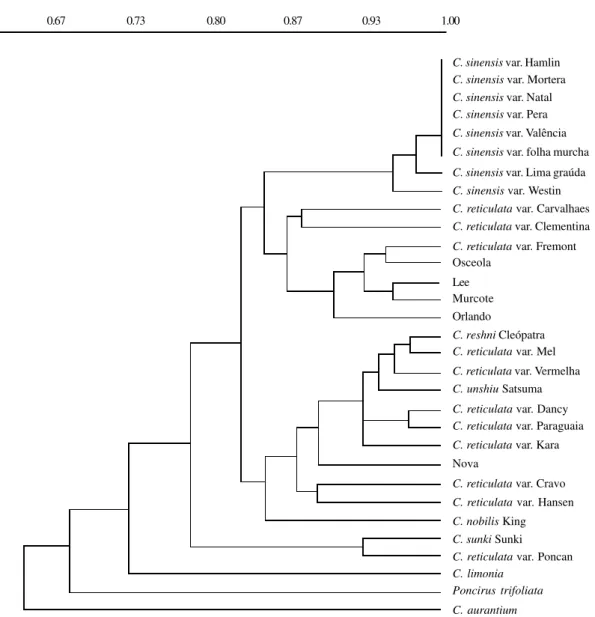
The GI obtained from the allelic frequencies (Nei, 1978 in Swofford and Selander, 1989) and the UPGMA cluster analysis ranged from 1, the most related acces-sions, to 0.65 for the less related (Figure 1). The highest GI was observed among the different cultivars of C. sinensis (0.94 to 1.0). This group was very distinct from the other accessions.
The C. reticulata accessions did not cluster into one group. Some were more similar to accessions of other species. Carvalhaes, Clementina and Fremont accessions (C. reticulata) were grouped together with Osceola, Lee, Murcote and Orlando hybrids, that have C. reticulata as one of the progenitors. Another subgroup included some C. reticulata accessions and C. reshni, C. nobilis species and Nova tangelo.
DISCUSSION
According to Iglesias et al. (1974), isoenzymatic vari-ability in Citrus is expected since many species and culti-vars probably originated through natural hybridization, which is the route to heterozygosity in plants.
Sweet orange cultivars (C. sinensis) showed the highest level of polymorphism, with 13 or 14 heterozygous loci out of 20 (Table II), although the alleles at these loci were almost always the same. Researchers suggest that this species originated from hybridization between C. grandis (L.) Osbeck and C. reticulata Blanco (Scora, 1975, 1988; Esen and Scora, 1977). Although heterozygosity within these cultivars is high, the need for uniform cultivation must have resulted in the selection of a few variants, that had the
de-C. sinensis var. Hamlin
C. sinensis var. Mortera
C. sinensis var. Natal
C. sinensis var. Pera
C. sinensis var. Valência
C. sinensis var. folha murcha
C. sinensis var. Lima graúda
C. sinensis var. Westin
C. reticulata var. Carvalhaes
C. reticulata var. Clementina
C. reticulata var. Fremont Osceola
Lee Murcote Orlando
C. reshni Cleópatra
C. reticulata var. Mel
C. reticulata var. Vermelha
C. unshiu Satsuma
C. reticulata var. Dancy
C. reticulata var. Paraguaia
C. reticulata var. Kara Nova
C. reticulata var. Cravo
C. reticulata var. Hansen
C. nobilis King
C. sunki Sunki
C. reticulata var. Poncan
C. limonia Poncirus trifoliata C. aurantium
0.60 0.67 0.73 0.80 0.87 0.93 1.00
sirable genotypic constitution, and these were multiplied through vegetative propagation (Barret and Rhodes, 1976). However, cultivars Westin and Lima graúda showed specific isoenzymatic patterns for SKD (IS) and ACP (FF/ SS), respectively, suggesting that less hybridization has oc-curred among these cultivars. These enzyme systems could be useful for identification. This could be important, since few studies have focused on polymorphism within cultivars of C. sinensis (Esen and Scora, 1977; Vardi, 1988; Sawasaki et al., 1992; Herrero et al., 1996). However, several culti-vars of sweet orange originated from somatic mutations of seedlings or limbsport and such mutations have been diffi-cult to detect by codominant markers, like isoenzymes.
In general, mandarins were found to be less polymor-phic than sweet orange cultivars. Fourteen different het-erozygous loci were observed, and the number of heterozy-gous loci per individual plant ranged from one to nine (Table II). The lower degree of polymorphism in this group may be due to the fact that this species originated from a cross either between two unknown C. reticulata cultivars or one C. reticulata cultivar and a different species. In all acces-sions, six homozygous loci and one heterozygous locus pre-sented the same phenotype. Therefore, C. reticulata culti-vars showed less polymorphism within groups than among them, suggesting some intraspecific variability from a nar-row genetic base.
Esen and Scora (1977) observed complete homology in amylase in Clementina and Dancy (C. reticulata), Cleópatra (C. reshni), and King (C. nobilis). In the present study seven enzymatic systems (PGI, PGM, PRX, AAT, 6-PGD, SKD and DIA) were useful in detecting differences between some of the accessions analyzed from the culti-vars cited above. In fact, some phenotypes were specific, such as King (PGM = II/PP), Cleópatra and Clementina mandarins (DIA = F1F1/S2S2/S3S3, and F1S1/F2S2, respec-tively) (Table II).
According to Scora (1975) and Barret and Rhodes (1976), the sour orange, C. aurantium, probably originated from a cross between C. grandis (L.) Osbeck (pummelo) and C. reticulata Blanco (mandarin). In this work some al-leles were common to C. aurantium and one of its prob-able progenitors, C. reticulata. In sour orange, specific phe-notypes were detected in three enzymatic systems (PGM (II/PS), PRX (FS/II), DIA (S1S1/F2F2/F3S3)), making these three systems useful in cultivar identification. Similarly, C. limonia Osbeck showed specific phenotypes in three enzy-matic systems: PRX (MM/FS), AAT (FF/FF/FS) and IDH (IS); C. sunki (Sunki) and C. reticulata cvs Cravo and Poncan could be identified by the following PRX specific patterns, MS/MM, FM/MM and MM/MM, respectively.
Some enzymatic phenotypes were specific to hybrids, such as Nova tangelo, which showed the IDH specific phe-notype SS. The hybrids Lee, Murcote and Orlando shared the same phenotype II/SS of 6-PGD, while Lee and Murcote had the phenotype MM of SKD. As expected, several alleles oc-curred in some hybrids as well as their probable progenitors.
The accession of Poncirus trifoliata showed specific phenotypes for four enzymatic systems: PGM (FF/--), IDH (FF), AAT (FF/FF/MP) and ACP (FF/--). In general, the phe-notypes were very similar to those described by Torres et al. (1978, 1982), Ballvé et al. (1991), Sawazaki et al. (1992) and Jarrel et al. (1992). Some alleles shared by P. trifoliata and other Citrus species suggest that the two gen-era, Citrus and Poncirus, are structurally and functionally related at the genomic level, although taxonomically dis-tinct on a morphological level, which would explain the re-sults of crossing these species (Torres et al., 1985; Jarrel et al., 1992).
According to Scora (1975), Esen and Scora (1977), Handa et al. (1986), Scora (1988), Vardi (1988) and Roose (1988), C. reticulata, a possible progenitor of several spe-cies, is related to many of the accessions. Thus, the simi-larity of C. reticulata to the other species is understand-able, considering the polyphyletic origin of Citrus culti-vated species.
Our data show that C. limonia, Poncirus trifoliata and C. aurantium are related species, but with a minor degree of intragroup similarity and C. aurantium is the most dif-ferentiated among them (Figure 1). It has been suggested that C. reticulata is involved in the origin of C. aurantium and C. limonia (Hodgson, 1967). The similarity observed here between the genera Poncirus and Citrus had been con-firmed at the molecular level by Torres et al. (1985) and Jarrel et al. (1992), who detected high structural and func-tional homology between the genomes of the two genera.
In conclusion, the isoenzyme phenotype results showed a high level of heterozygosity and allows one to infer the genotype of the 31 accessions studied and the ge-netic similarity among them.
ACKNOWLEDGMENTS
Thanks are due to Dr. Cláudio Costa and Dr. Marcos Gime-nes for their assistance. V.M.N. and C.R.L. are recipients of CNPq fellowship. Publication supported by FAPESP.
RESUMO
A análise do polimorfismo isoenzimático foi usada para determinar a variabilidade genética entre espécies e híbridos de
Citrus spp. e um acesso da espécie Poncirus trifoliata (L.) Raf. Dez diferentes sistemas enzimáticos foram analisados, incluindo aspartato aminotransferase (AAT), fosfatase ácida (ACP), leucina aminopeptidase (LAP), 6-fosfogluconato desidrogenase (6-PGD), isocitrato desidrogenase (IDH), fosfoglucose isomerase (PGI), fosfoglucomutase (PGM), diaforase (DIA), shiquimato desi-drogenase (SKD) e peroxidase (PRX). Um total de 20 locos e 48 alelos foram identificados. Os cultivares de laranja doce (C. sinensis
168 Novelli et al.
todas as espécies de Citrus e híbridos. Fenótipos exclusivos foram observados em alguns sistemas enzimáticos, sendo encontrados padrões similares entre os híbridos interespecíficos e seus possíveis parentais.
REFERENCES
Ballvé, R.M.L., Bordignon, R., Medina Filho, H.P., Siqueira, W.J., Sobrinho, J.T. and Pompeu Jr., J. (1991). Isoenzimas na identificação precoce de híbridos e clones nucelares no melhoramento de citros. Bragantia 50: 57-76.
Ballvé, R.M.L., Medina Filho, H.P., Bordignon, R. and Lima, M.M.A. (1995). Methodology for starch gel electrophoresis and protocols for isozymes of 32 plant genera. Rev. Bras. Genet. 18: 491-502.
Barret, H.C. and Rhodes, A.M. (1976). A numerical taxonomic study of affin-ity relationships in cultivated Citrus and its close relatives. Syst. Bot. 1: 105-136.
Bechara, M.D. (1996). Estudo da variabilidade isoenzimática em acessos de
Arachis pintoi Krapovickas and Gregory provenientes da Bacia do Rio Paranã em Goiás, Brasil. Master’s thesis, Instituto de Biociências, Universidade Estadual Paulista, Botucatu.
Cheliak, W.M. and Pitel, J.A. (1984). Techniques for Starch Gel Electrophore-sis of Enzymes from Forest Tree Species. Patawawa National Forestry Institute, Canadian Forestry Service Information Report PI-X-42, p. 49.
Conkle, M.T., Hodgskiss, P.D., Nunnally, L.B. and Hunter, S.C. (1982). Starch Gel Electrophoresis of Conifer Seeds: A Laboratory Manual. Pacific Southwest Forest and Range Experimental Station, California, p. 17.
Durham, R.E., Liou, P.C., Gmitter Jr., F.G. and Moore, G.A. (1992). Linkage of restriction fragment length polymorphisms and isozymes in Citrus.
Theor. Appl. Genet. 84: 39-48.
Esen, A. and Scora, R.W. (1977). Amylase polymorphism in Citrus and some related genera. Am. J. Bot. 64: 305-309.
Gogorcena, Y. and Ortiz, J.M. (1993). Use of multivariate analysis in the taxonomy of Citrus aurantium L. and relatives. Sci. Hortic. 53: 301-310.
Gogorcena, Y., Zubrzycki, H. and Ortiz, J.M. (1990). Identification of man-darin hybrids with the aid of isozymes from different organs. Sci. Hortic. 41: 285-291.
Handa, T., Ishizawa, Y. and Oogaki, C. (1986). Phylogenetic study of
Frac-tion I protein in the genus Citrus and its close related genera. Jpn. J. Genet. 61: 15-24.
Herrero, R., Asins, M.J., Carbonell, E.A. and Navarro, L. (1996). Genetic diversity in the orange subfamily Aurantioideae. I. Intraspecies and intragenus genetic variability. Theor. Appl. Genet. 92: 599-609.
Hodgson, R.W. (1967). Horticultural varieties of citrus. In: The Citrus Indus-try (Reuther, W., Webber, H.J. and Batchelor, L.D., eds). Vol. I.
Univer-sity of California Press, Berkeley, pp. 431-589.
Iglesias, L., Lima, H. and Simon, J.P. (1974). Isoenzyme identification of
zygotic and nucellar seedlings in Citrus. Heredity 65: 81-84.
Jarrel, D.C., Roose, M.L., Traugh, S.N. and Kupper, R.S. (1992). A genetic map of Citrus based on the segregation of isozymes and RFLPs in an intergeneric cross. Theor. Appl. Genet. 84: 49-56.
Rohlf, F.J. (1992). NTSYS-pc: Numerical Taxonomy and Multivariate Analy-sis System Version 1.7. Exeter Publ., New York.
Roose, M.L. (1988). Isozymes and DNA restriction fragment length polymor-phisms in Citrus breeding and systematics. In: Proceedings of the XVI International Citrus Congress, Tel Aviv, Israel. Philadelphia/Rehovot, Balaban, pp. 155-165.
Sawazaki, H.E., Ladaslav, S., Pio, R.M. and Muller, G.W. (1992). Identificação de espécies de Citros mediante polimorfismo enzimático. Bragantia 51: 121-128.
Scora, R.W. (1975). On the history and origin of Citrus. Bull. Torrey Bot. Club 102: 369-375.
Scora, R.W. (1988). Biochemistry, taxonomy and evolution of modern culti-vated Citrus. In: Proceedings of the XVI International Citrus Con-gress, Tel Aviv, Israel. Philadelphia/Rehovot, Balaban, pp. 277-287.
Soltis, D.E. and Soltis, P.S. (1989). Isozymes in Plant Biology. Discorides Press, Portland.
Swingle, W.T. and Reece, P.C. (1967). The botany of Citrus and its wild relatives. In: The Citrus Industry (Reuther, W., Webber, H.J. and Batchelor, L.D., eds). Vol. I. University of California Press, Berkeley, pp. 190-422.
Swofford, D.C. and Selander, R.B. (1989). Biosys-1: A Computer Program for the Analysis of Allelic Variation in Population Genetics and Bio-chemical Systematics. Release 1.7, Natural History Survey, Champaign, IL, p. 43.
Tanaka, T. (1954). Species Problem in Citrus. Janpanese Society for the Promotion of Science, Tokyo.
Tanksley, S.D. and Orton, T.J. (Eds.) (1983). Isozymes in Plant Genetics and Breeding. Part A. Elsevier, New York.
Torres, A.M., Soost, R.K. and Diedenhofen, U. (1978). Leaf isozymes as
genetic markers in Citrus. Am. J. Bot. 65: 869-881.
Torres, A.M., Soost, R.K. and Lastovicka, T.M. (1982). Citrus isozymes:
Genetics and distinguishing nucellar from zygotic seedlings. Heredity 73: 335-339.
Torres, A.M., Mau-Lastovicka, T., Williams, T.E. and Soost, R.K. (1985). Segregation distortion and linkage of Citrus and Poncirus isozyme genes. Heredity 76: 289-294.
Vardi, A. (1988). Applications of recent taxonomical approaches and new techniques to citrus breading. In: Proceedings of the XVI International Citrus Congress, Tel Aviv, Israel. Philadelphia/Rehovot, Balaban, pp. 303-308.