*Correspondence: F. L. Gouveia. Departamento de Ciências Farmacêuticas, Universidade Federal de Pernambuco. Av. Prof Moraes Rego, 1235, 50670-901 – Recife - PE, Brasil. E-mail: [email protected]
A
vol. 49, n. 4, oct./dec., 2013
Production of intravenous human dengue immunoglobulin from
Brazilian-blood donors
Frederico Leite Gouveia
1,*, Renata Mendes Batista de Oliveira
1, Antônio Edson de Souza Lucena
2,
Marli Tenório Cordeiro
3, Ana Cristina Lima Leite
11Department of Pharmaceutical Sciences, Federal University of Pernambuco, 2Empresa Brasileira de
Hemoderivados e Biotecnologia, 3Department of Virology and Experimental Therapy,
Research Center Aggeu Magalhães, Oswaldo Cruz Foundation
Dengue represents an important health problem in Brazil and therefore there is a great need to develop a vaccine or treatment. The neutralization of the dengue virus by a speciic antibody can potentially be applied to therapy. The present paper describes, for the irst time, the preparation of Immunoglobulin speciic for the dengue virus (anti-DENV IgG), collected from screened Brazilian blood-donations. Production was performed using the classic Cohn–Oncley process with minor modiications. The anti-DENV IgG was biochemically and biophysically characterized and fulilled the requirements deined by the European Pharmacopoeia. The inished product was able to neutralize different virus serotypes (DENV-1, DENV-2, and DENV-3), while a commercial IgG collected from American blood donations was found to have low anti-dengue antibody titers. Overall, this anti-DENV IgG represents an important step in the study of the therapeutic potential and safety of a speciic antibody that neutralizes the dengue virus in humans.
Uniterms:. Viral infections. Dengue/treatment. Dengue/virus/neutralization. Immunoglobulins/ preparation. Plasma fractionation. Virus neutralization.
A dengue representa um importante problema de saúde no Brasil, portanto, a identiicação de vacina ou tratamento eicaz é uma necessidade urgente. A neutralização do vírus da dengue, por anticorpo especíico, tem potencial aplicação terapêutica. Descrevemos aqui, pela primeira vez, a preparação de imunoglobulina especíica para o vírus da dengue (IgG anti-DENV), produzida a partir do plasma selecionado de doadores brasileiros. A produção foi realizada utilizando o método clássico de Cohn-Oncley com pequenas modiicações. A IgG anti-DENV foi bioquimicamente e bioisicamente caracterizada e cumpriu os requisitos deinidos pela Farmacopeia Europeia. O produto inal foi capaz de neutralizar diferentes sorotipos do vírus (DENV-1, DENV-2 e DENV-3), enquanto que a IgG comercial, produzida a partir do plasma de doadores americanos, apresentou baixos títulos de anticorpos anti-dengue. No geral, esta IgG anti-DENV representa uma importante etapa para o estudo do potencial terapêutico e segurança da neutralização, por anticorpos especíicos, do vírus da dengue em humanos.
Unitermos: Infecções virais. Dengue/tratamento. Dengue/vírus/neutralização. Imunoglobulinas especíicas/preparação. Fracionamento de plasma. Neutralização viral.
INTRODUCTION
There are around 2.5 billion people living in areas endemic for dengue fever and it is estimated that there
are 100 million infections annually (Gubler 1998). The
burden of dengue in endemic countries weighs heaviest on children. However, there has been an increasing trend
towards adult infection in certain countries (Ooi, Goh,
Gubler, 2006; Cummings et al., 2009). Most travelers with
dengue have been adults (Wilder-Smith, Schwartz, 2005).
virus inhibition activity have emerged (Yin et al., 2009). Passive transfer of specific antibodies is thus the most promising way of treating viral infections in such a way as to promote speedier patient recovery.
The dengue virus belongs to the Flaviviridae family
and there are four known serotypes: DENV-1, DENV-2, DENV-3, and DENV-4. All four virus serotypes cause a
spectrum of illness ranging from asymptomatic or mild
febrile disease to classical dengue fever (DF) and to more
severe disease manifesting as dengue hemorrhagic fever
(DHF) and dengue shock syndrome (DSS) (Souza et al.,
2009). The severity of the disease is likely to depend on
various factors, including the strain and serotype of the infecting virus, the age and genetic background of the
patient and the degree of viremia (Guzman, Kouri, 2002;
Vaughn et al., 2000). Many prospective, population-based
cohort and clinical studies have established secondary infections with a heterotypic dengue virus serotype as a major risk factor for severe disease.
Antibody-dependent enhancement (ADE) involves the boosting of virus replication in Fc-receptor bearing cells (especially monocytes and macrophages) by way of pre-existing,
non-protective levels of cross-reactive dengue antibodies.
It is postulated that ADE results in an ampliied cascade of
cytokines and complement activation causing endothelial dysfunction, platelet destruction, and consumption of coagulation factors, which result in plasma leakage and
hemorrhage (Halstead, 1979, 2003).
DENVs have given rise to large outbreaks in Brazil
in the past 25 years with more than 5 million reported
cases. (Figueiredo, 2010). Given that approximately 50%
of DENV-infected individuals remain asymptomatic,
and that the duration of viremia prior to the onset of symptoms is estimated at 1 to 2 days, it is possible that viremic individuals donate blood and serve as a source of
dissemination of the virus in the community (Mohammed
et al., 2008; Linnen et al., 2008; Tambyah et al., 2008; Chuang et al., 2008; Nishiura, Halstead, 2007). The irst epidemic of dengue fever in Brazil, with isolation of the
virus, occurred in 1981, in the State of Roraima, where
DENV-1 and DENV-4 were identiied (Osani et al., 1983).
In 1986, DENV-1 was identified in the State of Rio de
Janeiro (Nogueira et al., 1988) and subsequently spread
to other States in Brazil.
P o l y v a l e n t (i . e . n o r m a l ) i n t r a v e n o u s
immunoglobulins G (IVIGs) are collected from 1,000 to 10,000 healthy blood-donors. The irst therapeutic use of polyvalent IgGs was for antibody replacement therapy
(Orange et al., 1949). However, many other clinical
benefits of IVIGs have been demonstrated. They have
been used for bone marrow and organ transplantation, to
treat chronic inlammatory demyelinating polyneuropathy, severe asthma, pediatric HIV, dermatomyositis, idiopathic
thrombocytopenic purpura as well as multiple sclerosis
(Achiron et al., 1998; Achiron et al., 2000; Brennan,
2001; Dalakas et al., 1993; Hann et al., 1996; Lories et al., 2000; Ohlsson, Lacy, 2001). Different from the
polyvalent IVIGs, for the production of specific IVIG
(i.e., hyper-immune), intact IgG are collected from the
plasma of blood-donors previously identiied as having high levels of a speciic antibody or at least a population of
similar antibodies. Examples are the Hepatitis B, tetanus,
cytomegalovirus, or rabies anti-IgGs (Atkins et al., 2000;
Gelfand, 2001). The most classic examples of specific IVIG are the anti-D IgG (Rho) and anti-hepatitis B IgG (Okwundu, Afolabi, 2013).
Given this, it is still not known what implications
might arise from a treatment based on IVIG prepared from Brazilian blood-donors (anti-dengue antibodies) for neutralizing the virus. Another question is that of whether speciic anti-dengue IVIG preparation is eficient
and safer for dengue treatment. To date, no anti-dengue
IVIGs collected from a pool of blood-donors have been
produced. To address this, the present study describes the plasma screening, fractionation and biochemical
validation of anti-dengue IgG prepared from a plasma
pool of Brazilian blood donors. Among the procedures
available for producing speciic anti-IgGs in a laboratorial
scale, we choose the classic Cohn-Oncley protocol
(Lucena et al., 2010). The production process here also
includes two dedicated virus clearance steps, being thus a combination of the currently used Cohn–Oncley protocol
with modiications.
MATERIAL AND METHODS
Plasma selection
A plasma pool from blood-donations received at the Pernambuco Hematology and Hemotherapy Foundation
- HEMOPE (in the State of Pernambuco, in the Northeast Region of Brazil) was collected and the plasma bags
considered free of contamination were selected. Once the contamination-free plasma bags were selected, the
Immunoglobulin fractionation
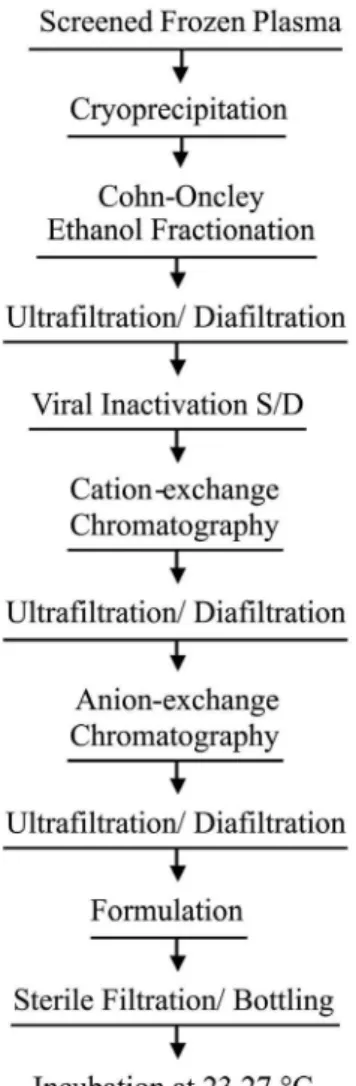
The IgG was precipitated out from the crude plasma using the Cohn-Oncley process (cold ethanol precipitation) with minor modifications. The general
process is depicted in Figure 1. The process of cold ethanol precipitation is based on tuning the protein solubility by adjusting pH, temperature, salt concentration, and ethanol
(Cohn et al., 1946). In short, the frozen plasma is thawed
until it reaches 4 °C, at which temperature ibrinogen and
clotting factor VIII are insoluble and are precipitated out.
The cryo-precipitate is then removed by centrifugation and the cryo-free plasma is treated using Method 6 from Cohn et al. (1946). Fibrinogen was precipitated in fraction I and
immunoglobulin was separated off from albumin by II + III precipitation. The precipitates were separated from the
supernatants by centrifugation.
In accordance with Oncley et al. Method 9 (1949),
fraction II + III was suspended and fraction III was
separated off. The supernatant was clarified by depth
iltration with the aid of a ilter. From this iltrate, an IgG
paste was obtained and collected by centrifugation. The
IgG paste was then dissolved in sterile water for injection and clariied by depth iltration with the aid of a ilter.
To reduce the ionic forces, the solution was iltered through ultrailtration membranes (diailtration) with sterile
water for injection, followed by protein concentration
adjustment to 5% (w/v). A 30 kD Millipore Pellicon Systen was used to perform diailtration and protein level adjustment. Virus inactivation was performed using a
solvent (tri-n-butyl phosphate; TNBP) and a detergent
(Tween 80) (Horowitz et al., 1985). To remove the solvent
and detergent, a cation-exchange chromatography using
a CM Sepharose FF stationary phase was performed. Yet
to remove immunoglobulin A and other components, an
anion-exchange chromatography in DEAE Sepharose FF was carried out. The low-through was concentrated by ultrailtration (10 KD Millipore Pellicon System) and diailtered with 0.25 mol/L glycine using the same system. The protein level was adjusted to 5% (w/v) and pH to 4.2-4.3. Sterilizing iltration was performed and the inal
solution packaged aseptically. To inactivate virus particles,
the inal product was incubated at 23-27 °C for 21 days
before stock at 2-8 °C.
Product validation
To check the functional properties of the product during the process and of the final preparation, we performed the protocols established by the European Pharmacopoeia and described in product marketing
FIGURE 1 - Puriication process for anti-dengue speciic IgGs (Oncley et al., 1949; Lucena et al., 2010).
authorization dossiers approved by National Regulatory
Authorities. Distribution of molecular size was analyzed using size exclusion chromatography with a Biosep
SEC-S3000 (600 x 7.8 mm) column (Phenomenex). Radial immune diffusion was used to determined IgM and subclass distribution of IgG. Enzyme-Linked Immunosorbent Assay (ELISA) was used to measure IgA and IgE and check the absence of antibodies screened for blood donation, such as Human Immunodeiciency Virus
(HIV1, HIV2), hepatitis B surface antigens (HBsAg),
Hepatitis C (HCV), Human T lymphotropic virus (HTLV),
Chagas disease and syphilis.
Cellulose acetate electrophoresis was used to measure
γ-globulin. The methods used for the determination
of pyrogen and anticomplementary activity were in accordance with European Pharmacopoeia monographs
2.6.8 and 2.6.17, respectively. A thermostability assay
was performed by incubation of the preparation at 57 °C
Identification of anti-dengue serotypes
To ascertain the broad neutralizing properties of the
anti-dengue IgG described here, the neutralizing action of IgG was measured for different isolated serotypes. Isolated serotypes DENV-1 (PE/97-42735), DENV-2 (PE/95-3808), and DENV-3 (PE/02-95016) were supplied by the Central Laboratory of Pernambuco (LACEN-PE, Brazil). In this experiment, a commercial polyvalent IVIG (Kiovig/ Baxter International Inc, Deerield, IL, USA) was
also used. Anti-dengue antibodies for different dengue
serotypes were measured using the Plaque-Reduction
Neutralization Test (PRNT) (Morens et al., 1985).
First, a two-fold serial dilution of IgG (1/20 to 1/2.560) in Minimum Essential Medium (MEM) (Invitrogen) was placed in 96-well microtiter plates to a inal volume of 100 µL. Then, 100 µL of a viral suspension (30 plaque forming units/mL) of DENV-1 (PE/97-42735), DENV-2 (PE/95-3808), and DENV-3 (PE/02-95016) was aliquoted into the respective wells. The plate was
incubated for 1 hour at 37 oC in 5% CO
2. Then, 50 µL of
the IgG/virus mixture was collected from each dilution
and transferred into a 24 well-plate containing Vero cells
previously seeded at a density of 3x10⁶ cells/mL, in MEM
supplemented with 10% Fetal Calf Serum (FCS, GIBCO).
After virus attachment (incubation for 1 hour at 37 oC in
5% CO2), each well was covered with 500 µL of MEM
10X medium, supplemented with 10% FBS, 1% penicillin/
streptomycin and 3% carboxymethylcellulose. The plate was then incubated for 7 days at 37 °C in 5% CO2. To inactivate the virus particles, the medium was removed
and the monolayer cells covered with formalin (solution at 3.5 M, 2 mL per well) and incubated for 1h. The formalin
solution was washed out and the cells were stained with
crystal violet (1:50 v/v, 0.5 mL per well). The number of regions of infected cells (plaques) was counted and
compared to the virus particles receiving only polyvalent
IVIG and the non-treated virus particles.
Ethics statement
The study protocol was approved by the HEMOPE
ethics committee (process number 002/2011). Patients were not identiied and study data was analyzed anonymously.
RESULTS AND DISCUSSION
In Table I, we summarize the biochemical and biophysical properties of the anti-dengue IgG. The parameters showed in Table I are deined by European
Pharmacopoeia and described in product marketing
authorization dossiers approved by National Regulatory
Authorities.
Electrophoresis showed a satisfactory level of purity
with 98% of proteins migrating to the gamma region. IgG
subclass content in this preparation was found to be similar
to naturally occurring ratios (Morell et al., 1972).
The speciic IVIG produced contained traces of IgA and IgM, immunoglobulins being mainly removed by
cation-exchanged and anion-exchanged chromatographs
respectively. Some authors have pointed out that the administration of IVIG preparations with significant amounts of IgA can cause severe anaphylactic reactions in
patients with IgA deiciency (Vyas et al., 1968; Bjorkander
et al., 1987).
The total number of aggregates present in the
preparation lies within the acceptable range. IgG
dimerization and aggregate formation was also associated
with an increase in the risk of adverse effects (Kroez et
al., 2003). These aggregates bind and activate components
of the complementary system and routine determination of anticomplementary activity was therefore adopted.
In the IVIG produced, consumption of the complement was not greater than 50%, as required by the European Pharmacopoeia. The product was kept at pH 4.0 – 4.5, which is optimal for maintaining IgG in an unaggregated state (Gelfand, 2006). Initially developed to produce a stable IgG solution, a low pH formulation was also used to achieve a inal step involving inactivation of the virus.
Two steps were taken to inactivate the virus: solvent/ detergent (S/D) treatment and incubation at low pH. S/D treatment is very effective against lipid-enveloped
viruses (Uemura et al., 1994; Chang et al., 2000). Low
pH incubation also provides robust inactivation of
lipid-enveloped viruses, including HIV (Bos et al., 1998;
Omar et al., 1996; Biesert, 1996; Reid et al., 1988).
This product responds negatively (i.e. is non-reactive)
to HBsAg, HCV, HIV1 and HIV2 antibodies, Chagas
disease and syphilis. These are important biochemical
characterizations, ensuring that the IgG is suitable for
intravenous administration in subjects.
Completing biochemical and biophysical analysis,
we examined the overall stability of this IgG preparation by way of thermo-stability. We did not observe alterations,
such as gelification or flocculation. Therefore, the
IVIG formulated in 0.25 mol/L glycine demonstrated
appropriate osmolality.
Once the anti-dengue IgG was carefully characterized
in terms of biophysical and biochemical properties, we
decided to quantify the ratio of IgG serotypes for DENV-1, DENV-2, and DENV-3. DENV-4 was not tested. Table II
TABLE I – Anti-dengue IgG characterization
Test Reference values Results
pH(a) 4.0 – 7.4 4.3
Total protein(b) 45 – 55 mg/mL 51 mg/ mL
Protein composition(c) Minimum of 95% gammaglobulin 98%
Distribution of molecule size(c) Minimum of 90% monomer and dimer
Maximum of 3% polymers and aggregates
98.1% 1.1%
IgA - 0.16 mg/mL
IgM - 0.10 mg/mL
Subclass distribution Percent Percent
IgG1 65 – 70 68
IgG2 20 – 25 19
IgG3 7 – 10 7
IgG4 3 – 6 6
Anticomplementary activity (%) ≤ 50 39
Thermo stability (57 °C/4h) No geliication No geliication
Antibody to hepatitis B surface antigen (d) Minimum 0.5 IU/g 1.24 IU/g
Pyrogen (e) Absence Absence
(a) Analyzed by luorescamine standard curve. (b)Determined by Kjeldahl method. (C) Determined by electrophoresis. (d) By using
ELISA kit assays against hepatitis. (e) Determined by using detection kit and analyzed by PCR.
TABLE II - Dengue antibody titers of the speciic immunoglobulin preparation by plaque reduction
Sample* antibodies
DENV-1 DENV-2 DENV-3
Crude plasma 1:160 1:640 1:40
Anti-dengue IgG 1:160 1:1280 1:160
Trademark (Kiovig) 1:40 1:40 < 1:20 (negative)
*Experiments were repeated at least three times independently. The data here present the mean for one single experiment. anti-dengue antibody titers of 1:1280 for DENV-2 and 1:160 for DENV-1 and DENV-3. This was expected, since this IVIG was prepared using blood donations from Brazil,
which is an endemic area (Cordeiro et al., 2007). In Brazil,
three serotypes are currently in circulation, DENV-1, 2, and 3, while infection by DENV-4 is more restricted to the North Region (Roraima, Manaus and Belém) (Brazil, 2010, 2011a, 2011b). The broad neutralizing property
in relation to the different virus types confirmed the
functional activity of this IgG product. The commercial IVIG (prepared from American blood donations, brand Kiovig/ Baxter) was found to have low titers for DENV.
Several preparations of IVIG are now available for
therapy, however it is well known that different plasma
sources may inluence the immunological composition of IVIG. In clinical practice, different preparations of IVIG or different batches may result in variable beneicial effects.
For a biological study, it is therefore very important to
describe the reasons for choosing a preparation of IVIG and to consider the speciic characteristics of the product
that are relevant to a particular clinical response (Elluru et
al., 2006; Gelfand, 2006; Gürcan, Keskin, Ahmed, 2010). The knowledge of virology gathered over the
years suggests that specific IVIGs are useful for virus
neutralization. This is the case for hepatitis B and for the
arbovirus West Nile virus (WNV). If we compare dengue and WNV, both infections are immunologically and
pathogenically similar to each other and have a similar
infection course. It has also been reported that speciic anti-WNV IgGs are eficient in reducing virus titers in
patients severely-infected with WNV (Saquib et al., 2008;
Wadei et al., 2004; Haley et al., 2003). In pre-clinical
studies, anti-WNV IgGs substantially reduced mortality in WNV-infected mice. In contrast, the mortality is observed in WNV-infected mice when a polyvalent is administered
instead of speciic IgG (Ben-Nathan et al., 2003). In light
of these indings, investigation of the potential of speciic human anti-dengue IgG would appear to be a reasonable
proposition.
The feasibility of a Brazilian IVIG, with anti-dengue
involve the same approach currently employed for patients
with WNV (Saquib et al., 2008; Wadei et al., 2004; Haley
et al., 2003). However, the safety of using this type of
preparation in dengue-patients should be conirmed. The
pre-existence of heterologous antibodies, in the presence of a new infection by a distinct serotype may cause
ADE (Gubler, 2002; Guzmán, Kouri, 2004; Ross, 2010;
Wilder-Smith et al., 2005). Since all four serotypes exist
in Brazil, further studies are necessary to conirm whether a treatment based on Brazilian IVIG is safe for
dengue-patients or may cause ADE.
CONCLUSION
The present study has described, for the irst time, the production and biophysical/biochemical validation of a human anti-dengue IVIG prepared using Brazilian blood
donations. The product was characterized in regarding to its immunoglobulin composition, biophysical parameters, purity and capacity to neutralizing Dengue antibodies. As
expected, this anti-Dengue IgG preparation exhibited higher
titers of anti-dengue antibodies than a trademark product, which is produced by plasma of donors living in
non-endemic Dengue areas. The anti-dengue IVIG described
here is useful for investigating the effect of anti-dengue
IVIG during infection and its potential therapeutic use.
ACKNOWLEDGEMENTS
This study received funding from FACEPE (PPSUS Program, grant number APQ-1380-4.00/08) and the Instituto Nacional de Pesquisas em Dengue (INCT em Dengue, CNPq, grant number 573876/2008-8). The
authors are deeply grateful to all the HEMOPE employees for their help during the study. F.L.G. is receiving a FACEPE scholarship for doctoral studies, while R.M.B.O.
is receiving a scholarship from INCT em Dengue. A.C.L.L. receives a senior scholarship awarded by CNPq (research productivity grant program).
LIST OF ABBREVIATIONS
ADE - Antibody-Dependent Enhancement, DENV
– Dengue Virus, DF - Dengue Fever, DHF - Dengue
Hemorrhagic Fever, DSS - Dengue Shock Syndrome, ELISA - Enzyme-Linked Immunosorbent Assay, FCS -
Fetal Calf Serum, HBsAg - Hepatitis B Surface Antigens,
HCV - Hepatitis C Virus, HEMOPE - Hematology and Hemotherapy Foundation of Pernambuco, HIV - Human
Immunodeiciency Virus, HTLV - Human T Lymphotropic
Virus, IVIG - Intravenous Immunoglobulins G,
LACEN-PE - Central Laboratory of Pernambuco, MEM - Minimum Essential Medium, PRNT - Plaque-Reduction
Neutralization Test, Rho - Anti-D IgG, S/D - Solvent/
Detergent, TNBP - Tri-n-Butyl Phosphate, WNV - West
Nile virus.
REFERENCES
ACHIRON, A.; GABBAY, U.; GILAD, R.; HASSIN-BAER, S.; BARAK, Y.; GORNISH, M.; ELIZUR, A.; GOLDHAMMER, Y.; SAROVA-PINHAS, I. Intravenous immunoglobulin treatment in multiple sclerosis: effect on relapses. Neurology, v.50, p.398-402, 1998.
ACHIRON, A.; MOR, F.; MARGALIT, R.; COHEN, I.R.; LIDER, O.; MIRON, S. Suppression of experimental autoimmune encephalomyelitis by intravenously administered polyclonal immunoglobulins. J. Autoimmun., v.15, p.323-330, 2000.
ATKINS, J.T.; KARIMI, F.; MORRIS, E.H.; DAVID, G.; SHIM, S. Prophylaxis for respiratory syncytial virus with respiratory syncytial virus-immunoglobulin intravenous among preterm infants of thirty-two weeks gestation and less: reduction in incidence, severity of illness and cost.
Pediatr. Infect. Dis. J., v.19, p.138-143, 2000.
BEN-NATHAN, D.; LUSTIG, S.; TAM, G.; ROBINZON, S.; SEGAL, S.; RAGER-ZISMAN, B. Prophylactic and therapeutic eficacy of human intravenous immunoglobulin in treating West Nile Virus infection in mice. J. Infect. Dis., v.188, p.5-12, 2003.
BIESERT, L. Virus validation studies of immunoglobulin preparations. Clin. Exp. Rheumatol., v.14, p.S47-S52, 1996.
BOS, O.J.; SUNYE, D.G.; NIEUWEBOER, C.E.; VAN, E.F.A.; SCHUITEMAKER, H.; OVER, J. Virus validation of pH 4-treated human immunoglobulin products produced by the Cohn fractionation process. Biologicals, v.26, p.267-276, 1998.
BRASIL. Secretaria de Vigilância em Saúde. Nota técnica: isolamento do vírus DENV 4 em Roraima, Brasil. Brasília, 2010. Available at: <http:// portal.saude.gov.br/portal/saude/ proissional/area>. Accessed on: 08 Dec. 2010.
BRASIL. Secretaria de Vigilância em Saúde. Nota técnica: isolamento do sorotipo DENV 4 em Belém/PA. Brasília, 2011b. Available at: <http://portal.saude.gov.br/portal/ saude/proissional/area>. Accessed on: 25 Feb. 2011.
BRENNAN, D.C. Polyclonal antibodies in immunosuppression.
Transplant. Proc., v.33, p.1002-1004, 2001.
BJORKANDER, J.; HAMMARSTROM, L.; SMITH, C.I.; BUCKLEY, R.H.; CUNNINGHAM-RUNDLES, C.; HANSON, L.A. Immunoglobulin prophylaxis in patients with antibody deficiency syndromes and anti-IgA antibodies. J. Clin. Immunol., v.7, p.8-15, 1987.
CHANG, C.E.; EO, H.G.; LEE, Y.S.; CHUNG, S.K.; SHIN, J.S.; LAH, Y.K.; PARK, C.W.; JUNG, J.T.; HUH, J.W.; LEE, S.M. Human intravenous immunoglobulin preparation and virus inactivation by pasteurization and solvent detergent treatment. Prep. Biochem. Biotechnol., v.30, p.177-197, 2000.
CHUANG, V.W.; WONG, T.Y.; LEUNG, Y.H.; MA, E.S.; LAW, Y.L.; TSANG, O.T.; CHAN, K.M.; TSANG, I.H.; QUE, T.L.; YUNG, R.W.; LIU, S.H. Review of dengue fever cases
in Hong Kong during 1998 to 2005. Hong Kong Med. J.,
v.14, p.170-177, 2008.
COHN, E.J.; STRONG, L.E.; HUGHES, W.L.J.R.; MULFORD, D.J.; ASHWORTH, J.N.; MELIN, M.; TAYLOR, H.L. Preparation and properties of serum and plasma proteins III. A system for the separation into fractions of the protein and lipoprotein components of biological tissues and luids.
J. Am. Chem. Soc., v.68, p.459-475, 1946.
CORDEIRO, T.M.; SILVA, M.A.; BRITO, A.A.C.; NASCIMENTO, M.J.E.; MAGALHÃES, F.C.M.; GUIMARÃES, F.G.; SILVA, L.N.; CARVALHO, F.M.E.; MARQUES, A.T.E. Characterization of a dengue patient cohort in Recife, Brazil. Am. J. Trop. Med. Hyg., v.77, p.1128-1134, 2007.
CUMMINGS, D.A.T.; IAMSIRITHAWORN, S.; LESSLER, J.T.; MCDERMOTT, A.; PRASANTHONG, R.; NISALAK, A.; JARMAN, R.G.; BURKE, D.S.; GIBBONS, R.V. The impact of the demographic transition on dengue in thailand: insights from a statistical analysis and mathematical modeling. PLoS. Med., v.6, p.e1000139, 2009.
DALAKAS, M.C.; ILLN, I.; DAMBROSIA, J.M.; SOUEIDAN, S.A.; STEIN, D.P.; OTERO, C. A controlled trial of high-dose intravenous immune globulin infusions as treatment for dermatomyositis. N. Engl. J. Med., v.27, p.1993-2000, 1993.
ELLURU, S.; HUYEN, J.D.V.; BAYRY, J.; DELIGNAT, S.; PROST, F.; EPHREM, A.; SIBERIL, S.; MISRA, N.; DESMZES, S.L.; KAZATCHKINE, M.D.; KAVERI, S.V. Comparative study of the anti-inlammatory effect of two intravenous immunoglobulin preparations manufactured by different processes. Immunol. Lett., v.107, p.58-62, 2006.
FIGUEIREDO L. Dengue in Brazil during 1999-2009: a review.
Dengue bullettin. WHO Regional Ofice for South-East
Asia, 2010. v.34, p.6-12.
GELFAND, M.D.J. Antibody-directed therapy: past, present, and future. J. Allergy Clin. Immunol., v.108, p.S111-S116,
2001.
GELFAND, E.W. Differences between IGIV products: impact on clinical outcome. Int. Immunopharmacol., v.6, p.592-599, 2006.
GUBLER, D.J. Dengue and dengue hemorrhagic fever. Clin. Microbiol. Rev., v.11, p.480-496, 1998.
GUBLER, D.J. Epidemic dengue/ dengue hemorrhagic fever as a public health, social and economic problem in the 21st century. Trends Microbiol., v.10, p.100-103, 2002.
GÜRCAN, H.M.; KESKIN, D.B.; AHMED, A.R. Information for healthcare providers on general features of IGIV with emphasis on differences between commercially available products. Autoimmun. Rev., v.9, p.553-559, 2010.
GUZMÁN, M.G.; KOURI, G. Dengue: an update. Lancet Infect.
Dis., v.2, p.33-42, 2002.
GUZMÁN, M.G.; KOURI, G. Dengue diagnosis, advances and challenges. Int. J. Infect. Dis., v.8, p.69-80, 2004.
HANN, A.F.; BOLTON, C.F.; ZOCHODNE, D.; FEASBY, T.E. Intravenous immunoglobulin treatment in chronic inlammatory demyelinating polyneuropathy. A double-blind, placebo-controlled study. Brain, v.119, p.1067-1077, 1996.
HALSTEAD, S.B. In vivo enhancement of dengue virus infection in rhesus monkeys by passively transferred antibody. J. Infect. Dis., v.140, p.527-533, 1979.
HALSTEAD, S.B. Neutralization and antibody-dependent enhancement of dengue viruses. Adv. Virus Res., v.60, p.421-467, 2003.
HOROWITZ, B.; WIEBE, M.E.; LIPPIN, A.; STRYKER, M.H. Inactivation of viruses in labile blood derivatives. Disruption of lipid-enveloped viruses by tri (n-butyl) phosphate detergent combinations. Transfusion, v.25, p.516-522, 1985.
KROEZ, M.; KANZY, E.J.; GRONSKI, P.; DICKNEITE, G. Hypotension with intravenous immunoglobulin therapy: importance of pH and dimer formation. Biologicals, v.31, p.277-286, 2003.
LINNEN, J.M.; VINELLI, E.; SABINO, E.C.; TOBLER, L.H.; HYLAND, C.; LEE, T.H.; KOLK, D.P.; BROULIK, A.S.; COLLINS, C.S.; LANCIOTTI, R.S.; BUSCH, M.P. Dengue viremia in blood donors from Honduras, Brazil, and Australia. Transfusion, v.48, p.1355-1362, 2008.
LORIES, R.J.; MAERTENS, J.A.; CEUPPENS, J.L.; PEETERMANS, W.E. The use of polyclonal intravenous immunoglobulins in the prevention and treatment of infectious diseases. Acta Clin. Belg., v.55, p.163-169, 2000.
LUCENA, A.E.S.; SAMPAIO D.S.; SILVA, E.R.; DE
PAIVA, V.F.; SANTIAGO, A.C.; LEITE, A.C.L. A new
methodology for polyvalent intravenous immunoglobulin solution production with a two-stage process of viral inactivation. Braz. J. Pharm. Sci., v.46, p.776-783, 2010.
MOHAMMED, H.; LINNEN, J.M.; MUÑOZ-JORDÁN, J.L.; TOMASHEK, K.; FOSTER, G.; BROULIK, A.S.; PETERSEN, L.; STRAMER, S.L. Dengue vírus in blood donations, Puerto Rico, 2005. Transfusion, v.48,
p.1348-1354, 2008.
MORELL, A.; SKVARIL, F.; STEINBERG, A.G.; VAN LOGHEM, E.; TERRY, W.D. Correlations between the concentrations of the four sub-classes of IgG and Gm Allotypes in normal human sera. J. Immunol., v.108,
p.195-206, 1972.
MORENS, D.M.; HALSTEAD, S.B.; REPIK, P.M.; PUTVATANA, R.; RAYBOURNE, N. Simpliied plaque reduction neutralization assay for dengue viruses by semimicro methods in BHK-21 cells: comparison of the BHK suspension test with standard plaque reduction neutralization. J. Clin. Microbiol., v.22, p.250-254, 1985.
NISHIURA, H.; HALSTEAD, S.B. Natural history of dengue vírus (DENV)-1 and DENV-4 infections: reanalysis of classic studies. J. Infect. Dis., v.195, p.1007-1013, 2007.
N O G U E I R A , R . M . R . ; S C H AT Z M AY R , H . G . ; MIAGOSTOVICH, M.P.; FARIAS, M.F.; FARIAS FILHO, F.C. Virological study of a dengue type 1 epidemic at Rio de Janeiro. Mem. Inst. Oswaldo Cruz, v.83, p.219-225, 1988.
OHLSSON, A.; LACY, J. B. Intravenous immunoglobulin for preventing infection in preterm and/or low-birth-weight infants. Cochrane Database Syst. Rev., n.2, 2001, Art. No.CD000361.
OKWUNDU, C.I.; AFOLABI, B.B. Intramuscular versus intravenous anti-D for preventing rhesus alloimmunization during pregnancy. Cochrane Database Syst. Rev., n.1, 2013, Art. No. CD007885.
OMAR, A.; KEMPF, C.; IMMELMANN, A.; RENTSCH, M.; MORGENTHALER, J.J. Virus inactivation by pepsin treatment at pH 4 of IgG solutions: factors affecting the rate of virus inactivation. Transfusion, v.36, p.866-872, 1996.
ONCLEY, J.L.; MELIN, M.; RICHERT, D.A.; CAMERON, J.W.; GROSS, P.M. The separation of the antibodies, isoaglutinins, prothrombin, plasminogen and betalipoprotein into subfractions of human plasma. J. Am. Chem. Soc., v.71, p.541-550, 1949.
OOI, E.E.; GOH, K.T.; GUBLER, D.J. Dengue prevention and 35 years of vector control in Singapore. Emerg. Infect. Dis., v.12, p.887-893, 2006.
ORANGE, J.S.; HOSSNY, E.M.; WEILER, C.R.; BALLOW, M.; BERGER, M.; BONILLA, F.A.; BUCKLEY, R.; CHINEN, J.; EL-GAMAL, Y.; MAZER, B.D.; NELSON, R.P.; PATEL, D.D.; SECORD, E.; SORENSEN, R.U.; WASSERMAN, R.L.; CUNNINGHAM-RUNDLES, C. Use of intravenous immunoglobulin in human disease: a review of evidence by members of the primary immunodeiciency committee of the American Academy of Allergy, Asthma
and Immunology. J. Allergy Clin. Immunol., v.117,
OSANAI, C.H.; TRAVASSOS DA ROSA, A.P.A.; TANG, A.T.; AMARAL, R.S.; PASSOS, A.D.C.; TAUIL, P.L. Surto de
dengue em Boa Vista Roraima. Rev. Inst. Med. Trop., v.25,
p.53-54, 1983.
REID, K.G.; CUTHBERTSON, B.; JONES, A.D.; MCINTOSH, R.V. Potential contribution of mild pepsin treatment at pH4 to the viral safety of human immunoglobulin products. Vox Sang., v.55, p.75-80, 1988.
ROSS, T.M. Dengue virus. Clin. Lab. Med., v.30, p.149-160,
2010.
SAQUIB, R.; RANDALL, H.; CHANDRAKANTAN, A.; SPAK, C.W.; BARRI, Y.M. West Nile virus encephalitis in a renal transplant recipient: the role of intravenous immunoglobulin. Am. J. Kidney Dis., v.52, p.19-21, 2008.
SOUZA, D.G.; FAGUNDES, C.T.; SOUSA, L.P.; AMARAL, F.A.; SOUZA, R.S.; SOUZA, A.L.; KROON, E.G.; SACHS, D.; CUNHA, F.Q.; BUKIN, E.; ATRASHEUSKAYA, A.; IGNATYEV, G.; TEIXEIRA, M.M. Essential role of platelet-activating factor receptor in the pathogenesis of Dengue virus infection. Proc. Natl. Acad. Sci. U.S.A., v.106, p.14138-14143, 2009.
TAMBYAH, P.A.; KOAY, E.S.; POON, M.L.; LIN, R.V.; ONG, B.K. Dengue hemorrhagic fever transmitted by blood transfusion. N. Engl. J. Med., v.359, p.1526-1527, 2008.
UEMURA, Y.; YANG, Y.H.; HELDEBRANT, C.M.; TAKECHI, K.; YOKOYAMA, K. Inactivation and elimination of viruses during preparation of human intravenous immunoglobulin. Vox Sang., v.67, p.246-254, 1994.
VAUGHN, D.W.; GREEN, S.; KALAYANAROOJ, S.; INNIS, B.L.; NIMMANNITYA, S.; SUNTAYAKORN, S.; ENDY, T.P.; RAENGSAKULRACH, B.; ROTHMAN, A.L.; ENNIS, F.A.;. NISALAK, A. Dengue viremia titer, antibody response pattern, and virus serotype correlate with disease severity. J. Infect. Dis., v.181, p.2-9, 2000.
VYAS, G.N.; PERKINS, H.A.; FUDENBERG, H.H. Anaphylactoid transfusion reactions associated with anti-IgA. Lancet, v.2, p.312-315, 1968.
WADEI, H.; ALANGADEN, G.J.; SILLIX, D.H.; EL-AMM, J.M.; GRUBER, A.S.; WEST, M.S.; GRANGER, D.K.; GARNICK, J.; CHANDRASEKAR, P.; MIGDAL, S.D.; HARIRIAN, A. West Nile virus encephalitis: an emerging disease in renal transplant recipients. Clin. Transplant., v.18, p.753-758, 2004.
WERDAN, K. Intravenous immunoglobulin for prophylaxis and therapy of sepsis. Curr. Opin. Crit. Care, v.7,
p.354-361, 2001.
WILDER-SMITH, A.; YOKSAN, S.; EARNEST, A.; SUBRAMANIAM, R.; PATON, N.I. Serological evidence for the co-circulation of multiple dengue virus serotypes
in Singapore. Epidemiol. Infect., v.133, p.667-671, 2005.
WILDER-SMITH, A.; SCHWARTZ, E. Dengue in travelers. N.
Engl. J. Med., v.353, p.924-932, 2005.
WILDER-SMITH, A.; OOI, E.; VASUDEVAN, S.G.; GUBLER, D.J. Update on dengue: epidemiology, virus evolution, antiviral drugs, and vaccine development. Curr. Infect. Dis. Rep., v.12, p.157-164, 2010.
Received for publication on 25th January 2013