composites for ceramic abutments
*e-mail: [email protected]
Article presented at the II SBPMat, Rio de Janeiro - RJ, 26-29 de Outubro/ 2003
Mechanical Properties of Alumina-Zirconia
Composites for Ceramic Abutments
Maria Cecilia Corrêa de Sáe Benevides de Moraesa*, Carlos Nelson Eliasa, Jamil Duailibi Filhob, Leandra Guimarães de Oliveirab
a
Departament of Mechanical and Metallurgical Engineering (DE-4), IME, Praça General Tibúrcio, 80, Praia Vermelha, 22290-270, Rio de Janeiro-RJ, Brazil
b
INT, Av. Venezuela 82, sala 604, Saúde, 20081-310, Rio de Janeiro-RJ, Brazil
Received: October 29, 2003; Revised: May 20, 2004
The need for new materials to substitute injured or damaged parts of the human body has led scientists of different areas to investigate bioceramics since the 70’s, when other materials in use started to show rejection problems. Ceramics show some advantages like being the material that best mimics the bone tissue, although present low toughness when compared with the metallic materials. As patients have become more and more demanding regarding esthetic and biocompatibility aspects of their dental restorations, ceramic material has become a main object of scientific interest especially from the material point of view. The alumina-zirconia composites are one of the relatively good and promising candidate for biomaterials application, due to biocompatibility and their mechanical properties that combines high flexural strength with a high toughness. The aim of the present work is to analyze the mechanical properties of these compos-ites, where Y-TZP zirconia content was varied from 5 to 80 wt.% These systems can achieve a flexural strength 93 % and fracture toughness 29 % superior when compared to the pure alumina ceramics. These results showed that ceramic abutments components can be prepared for pros-thetic rehabilitations with dental implants.
Keywords: ceramic abutments, alumina-zirconia composites, bioceramics and mechanical properties
1. Introduction
A great progress in dental restorations thecnique has been established by the use of ceramic materials since the 70’s. In some field application, the tendency is the elimination of the metallic substructure, including implant restorations. These materials show relative advantages, like esthetic, biocompatibility and chemical resistence. One problematic aspects of ceramic materials and of dental ceramics in par-ticular is their low mechanical resistance and fracture toughness(KIC)1.
Osseointegrated dental implants are been used since 80’s in the rehabilitation of partially and totally edentulous pa-tients2. The metallic abutments used in prosthetic restorations with implants mat compromise the esthetic in some cases3. To minimize this problem, some implant systems developed ceramic abutments. The use of alumina and zirconia with high density like biomaterial have been proposed. Alumina has shown excelent biocompatibility and wear resistance
however exhibits low flexural strenght and toughness4. The pure zirconia cannot be used in the manufacture of parts with-out the addition of stabilizers5. The yttria-tetragonal zirconia polycrystal(Y-TZP) has become a popular alternative to alumina as biomaterial and is used in dental applications such as endodontic posts6, orthodontic brackets7, crowns and bridges8,9 and in ceramic abutments10, beside the extensive experience of using the ceramic in orthopedics implants11,13. Zirconia presents good esthetic aspects after polishing, is in-ert in physiological environment, presents greater flexural re-sistance and toughness and lower Young’s modulus when compared with pure alumina14. The ability of Y-TZP to trans-form from tetragonal crystalline structure to a more volumi-nous monoclinic structure, and thus obstruct crack propaga-tion, gives the material its strength and toughness9.
alumina based ceramics densification. However, the con-cept of toughening alumina ceramics with dispersion of zirconia particles in a matrix was only recognized in the last 20 years. The introduction of small amounts of zirconia in alumina as additive of sintering causes the formation of solid solution which promotes the densification process by the introduction of defects15.
On the other hand, the microstructure of a composite material is formed from the addition of one second phase. A composite material is the way to improve reliability and lifetime of ceramic abutments by providing higher fracture toughness and mechanical strength. Material scientists are already familiar with composites like alumina-zirconia15-21. Since both materials are biocompatible, this could prove to be a new approach to dental abutments. Despite the com-munity of biomaterials being already familiar with alumina and zirconia separately, by being both biocompatible, little was published in literature on the use of alumina-zirconia composites as biomaterial14.
Two types of composites can be prepared from this sys-tem: a matrix of zirconia stabilized and strengthened with particles of alumina(Y-ATZ) or an alumina matrix strength-ened with particles of zirconia(Y-ZTA)4,21-23. With both ma-terials higher toughness values when compared with the monophase ceramics can be reached24.
In the current study, the hardness and fracture tough-ness of alumina-zirconia composites with respect to zirconia content are explored in details by utilization of Vickers in-dentation technique. The mechanical strength is also ana-lysed by four point flexural tests.
2. Experimental procedure
The commercially available powders used in this work were the oxides alumina, and yttria-stabilized zirconia(3 mol%) from two different manufacturers. Alumina SG-1000 (Alcoa-USA) presented specific surface area of 10,47 m2/g(BET) and average particle size deter-mined by laser scattering (d50 = 0,44 µm). The the yttria-stabilized zircônia(TZ3YSB - Tosoh Corporation - Japan) containning binder deposited by spay-drier, presented spe-cific surface area of 6,21 m2/g(BET) and average particle size by laser scattering(d50 = 0,35 µm). The yttria-stabi-lized zirconia (3Y-TZP - Mel Chemicals - England), pre-sented specific surface area of 11,10 m2/g(BET) and aver-age particle size by laser scattering (d50 = 0,19 µm).
Different compositions were prepared with mixture of oxides varying the zirconia amount from 5 to 80 wt.%. To attain the compositions, mechanical milling was performed in ethanol with 50 wt.% of solids content for 1 h and a half, in ball milling, with zirconia grinding medias (Ø = 2 mm). Citric acid (0.6% wt.%) was used as dispersant and polyethylene glicol (2 wt.%) as the binder. The slurry of
the powder mixtures was dried in rotatory evaporator, and the dried lumps were crushed and passed through a sieve. (65 Tyler mesh(0,212 mm). Powder compacts with dimen-sions of 5 × 6 × 80 mm were conformed by uniaxially press-ing at 55 MPa. The green bodies density was calculated from the ratio weight/volume. The withdrawal of the binder was carried through in a furnace type muffle with heating rate of 6 °C/min at 600 °C per 180 min. The sintering was carried out in air in a box furnace and in the temperature range of 1500 - 1600 °C for two hours, as the composition. The final density was measured by Archimedes method.
After the inlaying of the samples in bakelite, they were ground by silicon carbide(SiC) paper in sequence of #150, #180, #220, #320, #400, #600, for the complete removal of the material of inlaying and attainment of a plain surface. Af-ter, the samples had been polished with diamond pastes in the sequence of 15, 9, 6, 3, 1 and 0,25 µm to produce optical re-flective surface. During this stage, the samples were observed in optical microscope OLYMPUS LECO PME-3, with the aid of the image software IMAGE IA-3001, for the evaluation of the burnishing process. The burnishing time was not fixed, it was a function of the evolution of the process, the paste was only changed when the average size of the defect in the polish-ing surface, which was quantified through the optical micro-scope, was in the order of magnitude of the abrasive.
For all tested materials, the average grain size of the alumina and zirconia grains was determined from SEM images of randomly selected areas of the polished and ther-mally etched specimens using the linear intercept method. The average value was obtained based on the analysis of at least 150 grains for each material.
The methodology used for the determination of hard-ness, was in accordance with ASTM C 1327-9925. Thirty Vickers impressions had been carried through in the sur-faces of each one of the samples, which already were pol-ishing, using an applied load of 10 kgf (98.1 N) during ten seconds. After the diagonal length measurement, the val-ues of the Vickers hardness (GPa) were calculated, by the following equation:
Hv = 0.0018544 (P/d2) (1)
Where:
HV = Vickers hardness (GPa); P = applied load (N);
d = arithmetic mean of the two diagonal length(mm).
composites for ceramic abutments stress field that acts after removal of indenter. Each Vickers
impression presented two pairs of radial cracks emerging from the corners. A total of sixty pairs of cracks were obtained. For calculations, at least thirty perfect pairs of cracks were used for each composition, those that did not present interac-tions with burnishing imperfecinterac-tions and deviainterac-tions from crack. Three equations were used to determine the KIC values as follows: Eq. 2 - Anstis27, Eq. 3 -Casellas28 and Eq. 4a and 4b - Niihara29.
(2)
(3)
for (4a)
for (4b)
Where:
KIC = fracture toughness (MPa.m1/2); P = load applied(N);
E = Young’s modulus(GPa); H = hardness (GPa);
a = diagonal half-length of Vickers impression(m); l = crack length(m);
c = l + a (m).
In this work, the Young’s modulus were obtainned by rule of mixtures starting from 210 GPa for zirconia14,30,31 and 380 GPa for alumina14,30. Tuan, W.H. et al.32 measured the Young’s modulus by ultrasonic wave and for comparision plotted the line predicted by the rule of mixtures. Only slightly lower values of Young’s modulus than that predicted by the rule of mixtures were found for the analysed compositions. We can justify the use of this method because we have had samples with high density and a low defects number.
The presence of porosity can reduce fracture toughness by the reduction of the resistant area and by the effect of stress concentration in the pores. The correction was car-ried out by using the following equation27:
KIC = KICd . e-bp (5)
Where:
KIC = fracture toughness considering the porosity(MPa.m 1/2);
KICd = fracture toughness for dense material.(MPa.m1/2); p = apparent porosity of the material;
b = constant for material 5.3 ± 0,4. (In the calculations, b was assumed to be 5.3)33.
The sintered specimens were machined longitudinally with a 400 grit resin-bonded diamond wheel at a depth of
5 µm/pass with ample water coolant. The final dimensions of the specimens were 3 × 4 × 60 mm. The strength of the specimens was determined according with ASTM-1161-9034 by four-point flexural test(EMIC-DL 10000 - universal test machine), at ambient room temperature conditions. The upper and lower spans were 15 and 30 mm, respectively. The cross-head speed was 0.5 mm/min. At least thirty speci-mens for each composition were tested.
Throughout this paper, the following nomenclature has been used for pure oxides and composites: “A” indicates alumina, “XX ZT” represents zirconia Tosoh, “XX ZM” represents zirconia Mel Chemicals and XX represents the zirconia content (wt.%) in the composite. For instance, 80 ZT means composite with zirconia from Tosoh with 80 wt.% of zirconia.
3. Results and discussion
3.1. Density
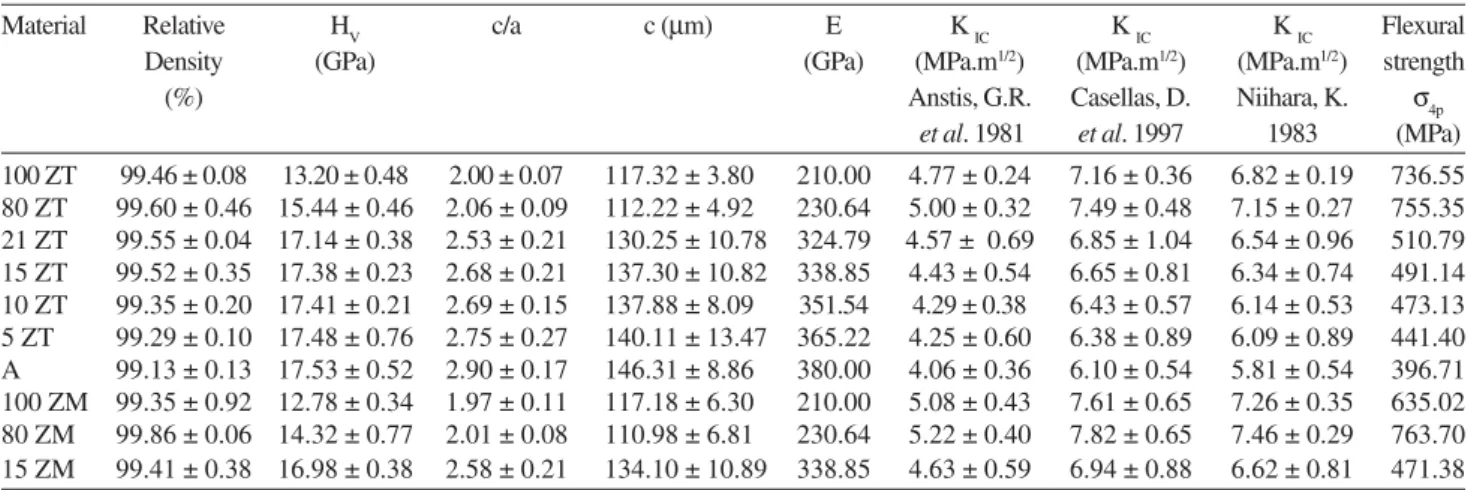
The sintered pure oxides and composites showed relative density in the range of 99.13% to 99.86%(Table 1). The total porosity less than 1%vol is required to high pure ceramics of alumina and zirconia for surgical implantations.(ASTM F-603-0035 and ASTM F-1873-9836, respectively). In general, sintered samples with higher relative density exhibit greater mechani-cal properties. However, there is also an influence of micro-structure uniformity on mechanical properties. The highest density were obtained for 80 ZT e 80 ZM (Table1). From pure alumina (A) untill 21 wt.% zirconia Tosoh (21 ZT), the density of the composites increases with the increase of zirconia con-tent, indicating that the addition of zirconia particles allowed the densification of alumina matrix. In the same way, starting from pure zirconia to 80 ZT, the adittion of alumina enhanced the composite densification. Observations of the sintered ma-terials by scanning electron microscopy (SEM, JSM-5200-LV, Jeol, Japan) showed highly homogeneous microstructures with-out aglomerates, pores or abnormally grown alumina grains. X-ray diffraction analyses of the samples indicated that only α-alumina, tetragonal and monoclinic zirconia are the crystal-line phases present in both the pure and in the composites. A fine and a bimodal distribution of particles size allowed the most efficient fulfilling of the matrix socket for uniaxially press-ing, promoting better densification of the powders. The use of 0.6 wt.%37,38 of citric acid as dispersant was effective to pre-vent agglomerates which are sources of imperfections during sintering39.
3.2. Indentation load and Vickers hardness
to be done. The indentation load is critical in the measure of hardness and fracture toughness using the indentation method. The amount of load could affect the indentation size and the crack length, being dependent of the sample dimension and the microstructure of the material. Many ceramic that show a decrease of hardness with the load in-crease can have this problem solved41. The solution is that the measure of the Vickers hardness be carried out in raised loads42, above of 50 N, where the influence of the load in the measure of the hardness decreases and so the standard hardness can be obtained.
3.3. Flexural strength measures
The ceramic strength values usually exhibit a large scat-tering (up to 100%) even for high performance ceramics43. This well known phenomenon, which arises from the scat-tering of the initial sizes of the defects responsible for failure, is generally studied statisticaly by means of Weibull’s analy-sis. The first and most important step for improving the strength and reliability of ceramics is to reduce the size of cracks and defects44. This can be achieved by obtaining a fine-grained more uniform and more dense structure by use of improved powders(higher purity and a fine and narrow initial particle size distribution) as well as by adopting better processing techniques. The composites 80 ZT and 80 ZM presented flexural strength 90% and 93% higher when com-pared with pure alumina, respectively, showing that the sec-ond phase addition provided a composite with a more dense and refined microstructure, a reduced size of the crack popu-lation, and as expected that the strength of ceramics is in-versely proporcional to the square root of the grain size45.
3.4. Measure of fracture toughness
The zirconia addtion had a large effect in increasing the fracture strength28, but its influence on fracture toughness was much smaller (Table 1). The reason for this behavior
Table 1. Material properties
Material Relative HV c/a c (µm) E K IC K IC K IC Flexural
Density (GPa) (GPa) (MPa.m1/2) (MPa.m1/2) (MPa.m1/2) strength
(%) Anstis, G.R. Casellas, D. Niihara, K. σ4p
et al. 1981 et al. 1997 1983 (MPa)
100 ZT 99.46 ± 0.08 13.20 ± 0.48 2.00 ± 0.07 117.32 ± 3.80 210.00 4.77 ± 0.24 7.16 ± 0.36 6.82 ± 0.19 736.55
80 ZT 99.60 ± 0.46 15.44 ± 0.46 2.06 ± 0.09 112.22 ± 4.92 230.64 5.00 ± 0.32 7.49 ± 0.48 7.15 ± 0.27 755.35
21 ZT 99.55 ± 0.04 17.14 ± 0.38 2.53 ± 0.21 130.25 ± 10.78 324.79 4.57 ± 0.69 6.85 ± 1.04 6.54 ± 0.96 510.79 15 ZT 99.52 ± 0.35 17.38 ± 0.23 2.68 ± 0.21 137.30 ± 10.82 338.85 4.43 ± 0.54 6.65 ± 0.81 6.34 ± 0.74 491.14
10 ZT 99.35 ± 0.20 17.41 ± 0.21 2.69 ± 0.15 137.88 ± 8.09 351.54 4.29 ± 0.38 6.43 ± 0.57 6.14 ± 0.53 473.13
5 ZT 99.29 ± 0.10 17.48 ± 0.76 2.75 ± 0.27 140.11 ± 13.47 365.22 4.25 ± 0.60 6.38 ± 0.89 6.09 ± 0.89 441.40
A 99.13 ± 0.13 17.53 ± 0.52 2.90 ± 0.17 146.31 ± 8.86 380.00 4.06 ± 0.36 6.10 ± 0.54 5.81 ± 0.54 396.71
100 ZM 99.35 ± 0.92 12.78 ± 0.34 1.97 ± 0.11 117.18 ± 6.30 210.00 5.08 ± 0.43 7.61 ± 0.65 7.26 ± 0.35 635.02
80 ZM 99.86 ± 0.06 14.32 ± 0.77 2.01 ± 0.08 110.98 ± 6.81 230.64 5.22 ± 0.40 7.82 ± 0.65 7.46 ± 0.29 763.70
15 ZM 99.41 ± 0.38 16.98 ± 0.38 2.58 ± 0.21 134.10 ± 10.89 338.85 4.63 ± 0.59 6.94 ± 0.88 6.62 ± 0.81 471.38
can be the absence of two of the main toughening mecha-nisms of ZTA: crack bridging and the transformation tough-ening. The crack bridging is negligible because of the small grain size of alumina (only small bridges were detected in pure alumina). The transformation toughening is also ab-sent because only 5% of ZrO2 transforms on fracture sur-faces. The reason for this can be the fact of the ZrO2 aver-age particle size is too small that it can not activate the stress-induced phase transformation. In fact, the authors had found greater values of fracture toughness when the grain size of alumina matrix and zirconia particles had been increased with thermal treatments of grain growth. The size of the tetragonal particle and the stabilizer content, have great in-fluence in the tension required for the transformation of te-tragonal particle46. The critical grain sizes increase with the Young’s modulus of the composite, which is related with the restrictions imposed to the matrix. A time that the Young’s modulus decreases with the zirconia content in accordance with the rule of mixtures, the critical grain sizes will be lesser in composites with higher zirconia.
composites for ceramic abutments transformation, when the tetragonal zirconia particles
trans-forms into monoclinic zirconia. The formation in excess of microcracks can degrade its mechanics resistance. Another effect is that when the transformation tetragonal to mono-clinic occurs, the resultant expansion creates compression zones that make it difficult the crack propagation from the defects of the material. As the second mechanism that acts in these composites, the microcracking that occurs around zirconia particles transformed causes energy dispersion and toughening the material. This mechanism operates in the same direction of the phase transformation and it is more impor-tant in the composites with higher zirconia content50. It can also be verified leaving from the pure zirconia that the 20 wt.% of alumina addition in the matrix of zirconia (80 ZT or 80 ZM), promoted the highest value of KIC, been 23% and 29% superi-ors to the KIC value found for pure alumina, respectively. Su-perior KIC values for 80 ZM can be explained by the better densification of the composite and by a finer and narrow parti-cle size distribution, a greater specific surface area and a higher retention of the tetragonal phase51 when compared with 80 ZT. In addition, other mechanisms that promotes the increase of fracture toughness such as crack bridging and crack deflection could be activated when alumina is added the zirconia stabi-lized with yttria.
3.5. Use of equations for indentation fracture toughness calculations
It is well known that toughness measurement using microindentation methods are readily influenced by the sur-face condition of sample as compared to that using the bulk techniques52. The employment of various techniques to meas-ure fractmeas-ure toughness would yield different results possibly due to difference of crack mechanisms induced, althought, ar-guments may be just due to the different toughness equations used(Table 1). The Eq. 3 and Eqs. 4a and 4b supply KIC values that are 50% and 43% superior for the same material when compared to the values obtained from Eq. 2, respectively. The low KIC obtained in samples with residual stress produced by indentation can be attributed to the fact that the equation pro-posed by Anstis with the parameters of adjustment A = 0.016 and n = 0.5 underestimates the residual stress field. Some au-thors have proposed correction for the parameter A (more than 20%) to be used in ceramics containing zirconia20,28. Despite the Anstis equation be widely applied for estimates the frac-ture toughness, its results are only average numbers calculated to adjust the results for a high range of materials. In the case of alumina, these values are used and present good results.
3.6. Crack system
Two types of crack system are at least produced by a Vickers indenter, i.e., a median crack system and a Palmqvist crack system. Generally, the high toughness material shows
Palmqvist crack system. However, most materials will present both crack systems dependent on the amount of load31,52. One way to distinguish the crack system present in the analysed material consists on verification of c/a ratio29. If it is less than 2.5, than the material shows Palmqvist crack system as for the samples 100 ZT, 80 ZT, 100 ZM e 80 ZM in Table 1. If it is greater or equal 2.5, the material exhibiths median crack system. The crack system mode for Y-TZP and composite with 80 wt%. of Y-ZrO2 , under loads of < 98 N, presents the Palmqvist crack system regardless of fracture toughness. All the other samples had presented median crack system53. For each sample, the value of a (semi-diagonal length) is approximately constant and there-fore, the ratio c/a increases with the increase of the crack length54 and lower is the fracture toughness of the analyzed sample. It is possible to verify in Table 1 that lesser crack length was presented for the samples 80 ZT and 80 ZM and that higher were the KIC values, independently of the equa-tion used for its calculaequa-tion, which allows to conclude that the trend observed for the KIC values for the samples of this work is not related with R-curve effects, where the resist-ance to crack propagation or the toughness would increase with the increase of crack length31.
4. Conclusions
1. The analysis of the zirconia-alumina composites have shown that the zirconia addition promotes composites with higher densities, higher flexural strength and frac-ture toughness. It was shown that there is an inverse dependence of KIC on the hardness.
2. These composites can achieve a flexural strength 93% and fracture toughness 29% superior when compared to the pure alumina ceramics.
3. The pure zirconia and the composite with 80% of zirconia addition have shown Palmqvist crack system under indentation load of 98,1 N. The other composi-tions have shown median crack system.
4. The use of different equations for indentation fracture toughness calculations have shown differences of 50% for KIC values for the same composition.
be developed in order to obtain a more reliable result of its performance in this specific dental application.
References
1. Fischer H.; Marx R. Fracture toughness of dental ce-ramics: comparision of bending and indentation method, Dental Materials, v. 18, n. 1, p. 12-19, 2002. 2. Brånemark P.I.; Zarb G. A.; Albrektsson T. Tissue-inte-grated prostheses: osseointegration in clinical dentistry, Quintessence Verlags - GmbH - Berlim, 1987. 3. Sadoun M.; Perelmuter S. Alumina-zirconia machinable
abutments for implant-supported single-tooth anterior crowns, Practical Periodontics and aesthetic dentistry, v. 9, n. 9, p. 1047-1053, 1997.
4. De Aza, A.H.; Chevalier, J.; Fantozzi, G. et al., Crack grouth resistance of alumina, zirconia and zirconia toughened alumina ceramics for joint prostheses, Biomaterials, v. 23, p.937-945, 2002.
5. Hannink, R.H.J. Transformation toughening in Zirconia-Containing Ceramics, J. Am. Ceram. Soc., v. 83, n. 3, p. 461- 487, 2000.
6. Fischer H.; Rentzsch,W.; Marx, R. Elimination of low-qual-ity ceramic posts by proof testing, Dental Materials, v. 18, n. 8, p. 570 - 575, 2002.
7. Keith, O.; Kusy, R.P.; Whitey J.Q. Zirconia brackets: an evalu-ation of morphology and coefficients of friction Am. J. Orthod. Dentofacial Orthop, v. 106, n. 6, p. 605 - 614, 1994. 8. Cando, D.C. Zirconia: una alternativa fiable, Labor
Den-tal, v. 4, n. 2, p.1-7, 2001.
9. Ardlin, B.I. Transformation-toughened zirconia for dental inlays, crowns and bridges: chemical stability and effect of low-temperature aging on flexural strength and sur-face structure, Dental Materials v. 18, n. 8, 590-595, 2002. 10. Prestipino, V. and Ingber, A. All-ceramic implant abut-ments: Esthetic indications, Journal of Esthetic Den-tistry v. 8, p. 255-262, 1996.
11. Christel, P.; Meunier, A.; Heller, M; Torre, J.P.; Peille, C.N. Mechanical properties and short-term in vivo evaluation of yttrium-oxide-partially-stabilized zirconia, J. Biomed. Mater. Res, v. 23, p. 45-61, 1989. 12. Affatato, S.; Goldoni, M.; Testoni, M.; Toni, A. Mixed-oxides prosthetic ceramic ball heads, Part 3: effect of the ZrO2 fraction on the wear of ceramic on ceramic hip joint prostheses, A long term in vitro wear study, Biomaterials, v. 22, p. 717-723, 2001.
13. Serra, E.; Tucci, A.; Esposito, L.; Piconi, C. Volumetric determination of the wear of ceramics for hip joints, Biomaterials, v. 23, p. 1131-1137, 2002.
14. Piconi, C.; Maccauro, G. Zirconia as a ceramic bio-material, Biomaterials v. 20, p. 1-25, 1999.
15. Wang, J.; Stevens, R. Review zirconia-toughened alumina(ZTA) ceramics, J. Mat. Science, v. 24,
p. 3421-3440, 1989.
16. Claussen, N.J.; Fracture toughness of Al2O3 with an un-stable ZrO2 dispersed second phase, J. American Ceram. Soc., v. 61, p. 49-51, 1976.
17. Lange, F.F. Transformation toughening: Part 4 - Fabri-cation fracture toughness and strength of Al2O3- ZrO2 composites, J. Mat. Sci., v. 17, p. 247-254, 1982. 18. Hori, S.; Yoshimura, M.; Somiya, S. Strength-toughness
re-lation in sintered and isostatically hot-pressed ZrO2- tough-ened Al2O3, J. Am. Ceram. Soc., v. 69, p. 169-172, 1986. 19. Evans, A.G.; Perspective on the development of
high-tough-ness ceramics, J. Am. Ceram. Soc, v. 73, p. 187-206, 1990. 20. Casellas, D.; Ràfols, I.; Llanes, L.; Anglada, M. Fracture toughness of zirconia-alumina composites, Int. J. of Re-fractory Metals & Hard Materials, v. 17, p. 11-20, 1999. 21. Gregori, G.; Burger, W.; Sergo, V. Piezo-spectroscopic analysis of the residual stress in zirconia-toughened alumina ceramics: the influence of the tetragonal-to-monoclinic transformation, Materials Science and Engineering, v. A271, p. 401-406, 1999.
22. Karihaloo, B.L. Contributions of t-m phase transfor-mation to the toughening of ZTA, J. Am. Ceram. Soc. v. 74, p. 1703-1706, 1991.
23. Becher, P.F.; Alexander, K.B.; Warmick, W. Influence of ZrO2 grain size and content on the transformation response in the Al2O3- ZrO2(12% mol CeO2) system, J. Am. Ceram. Soc, v. 76, p. 657-663, 1993.
24. Fantozzi, G.; Orange, G. Thermomechanical proper-ties of zirconia toughened alumina materials, In: eds. Moya, J.S.; De Aza, S. editors, Processing of advanced ceramics, Soc. Esp. Ceram. Vidr. Arganda Del Rey Ma-drid Spain, p. 187-215, 1986.
25. ASTM: C1327-99, Standard test method for Vickers in-dentation hardness of advanced ceramics, p.1-8, 1999. 26. ASTM: C-1421-99, Standard test method for determi-nation of fracture toughness of advanced ceramics at ambient temperature, p. 1-32, 1999.
27. Anstis, G.R.; Chantikul, P.; Lawn, B.R.; Marshall, D.B. A. critical evaluation of indentation techniques for meas-uring fracture toughness: I direct crack measurements, J. of American Ceramic Society, v. 64, n. 9, p. 533-538, 1981. 28. Casellas, D.; Nagl, M.M.; et al., Growth of Surface Inden-tation Cracks in Alumina and Zirconia Toughened Alumina, Key Engineering Materials, v. 127-131, p. 895-902, 1997. 29. Niihara, K.; Morena, R.; Hasselman, D.P.H. In: Bradt R.C.; Evans. A.G.; Hasselman D.P.H.; Lange. F.F. edi-tors, Fracture mechanics of ceramics, New York, Ple-num: v. 5, p. 97, 1983.
30. Hannink, R.H.J. Transformation toughening in Zirconia-Containing Ceramics, J. Am. Ceram. Soc., v. 83, n. 3, p. 461-487, 2000.
composites for ceramic abutments low yttria content, Acta Materialia, v. 50, p. 4555-4562, 2002.
32. Tuan, W.H.; Chen, R.Z.; Wang, C.H.; Cheng, P. S.; Kuo, P.S. Mechanical properties of Al2O3//ZrO2 composites, J. European Ceram Soc., v. 22, p. 2827-2833, 2002. 33. Silva, F.R. Cinética de sinterização e desgaste de pastilhas
de corte do sistema Si3N4-CeO2-AIN, Tese de Doutorado, Universidade de Aveiro, 1992.
34. ASTM: C1161-90, Standard Test Method for Flexural Strength of Advanced Ceramics at Ambient Temperature, p. 329-335, 1990.
35. ASTM: F-603,00, Standard specification for high-purity aluminium oxide for medical application, p. 103-105, 2000. 36. ASTM F-1873-98, Standard specification for high-purity dense yttria tetragonal zirconium oxide polycrystal(Y-TZP) for surgical implant applications, p. 1349-1351, 1998. 37. Kunes, K.; Havrda, J.; et al. Stabilization of Bioceramic
suspensions prepared from alumina-containing zirconia powders, Ceramics, v. 44, n. 1, p.1-8, 2000.
38. Oliveira, L.G. Efeito do processamento nas propriedades mecânicas da alumina tenacificada por zircônia parcialmente estabilizada com cálcia ou ítria, M. Sc. Thesis, COPPE-UFRJ, 2002.
39. Mukherjee, A.; Maiti, B.; Shara, A.D.; Basu, R.N.; Maiti, H.S. Correlation between slurry. rheology. green density and sintered density of tape cast yttria stabi-lised zirconia. Ceramics Int., v. 27, p. 731-739, 2001. 40. Lange, F.F. Transformation toughening: Part 4 - Fabri-cation fracture toughness and strength of Al2O3- ZrO2 composites, J. Mat. Sci., v. 17, p. 247-254, 1982. 41. Krell, A. Load dependence of hardness in sintered
submicrometer Al2O3 e ZrO2, J. Am. Ceram. Soc.,v. 78, n. 5, p. 1417-1419, 1995.
42. Celli, A.; Tucci, A.; Esposito, L.; et al., Fractal analysis of cracks in alumina-zirconia composites, J. Eur. Ceram. Soc., v. 23, p. 469-479, 2003.
43. Absi, J.; Glandus, J.C. Numerical separation of
bi-mo-dal strength distributions, Journal of the European Ce-ramic Society, v. 22, p. 593-601, 2002.
44. Tuan, W.H.; Kuo, J.C. Contribution of residual stress to the strength of abrasive ground alumina, J. Eur. Ceram. Soc. v. 19, p. 1593–1597, 1999.
45. Spriggs, R.M.; Vasilos, T. Effect of grain size on trans-verse bend strength of alumina and magnesia, J. Am. Ceram . Soc. v. 46, p. 224-228, 1963.
46. Gupta, T.K.; Lange, F.F.; Bechtold, J.H. Effect of stress-induced phase transformation on properties of polycrystalline zirconia containing metastable tetrago-nal phase, J. Mater. Sci., v. 13, p. 1464-1470, 1978. 47. Huang, X.W.; Wang, S.W.; Huang, X.X. Microstructure
and mechanical properties of ZTA fabricated by liquid phase sintering, Ceramics International, article in press. 48. Tomaszewski, H. Toughening effects in Al2O3- ZrO2
system, Ceram. Intern., v. 14, p. 117-125, 1988. 49. Hori, S.; Yoshimura, M.; Somiya, S. Strength-toughness
re-lation in sintered and isostatically hot-pressed ZrO2- tough-ened Al2O3, J. Am. Ceram. Soc., v. 69, p. 169-172, 1986. 50. Lange, F.F. Transformation toughening: Part 1- Size
ef-fects associated with the thermodynamics of constrained transformations, J. Mat. Sci., v. 17, p. 225-234, 1982. 51. Srdic, V.; Radonjic, L. Processing of the
alumina-zircônia composite and its mechanical properties. In: Third Euro-Ceramics, ed. Urán, P.; Fernández, J.F., v. 3, p. 701-706, 1993.
52. Lin, J.D.; Duh, J.G. Fracture toughness and hardness of ceria and yttria-doped tetragonal zirconia ceramics, Ma-terials Chemistry and Physics, v. 78, p. 253-261, 2002. 53. Basu, D.; Sarkar, B.K. Toughness determination of zirconia