DO:
D 10.1590/S1516-14392011005000069
*e-mail: [email protected]
Structural and Photocatalytic Characterization of BaFe
2O
4Obtained at Low Temperatures
Silvana Da Dalt*, Bruna Berti Sousa, Annelise Kopp Alves, Carlos Pérez Bergmann
Ceramic Materials Laboratory, Federal University of Rio Grande do Sul – UFRGS,
Av. Osvaldo Aranha 99, sala 705C, CEP 90035-190, Porto Alegre, RS, Brazil
Received: March 16, 2011; Revised: August 8, 2011
Barium monoferrite BaFe2D4 classiied as permanent magnet stands out among other ceramic magnets due
to its high chemical stability, corrosion resistance and low production cost. In addition, experiments conducted on photocatalytic degradation of methyl orange and UV transmittance by spectrophotometry have shown that this material has photocatalytic properties. The spinel ferrite is of importance in many technological areas such as computing, communications and security. Several techniques for synthesis have been studied to optimize the properties of this material. The synthesis of BaFe2D4 by conventional processes often occurs at temperatures above
1000 °C. In this work, we obtained the phase BaFe2D4 at low temperatures (600 °C) from the combustion reaction
using nitrates and maleic anhydride as metal complexing agent. Techniques of X-ray diffraction, speciic surface area, thermogravimetry analysis and photocatalytic analysis were employed to characterize the products obtained.
Keywords: barium monoferrite, combustion reaction, photocatalysis
1. Introduction
Barium ferrite is often used in the manufacture of permanent magnets, magnetic storage media, magneto materials and pigments, as well as in the absorption of electromagnetic waves1,2. The great
interest in ferrites is mainly due to the high abundance of reagents
and low cost of production. This material has high capacity of magnetization, high coercivity, high chemical stability1, as well as photocatalytic properties1. The degradation by photocatalysis is based on the irradiation of a photocatalyst, usually an inorganic N-type semiconductor3. Reducing or oxidizing reactions promoted by radiation energy are able to oxidize organic compounds to CO2 and H2D and to reduce the metals involved in the case4. The mixture of precursors at elevated temperatures (≥1000) is considered a trivial process for obtaining a barium ferrite5. However, the use of high temperatures during synthesis or subsequent heat treatment provides a natural loss of ine particles in the product6. We searched to ind a method that is simple, economical and which basically keeps the characteristics of the powder as much under controlas possible (purity, chemical homogeneity, shape and size of particles). The combustion method presents some advantages over other methods: the reagents are simple compounds and do not require any special equipment, the doping can be easily introduced, and the agglomeration of powders
remains limited7. Moreover, it has proven to be quite promising to obtain nanostructured ferrite powders5,7,8. This research had as main objectives to examine the photocatalytic activity of BaFe2D4 powders obtained via the combustion reaction using maleic anhydride and
metal nitrates as precursors, and to evaluate the behavior of crystalline phases and surface area obtained by thermal treatments.
2. Experimental
The following precursors were used to obtain ine powders: iron nitrate Fe(NO3)3. 9H2O (Vetec), barium nitrate Ba(NO3)2. 6H2D
(Vetec) and maleic anhydride (Synth), all compounds with high purity. Initially, the nitrates were dissolved in a minimum amount of deionized water (enough to dissolve) and subjected to thermal agitation at about 60 °C. The complexing agent was added and
the system remained for several minutes under agitation to ensure
homogenization. Subsequently, the precursor solutions were brought to an electric furnace (Sanchis), preheated at 400 °C, where the self-ignition of the system occurred. The prepared solutions have the stoichiometric composition between oxidizing and reducing agents. The as-synthesized sample obtained was named BFAS. After synthesis, the as-synthesized powders were thermally treated at 500,
600, 700, 800, 900 and 1000 °C for 1 hour, whose nomenclatures were established as BF500, BF600, BF700, BF800, BF900 and
BF1000, respectively.
The characterization of the resulting powders after heat treatment was performed by means of X-ray diffraction (XRD) to verify the presence of crystalline phases. For this purpose the X-ray diffractometer Philips X’Pert MPD was used, equipped with graphite monochromator and ixed anode operated at 40 kV and 40 mA, which uses a radiation wavelength (λ = 0.154056 nm) of Cu-Kα. The Autosorb Quantachrome (Nova 1000) was used for determining the speciic surface area by N2 adsorption using the BET method. The photocatalytic activity analysis uses an equipment consisting of 12 lamps of 8 W (λ = 365 nm), a Dreschel glass lask with a silicone septum for sample withdrawal, an air bubbler and a magnetic stirrer. The photoactivity of the samples was determined following the photodegradation of a solution containing 20 ppm of methylorange under UVA irradiation up to 80 minutes. For this analysis, samples
were collected every 10 minutes and their absorbance was determined
by UV-Vis spectrophotometry (Biospectro). The thermal analysis (TGA/SDTA - Metler Toledo 851e) was performed using O2 atmosphere with a heating rate of 10 K/min up to 900 °C.
Da Dalt et al.
Figure 1. TGA as-obtained sample BFAS.
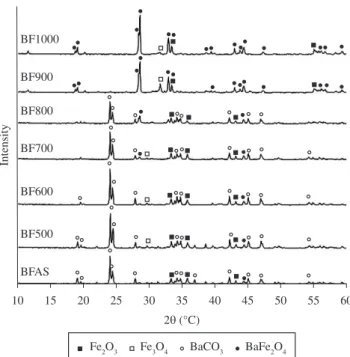
Figure 2. X-ray diffraction patterns of as-synthesized sample and samples
subjected to heat treatment for 1 hour.
Figure 3. SEM micrographs of samples: a) as-synthesized at 400 °C; b) heat treated at 1000 °C; and c) heat treated at 1000 °C with magnetic particles.
3. Results and Discussion
Figure 1 shows the thermal analysis (TGA/SDTA) of as-obtained sample BFAS. The TGA curve presents a continuous weight loss until 900 °C, probably due to residual organics and carbonates. The SDTA curve presents a peak, suggestive of an exothermic reaction around 550 °C, probably associated with the decomposition of
carbonates formed during the combustion synthesis of the nitrates
and the oxidizing agent.
In fact, the XRD analysis (Figure 2) of the samples as-synthesized and heat treated suggests the presence of secondary phases such as barium carbonate (BaCO3) between 500 °C and 800 °C. Between 900 °C and 1000 °C the presence of barium ferrite (BaFe2D4) becomes the main phase, but the samplealso presents some peaks of iron oxides.
Castro et al.7 also obtained BaFe
2D4 via combustion synthesis and
even after heat treatment at 700 °C for 2 hours they also observed
secondary phases such as BaCO3 and Fe3D4. Additional heat treatment
above 900 °C promotes the decomposition of residual carbonates
and the formation of BaFe2D4. Qiu et al.1, also obtained barium
ferrite and hematite phases before annealed at 850 °C employing
the combustion synthesis.
Structural and Photocatalytic Characterization of BaFe
2D4 Dbtained at Low Temperatures
Table 1. Relationship between annealing temperature (T) and speciic surface area (SBET) samples at different temperatures.
Sample T (°C) SBET (m2.g–1)
BFAS 400 9.40
BF500 500 4.65
BF600 600 7.62
BF700 700 3.34
BF800 800 6.73
BF900 900 8.67
BF1000 1000 9.92
Figure 3a presents an SEM image of the as-synthesized sample. It is possible to observe a large amount of microscopic pores, with the typical structure of the materials obtained by combustion synthesis. The distribution of holes forms a cluster system, presenting irregular shapes of different sizes and deformed surfaces. The formation of these clusters is probably due to the intense forces of van der Waals attraction between particles. However, in Figure 3b it is possible to notice the beginning of the coalescence process and the formation of aggregates. Figure 3c shows some areas comprising aligned acicular-shape magnetic particles. Some small spherical particles inside the acicular zone could also be observed. This could indicate there was not enough opportunity to convert all magnetite to hematite8.
Table 1 lists the temperature of heat treatment correlated with the speciic surface area (SBET) of the samples. The results show that the samples have similar speciic surface area values varying from 3.3 to
9.9 m2.g–1. It is possible, however, to observe that samples BF900 and BF1000 have the highest surface area among the heat treated samples.
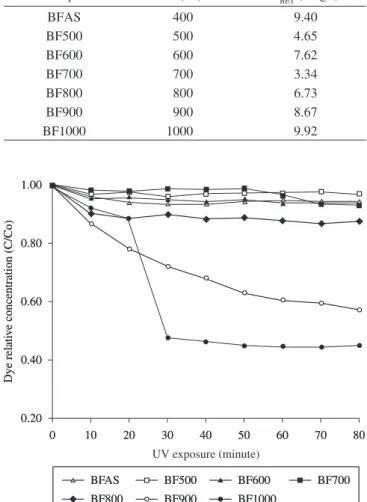
Figure 4 shows the results of photocatalytic degradation of methylorange in the presence of the different samples. Samples BFAS, BF500, BF600, BF700 and BF800 showed low values of
dye degradation. According to Yang et al.3 the low photocatalytic activity of these samples is mainly due to the presence of BaCO3 and
low crystalline phases present in these samples, as corroborated by
Figure 4. Transmittance of the samples with different temperatures of heat
treatments.
the analysis of XRD (Figure 2). Higher photoactivity was obtained for the BF900 and BF1000 samples, where the speciic surface area is higher and the presence of BaFe2D4 is more evident (Figure 2). It is well established that BaFe2D4 is a photocatalyst and that BaCO3
and isolated iron oxides do not promote photodegradation. Indeed, the main factor in the photoactivity of any catalyst is the presence of amorphous or low crystalline phases that act as electron traps, avoiding the free radical formation and, furthermore, dye degradation. In the XRD results it is possible to notice that the identiication (formation)
of BaFe2D4 peaks is only observed for samples annealed at 900 and
1000 °C. This correlates well with the photocatalytic results that show that these speciic samples have by far the highest photoactivity.
4. Conclusions
The combustion synthesis in the solution using maleic anhydride as fuel showed a favorable process for obtaining BaFe2D4. However,
when the sample was subjected to heat treatment at temperatures below 1000 °C, secondary phases such as BaCO3, Fe2D3 and Fe3D4
were observed. As for the photocatalytic activity, it was observed that samples annealed at 900 and 1000 °C showed considerable photocatalytic activity, presumably because of the presence of well-deined crystalline phases and higher surfaces areas. The presence of carbon and secondary phases of low crystallinity possibly intervened in the photocatalytic activity of the other samples. Thus, it was possible to combine the highest surface area (9.92 m2.g–1) and the presence of BaFe2D4 with the best photocatalytic performance.
Acknowledgements
The authors acknowledge CNPq for inancial support.
References
1. Qiu J, Le L and Gu M. Nanocrystalline structure and magnetic properties of barium ferrite particles prepared via glycine as a fuel. Materials Science and Engineering A. 2005; 393:361-365. http://dx.doi.org/10.1016/j.
msea.2004.11.003
2. Candeia RA, Souza MAF, Bernardi MIB, Maestrelli SC, Santos IMG,
Souza AG et al. Monoferrite BaFe2D4 applied as ceramic pigment. Ceramics International. 2007; 33:521-525. http://dx.doi.org/10.1016/j.
ceramint.2005.10.018
3. Yang Y, Jiang Y, Wanga Y, Suna Y, Liua L and Zhang J. Inluences of sintering atmosphere on the formation and photocatalytic property of
BaFe2D4. Materials Chemistry and Physics. 2007; 105:154-156. http:// dx.doi.org/10.1016/j.matchemphys.2007.04.050
4. Gouvêa CAK, Wypych F, Moraes SG, Durán N, Nagata N and
Peralta-Zamora P. Semiconductor-assisted photocatalytic degradation of reactive dyes in aqueous solution. Chemosphere. 2000; 40:433-440. http://dx.doi.
org/10.1016/S0045-6535(99)00313-6
5. Qiu J and Gu M. Crystal structure and magnetic properties of barium ferrite synthesized using GSPC and HEBM. Journal of Alloys and Compounds.
2006; 415:209-212. http://dx.doi.org/10.1016/j.jallcom.2005.03.125
6. Liu YL, Liu ZM, Yang Y, Yang HF, Shen GL and Yu QR. Simple
synthesis of MgFe2D4 nanoparticles as gas sensing materials. Sensors and Actuators B: Chemical. 2005; 107:600-604. http://dx.doi.org/10.1016/j.
snb.2004.11.026
7. Castro S, Gayoso M and Rodriguez C. A Study of the Combustion Method
to Prepare Fine Ferrite Particles. Journal of solid state chemistry. 1997;
134:227-231. http://dx.doi.org/10.1006/jssc.1997.7523
8. Nikkhah-Moshaie R, Ataie A and Seyyed Ebrahimi SA. Processing of nano structured barium hexaferrite by self-propagating high temperature synthesis (SHS) using nitrate precursor Journal of Alloys and Compounds.
2007; 429:324-328. http://dx.doi.org/10.1016/j.jallcom.2006.04.034