Early Phase of the Cross Car Beam Concept Development
Ana Rita Cunha Rodrigues da Silva
Dissertação para obtenção do grau de Mestre em Engenharia Mecânica
Orientador: Professor António Augusto Fernandes Presidente do Juri: Professora Lúcia Dinis Arguente externo: Engenheiro Jose Sampaio
Faculdade de Engenharia da Universidade do Porto Mestrado Integrado em Engenharia Mecânica
Design is in everything we make, but it’s also between those things. It’s a mix of craft, science, storytelling, propaganda, and philosophy.
ABSTRACT
Product development is the process of generating new products or services that intend to meet pre-existent needs. This process is a very powerful tool in the modern world, where competition became global and product life span is shorter than ever. However, its use and implementation may not be entirely straightforward and, if misunderstood can lead to a disastrous business or, ultimately to the company’s ruin. The recognition of a new market opportunity is how the whole process starts and goes through many steps until the product is ready to be launched.
This thesis submits an approach for the early phase of this process using an automotive component as a case-study. The intention is to reflect and understand how the process of design and product development can be applied to such complex product as the Cross Car Beam. Within the scope of the project it was established a partnership between a local Tier 1 car component supplier and the Faculty of Engineering, which allowed for a closer and direct contact with most stakeholders.
Being the automotive industry a very challenging industry regarding quality, reliability, safety and price, there was a special emphasis given to the effort of reducing costs and enhancing performances. Working with a zero constraint policy created multiple solutions, which means that each one had to be carefully analysed. From the traditional mild steel single tube, to the
highly integrated hybrid, many solutions can be obtained by varying only a few parameters. The systematic feature of the process allowed to get to the end of the project with clear-cut product specifications for what intends to be and what it has to be done to reach it.
KEYWORDS: Design and Product Development, Automotive Industry, Cross Car Beam, Systematic Process
RESUMO
Desenvolvimento de produto é o processo the geração de novos produtos ou serviços que pretendem responder a necessidades pré-existentes. Este processo é uma ferramenta muito ponderosa no mundo em que vivemos, uma vez que a competição é global e a vida útil de um produto é cada vez mais curta. No entanto, o uso e implementação desta ferramenta não é simples nem direto, se for mal usado pode levar ao falhanço de um projeto e, em casos mais graves à falência da empresa. O reconhecimento de novas oportunidades de mercado é como todo o processo se inicia, depois tem de passar por uma série de etapas até o produto estar pronto a ser lançado.
Esta tese submete uma abordagem à fase inicial deste processo usando um componente automóvel como caso de estudo. A intenção é refletir e perceber como é que o processo de design e desenvolvimento do produto pode ser aplicado num componente tão complexo como é o caso do Cross Car Beam. No âmbito deste projeto, foi estabelecida uma parceria entre um fornecedor de componentes automóveis local e a Faculdade de Engenharia, que permitiu um contacto mais próximo e facilitado com a maioria dos stakeholders.
Sendo a indústria automóvel tão exigente no que respeita a qualidade, confiabilidade, segurança e preço, que foi dado ênfase especial ao esforço de redução de custos e melhoria de desempenhos. Trabalhar com uma política de zero restrições criou múltiplas soluções, o que significa que cada uma teve de ser cuidadosamente analisada. Desde o tradicional tubo simples de aço-carbono até a solução híbrida altamente integrada muitas soluções poderiam ser obtidas com apenas uma pequena variação dos parâmetros.
A característica sistemático do processo permitiu chegar ao final do projeto, com especificações claras do que o produto pretende ser e o que tem de fazer para lá chegar.
KEYWORDS: Design e Desenvolvimento do Produto, Indústria Automóvel, Cross Car Beam, Processo Sistemático
ACKNOWLEDGEMENTS
My first words of appreciation are to my supervisor Professor António Augusto Fernandes for the opportunity to work with him, his expert knowledge in the field of this work was a great contribution and inspiration. I would like to acknowledge the support and optimism given during this period. Finally, I would also like to thank for the opportunity to participate in a conference about this theme.
Secondly, I am grateful for engenheiro Nuno Merendeiro and engenheiro Paulo Gomes without whom my work would have been much difficult since they were my contacts inside SODECIA, SA but also, because they always showed every willingness to receive me and help me with any specificities inherent to this work.
I would like to take advantage of this opportunity to acknowledge the presence of some people who are part of my life for which I have the privilege to call friends, they taught me to appreciate the things that are invisible to the eye. They are examples that I try to follow and that I will try to keep with me everywhere I go. Fortunately, there are many names that could appear on this list but I will mention those whose presence was decisive during this complicated time, they are Maria, Filipa, Iliona, Catarina, Mariana, João, Jorge and, of course the “Real Parvoíce”.
I would like to thank my parents for their unconditional love, hard work and dedication and for always being with me, especially when I needed the most. For their example and their support throughout my moments of doubt.
To Inês and Xinó that are always around to fill my life with many moments of happiness and stupidity.
Gostaria também de reconhecer a importância da minha família mais alargada, começando pelos meus avós Afonso, Maria, Manuel e Áurea que pelos seus ensinamentos e exemplo me mostraram como se pode ser inteiro e, me deram a determinação e coragem necessárias para também o querer alcançar. Segue também, um agradecimento à restante família pela confiança e carinho que sempre me transmitiram, particularmente à Tita em quem me apoio e por quem tenho grande admiração, respeito e especial ligação afetiva.
Saying thank you is not enough when someone gives you more than it is conceivable. Gonçalo, thank you for always seeing the better in me and for making me want to exceed every day.
TABLE OF CONTENTS
ABSTRACT ... VII RESUMO ... IX ACKNOWLEDGEMENTS ... XI INTRODUCTION ... 23 Motivation ... 23 Objectives ... 24 Thesis Structure ... 251 PRODUCT DEVELOPMENT PROCESS ... 27
1.1 The Innovation Role ... 28
1.2 The Design Method ... 30
1.3 Product Development Process ... 30
2 NEW PRODUCT DEVELOPMENT IN THE AUTOMOTIVE INDUSTRY ... 35
2.1 Corporate Strategy ... 35
2.1.1 Change of Paradigm: OEMs vs VBOs ... 36
2.2 Globalization ... 38
2.3 Safety and Security ... 38
2.4 Environmental Concerns ... 40
2.4.1 End-‐of-‐Life Vehicle Recycling ... 40
2.4.2 Automotive Material Recyclers ... 41
2.4.3 Regulations ... 41 2.5 Design Drivers ... 42 2.5.1 Lightweighting ... 42 2.5.2 Numerical Simulation ... 43 2.5.3 Prototyping ... 44 2.5.4 Costs ... 44
2.5.5 Material Selection Processes ... 45
2.6 Materials For Structure Applications ... 46
2.6.1 Material Classification ... 48
2.6.2 Overview Of Lightweight Materials ... 56
3 CROSS CAR BEAM ... 59
3.1 Product Description ... 59
3.2 Architecture ... 60
3.2.1 Modularity vs. Integrality ... 62
3.2.2 Basic Element Profile ... 64
3.2.3 Assembly Solutions ... 67 3.3 Mechanical Parameters ... 70 3.3.1 Safety ... 71 3.3.2 Comfort ... 75 3.4 Material ... 78 3.4.1 Steel ... 79 3.4.2 Light Metal ... 80 3.4.3 Plastic ... 82
3.4.4 Hybrid ... 84 4 METHODOLOGY ... 87 4.1 Sodecia ... 87 4.1.1 Business Strategy ... 87 4.2 Project Description ... 88 4.2.1 Goals ... 88 4.2.2 Challenges ... 88 4.3 Information Tools ... 89
4.3.1 Tools for Analysis ... 90
5 FINDINGS ... 93
5.1 Mission Statement ... 93
5.2 Benchmark Analysis ... 94
5.3 Attributes, Needs and Specifications ... 98
5.3.1 Customer Needs ... 98
5.3.2 Kano’s Model ... 100
5.3.3 Translation of Customer Needs into Specification Metrics ... 101
5.4 Quality Function Deployment Analysis ... 103
5.5 Discussion ... 105
6 MAIN CONCLUSIONS ... 107
CONTRIBUTIONS ... 109
FUTURE WORK ... 111
LIST OF FIGURES
FIGURE 0-‐1-‐1 – ILLUSTRATION OF THE THREE UNWISE MONKEYS, FROM THE LEFT TO THE RIGHT: SPEAK NO EVIL, SEE NO EVIL AND HEAR NO EVIL (HUCKFINNE 2009) / ... 24 FIGURE 1-‐1 – DIFFERENT PERSPECTIVES TO TAKE INTO ACCOUNT IN THE PRODUCT DESIGN AND DEVELOPMENT PROCESS
(ADAPTED FROM (TROTT 2005) ... 28 FIGURE 1-‐2 -‐ MEETING THE PRODUCT OPPORTUNITY GAP (CAGAN AND VOGEL 2002) ... 29 FIGURE 1-‐3 -‐ LINEAR MODELS OF INNOVATION (TROTT 2005) ... 30 FIGURE 1-‐4 – A SCHEME OF THE GENERIC DEVELOPMENT PROCESS FORMED BY SIX PHASES (ADAPTED FROM (ULRICH 2012)
... 31 FIGURE 2-‐1 -‐ SCHEME FOR THE AUTOMOTIVE INDUSTRY SUPPLY CHAIN ... 36 FIGURE 3-‐1 -‐ AUTOMOTIVE VEHICLE PILLARS ... 59 FIGURE 3-‐2 – A SIDE VIEW OF THE PASSENGER COMPARTMENT SHOWING WHERE THE CCB IS PLACED (BITTINGER, OZGA,
AND LEPLEY 1999) ... 60 FIGURE 3-‐3 – CCB POSITION INSIDE THE INSTRUMENT PANEL IN A RIGHT-‐HAND DRIVE VEHICLE (MATSUTANI 2006) ... 60 FIGURE 3-‐4 – A STANDARD CCB WITH MULTIPLE BRACKETS ATTACHED (JAHN ET AL. 2004) ... 60 FIGURE 3-‐5 – A STANDARD CCB WITH AN ILLUSTRATION OF HOW ADJACENT COMPONENTS ARE ATTACHED (MAXFIELD ET
AL. 2003) ... 60 FIGURE 3-‐6 – BY ATTACHING LINEARLY A SERIES OF THIN WALLED SECTIONS IS POSSIBLE TO BUILD MANY STRUCTURAL
MEMBERS (MANI 2011) ... 62 FIGURE 3-‐7 -‐ THE ADJACENT ENDS OF SECTIONS ARE WELDED TO THE INTERMEDIATE PLATES (MANI 2011) ... 62 FIGURE 3-‐8 – A CROSS CAR BEAM BUILT BY LINEARLY ATTACHING DIFFERENT THIN WALLED HOLLOWED SECTIONS (MANI
2011) ... 63 FIGURE 3-‐9-‐ AN EXPLODED VIEW OF THE INTEGRATED STRUCTURAL HVAC SYSTEM (KOVACIC, LANKA, AND MARKS 2002)
... 63 FIGURE 3-‐10-‐ AN EXPLODED VIEW OF THE COCKPIT INCLUDING THE INTEGRATED STRUCTURAL HVAC SYSTEM (KOVACIC,
LANKA, AND MARKS 2002) ... 63 FIGURE 3-‐11 – SECTIONED PERSPECTIVE VIEW OF THE INTEGRATED CROSS CAR STRUCTURAL DUCT CLUSTER: THE
EMBODIMENT COMPRISES OF STEEL RODS EMBEDDED IN A MOLDED PLASTIC BODY (KELMAN AND GRAY 1994) ... 64 FIGURE 3-‐12 -‐ SECTIONED PERSPECTIVE VIEW OF THE INTEGRATED CROSS CAR STRUCTURAL DUCT CLUSTER: THE
EMBODIMENT COMPRISES OF STEEL PLATES THAT ARE ATTACHED TO A MOLDED PLASTIC BODY (KELMAN AND GRAY 1994) ... 64 FIGURE 3-‐13 – (DERLETH ET AL. 2001) ... 66 FIGURE 3-‐14 – (DERLETH ET AL. 2001) ... 66 FIGURE 3-‐15 -‐ AN ADJUSTING ELEMENT CONSISTING OF A SPRING ELEMENT TO ELASTICALLY DEFORM (JUNGERT AND
MULLER 2010) ... 68 FIGURE 3-‐16 – AN ADJUSTING ELEMENT COMPRISING A HONEYCOMB STRUCTURE TO PLASTICALLY DEFORM (JUNGERT AND
FIGURE 3-‐17 -‐ AN ADJUSTING ELEMENT CONTAINING SEVERAL LUG STRUCTURES THAT SHOULD BREAK (JUNGERT AND
MULLER 2010) ... 68
FIGURE 3-‐18 – THE APPLIANCE USED TO SECURE THE IP TO THE CCB (BITTINGER, OZGA, AND LEPLEY 1999) ... 68
FIGURE 3-‐19 – A PERSPECTIVE REAR VIEW OF THE APPARATUS SET IN PLACE (BITTINGER, OZGA, AND LEPLEY 1999) ... 68
FIGURE 3-‐20 – A LEFT HAND DRIVE EXTRUDED CROSS CAR BEAM WHERE IT IS VISIBLE THE GROOVES THAT WILL RECEIVE THE VARIOUS COMPONENT BRACKETS (MANWARNING 1999) ... 69
FIGURE 3-‐21 – A PARTIAL VIEW OF THE EXTRUDED CCB WITH AN ADJUSTABLE BRACKET PLACED IN THE APPROPRIATE GROOVES (MANWARNING 1999) ... 69
FIGURE 3-‐22 – A PARTIAL VIEW OF AN ALTERNATIVE PROFILE FOR THE EXTRUDED CROSS CAR BEAM (MANWARNING 1999) ... 69
FIGURE 3-‐23 – THE END CAP SHOWING THE CAVITY WHERE IT WILL RECEIVE THE CROSS CAR BEAM (MANWARNING 1999) ... 69
FIGURE 3-‐24 – ISOMETRIC VIEW OF THE EXTRUDED CROSS CAR BEAM WITH SOME OF THE ADJUSTABLE MODULES (JR AND O'BRIEN 2000) ... 70
FIGURE 3-‐25 – CROSS SECTIONAL VIEW OF CROSS CAR BEAM MOUNTING SEVERAL COMPONENTS (JR AND O'BRIEN 2000) 70 FIGURE 3-‐26-‐ COCKPIT-‐LEVEL KNEE IMPACT MODELS (LIN AND PITROF 2004) ... 72
FIGURE 3-‐27 -‐ FE MODEL FOR DRIVER SIDE COLLISION (LAM, BEHDINAN, AND CLEGHORN 2003) ... 73
FIGURE 3-‐28 – DEFORMED FE MODEL AFTER DRIVER SIDE COLLISION (LAM, BEHDINAN, AND CLEGHORN 2003) ... 73
FIGURE 3-‐29 -‐ FE MODEL OF THE KNEE IMPACT (LAM, BEHDINAN, AND CLEGHORN 2003) ... 74
FIGURE 3-‐30 –OSCILLATION FREQUENCY RANGES ASSOCIATED WITH NVH (HEIflING 2011) ... 77
FIGURE 3-‐31-‐ EVOLUTION OF THE CCB MATERIAL AND MANUFACTURING PROCESS THROUGHOUT THE LAST DECADES (TAUB ET AL. 2007) ... 79
FIGURE 3-‐32 – A STEEL CCB FROM A BMW SERIE 3 ILLUSTRATING THE COMPLEXITY OF SOME STEEL SOLUTIONS WITH THEIR MULTITUDE OF SUPPORT BRACKETS WELDED TO THE MAIN STRUCTURAL ELEMENT (SODECIA 2012) ... 80
FIGURE 3-‐33 – A STEEL CCB FROM A CITROEN C1 ILLUSTRATING A VERY SIMPLE EXAMPLE MADE FROM TWO DIFFERENT TUBULAR SECTIONS THAT ARE WELDED TOGETHER (SODECIA 2012) ... 80
FIGURE 3-‐34-‐ SEVERAL PHOTOGRAPHS OF DIFFERENT PERSPECTIVES OF A MAGNESIUM CCB FROM A MERCEDES CLASS E OF 2007 (SODECIA 2012) ... 81
FIGURE 3-‐35-‐ SEVERAL PHOTOGRAPHS OF AN ALUMINIUM CCB FROM A VOLKSWAGEN PASSAT OF 2007 (SODECIA 2012) ... 82
FIGURE 3-‐36 – A PICTORIAL VIEW OF A PLASTIC THREE PIECE STRUCTURAL BEAM PLACED BEHIND THE INSTRUMENT PANEL, WHICH IS PARTIALLY CUT FOR BETTER UNDERSTANDING (JERGENS AND PITROF 1999) ... 82
FIGURE 3-‐37 – OUTER MEMBER OF THE THREE-‐PIECE INJECTION MOULDED PLASTIC CCB (JERGENS AND PITROF 1999) ... 83
FIGURE 3-‐38 – INTERMEDIATE MEMBER OF THE THREE-‐PIECE INJECTION MOULDED PLASTIC CCB (JERGENS AND PITROF 1999) ... 83
FIGURE 3-‐39 – INNER MEMBER OF THE THREE-‐PIECE INJECTION MOULDED PLASTIC CCB (JERGENS AND PITROF 1999) .... 83
FIGURE 3-‐41 – AN EXPLODED VIEW OF THE COCKPIT ASSEMBLY WITH BOTH THE CCB ASSEMBLY AND THE IP ASSEMBLY
(HABA AND TRUMAN 2001) ... 84
FIGURE 3-‐42 – THE FIRST PANEL OF THE CCB ASSEMBLY (HABA AND TRUMAN 2001) ... 84
FIGURE 3-‐43 – THE SECOND PANEL OF THE CCB ASSEMBLY (HABA AND TRUMAN 2001) ... 84
FIGURE 3-‐44 – THE THIRD PANEL OF THE CCB ASSEMBLY (HABA AND TRUMAN 2001) ... 84
FIGURE 3-‐45 -‐ A MODEL OF A HYBRID COCKPIT STRUCTURE (JAHN ET AL. 2004) ... 85
FIGURE 3-‐46 – THE UPPER IP FRAME OF THE HYBRID COCKPIT STRUCTURE (JAHN ET AL. 2004) ... 85
LIST OF TABLES
TABLE 2-‐1 -‐ ASPECTS TO CONSIDER IN MATERIAL SELECTION ... 47
TABLE 2-‐2 -‐ MAIN PROPERTIES OF LIGHTWEIGHT MATERIALS ... 56
TABLE 2-‐3 -‐COMPARISON OF LIGHTWEIGHT AUTOMOTIVE MATERIALS (CENTER FOR AUTOMOTIVE RESEARCH 2011) ... 57
TABLE 3-‐1 -‐ SIMULATION RESULTS FOR SIDE IMPACT ... 73
TABLE 3-‐2 -‐ KNEE IMPACT SIMULATION RESULTS ... 74
TABLE 3-‐3 –SOURCE AND FREQUENCY RANGE OF THE DIFFERENT OSCILLATORY MOVEMENTS (HEIflING 2011) ... 76
TABLE 3-‐4 -‐ DOMINANT NATURAL FREQUENCY AND WEIGHT OF EACH MODEL ... 78
LIST OF GRAPHICS
GRAPHIC 2-‐1 -‐ PRESENCE OF PLASTICS AND COMPOSITES IN NORTH AMERICAN LIGHT VEHICLES (JODY ET AL. 2010) ... 41
GRAPHIC 2-‐2 -‐ USE OF LIGHTWEIGHTING MATERIALS IN VEHICLES (JODY ET AL. 2010) ... 41
GRAPHIC 2-‐3 -‐ RECYCLABLE MATERIALS IN AN AVERAGE LIGHT VEHICLE (JODY ET AL. 2010) ... 42
GRAPHIC 2-‐4 -‐ LANDFILLED MATERIALS IN AN AVERAGE LIGHT VEHICLE (JODY ET AL. 2010) ... 42
GRAPHIC 2-‐5 – PARTIALLY RECYCLED MATERIALS IN AN AVERAGE LIGHT VEHICLE (JODY ET AL. 2010) ... 42
GRAPHIC 2-‐6-‐ COMPARISON OF GREENHOUSE GAS EMISSIONS FOR DIFFERENT MATERIALS THROUGHOUT THE VEHICLE LIFECYCLE (CENTER FOR AUTOMOTIVE RESEARCH 2011) ... 43
GRAPHIC 2-‐7 -‐ VEHICLE MATERIAL COMPOSITION OVER THE LAST DECADES (CENTER FOR AUTOMOTIVE RESEARCH 2011) ... 51
GRAPHIC 2-‐8 – SCHEMATIZATION OF STEELS DISTRIBUTION ACCORDING TO TOTAL ELONGATION AND YIELD STRENGTH ... 51
GRAPHIC 2-‐9 – COST COMPARISON OF BIW DESIGNS (GHASSEMIEH 2011) ... 56
GRAPHIC 2-‐10 –MATERIAL PRODUCTION GREENHOUSE GAS EMISSION (WORLDAUTOSTEEL 2013) ... 57
GRAPHIC 5-‐1-‐ SAMPLING DISTRIBUTION ACCORDING TO MATERIAL AND TYPE OF CONSTRUCTION ... 94
GRAPHIC 5-‐2-‐ WEIGHT DISTRIBUTION PER MATERIAL ... 95
GRAPHIC 5-‐3 -‐CCB WEIGHT EVOLUTION PER SEGMENT ... 96
GRAPHIC 5-‐4 -‐CCB WEIGHT EVOLUTION PER MATERIAL ... 96
GRAPHIC 5-‐5 -‐CCB WEIGHT EVOLUTION PER MATERIAL AND PER SEGMENT ... 96
INTRODUCTION
MOTIVATION
Product development is the process of generating new products or services that intend to meet pre-existent needs. This process is a very powerful tool in the modern world, where competition became global and product life span is shorter than ever. However, its use and implementation may not be entirely straightforward and, if misunderstood can lead to a disastrous business and, ultimately to the company’s ruin. The recognition of a new market opportunity is how the whole process starts and goes through many steps until the product is ready to be launched. This thesis submits an approach for the early phase of this process using an automotive component as a case-study.
The automotive industry is a very challenging industry regarding quality, reliability, safety and price, thus there is a special emphasis given to the effort of reducing costs and enhancing performances. Working with a zero constraint policy will create multiple solutions, which means that each one has to be carefully analysed. The process can be long depending on the complexity of the problem so setting planning is essential.
OBJECTIVES
The goals for this project are firstly to understand the product design and development process and apply that knowledge for the development of an actual product. This assignment intends to be a part of a larger project carried out by the Faculty of Engineering of Porto University (FEUP) in collaboration with a local automotive company, SODECIA S.A., aiming to design and develop a new concept of a cross car beam. This thesis will cover solely the early phase of the product development.
When dealing with systematic design, which it will be the case, Baxter presents in a very cheerful and simple way some ground rules that should be considered, he calls them the “three unwise monkeys rules”:
Figure 0-1-1 – Illustration of the three unwise monkeys, from the left to the right: speak no evil, see no evil and hear no evil (Huckfinne 2009) /
• See no evil: setting clear and realistic targets for the product/project is a way of
assuring that everyone knows the point of destination and consequently it gets easier to verify if you are on the right track;
• Hear no evil: it is worthless to have specific targets if the development process is not
kept under supervise, i.e., if no-one pays attention to the little deviations of the original plan, then it is impossible to guarantee the success of the project;
• Speak no evil: Thomas Edison once said, “creativity is one percent inspiration and
ninety-nine percent of perspiration”; this means that only after having a multitude of solutions you can be certain that your solution is the best possible one. It is convenient to remember that if you have a single solution you can’t attest that it is the optimum one, besides wrong paths lead many times to breakthroughs.
Our main concern will be the first rule, seeing that, as said before, this thesis will be focused on the early phase of the process, the establishment of the product design targets is the desired output.
The paramount goal of this thesis is to be able to contribute to a new concept for a Cross Car Beam, which integrates the cockpit system. By using the acquired knowledge of design methodologies to help the creation of a solution that best meets the duality performance vs. innovation.
THESIS STRUCTURE
The remainder of this thesis is split into 6 chapters.
The two first chapters are dedicated to the product development process as well as the some particularities of the automotive industry. So, the chapter 1 will be focused on the product development process, i.e., it will be explained in detail all steps and stages that concern product design and development. Notwithstanding, one can already say that describing these targets is the end of the early phase of development, right before beginning concept generation. Of course that there is no line to define the beginning and finish of a stage but one can assume some gates along the process. The chapter 2 gives an overview of the automotive industry as the case study we are presenting is based on a specific product, integrated in this economic field, pointing out the industry evolution.
Then chapter 3 will continue with reflexions on the specific product we aim to study. This section is intended for disclosing all there is to know about the cross car beam, what is it and how does it behave. In fact, it intends to give different perspectives of the state of art of the CCB.
Chapter 4 will introduce the methodology, i.e., it will hand us the description of the project and of some analysis tools that it will be of use. As the project in hands is part of a larger one, which has the collaboration of a local automotive manufacturer, this section it will also briefly introduce SODECIA, S.A.
The chapter 5 will present main findings and discuss their implications in defining the specifications of the cross car beam. It will comprise the study and analysis of existing cross car beams, the different choice of materials, configurations and other relevant features.
Finally, in chapter 6 it will be disclosed the main conclusions, followed by the contributions of this work and some recommendations for future work.
1
PRODUCT DEVELOPMENT
PROCESS
Throughout human existence we can find at least one crucial characteristic that defines us as specie, the ability to make all sort of tools and artifacts to suit our needs. Since the beginning of times, human beings have created new objects, or have simply improved the ones they already had, so they could continue to serve the ever-changing needs. However, the traditional craftsmanship is in many ways far from using the design process “per-se” (Cross 2008), at this point different meanings of the design concept start to appear.
The notion of what design is has been evolving from its very beginning, nonetheless, it is usually defined as the “art or action of conceiving and producing a plan or drawing of something before it is made” (Oxford Dictionaries). The word design is believed to come from “disegno”, which means drawing in Italian but from the previous definition it should be translated as a draft, that is, as something that requires more advance planning as opposed to hands on. Notwithstanding of its large variety of meanings, design has become over the recent years a very popular subject covering our daily lives (Hauffe 1998). The preoccupation with aesthetics (the form), probably the first feature to be assessed by a layman, and usefulness (the function) are no longer the only characteristics of design, its systematic methodology helps companies to foresee future problems, saving time and money in the long run (Cross 2008).
The industrial revolution in the 19th century brought a whole new dimension to design, from
concept generation to actual production of the product, a process that was till then usually carried by one man only, became responsibility of a large team with diversified knowledge. The creation and the execution were separated in two parts of the same process but the goal was preserved, responding to the society needs. That is how industrial design appeared and since then it has been the mediator between the necessity and the necessary, it is only fair to admit that it plays an extremely important part in today’s society as a social and economical phenomenon. One of the many definitions for industrial design assumes that the objects are formulated to be industrially manufactured, i.e., this definition excludes all craftsmanship work and applied art objects as they are not obtained neither by using machines nor from series production. This concept has also evolved greatly until the beginning of the 60‘s, when it was proposed a more complete definition with wide acceptance that included all process phases of producing a new product, from planning to design, including all the necessary research and testing (Maldonado 2009).
In that way, the development of a new product became a complex multi-phase process of answering to client demands, studying the competition, understanding the physics involved,
choosing the most suited materials, knowing the regulations, etc. That being the case and as it will be referred forward, some defend that the design and product development can only reach its full potential if combines social science (marketing), technology (engineering) and applied arts (design) in the use of systematic methods, which of course cannot be considered an easy task (Baxter 1995).
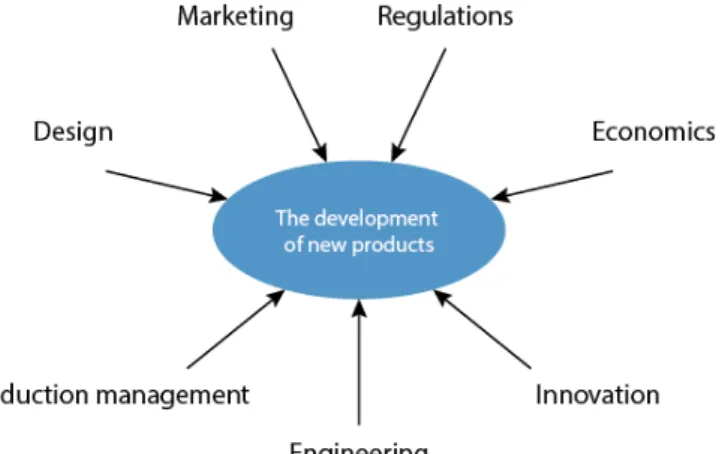
The industrialization of design called for larger teams and the addition of other expertise to the process, inevitably brought different approaches to what the design process used to be. The Figure 1-1 represents a schematization of the new perspectives brought into the design process.
Figure 1-1 – Different perspectives to take into account in the product design and development process (adapted from (Trott 2005)
1.1 THE INNOVATION ROLE
Nowadays, it is clearer than ever that innovation is a crucial part of business success. With increasing pressures from competition and with shorter average life span of products the solution for most companies has to be the continuous innovation. Nevertheless, new product development is not as simple or even as straightforward as we would hope it would be, there are some trade-offs that have to be made in order to meet the different, and sometimes, incompatible requirements of the product.
After the Second World War, US economists promoted the linear models of innovation, which, due to its uncomplicated characteristics, managed to endure for 40 years in the fields of science and industrial policy. The breakthrough achieved took place by the recognition that innovation emerges through the interconnection of the scientific and technological development when attending the needs of the market. This same basis supports the current models of innovation (Trott 2005).
Pursuing innovation is very close to what identifying the product opportunity gap is, that is, they are both based on the idea of ascertaining the margin between what already exists in terms of products or services and what can be created that will respond to the prevailing needs or trends. To reach the product opportunity gap, one should constantly and simultaneously consider three major factors: economical, technological and social (see Figure 1-2).
Figure 1-2 - Meeting the Product Opportunity Gap (Cagan and Vogel 2002)
If well studied, these three areas together can give the necessary information to meet or even exceed the customer desires and expectations:
• The economical factor evaluates the purchasing power people perceive they have that
will allow them to buy more products or services without even having the real necessity. The consciousness of who has the means, who is going to spend it and for whom is also of great importance since it will undeniably influence the course of action.
• The social factor alludes to the apprehension of the environment people live in, there
has to be a good understanding of today’s society to easily pick up the social and cultural tendencies. Societies are persistently injected with potential new trends, most of them created by the entertainment industry, from television to magazines or outdoors, but only a few manage to enchant and triumph.
• The technology factor is probably the most intuitive of them all, it deals with the
expertise on the available technology. The technology evolution has been continuous whether regarding new materials or new manufacturing processes, furthermore, the volume and speed with which a computer processes information has also suffered exceptional growth, ergo allowing significant lifestyle changes (Cagan and Vogel 2002).
Reinforcing this idea, the managing director of McCain Foods states that ‘Its only by understanding what the customer wants that we can identify the innovative opportunities. Then we see if there’s technology that we can bring to bear on the opportunities that exist’. He is also of the opinion that bringing innovation into a product can be easy however, that is not the same as having a commercially viable product (Trott 2005).
Although many external and internal circumstances may influence innovation, it is believed that the way these three areas are connected is the key to succeed, see Figure 1-3. For instance, the “technology push” model, where a technology is assumed and only then marketing and sales work their “magic” to the potential consumer, was a very popular innovation model after the Second World War but nowadays it is mostly seen in pharmaceutical industry (Trott 2005). The generic model, “market pull”, is based on the opposite assumption, i.e., the marketplace is no longer a passive component of the process but a crucial one instead. The marketing finds a market opportunity by keeping close relationships with customers and users, then the designers and engineers search for the design and the (available) technology that best suits the market needs (Ulrich 2012).
Figure 1-3 - Linear models of innovation (Trott 2005)
1.2 THE DESIGN METHOD
Traditionally any procedure, technique or tool used for designing, could be called design method but there has been a boom of new and groundbreaking procedures that are more suitable for the existent complex problems. Sometimes these new methods may seem to be nothing more than elaborate names for common-sense techniques. For instance, the “design-by-drawing” method refers to the use of drawing as being almost the sole task to design. But, going beyond the time of the Renaissance it is possible to observe, though on a smaller scale, the use of drawings and sketches already then at the service of design. Nowadays, designers, like architects, keep using this method as basis for their work, not only to represent the overall layout but also its critical details (Cross 2008).
The idea that a product concept is expected to be converted into a manufacturable, saleable and profitable product is quite simple but, on top of these characteristics, producibility is also implicit. This means that the easiness with which a design can be manufactured in good time maintaining the high quality at a low cost that can and should be controlled (Magrab 1997a). That is why industrial design has embedded on its basis the serial production nature, where at anytime of the product manufacture there can be a tight control of the overall performance, and by doing so, deviations can be kept to a minimum (Dorfles 1991).
It is well accepted that in the design process you should have the design first and its materialization later, i.e., only after having the project completed you can produce the product. Although we make this process partition, in the end, they both have to exist, seeing that the product development can only be successful if the product is indeed manufactured and sold.
Nowadays, within some industries it is common to refer to design as a small part of the product development process, that is, the design can be seen just as an exercise to create new concepts. The automotive and aerospace industries are good examples of such since they deal with problems of great complexity where the development process has to be wider in order to comprise all factors involved. In other business areas like fashion, product design has practically the same meaning as product development ; (Trott 2005; Cross 2008).
1.3 PRODUCT DEVELOPMENT PROCESS
Product development is the process of generating new products or services that intend to meet pre-existent necessities. The process is quite extent and it can take from a few weeks to several years to be completed depending on the complexity of the problem. The initiation of
the process is set by the recognition of a new market opportunity and goes all the way to the product launch and its sale.
A process can be portrayed as a recipe, i.e., simply a sequence of instructions or steps that transform inputs into outputs. And as a recipe, the steps can be manipulated to create a new process that is more efficient given the problem at hands and the company’s organization. However, there are certain rules that have to be met for the product to be successful. The following figure illustrates a generic development process with its six corresponding phases. Remember that there can be several different models of the process depending on the complexity of the product, the industry or the available resources, but generally speaking, they all meet the basic steps depicted in this figure.
Figure 1-4 – A scheme of the generic development process formed by six phases (adapted from (Ulrich 2012)
It is easy to understand that the early steps of the process are crucial and one should want to spend enough time on them since, the time and money spent on it should minimize the probability of failure. By the end of the early steps, major decisions regarding how the product will be done will have already been taken and a considerably large part of the funds will be committed by then. And for this reason, the sooner you make changes in the project the less expensive it gets to do it (Magrab 1997a). Nonetheless, as tempting as it sounds, one does not have all the time in the world to complete these first steps, just the enough time. That is to say, if one does not intend to meet the established deadlines then, there is no point on having them in the first place, and ultimately, will never be able to produce any product. In the development process, the decisions are made by constantly having to weigh and choose between different options. These processes have many challenges that have to be exceeded thereby the team have to be confident of the path chosen because there are many detailed decisions that have to be made along the way. It is also important to be aware that there are deadlines to be met and that the team not only have to master the technology to be used but also to be cautious to produce the lowest cost product possible without sacrificing the quality (Ulrich 2012).
A successful product development can make the difference between having a competitive company or endanger the entire business. As a consequence, the literature available on the topic is endless. However, despite the great number of product development processes available, in the end they all have similar guidelines that help managing the process and consequently the risks involved.
Assessing product profitability is not a remotely immediate task but is one of the easiest ways to evaluate the product development success. For all that, there are other five dimensions that, in the end, will affect profit and, are more expeditious for analysing the performance of the product development plan (Ulrich 2012). They are:
• Product cost, which includes equipment and tooling, and is reflected on the balance
between the investment and the sales;
• Product quality that is usually used to set the product value;
• Development time, that is directly related to the time the product becomes available in
the market;
• Development cost as part of the initial investment;
• Development capability, which indicates if the team has the capability to do future
development projects more efficiently and economically;
In the following paragraphs there will be made an attempt to explain and describe all the steps of the generic development process depicted in Figure 1-4.
A - PLANNING
Planning the product development is essential to the overall project schedule. Naturally it corresponds to a stage prior to project approval and launch of the product development process, and is therefore often considered the “phase zero”. The main goal of the Product Planning is to find the products to be created/developed under a given organization, and establish the time period under which it will be introduced on the market. Therefore it implies the need of a structured step-by-step process, and the key steps are as follows:
• Opportunities Identification
• Evaluation and Prioritization
• Allocation and Timing
• Pre-project Planning
• Results and Process Analysis
An opportunity is an idea for a new product or, simply, the characterization of a solution for a new need. Opportunities are identified through analysis of market trends as well as technological developments. This means that to identify an opportunity, both the technology and the market must be known, as it implies to search for a wide range of alternatives and filter them to identify those that are really promising. To identify opportunities is essential to rule out the ones that might not create value so that the most promising ideas can be developed. These would be the ones that are worthy of future investment. However, this selection should be done carefully, you can not know for sure in advance which ones are going to successful. And because, excellent opportunities are rare, ideas should initially be generated in large numbers without ever being sacrificed their average quality. It may also be interesting to create absurd notions to widen diversity and increase the chance of emerging an exceptional good opportunity.
To skip to the next step it is necessary to perform a mission statement, which intends to disclose the proposal, objectives, target markets and the stakeholder.
B - CONCEPT DEVELOPMENT
Typically a concept is best defined by the effort to designate the form, function and features of a product. It is usually accompanied by a full list of specifications, together with a study of the “status quo” on the market and the correspondent economical validation.
In the Concept Development phase, one tries, after defining the necessities found in the market to which the product is aimed, to create and assess alternate product ideas. Among these, a few are chosen for further development and analysis.
The steps within this phase are generally composed by:
1. Identifying customer needs - one key factor in Product Design and Development is to
start with a set of well-defined needs to respond to. It is of major importance to manage to enable an accurate and assertive link between the customers and those who will develop the product.
2. Product Specifications - in Product Specifications there is no place for subjectivity, on
the contrary, they seek to describe in measurably detail the requirements of a product. A target-value is defined for each characteristic, which should answer one or more needs. To achieve this correlation it is necessary to know the customer needs, collect information of competitive products, set final specifications and finally, establish target-values.
3. Concept Generation - this must be the step where a description of form, technology
and working principles starts to appear. It should be noted that with a good concept it might be hard to carry out effectively the remaining development phases but with a weak concept that is almost impossible. The good part is that this step is quite inexpensive and rapid comparing to the whole process. As this is a stage, for creative excellence, several concepts should be generated. Though, they should not all be considered and that is where structured methods can be helpful.
4. Concept selection - Is an assessing process, which is used to compare and choose one
or more concepts that would best fit customer’s needs. One must be aware that selection of concepts is applied throughout all the development phases.
5. Concept testing - This phase will depend on the answer given by potential consumers,
more than the one given by the development team itself. The idea is to take the concepts from the previous step and test them among the customers in order to understand which are the ones that should be pursued. This test can also contribute to make sales forecasts.
C - SYSTEM LEVEL DESIGN
System level design is the stage, within the process, where the product starts to gain “character” because only at this stage the product architecture can be properly defined, by deconstructing the product into several sets of smaller components. These are shaped individually but their assembly is also included in this phase.
A product must be thought of in a formal and functional level. The functional elements correspond to the individual operations that the physical elements execute enabling the good performance of the product. The architecture of a product is seen as the plan that translates the function into the form and that it establishes the interactions between them. Decisions taken in this phase of development will have serious implications at various levels afterwards,
including performance, manufacturing, product replication and all the logistics involved in the standardization of the product.
In short, this phase should stipulate the overall product geometry, the functional specifications and an early description of the assembly process.
D - DETAIL DESIGN
As the designation suggests, is where specifications of all elements composing the product are designed in detail. All the documentation necessary is gathered in order to create a manual of rules that establish measures, geometry, tolerances, etc. to be sent to the production. The parts to be acquired from suppliers must be listed and inventoried. Material’s selection, production costs and physical strength will be the most relevant aspects at this stage.
E - TESTING AND REFINEMENT
In this stage, the product will be tested in order to verify the compliance of the objectives proposed, but this stage may also imply an analysis in which assessment may result in product adjustments.
Several models have to be built to evaluate different aspects. Sometimes, the models are alike regarding geometry and materials but they might vary in fabrication or assembly process. The goal of such prototypes is to assess the suitability of the product to its function and user needs, that is, to evaluate the overall design and performance. There are also models or prototypes made through the real process of production that serve to test the performance and dynamics of the product. This assessment can result in changes in the engineering of the product itself. That is to say that for the various types of prototypes, there are different types of technologies. It must be emphasized that this phase of product development, although very valuable, entails very high costs, mainly because it is often necessary to produce various models for different test types and, also because it is quite lengthy. Since this is a very important phase for product validation, these two factors often represent an obstacle. And, in order to greatly reduce the cost and time associated with prototyping this is commonly preceded by numerical simulations. Numerical models intend to reproduce the actual product and, these should also be tested by simulating different service conditions or accidental events. Having said that, the physical prototypes should only be designed after the virtual models pass the tests.
F - PRODUCTION RAMP-UP
This is the last phase of product development, preceding the product distribution to the market. Before releasing the product, the complete production system must be tested and the ramp-up is designed to simulate and fix problems that might still exist in the production process. Apart from the technical perspective, this approach enables an assessment of the commercial perspective, allowing identification of failures and subsequent development of improvements.
2
NEW PRODUCT DEVELOPMENT
IN THE AUTOMOTIVE INDUSTRY
2.1 CORPORATE STRATEGY
Automotive industry is a particular business, which surpassed numerous challenges over the years and that, without any doubt, greatly influenced modern society. Europe’s economy, for instance, relies on a solid and innovative industrial base, being the automotive industry one of the prime contributors to its economic output. Together, the European vehicle manufacturers represent the largest private investor in European Research and Development (R&D), investing an average of 5% of turnover each year on R&D activities, amounting to an annual investment of over 20 billion Euros (The Automotive Industry - Focus on the future R&D Challenges 2009; ACEA - European Automobile Manufacturers' Association 2010) ; . The U.S. automotive industry also corroborates this idea of great weight in today’s society by being responsible for 1,7 million direct jobs and 8 million indirect jobs nationwide. Its R&D investment is close to 17 billion dollars a year from which 99% is generated by the auto industry itself. If not that, then the fact that all but one (Saudi Arabia) of the G-20 countries, the world’s prime economies, have automotive production should confirm that it is indeed an industry of great importance to the economy and development of a country (Alliance 2012). There has been a continuous search for differentiation strategies to produce passenger cars from the beginning. In 1913, Ford was the first automotive company to break with the conventional by adopting a strategy of manufacturing standardized products in high volumes with low production costs. A few years later, around 1920, General Motors was turning to another direction, Alfred P. Sloan gave customers more than a cheap car, he invested on style, power and prestige without neglecting the significance of cost. There are other examples throughout automotive history that can attest that both technology and market changes can create the right circumstances for new strategies to emerge (Ibusuki and Kaminski 2007). The classical arrangement of a supply chain in the automotive industry as seen in Figure 2-1 is composed of distinct layers that may sometimes overlap. On the top of the chain are the Original Equipment Manufacturers (OEMs). These are vehicle manufacturers that do not only produce the greatest part of the car components (around 70%) but are also responsible for the entire design and development work. These are followed by the “Tier-1” suppliers, which are major suppliers that sell finished components to the OEMs. Subsequently there are the “Tier-2” companies, which represent key suppliers to Tier-1 firms and, do not supply directly the OEM. The following suppliers, the “Tier-3” or “Tier-4”, are firms that supply the Tier-2 companies and, usually provide the basic raw materials. In spite of all that, a company may be
a Tier-1 supplier to one OEM and also a Tier-2 to another or even, a Tier-1 supplier for one product and a Tier-2 supplier for a different product for the same OEM.
Since the beginning, the automotive industry has been evolving towards a more efficient business, always looking for new ways to improve its supply-chain, reduce time-to-market and integrate global operations. This evolution co-occurred with several mergers between key OEMs over the years, thus reducing considerably the number of nameplates. These major dealers were offering products and brands from many different automotive manufacturers (Davenport, Leibold, and Voelpel 2007).
It was in the 70's that this business model began to experience some changes. More and more products were being purchased from external suppliers, maintaining however the vehicle assembly and the
majority of engineering and product design work being carried out in-house (Miller 2005). The following section will cover some of these changes, attempting to explain its source, reflect on its consequences and, also, trying to depict today’s reality.
2.1.1 CHANGE OF PARADIGM:OEMS VS VBOS
In the more recent decades, the automotive industry has been suffering another drastic change, a paradigm shift due to the political and economic circumstances of today's world. What used to be a well-structured supply-chain with the OEM at the top followed by a few thousand Tier-1 suppliers is disappearing to make place for a new business model, the Vehicle Brand Owner (VBO). The latter is mostly about managing, marketing and sustaining the nameplates thus, entrusting most of the responsibility and the manufacture work to outsourced companies (PriceWaterhouseCoopers 2000).
In the OEM business model, all the development and engineering was a secret kept under locked keys by the OEMs. They would only advance a detailed design of the product to be manufactured to potential suppliers so they could vie between them to get the contract. Usually the supplier that presented the lowest price got the contract, agreeing with a specific fixed price, production volume and period of time. Apart from price, suppliers would also be evaluated regarding manufacturing capability, capacity, reputation, reliability and, in a lower degree by product quality. Recurrently, the OEMs could hold legal ownership of all the tool sets, moulds and stamping dies. The supplier’s role was mostly limited to engineer the best way to manufacture the product at the lowest cost and with an acceptable gain (Miller 2005). With this inverted pyramid model, the OEM’s hand over most of the power and responsibility relieving a substantial part of their costs and, in some extent, empowering the most ambitious Tier-1 suppliers, which readily embraced the opportunity to upgrade their “status” to “Tier one-half systems integrators” (Tier-0,5). This means that they cover part of the responsibility formerly assumed by the OEMs, namely product design and development and, supply chain management. (Davenport, Leibold, and Voelpel 2007; OTM 2005; Harrington 2007). This
Figure 2-1 - Scheme for the Automotive Industry Supply chain
kind of responsibility will bring the biggest challenge of them all, how to maintain confidentiality within different relationships with VBOs while assuming the best practices. The relationships between mega-suppliers and VBOs are key to success. In this new business model, suppliers are assessed more judiciously. VBOs should no longer focus so much on short-term price to be equally able to equate corporate stability, product design and production engineering capabilities. Subsequent levels of the supply chain should also receive attention, particularly on the degree of reliability, availability to locate the plants near OEMs and participation in the assembly process (Miller 2005). This means that the OEMs/VBOs now expect their Tier-1 suppliers to submit ideas on how their products and systems should evolve, and make proposals on how these would fit the OEM product line-up. The early and final steps of design and development process may be performed in a partnership relationship, but the steps in between should be fully borne by the suppliers. Such shifts of roles will inevitable have consequences throughout the entire supply-chain. (Willem van der Wiel 2012; Mehta 2000) ; .
This tendency transpires the state at which the automotive industry reached; today the sale of vehicles by itself does not bring much profit for OEMs but, on the other hand, services such as assistance and repair or, aftermarket and car finance proved to be very lucrative. The VBOs would become a kind of relationship manager: they would be in charge of the creation and maintenance of new alliances, the enrichment of the supply chain networks and the direct communication with customers. Because of all that, the progression from one business model to another seems only to be expected (Davenport, Leibold, and Voelpel 2007).
The suppliers that assume the Tier-0,5 category will have to make substantial efforts in order to meet with its new expectations, only the best production practices will be considered. Complying with just-in-time requirements to diminish inventory exposure and offering only the best manufacturing practices should be the way to go. This means that not all suppliers will want or will have the conditions to take this path. After all, the ones who actually decide to give that step will have to seriously invest in technology development, either by developing it themselves or by acquiring/merging with other firms that have the proper know-how. There are studies suggesting that companies that remain in the same category may be more lucrative in the short-run but will eventually struggle with the fierce competition if they do not present differentiation factors. The two world leading Tier-0,5 companies regarding parts production are Delphi and Visteon, both good examples of companies formed from the divorce of small businesses with their parent-company, GM in 1999 and Ford in 2000 respectively (Miller 2005).
VBO model is very much based on a consumer centred model, or at least it is believed to be true in the future. The companies will no longer be the sole dictators of the rules but instead, they will be closer than ever to the customers in order to better understand their needs, and to rapidly answer to their demands. A new customer interface will emerge using alternative channels and a fresher message. The cost of maintaining a distribution network, such is the case of the dealerships, will eventually become superfluous in many markets. Today’s reality shows us that a customer who has better access to information, easily acquired in the borderless world of technology, will be a more demanding customer. Ergo, a relationship based on a simple “one-to-one” approach should be much more effective than a “one size fits all” (PriceWaterhouseCoopers 2000).
2.2 GLOBALIZATION
Transportation is a synonym for both freedom and proximity, making it a key element of the globalized world. Nowadays, information, products and people travel across the world quite easily, resulting in an unparalleled increase of competitiveness, because the market is now global.
In the automotive industry, the pressure to keep the costs down is higher than before, and the use of common parts throughout different models is a predictable procedure for multi-country platforms of global OEMs. However, this approach needs to be pondered and must have into consideration the local market. From regulations to climate conditions or material availability, there are many factors that must be evaluated locally in order to avoid an "over-designed" and "over-costly" product, which happens if one tries to satisfy the higher common denominator for each specification. For the most part, this broad approach has the advantage of achieving the intentioned costs savings, insofar as it benefit from scale economy, shorter development times, proven designs and fewer tests (ICRA 2011).
As the automotive industry is a very challenging industry regarding quality, reliability, safety and price, a special emphasis is given to the effort of reducing costs and enhancing efficiency. As previously stated, in order to reduce the overall cost it is necessary to take into account that if one plans carefully in advance it will diminish the probability of having to make changes in the future, thereby avoiding not accounted costs.
From its inception, the automotive industry seeks to reduce production time and costs and, despite Henry Ford’s assembly line, which reduced time by 90% revolutionizing the sector, this is still a concern. We live in a world more and more global that promotes the competitiveness along with a greater productivity, thus, every manufacturer that wants to endure and prosper has to reduce the production and development times while reducing the components costs and maintaining its performance and quality standards. On the other hand, the manufacturers need to add value to their products by redesigning functionality or by reducing its complexity (SODECIA 2012).
2.3 SAFETY AND SECURITY
Another serious concern derived from globalization is the awareness that one should ensure greater safety and comfort as the traffic increases. Investment in R&D and in transport policies is continually growing to ensure a future with less road accidents and a greener industry.
Road safety is a pivot concern for all stakeholders as it may dictate the sustainability of the industry itself. By becoming an affordable asset to all families, the automobile became a repeated sight in cities all over the world. This phenomenon led to a serious road traffic growth that forced governments, both central and local, to rethink town planning. This new machine has the power to bring communities together but also has the power to take lives and, although the number of casualties keeps on dropping every year, automobiles are still responsible for thousands of deaths all over the world. Every player related to this industry will have to continuously contribute to the efforts of diminishing this affliction; from auto-companies and research centers to large governmental institutions all have a role to play in this fight for safety. As examples of such measures we have on the political field: better communication routes, better planning, more regulation, more investment in education and
awareness and; on the technological field: better materials and strengthening of active and passive safety systems (European Council for Automotive R&D 2011).
The massive extension of regulation and laws surrounding the automotive industry can be explained by the fact that a car is the most hazardous way of transportation of today’s society. In fact, the automobile is responsible for some thousands of deaths every year in Europe alone (SODECIA 2012) but, in the US the numbers are not far off, in 2008 almost six million car accidents were registered from which resulted 37.000 deaths (NHTSA 2013). And although human error is the most frequent cause for car accidents, there is a general concern for this issue. OEMs keep on improving their automobiles safety, at the same time that governments and other international institutions are campaigning for greater awareness and sensitisation in the hope for a more responsible behaviour by both drivers and pedestrians. As a consequence, consumers became more informed and safety became an essential and valued aspect when buying a car. Therefore, it is necessary that accurate information regarding safety performances for each individual car is made available. In 1997, was created an international independent entity that has been the catalyst for the continuous and rapid improvement on the car safety issue, the European New Car Assessment Program (Euro-NCAP) as it is called. This entity has the purpose of assessing vehicles performance in crash simulations, that is, they carry out several tests simulating the most serious and fatal car accidents and, rate them with the maximum of five stars according to four different areas: adult protection, child protection, pedestrian protection and safety assist. European legislation dictates a minimum statutory criterion of safety for new cars, Euro NCAP however pushes manufactures to overcome these minimum requirements (Euro NCAP 2012).
Safety is an issue that will never be entirely resolved because of the industry dynamic nature, which enables continuous improvements. As long as new materials and new designs keep emerging, safety measures have to keep up and evolve accordingly. To ensure proper performance, durability and reliability tests have to be performed in compliance with the circumstances. This requires a deep knowledge of the materials to use and a comfortable mastery of the manufacturing processes and joining techniques. The ones that have this know-how will be capable of predicting the behaviour of products in specific environments more easily. In truth, the growth of computer-aided tools that are widely used in this industry was only possible due to the great understanding of these domains (Center for Automotive Research 2011).