1 Introduction
Exotic fruits play an important role in nutrition and are an excellent base for dietetic products due to their benefi-cial bioactive compounds and low energetic value. Highly valued for its unique flavour, texture and colour, recent research has shown Physalis peruviana L. fruit to be rich in many beneficial compounds [1, 2]. For instance, the physalis fruit is rich in pro-vitamin A, ascorbic acid, and in some vitamins of the B complex (thiamine, niacin, and vitamin B12). Additionally, the fruit is rich in crude protein, phosphorous and iron, although calcium content is low [3]. Some of the health benefits of physalis include: blood purification, reduction of the albumin in the kidneys, reconstruction and strengthening of the optic nerve, alle-viation of throat infections, elimination of intestinal par-asites, and treatment of prostate problems [3].
The Physalis genus includes approximately 100 species originally from the Andes, although its modern distribution includes tropical regions and areas with a more moderate climate, such as Portugal. The majority of the species is wild, but some species are cultivated in Colombia, Mexico, China, Japan, and more recently in Brazil and in Portugal. The main consumer market of these countries is Europe, where fresh fruits are used as food and in the pharmaceutical industry. Only recently has the plant become an important crop and widely introduced in cultivation in tropical, subtropical and even temperate areas. Physalis peruviana has numerous common names depending on the country and/or region where it is found [4, 5]. Some of the common names are: cape gooseberry (South Africa, UK), Inca berry, Aztec berry, golden berry, giant ground cherry, African ground cherry, Peruvian groundcherry, Peruvian cherry, “amour en cage” (France), and sometimes simply physalis (United Kingdom).
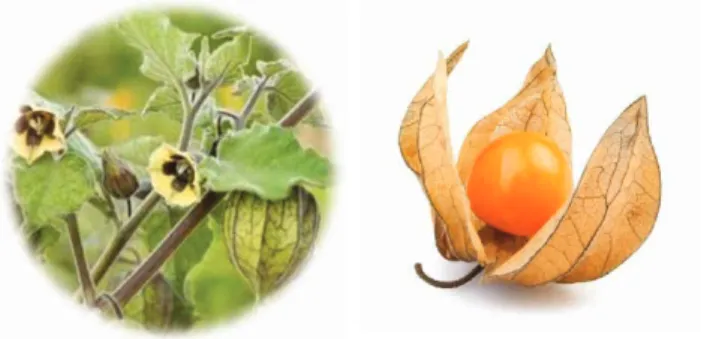
Physalis has a short shelf life cycle. It can be planted any time of the year. The species is capable of adapting to any warm climate and expresses tolerance to cold. However, it does not like excess moisture or frost. The flowers are hermaphrodite, solitary, and bell-shaped. Its most distinctive feature is the fruiting calyx which enlarges to cover the fruit and hangs downwards similar to a lantern. Physalis forms a domed shrub that can DOI: 10.1515/opag-2016-0007
received May 16, 2016; accepted June 30, 2016
Abstract: Physalis (Physalis peruviana L.), also known as cape gooseberry or ground-cherry, plays an important role in nutrition as an excellent base for dietetic products. Highly valued for its unique flavour, texture and colour, recent research has shown that physalis fruit is rich in many beneficial compounds.
In this study, the diameter and mass of physalis fruits were measured, which can be used to calculate other biometric characteristics of the fruit, such as: surface area, volume or density. Other physical properties were measured, namely the colour coordinates, by means of a Chroma meter, whilst the textural parameters firmness and elas-ticity were measured with a texturometer.
The following values were calculated for the physalis fruits analysed in the present work: 1.69 cm for average diameter; 8.98 cm2 for surface area, 2.51 cm3 for volume; 2.77 g for mass was, and 1.10 g/cm3 for density. The colour coordinates were 56.72 for lightness, 16.69 for redness, and 58.11 for yellowness. Skin firmness and elasticity were evaluated for texture attributes, and their average values were 2.40 N and 2.94 mm, respectively. The results of this work are in accordance with data reported by other authors in the literature.
Keywords: Physalis peruviana L., gooseberry, diameter, mass, colour, texture
*Corresponding author: Raquel P. F. Guiné, Dep. Indústrias
Ali-mentares, ESAV, Instituto Politécnico de Viseu, 3500-606 Viseu, Portugal, E-mail: [email protected]
Solange F. Oliveira, Fernando J. A. Gonçalves, Paula M. R. Correia,
Dep. Indústrias Alimentares, ESAV, Instituto Politécnico de Viseu, 3500-606 Viseu, Portugal
Raquel P. F. Guiné, Fernando J. A. Gonçalves, Paula M. R. Correia,
CI&DETS/ESAV, Instituto Politécnico de Viseu, 3504-510 Viseu, Portugal
Rapid Communication
Open Access
Solange F. Oliveira, Fernando J. A. Gonçalves, Paula M. R. Correia, Raquel P. F. Guiné*
grow up to 1 m tall. The flowers, produced in winter, are yellow with purple blotches. Physalis is an upright, her-baceous, semi-shrub, and perennial in subtropical zones. Its ovoid-shaped fruit can weight approximately 4–5 g, is protected by an accrescent calyx or fruit basket covered by a brilliant yellow peel [1, 3] that completely surrounds the fruit during its development and ripening, and pro-tects it against insects, birds, diseases and adverse cli-matic conditions [6].
The fruit is a juicy berry that can reach 1.25 to 2.50 cm in diameter, can contain around 100 to 200 small seeds. The lifetime of the plant production goes from nine to eleven months from the time of the first harvest; thereaf-ter, both the productivity and fruit quality decrease. Shelf life of the fruit is one month with the calyx, and four to five days without the calyx [1].
This crop represents an alternative for the produc-tion sector in many countries, creating a positive eco-nomic impact due to the good perspectives and interest of the worldwide trade for fruits and berries, and the demand from consumers for fruits that have nutritional and medicinal properties [7]. The principal growers of physalis are Colombia, Kenya, Zimbabwe, Australia, New Zeeland, India and Ecuador. Other less expressive growers include the United States, Brazil, Venezuela, Bolivia, Peru, Chile, Central-America, Mexico, Belize, Guatemala, El Salvador, Nicaragua, Costa Rica, Panama, Jamaica, South Africa, Gabon, Egypt, China, Japan, Malaysia, Indonesia, Philippines, Samoa, Tonga, New Caledonia, Guam, United Kingdom and Israel [7].
Although there are some studies about physalis, the information on this berry is still scarce. Therefore, this study was undertaken to analyse some biometric and physical properties of physalis fruit grown in Portugal as an attempt to compliment the information presently available in the scientific literature.
2 Experimental procedure
2.1 Sampling
The fruits of one variety of physalis (Physalis peruviana L.) were harvested from one farm in North-Central Portugal and analysed for this work. The physalis fruits originated from conventional production methods.
The fruits were harvested at maturity. Approximately 750g of berries were randomly selected and collected from
several plants growing in different parts of the same plan-tation area.
2.2 Handling and conservation
After harvesting, the samples were transported to the lab-oratory in appropriate plastic cuvettes to protect the fruits from light, then refrigerated.
The refrigerated fresh samples, at 4 ºC and 85 to 90% relative humidity (RH), were then analysed for their bio-metric and physical properties.
2.3 Biometric characteristics
Around 100 berries were randomly selected as represen-tative of the sample for biometric characteristic analysis, weight and size. The size of each berry was measured with the aid of an automated calliper rule, and the weight was determined with a precision scale.
In order to calculate the volume and surface area of the berries, it was assumed that the fruit were sphere-shaped. Specific mass was subsequently calculated by dividing the mass by the volume.
2.4 Colour measurement
The skin colour of the physalis can be used as a maturity index; therefore, harvesting should start when the calyx begins to turn yellow, as to avoid over-maturity [2].
The colour of the physalis fruits was determined with a colorimeter (Chroma Meter - CR-400, Konica Minolta) in the CIE Lab colour space, by assessing the L*, a* and b* Cartesian coordinates, and using the illuminant D65 The L* axis represents Lightness and varies from 0 (cor-responding to no lightness, i.e., absolute black) to 100, or maximum lightness (i.e. absolute white). The other axes
are represented by a* and b* and they are at right angles to each other. The a* axis varies from green at one extremity (represented by -a) to red at the other (+a), whereas the b* axis varies from blue at one end (-b), to yellow (+b) at the other. Although in theory there are no extreme values of a* and b*, in practice, they can be numbered from -128 to +127.
The chroma is the ratio between the values of a* and b* (2). Hue angle is the angle between the a* and b* axes, indicating the colour saturation of the subject [8].
The coordinates for value, colour intensity (Chroma) and hue angle were calculated using the following Equations [9]:
(1)
(2)
(3)
One hundred berries were analysed to determine the colour.
2.5 Texture analysis
One hundred berries were randomly selected as represen-tative of the sample to determine skin strength and elas-ticity as texture attributes. The analyzes were performed with a TA.XT Plus texturometer from Stable Micro Systems using a 2 mm probe (P/2) and the following test conditions: pre-test speed = 1.50 mm/s, test-speed = 1.00 mm/s, post-test speed = 10.00 mm/s, distance = 6 mm, trigger force = 0.05 mm and a load cell of 50 kg. The results were treated with Exponent software TEE (Stable Micro Systems) and the obtained texture profile (Figure 2) was used to deter-mine firmness (strength on the highest peak) and elastic-ity (distance to the highest point). One hundred samples were used for the texture analysis.
3 Results and Discussion
3.1 Biometric characteristics
Mean values and corresponding standard deviations for diameter, volume, mass, and specific mass are presented in Table 1.
The average diameter of the analysed physalis fruits was 1.67 ± 0.14 cm. This result was within the standard values obtained by Fischer et al. [2], Lucchese et al. [4] and Puente et al. [6], who found that the diameter of the phys-alis berries can vary between 1.25 and 2.50 cm.
The average mass of the berries was 2.77 ± 0.67 g. The values found in the present work were lower than (however close to) the lowest limit of the 4 to10 g interval estimated by Fischer et al. [2], Lucchese et al. [4] and Puente et al. [6]. Variations may be due to the state of maturity in which the berries were collected or to the specific climate and soil conditions of the region where the berries were grown.
Average surface area was 8.98 ± 1.28 cm2. Average volume of the berries was 2.51 ± 0.59 cm3 and specific mass was 1.10 ± 0.04 g/cm3. These values are similar to, although slightly higher than, those obtained by Puente et al. [4] (1.038 ± 0.0054 g/cm3).
Figure 2: Texture profile analysis for physalis
Table 1: Biometric characteristics of physalis Diameter (cm) Surface area (cm2) Volume (cm3) Mass (g) Specific mass (g/cm3) 1.69 ± 0.16 8.98 ± 1.28 2.51 ± 0.59 2.77 ± 0.67 1.10 ± 0.04
3.2 Colour
Table 2 shows the values for chromatic coordinates: the Cartesian coordinates (L*, a* and b*) as well as the cylin-drical coordinates (V, Hº and C).
The L* coordinate corresponded to 65.72 ± 3.13, a value closer to 100 (white) than to 0 (black), thus leading to the conclusion that the berries were clear. The berries anal-ysed in the present work were slightly clearer than those analysed by Puente et al. [6], who determined an L* coor-dinate range between 70.31 ± 0.39 and 71.37 ± 1.10.
The value of the a* coordinate was 16.69 ± 2.70. A posi-tive value for this coordinate, as in the present case, corre-sponds to the red colour, and redness intensity increases as values increase. Puente et al. [6] found values obtained for this coordinate ranging between 14.31 ± 1.28 and 15.20 ± 0.48. Hence, the berries evaluated in this work had a slightly more intense red coloration. The value of the b* coordinate was 57.94 ± 3.60. A positive value for this param-eter showed that the colour of the berries was within the yellow spectrum. Puente et al. [6] reported values for this coordinate varying from 60.84 ± 3.10 to 61.76 ± 1.34; hence, the berries analysed in the present work were marginally less yellow. The slight differences found in the colour coordinates may naturally occur due to different maturity stages, cultivar or cultivation procedures.
Chroma value was 60.64 ± 3.19, and slightly lower than those described by Puente et al. [6], who found Chroma values ranging from 63.61 ± 1.40 to 62.50 ± 3.26. Hue angle was 73.95 ± 2.57, which can be considered a slightly lower value for such parameter when compared to the range value of 76.77 ± 0.57 to 76.20 ± 0.26 found by Puente et al. [6].
3.3 Texture
Texture may be affected during post-harvest storage and handling. Therefore, assessing texture is crucial for con-sumer’s acceptance, but also to avoid skin injuries and, consequently, fruit waste. Some of the factors that can affect fruit texture are respiration of the fruit and eth-ylene production. Etheth-ylene promotes fruit softening as a
consequence of the weakening of the cell wall caused by hydrolases [2].
Table 3 presents the values for the analysed textural attributes: firmness and elasticity. Firmness reflects the integrity of the pericarp tissue Berry firmness was 2.40 ± 0.53 N. This value was lower than what Trinchero et al. [10] found for the physalis berries they analysed (3.42 ± 0.32 N). As for elasticity, the value obtained was 2.94 ± 0.54 mm. The differences observed in this study may be linked to the state of maturity of when the berries were harvested, among other factors.
4 Conclusions
The results of the present work showed that the analysed physalis berries had an average diameter of 1.69 cm, a surface area of 8.98 cm2, a volume of 2.51 cm3, a mass of 2.77 g and a density of 1.10 g/cm3. The biometric character-istics were relatively similar to those reported in the litera-ture for the same product.
The colour coordinates obtained for the analysed berries were similar to those reported in the literature. Skin firmness and elasticity, the two attributes related to texture, were also in accordance with data published by other authors.
The results of this work presented a better under-standing of the characteristics of the physalis berries, some of which up to the present time had not been eval-uated yet. However, the present study could be comple-mented by researches on the effects of time on post-har-vested physalis berries to help understand the effects of conservation conditions on the biometric and physical properties of this fruit.
Table 2: Chromatic coordinates in physalis
Cartesian coordinates Cylindrical coordinates
Lightness L* Redness a* Yellowness b* Value V Chroma C* Hue Angle Hᵒ
65.72 ± 3.13 16.69 ± 2.70 58.11 ± 3.21 6.57 ± 0.31 60.64 ± 3.19 73.95 ± 2.57
Table 3: Texture characteristics of physalis Firmness (N) Elasticity (mm)
Acknowledgement: The authors thank Research Centre CI&DETS and Polytechnic Institute of Viseu for financial support.
References
[1] Ramadan M.F. Bioactive phytochemicals, nutritional value, and functional properties of cape gooseberry (Physalis peruviana): An overview. Food Research International, 2011, 44: 1830-1836 [2] Fisher G., Herrera A., Almanza P.J. Cape gooseberry (Physalis
peruviana L.) In: YAHIA, E.M. (Ed.). Postharvest biology and
technology of tropical and subtropical fruits. Acai to citrus. Cambridge: Woodhead Publishing, 2011. v. 2, p.374-396 [3] Fischer G., Miranda D. Uchuva (Physalis peruviana L.), In:
Fischer, G. (ed.). Manual para el cultivo de frutales en el trópico. Produmedios, Bogotá, 2012, Chapter 4.22, pp. 851-873 [4] Lucchese C.l., Guruk P.D., Marczak L.D.F. Osmotic dehydration
of physalis (Physalis peruviana L.): Evaluation of water loss and sucrose incorporation and the quantification of carotenoids.
LWT-Food Science and Technology, 2015, 63: 1128-1136
[5] Afsah A.F.E. Survey of insects & mite associated Cape gooseberry plants (Physalis peruviana L.) and impact of some
selected safe materials against the main pests. Annals of Agricultural Science, 2015, 60: 183-191
[6] Puente L.A., Pinto-Muñoz C.A., Castro E.S., Cortés M. Physalis
peruviana Linnaeus, the multiple properties of a highly
functional fruit: A review. Food Research International, 2011, 44: 1733-1740
[7] Fischer G., Almanza-Merchán J.P., Miranda D. Importancia y cultivo de la uchuva (Physalis peruviana L.). Revista Brasileira de Fruticultura, 2014, 36(1): 1-15
[8] Harder M.N.C., Canniatti-Brazaca S.G., Arthur V. Avaliação quantitativa por colorímetro digital da cor do ovo de galinhas poedeiras alimentadas com urucum (Bixa orellana). Revista Portuguesa de Ciências Veterinárias, 2007, 102: 339-342 [9] Vega-Gálvez A., Scala K.D., Rodríguez K., Lemus-Mondaca
R., Miranda M., López J., Perez-Won M. Effect of air-drying temperature on physico-chemical properties, antioxidant capacity, colour and total phenolic content of red pepper (Capsicum annuum, L. var. Hungarian). Food Chemistry, 2009, 117: 647-653
[10] Trinchero G.D., Sozzi G.O., Cerri A.M., Vilella F., Fraschina A.A. Ripening-related changes in ethylene production, respiration rate and cell-wall enzyme activity in goldenberry (Physalis
peruviana L.), a solanaceous species. Postharvest Biology and