UNCORRECT
ED
PROOF
O R I G I N A L P A P E R1
2
Clustering and forecasting of dissolved oxygen concentration
3
on a river basin
4 Marco Costa•A. Manuela Gonc¸alves
5
6 !Springer-Verlag 2010
7 Abstract The aim of this contribution is to combine
8 statistical methodologies to geographically classify homo-9 geneous groups of water quality monitoring sites based on 10 similarities in the temporal dynamics of the dissolved 11 oxygen (DO) concentration, in order to obtain accurate 12 forecasts of this quality variable. Our methodology intends 13 to classify the water quality monitoring sites into spatial
14 homogeneous groups, based on the DO concentration,
15 which has been selected and considered relevant to char-16 acterize the water quality. We apply clustering techniques 17 based on Kullback Information, measures that are obtained 18 in the state space modelling process. For each homoge-19 neous group of water quality monitoring sites we model the 20 DO concentration using linear and state space models, 21 which incorporate tendency and seasonality components in 22 different ways. Both approaches are compared by the mean 23 squared error (MSE) of forecasts.
24
25 Keywords Hydrological basin! Water quality ! 26 Clustering! State space model ! Linear model !
27 Kalman filter
28 1 Introduction
29 As water is a precious asset as well as a potential inducer of
30 riches, water quality monitoring networks are important
31 tools in the management and assessment of surface water
32 quality and they could be improved by means of accurate
33 forecasts of the surface water variables. The European
34 Water Framework Directive (WFD) establishes a common
35 framework for sustainable and integrated management of
36 natural waters. This implies a high level of
multi-disci-37 plinary and a tight connection between water management
38 technical bodies and instruments of analysis for
decision-39 making (Vieira2003).
40 Surface waters in a river basin are usually submitted to
41 pressures and changes due to human activities. These
42 activities are one of the most important causes of the
43 degradation of water quality, which could pose risks for
44 public health. At a river basin scale there is a need to
45 establish a methodology for systematic data monitoring for
46 the characterization of surface water quality and for the
47 correct analysis of collected data, so that the present and
48 expected future pressures can be identified and understood.
49 Assessment of pressure-state impact interaction can be
50 facilitated using environmental indicator tools (Oliveira
51 et al. 2005).
52 In this work, we intend to contribute to the discussion
53 and understanding of an environmental issue of such
54 importance to the community, as is the case of the quality
55 control of the surface water of River Ave basin. The River
56 Ave hydrological basin is located in the northwest of
57 Portugal, with an approximate basin area of 1390 km2and
58 its main stream length of 101 km (Fig.1).
59 In a region such as the Ave valley, with its economic
60 ground highly dependent on industry (predominantly textile:
61 there are about 340 registered factories), water plays
A1 M. Costa (&)
A2 Escola Superior de Tecnologia e Gesta˜o de A´ gueda, A3 Universidade de Aveiro, Apartado 473, 3754-909 A´ gueda, A4 Portugal
A5 e-mail: [email protected] A6 A. Manuela Gonc¸alves
A7 Departamento de Matema´tica e Aplicac¸o˜es, Universidade do A8 Minho, Campus de Azure´m da Universidade do Minho, A9 4800-058 Guimara˜es, Portugal
DOI 10.1007/s00477-010-0429-5
UNCORRECT
ED
PROOF
62 undoubtedly a determining role in the industry dissemina-63 tion in this valley. This region’s water streams have been in a 64 situation of obvious environmental degradation for many 65 years. From the 1970s onwards, the worsening of the envi-66 ronmental situation of this basin has led the government 67 authorities to be concerned with the increase of the water 68 pollution in this basin. Since 1988, and as part of a national 69 plan, the Central Administration, through the Regional
70 Directory for the Northern Environment and Natural
71 Resources (DRAN), and the Institute of Water (INAG)
72 monitored the quality of surface water periodically
73 (monthly) along the River Ave and its main adjacent
74 streams. The project PGIRH/N (1988) established a first
75 integrated management plan to the River Ave basin
76 including public organizations such as the Ministry of Public
77 Works, Transport and Communications, LNEC (National
78 Laboratory for Civil Engineering), the Ministry of Planning 79 and Territorial Administration and Coordination Committee 80 of the Northern Region (CCRN). Hydrologic problems had 81 been firstly discussed in the Project of Integrated
Manage-82 ment of Northern Water Resources (PGIRH/N and
NATO-83 RIVERS 1994) in co-partnership with the Environmental 84 and Natural Resources Office, DRAN and INAG. Besides, 85 these projects characterize the hydrological Ave basin 86 concerning climatic and orographic properties.
87 The aim of this study is to identify homogeneous regions 88 based on similarities in the temporal dynamics of variables 89 of water quality measured patterns by observing hydro-90 logical series, namely the dissolved oxygen (DO) concen-91 tration variable, in mgO2/l, recorded in time and space, in 92 the River Ave basin with the purpose to evaluate the sur-93 face water quality and to obtain accurate predictions.
94 Clustering has been widely used in environmental
95 problems, namely in climatic themes (Zhu and El-Shaarawi
96
2009; Gong and Richman1995; Fovell and Fovell1993), 97 and atmospheric science (Bengtsson and Cavanaugh2008;
98 Stone1989). The combination of state space models with
99 clustering procedures improved the fitting and prediction
100 accuracy. Indeed, the state space approach with Kalman
101 filter technique produces good results in weather radar
102 calibration (Alpuim and Barbosa1999; Brown et al.2001),
103 in correct temperature forecasts (Libonati et al.2008) and
104 in forecasting near-surface parameters (Galanis and
105 Anadranistakis 2002; Boi 2004). The application of
dif-106 ferent multivariate statistical techniques, such as cluster
107 analysis, helps in the interpretation of complex data
108 matrices to better understand the water quality and
eco-109 logical status of the studied systems; it also allows the
110 identification of possible factors/sources as well as rapid
111 solutions to pollution problems, and it is useful in verifying
112 temporal and spatial variations caused by natural and
113 anthropogenic factors linked to seasonality. Cluster
anal-114 ysis allows the grouping of river water samples based on
115 similarities in physical–chemical composition (Shrestha
116 and Kazama 2007). Hierarchical agglomerative clustering
117
by the Ward’s method was selected for sample
118 classification.
119 We present a comparative study based on DO
concen-120 tration considering two approaches: state-space and linear
121 models, both associated to clustering techniques. We
122 identify homogeneous regions, based on similarities in the
123 temporal dynamics of water quality variables measured
124 patterns, following a similar strategy adopted in Bengtsson
125 and Cavanaugh (2008). For each cluster, we establish
Fig. 1 River Ave hydrological basin located in the northwest of Portugal and its water monitoring sites
UNCORRECT
ED
PROOF
126 linear and state space models aiming at modelling and 127 forecasting water quality variables. The state-space mod-128 els, associated with the Kalman filter, allow us to model the 129 studied variable by establishing a dynamic model, where 130 the dependence structure is modelled by a latent state 131 variable. The linear models contain a term for the global 132 trend and the seasonal variation throughout the year. We 133 discuss the quality of the predictions produced by the two 134 approaches by comparing them, via the mean squared error 135 (MSE), in a period of time.
136 2 Data set description
137 The Northern Regional Directory for the Environment and 138 Natural Resources and the Portuguese Institute of Water 139 have been collecting various water quality variables 140 (monthly physical–chemical and microbiological analysis) 141 from 20 quality monitoring sites in the River Ave basin. 142 Although there are more water quality variables avail-143 able, we selected the DO concentration due to its continuity 144 in measurement at all selected water quality monitoring 145 sites and its importance in the evaluation of the water 146 quality of this river (point sources: industry, domestic 147 wastewater, agriculture, wastewater treatment plants). The 148 DO concentration analysis measures the amount of gaseous 149 oxygen (O2) dissolved in an aqueous solution. Oxygen gets 150 into water by diffusion from the surrounding air, by aera-151 tion (rapid movement), and as a waste product of photo-152 synthesis. The DO in water is one of the most important 153 quality variables to assess the degree of pollution existent 154 in the surface waters of a river’s hydrological basin. Low 155 values indicate bad water quality. Organic pollution is the 156 most common type of pollution in this basin and, conse-157 quently, a frequent problem is a deficit of DO. This results 158 in anaerobiosis situations, which produce bad smells and 159 destroys organic life. This problem is aggravated by the 160 existence of a sequence of small dams in the River Ave and 161 its main adjacent rivers, which limit the oxygen transfer by 162 aeration.
163 In this study we consider data series from 16 water
164 monitoring sites because the remaining four monitoring 165 sites are very recent, and data series are very short. Thus, 166 the data sets of 16 water quality monitoring sites of DO 167 concentration used in this work have been monthly
mea-168 sured between 1988 and 2006, with some missing data.
169 Summary statistics for DO in all monitoring sites are given 170 in Table1.
171 Data series were separated in two independent data sets: 172 one for the modelling process and the other for the forecast 173 procedure. The choice of these two data sets is established 174 to guarantee a significant data set for the parameters esti-175 mation, whereas the remaining data must be sufficient to
176 assess the forecasts accuracy. Indeed, a substantial data set
177 is necessary to fit state space models to water monitoring
178 sites series, while a data set is left with an expressive
179 number of observations in order to properly evaluate the
180 quality of forecasts. Taking this into consideration, for the
181 modelling process we consider data until December 1998
182 in Garfe (GAR), Ponte Junqueira (PJU), and Caldas de
183 Vizela(CVI) until September 1999 in Portos (POR), until
184 January 2000 in Ponte Branda˜o (PBR), Canic¸os (CAN),
185 Formariz (FOR) and Ponte Velha do Ave (PVA). In the
186 remaining water monitoring sites we consider data until
187 September 2004. Data not considered in the modelling
188 process, namely in the clustering procedure, was relegated
189 for the forecast and assessment stage.
190 3 Clustering analysis
191 To identify homogeneous groups of water monitoring sites
192 based on similarities in the temporal dynamics we select
193 the modelling data sets through state space models and
194 Kullback information measure, adapting the methodology
195 adopted in Bengtsson and Cavanaugh (2008). As the DO
196 concentration shows much diversity on tendency and
sea-197 sonality components in the River Ave and in its main
198 adjacent rivers, we want to identify homogenous clusters of
199 water monitoring sites in the sense of the magnitude of DO
200 concentration, and adopt a simple univariate state space
201 model for each location which considers the DO in its true
202 magnitude. Using a discrepancy measure suggested in
203 Bengtsson and Cavanaugh (2008), we obtain a discrepancy
204 matrix that allows us to identify homogenous groups by
205 applying clustering techniques.
206 3.1 State space model
207 State space models have been used in many different areas
208 to describe the evolution of dynamic systems. Such models
209 are defined by the equations
Yt¼ HtXtþ et; ð1Þ 211 211 Xt¼ UXt&1þ et: ð2Þ 213 213 Equation1 is called the measurement equation and
214 relates the n 9 1 vector of observable variables, Yt, with
215 the m 9 1 vector of unobservable variables, Xt, called
216
states. The n 9 m matrix Ht is a matrix of known
217 coefficients and et is a white noise n 9 1 vector, called
218 the measurement error, with covariance matrix E ete0t
! " ¼
219 Re: Furthermore, the vector of states Xt varies in time
220 according to Eq. 2, the transition or state equation. In this,
221 U is an m 9 m matrix of autoregressive coefficients and et
222 is a white noise m 9 1 vector with covariance matrix
UNCORRECT
ED
PROOF
223 E ete0 t !" ¼ Re: The disturbances etand etare assumed to be
224 uncorrelated, that is, E ete0
s
!
" ¼ 0; for all t and s. One class 225 of models with particular interest arises when the state 226 vector is a stationary process with mean E Xð Þ ¼ l:t
227 We fit the monthly DO data using an univariate state
228 space model with constant coefficients (Ht=H, in this 229 case we took Ht=1). For water monitoring site i the
230 model represents the observed monthly measure of the DO 231 as a sum of the DO’s true value and a white noise term. The 232 true value is denoted by Xi,tand is the latent process, and 233 the white noise component by eit. Thus, with Yi,t repre-234 senting the observed DO concentration for water moni-235 toring site i and month t, we have the observation equation 236 Yi;t¼ Xi;tþ ei;t; where ei,t is an i.i.d. gaussian zero-mean 237 white noise process with variance r2
ei; i.e., ei;t' N 0; r 2 ei
# $
: 238 In their work Bengtsson and Cavanaugh (2008) considered 239 an additive structural state space model with a monthly
240 mean, a seasonal component, a monthly anomaly and a
241 noise term to model the monthly temperature from loca-242 tions across Colorado, USA. They include these compo-243 nents because their main interest is to perform a clustering 244 process relatively to each structural component. However, 245 this approach can originate different clusters according to 246 the structural component in question. In our case, we want 247 to identify clusters of data series according to a global 248 stochastic behaviour, as in the case of the pseudo-distance 249 used in next sections. Consequently, we intend to focus on 250 the true greatness of DO concentration, because this value 251 indicates water quality. So, we establish a simple model to 252 catch DO concentration magnitude. Thus, we can consider 253 that we are observing the true value of the DO
concen-254 tration added to a random error due to measurement
255 devices and uncontrolled physical conditions.
256 For simplicity, we consider that states Xi,t are mod-257 elled by stationary AR(1) processes, Xi;t& li¼ /i!Xi;
258 t& 1 & liÞ þ ei;t; where ei;t is an i.i.d. gaussian
259 zero-mean white noise process with variance r2
ei; i.e.,
260 ei;t' N 0; r2ei
# $
: Some authors (for instance Alpuim and 261 Barbosa 1999) indicate that some types of environmental
262 variables could deviate from the normal curve and, in this
263 case, the assumption of normality to the errors would not
264 be a good choice. However, as will be shown later, the
265 normal distribution seems to fit data and this fact allows
266 implementing gaussian maximum likelihood estimation
267 procedures. Thus, an univariate state space process Yi,tof
268 the DO concentration, at location i and month t, is
repre-269 sented into the state space representation:
Yi;t¼ Xi;tþ ei;t; ð3Þ
271 271 Xi;t& li¼ /i Xi;t&1& li
!
" þ ei;t: ð4Þ
273 273 We assume that error measurements ei,tare uncorrelated
274 to the state errors, i.e., cov ei;t; ej;s
!
" ¼ 0; for all i, j, t and 275 s. It is common to consider that the model assumes a prior
276 distribution for Xi,0with E Xi;0
!
" ¼ li;0and V Xi;0
!
" ¼ r2 i;0;
277 assuming that Xi,0 is uncorrelated to ei;t and ei,t for all
278 t. However, as the process Xi,tis a stationary AR(1), we can
279 reduce the number of unknown parameters to be estimated,
280 considering that E Xi;0
! " ( E Xð Þ ¼ li i and V Xi;0 ! " ( 281 V Xð Þ ¼ ri 2i= 1& / 2 i ! "&1
: For each water monitoring site i, 282 we will let Hi¼ li; /i; r2e; r2e
% &
denote the set of 283 parameters for the model (3)–(4) to be estimated by
284 gaussian maximum likelihood.
285 3.2 Parameter estimates
286 As we referred in the last section, we obtain the parameter
287 estimates by maximum likelihood estimation assuming
288 gaussian errors. In order to provide the usual iterative
289 procedure to obtain these estimates, we need to introduce
Table 1 Sample characteristics for the 16 water monitoring sites
Monitoring site CANT GAR TAI PBR RAV CAN POR STI
No. of records 111 124 122 135 99 104 59 101
Start Sep-93 Oct-89 Nov-92 Oct-88 May-98 Oct-88 Jan-93 May-98
End Oct-06 Feb-00 Oct-06 Jan-00 Oct-06 Jan-00 Sep-99 Oct-06
Annual mean 9.997 9.403 9.503 7.327 8.230 8.282 7.917 7.621
Monitoring site PTR PVA FOR PJU GOL FER VSA CVI
No. of records 100 116 65 95 124 125 124 90
Start May-98 Oct-88 Jan-93 Oct-90 Nov-92 Nov-92 Nov-92 Oct-90
End Oct-06 Jan-00 Jan-00 Jan-00 Out-06 Sep-06 Oct-06 Jan-00
Annual mean 7.480 8.459 8.069 9.016 9.687 9.752 9.837 9.211
Monitoring sites: Cantela˜es, CANT; Garfe, GAR; Taipas, TAI; Riba d’ Ave, RAV; Canic¸os, CAN; Portos, POR; Santo Tirso, STI; Ponte Trofa, PTR; Ponte Velha do Ave, PVA; Formariz, FOR; Ponte Branda˜o, PBR; Ferro, FER; Gola˜es, GOL; Vizela Santo Adria˜o, VSA; Caldas de Vizela, CVI; Ponte Junqueira, PJU
UNCORRECT
ED
PROOF
290 the Kalman filter algorithm. The main goal of the Kalman 291 filter algorithm is to find estimates of unobservable vari-292 ables, based on related observable variables through a state 293 space representation in form (1)–(2). Briefly, the Kalman 294 filter is an iterative algorithm that produces an estimator of 295 the state vector Xt at each time t, which is given by the 296 orthogonal projection of the state vector onto the observed 297 variables up to that time.
298 Thus, let ^Xtjt&1 represent the estimator of Xtbased on
299 the information up to time t - 1, that is, based on
300 Y1; Y2; . . .; Yt&1; and let Ptjt&1 be its MSE matrix. As the 301 orthogonal projection is a linear estimator, the predictor for 302 the next variable, Yt, is given by
^
Ytjt&1¼ HtX^tjt&1:
304
304 When, for time t, Ytis available, the prediction error or 305 innovation, gt¼ Yt& ^Ytjt&1; is used to update the estimate 306 of Xtthrough the equation
^
Xtjt¼ ^Xtjt&1þ Ktgt;
308
308 where Ktis called the Kalman gain matrix and is given by 309 Kt¼ Ptjt&1H0
t HtPtjt&1H0tþ Re
! "&1
: Furthermore, the MSE 310 of the updated estimator ^Xtjtverifies the relationship Ptjt¼ 311 Ptjt&1& KtHtPtjt&1: In turn, for time t, the forecast for the 312 state vector Xt?1 is given by the equation ^Xtþ1jt¼ U ^Xtjt 313 and its MSE matrix is Ptþ1jt ¼ UPtjtU0þ Re:
314 This recursive process needs initial values for the state 315 vector, X1|0, and for its MSE, P1|0that will be seen later in 316 more detail. As usual, the orthogonal projection corre-317 sponds to the best linear unbiased predictor. When the 318 disturbances et and et are normally distributed, the state 319 vector and the observed variables are also normal. There-320 fore, in this case, the orthogonal projection is also the 321 conditional mean value and the Kalman filter is optimal. 322 For a state space model (1)–(2), under the assumption of 323 normality, the log-likelihood of a sample Yð 1; Y2; . . .; YnÞ 324 can be written through conditional distributions, that is
log L H; Yð 1; Y2; . . .; YnÞ ¼ & n 2log 2pð Þ & 1 2 Xn t¼1 logðjXjtÞ &1 2 Xn t¼1 g0tX&1t gt 326 326 where Xt¼ HtPtjt&1H0
tþ Re: Thus, it is possible to obtain
327 the maximum likelihood estimates by maximizing the log-328 likelihood in order to obtain the unknown parameters by
329 using numerical algorithms, namely the EM algorithm
330 (Dempster et al. 1977) or the Newton–Raphson algorithm 331 (Harvey1996). In view of the construction of the discrepancy 332 matrix to discrimination and clustering of water monitoring 333 sites, and according to Shumway and Stoffer (1982), we 334 implemented the EM algorithm procedure to the parameters 335 estimation. Taking initial values of parameters Hð Þ0—for
336 instance obtained by distribution-free estimators (Costa and
337 Alpuim 2010)—we implemented the iterative procedure of
338 the EM algorithm (Shumway and Stoffer2006) composed by
339 the following equations
^
lð Þk ¼ n&1 I& ^Uðk&1Þ
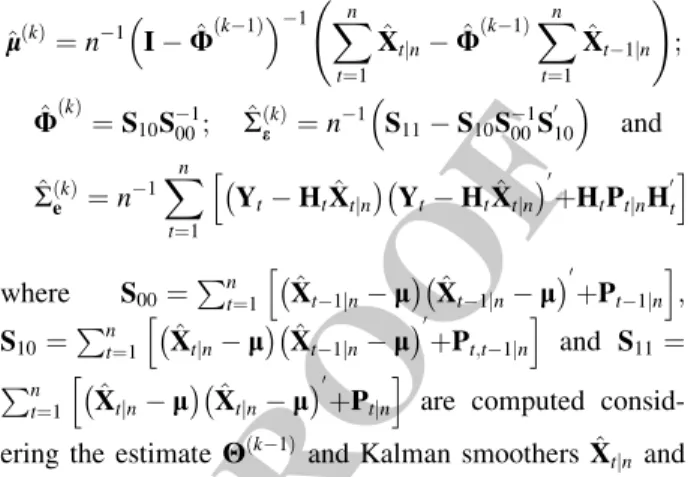
# $&1 Xn t¼1 ^ Xtjn& ^U k&1 ð ÞXn t¼1 ^ Xt&1jn ! ; ^ Uð Þk ¼ S10S&100; R^ k ð Þ e ¼ n &1 S 11& S10S&100S 0 10 # $ and ^ Rð Þek ¼ n &1X n t¼1 Yt& HtX^tjn ! " Yt& HtX^tjn ! "0 þHtPtjnH 0 t h i 341 341 where S00¼ Pn t¼1 X^t&1jn& l ! " ^ Xt&1jn& l ! "0 þPt&1jn h i ; 342 S10¼ Pn t¼1 X^tjn& l ! " ^ Xt&1jn& l ! "0 þPt;t&1jn h i and S11¼ 343 Pn t¼1 X^tjn& l ! " ^ Xtjn& l ! "0 þPtjn h i
are computed consid-344 ering the estimate Hðk&1Þand Kalman smoothers ^Xtjnand
345 ^
Xt&1jnand its MSE, Shumway and Stoffer (1982).
346 Table2 shows parameters estimates (for the 16 water
347 monitoring sites in the study) obtained by gaussian
maxi-348 mum likelihood estimation by using EM algorithm, as
349 shown before. In the parameter estimation process, we
350 opted for replacing missing values with seasonal
coeffi-351 cient estimates, because a significant number of missing
352 values can difficult the convergence of parameter
estima-353 tion process. On the one hand, the global means estimates
354 indicate that monitoring sites Cantela˜es (CANT), Visela
355
Santo Adria˜o (VSA), Ferro (FER) and Gola˜es (GOL)
356 present the best water quality, considering the DO
con-357 centration. On the other hand, at monitoring sites Ponte
358 Branda˜o(PBR), Ponte Trofa (PTR), Santo Tirso (STI) and
359 Portos(POR) we obtained the lowest values means of DO
360 concentration, i.e., these locations have the worst water
361 quality. These conclusions are reinforced by the analysis of
362 error variances estimates. Indeed, low values of both
363 variances estimates, mainly the variance error estimates of
364 the state equation, are obtained at locations with high
365 means of DO concentration. If we consider the
geograph-366 ical locations corresponding to the lowest values of
vari-367 ance errors estimates, we conclude that DO has less
368 variability at water monitoring sites closer to the sources of
369 River Ave and its adjacent streams.
370 Residuals analysis was performed for each of the 16
371 monitoring sites in order to evaluate the models
adjust-372 ment. Globally, satisfactory fits were obtained in all
mon-373 itoring sites. Although some histograms indicate slightly
374 skewed residuals, the Smirnov–Kolmogorov test does not
375 reject the normal distribution of residuals in none of the
376 monitoring sites under study. In some monitoring sites, for
377 instance Ponte Trofa (PTR) and Portos (POR), PACF and
378 ACF plots seem to indicate the existence of a seasonal
379 component. However, as our main objective in this context
UNCORRECT
ED
PROOF
380 is to model the global behaviour to identify homogenous
381 groups concerning DO magnitude, we thought that this
382 aspect could be neglected at this moment, considering the 383 gain in simplicity and parsimony of models.
384 3.3 Discrepancy measure and clustering results
385 Adapting the discrepancy measure suggested in Bengtsson 386 and Cavanaugh (2008), we define a discrepancy measure 387 based on the state component by considering the Kullback 388 information (Kullback1968) for the state densities f XjHð iÞ 389 and f XjH! j" dX Yi; Hi;Hj ! " ¼ Eiln f Xð ijHiÞ f XijHj ! " ¼ Z lnf Xð ijHiÞ f XijHj ! "f XijYi;Hi ! "dX: ð5Þ 391
391 The pseudo-distance between two monitoring sites i and 392 j, based on (5), defined as a form of the J-divergence 393 (Kullback1968), accounts for the different lengths of each 394 series of data sets by averaging over time
! JX Yi; Hi;Yj; Hj ! " ¼ N&1 i d X Y i; Hi;Hj ! " þ Nj&1dX Yj; Hj;Hi ! ": 396
396 Employing output from the EM algorithm, including the 397 maximum likelihood estimates, the sample !JX-divergence
398 (Bengtsson and Cavanaugh2008) reduces to ! JX Yi; ^Hi;Yj; ^Hj # $ ¼ 1 2Nj^r2ei Sð Þ11j & 2^/iS10ð Þj þ ^/2iSð Þ00j # $ þ 1 2Ni^r2ej Sð Þ11i & 2j/S^ i ð Þ 10þ ^/ 2 jS ðiÞ 00 # $ & 1 400
400 where smoothing quantities Sð Þk
11; S k ð Þ 10; S k ð Þ 00 and parameters
401 estimates ^Hk are computed based on the model Yð k; HkÞ: 402 The defined symmetric J-divergence is based solely on 403 the state process and targets only the state densities 404 f Xð ijHiÞ and f X! jjHj
"; where i and j are two water moni-405 toring sites and dX Y
i; Hi;Hj
!
" provides an unbiased esti-406 mate of the Kullback information between f Xð ijHiÞ and 407 f X! jjHj": The evaluation of the discrepancy measure solely 408 depends on the parameters estimates and on partial values 409 obtained from the parameters estimation procedure asso-410 ciated to each location’s model. Thus, as occurs in this case
411 study, the data series does not necessarily have to be
412 reported over the same timeframe. However, the
applica-413 tion of any process of data series clustering relative to
414 contemporary periods should be accompanied by an
anal-415 ysis of the impact on results. The legitimacy of the
appli-416 cation of this procedure to these data series follows the fact
417 that data do not present an accentuated tendency nor
418 structural changes over time. Moreover, their magnitudes
419 are too small, even in the cases where linear models
indi-420 cate a statistical significant slope in the linear tendency (as
421 it is shown later); consequently, state space models can
422 accommodate this component through their known
versa-423 tility and dynamics.
424 By using the parameters estimates of Table1 and the
425 partial results of EM algorithm, the calculation of sample
426 values !JX Yi; ^Hi;Yj; ^Hj
# $
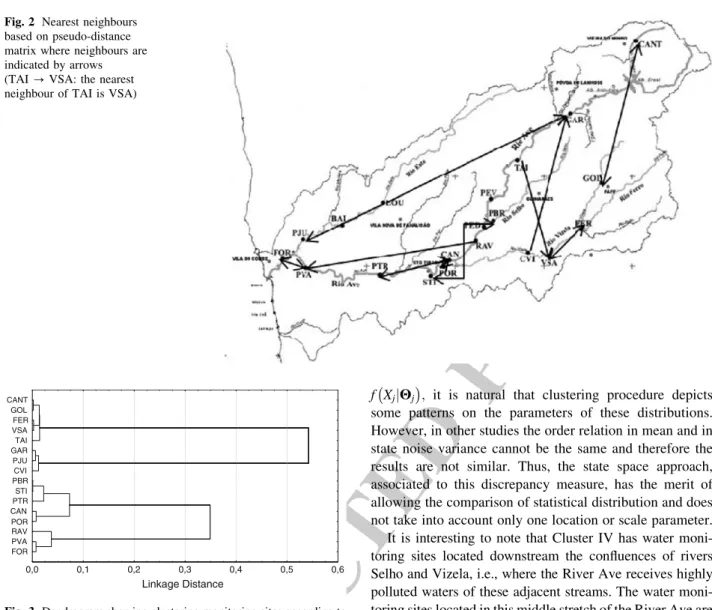
; i; j¼ 1; . . .16 allowed to obtain 427 a matrix of pseudo-distances. In Fig.2, nearest neighbours
428 are represented based on pseudo-distance matrices. It can
429 be seen from the plot that the location of each water
430 monitoring site in the river or its adjacent streams (closer to
431 the source of the river or to the confluence of the River Ave
432 with its adjacent streams) is an important factor to
deter-433 mine the nearest neighbour. However, the location of point
434 sources such as industries and domestic wastewater induces
435 some neighbour relations between Santo Tirso (STI) and
436 Ponte Branda˜o(PBR).
437 In order to identify potential clusters, we apply
clus-438 tering procedures by using the discrepancy matrix
pro-439 duced by evaluation of !JX Yi; ^Hi;Yj; ^Hj
# $
; i; j¼ 1; . . .16: 440 The discrepancy matrix was subjected to Ward’s, single
441 linkage and complete linkage clustering procedures
(Eve-442 ritt et al.2001). Because the three methods produce similar
443 results, we only discussed the results of Ward’s method. As
444 seen in the dendrogram in Fig.3, the identified clusters are
445 given by sites: Cluster I {CANT, TAI, GOL, FER, VSA};
446 Cluster II {GAR, PJU, CVI}, Cluster III {RAV, PVA,
447 FOR} and Cluster IV {PBR, CAN, POR, STI, PTR}, which
448 are geographically represented in Fig.4.
449 Considering the estimates of the processes mean
450 obtained in the estimation procedure and indicated in
451 Table2, it is clear that the clustering procedure performs a
452 classification of the monitoring sites into a possible water
453 quality scale, in what concerns the annual mean DO
con-454 centration. In fact, the estimates of the processes mean in
Table 2 Gaussian maximum likelihood parameter estimates for the 16 water monitoring sites in the clustering process
Site CANT GAR TAI PBR RAV CAN POR STI PTR PVA FOR PJU GOL FER VSA CVI ^ l 10.017 9.256 9.427 7.240 8.166 8.286 7.843 7.609 7.439 8.457 8.034 9.016 9.642 9.672 9.809 9.357 ^ / 0.568 0.581 0.657 0.537 0.616 0.586 0.646 0.561 0.521 0.644 0.598 0.567 0.596 0.566 0.605 0.645 ^ r2 e 0.035 0.271 0.0005 2.199 0.002 0.616 2.203 0.003 0.020 0.194 0.010 0.033 0.008 0.004 0.003 0.002 ^ r2 e 0.724 1.381 0.780 4.184 2.055 3.136 3.340 4.210 3.517 2.489 2.718 1.240 0.752 0.832 0.825 1.366
Author Proof
UNCORRECT
ED
PROOF
455 Cluster I monitoring sites present the highest values
456 obtained from the DO concentration. Indeed, the five
457 monitoring sites of Cluster I present the best water quality 458 annual indicators, while the worst indicators are observed
459 in Cluster IV monitoring sites. On the one hand this
460 methodology allows classifying the water monitoring sites, 461 in regard to annual mean DO concentration, in four cate-462 gories: from best water quality (Cluster I) to worst water 463 quality (Cluster IV). On the other hand, clustering proce-464 dure performs a discrimination of water monitoring sites 465 based on state noise variance. Indeed, Cluster I corresponds 466 to locations with the lowest state noise variances; Cluster II 467 has state noise variances greater than Cluster I and so on. 468 As expected, similar results are not obtained by observing 469 equation variance because the J-divergence !JX Yi; ^Hi;
#
470 Yj; ^HjÞ is based on the state process. Since the discrepancy
471 measure tends to compare state densities f Xð ijHiÞ and
472 f XjjHj
!
"; it is natural that clustering procedure depicts 473 some patterns on the parameters of these distributions.
474 However, in other studies the order relation in mean and in
475 state noise variance cannot be the same and therefore the
476 results are not similar. Thus, the state space approach,
477 associated to this discrepancy measure, has the merit of
478 allowing the comparison of statistical distribution and does
479 not take into account only one location or scale parameter.
480 It is interesting to note that Cluster IV has water
moni-481 toring sites located downstream the confluences of rivers
482 Selho and Vizela, i.e., where the River Ave receives highly
483 polluted waters of these adjacent streams. The water
moni-484 toring sites located in this middle stretch of the River Ave are
485 much more polluted, probably because they are close to
486 densely populated areas with high industrial production units.
487 4 Forecasting models
488 As mentioned above, data not considered in the modelling
489 process was used in the assessment of the performance of
490 the adjustment models: LM and state space models,
con-491 sidering the obtained clustering results concerning the
492 mean square error forecast. Thus, for each of the four
493 clusters identified in last section, two models are
estab-494 lished by using the available data until September 2006.
495 As we considered that inside each cluster there is a
496 homogenous annual mean behaviour of DO, it is
reason-497 able to assume that monthly measurements of water
mon-498 itoring sites inside a cluster are observations of the same
499 process. Therefore, models have to accommodate
repli-500 cates at each time. Moreover, as the goal at this stage is to
Fig. 2 Nearest neighbours based on pseudo-distance matrix where neighbours are indicated by arrows (TAI ? VSA: the nearest neighbour of TAI is VSA)
FOR PVA RAV POR CAN PTR STI PBR CVI PJU GAR TAI VSA CANT FER GOL 0,0 Linkage Distance 0,1 0,2 0,3 0,4 0,5 0,6
Fig. 3 Dendrogram showing clustering monitoring sites according to DO characteristics based on Ward’s method
UNCORRECT
ED
PROOF
501 make monthly predictions of the DO concentration, the 502 seasonality component should not be omitted in models 503 formulations.
504 4.1 Linear models
505 This section presents the linear models used to describe the 506 main characteristics of the DO series and to adjust different 507 models to each homogeneous group of monitoring sites 508 (cluster). Linear models are primary tools in the context of 509 environmental problems. There are many contributions 510 (Carl and Ku¨hn 2008; Mourin˜o and Bara˜o2009; Paschal-511 idou et al.2009). Linear models are simple and have good 512 statistical properties; they are very robust statistical meth-513 ods and this feature makes them a very attractive frame-514 work to describe the quality variables under study. It is 515 well known that the choice of the independent variables 516 should rely on the principle of parsimony. Also, their 517 selection is heavily context dependent, because both vari-518 ables themselves and the respective estimates for the 519 coefficients should have a clear interpretation within the 520 framework in which the case study is included.
521 Environmental data are naturally affected by the dif-522 ferent seasons and by the environmental degradation that 523 has been verified in a more aggravated way in recent years. 524 Thus, any model to predict the behaviour of data must take 525 these two factors into account. In this case study there is no 526 measure of space continuity and, therefore, the observa-527 tions at different locations in the cluster will be treated as 528 independent observations, referenced in time. Hence, 529 within each cluster we consider a variable observation 530 by Yð Þi
j;t; where i represents the cluster, i = 1, 2, 3, 4,
531 jrepresents the monitoring site running along all the sites
532 in the cluster i, j¼ 1; . . .; ki and t¼ 1; . . .; nðiÞj stands for
533 the month. With this notation, the model in each cluster
534 i includes two additive components corresponding to
dif-535 ferent types of effects, that is,
Yj;tð Þi ¼ Ttð Þi þ S i ð Þ t þ e i ð Þ j;t: ð6Þ 537 537 Let us now analyse in more detail how to describe each
538 component with the help of a linear model. The trend is
539 generally described by a simple linear function of time,
540 Ttð Þi ¼ að Þi þ bð Þit: The seasonal component S
i ð Þ t is a
541 periodic function taking 12 different values, say, kð Þsi;
542 s = 1,…, 12 associated with each month of the year and
543 expressing the positive or negative deviation from the trend
544 due to the effect of that month. This type of effect is
545 usually described with the help of 12 dummy variables
546 indicating if each time instant t corresponds to month
547 i. However, when the model has a constant term, in order
548 for these parameters to be estimable they have to add up to
549 0, that is,P12 s¼1ks¼ 0 and kð Þ12i ¼ & P11 s¼1k i ð Þ s : Thus, as one 550 of the seasonal coefficients has to be written as a function
551 of the others, the seasonal component is represented by a
552 linear combination of 11 explanatory variables
SðiÞt ¼
X11
s¼1
kð ÞsiSs;t;
where Ss;t¼
1; if date t corresponds to month s &1; if date t corresponds to month 12
0; otherwise 8 < : : 554 554 Clearly, the choice of the twelfth month, December, to
555 be written as a linear combination of the others is arbitrary
Fig. 4 Representation of clusters in the River Ave hydrological basin
UNCORRECT
ED
PROOF
556 and any month can be used for that role. Finally, the model 557 includes a stochastic component, eð Þi
j;t; which we suppose to
558 be simply a white noise process, that is, a sequence of 559 uncorrelated zero mean random variables, with constant 560 variance r2 ið Þ: A careful check of residuals shows that there
561 were no significant violations of the normality and
562 independence conditions. This procedure ensures the
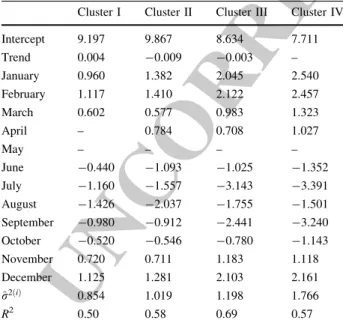
563 optimality properties of the OLS as well as the power of 564 the t and F tests performed. After the model with all 565 variables (full model) was adjusted, the authors used a 566 backwards elimination procedure to select the significant 567 variables. The regressor with largest p-value for its 568 t-statistic was removed at each step, until all the regressors 569 were significant at the level 0.05. The final reduced model 570 was also tested against the full model with the help of a 571 F-test on the set of all removed independent variables. 572 The DO modelling procedure starts by fitting the linear 573 model (6) to the DO data observed in each cluster. The 574 regression parameters obtained for each cluster are pre-575 sented in Table3. As expected, the four clusters show a 576 seasonal pattern with lower values of DO concentration in
577 the warmer months as compared to autumn and winter
578 months. This could be expected because the inverse rela-579 tionship between temperature and DO is a natural pro-580 cess—warmer water becomes more easily saturated with 581 oxygen and it can hold less DO. Cluster I presents a weak 582 positive significant trend associated to the sites in rural 583 areas near the source of the river with good water quality. 584 Cluster II and Cluster III present a weak decreasing trend 585 associated to polluted areas that are densely populated, 586 with high industrial productivity and where the Ave also
587 receives similarly polluted waters from its adjacent
588 streams. Cluster III presents the highest coefficient of
589 determination (69%). Cluster IV, the most polluted cluster,
590 has a stable behaviour with no significant trend, which may
591 be justified if we take into consideration the highest
vari-592 ability when compared with other clusters. In this case, the
593 coefficient of determination was 57%.
594 4.2 State space models
595 In the previous section it was verified that the seasonality is
596 an important structural component to predict the monthly
597 DO concentration. Thus, a regression model with varying
598 coefficients (Pagan1980; Leybourne2006) represented in a
599 state space framework could improve the predictions
600 accuracy. However, in this case it implies establishing
601 multivariate models that involve a large number of
602 parameters, in addition to a complex structure that
diffic-603 ults its interpretation.
604 We propose an alternative model that assumes prior
605 knowledge of DO seasonal coefficients st or its estimates
606 (in this case, its monthly means computed in the past). This
607 assumption implies some knowledge of the seasonal
608 component behaviour. However, the modelling of this type
609 of data is usually performed under previous studies or
610 considering a significant data set. Another solution to
611 overcome the monthly means of DO could be the use of
612 seasonal coefficients estimates obtained via the linear
613 process. Nevertheless, we selected the simplest option to
614 compute the monthly means of observations, to compare
615 linear regression with state space approaches in order to
616 guarantee the independency of two estimation processes.
617 The model assumes that for month t the measurement
618 Yj;tð Þi of the DO in monitoring site j of the cluster i is the
619 calibrated seasonal coefficient added to a zero mean error,
620 i.e., Yj;tð Þi ¼ sð Þtibð Þti þ e
i ð Þ
j;t; where bð Þti is a calibration factor of
621 cluster i at time t. Considering that cluster i is composed by
622 ki water monitoring sites, the DO can be modelled at
623 cluster i by Yð Þti ¼ s i ð Þ t bð Þti þ e i ð Þ t : ð7Þ 625 625 bð Þti & 1 ¼ /ð Þi bð Þi t&1& 1 # $ þ eð Þti: ð8Þ 627 627 where Yð Þti ¼ Y i ð Þ 1;t; Y i ð Þ 2;t; . . .; Y i ð Þ ki;t h i0 and sð Þti ¼ s i ð Þ t ! 1ki: The 628 error vector eð Þti ¼ e i ð Þ 1;t; e i ð Þ 2;t; . . .; e i ð Þ ki;t h i0
and the error eð Þti are
629 zero means uncorrelated errors, E eð Þj;tieð Þi
s
h i
¼ 0 for all t, 630 sand j, with matrix of covariance E eð Þtie
0ð Þi t h i ¼ r2 e;i! Ikiand 631 variance E e2 t;i h i ¼ r2
e;i; respectively. The calibration factor
632 bð Þti is assumed to be a stationary autoregressive process of
633 order 1, /ðiÞ ' ' ' ' '
'\1; with unitary mean.
Table 3 Results for linear models adjustment to the four clusters Cluster I Cluster II Cluster III Cluster IV Intercept 9.197 9.867 8.634 7.711 Trend 0.004 -0.009 -0.003 – January 0.960 1.382 2.045 2.540 February 1.117 1.410 2.122 2.457 March 0.602 0.577 0.983 1.323 April – 0.784 0.708 1.027 May – – – – June -0.440 -1.093 -1.025 -1.352 July -1.160 -1.557 -3.143 -3.391 August -1.426 -2.037 -1.755 -1.501 September -0.980 -0.912 -2.441 -3.240 October -0.520 -0.546 -0.780 -1.143 November 0.720 0.711 1.183 1.118 December 1.125 1.281 2.103 2.161 ^ r2ðiÞ 0.854 1.019 1.198 1.766 R2 0.50 0.58 0.69 0.57
Author Proof
UNCORRECT
ED
PROOF
634 Table4 summarizes seasonal coefficients estimates for 635 the four clusters computed by the mean of the observed 636 values of the DO concerning monitoring sites that belong 637 to each cluster and according each month. Table5presents
638 gaussian maximum likelihood estimates of parameters
639 (referred in Sect. 3.2) that concern each cluster’s multi-640 variate model (7)–(8). As mentioned before, the state 641 process bð Þi
t can be interpreted as a dynamic calibration
642 factor of the seasonal component; so, it is reasonable that 643 state noise has a small variance, as can be seen in Table5. 644 The largest values of both state and observation equations 645 error variances are obtained in Clusters III and IV. As 646 mentioned before concerning the clustering analysis, these 647 clusters include the water monitoring sites which have the 648 lowest annual DO values. Therefore, Clusters III and IV 649 include sites with worse indicators in what concerns DO 650 concentration, but at the same time they also present the 651 largest variability. Nevertheless, Cluster IV presents worse 652 water quality indicators that clearly distinguish it, even 653 from Cluster III.
654 Taking advantage of the interpretability of the state 655 process, Fig.5 shows filtered state values estimates ^b
tjt in
656 the modelling period. As the graphic shows, the model
657 captures changes in a dynamic way that overlaps the
658 default behaviour evidenced by the seasonality. The state 659 space model (7)–(8) provides a useful tool to evaluate 660 changes in real time on DO concentration in each month. 661 Indeed, calibration factor estimates greater than one indi-662 cate an improvement in water quality, while estimates 663 lower than one can indicate water quality deterioration. 664 This possibility of model formulation (7)–(8) benefits the 665 water monitoring process in a way that linear models are 666 not able to provide, since linear models incorporate global 667 trends in pre-established time periods.
668 4.3 Comparative analysis
669 A first analysis of adjustment models is done comparing
670 data and predictions. Globally, models fit the data
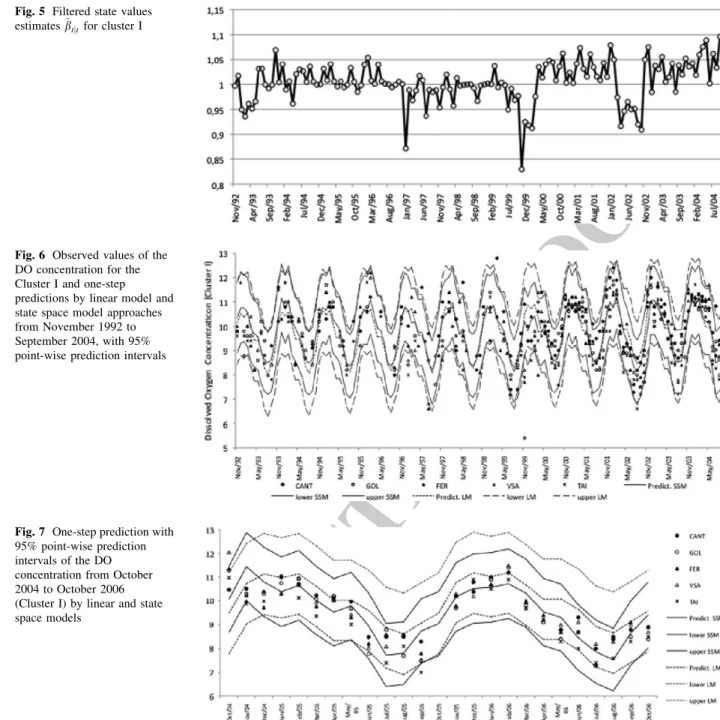
satis-671 factorily. For instance, Fig. 6 shows the observed values
672 and one-step predictions of the DO concentration
con-673 cerning Cluster I from November 1992 to September 2004,
674 with 95% point-wise prediction intervals. Graphic
repre-675 sentation shows that the linear model produces point-wise
676 prediction intervals with large amplitude than state space
677 models, as is the case in other clusters. As the state space
678 model incorporates the last observation at each time, it
679 enables updating and accurate predictions.
680 Accurate forecasts are important information on water
681 monitoring processes; therefore, they are a good criterion to
682 assess the model performance. Thus, we compare the linear
683 and state space models performance concerning the one-step
684 forecast’s mean square error, relatively to the remaining
685 unused data in the modelling process. So, we computed
686 forecasts for the 228 observations by using two approaches.
687 However, approximately half of this data is related to Cluster
688 I, because some water monitoring sites belonging to other
689 clusters were inactive due to public policy restructuring.
690 In order to compute forecasts based on linear models, we
691 applied the estimated regression equation obtained from
692 Table3, while state space models forecasts are evaluated
693 through Kalman filter predictors. The Kalman filter
algo-694 rithm produces the best linear prediction ^bð Þtjt&1i for the
cali-695 bration factor bð Þti for month t and cluster i and,
696 consequently, the best linear prediction of DO is ^Ytð Þi ¼
697 sð Þtib^
i ð Þ
tjt; which is clearly equal for all sites from a same cluster
698 at each month.
699 In Fig.7 we present forecasts with 95% point-wise
700 prediction intervals of DO concentration from October
701 2004 to October 2006. We do not have records from
702 October 2005 in any of the water monitoring sites and we
703 were not able to determine the cause of this occurrence.
704 This representation indicates that state space approach
705 allows obtaining prediction intervals with lower range than
706 linear models. The state space model tends to fit data
707 better, whereas the linear model seems to overestimate the
708 values. In this concrete cluster, the linear model considers
709 the trend as a significant component with a small positive
710 slope in the modelling period. Nevertheless, its rigid
Table 4 Seasonal coefficients (monthly means) of the DO concentration of the four clusters
Month Jan Feb Mar Apr May Jun Jul Aug Sep Oct Nov Dec
Cluster I 10.66 10.87 10.25 9.89 9.82 9.14 8.48 8.36 8.64 9.44 10.34 10.77 Cluster II 10.97 10.53 9.96 9.97 9.12 8.47 7.52 7.25 8.06 8.43 9.76 10.63 Cluster III 10.22 10.24 9.16 8.92 8.52 7.21 5.16 6.47 5.80 7.46 9.33 10.09 Cluster IV 10.10 10.03 8.98 8.70 8.21 6.56 4.11 6.28 4.36 6.62 8.80 9.88
Table 5 Estimated values obtained for the multivariate models parameters of the four clusters via gaussian maximum likelihood estimation Cluster /^ ^r2 e r^2e I 0.5213 0.0016 0.3140 II 0.5246 0.0035 0.5549 III 0.7527 0.0036 0.7138 IV 0.2242 0.0158 1.6322
Author Proof
UNCORRECT
ED
PROOF
711 structure may not have detected temporary changes or new 712 conditions such as new industries in that area, for instance. 713 In order to compare the two approaches in a quantita-714 tively point of view, in the sense of predictions accuracy, 715 we computed the root of the mean square errors (RMSE) of 716 predictions, i.e., RMSE¼ ffiffiffiffiffiffiffiffiffiffiffiffiffiffiffiffiffiffiffiffiffiffiffiffiffiffiffiffiffiffiffiffiffiffiffiffiffiffiffiffiffiffiffiffiffiffiffiffiffiffiffi 1 228 X4 i¼1 Xni t¼1 Ytð Þi & ^Y i ð Þ t # $2 v u u t : 718
718 Taking into account all 228 predictions computed
719 in the period of the assessment procedure, we obtained
720 RMSE = 0.961 in the linear models and RMSE = 0.846
721 in the state space approach. Globally, it is the state space
722 modelling approach that provides the least RMSE as far as
723 concerns all the predictions we made. So, the dynamic
724 structure of the state space models improved the
725 predictions accuracy in the sense of the mean square error.
726 5 Conclusions
727 This work shows that state space approach combined with
728 clustering techniques allows identifying homogeneous
Fig. 5 Filtered state values estimates ^btjtfor cluster I
Fig. 6 Observed values of the DO concentration for the Cluster I and one-step predictions by linear model and state space model approaches from November 1992 to September 2004, with 95% point-wise prediction intervals
Fig. 7 One-step prediction with 95% point-wise prediction intervals of the DO concentration from October 2004 to October 2006 (Cluster I) by linear and state space models
UNCORRECT
ED
PROOF
729 groups of water monitoring sites, based on similarities in
730 the temporal dynamics of monthly records of DO
con-731 centration. With an appropriate disparity measure based 732 on Kullback information, we identified four clusters of 733 water monitoring sites in the River Ave basin that allow 734 us to construct only four models in order to forecast this 735 variable in the future by reducing the initial 16 water 736 monitoring sites. Besides, it is possible to arrange these 737 groups by order of water quality degree, from the less 738 polluted (Cluster I) to the most polluted (Cluster IV). So, 739 the less polluted monitoring sites are near the sources of 740 River Ave or its adjacent streams (except for river Selho), 741 and the most polluted water monitoring sites are located
742 in a highly industrial area exposed to discharges of
743 industrial effluents.
744 After a clustering procedure, the comparison between
745 the forecast’s mean square error of the linear model and 746 of the state space model shows that the latter evidences an 747 improved accuracy within the proposed assessment
per-748 iod. We adopted a state space model to predict the
749 monthly DO concentration, which calibrates the seasonal 750 coefficients through an autoregressive calibration factor. 751 This approach is an alternative to the standard linear
752 model with tendency and seasonality components,
753 because this model incorporates a dynamic structure that 754 allows an easy data fitting. Furthermore, calibration fac-755 tors have a useful interpretation as an approximate ratio
756 between observed measure of the DO concentration and
757 the respective seasonal coefficient. This approach pro-758 vides a real time procedure to monitoring DO concen-759 tration in which calibration factors greater or lower than 760 one indicate that water quality improved or deteriorated in 761 comparison to the expected value based on past behav-762 iour. From the forecast point of view, the state space
763 model reduced the forecast’s mean square error from
764 0.961 (obtained with linear model) to 0.846, which is a 765 significant improvement.
766 We hope that this work could be a tool for decision
767 support, because monitoring procedures and good models 768 of water quality variables are indispensable, mainly in a 769 highly industrial region as is the Ave Valley in the north-770 west of Portugal.
771 Acknowledgments The authors would like to thank the anonymous 772 referees for many helpful critics and suggestions that contributed to 773 improve this paper. The authors would like to thank to Eng. Pimenta 774 Machado from the Portuguese Regional Directory for the Northern 775 Environment and Natural Resources and to Eng. Cla´udia Branda˜o 776 from the Portuguese Institute of Water, for sharing their skills and 777 experiences and for supplying the monitored data. A. Manuela 778 Gonc¸alves acknowledges the financial support provided by the 779 Research Centre of Mathematics of the University of Minho through 780 the FCT Pluriannual Funding Program.
781 References
782
Alpuim T, Barbosa S (1999) The Kalman filter in the estimation of
783
area precipitation. Environmetrics 10:377–394
784
Bengtsson T, Cavanaugh JE (2008) State-space discrimination and
785
clustering of atmospheric time series data based on Kullback
786
information measures. Environmetrics 19:103–121
787
Boi P (2004) A statistical method for forecasting extreme daily
788
temperatures using ECMWF 2-m temperatures and ground
789
station measurements. Meteorol Appl 11:245–251
790
Brown P, Diggle P, Lord M, Young P (2001) Space-time calibration
791
of radar rainfall data. Appl Stat 50(2):221–241
792
Carl G, Ku¨hn I (2008) Analysing spatial ecological data using linear
793
regression and wavelet analysis. Stoch Environ Res Risk Assess
794
22(3):315–324
795
Costa M, Alpuim T (2010) Parameter estimation of state space
796
models for univariate observations. J Stat Plan Inference
797
140(7):1889–1902
798
Dempster AP, Laird NM, Rubin DB (1977) Maximum likelihood
799
from incomplete data via the EM algorithm. J R Stat Soc Ser B
800
39:1–38
801
Everitt BS, Landau S, Leese M (2001) Cluster analysis, 4th edn.
802
Arnold, London
803
Fovell R, Fovell M (1993) Climate zones of the conterminous United
804
States defined using cluster analysis. J Clim 6:2103–2135
805
Galanis G, Anadranistakis M (2002) A one-dimensional Kalman filter
806
for the correction of near surface temperature forecast. Meteorol
807
Appl 9:437–441
808
Gong X, Richman M (1995) On the application of cluster analysis to
809
growing season precipitation data in North America east of the
810
Rockies. J Clim 8:897–931
811
Harvey AC (1996) Forecasting structural time series models and the
812
Kalman filter. Cambridge University Press, Cambridge
813
Kullback S (1968) Information theory and statistics. Dover, New York
814
Leybourne SJ (2006) Estimation and testing of time-varying
coeffi-815
cient regression models in the presence of linear restrictions.
816
J Forecast 12(1):49–62
817
Libonati R, Trigo I, DaCamara C (2008) Correction of 2
m-818
temperature forecasts using Kalman filtering technique. Atmos
819
Res 87:183–197
820
Mourin˜o H, Bara˜o MI (2009) A comparison between the linear
821
regression model with autocorrelated errors and the partial
822
adjustment model. Stoch Environ Res Risk Assess 24(4):
823
499–511
824
Oliveira RES, Lima MMCL, Vieira JMP (2005) An indicator system
825
for surface water quality in river basins. In: Inter-Celti colloquium
826
on hydrology and management of water resources 4, Guimara˜es
827
Pagan A (1980) Some identification and estimation results for
828
regression models with stochastically varying coefficients.
829
J Econom 13:341–363
830
Paschalidou AK, Kassomenos PA, Bartzokas A (2009) A comparative
831
study on various statistical techniques predicting ozone
concen-832
trations: implications to environmental management. Environ
833
Monit Assess 148:277–289
834
PGIRH/N (1988) Metodologias para a Avaliac¸a˜o de Polı´ticas de
835
Recursos Hı´dricos - Plano de Gesta˜o da Bacia Hidrogra´fica do
836
Rio Ave (in Portuguese). Ministe´rio das Obras Pu´blicas,
837
Transportes e Comunicac¸o˜es, Laborato´rio Nacional de
Enge-838
nharia Civil, Ministe´rio do Plano e Administrac¸a˜o do Territo´rio,
839
Comissa˜o de Coordenac¸a˜o da Regia˜o Norte 8:66, Lisboa
840
PGIRH/N and NATO PO-RIVERS (1994) Caracterizac¸a˜o e
Direct-841
rizes de Planeamento dos Recursos Hı´dricos do Norte – A Bacia
842
Hidrogra´fica do Rio Ave (in Portuguese). Ministe´rio do
UNCORRECT
ED
PROOF
843 Ambiente e dos Recursos Naturais, Direcc¸a˜o Regional do 844 Ambiente e Recursos Naturais, Instituto da A´ gua. Porto 1–5,
845 1–13
846 Shrestha S, Kazama F (2007) Assessment of surface water quality 847 using multivariate statistical techniques: a case study of the Fuji 848 river basin, Japan. Environ Model Softw 22:464–475
849 Shumway R, Stoffer D (1982) An approach to time series smoothing 850 and forecasting using the EM algorithm. J Time Ser Anal 851 3:253–264
852
Shumway R, Stoffer D (2006) Time series analysis and its
applica-853
tions, 2nd edn. Springer-Verlag, Berlin
854
Stone RC (1989) Weather types at Brisbane, Queensland: an example
855
of the use of principal components and cluster analysis. Int J
856
Climatol 9:3–32
857
Vieira JMP (2003) Water management in national water plan
858
challenges (in Portuguese). Revista Engenharia Civil 16:5–12
859
Zhu R, El-Shaarawi AH (2009) Model clustering and its application
860
to water quality monitoring. Environmetrics 20:190–205
861