Teresa Margarida Figueiredo Silva
Lincenciatura em Ciências de Engenharia BiomédicaCharacterization of mating behaviour of the
female fruit fly using machine vision
Dissertação para obtenção do Grau de Mestre em Engenharia Biomédica
Orientadora: Maria Luísa Vasconcelos, Principal Investigator, Vasconcelos Lab - Champalimaud Foundation Co-orientadora: Márcia Aranha, Postdoctoral Fellow,
Vasconcelos Lab - Champalimaud Foundation
Presidente: Doutora Carla Maria Quintão Pereira
Arguente: Doutor César Miguel Pereira Soares Mendes Vogal: Doutora Maria Luísa Vasconcelos
Characterization of mating behaviour of the female fruit fly using machine vision
Copyright © Teresa Margarida Figueiredo Silva, Faculdade de Ciências e Tecnologia, Uni-versidade NOVA de Lisboa.
A Faculdade de Ciências e Tecnologia e a Universidade NOVA de Lisboa têm o direito, perpétuo e sem limites geográficos, de arquivar e publicar esta dissertação através de exemplares impressos reproduzidos em papel ou de forma digital, ou por qualquer outro meio conhecido ou que venha a ser inventado, e de a divulgar através de repositórios científicos e de admitir a sua cópia e distribuição com objetivos educacionais ou de inves-tigação, não comerciais, desde que seja dado crédito ao autor e editor.
Este documento foi gerado utilizando o processador (pdf)LATEX, com base no template “unlthesis” [1] desenvolvido no Dep. Informática da FCT-NOVA [2].
Ac k n o w l e d g e m e n t s
Another big achievement of my life that comes to an end. These nine challenging months leave me with some grateful words to say.
First, I would like to thank my adviser, Maria Luísa Vasconcelos, for giving me this huge opportunity to work in this incredible institution, for receiving me in her lab and for the crucial help and guidance throughout the development of this work.
To my co-adviser, Márcia Aranha, thank you very much for all the support through your kind words and for the essential help you gave me to achieve a better work.
I am really grateful for having been in the Innate Behaviour lab, the best (and sweetest) lab of Champalimaud Foundation, where I met awesome people, that I can call now ’friends’. To Hugo Cachitas, the coolest physics engineer that I ever met, a huge thank you for all the help that you gave me and for all the patience that you had with me. To Nélia Varela, my favorite bully, I will miss you but you will miss me more, thank you for everything. To Eliane Arez, thank you for the support, for the conversations and for the workouts. To Cristina Ferreira, thank you for all the help and tips that you were always ready to give me. To Cecilia Mezzera, the kindest and stylist italian that I ever met, thank you for the support. To Miguel Gaspar, thank you for all the support and help that you gave me during my work. To Melis Chakar, thank you very much for making my summer here to become really better.
To my family, thank you very much for the support, for the love and for all the effort
that you had to do for me being able to finish my degree.
Finally, to Carolina, Eduarda, Filipa and Francisco, a special thank you for being who you are, for the friendship, for all the love and for making me laugh.
A b s t r a c t
Courtship behaviour is the means for the animals to select their partner for reproduc-tion. The fruit fly,Drosophila melanogaster, exhibit a complex courtship behaviour. Nearly all studies ofD. melanogastercourtship have focused exclusively on the male behaviour. Female pre-copulatory behaviour is often relegated to ‘accepting’ or ‘rejecting’ of mating, and how females interact with males remains largely unknown. The aim of this study is to quantify and describe the mating behaviour of the femaleD. melanogaster.
D. melanogasteris a model system that offers many genetic tools and when coupled
with the recent technologies for neuronal manipulation, mapping and behavioural char-acterization, it has the potential to reveal the neurons involved in a particular behaviour. We analyzed the behaviour of thewild-type(WT) female fly by collecting information of the flies’ position during courtship using a tracking system and by automatically detect-ing specific behaviours usdetect-ing an automatic classifier. We found that WT flies displayed courtship acts and mating responses differently depending on their geographical origin
strains. The automatic classes were developed in a machine learning system, to allow a faster and reliable behavioural analysis.
In future work, the automatic classes developed in this research will be key to continue the female behaviour characterization.
Keywords: courtship; female receptivity behaviour; mating;Drosophila melanogaster
R e s u m o
A corte é a forma através da qual os animais selecionam os seus parceiros para re-produção. A mosca da fruta,Drosophila melanogaster, exibe um comportamento de corte complexo. A maioria da investigação científica dedicada ao estudo do comportamento de corte emD. melanogastertem-se focado exclusivamente no comportamento do macho. O comportamento pré-copulatório da fêmea resume-se a ‘aceitação’ ou ‘rejeição’, pelo que a forma como a fêmea interage com o macho permanece ainda desconhecida. O ob-jectivo deste trabalho é quantificar e descrever o comportamento de corte da fêmeaD. melanogaster.
D. melanogasteré um organismo-modelo que tem à sua disposição ferramentas gené-ticas que, conjugadas com as novas tecnologias de manipulação neuronal, mapeamento de circuitos e caracterização de comportamento, permite a identificação de neurónios envolvidos no comportamento.
Nós analisamos o comportamento da mosca fêmea da linhagem tipo selvagem através da recolha de informação relativa à posição das moscas durante a corte utilizando um sistema de rastreio e deteção automática de comportamentos específicos usando um clas-sificador automático. Descobrimos que estas moscas exibem comportamentos de corte e respostas que dependem da sua origem geográfica de linhagem. As classes automáticas foram desenvolvidos num sistema de aprendizagem e permitiram uma análise do com-portamento mais rápida e fiável. No futuro, as classes automáticas desenvolvidas neste trabalho serão fundamentais para caracterizar o comportamento da fêmea.
Palavras-chave: corte; comportamento de receptividade da fêmea; acasalamento; Dro-sophila melanogaster
C o n t e n t s
List of Figures xiii
List of Tables xvii
Acronyms xix
1 Introduction 1
1.1 Motivation . . . 1
1.2 Objectives . . . 1
1.3 Thesis Outline . . . 1
2 Theoretical Background 3 2.1 Innate behaviours . . . 3
2.2 Drosophila melanogaster . . . 4
2.3 Mating behaviours - the male strategies and the female responses . . . 4
2.4 Genes, neural circuits and sensory signals . . . 7
2.5 Computational tools for animal behaviour analysis . . . 8
3 Materials and Methods 11 3.1 Fly Stocks . . . 11
3.2 Video Data Acquisition . . . 11
3.3 Video Data Analysis . . . 12
3.3.1 Tracking system . . . 13
3.3.2 Machine learning system . . . 14
3.3.3 Manual Video Annotator . . . 15
4 Experimental Results, Data Analysis and Discussion 17 4.1 Tracking performance optimization . . . 17
4.2 Female virgin mating behaviour . . . 18
4.2.1 Scotland female flies display higher receptivity when compared with Canton-S . . . 20
4.3 Automatic behavioural classes . . . 21
4.3.1 Creation and development of an automatic class . . . 22
4.3.2 Accuracy of an automatic class . . . 22
CO N T E N T S
4.3.3 Male courtship class . . . 23
4.3.4 Female locomotion class . . . 24
4.3.5 Attempted copulation class . . . 25
4.3.6 Male song class . . . 25
4.4 Scotland males spend less time courting the female . . . 26
4.4.1 Courtship bout structure vary within thewild-typestrains . . . 27
4.4.2 Characterization of the female speed during courtship . . . 30
4.5 Female virgin mating behaviour between Canton-S and Scotland strains . 32 4.5.1 Scotland females display higher receptivity when paired with a male from the same strain . . . 32
5 Conclusions and Future Work 35
Bibliography 37
L i s t o f F i g u r e s
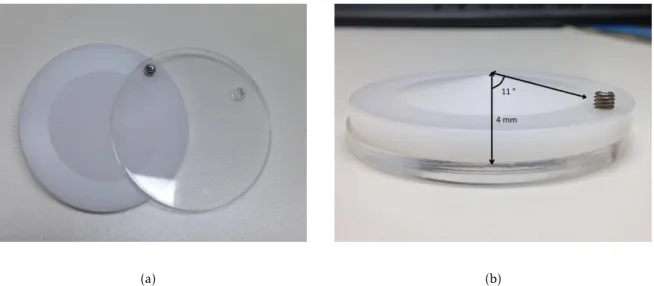
3.1 Images of the conical shaped arenas used in the behavioural experiments. (a) The arena is made of white Delrin and a plexiglass lid. (b) The arena has 11◦ sloped walls and 4 mm of height at the center. . . 12 3.2 Image of the behavioural set up. It is composed by a high resolution camera, an
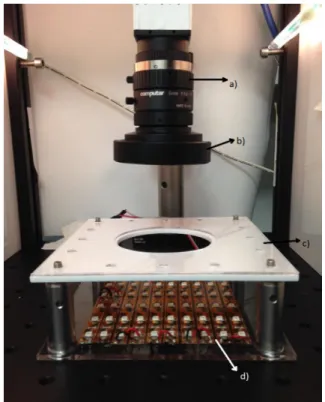
arena support and illuminated with an infrared light. a) Camera; b) infrared filter; c) Platform for the behavioural arena; d) infrared light. . . 13 3.3 Examples of individual and relative features that can be obtained from
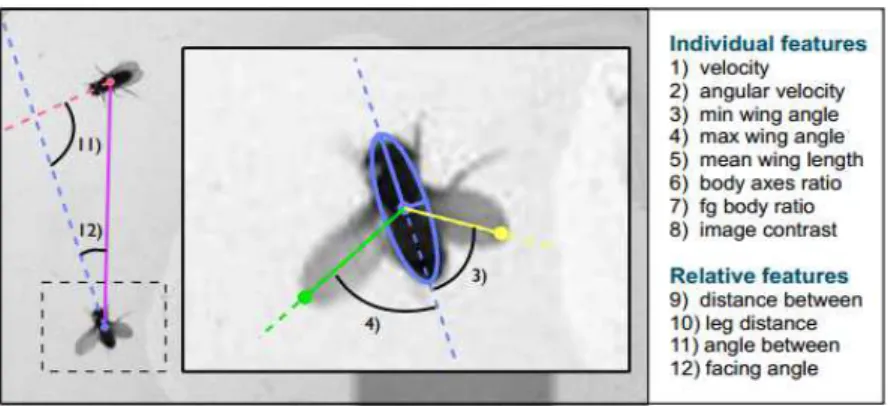
Cal-tech FlyTracker. 1)velocity: speed of fly; 2)angular velocity: angular velocity of fly; 3)min wing angle: mininum of left and right wing angle; 4)max wing angle: maximum of left and right wing angle; 5)mean wing length: mean of left and right wing length; 6)body axes ratio: major axis length divided by minor axis length; 7)fg body ratio: foreground area divided by body area; 8)image contrast: mean gradient in image around fly; 9)distance between: dis-tance between the centers of the two flies; 10)leg disdis-tance: minimum disdis-tance between foregrounds of the two flies; 11)angle between: angle between the facing vectors of the two flies; 12)facing angle: angle between facing vector and the vector towards other fly. From [11, 12]. . . 14 3.4 JAABA software layout illustrating a class construction and examples of input
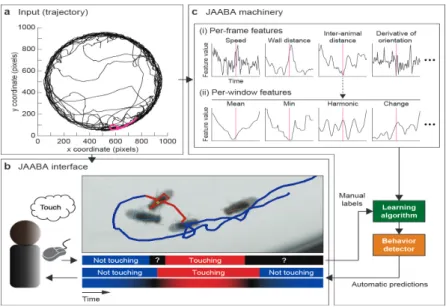
features. a) Input position (x,y) of the flies; b) Representation of the labelling made by the user: in red the ’behaviour’ (e.g. Touching) and in blue the ’none behaviour’ (e.g. Not touching); c) Examples of features provided by the tracker. The learning algorithm detect the behaviour through the manual labels and the input features and perform it by automatic predictions. From [19]. . . 15 3.5 Python Video Annotatorsoftware layout illustrating an example of the moment
of copulation. . . 16
4.1 Receptivity of virgin females with and without Sigmacote (ns, not significant, Fisher exact test corrected for multiple comparison Sidák-Bonferroni proce-dure, (n)(n)= No. of flies’ pairs tested). Flies were considered receptive if mating happened in 15 min. . . 19
L i s t o f F i g u r e s
4.2 Courtship index of WT males displayed in the videos, in each strain, with and without Sigmacote.(n)(n)= No. of flies’ pairs tested. . . 19 4.3 Receptivity of virgin females in female virgin mating behaviour experiment,
in each strain (ns, not significant,*p < 0.05, Fisher exact test corrected for mul-tiple comparison Sidák-Bonferroni procedure, (n)= No. of flies’ pairs tested). 20 4.4 Latency to copulate of the female fly, in each strain (ns, not significant,*p <
0.05, ***p<0.001, Kruskal-Wallis test combined with Dunn’s multiple-comparison post hoc test,(n)= No. of flies’ pairs tested). . . 21 4.5 Cumulative mating curves within the experimental period (15 minutes) for
each strain. A plateau was not attained in any curve except in Scotland strain. 22 4.6 Distribution of courtship bout duration. The courtship bouts were predicted
by the courtship class in all videos of the female virgin mating behaviour experiment. There are 134 bouts distributed with durations between 1 and 4 min. . . 24 4.7 Raster plot for the courtship bouts as a result of the application of courtship
automatic class in each video, separated by strain. The courtship bouts are represented in blue and the red dots in the end of the last bout represent the moment of copulation. . . 27 4.8 Courtship index of WT males displayed in the videos, in each strain (ns, not
significant,*p<0.05, ****p<0.0001, Kruskal-Wallis test combined with Dunn’s multiple-comparison post hoc test, (n)= No. of flies’ pairs tested). . . 28 4.9 Courtship index of WT males displayed in the videos with and without
cop-ulation, in each strain (ns, not significant, Mann–Whitney U test combined with variance and normality test, (n)(n)= No. of flies’ pairs tested). . . 28 4.10 Latency to court by the male, in each strain (ns, not significant, *p < 0.05,
****p<0.0001, Kruskal-Wallis test combined with Dunn’s multiple-comparison post hoc test, (n)= No. of flies’ pairs tested). . . 29 4.11 Cumulative curve of the distribution of total courtship duration in 118 videos.
The duration of each video is 15 minutes, when the copulation happens, the duration of the video is until their occurrence. . . 29 4.12 Number of courtship bouts per minute of courtship, in each strain (ns, not
significant,**p<0.01, ***p<0.001, ****p<0.0001, Kruskal-Wallis test combined with Dunn’s multiple-comparison post hoc test, (n)= No. of flies’ pairs tested ). 30 4.13 Courtship mean bout duration, in each strain (ns, not significant, **p<0.01,
***p<0.001, ****p<0.0001, Kruskal-Wallis test combined with Dunn’s multiple-comparison post hoc test, (n)= No. of flies’ pairs tested). . . 31 4.14 Female speed variation (mean and s.d.) as a function of the distance between
the two flies, in each strain. . . 31 4.15 Angular position (mean and s.d.) of the female fly with the male fly as a
func-tion of the distance between them, in each strain. . . 32
L i s t o f F i g u r e s
4.16 Receptivity of virgin females in female virgin mating behaviour experiment between Scotland and Canton-S strains (ns, not significant, *p < 0.05, **p < 0.01Fisher exact test corrected for multiple comparison Sidák-Bonferroni procedure, (n)= No. of flies’ pairs tested ). . . 33 4.17 Courtship index of WT males displayed in the videos (ns, not significant,
Kruskal-Wallis test combined with Dunn’s multiple-comparison post hoc test, (n)= No. of flies’ pairs tested). . . 33
L i s t o f Ta b l e s
4.1 Tracking errors found inCaltech FlyTrackerduring the tracking performance optimization experiment, to test the efficiency of Sigmacote compound. . . . 18
4.2 Result of Ground Truthing (GT) for the courtship class. The columns of the table correspond to the classifiers’ predictions, and the rows correspond to the manual labels. Each element of the table corresponds to the number and percentage of frames with the given type of manual labels that have the given prediction. Percentages are computed over rows [18]. . . 23 4.3 Result of GT for the female locomotion class. The columns of the table
corre-spond to the classifiers’ predictions, and the rows correcorre-spond to the manual labels. Each element of the table corresponds to the number and percentage of frames with the given type of manual labels that have the given prediction. Percentages are computed over rows [18]. . . 24 4.4 Result of GT for the attempted copulation class. The columns of the table
cor-respond to the classifiers’ predictions, and the rows corcor-respond to the manual labels. Each element of the table corresponds to the number and percentage of frames with the given type of manual labels that have the given prediction. Percentages are computed over rows [18]. . . 25 4.5 Result of GT for the male song class. The columns of the table correspond to
the classifiers’ predictions, and the rows correspond to the manual labels. Each element of the table corresponds to the number and percentage of frames with the given type of manual labels that have the given prediction. Percentages are computed over rows [18]. . . 26
Ac r o n y m s
CI Courtship Index.
CP Copulation Percentage.
Ctrax Caltech Multiple Walking Fly Tracker.
DL Dickinson Lab.
dsx doublesex.
fru fruitless.
GT Ground Truthing.
JAABA Janelia Automatic Animal Behavior Annotator.
WT wild-type.
C
h
a
p
t
e
r
1
I n t r o d u c t i o n
1.1 Motivation
The importance of this research rely on the construction of solid bases of knowledge to understand innate behaviours. Simple but intriguing, these behaviours do not require learning or previous experience, are expressed in newborn animals of many species. This research aims to improve the knowledge of these behaviours, in particular of the mating behaviours displayed by the female fly when in a presence of a courting male. Since the success of copulation is a negotiation between the two genders, it is crucial to understand her side, given that the male behaviours are already well characterized and she is the one that decide to mate or not to mate.
1.2 Objectives
The main goal of this research is the characterization of the Drosophila female be-haviours during courtship using machine vision. Initially, we aim to characterize the behaviour of virgin receptive females and assess intra-specific variability in receptivity behaviour. The characterization of the behaviour is performed using four different stains
of WT virgin females. Then, we wished to implemented the machine vision software such that it automatically detects relevant behaviours to make a faster, reliable and efficient
behavioural analyses.
1.3 Thesis Outline
This thesis is structured in five chapters.
C H A P T E R 1 . I N T R O D U C T I O N
The Chapter 1 -Introduction- reports the motivation of this research, the objectives and the outline.
The Chapter 2 -Theoretical Background- begins with a overview of the important background about the research theme, a definition on innate behaviour, the profit of using the fruit fly and it ends with a description of mating behaviours and softwares used in previous behavioural analysis done in literature.
The Chapter 3 -Materials and Methods- present a description of how video data ac-quisition was performed in the experiments and the softwares that were used, in tracking, annotation and machine learning.
The Chapter 4 -Experimental Results, Data Analysis and Discussion- begins with the explanation of all experiments and their goals, followed by the respective data anal-ysis, results and discussion. Finally, the Chapter 5 - Conclusions and Future Work -summarize the main conclusions of this research and outlook for future work.
C
h
a
p
t
e
r
2
T h e o r e t i c a l Ba c k g r o u n d
This research aims to characterizeDrosophilafemale mating behaviours. Those be-haviours can be described as a repertoire of responses during the courtship acts of the male and may predict receptivity outcome. Below we will contextualize our work with a overview of the literature relevant for our work. The most recent technological achieve-ments for behaviour quantification, qualification and analysis will also be presented.
2.1 Innate behaviours
Behaviour can be defined as the expression of the nervous system activity [17]. From a genetics perspective, behaviours are quantitative phenotypes. That is, traits that vary among individuals and arise from multiple interacting and segregating genes both mod-ulated by the organism’s developmental history and its environment [1]. It is associated with an action-specific energy, described as a reservoir. When the animal perceives such a stimulus, given the right motivational internal state, the stored energy is released, leading to the execution of a fixed action (innate) behavioural pattern [2]. The causes of behaviour include stimuli, the internal state of the animal, the effects of the various types of
experi-ence the animal had during its development, as well as activation of the genes with which it is endowed [17].
Animals of many species display a rich repertoire of species-specific behaviours, which can be either innate or learned. The behaviours that do not require learning or previous experience are denominated innate. By definition, an innate behaviour is exhib-ited by different individuals of the same species, persists stably under variable conditions
and results in stereotyped sexual and social responses to their environment, even when an animal is raised in isolation [33]. Innate behaviours allow organisms to react quickly and accurately in vital situations without the need of spending time or energy in learning.
C H A P T E R 2 . T H E O R E T I CA L BAC KG R O U N D
Actually, most innate behaviours are linked to survival of individuals and propagation of the species. Innate behaviours are likely to reflect the activation of developmentally programmed neural circuits [33].
Feeding, sleeping and reproductive behaviours, including courtship, mating, parental care and aggression, are conventionally classified as genetically programmed innate be-haviours [2].
2.2
Drosophila melanogaster
The nervous system of the fruit flyDrosophila melanogasteris a good model organism for relating brain structure to function [14] and to understand the neurobiology of be-haviour. The fruit fly has a nervous system numerically five orders of magnitude simpler than vertebrates and it is capable of complex behaviours that are controlled by a brain containing only 135 000 neurons [14].
Despite of the differences in size and complexity between the mammalian and fly
brains, researchers have observed common design principles in the structure of their sen-sory subsystems. Moreover many of the genes and proteins expressed in the mammalian brain are conserved in the genome ofDrosophila[14]. Other advantage of using this fly as a model organism it is the existence of a powerful toolkit of genetic techniques that allow access to relevant structural and behavioural data that can be used to model how the fly brain’s neural circuitry implements processing of sensory stimuli [14]. Finally, the fly is also attractive because it has a short life cycle, low cost and an essentially limitless supply [22].
Research inDrosophilamay reveal basic principles that may inspire medical research aiming to discover and understand neuronal basis of disorders such as: drug abuse, ag-gression, sleep deprivation, aging and memory loss [3].
The status ofDrosophilaas an ideal and attractive model organism system for inves-tigating the genetic architecture of behaviour and aspects of sexual selection is a conse-quence of the genetic background but also the environmental rearing conditions that can be controlled precisely [1].
2.3 Mating behaviours - the male strategies and the female
responses
Mating behaviours involve interactions between two or more individuals. Mating in-teractions between male and femaleD. melanogasterinfluence the strength and direction of sexual selection as well as mechanisms of reproduction isolation that lead to speciation [9].
MaleDrosophila melanogasterdisplayes numerous strategies to persuade the female to copulation. Since the mating success occurs under the negotiation between the two
2 . 3 . M AT I N G B E H AV I O U R S - T H E M A L E S T R AT E G I E S A N D T H E F E M A L E R E S P O N S E S
sexes, the male’s strategies induce the female’s responses and vice versa. Females typically accept males as mates only after an extended period of courtship display and provide to males an immediate feedback [9]. Such responses can inform the males about their chance of mating if they persist in courting and thus affect their subsequent courtship
effort and strategy. Persistent courtship is typically a pre-requisite for acceptance by
females. Its duration, structure and quality can determine the frequency of mating [9, 27].
In a seminal article in 1994, Jeffrey Hall [16], describes the whole interactions and
behaviours of female and male fruit flies during courtship and mating. At the first in-terpretation, during courtship behaviour, primarily, the male detects the female and he orients towards her, he taps the female with his foreleg and if she is walking he chases her. While he chases or circles around her, he frequently extends his wing unilaterally producing a courtship song [16]. Male wing vibration (courtship song) has a decisive influence on female mating propensity. The "love song" consists of rapid short pulses (’pulse’ song) and a humming noise (sine song) produced by extended longer bursts of vibration. Females use the inter-pulse interval of pulse song for species identification and intra-specific mate choice [13, 20, 24]. He also licks her genitalia that is also immediately followed by the male’s first copulation attempt, which involves his abdominal bending when he is on her back and very close to her. If the attempted copulation fails, he ceases courting for a while and then he decides did it again, he repeats the courtship stages [16]. Despite its stereotypical pattern, mating behaviour exhibits adjustability [32]. The female indicates receptivity by slowing down her locomotor activity, possibly to become a better target. On the other hand, a fertilized female exhibits a strong rejection response, she extrudes her ovipositor in the face of the male who tries to mate with her. This ac-tion blocks most copulaac-tion attempts. This characterizaac-tion assumes that males pursue females and females respond to males [16].
Copulation posture and duration are also influenced by both sex partners. During copulation, the male is usually positioned centrally on the female’s back. In WT strains, copulation duration is normally very stable (~15 min), with little variations (±2 min) depending on the influence of female contact pheromones and a previous mating experi-ence. During copulation, the male normally transfers sperm and many kinds of accessory gland proteins including a small ’sex-peptide’ [13].
Male behaviours can be modified by his age and experience [16].
Age has a profound effect on mating success in both genders [23]. Newly-eclosed
females are unreceptive and need a few hours to mature before they are likely to mate. That peak in sexual receptivity is achieved within 48h of eclosion and maintained there-after [23]. Although most females are unreceptive on the day of eclosion, they are highly receptive between days 2 and 20, after which there is a general receptivity decline [23]. Aging flies show a preference for morning matings and by 9 days old they are more likely to mate in the morning than in the evening. These temporal changes in mating frequency appear to be determined by females because males apparently are most of the times
C H A P T E R 2 . T H E O R E T I CA L BAC KG R O U N D
sexually active [23].
Females’ behavioural repertoire of responses towards males’ courtship advances, has been poorly described. However, few studies tried to analyze the causes and conse-quences of various responses emitted by female Drosophila melanogasterin relation to the behaviour of the courting male.
One of the first and most important studies comes from the 70’s, with a study from Connoly and Cook [6], who characterized the most predominant responses of the female when in contact with a courting male. They studied different groups of female fruit
flies, divided by age and mating status. The study was made by observing and recording male and female behaviours. The various behaviours exhibited by the flies were coded onto a multi-channel pen recorder by the observer depressing micro-switches on a finger keyboard [6]. They identified and defined female behaviours such as flicking, kicking, ovipositor extrusion, fending and curling. They found that flicking was the predominant response of very young (immature virgin) and unreceptive females, while kicking was the major response of 3-4 days virgin and receptive females. For 28 days virgin females and 4 days fertilized females, the modal response was ovipositor extrusion. In the case of immature virgin females, the male showed a high level of locomotor activity and orientation, which implies that the female locomotor activity was high. These results indicate that males receive behavioural feedback that indicates the receptivity state of the respective females. The distinct responses of immature and mature females could merely indicate age-specific variation. However, the fact that females responded differently to
males provides concrete evidence that females modulate their set of behaviours based on the specific characteristics of the males that court them. This study concluded that kicking is more likely to occur as a response to attempted copulation. The ovipositor extrusion in fertilized females and old virgins was associated with the wing vibration of the male, and in both groups, was followed by attempted copulation. Extrusion was interpreted as a means of physically preventing copulation [6].
Ten years ago, Ferveur and coauthors [20] studied the female behaviour and identified some relevant behaviours in courtship. They recorded male and the female behaviours under a stereoscope in a variety of social conditions. Their analysis showed that the female displays two specific behaviours that may predict mating success. Through ovipositor extrusion, that can be partial or complete, she stimulates the male with opposite cues. While partial extrusion increases male sexual activity, complete extrusion inhibits male courtship. In addition, they showed that the female plays an active role in mating success, revealing that droplet emission, preening of their wings and abdomen are associated with successful copulation and increase the intensity of the male’s courtship [20].
Although females responses are hard of interpret, it is known that females modulate their behaviours based on specific characteristics of the males that court them, like odor, song and behaviour. Females also provide behavioural cues, which indicate their sexual receptivity and males can rely on them for learning and modulate their courtship acts in function of those cues [9].
2 . 4 . G E N E S , N E U R A L C I R C U I T S A N D S E N S O RY S I G N A L S
There are many open questions about the female mating behaviours, without concrete answers and explanations. For example, is the behavioural repertoire of the male and the female always present during courtship? Is it expressed in a specific sequence? How are those behaviours influenced by the fly strain? How are those behaviours influenced when the pair has a different behaviour (fly strain mix)? What makes a receptive female fly not
accept a courting male?
2.4 Genes, neural circuits and sensory signals
Drosophila melanogasterexhibits a very complex mating behaviour [31]. The sophisti-cation of courtship behaviour between the mating pairs of fruit flies through evolution is achieved at least in part by neural-circuit remodelling, which in turn is likely to be done through structural and functional changes in genes that are subjected to sexual and natural selection [32].
The detailed analysis of the dynamic interaction between the two flies have allowed to determine the nature of the sensory signals involved and to identify the tissues involved in the emission and perception of these signals [13]. Visual signals have primary roles in the initiation of courtship under daylight and dark conditions [32]. These signals can be both dynamic (motion and pattern of activity) and static (pigmentation, color, shape, wing displays) [13]. However, these signals are not the most important in courtship.
In D. melanogaster, the olfactory pheromone, cis-Vaccenyl acetate (cVA), which is exclusively produced by males in the male accessory gland, induces reciprocal effects in
the sexes: it inhibits other males’ sexual behaviour and stimulates female mating [13, 32]. Gustatory cues also play a role during mating. There are 60 gustatory receptor pro-teins, several of which have been shown to have influence in inhibiting male courtship. The gustatory pheromone 7-tricosene (7-T) is a male-predominant hydrocarbon that acts as an aphrodisiac for females and as an anti-aphrodisiac for males [32].
Audition helps males to find a female in darkness, since she generates some degree of noise. However, it is the male courtship song in manyDrosphilaspecies that has a decisive influence on female mating. Depending on the species, the love song consists of rapid short pulses and a humming noise produced by extended longer bursts of vibration.D. melanogasterfemales perceive the courtship song through the auditory system and use pulse song inter-pulse interval for species identification and intra-specific mate choice [13, 32].
During courtship, the male produces complex visual, acoustic, chemical and be-havioural signals. However, it is difficult to evaluate the contribution of each sensory
stimulus in isolation and in determining female mate preference. Although all sensory cues discussed lead to two different aspects of courtship behaviour: the initiation of
courtship acts and maintenance until mating success [32].
Genes of the sex determination pathway such astransformer (tra),transformer2 (tra2),
C H A P T E R 2 . T H E O R E T I CA L BAC KG R O U N D
fruitless (fru)anddoublesex (dsx)play a central role in the realisation of sex-specific be-haviours [13].
Bothfruanddsxare part of the sex determination hierarchy of genes inDrosophilathat control both morphological and behavioural sexual dimorphisms. The presence/absence offruand/ordsxspecify the sexual identity of sex-specific neurons. The two genes have distinct mutant phenotypes:frumutations disturb male sexual behaviour, anddsx mutan-tions interfere in the normal males and females morphological markers. These implies that these two genes function in distinct anatomical domains: fruspecifies sex-specific neural development while dsx specifies morphological sexual dimorphisms. However, this gene is expressed in both neuronal and non-neuronal cells. Only neuronal expres-sion is necessary for females to exhibit a normal set of female behaviours (e.g. ovipositor extrusion and wing spreading) [13, 29, 32].
2.5 Computational tools for animal behaviour analysis
Quantitative measurement of behaviour is an important tool for understanding genet-ics, evolution, and development of the nervous system and it has shed some light into human diseases and behaviours. Automated tools aim to support large-scale experiments. They help saving time, limit human error and extends possibilities for robust, objective and reproducible analysis [7, 27].
Over the last 20 years researchers have used video recording and playback to study courting pairs of flies by live observation. Video recording allows the observer to review the courtship behaviour anytime, and should lead to more consistency in scoring specific behaviour aspects. It should also enable more efficient training of new researchers to
ensure that different observers are interpreting primary courtship behaviour in the same
way. Recent advances in digital technology that allows automated scoring of specific behaviours changed the way in which courtship is investigated.
Tracking refers to the idea of maintaining a relative position within a given group of species or individuals as they change in time [30]. The tracking of a movement element within a given scene requires a suitable discrimination between this element and the back-ground, i.e., a suitable segmentation [4]. Caltech Multiple Walking Fly Tracker (Ctrax) is an open source, freely available that uses machine vision techniques to automatically track large groups of unmarked flies while maintaining their distinct identities. Ctrax obtains some trajectories like the position and orientation of each fly in each frame of a recorded video. The software is user-friendly, and detectors for new behaviours can be created without additional programming [3, 19]. However, this system suffers from
eventual tracking errors (loss and swap of individual identities) derived from the selected tracking procedure, which uses a weakly characterized dynamic model [4].
When animals in groups touch each other, move in paths that cross, and interact in complex ways, it can be very difficult to find the correct identities after the point
of overlap. Current video tracking methods sometimes switch identities of unmarked
2 . 5 . CO M P U TAT I O N A L T O O L S F O R A N I M A L B E H AV I O U R A N A LYS I S
individuals during these interactions. These errors propagate and result in random as-signments after a few minutes unless manually corrected. idTracker, a multitracking algorithm, extracts a characteristic fingerprint from each animal in a group of animals. This software uses a methodology distinct from previous approaches. These fingerprints are used to identify individuals in each frame, keeping the correct identities even after crossing or occlusions. Trajectories are then obtained by joining the centers of the labeled individuals, and an additional algorithm estimates the position of individuals in the re-gions in which animals overlap. The essence ofidTrackerconsists in automatically finding a fingerprint for each animal that enables identification during the video data. idTracker can also be used to distinguish marked individuals. Markings may allow the system to track an even higher number of animals beyond the limit of video resolution and quality imposed by the small differences existing among unmarked animals [25]. However, this
system has some drawbacks: this software can not make corrections in real time in order to avoid propagating identification errors, it takes a long time to track a video and the output given has few information [4].
Caltech FlyTrackeris another tracking system. This tracker provides a repertoire of fea-tures useful for specific behaviour analysis such as the flies’ body, wings and legs feafea-tures, something that other trackers do not provide [11].Caltech FlyTrackerhas implemented a tool that tracks individual flies and segments them into body, wing and leg pixels, which are parameterized further by fitting an oriented ellipse to the body component and line segments to the wing componets [12]. From this tracker output it derives a set of features that are designed to be invariant of the absolute position and orientation of a fly, and relate its pose to that of the other fly. The features can be individual, which include the fly’svelocity, angular velocity, min and max wing angles, mean wing length, body axis ratio, foreground-body ratioandimage contrastin a window around the fly; and relative features which relate one fly to the other withdistance between their body centers, leg distance (shortest distance from its legs to the foregound of the other fly),angle between, andfacing angle[12]. The drawbacks of this system are related with the missing features values of the wings and legs. Body fly’s parts easy of lost while tracking.
After tracking, it is ideal a classifier able to detect automatically social behaviours. Social behaviours, such as courtship and aggression, are of particular interest because they have strong innate components and consists of rich aggregate of stereotyped behaviours, which is often expressed in a characteristic sequence.
Caltech Automated Drosophila Aggression-Courtship behavioural Repertoire Anal-ysis (CADABRA) is another machine vision system designed to quantify and analyze various social behaviours in Drosophila. Actions associated with courtship, aggression and locomotion are detected from fly pairs videos. This system is simple and affordable
to build and replicate, it works automatically and permits measurements of multiple fly pairs simultaneously. The software consists of six modules: video import, ground trouthing, calibration, fly detection and tracking, action detection and graphical user interface. It detects wing postures and allows measurements of wing threat and wing
C H A P T E R 2 . T H E O R E T I CA L BAC KG R O U N D
extension. Wing threat, in particular, is an interesting and important aggressive display because it is independent of locomotor activity [7]. However, this system’ classifiers is be-ing tuned for a specific environment, which illustrates the necessity of adaptbe-ing behaviour definitions to the environment [19].
Janelia Automatic Animal Behavior Annotator (JAABA) is a machine learning sys-tem. This software was implemented in MATLAB and it is based on a machine learning algorithm called GentleBoost, the classifier. Boosting algorithms such as GentleBoost combine many weak rules to learn an accurate class. JAABA’s weak rules are decision stumps (one-level decision tree), which threshold a single, selected feature. In each boost-ing iteration, the learnboost-ing algorithm adds the weak rule that best increases the separation of the two labels in the training data [8, 19]. JAABA allows users to create a variety of automatic behaviour classes and these classes input the animals’ movements and trajec-tories computed by a tracking system, and they output time series indicating whether each animal is performing a given behaviour in each video frame. JAABA ’s user interface allows users to observe the video and add labels to frames in which they are certain of the animals’ behaviour. Users label a selected animal in a selected frame as performing the given behaviour. The machine learning algorithm searches for the class function that inputs the trajectories and best reproduces these manual labels [19, 23]. Some drawbacks of this system are the the fact that it relies on the observer’s definition of the behaviour and the noise produced by the automatic classes. JAABA has been adapted to work with the outputs of a few tracking systems.
C
h
a
p
t
e
r
3
M a t e r i a l s a n d M e t h o d s
3.1 Fly Stocks
Flies were raised in a 12:12 h light/dark cycle at 25±0.5ºC with 70±5 % relative humidity. The fly food is composed by molasses (80 gl−1
), beet syrup (22 gl−1
), cornmeal (80 gl−1
), yeast (18 gl−1
), soya flour (10 gl−1
), agar (8 gl−1
), dH2O (1050 mll−1
), propionic acid (8 mll−1
), nipagin (12 mll−1
) and bavistina (35 mll−1 ).
In the tracking performance optimization experiment, we used the following WT flies: Dickinson Lab (DL) and three recently established fly strains (2005), collected in three different countries: Ghana (Drosophila Species Stock Center #14021-0231.172),
California (Drosophila Species Stock Center #14021-0231.131) and Japan (Drosophila Species Stock Center #14021-0231.121).
For the characterization of the female mating behaviour, the following WT flies used were: Canton-S (CS) and WT flies collected in: California, Japan and Scotland (Drosophila Species Stock Center #14021-0231.130).
3.2 Video Data Acquisition
Virgin females and males were collected soon after eclosion usingCO2 anesthesia. Flies were kept individually in vials with food for 4-8 days before video acquisition.
In all the experiments, we paired a female along with a male using a mouth aspirator in a conical shaped arena adapted from Simonet al.(2010) [28] and made of white Delrin and a plexiglass lid (Figure 3.1 (a)). The arena has 11◦
sloped walls and 4 mm of height at the center (Figure 3.1 (b)). Flies are able to walk in a circle of∼3cm diameter. This specific shape of arenas prevents flies from walking in the walls [28], thus simplifying video tracking.
C H A P T E R 3 . M AT E R I A L S A N D M E T H O D S
In all experiments except in the tracking performance optimization, the arenas were incubated with fly food on the day before testing, as it was previously shown that the food odor stimulates the male courtship behaviour [15].
(a) (b)
Figure 3.1: Images of the conical shaped arenas used in the behavioural experiments. (a) The arena is made of white Delrin and a plexiglass lid. (b) The arena has 11◦
sloped walls and 4 mm of height at the center.
Movies were acquired using a high resolution Point Grey camera (Point Grey FL3-U3-32S2M-CS with a 5 mm fixed focal length lens, (Edmund Optics)) placed on top of a behavioural arena and is illuminated with infrared 940 nm LED strips (SOLAROX). The camera selectively captures an infrared light due to the presence of a Hoya 49 mm R72 infrared filter (Figure 3.2).
The videos were acquired in greyscale (1024x1024 pixels), at 30 and 60 FPS (frames per second) for the tracking performance optimization experiment and the characteriza-tion of the female mating behaviour, respectively, for 15 minutes. The acquisicharacteriza-tion was supported by the framework Bonsai [21].
3.3 Video Data Analysis
The analysis of the video data was performed in sequential steps, using three diff
er-ent softwares. Initially, we tracked the position of each fly using a tracking system that provided kinematic parameters of each video. These data were subsequently used by the machine learning system and by the implementation editors (Jupyter Notebook and Spyder). The machine learning system was used to develop classes that automatically detect specific behaviours. All graphs and statistical analysis was performed using imple-mentation editors. Python was the programming language used for the impleimple-mentation of data and statistical tests.
3 . 3 . V I D E O DATA A N A LYS I S
Figure 3.2: Image of the behavioural set up. It is composed by a high resolution camera, an arena support and illuminated with an infrared light. a) Camera; b) infrared filter; c) Platform for the behavioural arena; d) infrared light.
3.3.1 Tracking system
A tracking system is a system that provides the position and pose of the animals over time. Tracking can be seen like a data-association problem where there is an association of each pixel in each frame of the video with either an animal or the background [10].
Caltech FlyTrackerwas the tracking system used in this research because it gives a vast array of output information. This tracker is faster than others and gives a repertoire of output features, such as features related with the flies’ body, wings and legs, something that other trackers do not provide. This tracker provides features useful for specific behaviour analysis such as the speed and distance between one or multiple flies while it maintains their identities throughout the video [11].
The output ofCaltech FlyTrackeris composed by: a file named ’track.mat’, that has the tracking data, such as position (x,y) of each fly, orientation and wing angles; a file named ’feat.mat’, that contains the individual and relative features which are calculated based on the tracking data. An individual feature is related to a single fly, e.g. their velocity. A relative feature is related to two or more flies, e.g. the distance between them (Figure 3.3). Examples of individual features are the minimum of left and right wing angle (’min_wing_angle’), the foreground area divided by body area (’fg_body_ratio’) and the mean gradient in image around each fly (’contrast’). Examples of relative features include the distance between the centers of the two flies (’dist_to_other’), the angle between the facing vectors of the two flies (’angle_between’) and the angle between facing vector
C H A P T E R 3 . M AT E R I A L S A N D M E T H O D S
and the vector towards other fly (’facing_angle’); a file named ’seg.mat’, that provides the pixel locations of foreground, body, wings and legs of each fly; and a file named ’actions.mat’, that provides a list of actions annotated by the user using the visualizer tool. Visualizer is a tool that complements the tracker. This tool provide the user the possibility to manually correct identity fly swaps. Those corrections, when saved, re-write all the necessary output files. Finnaly, JAABA folder contains tracking and video data, suitable for JAABA (Machine learning software) processing [11].
Figure 3.3: Examples of individual and relative features that can be obtained fromCaltech Fly-Tracker. 1)velocity: speed of fly; 2)angular velocity: angular velocity of fly; 3)min wing angle: mininum of left and right wing angle; 4)max wing angle: maximum of left and right wing angle; 5)mean wing length: mean of left and right wing length; 6)body axes ratio: major axis length divided by minor axis length; 7)fg body ratio: foreground area divided by body area; 8)image contrast: mean gradient in image around fly; 9)distance between: distance between the centers of the two flies; 10)leg distance: minimum distance between foregrounds of the two flies; 11)angle between: angle between the facing vectors of the two flies; 12)facing angle: angle between facing vector and the vector towards other fly. From [11, 12].
3.3.2 Machine learning system
Since the tracking system is only capable to provide kinematic parameters about each fly, there is a need of describing some other complex and specific movements and behaviours of the flies’ pair during courtship. Therefore, in order to fill the lack, we created behavioural classes able of detect behaviours automatically.
Automatic behaviour classes are sets of manually defined rules that describe whether the animal is performing a given behaviour. There are supervised machine-learning meth-ods, that train classes automatically from small sets of manually labeled video sequences, and there are unsupervised machine-learning methods, that can automatically cluster groups of video sequences into classes [10].
JAABA is a supervised machine-learning system, in which the user labels the be-haviour of interest manually for a set of frames and a machine learning algorithm is used to find the parameters of the class function that can replicate these annotations using pixel- or trajectory-based features [10].
When the collection of video data is extensive, manual annotations become extremely time consuming and can vary from user to user. For these reasons, there is a need of
3 . 3 . V I D E O DATA A N A LYS I S
creating automatic classes in order to make the video data analysis faster and efficient.
JAABA allows users to create a variety of automatic behaviour classes, using as input the animals’ movements and trajectories computed by a tracking system, and generating as output a time series indicating whether each animal is performing a given behaviour in each video frame [19].
JAABA’s user interface allows users to add labels to frames during which the animal is performing a given behaviour (labeled as ’behaviour’) and frames during which the animal is not performing it (labeled as ’none behaviour’) (Figure 3.4). The machine learning algorithm searchers for the class function that inputs the trajectories and best reproduces these manual labels [19, 23]. After the creation of the class, users can test the performance using GT method provided by JAABA. This method test the performance of the class by measuring their accuracy, when comparing the manually labeled frames with the predictions from JAABA, in the same bout of frames.
Some drawbacks of this system are the the fact that it relies on the observer’s definition of the behaviour and the noise produced by the automatic classes.
One of the major contribution of this research was the creation of four different
auto-matic classes, which will be described below, in Chapter 4.
Figure 3.4: JAABA software layout illustrating a class construction and examples of input features. a) Input position (x,y) of the flies; b) Representation of the labelling made by the user: in red the ’behaviour’ (e.g. Touching) and in blue the ’none behaviour’ (e.g. Not touching); c) Examples of features provided by the tracker. The learning algorithm detect the behaviour through the manual labels and the input features and perform it by automatic predictions. From [19].
3.3.3 Manual Video Annotator
Some subtle behaviours can not be automatically detected by the software and they have to be manually annotated.Python Video Annotatorwas the software used for manual annotations of specific behaviours.
C H A P T E R 3 . M AT E R I A L S A N D M E T H O D S
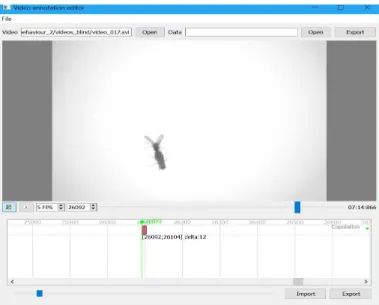
This software is a custom made application written in Python, which provides a GUI (Graphical User Interface) for users to indicate the occurrence of a behavioural event. The features provided by this software are a timeline for video navigation capable of multiple events edition, graphs visualization over time and objects tracking path edition (Figure 3.5) [26].
Courtship and the moment of copulation were manually annotated using this software in the acquired videos for the tracking performance optimization experiment. For the female virgin mating behaviour experiments, the moment of copulation was manually annotated. Those annotations were saved and exported in .csv files.
Figure 3.5: Python Video Annotatorsoftware layout illustrating an example of the moment of copulation.
C
h
a
p
t
e
r
4
E x p e r i m e n ta l R e s u lt s , Da ta A n a ly s i s a n d
D i s c u s s i o n
Drosophilafemale mating behaviours are subtle and maybe for this reason hard to char-acterize. All the quantitative and qualitative information about those are poorly known. In this Chapter, the experimental results obtained aimed to increase our knowledge about Drosophilafemale receptivity behaviour.
4.1 Tracking performance optimization
Preliminary results from the lab, that aimed to characterize female receptivity be-haviour, revealed a problem during video acquisition that consisted in tracking errors during the moments in which two or more flies in the same arena overlap and obscure each other as they can walk in the floor and the lid of the arena. This is a problem for some tracking systems because it increase the chances of losing the identity of the flies.
In order to avoid identity loss, we aimed to restrict the flies within a monolayer, preventing the moments in which they overlap and obscure each other. This can be achieved by covering the lid of the mating arena with Sigmacote, a compound that create a hydrophobic thin film and makes the surface slippery which avoid flies from walking there.
The impact of this compound in improving the tracking performance was tested by generating movies of the mating behaviour between two flies, using four different strains:
DL, Ghana, California and Japan. For each strain, a total of 10 movies were acquired, 5 of them with Sigmacote.
Sigmacote was evaluated at two levels. The amount of tracking errors in the acquired data and the existence of some interference of this compound with the behaviours exhib-ited by the flies.
C H A P T E R 4 . E X P E R I M E N TA L R E S U LT S , DATA A N A LYS I S A N D D I S C U S S I O N
Table 4.1: Tracking errors found inCaltech FlyTrackerduring the tracking performance optimiza-tion experiment, to test the efficiency of Sigmacote compound.
# of videos with tracking errors
14/40 videos 5 with Sigmacote
9 without Sigmacote
The tracking system used in this experiment was theCaltech FlyTrackerthat provides an extensive output information that includes the position of the body, wings and legs, as opposed to other available trackers. This does not correspond to the tracking system used in the preliminary data.
The results (Table 4.1) indicate that only a small fraction of the videos (35%) led to tracking errors. The type of errors accounted by this software mainly include identity loss, identity swaps, wings and legs loss and change of ellipses size (each ellipse represent a fly). The errors more frequent were the change of ellipse size and identity loss. Importantly, 5 of them had Sigmacote whereas 9 did not. In order to make a final decision we needed to evaluate whether Sigmacote affects behaviour.
For this, we looked at the mating success and the courtship index in the presence of Sigmacote. Mating success correspond to the fraction of copulation pairs within 15 min. Courtship index correspond to the fraction of time the male spend courting the female until copulation or during 10 min.
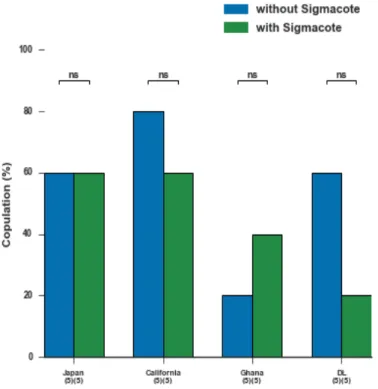
We observed no significant difference in mating success using Sigmacote compared
to the control (without Sigmacote). However, we observed a tendency for decreased receptivity in some strains in the presence of Sigmacote (Figure 4.1). Regarding the courtship index, we observed a tendency for decreased courtship in the California strain although it lacks statistical support because of a small sample (Figure 4.2).
We therefore decided not to use Sigmacote compound in the next experiments. Al-though we lack the support of statistical analysis, we observed a tendency for reduced receptivity and courtship index, which is in agreement with previous studies. In future tests, it should be taken in consideration the use of a bigger sample size to allow statistical analysis and the fact that the results may depend of the tracking system that is used, so we should compare more than one tracking system.
4.2 Female virgin mating behaviour
Female receptivity is a complex behaviour, hard to understand and characterize as it is composed by subtle movements.
In order to characterizeDrosophila female mating behaviours we recorded the be-haviour displayed by mating pairs using four WT strains: Japan, California, Scotland and Canton-S. We choose four different strains in order to understand if there are
inter-specific variability. In this experiment, we did not use Ghana strain because females displayed low receptivity in the tracking performance optimization experiment and we
4 . 2 . F E M A L E V I R G I N M AT I N G B E H AV I O U R
Figure 4.1: Receptivity of virgin females with and without Sigmacote (ns, not significant, Fisher exact test corrected for multiple comparison Sidák-Bonferroni procedure, (n)(n)= No. of flies’ pairs tested). Flies were considered receptive if mating happened in 15 min.
Figure 4.2: Courtship index of WT males displayed in the videos, in each strain, with and without Sigmacote.(n)(n)= No. of flies’ pairs tested.
C H A P T E R 4 . E X P E R I M E N TA L R E S U LT S , DATA A N A LYS I S A N D D I S C U S S I O N
changed DL for Canton-S, because Canton-S is the WT strain more commonly used for studying receptivity behaviour. We used 118 videos in the analysis and excluded seven videos that displayed no courtship.
4.2.1 Scotland female flies display higher receptivity when compared with Canton-S
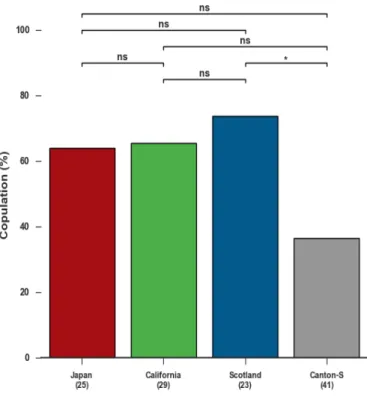
To analyze the female receptivity, we looked at the fraction of flies that mated within 15 min. The results indicate that Scotland female flies display higher receptivity (Copula-tion Percentage (CP): 74%) compared to the Canton-S flies (CP: 37%) (Figure 4.3). Even if not statistically significant, there is a difference between Canton-S flies and both Japan
and California flies. Between Japan, California and Scotland, the results showed little variability in receptivity.
Figure 4.3: Receptivity of virgin females in female virgin mating behaviour experiment, in each strain (ns, not significant,*p < 0.05, Fisher exact test corrected for multiple comparison Sidák-Bonferroni procedure, (n)= No. of flies’ pairs tested).
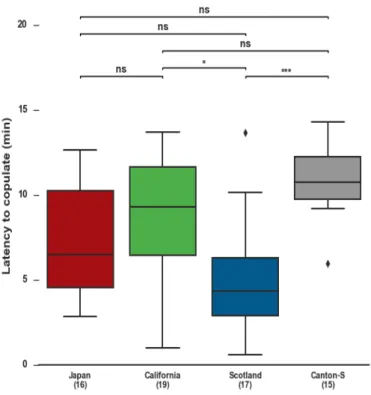
We next measured how fast the female accepts the male by measuring the latency to copulate, that corresponds to the time that goes from the beginning of courtship un-til copulation. The results of this experiment indicate a significant difference between
Scotland and Canton-S flies and between Scotland and California flies. Scotland females accept more readily the male (mean= 4.31 min) when compared with Canton-S (mean= 10.76 min) and California (mean= 9.30 min) (Figure 4.4).
Taken together, these results indicate that some variability exists among WT strains. While the receptivity of Canton-S females is lower and they take longer to accept the
4 . 3 . AU T O M AT I C B E H AV I O U R A L C L A S S E S
Figure 4.4: Latency to copulate of the female fly, in each strain (ns, not significant,*p < 0.05, ***p<0.001, Kruskal-Wallis test combined with Dunn’s multiple-comparison post hoc test,(n)= No.
of flies’ pairs tested).
male, Scotland females display high receptivity and accept the male faster.
To understand how mating happens during time, we performed a cumulative mating curve where we can track mating occurrence over the experimental period (Figure 4.5). Mating curves usually fit a sigmoid curve, with a lag period followed by a exponential growth phase and a stationary phase (plateau). When looking at the curve we do not recognize the presence of a stationary phase, except in Scotland strain, which may indicate that the percentage of copulation could have changed if the experimental period was longer than 15 minutes, for the other strains.
4.3 Automatic behavioural classes
After analyzing mating success, we studied the courtship displayed by the male fly. Manual annotation of the courtship is extremely time consuming, so we created an au-tomatic behaviour class in the machine learning system, JAABA, to auau-tomatically detect the courtship periods in the videos. Using this information we were able to calculate the courtship index and some other interactions between flies during courtship. In addition to courtship automatic class, we developed three more classes in this project: the female locomotion class, attempted copulation class and male song class. These will be used for further analysis in lab experiments.
C H A P T E R 4 . E X P E R I M E N TA L R E S U LT S , DATA A N A LYS I S A N D D I S C U S S I O N
Figure 4.5: Cumulative mating curves within the experimental period (15 minutes) for each strain. A plateau was not attained in any curve except in Scotland strain.
4.3.1 Creation and development of an automatic class
The learning algorithm from JAABA learns how to detect a specific behaviour by com-bining the kinematic parameters of the tracker with the occurrence of specific behaviours that are manually labeled by the user. It is therefore crucial to have a precise perception of what is the ’behaviour’ and what is the ’none behaviour’.
The development of a class requires labeling both periods that we want automatically detected (e.g. Courtship), and periods in which the behaviour is not being executed (e.g. None). After labeling, we select which tracking features, from the tracker, the classifier should use to train the class. Training is the process of creation of the class. The selection of the features will depend on the class that we want to generate. Next, we perform predictions which corresponds to letting the classifier predict the ’behaviour’ and the ’none behaviour’ alone. Next, we evaluated and corrected the predictions, in the frames where the learning algorithm predicted the wrong behaviour. The process of adding more videos and correcting them should stop when almost all the predictions are right.
4.3.2 Accuracy of an automatic class
Ground Truthing (GT) was the method used to test the performance of a class. The accuracy is measured through a percentage, that is calculated between the manually label frames outside of training data and the predictions from JAABA in the same bout of frames, that were not trained before [18].
The GT test requires manual labelling of 2000 frames (a random bout of frames that is not selected by the user) in a specific video and then the GT provides us with the percentages of accuracy of the detection for the ’behaviour’ and for the periods in which the ’behaviour’ is not being executed.
4 . 3 . AU T O M AT I C B E H AV I O U R A L C L A S S E S
Table 4.2: Result of GT for the courtship class. The columns of the table correspond to the classifiers’ predictions, and the rows correspond to the manual labels. Each element of the table corresponds to the number and percentage of frames with the given type of manual labels that have the given prediction. Percentages are computed over rows [18].
Manual labels
Classifiers’ predictions
Courtship Predicted None Predicted Courtship 23591 (98.3%) 410 (1.7%)
None 206 (1.7%) 12077 (98.3%)
Depending of this percentage, the new class is ready to be used or not. If not, new strategies should be applied to understand why it failed and how to improve it. The criteria for accepting or not a class is an accuracy close of 100%. In the following chapters, these percentages and strategies are presented for the four automatic classes that were created in this study.
4.3.3 Male courtship class
Courtship is displayed by the fly male as a repertoire of specific behaviours performed in bouts. The male orients towards the female, he chases her when she is walking away, he opens one of his wings and sings a courtship song; he taps her with his fore legs, licks her genitalia and attempts to copulate. To develop the male courtship class we labeled these specific courtship behaviours. All the others male behaviours were labeled as ’none behaviour’.
To generate this class, we used the majority of the tracking features because it is a class with a considerable amount of different behaviours and actions. However we excluded
the distance to wall (distance between the wall and the flies) and the position of the legs of each fly because the distance to the wall is not important for the development of this class and a huge amount of the values of the positions of the legs were missing (hard to track by this tracking system). This features were not included in the construction of any classes.
To evaluate this class, we performed the GT (Table 4.2). The GT of this class was performed with 24001 labeled frames for the ’behaviour’ and with 12283 labeled frames for the ’none behaviour’. The results indicate that the accuracy of the class is high and equal (98.3%) both for the ’behaviour’ and for the ’none behaviour’. This class was then applied to all the videos acquired for the female virgin mating behaviour experiment.
In order to validate the results obtained from the class, we analyzed the distribution of courtship bouts created by the classifier in each video. We calculated the frequency of the duration of each bout (Figure 4.6). Despite bouts duration between 1 and 4 min are not shown, there are 134 bouts distributed in there. The results indicate that the majority of bouts are short. The courtship bouts with the highest frequency have a duration of 0.1 minutes (0.1 min = 6sec = 360 frames). By looking at the movies during bouts that are shorter than 20 frames, we observed that about half are false positives (data not shown).
C H A P T E R 4 . E X P E R I M E N TA L R E S U LT S , DATA A N A LYS I S A N D D I S C U S S I O N
Figure 4.6: Distribution of courtship bout duration. The courtship bouts were predicted by the courtship class in all videos of the female virgin mating behaviour experiment. There are 134 bouts distributed with durations between 1 and 4 min.
Table 4.3: Result of GT for the female locomotion class. The columns of the table correspond to the classifiers’ predictions, and the rows correspond to the manual labels. Each element of the table corresponds to the number and percentage of frames with the given type of manual labels that have the given prediction. Percentages are computed over rows [18].
Manual labels
Classifiers’ predictions
Locomotion Predicted None Predicted
Locomotion 21429 (95.5%) 1013 (4.5%)
None 215 (4.1%) 5044 (95.9%)
4.3.4 Female locomotion class
To develop a class for the female locomotion, we considered as ’behaviour’ the mo-ments in which the female fly was walking and as ’none behaviour’ when the female fly was not walking or when she was stationary but moving her legs, wings or head.
Since this class is intrinsically correlated with the velocity of the female, we selected all the tracking features except the features related with wings, axis body ratio and fore-ground body ratio. Features related with her wings and her body were not relevant for the development of this class.
Analysis of the performance of this class by GT (Table 4.3) revelead that the accuracy of the classifier is high, both for the ’behaviour’ (95.5%) as well as for the ’none behaviour’ (95.9%). The GT of this class was made with 22442 labeled frames for the ’behaviour’ and with 5259 labeled frames for the ’none behaviour’.
Despite the high accuracy, we decided to look at in those 5% of frames where the classifier did a wrong prediction, for the ’behaviour’ and for the ’none behaviour’. After visual inspection of those video frames, we did not see any intriguing result. So perhaps the error stems from the noise in the velocity of the female. This could be addressed by applying a threshold based on the medium value of the female velocity to work as a noise