Assessment of the prevalence of vertical hepatitis B transmission
in two consecutive generations
LARISSA AKEME NAKANO1* , JÉSSICA TOSHIE KATAYOSE1, RODRIGO MARTINS ABREU2, LUIS CLÁUDIO ALFAIA MENDES2,
MARIA CLEUSA MARTINS1, VANUSA BARBOSA PINTO1, FLAIR JOSÉ CARRILHO2, SUZANE KIOKO ONO2
1Division of Pharmacy, Hospital das Clínicas da Faculdade de Medicina da Universidade de São Paulo (HC-FMUSP), São Paulo, SP, Brazil 2Division/Department of Gastroenterology and Hepatology, HC-FMUSP, São Paulo, SP, Brazil
S
UMMARYStudy conducted at Hospital das Clínicas da Faculdade de Medicina da
Universidade de São Paulo (HC-FMUSP), São Paulo, SP, Brazil
Article received: 6/5/2017
Accepted for publication: 7/16/2017
*Correspondence:
Instituto Central, Hospital das Clínicas
Address: Av. Dr. Enéas de Carvalho Aguiar, 255, 9º andar, sala 9.159
São Paulo, SP – Brasil Postal code: 05403-000
http://dx.doi.org/10.1590/1806-9282.64.02.154
Introduction: Hepatitis B is an important public health problem in the world and one of the forms of contagion would be through vertical transmission. Precose diagnosis allows the adoption of prophylaxis measures, which results in prevention in more than 90% of cases.
Objective: To describe the prevalences of vertical transmission and compare two generations (mother/patient and patient/child).
Method: This was a cross-sectional study, which included 101 patients. The interviews were performed through the application of the instrument of data collection and information of the physical file before the medical consultation. Results: The mean ± SD of age was 50.9 ± 13.1 years, the male gender predominated, with 56.4% of the patients, and the predominance was white, with 43.6%. Vertical transmission between mother and patient occurred in 17.8% and between patient and child, in 7.9%. In all of the eight cases of vertical transmission, the diagnosis was after the birth of children infected with HBV, and in 3/8 (37.5%), there was more than one case of infection by this mechanism per patient, totaling 13 children with the disease.
Conclusion: There was a reduction in vertical transmission, showing that preventive measures were effective.
Keywords: Hepatitis B. Infectious Disease Transmission, Vertical. Antiviral Agents.
I
NTRODUCTIONChronic infection caused by hepatitis B virus (HBV) is a major public health problem.1-3 According to the World Health Organization (WHO), approximately 2 billion people have been exposed to the virus. Of these, 240 million are estimated to have the chronic form of the disease. Hepatitis B accounts for about 786,000 deaths per year worldwide.2,4,5
Hepatitis B is the most common form of chronic hepatitis and is caused by a DNA virus that belongs to the Hepadnaviridae family. There exist ten genotypes of HBV, which are named from A to J. They differ from one another in their nucleotide sequence in the genome, varying as to geographic distribution. The infection can cause acute or chronic hepatitis, both forms being usu-ally oligosymptomatic.5
Chronic hepatitis B can be divided into four phases. First phase: immune tolerance; second phase: immune clearance; third phase: inactive carrier; and fourth phase: reactivation. The main goal of treatment is to reduce the risk of progression of liver disease and its primary out-comes, specifically cirrhosis, hepatocellular carcinoma (HCC) and, consequently, death. Pharmacological options for the treatment of hepatitis B are: interferon-alpha, lamivudine, peg-interferon-alpha 2a and 2b, adefovir, entecavir, telbivudine, and tenofovir.1,5,6
postnatal period through contact with infected adults. When acute HBV infection occurs during the first trimester of pregnancy, the risk of transmission to the newborn (NB) is less than 10%. However, when the infection occurs in the second or third trimesters, transmission may occur in more than 60% of cases. Therefore, it is recommended that all pregnant women perform a rapid test for HBV at their first visit, in the first trimester, or when they begin prenatal care. The diagnosis makes it possible to adopt prophylaxis mea-sures, therefore ensuring that the vaccine and human anti-hepatitis B immunoglobulin will be administered during the first 12 hours of life of the newborn. This prevents perinatal transmission in more than 90% of cases.3,5-7
Care to pregnant women with hepatitis B should be given so as to prevent the vertical transmission of infec-tion to newborns and treat the disease in mothers. Fam-ily planning should always be discussed with women of childbearing potential before starting any therapeutic procedure, especially antiviral therapy for hepatitis B.3,4,7,8
M
ETHODStudy design
This is a cross-sectional study conducted from June 2016 to December 2016 with patients having chronic hepatitis B infection and who were being followed up at the Clinical Hepatology Outpatient Clinic of Instituto Central, Hos-pital das Clínicas, Faculdade de Medicina, Universidade de São Paulo (ICHC-FMUSP), a tertiary-level university hos-pital that operates seamlessly with Brazil’s Unified Health System (Sistema Único de Saúde, SUS, in the portuguese acronym). It is internationally well-known for providing medical care and treatment for high-complexity patients.
By using the Hospital Information and Management System (Sistema de Informação e Gestão Hospitalar, SIGH, in the Portuguese acronym), it was possible to generate a Report of Scheduled Visits (Relatório de Consultas Agenda-das) and thus obtain patient listings. The interviews were conducted by administering a data collection instrument and supplemented with the medical record information prior to the visit with a medical consultation with the purpose of assessing the prevalence of vertical hepatitis B transmission in two generations (mother/patient and patient/offspring).
Inclusion and exclusion criteria
Inclusion criteria: patients from the clinical hepatology out-patient clinic at HC-FMUSP, of both genders, aged ≥ 18 years, diagnosed with chronic hepatitis B infection (tested positive for HBsAg for more than six months), with children and who agreed to sign a free informed consent form. Exclusion criteria: co-infection with the hepatitis C virus and HIV.
Ethical aspects
Our project was submitted for evaluation by the Re-search Ethics Committee of HC-FMUSP (Cappesq) and over Plataforma Brasil (a national and unified data-base of research records involving human subjects) alongside with its CAEE (a submission protocol num-ber): 56746916.4.0000.0068, opinion No. 1.592.921 on June 16, 2016. All patients meeting the inclusion crite-ria and none of the exclusion critecrite-ria were asked to read, discuss and sign a free informed consent form prior to the interviews.
Statistical analysis
The data collected were stored in an Excel® database. The results from the descriptive analysis were expressed as mean, median, standard deviation, maximum and mini-mum values, and frequency distribution. They were then depicted in graphs and tables.
R
ESULTSWe selected 193 patients, of whom 92 were excluded: 39 who did not show up in the outpatient clinic, nine because they did not accept to participate in the study, six who tested negative for HBsAg, 36 for not having had children, and two because they met the exclusion criteria. Once the selection criteria were applied, a total of 101 patients comprised the study sample.
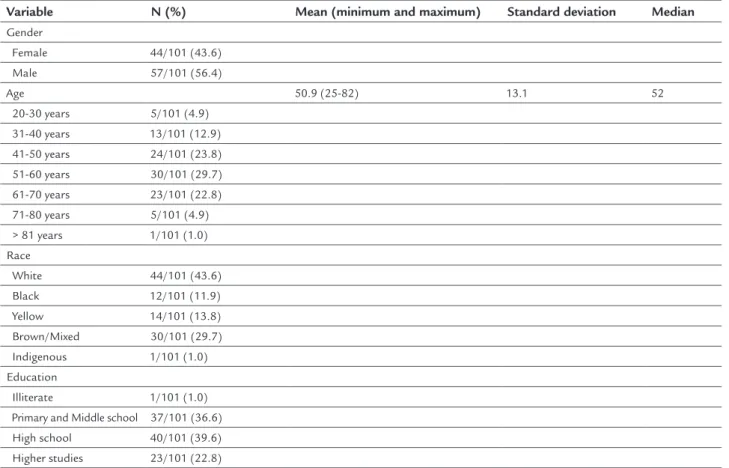
With respect to the distribution by gender, age, eth-nicity and number of school years completed, the data obtained are shown in Table 1. The mean ± SD age was 50.9 ± 13.1 years, with a larger number of male partici-pants, i.e. 57/101 (56.4%) of all selected patients, and also a larger number of caucasians, i.e. 44/101 (43.6%). The distribution according to number of school years completed showed similar values of patients who com-pleted primary education 37/101 (36.6%) and high school 40/101 (39.6%).
Regarding the pharmacological regimen currently used, the use of tenofovir 300 mg as monotherapy was predominant, with 20/101 (19.8%) patients. Still, the non-use of antivirals was found in 46/101 (45.5%) patients, a larger number when compared to monotherapy, 40/101 (39.6%) or combination therapy, 15/101 (14.9%).
TABLE 1 Distribution of traits according to gender, age, ethnicity and number of school years completed. June/2016 to December/2016 (n=101).
Variable N (%) Mean (minimum and maximum) Standard deviation Median Gender
Female 44/101 (43.6) Male 57/101 (56.4)
Age 50.9 (25-82) 13.1 52
20-30 years 5/101 (4.9)
31-40 years 13/101 (12.9) 41-50 years 24/101 (23.8) 51-60 years 30/101 (29.7)
61-70 years 23/101 (22.8) 71-80 years 5/101 (4.9) > 81 years 1/101 (1.0)
Race
White 44/101 (43.6) Black 12/101 (11.9)
Yellow 14/101 (13.8) Brown/Mixed 30/101 (29.7) Indigenous 1/101 (1.0) Education
Illiterate 1/101 (1.0) Primary and Middle school 37/101 (36.6) High school 40/101 (39.6)
Higher studies 23/101 (22.8)
Vertical transmission can occur at two moments: mother/patient and patient/offspring. The vertical trans-mission rates we found in our study were 18/101 (17.8%) and 8/101 (7.9%), respectively (Figure 1).
Regarding the use of prophylaxis tools in the offspring, we found that immunoprophylaxis after childbirth rep-resented 10/101 (9.9%); of these, there was no transmission of hepatitis B, and 68/101 (67.3%) were vaccinated, with only 3/68 (4.4%) patients having hepatitis B. With regard to the unvaccinated offspring, 33/101 (32.7%), 6/33 (18.2%) had hepatitis B.
When analyzing the vertical transmission rate among the patients interviewed, 8/101 (7.9%), we found that 7/8 (87.5%) are females and the only male has a wife with HBV. Offspring with HBV were 34 ± 6.2 (mean ± SD) years old. None of them received immunoprophylaxis, whereas 4/13 (30.8%) were vaccinated.
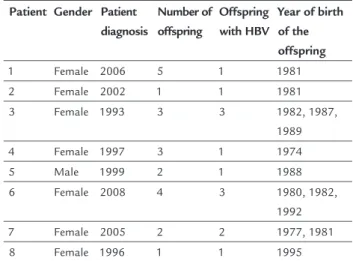
We found that all eight cases of vertical transmission were diagnosed after the birth of the HBV-infected off-spring. In 3/8 (37.5%), there was more than one case of infection by this mechanism per patient, therefore total-ing 13 children with the disease, as shown in Table 2.
D
ISCUSSIONIn the period from 1999 to 2015, 196,701 cases of hepa-titis B in Brazil, a notifiable disease, were notified through the Notification Information System (Sistema de Infor-mação de Agravos de Notificação, SINAN). Of these, 106,371 (54.1%) correspond to affected males, which is in agreement with the findings of our study, i.e. 56.4%. How-ever, that difference in the number of cases according to gender has been decreasing over the years. The 2015 dis-tribution of cases according to ethnicity/skin color shows that most cases are of Caucasians/white people (50.2%), which is similar to the value we found, 43.6%.9
TABLE 2 Description of cases of vertical transmission cases — patient/offspring. June/2016 to December/2016 (n=101).
Patient Gender Patient diagnosis
Number of offspring
Offspring with HBV
Year of birth of the offspring
1 Female 2006 5 1 1981
2 Female 2002 1 1 1981
3 Female 1993 3 3 1982, 1987, 1989
4 Female 1997 3 1 1974
5 Male 1999 2 1 1988
6 Female 2008 4 3 1980, 1982, 1992 7 Female 2005 2 2 1977, 1981
8 Female 1996 1 1 1995
piercing; dental or surgical procedures not meeting bio-safety standards; unprotected sex (this being the pre-dominant route); blood transfusion; and vertical trans-mission (mother/child) — with this being an important route and associated with unfavorable disease progression, with a higher risk of chronification.2,5,10
In the transmission between patient/offspring, only 8/101 (7.9%) were infected through this route, a lower number when compared to mother/patient transmission, 18/101 (17.8%). Studies show that the infection rate from HBV-carrying mothers to their children amounts to about 90% of cases when the mother tested positive for HBsAg and antigen “e” (HBeAg-positive) and to 10% of cases when positive only for HBsAg.8
Of the 8/101 (7.9%) patients presenting vertical trans-mission to their children, the last infected child was born in 1995. This shows that, as from that date, the installed measures were effective in preventing this type of transmis-sion, as well as in reducing the vertical transmission rate.
In Brazil, since 1998, the Ministry of Health’s Na-tional Immunization Program (Programa Nacional de Imunizações, PNI, in the Portuguese acronym) recom-mends that all children from birth be universally vac-cinated against hepatitis B.11 The first dose, allied to immunoglobulin within the first 12 hours of birth, re-sults in 95% efficacy in preventing vertical infection. As from 2001, the age range was extended to 19 years of age. Several studies show that hepatitis B vaccines have good immunogenicity and are effective, providing pro-tection in more than 90% of healthy young adults and in more than 95% of infants, children and adolescents. Efficacy decreases gradually after 40 years of age, and
other factors such as obesity, stress, smoking habits and alcohol consumption are also associated with lower vaccine efficacy.11-14
Despite the introduction of vaccination and progres-sive efforts in campaigns, it was found that 9/13 (69.2%) cases involving vertical transmission had not been vac-cinated or did not know whether they had been vacci-nated. Among patients who had children, this occurred in 33/101 (32.7%) cases – and of these, 6/33 (18.2%) have HBV. The low vaccine adherence can be explained by the long period necessary for completing the vaccination schedule (three doses: in months 0, 1, and 6). This high-lights the need for health education programs geared to raise the population awareness and reinforce the impor-tance of immunization strategies for compliance with the complete HBV vaccination scheme.3,11
With increased access to information and a larger number of campaigns on the disease, the number of new infections is expected to decline. Health promotion be-gins with prevention measures and educating the popu-lation, who need to be informed about everything involv-ing their disease.
C
ONCLUSIONThere was a reduction in vertical transmission when com-paring the two generations. This shows that even with low immunoprophylaxis rates, the installed measures have been effective in preventing this type of transmis-sion. The importance of health education, raising aware-ness about vaccination and disseminating information on hepatitis B contributes to the debunking of myths and prejudices.
FIGURE 1 Distribution of patients according to patient/offspring vertical transmission. June/2016 to December/2016 (n=101).
93/101 (92.1%)
Vertical transmission 8/101 (7.9%)
R
ESUMOAvaliação da prevalência de transmissão vertical de hepa-tite B em duas gerações consecutivas
Introdução: A hepatite B é um importante problema de saúde pública no mundo e uma das formas de contágio seria através da transmissão vertical. O diagnóstico pre-coce possibilita a adoção de medidas de profilaxia, o que resulta na prevenção em mais de 90% dos casos.
Objetivo: Descrever as prevalências de transmissão vertical e comparar duas gerações (mãe/paciente e pa-ciente/filho).
Método: Trata-se de um estudo transversal, que incluiu 101 pacientes. As entrevistas foram realizadas por meio da aplicação do instrumento de coleta de dados e infor-mações do prontuário físico antes da consulta médica. Resultados: A média ± DP de idade foi de 50,9 ± 13,1 anos, houve predomínio do gênero masculino, com 56,4% dos pacientes, e predominou a cor branca, com 43,6%. A transmissão vertical entre mãe do paciente/paciente ocorreu em 17,8% e entre paciente/filho, em 7,9%. Em todos os oito casos de transmissão vertical, o diagnósti-co foi posterior ao nascimento dos filhos infectados por HBV; em 3/8 (37,5%), houve mais de um caso de infecção por esse mecanismo por paciente, totalizando 13 filhos com a doença.
Conclusão: Houve uma redução na transmissão vertical, mostrando que as medidas preventivas foram efetivas.
Palavras-chave: Hepatite B. Transmissão Vertical de Doença Infecciosa. Antivirais.
R
EFERENCES1. Abreu RM. Validação de um questionário para a avaliação da adesão ao tratamento antiviral em pacientes portadores de hepatite B crônica [dissertation]. São Paulo: Faculdade de Medicina, Universidade de São Paulo; 2013. 2. Ono-Nita SK, Carrilho FJ, Cardoso RA, Nita ME, Silva LC. Searching for
chronic hepatitis B patients in a low prevalence area: role of racial origin. BMC Fam Pract. 2004; 5:7.
3. Brasil. Ministério da Saúde. Secretaria de Vigilância em Saúde. Departamento de Vigilância, Prevenção e Controle das DST, Aids e Hepatites Virais. Protocolo clínico e diretrizes terapêuticas para prevenção transmissão vertical de HIV, sífilis e hepatites virais. Brasília: Ministério da Saúde; 2015. 4. Terrault NA, Bzowej NH, Chang KM, Hwang JP, Jonas MM, Murad MH;
American Association for the Study of Liver Diseases. AASLD guidelines for treatment of chronic hepatitis B. Hepatology. 2016; 63(1):261-83. 5. Brasil. Ministério da Saúde. Secretaria de Vigilância em Saúde. Departamento
de Vigilância, Prevenção e Controle das DST, Aids e Hepatites Virais. Protocolo clínico e diretrizes terapêuticas para hepatite B e coinfecções. Brasília: Ministério da Saúde; 2016.
6. Cheung KW, Seto MTY, Wong SF. Towards complete eradication of hepatitis B infection from perinatal transmission: review of the mechanisms of in utero infection and the use of antiviral treatment during pregnancy. Eur J Obstet Gynecol Reprod Biol. 2013; 169(1):17-23.
7. Kim HY, Choi JY, Park CH, Jang JW, Kim CW, Bae SH, et al. Outcome after discontinuing antiviral agents during pregnancy in women infected with hepatitis B virus. J Clin Virol. 2013; 56(4):299-305.
8. Dionne-Odom J, Tita AT, Silverman NS. Society for Maternal-Fetal Medicine (SMFM) Consult Series #38: hepatitis B in pregnancy – screening, treatment, and prevention of vertical transmission. Am J Obstet Gynecol. 2016; 214(1):6-14. 9. Brasil. Ministério da Saúde. Secretaria de Vigilância em Saúde. Departamento
de Vigilância, Prevenção e Controle das DST, Aids e Hepatites Virais. Boletim Epidemiológico – Hepatites Virais. Brasília: Ministério da Saúde; 2016. 10. Brasil. Ministério da Saúde. Secretaria de Vigilância em Saúde. Departamento
de Vigilância Epidemiológica. A, B, C, D, E de hepatites para comunicadores / Ministério da Saúde, Secretaria de Vigilância em Saúde, Departamento de Vigilância Epidemiológica. Brasília: Ministério da Saúde; 2005.
11. Divisão de Imunização. Divisão de Hepatites. Centro de Vigilância Epidemiológica “Prof. Alexandre Vranjac”. Coordenadoria de Controle de Doenças. Secretaria de Estado da Saúde de São Paulo – DI/DH/CVE/CCD/ SES-SP. Vacina contra hepatite B. Rev Saúde Pública. 2006; 40(6):1137-40. 12. Zhuang H. [Prevention of mother-to-child transmission of hepatitis B virus].
Zhonghua Gan Zang Bing Za Zhi. 2016; 24(23):881-4.
13. Brasil. Ministério da Saúde. Secretaria de Vigilância em Saúde. Departamento de Vigilância das Doenças Transmissíveis. Manual dos centros de referência para imunobiológicos especiais / Ministério da Saúde, Secretaria de Vigilância em Saúde, Departamento de Vigilância das Doenças Transmissíveis. 4. ed. Brasília: Ministério da Saúde; 2014.
14. World Health Organization. Guidelines for the Prevention, Care and Treatment of Persons with Chronic Hepatites B Infection. Geneva: World Health Organization; 2015.