Department of Analytical Chemistry
QUALITY SYSTEM DESIGN AND
IMPLEMENTATION IN A PROFICIENCY
TEST PROVIDER LABORATORY BASED IN
AN INTERNATIONAL NORM.
Glauce Guimarães Pereira Barcelona, February 2010
Master thesis presented by Glauce Guimarães Pereira
ATTEST
That current work entitled
“Quality system design and implementation in proficiency test provider laboratory based in an international norm.”
Has been conducted by Glauce Guimarães Pereira in the Department of Analytical Chemistry at University of Barcelona
Barcelona, February 2010
_______________________ Drª. Angels Sahuquillo
Drª. Isabel Cavaco for the coordination of EMQAL and strong dedication to the quality of this course.
Drª. Angels Sahuquillo for trusting in my work, recognizing and correcting my mistakes, and teaching me proficiency test issues, especially things regarding human factors.
Drª. Gemma Rauret for her great contribution to the elaboration of the Mat Control quality system and for being a life example.
Drª. Montserrat Llauradó for teaching me and providing access to all the documentation from an accredited laboratory.
Ms. Mar Seara and Dr. Emilio Carrasco for the companionship and the many technical explanations in Mat Control.
Dr. Ramon Companyó and Dr. Miquel Esteban for arranging practical details and allowing the development of the project in the University of Barcelona.
All the staff from University of Algarve and University of Barcelona, especially Célia Oliveira for her friendship and for taking care of many practical things.
Ms Joana Medeiros for the English corrections and for her friendship.
The Education and Culture Committee of the European Union for the financial support.
Finally, to all the personal and emotional support that helped me complete this course in Faro and Barcelona: Jordana Brock, Isaura Cuambe, Praveen Kumar, Leonardo Gamboa, Moosa Faniband, Saif Rehman, Raquel González, Daniel Zapata and Jandir dos Reis.
A special thanks to my sister Glaucia Pereira and my parents Valter and Edna not just for these 18 months, but for all my life.
List of Acronyms ... 10 List of Figures ... 11 List of Tables ... 11 1 Abstract ... 12 2 Objectives ... 13 3 Introduction ... 14
3.1 Quality and Proficiency Test Schemes ... 14
3.2 Mat Control Laboratory ... 21
4 Experimental ... 23
4.1 Study of official documents ... 24
4.2 Development of a PT campaign ... 25
4.3 Elaboration of documents to Mat Control ... 29
5 Results and Discussion ... 31
5.1 Identification of Processes ... 31
5.2 Identification and Formalization of Tasks and Profiles ... 32
5.3 Quality management system ... 38
5.4 Elaborated documents ... 42
6 Conclusions and Recommendations ... 47
7 Bibliography ... 49
8 Annexes ... 50
Annex 1 – Quality Manual ... 50
List of Acronyms
CRM Certified Reference Material
FBG Fundació Bosch i Gimpera
DIS Final Draft International Standard
IEC International Electrotechnical Commission
IQC Internal Quality Control
ISO International Organization for Standardization
PGC General Quality Procedure (Spanish acronym)
PNT Standardized Operation Procedure (Spanish acronym)
PT Proficiency testing
PTS Proficiency Testing Scheme
QA Quality Assurance
QCM Quality Control Material
List of Figures
Figure 1 – Eight management principles – ISO 9000. ... 15
Figure 2- Plan-Do-Check-Act cycle. ... 17
Figure 3 – Illustration of interlaboratory comparison. ... 18
Figure 4 – Mat Control logotype. ... 22
Figure 5 – Activities in experimental part. ... 23
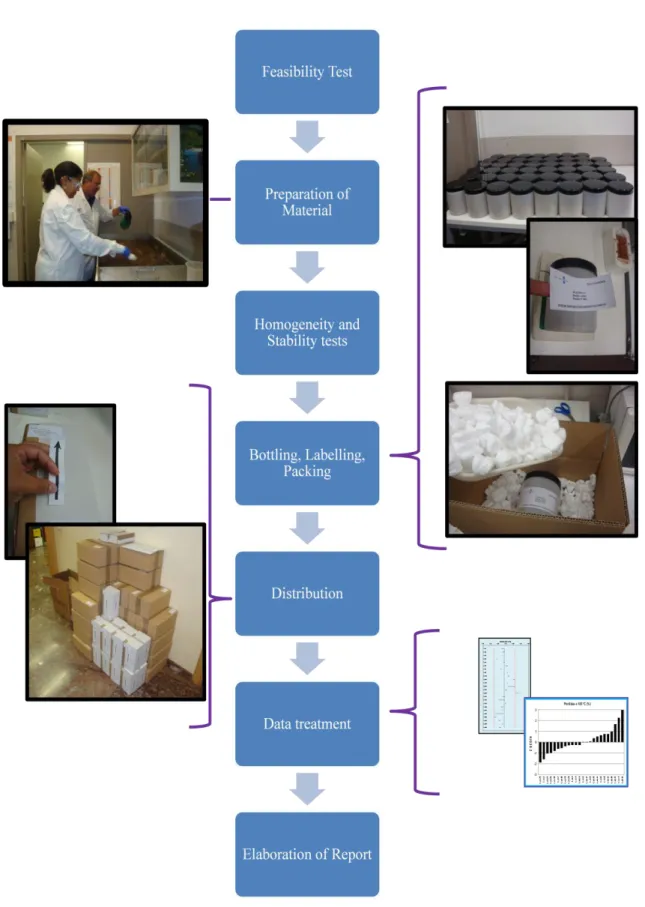
Figure 6 – PT activities followed from September to December 2009. ... 28
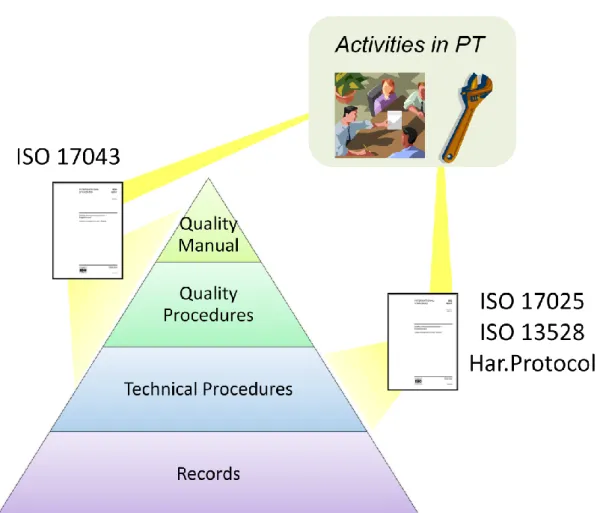
Figure 7 – Documentation resulted after studying documents and attend PT activities. 30 Figure 8 – Mat Control processes. ... 31
Figure 9 – Personnel organization chart. ... 32
Figure 10 – Documents interaction illustration. ... 40
List of Tables
Table 1 – Laboratory participation in PT campaign according to the samples. ... 26Table 2- Requirements of knowledge, experience and type of link with the institution. 34 Table 3 -Function replacement. ... 38
Table 4 – Equivalence between the Quality Manual and ISO /IEC DIS 17043. ... 39
Table 5 – Responsible of elaboration and control of documents. ... 41
12
1 Abstract
Proficiency testing is defined as the use of interlaboratory comparisons to determine the performance of individual laboratories for specific tests or measurements and to monitor laboratories‘ continuing performance.
The number of PTs is increasing in the last years because the result of this exercise is useful not just for costumers, but also for other interested parties, such as regulators, laboratory accreditation bodies and other organizations who specify requirements for laboratories. Hence, it is very important to organize PT with criteria, focus and quality.
The objective of this work was design of a quality system in Mat Control Laboratory of the University of Barcelona, according to the ISO/IEC DIS 17043 as a Proficient Test Provider.
The quality system proposal for Mat Control was elaborated from September 2009 to January 2010 based on the attendance and participation in PT activities carried out in the Department of Analytical Chemistry of the Faculty of Chemistry, University of Barcelona.
Fifteen documents were proposed to compose the structure of the quality system. Seven elaborated ―Standardized Operation Procedures‖ cover technical requirements of ISO/IEC DIS 17043. Instructions for a management equipment procedure shall be done considering mainly ISO/IEC 17025, and this will be a very important step to demonstrate Mat Control‘s competence to run analytical tests. Two ―General Quality Procedures‖ define elaboration, coding and management of documents. Other management requirements are contemplated in the quality manual and will be totally covered with the elaboration of instructions for four management procedures already structured.
13
2 Objectives
The objective of this work was the design of a quality system in Mat Control Laboratory of University of Barcelona according to ISO/IEC DIS 17043 as a Proficient Test Provider.
Specific Objectives:
This work has been a starting point for developing a quality system in Mat Control Laboratory and had as specific objectives:
Identify which activities needs quality mechanisms,
Interpret and adapt the international norm to Mat Control reality, structuring the quality system.
Elaborate documents that cover the technical requirements of ISO/IEC DIS 17043.
14
3 Introduction
This chapter brings the context of this work addressing that accreditation of proficiency test provider is a way to assure quality in all processes of an intercomparison exercise. The challenge of this work was adapt an international standard for the reality of a university laboratory, respecting the number of personnel and coexistence of other norms and regulations.
3.1 Quality and Proficiency Test Schemes
There is no absolute scale to quantify quality. Quality depends on the client‘s subjective impression on service and products. Although a universal definition could be elusive, a Quality System is an important tool to reach the client´s expectations and exceed them. Even without a complete quantitative and objective method to measure quality, it is possible to judge if something is better or worse, comparing with a previous one. This is the key for a quality system proposal: improvement.
But the improvement of a product alone is not enough to implement a quality system; defined aims and objectives from the organizations is also very important. ISO 9000 (1) brings 8 quality management principles to lead and operate an organization successfully.
ISO 9000 was prepared by the Technical Committee ISO/TC 176, quality management and quality assurance, Subcommittee SC 1, Concepts and terminology. The third edition (2005) cancels and replaces the second edition (ISO 9000:2000).
The eight quality management principles (Figure 1) form the basis for the quality management system standards within the ISO 9000 family.
These eight principles are a fundamental rule or belief to performing a solid and operated quality system. Applying these eight principles in an organization requires deep comprehension and focus in satisfaction. Not just the client‘s satisfaction but all the staff‘s satisfaction and society/environmental responsibility.
All principles require actions and measurement of the activities developed, being this last one very important to take decisions on a factual approach (principle 7). To
15 cover principle 1, customer focus, it is necessary to ensure a balanced approach among customers and other stake holders (owners, people, suppliers, local communities and society at large), needs and expectations, to communicate these needs and expectations throughout the organization, to measure customer satisfaction and act on results, and to manage customer relationships.
16
Leadership involves being proactive and leading by example. A leader needs
understand the external environment and respond to changes. After establish a clear vision of the organization‘s future, a leader shall shared values and ethical role models at all levels of the organization. It is necessary consider the needs of all people involved including customers, suppliers, local communities, society and owners. Human relationship shall building trust and eliminating fear, providing people with the required resources and freedom to act with responsibility and accountability. Leadership is inspiring, encouraging and recognizing people's contributions. The communication shall be open. It is necessary promote educating, training and coaching people. Recognize challenging goals and targets, and implementing a strategy to achieve them.
The involvement of people passes through the acceptance of ownership and responsibility to solve problems; the active seek of opportunities to make improvements and enhance competencies, knowledge and experience, the free share of knowledge and experience in teams; the focus on the creation of value for customers; being innovative in furthering the organization‘s objectives; improving the way of representing the organization to customers, local communities and society at large; helping people derive satisfaction from their work, and making people enthusiastic and proud to be part of the organization.
Application of the process approach has steps as definition of the process to achieve the desired result, identification and measure the inputs and outputs of the process; identification of the interfaces of the process with the functions of the organization, evaluation of possible risks, consequences and impacts of processes on customers, suppliers and other stake holders of the process; establish clear responsibility, authority, and accountability for managing the process. When designing processes, consider the process steps, activities, flows, control measures, training needs, equipment, methods, information, materials and other resources to achieve the desired result. (2)
System approach management reaches comprehension of the interdependencies
among the processes of the system. It is necessary structure the system to achieve the objective in the most efficient way. Measurement and evaluation are the way to continuous improving.
17
Continual improvement for organization involves products, processes, systems
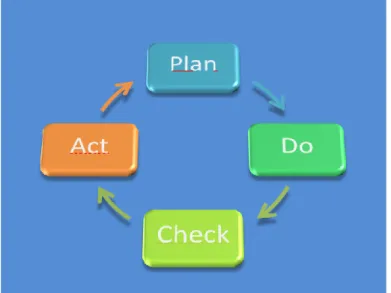
and personnel. It is fundamental to use periodic evaluation against established criteria of excellence. With this, it is possible to identify areas for potential improvement. Primordial also is promote prevention-based activities and provide an appropriate education and training to every member of the organization. A tool for continual improvement is plan action according the Plan-Do-Check-Act cycle (Figure 2). It is also necessary to establish measures and goals to guide and track improvements and recognize these improvements.
Figure 2- Plan-Do-Check-Act cycle.
Factual Approach means take decisions based in measurements. For reach this
principle it necessary plan an evaluation defining type of data and information relevant to the objective. It is important ensure that the data and information are accessible, accurate and reliable. Valid methods shall be use to analyze the data and information. After understand the value of appropriate statistical techniques, experience and logical analysis of results are the base to take decisions.
The mutual beneficial supplier relationships can be reaching with identification
and selection of key suppliers. After defining them, it is possible to create clear and open communication, understand together the customers' needs, share information and do future plans. It is important to have a tool to recognize supplier‘s improvements and achievements.
18
Applying a quality system in a laboratory, besides management, specific technical requirements are also needed to reach costumer‘s satisfaction. There are some standards for laboratories, as ISO/IEC 17025 (3) that is based in the ISO 9000 and9001 (4) and has as objective detail technical issues to demonstrate competence for calibration or test. Even receiving the name technical, the principles of quality are the same. For example, to reduce variability on the process is the way to assure defined physical requirements are reach or to meet the customer‘s previous expectation (5). In a laboratory, reducing variability means improving the precision of the process and this is one of the accreditation aims for laboratory.
To demonstrate competence among other laboratories, one of the requirements in ISO/IEC 17025 is the participation in proficiency tests schemes (PTS) as a mechanism to inter compare results and take corrective actions, if necessary.
The number of proficiency testing (PT) is increasing in the last years because the result of this exercise is useful not just for costumers, but also for other interested parties, such as regulators, laboratory accreditation bodies and other organizations who specify requirements for laboratories.
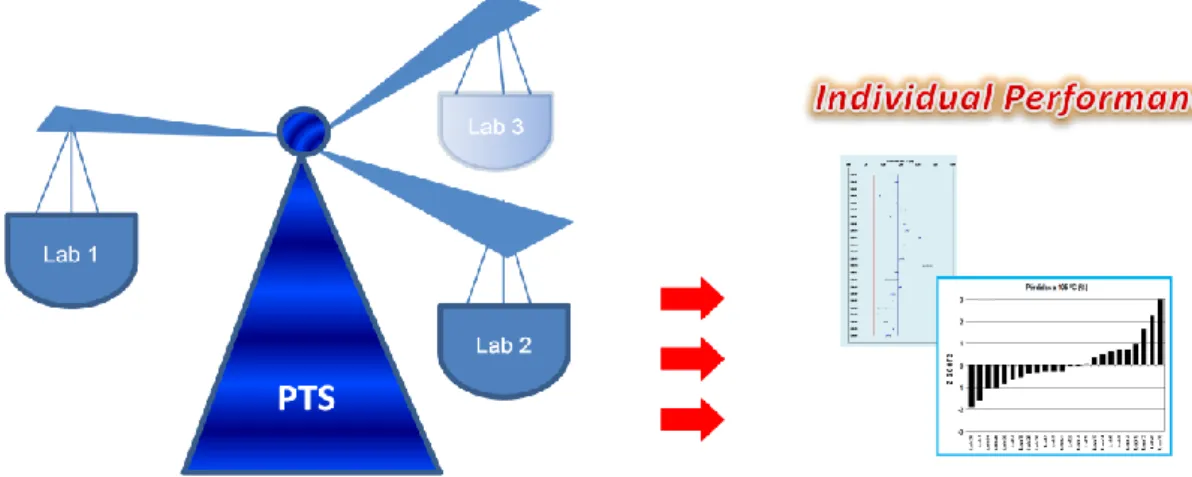
Proficiency testing is defined in ISO/IEC 43-1:1997 (6) as the use of interlaboratory comparisons to determine the performance of individual laboratories for specific tests or measurements and to monitor laboratories‘ continuing performance. Figure 3 is an illustration of an interlaboratory comparison to evaluate individual performance. PT provider works as a balance among laboratories participants.
19 ISO/IEC Guide 43-1:1997 and ISO/IEC Guide 43-2:1997 (7) bring directives to accreditation of PT providers to assure that PTS are being organized with quality. These act like guidance on the development and operation of proficiency testing. The Part 1 sets out the principles for organization, planning and conducting programs of proficiency testing and describes the different types of schemes for these tests. Part 2 describes how the accreditation bodies, which assess the technical competence of laboratories, shall select and use proficiency testing programs.
In addition to PT, a holistic quality assurance (QA) scheme in laboratories includes other elements as validation of analytical methods, use of certified reference materials (CRMs) and the employment of routine internal quality control (IQC).
Method validation covers performance of trueness, precision under various conditions, linearity and also it is possible to estimate the method‘s measurement uncertainty. If a CRM in an appropriate matrix is available, it is also a tool for QA.
A routine IQC that included the use of ―control materials‖ within every run of analysis and control charts ensures that the method is working fit-for-purpose, as demonstrated in the previous validation process.
In principle, method validation and IQC alone are sufficient to ensure accuracy. However, mainly when CRMs are not available, it is not easy to determine the interferences in the measurement process and to estimate the uncertainty. Environmental conditions and personnel behavior can interfere in the measurement and is not easy have a global control of this type of variability.
Proficiency testing is, therefore, the means of ensuring that these two within-laboratory procedures are working satisfactorily and participants can obtain an external and independent assessment of the accuracy of their results. (8)
The ISO/IEC 17043 (9) will be the new International Standard for proficiency testing providers. The first edition of ISO/IEC 17043 cancels and replaces ISO/IEC Guide 43-1:1997 and ISO/IEC Guide 43-2:1997, which have been technically revised.
As the results of a PT are used as evidences of technical competence in accreditation processes of other laboratories, the organization of a PT shall be done with
20
care and sense of responsibility. The accreditation of a laboratory as PT provider is the way to assure that all activities will be carry out with quality.
As most of laboratories do not have PT organization as only activity, the challenge is adapt this international standard for the reality of the laboratory, respecting the number of personnel and coexistence of other norms and regulations. It is primordial design a quality system that works properly without becoming a heavy activity.
About the current status of the standard, Tholen (2009) (10) affirms that ―the Draft International Standard (DIS) version of the document was circulated to the membership of the International Organization for Standardization (ISO) and the International Electrotechnical Commission (IEC) on 15 November 2008, with comments and votes closing on 16 April 2009. The ballot question was whether the DIS should be advanced as a Final Draft International Standard (FDIS). This question was successful in both organizations, with 57 ISO participating members voting to ‗‗Approve‘‘ or ‗‗Approve with comment‘‘, 3 members ‗‗Disapprove‘‘, and an additional 5 members voting to ‗‗Abstain‘‘. In the IEC the ballot was ‗‗Yes‘‘ by 19, ‗‗No‘‘ by 2 members, and 3 members choose to abstain. There were approximately 400 comments received from ISO and IEC members and liaison bodies. The ISO Committee on Conformity Assessment (CASCO) Working Group responsible for the document, WG28, met on 29 June until 1 July to address the comments. The meeting was held in Milwaukee, Wisconsin in the USA, at the headquarters of the American Society for Quality (ASQ), hosted by the American National Standards Institute (ANSI). At this meeting the WG successfully reached agreement on the resolution of all comments and unanimously recommended that the document be advanced. The document is now being balloted as ISO/IEC FDIS 17043 with comments due to ISO in December 2009. However, according to the rules of ISO and IEC, only editorial comments are allowed. If the ballot is successful it will be declared an approved International Standard, early in 2010.‖
In this current text, formulation ―ISO 17043‖ or ―17043‖ refers to ISO/IEC DIS 17043, 2008, used during this work.
21
3.2 Mat Control Laboratory
The ―Laboratorio de Preparación de Materiales para el Control de la Calidad‖ -
Mat Control is located in the Department of Analytical Chemistry from the Faculty of
Chemistry of the University of Barcelona.
Mat Control has as basic objectives to prepare environmental and agro-food items to quality control, organize regular patterns of proficiency tests, and advise on subjects related to quality assurance of the analytical laboratories.
Mat Control was established in June 2001 by the research group QÜESTRAM (Qualitat en l’especiació d’elements traça i radionúclids en el medi) of the Department of Analytical Chemistry, University of Barcelona and recognized by the Government of Catalunya (SER2009-1188). The group had experience since the early 90s in activities related with quality assessment.
At the end of the year 2001, the Mat Control project obtained the financial support of Centre d ' Innovació y Desenvolupament Empresarial (CIDEM) de Generalitat de
Catalunya. This funding allowed the consolidation of the laboratory activities in
environmental field for the preparation of Quality Control Material (QCM) and the organization of the first proficiency test PT campaigns.
From 2003 to nowadays Mat Control is organizing regular PTS (around 30) in environmental and agro-food fields and also has produced more than 125 different QMCs. The number of participant laboratories increases in each campaign because proficiency testing schemes are a useful tool for laboratories that are accredited or in the process of obtaining accreditation, according to ISO norm 17025.
Fundación Bosch i Gimpera of University of Barcelona Group support Mat Control in management of financial issue, and the juristic liability of Mat Control is under responsibility of University of Barcelona.
Since 19th May 2003, Mat Control is a registered Spanish trademark (Nº 2.514.411) by the Spanish Patent and Trademark Office in class 42 (scientific research and industrial service), including the Mat Control design (Figure 4).
22
Figure 4 – Mat Control logotype.
Considering the magnitude of proficiency test schemes for the laboratories‘ quality assurance, there is the need and importance to organize PTS with seriousness, proven for the imminence of new standard ISO/IEC 17043 and, taking into account the competence and experience of Mat Control in this field, the objective of this work was to establish a quality system structure according to ISO/IEC DIS 17043 for Mat Control.
23
4 Experimental
The quality system proposal for Mat Control was elaborated from September 2009 to January 2010, based on attendance and participations in activities carried out in Mat Control located in the Department of Analytical Chemistry, at the Faculty of Chemistry, University of Barcelona.
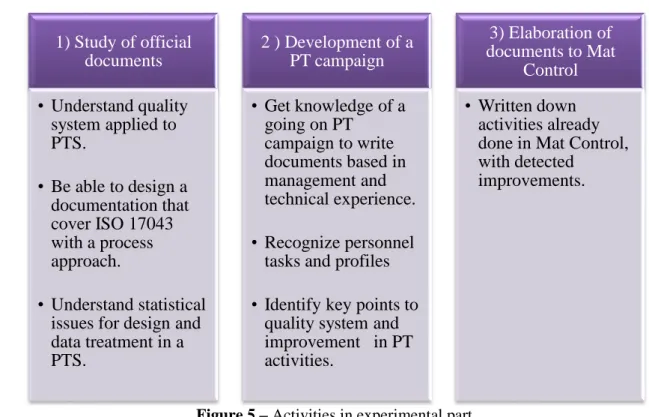
The experimental part can be divided in three types of operational focus, according to the development of technical or management skills, being: 1) Study of official documents, 2) Development of a PT campaign and 3) Elaboration of documents for Mat Control. Figure 5 shows the main objectives in each type of operation.
Figure 5 – Activities in experimental part.
This classification of the types of focus does not involve a chronological sequence among them, because activities from each type were run concomitantly during five months. However, considering an individual issue in PTS, e.g. ―Packing, labelling and distribution of items‖, the chronological order was applied following these three steps.
In the first moment, it was checked which official requirements were necessary to comply with ISO 17043 and/or ISO 13528 (11) for each activity. Then, this activity was run during PTS Waste Characterization 2009 – B. Therefore, a document was
1) Study of official documents • Understand quality system applied to PTS. • Be able to design a documentation that cover ISO 17043 with a process approach. • Understand statistical issues for design and data treatment in a PTS. 2 ) Development of a PT campaign • Get knowledge of a going on PT campaign to write documents based in management and technical experience. • Recognize personnel
tasks and profiles • Identify key points to
quality system and improvement in PT activities. 3) Elaboration of documents to Mat Control • Written down activities already done in Mat Control, with detected
24
elaborated based on a theoretical study of quality requirements and a practical operation of the activity, covering management and technical aspects.
The next three topics deal with each one of these operational focuses, as a fragmented approach. However, the results are present in a global way, showing first the identification of the processes, second the personnel tasks and profiles in all organizations and activities, third explain how the quality system was designed, and fourth which documents were suggested to reach ISO 17043 requirements.
4.1 Study of official documents
Besides scientific journals‘ publications and books, cited along this work, four main documents were deeply studied to define the framework of Mat Control processes and quality system, and to take important decisions about the management structure and statistical issues, as listed next:
ISO/IEC DIS 17043 – Conformity assessment - General requirements for
proficiency testing. - As already discussed on ―Introduction‖, this will be the new
standard for accreditation of laboratories that organize proficiency tests, hence used in this work. All documentation elaborated for this quality system covers ISO 17043 requirements.
ISO/IEC 17025 – General requirements for the competence of testing and
calibration laboratories. - The development and operation of proficiency testing
schemes shall only be undertaken by PT providers having competence in the measurement of the properties being determined or having subcontracted this service. ISO 17025 is used as guideline to demonstrated Mat Control competence in analytical measurement.
IUPAC - The international harmonized protocol for the proficiency testing of analytical chemistry laboratories (8) and ISO 13528 – Statistical methods to be used in
proficiency testing by interlaboratory comparisons (11). – Statistical issues shall be applied in the planning, collection, analysis and reporting of the proficiency testing scheme data. Choosing a statistical method shall considerate the goals of the scheme based on the nature of the data (quantitative or qualitative), statistical assumptions,
25 nature of errors, and expected number of results. These documents were used to base the statistical decisions and approach in elaborating a quality system.
4.2 Development of a PT campaign
Development of a real PTS was the way to get knowledge on challenges and perception in a campaign, and to write documents based in management and technical experience. At the same time, it was possible to identify technical points of improvement in PT activities.
The aim of this intercomparison exercise has been the external evaluation laboratory analysis and characterization of wastes. It was intended for collaborating laboratories of Waste Agency of Catalunya and the Department of the Environment of Catalunya, as well as labs from other areas involved in this type of analytical determinations.
The 2009 Program was developed by Mat Control with 5 representatives of laboratories. The Organizing Committee met in January 2009, and agreed on the total number of samples and parameters to be analyzed, the most suitable samples for the year, the annual calendar, and the statistical treatment of data.
Three samples were agreed for this campaign which followed parameters:
Sample A: solid waste 1
On solid weight loss at 105 ºC (%) and at 550 ºC.
On leachate: cadmium, nickel, lead and zinc (mg kg-1) and total organic carbon (TOC) (mg C kg-1).
Sample B: wastewater
Ammonium content (mg NH4+ l-1).
Sample C: solid waste 2
Organic compounds (BTEX) (mg kg-1): benzene, toluene, ethylbenzene, total xylenes, o-xylene, m + p - xylene.
26
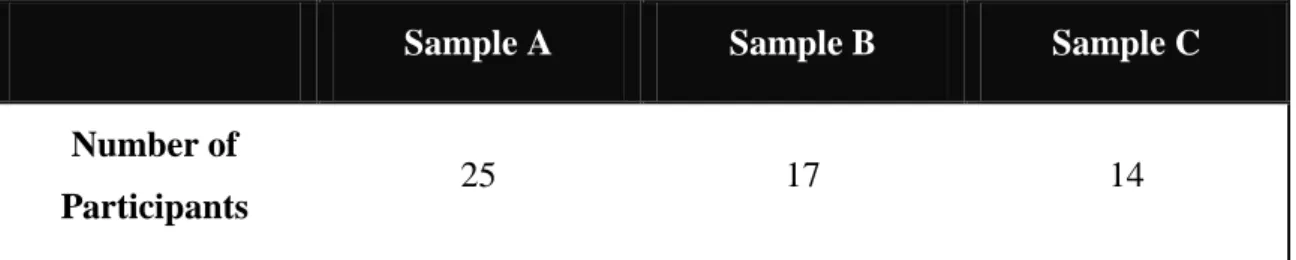
In this campaign 32 laboratories participated. Table 1 resumes the number of participant laboratories for each sample.
Table 1 – Laboratory participation in PT campaign according to the samples.
Sample A Sample B Sample C
Number of
Participants 25 17 14
Activities in this PT campaign were followed from September to December 2009. In this period, it was possible to attend PT activities as described:
Participation on feasibility test of material (solid residue) – Fortification of soil with metal solution, leachate test and determination of metals by atomic absorption.
Preparation of reference material (solid residue) – Drying, fortification, sieving, homogenization and bottling activities. In Mat Control the preparation area is fully equipped to carry out pre-treatment processes with large volumes of samples, up to 150 kg, including a drying system with computerized control, a freeze-drying system, and grinding and sieving devices. A special cabinet with a dust aspiration system fitted with synthesized Teflon filters has been designed with the aim of avoiding cross-contamination of different matrices and levels of pollution during the production of QCM. (12)
Handling of PT items – Participation in labeling, packing and distribution activities.
Observation of communication with participants.
27 Communications of participants started by Mat Control occurred in 4 mainly occasions, being:
Information about PT was sent by email four weeks before the date due to receive the samples. In this occasion an application form in the exercise was sent.
Letter information about samples, methods and schedule details was sent together samples by post (private agency).
An Excel file was sent by email to report the results 15 days before the deadline of results. Participants sent this back, also by email.
A technical report was sent in a date previously agreed, 15 days after receiving the results from the participants.
Another communication is programmed to call participants to attend a final meeting to explain and clarify doubts about results and reporting. This meeting is appointed to 23rd February 2010.
28
29
4.3 Elaboration of documents to Mat Control
After attending activities in a real PT campaign, the documents for Mat Control were elaborated. There is an exception for the case of homogeneity and stability, as is explained ahead, in item 5.4.
Documentation was elaborated seeking a simple structure. Due to the few number of personal it is very important for the quality system documentation not to be a very time consuming activity.
The idea was to elaborate a set of documents that contemplates the steps in a PTS, from the planning until the reporting of results. This set was formulated aiming to cover all the technical requirements of ISO 17043, and therefore cover all points that can influence in the quality of proficiency test scheme.
Besides procedures, two excel files were elaborated to support the homogeneity and stability procedure and the transfer of data operation.
Figure 7 is an illustration of how activities of items 4.1 and 4.2 affect the documentation system.
30
31
5 Results and Discussion
5.1 Identification of Processes
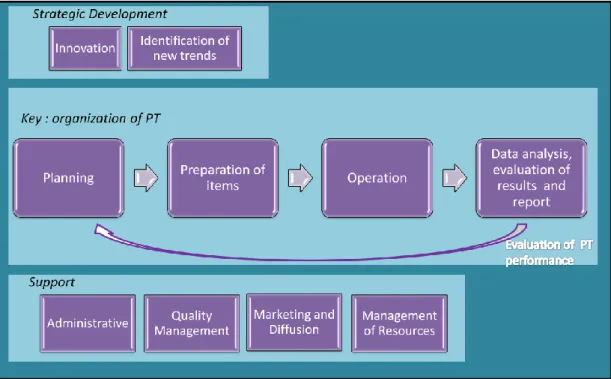
To define the structure of the quality system, there was a reflection about the main activities and how they are connected. Figure 8 shows all processes that can be involved in Mat Control activities. These processes were divided in three types, according to focus and goals, which are strategic development, key, and support process.
Figure 8 – Mat Control processes.
Strategic development processes are responsible to keep Mat Control growing and increasing its portfolio of assistance. These contemplate activities such as research about new material, feasibility studies, identification of potential participants, and identification of the needs of intercomparison laboratories.
Key processes contemplate the organization of PT in many aspects, since the PT involves many steps, until the reporting of results to the participants. These processes are divided in four main areas (Planning, Preparations of items, Operation and Data analyses, evaluation of results and report) that reach the technical requirement items 4.4 to 4.9 on ISO 17043.
Support processes allow Mat Control to organize PTs with quality assurance, adequate for the market and equilibrated in financial and human resources.
32
Administrative activities well executed are the key to have Mat Control perform the PT schedule and obtain customer satisfaction.
Complying with an improvement policy, all the processes are covered by the continuous evaluation of performance.
5.2 Identification and Formalization of Tasks and Profiles
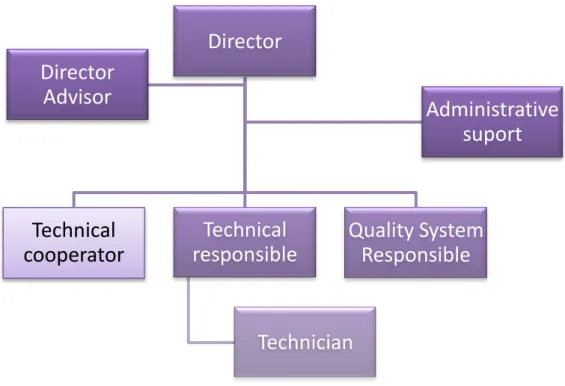
The identification and formalization of tasks and profiles was important to establish Mat Control‘s needs in terms of personnel. Based in tasks that already exist, Figure 9 shows a proposal for personnel organization for the laboratory. This structure shall be ever verified with such workers because the PT provider should be aware of the conflict of interests when deciding the positions in the hierarchy.
Figure 9 – Personnel organization chart.
The involvement of people is very important to the Mat Control quality system, since it is a quality management principle. Everyone should feel important and responsible for the quality system operation. All abilities shall be used with the
Director
Technical
cooperator
Technical
responsible
Technician
Quality System
Responsible
Director
Advisor
Administrative
suport
33 improvement proposal. Due to the dimension of Mat Control, it is necessary that some members execute more than one activity in the quality system structure.
During the annual management review, direction shall identify training needs and establish a plan for each staff member involved in the development of proficiency testing schemes.
5.2.1 Profile
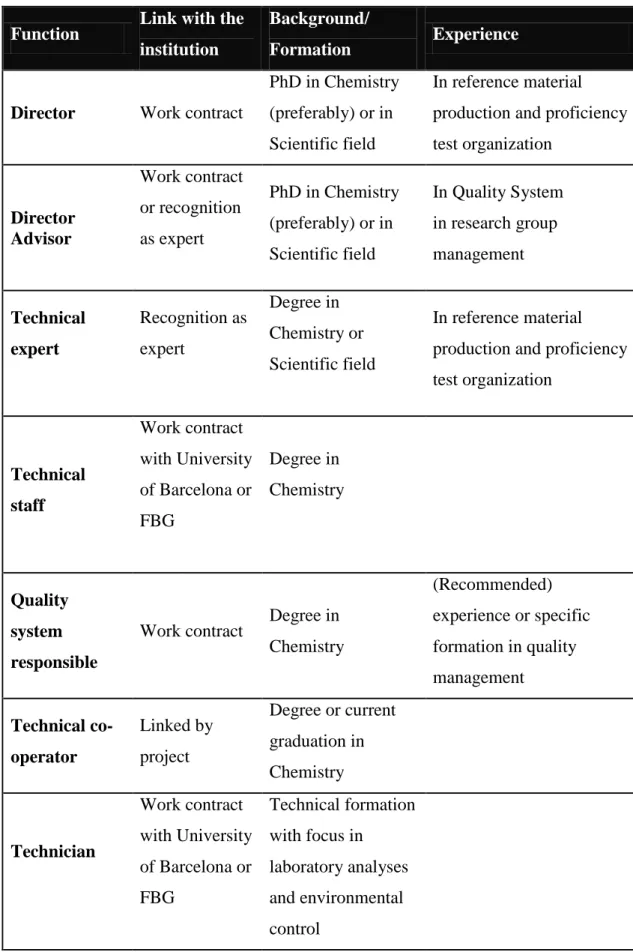
For each job description there are minimum requirements of knowledge, experience and type of link with the institution (Table 2). This was a first step to structure personnel. Even if it would not be necessary that the director a PhD to develop well her(his) tasks and responsibilities, this work has considered the current situation in Mat Control to written down the quality system.
The laboratory shall have files evidence that all personnel is able to develop designed activities.
34
Table 2- Requirements of knowledge, experience and type of link with the institution.
Function Link with the institution
Background/
Formation Experience
Director Work contract
PhD in Chemistry (preferably) or in Scientific field
In reference material production and proficiency test organization Director Advisor Work contract or recognition as expert PhD in Chemistry (preferably) or in Scientific field In Quality System in research group management Technical expert Recognition as expert Degree in Chemistry or Scientific field In reference material production and proficiency test organization Technical staff Work contract with University of Barcelona or FBG Degree in Chemistry Quality system responsible
Work contract Degree in Chemistry (Recommended) experience or specific formation in quality management Technical co-operator Linked by project Degree or current graduation in Chemistry Technician Work contract with University of Barcelona or FBG Technical formation with focus in laboratory analyses and environmental control
35
5.2.2 Tasks
5.2.2.1 Director:
Conduct Mat Control.
Define organization and management structure.
o Identify the responsibilities of key personnel in the proficiency test activities, avoiding potential conflicts of interest.
Work, together with the director advisor, in a strategic way to obtain resources and develop Mat Control.
Quality management
o Establish together with the director advisor the Quality Policy and actions to attend it.
o Approve the Quality Manual
o Establish contact with accreditation body.
o Review and approve documents elaborated by the quality system responsible.
Management financial.
o Review and approve purchasing. o Conduct all commercial activities. Design PTS
o Review and approve documents elaborated by the technical responsible.
o Plan of the proficiency test scheme, together with the technical staff and expert, including the preparation of items.
o Operated PTS, together with the technical staff and expert, tasks that involve instruction to participants, distribution of items and data analyses.
o Authorize the final report PTS.
o Define together with the technical staff and expert, the training needs for all personnel.
36
5.2.2.2 Director advisor
Establish together with the director the Quality Policy and actions to attend it.
Work, together with the director, in a strategic way to obtain resources and develop Mat Control.
Responsible for improvement of the management system. Review and approve all quality management documents. Plan and organize audits as required by the schedule.
Define together with the director and technical, training needs for all personnel.
5.2.2.3 Technical responsible: staff or expert
In Mat Control the technical responsible is classified as ―staff‖ or ―expert‖ according to the link with the institution. Staff members have a work contract with the University of Barcelona or FBG and Expert members are recognized by the University of Barcelona as linked directly with Mat Control, due to their knowledge in a specific subject.
The tasks for both figures are the same:
Elaborate and document procedures and instructions necessary to assure the quality of all aspects of proficiency testing as is the purchase, reception, and storage of reagents, proficiency test items, reference materials, and other consumable materials.
Plan of the proficiency test scheme, together with the director, including the preparation of items. Establish methods and work schedules for PTS. Operated PTS, together with the director, tasks that involve instruction to
participants, distribution of items and data analyses.
Take decisions about PT items suitability (homogeneity and stability). Establish statistical design for analysis.
Conduct commercial activities, including updating the website.
Inspect or otherwise verify if purchased items are complying with standard specifications or requirements.
37 Inform the director about material and equipment needs.
Demonstrate experience and technical competence of subcontractors. Clarify customers‘ requests and check costumer‘s feedback and solve
incidents.
Identify, inform and solve technical nonconformities. Review and approve requests, tenders and contracts. Responsible for the evaluation of performance of PTS.
5.2.2.4 Quality system responsible
Organize meetings with personnel to evaluate and to review the management system.
Evaluate, together with the technical, suppliers of critical supplies and services which affect the quality of proficiency testing schemes.
Responsible for implementation, maintenance and improvement of the management system.
Elaborate, identify and codify all quality management documents Establish document control policies and procedure.
Control documents.
Participate in evaluation of performance of PTS.
5.2.2.5 Technical co-operator
The technical co-operator is someone working eventually in Mat Control. As Mat Control is part of university group, some students can do research projects and carry out some activities that comply with the management system of the laboratory. These activities can be the same as for the quality system responsible, technical responsible and/or technician and are supervised by the director.
5.2.2.6 Technician
Support the proficiency test developing chemical analyses involved.
Involved in the preparation, characterization, handling, packing and labelling of PTS items.
38
Do maintenance, verification and/or calibration of equipments and materials.
Control stock of material. Inform the technical about reagents and equipments needs.
Control environmental conditions and maintenance of installations that could have influence on the proficiency test activities.
5.2.2.7 Replacement
In the case any worker is absent, the replacement of his/her activities is done according Table 3, always respecting training and abilities context.
Table 3 -Function replacement.
Function Replacement by
Director Director advisor or Technical responsible Director advisor Director or Technical responsible
Quality system responsible Technical responsible
Technical responsible Another technical responsible or director Technician Technical responsible
5.3 Quality management system
Mat Control quality system documentation covers an explanation of organization, definition of personnel tasks and profile, management of activities and all documents necessary to develop the work. Seeking satisfaction of customers‘ proficiency tests, the quality system was structured to attend the technical and management requirements of ISO/IEC DIS 17043.
Table 4 shows the equivalence between the Mat Control Quality Manual (ANNEX 1) items and ISO/IEC DIS 17043.
39
Table 4 – Equivalence between the Quality Manual and ISO /IEC DIS 17043.
Mat Control Quality Manual ISO/IEC 17043
6.1. Technical requirements- general
3 Personnel
6.1.1/ 6.1.2 Equipment, accommodation and environment
6.2.1 Planning
6.2.2 Preparation of proficiency test items
6.2.2 Homogeneity and stability
6.2.1 Statistical design
6.2.1/ 6.2.4 Assigned values
6.2.1 Choice of method or procedure
6.2.3 Operation of proficiency testing schemes
6.2.4 Data analysis and records
6.2 Evaluation of performance
6.2.4 Reports
6.2.3 Communication with participants
4 Confidentiality
2.1 Organization
5 Management system
5.1 Document control
5.2 Review of requests, tenders and contracts
5.3 Subcontracting services
5.3 Purchasing services and supplies
5.2 Service to the customer
5.4 Complaints
5.4 Control of nonconforming activities
5.4 / 5.5 Improvement 5.4 Corrective action 5.5 Preventive action 5.1 Control of records 5.5 Internal audits 5.5 Management reviews
The elaboration of documents that allow all personnel to work in the same way was proposed, following quality system principles, and registering all evidences, which must be traceable.
40
Mat Control has a document structure based on five types of documents, these being Quality Manual (Manual de Calidad - MC), General Quality Procedure (Procedimientos General de Calidad – PGC), Standardized Operation Procedure (Procedimientos Normalizados de Trabajo - PNT), Registers and External Documents.
Quality Manual (MC) covers all explanation about Mat Control and is the main document that allows the following of all other documents. Standardized Operation Procedures (PNT) establish details that support Mat Control‘s activities and General Quality Procedures (PGC) cover all activities in a way to assure the quality. Figure 10 illustrates these documents‘ interaction.
Figure 10 – Documents interaction illustration.
Registers are generated during Mat Control‘s activities and are kept as evidences. External documents are not elaborated by Mat Control but influence it in activities and quality, being also managed by the quality system, e.g. reagents and calibration certificates.
41 Table 5 is a proposal of personnel responsibilities to management each type of document and also the periodical review. Having continual improvement as a principle, all personnel can suggest modifications on the procedures that are analyzed by the superior and/or director.
Table 5 – Responsible of elaboration and control of documents.
Type of
Document Writing Review Approval
Control of Copy Periodical Review MQ Quality system responsible All personnel can review and suggest modifications Director Quality system responsible 3 years PGC Quality system responsible All personnel can review and suggest modifications Director Quality system responsible 3 years PNT Technical responsible, Quality system responsible, Technician All personnel can review and suggest modifications Director Quality system responsible 3 years Registers All personnel All personnel can review and suggest modifications Technical responsible, Quality system responsible, Director Technical responsible, Quality system responsible --- External --- --- Technical responsible, Director Quality system responsible ---
42
This proposal works well in a small laboratory with few personnel, once there is no so wide range of technical documents and all personnel shall know of all processes. In a bigger laboratory, the PNTs elaboration could require more responsibilities details. In this work, the author of this current text had been actuating as quality system responsible.
5.4 Elaborated documents
Documents for Mat Control were elaborated in parallel or after attending activities in a real PT campaign. As these documents were done after the focus operation, it is very important to test them in the next PT exercise and modify them in such a way to reach the objective described in each one.
Two PGCs define elaboration, coding and management of documents.
All documents, with the exception of the quality manual, contain the same structure with:
Objective: Purpose of the procedure.
Scope: Activities covering the procedure and/or the persons to whom it is applied. Definitions: Precise definitions for the correct understanding of the procedure by
which people have used. If necessary, you see the phrase "Not Applicable".
Related Procedure: Indicated code and title procedures that complement the
procedure in question. If so, you see the phrase "Not Applicable".
Responsibilities: List of people associated with the procedure, specifying its
functions.
References: Bibliographic material used for writing (books, articles, standards,
legislation, etc.), or procedures that can serve as supplementary information. If necessary, you see the phrase "Not Applicable".
Instructions: Description and detailed sequence of operations to follow.
Annexes: It includes the information necessary to complete the content of the
43 As result of this work, a quality manual, two PGCs and seven PNTs were done. Due time constraint, some documents were just structured with objectives, scope and responsibilities, but instructions to reach the objectives are missing. This structure was done to facilitate the permanence of the quality system‘s development and to avoid overlaps or cross information in the documentation. The documents can be found in ANNEX 2.
Table 6 brings the code, title and status of the elaborated documents. It was used ―D‖ for the completed documents and ―S‖ for the documents just structured.
Table 6 – Elaborated documents and status.
Code Title Status
MC02 Quality Manual D
PGC/MAT/001 Codification and structure of procedures D
PGC/MAT/002 Writing, review, approval, distribution and
maintenance of procedures
D
PGC/MAT/003 Review of quality system S
PGC/MAT/004 Management of Personnel S
PGC/MAT/005 Evaluation of technical competence and quality of
services and material
S
PGC/MAT/006 Detection, management of incidents and improvement S
PNT/MAT/001 Management of equipments S
PNT/MAT/002 Planning proficiency test scheme D
PNT/MAT/003 Preparation of proficiency test items D
PNT/MAT/004 Homogeneity and stability tests D
PNT/MAT/005 Labelling, packing and distributions of PT items D
PNT/MAT/006 Communication with participants D
PNT/MAT/007 Data analysis and evaluation of proficiency testing
scheme results
D
PNT/MAT/008 Elaboration of reports D
44
The elaboration and changes of PNT and PGC is done according to PGC/MAT/002 ―Writing, review, approval, distribution and maintenance of procedures‖. The code of procedures is generated according to PGC/MAT/001 ―Codification and structure of procedures‖ and has as objective to facilitate the identification and recognize easily the document proposed.
The code is composed by four parts. Some PNTs can have one more part as described in PGC/MAT/001. Generally procedures are identifying as PZZ/MAT/XXX/YY, being:
PZZ = PGQ or PNT: abbreviation identifying the type of document. MAT: Acronym for Mat Control.
XXX: digit order number to the document. YY: digit version of the document.
In this current document and in the quality manual, the digit version YY is omitted. In the QM this omission avoids the need of updating and approval of QM each time that a procedure is modified.
Under the code PNT/MAT/00X it is found all the instructions and forms to register activities and decisions about each subject. PNT/MAT/002, e.g., establishes steps to plan the PTS and generate a schedule for such steps. Annexes under this document register the meetings between Mat Control and interested people in the PT, register decisions about nature and amount of sample, analytical methods, range of parameters, statistical design, assigned value method and personnel involved. When filling this document it is possible to evidence how Mat Control plans item preparation, homogeneity and stability test, contacts with participants (information and way to participant send results), distributes items, and evaluates and reports results.
PNT/MAT/003 - Establishes the characteristics of the item that will be prepared, as well as the steps necessary to reach such characteristics. Mat Control can obtain the proficiency test item by acquisition or can prepare it following the instructions for pre-treatment, fortification, chemical analysis, handling and storage according to the ISO Guide 34 (13). This is a procedure to ensure that each proficiency test item is prepared in
45 accordance with the details established in PNT/MAT/002 ―Planning proficiency test scheme‖ for such exercise.
PNT/MAT/004 establishes the criteria to considerate the homogeneity and/or stability of the material, being purchased or prepared by Mat Control.
This was the first PNT elaborated, and established before following the related activity. This showed that Mat Control has to adapt the way of testing homogeneity and stability in accordance to ISO 17043. The PNT was kept with the compromise of being improved with the next items to be prepared.
This procedure considerates two documents to run the homogeneity and stability test: the Harmonized Protocol (8) and ISO 13528 (11).
Both documents suggest the same procedure to run the homogeneity test. The difference is in the treatment of data. The Harmonized Protocol has a pre-procedure to compare the duplicates between them (Cochran test) and reject the pair in case of discrepancies. For this advance to detect analytical error between samples, the procedure to calculation homogeneity is done according Harmonized Protocol. An excel file was elaborated to facilitate the Homogeneity and Stability decisions.
PNT/MAT/005 establishes steps to run labelling, packing and distributions in a standardized way, in items purchased or prepared by Mat Control. All processes are done according to relevant national, regional, and/or international safety and transport requirements. Such PNT has a model of labels as information that can be found as an electronical copy. Annex A is used to register all decisions and notes that can influence the physical integrity of the samples.
PNT/MAT/006 deals with the communication of participants that is done according to a previous agreement between the parts, e.g. courier, email, fax, or phone. This document brings the situation, time and media for each communication.
PNT/MAT/007 establishes the main actions to analyze results of PTS statically and evaluates the performance of each participant.
In this activity it was detected that the transfer of data had many steps that could cause data treatment mistakes.
46
After receiving the excel sheet from the participants, the technical responsible transfers, by copy and paste action, each parameter values. This means opening the right file for each laboratory, selecting the sample sheet, and selecting the parameter with three replicates. For the followed campaign, just considering the parameter choice, this meant 416 selections.
To avoid these possible mistakes due to human interference, and agreeing with item 4.7.1.2 of ISO 17043, an excel tool was developed as the mechanism to transfer data.
The PNT contemplates this transfer as a pre-arrangement. A new excel sheet is constructed, resuming the data as shall be insert in the data treatment software. For this resume the function VLOOKUP was used. In a group of data, this function searches the sheet of each laboratory, searches the name of parameter and returns the three replicate values.
With this command, the technical responsible just needs to open all the laboratory files and copy and paste once, reducing considerably the possibilities of mistakes.
Continuing data treatment, this resume is used in the software Tool4PT version 1.06.09. There is already software instruction elaborated in Spanish for this software. It was not translated to English and it is not presented as result of this work.
After data treatment, PNT/MAT/008 contemplates the minimum information that a report of results sent to participants should have. This document has tables and graphics as models, but doesn‘t inform yet how it was generated.
These seven elaborated PNTs cover the technical requirements of ISO/IEC DIS 17043. Instructions for PNT/MAT/001 shall be done considering mainly ISO/IEC 17025 and this will be a very important step to demonstrate Mat Control‘s competence to run analytical tests. These procedures shall be tested in a real proficiency test scheme and details shall be added to improve them.
PGC/MAT/001 PGC/MAT/002 reach item 5.3 of ISO 17043. Other management requirements are contemplated in the quality manual and will be totally covered with the elaboration of an instruction for PGCs, already structured.
47
6 Conclusions and Recommendations
From the study of documents it is possible conclude that:
o It is important design a simple quality system according the number of personnel, mainly in a small laboratory.
o It is necessary to have a previous statistic plan of all campaign, complying with ISO 13528 and Harmonized Protocol for PT.
o Calculation of uncertainty of process shall be plan and this is a point to be improved.
o One goal for improvement is how establish the assigned value. Today in Mat Control this is done by consensus from participants. One recommendation is have an action plan to exchange for ―know value‖, decreasing the uncertainty of the process.
Attending activities in a PT campaign it became clear:
o Importance of thinking and formulating about the organization, defining processes and structuring the quality system with a process approach. o Importance of having all documents before a campaign starts, testing the
elaborated documents and improvement of them.
o The application of VLOOKUP tool to resume the data from participants in only one excel sheet increased the quality of transfer data process, decreasing mistakes possibilities.
After elaboration of documents it is possible conclude that:
o Simple design of quality system, with few documents is the key for the documentation do not become a hard task, mainly in a small laboratory. o The elaboration of PNT/MAT/001 (management of equipments) shall be
48
important step to demonstrate the technical competence of Mat Control to run analytical tests.
o This work was a starting point and, due time constraint, it was not possible to test the elaborated documents. Now it is necessary to run other campaigns and update the technical documents, where necessary. o It is necessary complete the management system, defining points that can
affect the quality of the PT.
This new standard for proficiency test provider will demand a relevant reflection about the organization of an intercomparison exercise. It will require the definition of needs and expectations of customer and society. Organizations that already organize PT will need leadership to exchange some points that not totally comply with ISO 17043.
The identification and measure of inputs and outputs of the process will facilitate to detect points that influence in the quality, mechanisms to assure the good performance and to identify areas for potential improvement.
Appropriate statistical techniques shall be use to evaluate the proficiency test campaign. It is important that this data and information are not influenced by performance of the customer in the exercise.
As the results of a PT are used as evidence of technical competence in accreditation processes of other laboratories, the organization of a PT shall be done with care and sense of responsibility. A PTS well organized is interested for all parts. The participant laboratory can identify sources of error and improve; also it can prove its competence among other laboratories. The accreditation body has a tool to evaluate laboratories. Society and customers can trust more in a laboratory, if it is participating in intercomparison activities.
Due the importance of a proficiency test, it is expected that, after the release of ISO/IEC 17043, accreditation bodies will start to require PTS that have been organized by an accredited provider in the following years.
49
7 Bibliography
1. ISO. 9000 - Quality management system - Fundamentals and Vocabulary. 2000. 2. David Hoyle, John Thompson. Del asseguramiento a la gestión de la calidad. El enfoque basado en procesos. 2002.
3. ISO/IEC. 17025 - General requirements for the competence of testing and calibration laboratories. 2005.
4. ISO. 9001 - Quality managemente systems - Requirements. 2000.
5. Rasberry, Stanley D. Thoughts on quality systems. Accred Qual Assur. 2009, Vol. 14, pp. 233-234.
6. ISO/IEC. Guide 43-1, Proficiency testing by interlaboratory comparisons — Part 1: Development and operation of proficiency testing schemes. 1997.
7. ISO/lEC. Guide 43-2, Proficiency testing by interlaboratory comparisons — Part 2: Selection and use of proficiency testing schemes by laboratory accreditation bodies. 1997.
8. IUPAC. The international hamonized protocol for the proficiency testing of analytical chemistry laboratories. 2006.
9. ISO/IEC. FDIS 17043 - Conformity assessment – General requirements for proficiency testing. 2008.
10. Tholen, Daniel W. Update on ISO/IEC 17043: The New International Standard.
Accred Qual Assur. 2009, Vol. 14, pp. 635-637.
11. ISO. 13258 - Statistical methods for use in proficiency testing by interlaboratory comparisons. 2005.
12. A. Sahuquillo, E. Carrasco, H. Muntau, R. Rubio, G. Rauret. Mat Control:a new laboratory for the preparation of reference materials at the University of Barcelona, Spain. Accred Qual Assur. 2004, Vol. 9, pp. 272-277.
13. ISO. Guide 34 - General requirements for the competence of reference material producers. 2000.
14. Blaza Toman, Antonio Possolo. Laboratory effects models for interlaboratory comparisons. Accred Qual Assur. 2009, p. online version.
50