Microbiology ( 1 996), 142, 72 1 -7 3 1 Printed in Great Britain
Response of
Saccharomyces cerevisiae to
REVIEW
changes in external osmolarity
I I
Jozio
C. S.Varelat and Willem H. Mager
Author for correspondence: Willem H. Mager. Tel: +31 20 4447569. Fax: +31 20 4447553. e-mail: mager@,chem.vu.nl
Department of Biochemistry and Molecular Biology, Institute for Molecular Biological Sciences, BioCentrum Amsterdam, Vrije Universiteit, De Boelelaan 1083, 1081 HV Amsterdam,
The Netherlands
Keywords : Saccharomyces cerevisiae, osmostress, salt stress, MAP kinases, growth control
Overview
A few years ago, knowledge about the molecular and genetic details of osmoregulatory processes was confined to prokaryotes (reviewed by Csonka, 1989; Csonka & Hanson, 1991). Recently, however, numerous reports have been published describing genes, or their products, involved in the response of eukaryotic organisms to changes in the external osmolarity. Because of its genetic tractability, the budding yeast Saccharomjces cerevisiae has
been the organism of choice for the isolation and characterization of components that may have functional counterparts in higher eukaryotes. In addition,
S.
cerevisiaeis used in industrial processes (e.g. dough leavening), where tolerance to high salt and sugar as well as other stresses is essential (Reed & Nagodawithana, 1991). This has led to an increasingly better understanding of how yeast senses and responds to osmotic and ionic stress (previously reviewed by Mager & Varela, 1993).
Sensing of and responding to osmotic
stress
Hyperosmotic stress
The earliest event upon transfer of yeast cells to conditions of high osmolarity (equivalent to salt concentrations above about 0.3 M) is the almost instantaneous loss of cytoplasmic water. This sudden dehydration is partially compensated by a rapid influx of water from the vacuole (Blomberg & Adler, 1992 ; Latterich & Watson, 1992). This net loss of water results in a decrease or even abolishment of the turgor pressure exerted by the plasma membrane upon the cell wall, depending upon the severity of the stress (Blomberg & Adler, 1992). At a later stage, glycerol accumulates in the cytoplasm up to molar ... 1 . . . ... ... ... tPresent address: Division of Molecular Carcinogenesis, Cancer Institute of The Netherlands, Plesmanlaan 121, 1066 CX Amsterdam, The Netherlands.
concentrations, this being a long-term osmoregulatory strategy widely used by fungi and other organisms (e.g. algae) in order to counteract cell dehydration. However, other mechanisms protecting yeast from changes in the external osmolarity are likely to exist (see below). Two models can be envisioned as to how yeast senses osmostress : (i) intracellularly, e.g. by sudden increase in the concentration of a solute (e.g. Ca2+); or (ii) extra- cellularly, e.g. by activation/inhibition of a plasma- membrane- bound receptor.
Recently, model (ii) has received experimental support through the identification of an osmosensing trans- membrane protein, Slnlp (Maeda et a/., 1994). SLNI was
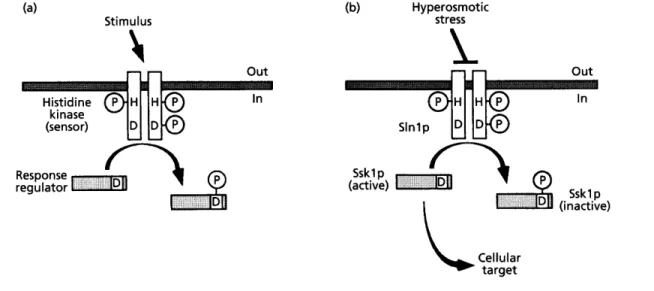
initially isolated in a synthetic lethality screen with UBR 1, a gene implicated in ubiquitin-dependent proteolytic processes (Ota & Varshavsky, 1993). SLNI is an essential gene for growth on rich medium, showing strong similarities with the ' two-component ' regulatory systems that respond to a variety of environmental stimuli in prokaryotes (Ota & Varshavsky, 1993). These systems are typically composed of a membrane-bound ' sensor ' and a cytosolic ' regulator' (Fig. la). Upon stimulation, histidine autophosphorylation of the sensor molecule is induced. Subsequently, the kinase transfers the phosphate group to an aspartate residue on the response regulator, modulating its activity (Fig. la).
Unlike the prokaryotic two-component systems, the eukaryotic homologues described so far do not relay the signal directly to the transcriptional machinery but rather to a regulator of a protein kinase cascade. This cascade may eventually regulate transcriptional activation (Hughes, 1994). In the SLNI-mediated pathway, the regulator corresponds to Ssklp (Fig. 1 b). High osmolarity appears to inhibit phosphorylation of Ssklp by Slnlp (Maeda et a/., 1994). It has been proposed that the
unphosphorylated form of Ssklp activates a pair of serine- threonine kinases, Ssk2p and Ssk22p, two yeast homo- logues of mitogen-activated protein (MAP) kinase kinase
J. C. S. V A R E L A a n d W. H. M A G E R
Stimulus (b) Hyperosmotic stress
Response regulator u u Sskl p (active) Sskl p (i n a c t i ve) Cel I u la r target
Fig. 1. Two-component systems. (a) Two-component systems consist of a 'sensor' and a 'response regulator'. Upon stimulation, the histidine autophosphorylation activity of the sensor molecule (shown as a homodimer) is activated. Subsequently, phosphotransfer to an aspartate residue of the sensor and/or of the response regulator takes place. This phosphorylation may then modulate the activity of both the sensor and the response regulator. The plasma membrane is depicted as a grey bar. (b) In yeast, the activity of the sensor molecule, Slnlp, is repressed by high osmolarity, preventing the phosphorylation and inactivation of the response regulator, Sskl p (modified from Hughes, 1994).
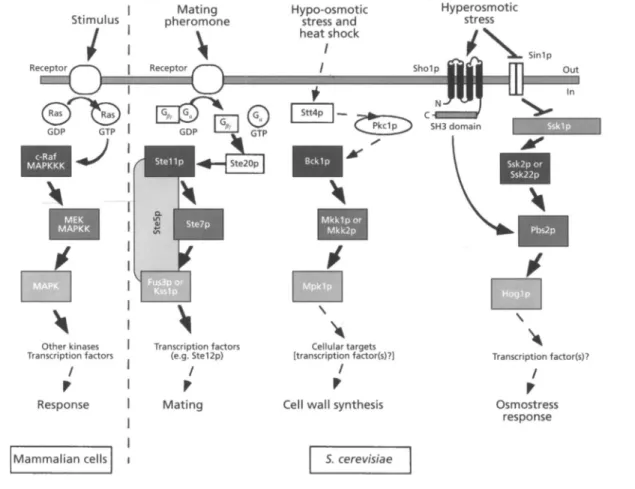
kinases (MAPKKKs) of mammalian cells (Fig. 2). In turn, Ssk2p and Ssk22p appear to stimulate tyrosine phosphorylation on Hoglp, a yeast homologue of the mammalian MAP kinases (MAPKs), by Pbs2p, a MAPK kinase (MAPKK) homologue (Fig. 2; Brewster e t al.,
1993; Maeda e t al., 1775). Recently, it has been found that Pbs2p binds to a second putative transmembrane protein, Sholp (Maeda et al., 1775). The interaction between a proline-rich motif of Pbs2p and the SH3 domain present in Sholp seems to result in the activation of the MAPKK upon a shift to high osmolarity (Fig. 2). Deletions in
HOG1 or PBS2 or the simultaneous disruption of SSK2,
SSK22 and SHO I produce an osmosensitive phenotype and (at least in the former cases) was shown to lead to the accumulation of lower amounts of glycerol in the cell, thus confirming the essential role played by the SLNI- and SHO7-mediated pathways [also known as the high- osmolarity glycerol (HOG) pathway] in sensing osmo- stress (Brewster etal., 1773; Maeda etal., 1774,1775). This conclusion is further supported by the finding that GPD7, encoding the key enzyme for glycerol production, glycerol-3-phosphate dehydrogenase, is under the regu- lation of this osmosensing signal transduction pathway (Albertyn e t al., 1774). In addition, activation of several general stress-responsive genes, such as CTTl (encoding cytosolic catalase; Marchler e t al., 1773) and HSP72 (Varela et al., 1972,1975), are triggered through the HOG pathway. In the latter case, gene activation by the HOG pathway is apparently mediated by the CCCCT-motif (STRE, stress-responsive element ; Marchler e t al., 1973 ; Varela et al., 1775; Mager & De Kruijff, 1775).
STREs are cis-acting elements occurring in the promoter regions of many stress-related genes (summarized by Varela e t al., 1795; Mager & De Kruijff, 1975) and
responsive to a broad range of stresses, including high osmolarity. Detailed analysis of the HSP 72 promoter revealed that multiple STREs are required for full activation under stress circumstances (Varela e t al., 1775). Since the HOG pathway appears to be specifically involved in signalling increases in external osmolarity, it is thus likely that multiple stress-signalling pathways are targeted to the STRE. Tyrosine phosphorylation of Hoglp has been shown to occur within 1 min after the onset of the osmotic stress, and immediately afterwards
CTT7 mRNAs were found to accumulate (Schuller e t al.,
1774). Combined with the dramatically reduced levels of transcription of CTTI, HSP12 and DDRZ (implicated in DNA damage repair) observed in hog7 or pbs2 mutants (Schuller e t al., 1774; Varela e t al., 1975), the data are consistent with the idea that osmostress-induced acti- vation via STREs is directly triggered by Hoglp. Very recently, Msn2p and Msn4p, two Miglp-like polypeptides (Estruch & Carlson, 1773), have been identified as STRE- binding factors (Ruis & Schuller, 1775). Consistent with this, Msn2p and Msn4p have been shown to be essential for the stress-inducibility of the HSP 72 and HSP26 genes (Martinez-Pastor & Estruch, 1795). The possibility of Miglp-like factors regulating the expression of stress- inducible genes is further strengthened by the presence of sequences resembling Migl p-binding sites which overlap functional STREs in the HSP72 promoter (Varela et al., 1795).
Hypo-osmotic stress
Upon a downshift in the external osmolarity, the yeast cell ceases accumulating glycerol, and rather releases this polyol into the medium (Blomberg & Adler, 1992). Glycerol efflux appears to be mediated by a glycerol
Salt response of yeast
.... ... . ... ... ...
Fig. 2. Mitogen-activated protein (MAP) kinase pathways. MAP kinase (MAPK) cascades are typically composed of a MAPK, a MAPK kinase (MAPKK) and a MAPKK kinase (MAPKKK). MAPKs and MAPKKKs correspond to serinehhreonine protein kinases, whereas MAPKKs are serinekhreonine-tyrosine-directed protein kinases. Identical shades of grey indicate homology among protein kinases. Components operating upstream of the MAPK cascade are given as boxes, rounded rectangles and ellipses with a white background, except for Shol p and Sskl p. The plasma membrane is depicted as a grey bar.
facilitator, Fpslp, which is inactive in cells exposed to hyperosmotic stress (Luyten e t al., 1995). Fpslp, however,
is apparently not regulated by the HOG pathway. Instead, the activity of Fpslp may be modulated by protein kinase C (encoded by PKCI), an enzyme thought to regulate a MAPK cascade involved in signalling hypo-osmotic stress (Thevelein, 1994; Gustin e t al., 1995).
The MAPK cascade regulated by Pkclp (PKCI pathway) consists of a MAPKKK (Bcklp), a pair of functionally redundant MAPKKs (Mkklp and Mkk2p), and a MAPK (Mpklp) (Fig. 2; Torres e t al., 1991 ; Lee & Levin, 1992; Irie e t al., 1993 ; Lee e t al., 1993b; reviewed by Thevelein, 1994 ; Herskowitz, 1995). Besides hypo-osmotic stress, components of the PKCI pathway have been reported to signal heat stress and (lack of) nutrients, the latter in a
CAMP- independent manner (Costigan & Snyder, 1994 ; Gustin e t al., 1995; Kamada et al., 1995). Accordingly, mutations in this pathway produce lytic growth defects which are suppressed by osmotic stabilizers (e.g. sorbitol ; Torres e t al., 1991; Costigan e t al., 1992; Lee & Levin, 1992 ; Levin & Bartlett-Heubusch, 1992 ; Paravicini e t al.,
1992; Irie etal., 1993; Lee etal., 1993b; Martin etal., 1993;
Posas e t al., 1993; Shimizu e t al., 1994; Yoshida et al., 1994a, b, 1995). Mutations in PKCI result in a lethal phenotype at all temperatures (Levin & Bartlett- Heubusch, 1992 ; Paravicini et al., 1992). However, cells defective in the kinases operating downstream of Pkclp exhibit a lethal growth defect at 37 "C (Lee & Levin, 1992; Irie et al., 1993; Lee e t al., 199313; Martin e t al.,
1993). The more severe phenotype ofpkcl cells has led to the conclusion that Pkclp may have targets other than Bcklp. Nevertheless, the thermosensitive phenotype of these mutants is in agreement with the activation of the
PKCI pathway by heat shock (Kamada e t al., 1995).
In addition to promoting protein denaturation, hypo- osmotic stress and heat stress may have similar effects on the structure of the cell wall and membrane fluidity. In both cases, the cell wall is weakened and the membrane stretches, probably due to an increase in turgor pressure (Kamada et a/., 1995). Interestingly, the PKCI pathway seems to regulate cell morphogenesis and growth by modulating the synthesis of enzymes involved in the cell wall assembly (Fig. 2 ; Costigan e t al., 1992 ; Mazzoni et al., 1993; Roemer e t al., 1994; Shimizu e t al., 1994). Since
J. C. S. V A R E L A a n d W. H. MAGER
Pkclp is a homologue of the mammalian Ca2+-responsive, phospholipid-dependent protein kinases, it has been proposed that the PKCI pathway may be activated by stress through an influx of Ca2+ (Kamada et al., 1995). This ion movement could be caused by the activation of mechanosensitive ion channels (responsive to membrane stretching) previously described by Gustin e t al. (1988). This model may be supported by the apparent involve- ment of Ca2+ in the regulation of growth and stress tolerance in yeast (see below).
Stress-signalling path ways and substrate specificity
The widespread occurrence in eukaryotic cells of highly homologous protein kinase cascades is intriguing (Kosako et al., 1993; Lange-Carter et al., 1993; Can0 & Mahadevan, 1995; Herskowitz, 1995). From yeast to mammals, MAPI< cascades transduce signals triggered by diverse environmental stimuli, such as nutrients, mating pheromones, plant hormones (ethylene), growth factors, heat shock, UV irradiation, hyperosmotic- and hypo- osmotic stress (Dubois & Bensaude, 1993; Kosako et al., 1993; Lange-Carter e t al., 1993; Blumer & Johnson, 1994 ; Costigan & Snyder, 1994 ; Galcheva-Gargova e t al.,
1994; Han et al., 1994; Hughes, 1994; Rouse e t al., 1994; Terada e t al., 1994 ; Thevelein, 1994 ; Can0 & Mahadevan, 1995; Gustin e t al., 1995; Herskowitz, 1995; Shiozaki & Russell, 1995). Although the significance of the reiteration of such protein kinases ' modules ' is presently not known (see Herskowitz, 1995), it has been suggested that the sequential activation of kinases serves two purposes, namely (i) rapid signal amplification and (ii) multiple signal integration via interaction (cross-talk) among components of different pathways (Maeda et al., 1995). In yeast, diverse MAPK cascades operate in parallel, being activated by different stimuli (Fig. 2). Substrate- specificity is apparently achieved by anchoring proteins, such as Ste5p (Fig. 2), which confine the kinases of a particular pathway to a defined multiprotein complex, thereby avoiding promiscuous activation (Cano & Mahadevan, 1995 ; Herskowitz, 1995). Other possible anchoring proteins regulating protein kinases as well as phosphatases may correspond to the 14-3-3 proteins. Like the components of the MAPK cascades, the 14-3-3 proteins are highly conserved throughout evolution (Ferl
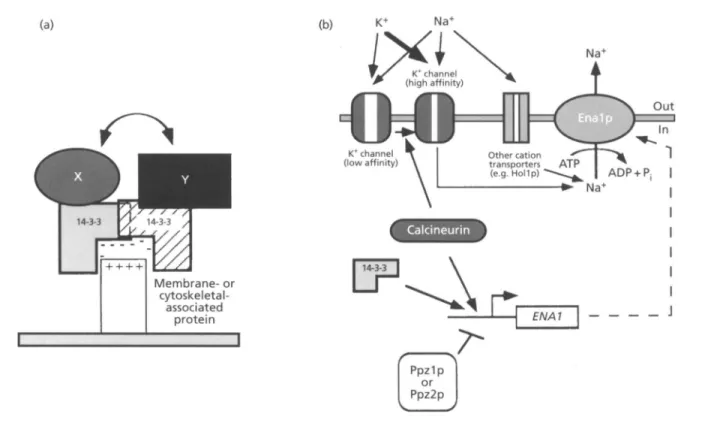
e t al., 1994; Aitken, 1995). This family of acidic proteins binds and possibly regulates diverse protein kinases (e.g. protein kinase C and Raf, a mammalian homologue of MAPKKK), whereas other 14-3-3 isotypes participate in DNA-binding complexes in plants (Ferl e t al., 1994; Aitken, 1995). With the recent elucidation of the structure of the 14-3-3 dimers, it became clear that these poly- peptides may act as 'adapter' proteins (Liu e t al., 1995; Xiao et al., 1995). The formation of either hetero- or homodimers may bring together different regulatory proteins, allowing a productive interaction between the enzyme (kinase or phosphatase) and the protein substrate (Fig. 3a; Jones et al., 1995). Moreover, the negatively charged pocket formed by the 14-3-3 dimer may associate with cytoskeleton- and membrane-bound proteins,
anchoring the multiprotein complex to a circumscribed location in the cell (Jones e t al., 1995). As to the yeast 14- 3-3 homologues Bmhlp and Bmh2p (van Heusden e t al., 1992, 1995), it is as yet not clear whether their function is related to regulation of protein kinases/phosphatases or direct interaction with the transcriptional machinery. Notably, we have recently found that disruption of either
BMHI or BMH2 causes a Na+- and Li+-sensitive pheno- type (J. C. S. Varela and others, unpublished results). The intolerance to these ions however appeared not to be due to a general osmotic defect, suggesting that the response to high salt is more complex than a simple osmoregulatory process (see below).
Sensing of and responding to sodium stress
Upon transfer to high salt (NaCl), the toxic Na+ ions enter the cell via the yeast K+ channels (encoded by TRKI and
TRK2) and probably via other cation transporters (e.g.
H O L I ; Fig. 3b; Rodriguez-Navarro & Ramos, 1984; Gaber et al., 1988, 1990; KO e t al., 1990; Wright e t al., 1996). The toxicity of Na+ to the yeast cell may be due to the interference of this ion with cellular processes that require Kf (Haro et al., 1993). Indeed, overexpression of genes (e.g. H A L I ) improving the K+/Na+ ratio appear to enhance salt tolerance (Gaxiola et al., 1992).
In order to prevent extensive uptake of Na+, the K+ transport system shifts from a low-affinity to a high- affinity state in NaC1-containing media (Fig. 3b; Rodriguez-Navarro & Ramos, 1984; Haro e t al., 1993). This shift in the affinity to K+ is determined by Trklp, whereas Trk2p seems to be exclusively required for the low-affinity mode (Gaber etal., 1988; KO etal., 1990). The excess of Na+ ions which have entered the cell are then pumped out by a P-type ATPase encoded by ENAI-
ENA4 (Fig. 3b ; reviewed by Rodriguez-Navarro et al. , 1994). However, only Enalp appears to be salt-responsive (Garciadeblis et al., 1993).
Disruption of TRKI or E N A I confers a non- osmosensitive, Na+-sensitive phenotype (Haro et al. ,1991, 1993 ; Garciadeblis et al., 1993). This hypersensitivity to Na' resembles phenotypes exhibited by calcineurin- deficient strains as well as yeast containing defects in
ERG6, HOLI and the 14-3-3 genes (see above; Gaber et
a]., 1990; Nakamura e t al., 1993; Mendoza et al., 1994;
Welihinda e t al., 1994; Wright e t al., 1996; J. C. S. Varela and others, unpublished results). Calcineurin is a protein phosphatase (type 2B) requiring Ca2+ and calmodulin for enzyme activation. In yeast, calcineurin is a heterodimer consisting of a catalytic subunit, encoded by a pair of homologous genes ( C N A I and CNAZ), and a regulatory subunit, encoded by CNBI (Cyert etal., 1991 ; Kuno etal., 1991; Liu e t al., 1991; Cyert & Thorner, 1992). Calcineurin-deficient (cnb I ) strains are unable to activate
E N A I gene expression (Mendoza e t al., 1994). In addition, cnbl cells fail to shift the K+ uptake system from the low-affinity to the high-affinity state (Mendoza et al., 1994). The recently found salt-hypersensitive phenotype displayed by bmhl null mutant cells also appeared to be correlated with the loss of salt-induction of E N A I (J. C.
Salt response of yeast
Fig. 3. Possible function of the 14-3-3 proteins. (a) 14-3-3 proteins as 'adaptors'. The mammalian 14-3-3 proteins can form homo- and heterodimers (as shown) and associate with several regulatory proteins (depicted as 'X' and 'Y'). The 14-3-3 dimers form a negatively charged pocket, which may bind to membrane- and cytoskeletal-associated proteins. This model reflects the proposed function of the 14-3-3 dimers, not only as an important determinant of the cellular location of regulatory proteins (e.g. the mammalian protein kinase Raf), but also as a scaffold for protein-protein interaction (and regulation) between signalling molecules (adapted from Jones et a/., 1995). (b) Possible function of the yeast 14-3-3 homologues (Bmhlp and BmhZp). In yeast, the 14-3-3 homologue Bmhlp seems to play an important role in the regulation of ENAl gene expression, together with the protein phosphatases calcineurin, Ppzl p and Ppz2p. ENAl encodes a P-type ATPase that pumps the toxic Na+ ions from the cytoplasm back into the medium. Na+ may enter the cell through different cation transporters, such as Hollp and the K+ channels. Upon a shift to high salt, the transport system for K+ shifts from low affinity to high affinity. This event is mediated by calcineurin. So far, it is not known whether the yeast 14-3-3 homologues and calcineurin operate in the same or independent pathways (see text for details). Arrows pointing from and to cations represent ionic fluxes; in all other cases, they indicate positive regulatory interactions.
S. Varela and others, unpublished results). Although epistatic interactions between CNB 1 and BMHI remain to be investigated, these results suggest that calcineurin and the 14-3-3 proteins participate in the regulation of ion homeostasis in yeast (Fig. 3b).
Deregulation of the K' channels or other ion transporters may also account for the increased levels of Na' found in
erg6 and boll cells exposed to high salt (Gaber e t al., 1990; Welihinda et al., 1994). ERG6 encodes a putative
S-
adenosylmethionine-dependent methyltransferase that appears to be essential for the maintenance of suitable levels of ergosterol and other sterols in cell membranes (Welihinda et al., 1994). On the other hand, gain-of- function mutations in H O L 1 result in increased uptake of Na' and other monovalent cations (Gaber e t al., 1990; Wright e t al., 1996). Therefore, it has been suggested that alterations in the structure of ion transporters, either due to mutations in the primary sequence or changes in the lipid composition of cell membranes, may influence the activity and specificity of these transport proteins (Welihinda et al., 1994). This assumption is supported by
the observation that Na' uptake but not Na' efflux is increased in erg6 and boll mutants (Gaber e t al., 1990; Welihinda e t al., 1994).
The importance of exclusion and extrusion of Na' ions for acquisition of NaCl tolerance is further emphasized by the hyper-resistant phenotype exhibited by cells lacking the protein phosphatases Ppzlp and Ppz2p (Posas e t al., 1995b). This enhanced NaCl resistance seems to be the consequence of increased E N A 7 gene expression, resulting in a more efficient efflux of Li', a Na' analogue in transport studies (Rodriguez-Navarro & Ortega, 1982 ; Posas et a/., 1995b). Remarkably, the Ppz protein
phosphatases appear to interact with the PKCl pathway (Lee e t a/., 1993a; Posas e t al., 1995b).
ppx7
ppx2 cells show a lytic defect at 37 "C very similar to that of bck.7,mkk7 mkk2 and mpk7 cells (see above). However, when a
mpk 7 null mutation is combined with a double disruption of PPZ7 and PPZ2, cell lysis occurs at any temperature (Lee e t al., 1993a). This more severe phenotype has been taken to imply that the Ppz phosphatases and Mpklp converge on a common downstream target, though -
J. C. S. V A R E L A a n d W. H. M A G E R
functioning in independent pathways. A possible func- tional link between this MAPK and the Ppz phosphatases is supported by the fact that the NaC1-hyperresistant phenotype caused by the disruption of P P Z l (see above) does not occur in a mpkl genetic background (Posas etal.,
1995b).
Stress tolerance versus growth
Cross-protection and similarities among stress responses
The thermosensitive, NaC1-hyper-resistant phenotype showed by ppxl ppx2 cells is a provocative example that tolerance to a form of stress is not always accompanied by an enhanced survival upon exposure to other stressful conditions. Nevertheless, it is apparent that the yeast responses to heat shock, osmostress and nutrient de- pletion share similarities. Apart from heat shock and osmostress, the heat-shock proteins Hspl2 and Hsp26 and the cytosolic catalase Cttlp are induced by other stresses, such as nutrient depletion (Kurtz e t al., 1786; Praekelt & Meacock, 1770; Varela e t al., 1772, 1775; Marchler e t al., 1973). Similar observations were extended to HSP104, D D R 2 and TPS2 (Gounalaki & Thireos, 1774; Schuller e t al., 1774). Hspl04 is a highly conserved stress-inducible protein, which, apparently by catalysing an ATPase-driven protein re-folding (Parsell et a/., 1974),
is protective against several severe forms of stress (Sanchez e t al., 1772). The heat-responsive Ddr2p and Tps2p, on the other hand, accumulate upon exposure to DNA-damaging reagents and entry into stationary phase, respectively (Kobayashi & McEntee, 1773; Vuorio e t a/.,
1993 ; Gounalaki & Thireos, 1774). Interestingly, the latter protein has been identified as one of the three subunits of the trehalose synthase/phosphatase complex (De Virgilio et al., 1793; Vuorio e t al., 1773). The stress- inducibility of TPS2 is in keeping with enhanced trehalose levels in heat-shocked cells, stationary-phase cells and cells growing on high-salt media (Wiemken, 1770; Andre
e t al., 1791) and the proposed protective effect of this carbohydrate on membranes and proteins (Wiemken, 1990; Hottiger et al., 1774; Iwahashi e t al., 1775). The overlap among stress responses is often confirmed by the observation that previous exposure to a stress increases tolerance against a challenge by another form of stress (Mager & Moradas Ferreira, 1773). Two factors may contribute to this cross-protection, namely (i) the existence of common transcriptional regulatory mech- anisms, such as cis-acting elements responsive to a broad range of stressful conditions (STREs; Mager & De Kruijff, 1775); and (ii) the interplay between the pro- liferative state of the cell and stress tolerance (see below).
Nutrient signalling, growth control and stress tolerance
For an organism to survive successfully, a tight control between growth and response to (osmo)stress must be accomplished. Initiation of growth in media lacking essential nutrients is lethal (Granot & Snyder, 1771). This
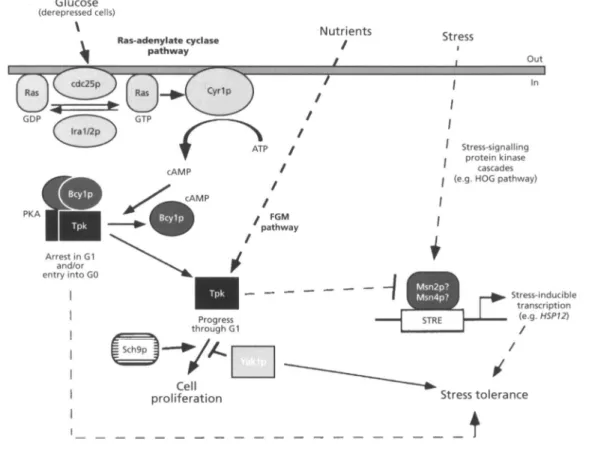
is further demonstrated by the rapid loss of viability and the extreme stress-sensitivity of mutants failing to arrest at the G1 phase of the cell cycle upon nutrient starvation (e.g. Thompson-Jaeger e t al., 1791). It is evident by now that the RAS-adenylate cyclase pathway plays a major part in the nutrient regulation of enzyme activities and gene expression in yeast (reviewed by Thevelein, 1774). It could be argued, therefore, that CAMP signals nutrient availability and regulates cell proliferation as well as acquisition of stress tolerance (Costigan & Snyder, 1774 ; Engelberg e t al., 1774). On the other hand, since the Ras- adenylate cyclase pathway is repressed by glucose, it has been suggested that in cells grown on rapidly fermentable sugars an alternative pathway, referred to as the fermentable-growth-medium (FGM)-induced pathway, is operative (Fig. 4; Thevelein, 1774).
How nutrient signalling is translated into control of cell proliferation and/or acquisition of tolerance to (osmo)stress is largely unknown. However, there is evidence suggesting that protein phosphorylation by PKA and other nutrient-signalling pathways regulate not only growth-related processes but also the response of yeast to several forms of stress. That PKA may play a role in integrating growth control with stress (cross-)pro- tection is strengthened by the finding that high PKA activity reduces or abolishes transcriptional activation of several stress-inducible genes (Boorstein & Craig, 1770 ; Praekelt & Meacock, 1770; Marchler e t al., 1773 ; Varela
e t al., 1775). This negative effect is apparently exerted on the CCCCT-motif (Marchler e t al., 1773; Varela e t al.,
1775). Repression is only relieved upon stress by ac- tivation of stress-sensing pathways, such as the HOG pathway (Schuller e t al., 1774 ; Varela e t al., 1775), and/or by the failure of activating nutrient-sensing pathways, such as the FGM pathway (see Thevelein, 1774). Recent genetic evidence suggests that the antagonistic effects of PKA and the HOG pathway converge on a common cellular target (Schuller e t al., 1774). An attractive model predicts that this common target corresponds to the STRE-binding factor(s) (Fig, 4). The identification of Msn2p and Msn4p as STRE-binding proteins (see above) may soon address the validity of the proposed model. Convergence of pathways on PKA cellular targets is not restricted to the HOG pathway. Epistasis studies have indicated that the protein kinases Yaklp and Sch7p and the catalytic subunits of PKA may phosphorylate over- lapping targets (Fig. 4; Hartley e t al., 1974). Evidence exists suggesting that Sch7p, Yaklp and PKA operate in independent pathways and that Sch9p and PKA effects on cell proliferation are counteracted by Yaklp. Interestingly, overexpression of YAK1 enhances tol- erance to heat shock in wild-type cells (Hartley et al.,
1974). Although the mechanism for this increase in stress tolerance is yet to be understood, it highlights once more the link between a slow-growing or non-proliferative physiological state (growth control) and resistance to stress (Fig. 4).
A final example of an interaction between PKA and a stress-responsive pathway is provided by the caffeine-
Salt response of yeast
... ... ... . ... . ... . ...
Fig. 4. Growth control and stress tolerance. Addition of glucose to derepressed cells activates the Ras-adenylate cyclase pathway (Thevelein, 1994). During this transition period from respiration to fermentation, cdc25p stimulates the exchange of GDP for GTP on the Ras proteins. This exchange is negatively regulated by lralp and Ira2p. The GTP-bound form of Ras activates Cyrlp (= adenylate cyclase), producing a transient cAMP peak. The rise in cAMP levels leads to release of the catalytic PKA subunits (encoded by three functionally redundant genes, TPK1, TPK2 and TPK3) from the CAMP-bound form of Bcylp. The Tpk catalytic subunits are then able to phosphorylate their cellular targets. The Ras- adenylate cyclase pathway is repressed by glucose. It has therefore been postulated that an alternative signal transduction pathway, the fermentable-growth-medium (FGM)-induced pathway, signals nutrients in glucose-grown cells. According to this model, basal levels of cAMP in cells fermenting glucose may permit the activation of the free catalytic subunits (Tpk) of protein kinase A (PKA) by a component of the FGM pathway. Activation of PKA by nutrients stimulates mitosis (progress through the G1 phase of the cell cycle) and cell growth and represses the expression of stress genes. On the other hand, stressful conditions activate stress-signalling pathways (e.g. HOG pathway), stimulating transcription of stress-inducible genes and overcoming the negative effect exerted by PKA. PKA activity and stress tolerance are apparently modulated by other protein kinases (e.g. Yak1 p) and phosphatases (Ppzl p and PpzZp?) (see text for details).
sensitive phenotype ofpppl ppx2 cells (Posas e t al., 1993). Caffeine is a known inhibitor of cAMP phospho- diesterases, mimicking mutations that result in high PKA activity (Parsons e t al., 1988). A possible interaction between Ppzlp/Ppz2p and PKA is further supported by the ability of PKA to phosphorylate Ppzlp in vitro and the hypersensitivity to heat shock shared by
pppI
ppp2 andb y 1 cells (Toda e t al., 1987; Posas et al., 1993, 1995a). As a result, it has been suggested that the Ppz phosphatases may offset the effect of PKA phosphorylation and that PKA may regulate the activity of these phosphatases (Posas e t al., 1993, 1995a). The significance of this postulate concerning the role of Ppzlp/Ppz2p in the acquisition of NaCl tolerance is as yet unclear (see above). It should be noted, however, that the caffeine-sensitivity ofppp Ippp2 cells can be suppressed by osmotic stabilizers, a phenotype associated with mutations in the PKCI
pathway (see above). On the other hand, Epstein & Cross
(1994) and Di Como et al. (1995) have shown that BCK2,
a multicopy suppressor ofpkcl and mpk7 lytic phenotype (Lee e t al., 1993a), regulates CLNI and CLN2 gene expression. Interestingly enough, Bck2p seems to operate in the same pathway as the Ppz phosphatases (Lee e t al.,
1993a), thereby providing another indication that yeast integrates the regulation of cell morphogenesis and cell cycle with the acquisition of stress tolerance.
Ca2+ signalling: a novel determinant of cell proliferation and stress tolerance 7
Although nutrient signalling via PKA appears to be a key event for the modulation of the different stress responses, it is increasingly obvious that Ca2+ intracellular levels [see model (i)] may influence cell proliferation and stress tolerance as well (Cunningham & Fink, 1994b). Indeed, activation of calcineurin by Ca2+ and calmodulin (a Ca2+-
J. C. S. V A R E L A a n d W. H. M A G E R
binding protein) appears to negatively regulate cell growth (Cunningham & Fink, 1994a). This negative effect may be modulated by the PKCl pathway, a MAPI< cascade presumably activated by Ca2+ (see above). This idea is supported by the lethality of the pkcl and mpkl
growth defects in a calcineurin-deficient strain and the suppression of the pkcl and mpkl lytic phenotype by a
constitutively active calcineurin (Garrett-Engele e t al., 1995). Moreover, calmodulin and the calmodulin-de- pendent protein kinase I1 have recently been shown to be required for induced thermotolerance (Iida e t al., 1995).
Final remarks
Although different stresses elicit different cellular responses in order to ensure survival and adaptation to the new growth conditions, a few common themes are observed. Firstly, protein kinase cascades, MAPK cascades in particular, are used to signal diverse forms of stress in yeast and mammals. Secondly, these cascades may also be responsive to growth-related stimuli, such as nutrients or growth factors. Thirdly, transcriptional regulation of stress-inducible genes may be mediated by a closely related family of transcription factors binding to the CCCCT motif (STRE), in conjunction with the previously described heat-shock transcription factor. Finally, it is apparent that an overlap between growth- related cellular processes and response to stress occur and that PKA, among other protein kinases and phosphatases, plays a central role in signal integration.
This interplay between growth control and stress tol- erance is not surprising if one considers that the main goal of a stress response is adaptation to and growth under different, though potentially lethal, environmental con- ditions. Whether the response to stress (e.g. activation of stress-inducible genes) is due to the activation of stress- responsive pathways and/or the failure to activate pathways sensing favourable growth conditions (e.g. FGM pathway) remains unclear. A major role for both mechanisms in regulating growth and stress tolerance is a likely possibility. Further developments in the field, such as the characterization of the STRE-binding factor(s) and the pathways interacting with these transcription factors, will be crucial to understand how the equilibrium between growth and stress tolerance is achieved.
Acknowledgements
The authors are indebted to Professor Rudi J. Planta and D r J.G. Griffioen for critically reading the manuscript. Our own experimental work referred to in this article was financially supported by the Junta Nacional de Investigasao Cientifica e Tecnol6gica (Portugal) through a grant to J. C. S. V.
References
Aitken, A. (1995). 14-3-3 proteins on the MAP. Trends Biochem Sci 20, 95-97.
Albertyn, J., Hohmann, S., Thevelein, J. M. & Prior, B. A. (1994). GPD 1 , which encodes glycerol-3-phosphate dehydrogenase, is essential for growth under osmotic stress in Saccharomyces cerevisiae, and its expression is regulated by the high-osmolarity glycerol reponse pathway. Mof Cell Biof 14, 4135-4144.
Andr6, L., Hemming, A. & Adler, L. (1991). Osmoregulation in Saccharomyces cerevisiae. Studies on the osmotic induction of glycerol production and glycerol 3-phosphate dehydrogenase (NAD+). FEBS Lett 286, 13-17.
Blomberg, A. & Adler, L. (1992). Physiology of osmotolerance in fungi. Adv Microbiof Pbysiof 33,143-212.
Blumer, K. J. & Johnson, G. L. (1994). Diversity in function and regulation of MAP kinase pathways. Trends Biochem Sci 19,236-240. Boorstein, W. R. & Craig, E. A. (1990). Regulation of a yeast HSP70 gene by a CAMP responsive transcriptional control element. EMBO Brewster, 1. L., de Valoir, T., Dwyer, N. D., Winter, E. & Gustin, M. C. (1993). An osmosensing signal transduction pathway in yeast. Science 259,176&1763.
Cano, E. & Mahadevan, L. C. (1995). Parallel signal processing among mammalian MAPKs. Trends Biochem Sci 20, 117-122. Costigan, C. & Snyder, M. (1994). SLK1, a yeast homolog of MAP kinase activators, has a RAS/cAMP-independent role in nutrient sensing. Mof b Gen Genet 243, 286-296.
Costigan, C., Gehrung, S. & Snyder, M. (1992). A synthetic lethal screening identifies SLKl, a novel protein kinase homolog implicated in yeast cell morphogenesis and cell growth. Mof Ceff Csonka, L. N. (1989). Physiological and genetic responses of bacteria to osmotic stress. Microbiof Rev 53,121-147.
Csonka, L. N. & Hanson, A. D. (1991). Prokaryotic osmoregulation. Genetics and physiology. Annu Rev Microbiof 45, 569-606. Cunningham, K. W. & Fink, G. R. (1994a). Calcineurin-dependent growth control in Saccharomyces cerevisiae mutants lacking PMC1, a homolog of plasma membrane Ca2+ ATPases. J Cell Biol 124, Cunningham, K. W. & Fink, G. R. (1994b). Ca2+ transport in Saccharomyces cerevisiae. J Exp Biofl96, 157-1 66.
Cyert, M. 5. & Thorner, 1. (1992). Regulatory subunit ( C N B I gene product) of yeast Ca2+/calmodulin-dependent phosphoprotein phosphatases is required for adaptation to pheromone. Mof Cell Biof Cyert, M. S., Kunisawa, R., Kaim, D. &Thorner, 1. (1991). Yeast has homologs ( C N A I and C N A Z gene products) of mammalian calcineurin, a calmodulin-regulated phosphoprotein phosphatase. Proc Natf Acad Sci U S A 88, 7376-7380.
De Virgilio, C., BUrckert, N., Bell, W., JenU, P., Boller, T. & Wiemken, A. (1993). Disruption of TPSZ, the gene encoding the 100-kDa subunit of the trehalose-6-phosphate synthase/ phosphatase complex in Saccharomyces cerevisiae, causes accumulation of trehalose 6-phosphate and loss of trehalose 6-phosphate phos- phatase activity. Eur J Biochem 212, 315-323.
Di Como, C. J., Chang, H. & Arndt, K.T. (1995). Activation of CLNI and CLNZ G1 cyclin gene expression by BCKZ. Mol Cell Biof 15, 1835-1846.
Dubois, M.-F. & Bensaude, 0. (1993). MAP kinase activation during heat shock in quiescent and exponentially growing mam- malian cells. FEBS Lett 324, 191-195.
Engelberg, D., Zandi, E., Parker, C. 5. & Karin, M. (1994). The yeast and mammalian Ras pathways control transcription of heat shock genes independently of heat shock transcription factor. Mol Cell Biof Epstein, C. B. & Cross, F. R. (1994). Genes that bypass the C L N requirement for Saccharomyces cerevisiae cell cycle START. Mof Cell Estruch, F. & Carlson, M. (1993). Two homologous zink finger J 9,2543-2553. Biof 12, 1162-1178. 351 -363. 12, 3460-3469. 14, 4929-4937. Bi0ll4, 2041-2047.
Salt response of yeast genes identified by multicopy suppression in a SNFl protein kinase
mutant of Saccbaromyces cerevisiae. Mof Cell Biof 13, 3872-3881. Ferl, R. J., Lu, G. & Bowen, B. W. (1994). Evolutionary implications of the family of 14-3-3 brain protein homologs in Arabidopsis tbaliana. Genetica 92, 129-1 38.
Gaber, R. F., Styles, C. A. & Fink, G. R. (1988). TRKl encodes a plasma membrane protein required for high-affinity potassium transport in Saccbaromyces cerevisiae. Mof Cell Biof 8, 2848-2859. Gaber, R. F., Kielland-Brandt, M. C. & Fink, G. R. (1990). HOLI mutations confer novel ion transport in Saccbaromyces cerevisiae. Mof Cell Biof 10, 643-652.
Galcheva-Gargova, Z., Derijard, B., Wu, LH. & Davis, R. J. (1994). An osmosensing signal transduction pathway in mammalian cells. Science 265, 806-808.
Garciadeblds, B., Rubio, F., Quintero, F. J., BaAuelos, M. A., Haro, R. & Rodriguez-Navarro, A. (1993). Differential expression of two genes encoding isoforms of the ATPase involved in sodium efflux in Saccbaromyces cerevisiae. Mof 0 Gen Genet 236, 363-368.
Garrett-Engele, P., Moilanen, B. & Cyert, M. 5. (1995). Calcineurin, the Ca2+/calmodulin-dependent protein phosphatase, is essential in yeast mutants with cell integrity defects and in mutants that lack a functional vacuolar H+-ATPase. Mof Cell Bid 15, 410341 14. Gaxiola, R., de Larrinoa, 1. F., Villalba, 1. M. & Serrano, R. (1992). A novel and conserved salt-induced protein is an important determinant of salt tolerance in yeast. EMBO J 11, 3157-3164. Gounalaki, N. & Thireos, G. (1994). Yaplp, a yeast transcriptional activator that mediates multidrug resistance, regulates the metabolic stress response. EMBO J 13, 4036-4041.
Granot, D. & Snyder, M. (1991). Glucose induces CAMP-in- dependent growth-related changes in stationary-phase cells of Saccbaromyces cerevisiae. Proc N a t f Acad Sci U S A 88, 5724-5728. Gustin, M. C., Zhou, X.-L., Martinac, B. & Kung, C. (1988). A mechanosensitive ion channel in the yeast plasma membrane. Science Gustin, M. C, Davenport, K. & Sohaskey, M. (1995). Osmosensing signal transduction pathways. Yeast 11, S17.
Han, J., Lee, J.-D., Bibbs, L. & Ulevitch, R. J. (1994). A MAP kinase targeted by endotoxin and hyperosmolarity in mammalian cells. Science 265, 808-81 1.
Haro, R., Garciadeblds, B. & Rodrlguez-Navarro, A. (1991). A novel P-type ATPase from yeast involved in sodium transport. FEBS Lett 291, 189-191.
Haro, R., Bafiuelos, M. A., Quintero, F. J., Rubio, F. & Rodrlguez- Navarro, A. (1993). Genetic basis of sodium exclusion and sodium tolerance in yeast. A model for plants. Pbysiof Plant 89, 868-874. Hartley, A. D., Ward, M. P. & Garrett, S. (1994). The Yak1 protein kinase of Saccbaromyces cerevisiae moderates thermotolerance and inhibits growth by an Sch9 protein-kinase-independent mechanism. Genetics 136, 465-474.
Herskowitz, I. (1995). MAP kinase pathways in yeast: for mating and more. Cell 80, 187-197.
van Heusden, G. P. H., Wenzel, T. J., Langedijk, E. L., Steensma, H. Y. & van der Berg, 1. A. (1992). Characterization of the yeast BMHl gene encoding a putative protein homologous to mam- malian protein kinase I1 activators and protein kinase C inhibitors. FEBS Lett 302, 145-150.
van Heusden, G. P. H., Griffiths, D. 1. F., Ford, 1. C., Chin-A- Woeng, T. F. C., Schrader, P. A. T., Carr, A. M. & Steensma, H. Y. (1995). The 14-3-3 proteins encoded by the BMHl and BMHZ genes are essential in the yeast Saccbaromyces cerevisiae and can be replaced by a plant homologue. Ear J Biocbem 229, 45-53. 242, 762-765.
Hottiger, T., De Virgilio, C., Hall, M. N., Boller, T. & Wiemken, A. (1994). The role of trehalose synthesis for the acquisition of thermotolerance in yeast. 11. Physiological concentrations of trehalose increase the thermal stability of proteins in vitro. Etlr J
Biocbem 219, 187-1 93.
Hughes, D. A. (1994). Histidine kinases hog the limelight. Nattlre lida, H., Ohya, Y. & Anraku, Y. (1995). Calmodulin-dependent protein kinase I1 and calmodulin are required for induced thermotolerance in Saccharomyces cerevisiae. Ctlrr Genet 27, 190-1 93. Irie, K., Takase, M., Lee, K. L., Levin, D. E., Araki, H., Matsumoto, K. & Oshima, Y. (1993). MKKI and MKKZ, which encode Saccbaromyces cerevisiae mitogen-activated protein kinase-kinase homologs, function in the pathway mediated by protein kinase C. Mol Cell Biof 13, 3076-3083.
Iwahashi, H., Obuchi, K., Fujii, 5. & Komatsu, Y. (1995). The correlative evidence suggesting that trehalose stabilizes membrane structure in the yeast Saccbaromyces cerevisiae. Cell Mof Biof 41, Jones, D. H., Ley, 5. & Aitken, A. (1995). Isoforms of 14-3-3 protein can form homo- and heterodimers in vivo and in vitro: implications for function as adapter proteins. FEBS Lett 368, 55-58.
Kamada, Y., lung, U. S., Piotrowski, J. & Levin, D. E. (1995). The protein kinase C-activated MAP kinase pathway of Saccharomyces cerevisiae mediates a novel aspect of the heat shock response. Genes & Dev 9, 1559-1571.
KO, C. H., Buckley, A. M. & Gaber, R. F. (1990). TRKZ is required for low affinity K+ transport in Saccbaromyces cerevisiae. Genetics 125, Kobayashi, N. & McEntee, K. (1993). Identification of cis and trans components of a novel heat shock stress regulatory pathway in Saccbaromyces cerevisiae. Mof Cell Biof 13, 248-256.
Kosako, H., Nishida, E. & Gotoh, Y. (1993). cDNA cloning of MAP kinase kinase reveals kinase cascade pathways in yeasts to vertebrates. EMBO J 12, 787-794.
Kuno, T., Tanaka, H., Mukai, 1. C., Chang, C., Hiraga, K., Miyakawa, T. & Tanaka, C. (1991). cDNA cloning of a calcineurin B homolog in Saccbaromyces cerevisiae. Biocbem Biopbys Res Commtln Kurtz, S., Rossi, J., Petko, L. & Lindquist, 5. (1986). An ancient developmental induction : heat-shock proteins induced in sporu-
lation and oogenesis. Science 231, 1154-1 157.
Lange-Carter, C. A., Pleiman, C. M., Gardner, A. M., Blumer, K. J. & Johnson, J. L. (1993). A divergence in the MAP kinase regulatory network defined by MEK kinase and Raf. Science 260, 315-319. Latterich, M. & Watson, M. D. (1992). Isolation and charac- terization of osmosensitive vacuolar mutants of Saccbaromyces cerevisiae. Mol Microbiof 5, 241 7-2426.
Lee, K. & Levin, D. E. (1992). Dominant mutations in a gene encoding a putative protein kinase (BCK 1) bypass the requirement for a Saccbaromyces cerevisiae protein kinase C homolog. Mof Cell Biof Lee, K., Hines, L. K. & Levin, D. E. (1993a). A pair of functionally redundant yeast genes (PPZI and PPZZ) encoding type 1-related protein phosphatases function within the PKCI-mediated pathway. Mol Cell Bioll3, 5843-5853.
Lee, K., Irie, K., Gotoh, Y., Watanabe, Y., Araki, H., Nishida, E., Matsumoto, K. & Levin, D. E. (199315). A yeast mitogen-activated protein kinase homolog (Mpkl p) mediates signalling by protein kinase C. Mol Cell Biof 13, 3067-3075.
Levin, D. E. & Bartlett-Heubusch, E. (1992). Mutants in the S.
369, 187-1 88. 763-769. 305-31 2. 180, 1159-1163. 12, 172-182. 729
J. C. S. V A R E L A a n d W. H. M A G E R
cerevisiae PKCl gene display a cell-cycle-specific osmotic stability defect. J Cell Biof 116, 1221-1229.
Liu, D., Bienkowska, J., Petosa, C., Collier, R. J., Fu, H. & Liddington, R. (1995). Crystal structure of the zeta isoform of the 14-3-3 protein. Nattlre 376, 191-194.
Liu, Y., Ishii, S., Tokai, M., Tsutsumi, H., Ohke, O., Akada, R., Tanaka, K., Tsuchiya, E., Fukui, F. & Miyakawa, T. (1991). The Saccharomyces cerevisiae genes (CMP 1 and CMP2) encoding calmodulin-binding proteins homologous to the catalytic subunit of mammalian protein phosphatase 2B. Mof 0 Gen Genet227,52-59. Luyten, K., Albertyn, J., Skibbe, F., Prior, B. A., Ramos, J., Thevelein, 1. M. & Hohmann, 5. (1995). Fpsl, a yeast member of the MIP family of channel proteins, is a facilitator for glycerol uptake and efflux and it is interactive under osmotic stress. EMBO Maeda, T., Wurgler-Murphy, S.M. & Saito, H. (1994). A two- component system that regulates an osmosensing MAP kinase cascade in yeast. Nattlre 369, 242-245.
Maeda, T., Takekawa, M. & Saito, H. (1995). Activation of yeast PBS2 MAPKK by MAPKKKs or by binding of an SH3-containing osmosensor. Science 269, 554-558.
Mager, W. H. & De Kruijff, A. 1. J. (1995). Stress-induced trans- criptional activation. Microbiol Rev 59, 506-531.
Mager, W. H. & Moradas-Ferreira, P. (1993). Stress response of yeast. Biochem J 290, 1-13.
Mager, W. H. & Varela, J. C. S. (1993). Osmostress reponse of the yeast J'accharomyces cerevisiae. Mof Microbiof 10, 253-258.
Marchler, G., SchUller, C., Adam, G. & Ruis, H. (1993). A Saccharomyces cerevisiae UAS element controlled by protein kinase A activates transcription in response to a variety of stress conditions. Martln, H., Arroyo, J., Sanchez, M., Molina, M. & Nombela, C. (1993). Activity of the yeast MAP kinase homologue Slt2 is critically required for cell integrity at 37 "C. Mof & Gen Genet 241, Martlnez-Pastor, M. T. & Estruch, F. (1995). The Msn2 and Msn4 zinc finger transcriptional activators are required for the stress- induced expression of the small HSP genes. Yeast 11, S224. Mazzoni, C., Zarzov, P., Rambourg, A. & Mann, C. (1993). The S L T 2 ( M P K I ) MAP kinase homolog is involved in polarized cell growth in Saccharomyces cerevisiae. J Cell Biof 123, 1821-1833. Mendoza, I., Rubio, F., Rodriguez-Navarro, A. & Pardo, J. M. (1994). The protein phosphatase calcineurin is essential for NaCl tolerance of Saccharomyces cerevisiae. J Biof Chem 269, 8792-8796. Nakamura, T., Liu, Y., Hirata, D., Namba, H., Harada, S.-I., Hirokawa, T. & Miyakawa, T. (1993). Protein phosphatase type 2B (ca1cineurin)-mediated, FK506-sensitive regulation of intracellular ions in yeast is an important determinant for adaptation to high salt stress conditions. EMBO J 12, 40634071.
Ota, I. M. & Varshavsky, A. (1993). A yeast protein similar to bacterial two-component regulators. Science 262, 566-569. Paravicini, G., Cooper, M., Friedli, L., Smith, D. J., Carpentier, J.-L., Klig, L. S. & Payton, M. A. (1992). The osmotic integrity of the yeast cell requires a functional PKCl gene product. Mof Cell Biol 12, Parsell, D. A., Kowall, A. S., Singer, M. A. & Lindquist, 5. (1994). Protein disaggregation mediated by heat shock protein Hspl04. Nature 341, 475-478.
Parsons, W. J., Ramkumar, V. & Stiles, G. L. (1988). Isobutyl- methylxanthine stimulates adenylate cyclase by blocking the inhibitory regulatory protein, Gi. Mof Pharmacof 34, 37-41. J 14, 1360-1371.
EMBO J 12, 1997-2003.
177-1 84.
4896-4905.
Posas, F., Casamayor, A. & Ariflo, J. (1993). The PPZ protein phosphatases are involved in the maintenance of osmotic stability of yeast cells. FEBS Lett 318, 282-286.
Posas, F., Bollen, M., Stalmans, W. & Ariflo, J. (1995a). Biochemical characterization of recombinant yeast PPZl , a protein phosphatase involved in salt tolerance. FEBS Lett 368, 39-44.
Posas, F., Camps, M. & AriAo, 1. (1995b). The PPZ protein phosphatases are important determinants of salt tolerance in yeast cells. J Biof Chem 270, 13036-1 3041.
Praekelt, U. M. & Meacock, P. A. (1990). HSP12, a new small heat shock gene of Saccharomyces cerevisiae : analysis of structure, regu- lation and function. Moi & Gen Genet 223, 97-106.
Reed, G. & Nagodawithana, T. W. (1991). Yeast Technology, 2nd edn. New York: Van Nostrand Reinhold.
Rodrlguez-Navarro, A. & Ortega, M. D. (1982). The mechanism of sodium efflux in yeast. FEBS Lett 138, 205-208.
Rodrlguez-Navarro, A. & Ramos, J. (1984). Dual system for potassium transport in Saccharomyces cerevisiae. J Bacteriof 159, Rodrlguez-Navarro, A., Quintero, F. 1. & Garciadeblds, B. (1994). Na+-ATPases and Na+/H+ antiporters in fungi. Biochim Biophys Acta 1187,203-205.
Roemer, T., Paravicini, G., Payton, M. A. & Bussey, H. (1994). Characterization of the yeast (1 + 6)-/3-glucan biosynthetic com-
ponents, Kre6p and Sknlp, and genetic interactions between the PKCl pathway and extracellular matrix assembly. J Cell Biof 127, Rouse, J., Cohen, P., Trigon, S., Morange, M., Alonso-Llamazares, A., Zamanillo, D., Hunt, T. & Nebreda, A. R. (1994). A novel kinase cascade triggered by stress and heat shock that stimulates MAPKAP kinase-2 and phosphorylation of the small heat shock proteins. Cell Ruis, H. & SchUller, C. (1995). Stress signaling in yeast. Bioessqs 17 Sanchez, Y., Taulien, J., Borkovich, K. A. & Lindquist, 5. (1992). Hspl04 is required for tolerance to many forms of stress. E M B O J SchUller, C., Brewster, J. L., Alexander, M. R., Gustin, M. C. & Ruis, H. (1994). The HOG pathway controls osmotic regulation of transcription via the stress response element (STRE) of the Saccharomyces cerevisiae CTTl gene. EMBO J 13, 4382-4389. Shimizu, J., Yoda, K. & Yamasaki, M. (1994). The hypo-osmolarity- sensitive phenotype of the Saccharomyces cerevisiae hp02 mutant is due to a mutation in PKCI, which regulates expression of /3-glucanase. Mof b Gen Genet 242, 641-648.
Shiozaki, K. & Russell, P. (1995). Counteractive roles of protein phosphatase 2C (PP2C) and a MAP kinase kinase homolog in the osmoregulation of fission yeast. EMBO J 14, 492-502.
Terada, Y., Tomita, K., Homma, M. K., Nonoguchi, H., Yang, T., Yamada, T., Yuasa, Y., Krebs, E. G., Sasaki, 5. & Marumo, F. (1 994). Sequential activation of Raf-1 kinase, mitogen-activated protein (MAP) kinase kinase, MAP kinase, and S6 kinase by hyperosmolarity in renal cells. J Biol Chem 269, 31296-31301. Thevelein, 1. M. (1994). Signal transduction in yeast. Yeast 10, Thompson-Jaeger, S., Frangois, J., Gaughran, 1. P. & Tatchell, K. (1991). Deletion of S N F l affects the nutrient response of yeast and resembles mutations which activate the adenylate cyclase pathway. Genetics 129, 697-706.
Toda, T., Cameron, S., Sass, P., Zoller, M., Scott, 1. D., McMullen, B., Hurwitz, M., Krebs, E. G. & Wigler, M. (1987). Cloning and 940-945. 567-579. 78, 1027-1037. 959-965. 11, 2357-2364. 1753-1790.
Salt response of yeast chracterization of B C Y l , a locus encoding a regulatory subunit of
the cyclic AMP-dependent protein kinase in Saccbaromyces cerevisiae. Moi Cell Bioi 7, 1371-1 377.
Torres, L., Martin, H., Garcla-Saez, M. I., Arroyo, J., Molina, M., Sanchez, M. & Nombela, C. (1991). A protein kinase gene complements the lytic phenotype of Saccbaromyces cerevisiae 4t2 mutants. Moi Microbioi 5, 2845-2854.
Varela, J. C. S., van Beekvelt, C. A., Planta, R. 1. & Mager, W. H. (1992). Osmostress-induced changes in yeast gene expression. Moi
Microbiol6, 21 83-2190.
Varela, J. C. S., Praekelt, U. M., Meacock, P. A., Planta, R. J. & Mager, W. H. (1995). The Saccbaromyces cerevisiae H S P l 2 gene is activated by the high-osmolarity glycerol pathway and negatively regulated by protein kinase A. Moi Cell Bioi 15, 6232-6245. Vuorio, 0. E., Kalkkinen, N. & Londesborough, 1. (1993). Cloning of two related genes encoding the 56-kDa and 123-kDa subunits of trehalose synthase from the yeast Saccbaromyces cerevisiae. Etrr J Biocbem 216, 849-861.
Welihinda, A. A., Beavis, A. D. & Trumbly, R. J. (1994). Mutations in L I S l (ERG6) gene confer increased sodium and lithium uptake in Saccbaromyces cerevisiae. Biocbim Bioph_ys Acta 1193, 107-1 17.
Wiemken, A. (1990). Trehalose in yeast, stress protectant rather than reserve carbohydrate. Antonie Leeuwenhoek 58, 209-21 7. Wright, W. B., Howell, E. A. & Gaber, R. F. (1996). Gain-of- function mutations in the H O L 1 gene of Saccbaromyces cerevisiae confer non-selective cation transport and abolish translational repression by a small upstream open reading frame. Mol Cell Bioi (in p re s s)
.
Xiao, B., Smerdon, 5. J., Jones, D. H., Dodson, G. G., Soneji, Y., Aitken, A. & Gamblin, 5. J. (1995). Structure of a 14-3-3 protein and implications for coordination of multiple signalling pathways. Nattrre 376, 188-1 94.
Yoshida, S., Ohya, Y., GOebl, M., Nakano, A. & Anraku, Y. (1994a). A novel gene, STT4, encodes a phosphatidylinositol4-kinase in the P K C l protein kinase pathway of Saccbaromyces cerevisiae. J Bioi Cbem Yoshida, S., Ohya, Y., Nakano, A. & Anraku, Y. (1994b). Genetic interactions among genes involved in the STT4-PKCl pathway of Saccbaromyces cerevisiae. Mol 6- Gen Genet 242, 631-640.
Yoshida, S., Ohya, Y., Hirose, R., Nakano, A. & Anraku, Y. (1995). STT10, a novel class-D V P S yeast gene required for osmotic integrity related to the P K C l I S T T l protein kinase pathway. Gene
269, 1166-1172.
160, 1 17-1 22.