outubro de 2013
João Miguel de Jesus Mendes Gomes
Patterns of affect in the daily life of
adolescent alcohol users and non
-users:
a sample week
Universidade do Minho
Escola de Psicologia
Dissertação de Mestrado
Mestrado em Psicologia,
Área de especialização em Psicologia Clínica e da Saúde
Trabalho realizado sob orientação da
Professora Doutora Teresa Freire
outubro de 2013
João Miguel de Jesus Mendes Gomes
Patterns of affect in the daily life of
adolescent alcohol users and non-users:
a sample week
Universidade do Minho
Escola de Psicologia
DECLARAÇÃO
Nome: João Miguel de Jesus Mendes Gomes
Endereço electrónico: [email protected] Telefone: 933 634 961
Número do Cartão de Cidadão: 11939952
Título da Dissertação: Patterns of affect in the daily life of adolescent alcohol users and
non-users: a sample week
Orientador: Prof. Doutora Teresa Freire
Ano de conclusão: 2013
Designação do Mestrado: Mestrado em Psicologia, área de especialização em Psicologia
Clínica e da Saúde
É AUTORIZADA A REPRODUÇÃO INTEGRAL DESTA DISSERTAÇÃO APENAS PARA EFEITOS DE INVESTIGAÇÃO, MEDIANTE DECLARAÇÃO ESCRITA DO INTERESSADO, QUE A TAL SE COMPROMETE;
Universidade do Minho, ___/___/______
Index Agradecimentos……….……….………..iii Resumo………..………iv Abstract………..………v 1. Introduction ………...6 1.1 Positive Health ………....7
1.2 Alcohol and Adolescents ……….………7
1.3 Affect ………...………....8
1.4 Affect, days of the week and the weekend ………10
1.5 Experience Sampling Method ………...………10
2. Method: ………...11
2.1 Participants……….………....11
2.2 Measures……….…………....12
2.2.1 Experience Sampling………...………....12
2.2.2 Questionnaire for the evaluation of patterns of alcohol use …...13
2.3 Procedure ………...13
2.4 Design and data analysis ………...………14
3. Results ………....15
3.1 Compliance ……….………...15
3.2 Factor analysis and internal consistency ………...………15
3.3 Patterns of affect across the week ……….………16
3.3.1 Week overview ………...………17
3.2.2 A deeper insight: weekdays vs weekend ………17
4. Discussion ………...20
5. References ………...………...23
Agradecimentos
Uma palavra de profunda gratidão, à Prof. Doutora Teresa Freire, aos colegas do Grupo de Investigação em Funcionamento Óptimo,
a todos os participantes do estudo, aos meus colegas de trabalho e à Delegação de Braga da Cruz Vermelha Portuguesa, a toda a minha família e amigos, em particular aos meus pais, José e Célia e à minha irmã Clarisse,
à Susana, minha mulher. Sem o vosso apoio, incentivo, presença e carinho não teria sido possível.
Padrões de afeto na vida diária de adolescents consumidores e não consumidores de álcool: uma semana tipo
Resumo
Partindo de uma perspetiva positiva da psicologia, este estudo lança um olhar sobre o fenómeno do consumo de álcool entre os jovens. Teve como objetivo compreender os padrões de afeto positivo e negativo ao longo de uma semana de um grupo de adolescentes que relataram consumir álcool (consumidores) e não consumir álcool (não-consumidores). 142 estudantes a frequentarem a escola secundária (10º, 11º e 12º ano), de ambos os sexos (rapazes=65; raparigas=77), com idades compreendidas entre os 14 e os 23 anos, participaram no estudo. Os dados foram recolhidos fazendo uso do Experience Sampling Method e de um questionário de avaliação dos padrões de consumos. Olhámos para as diferenças significativas no afeto de consumidores e não consumidores nos diversos dias da semana e do impacto do fim de semana na sua experiência afetiva.
Os resultados apontam para a existência de diferenças significativas ao nível do afeto positivo e negativo entre dias da semana vs fim de semana. Os não consumidores mostram níveis de afeto negativo menores ao fim de semana e níveis de afeto positivo maiores quando comparados com os seus pares consumidores. Não foram encontrados resultados significativos entre os grupos ou os dias da semana quando analisada a semana como um todo. Os resultados são discutidos em termos da importância de promover trajetórias positivas e contribui para o desenvolvimento de estilos de vida saudáveis e comportamentos preventivos.
Palavras-chave: afeto positivo, afeto negativo, consumo de álcool, experience sampling,
adolescentes
Patterns of affect in the daily life of adolescent alcohol users and non-users: a sample week
Abstract
Drawing from a positive perspective on psychology, this study sheds light into the phenomena of alcohol abuse among adolescents. It aimed at understanding the patterns of positive and negative affect over a normal and full week of a group of adolescents that report using alcohol (users) and not using alcohol (non-users). 142 students attending secondary school (10th, 11th and 12th grades), both males (n=65) and females (n=77), aged between 14 to 23 years old, participated in the study. Data was drawn making use of the Experience Sampling Method and a questionnaire for the evaluation of patterns of alcohol use. We look at significant differences in affect between users and non-users from one day of the week to the other and draw a close look into the impact of the weekend in their emotional experience.
Results showed significant differences in positive and negative affect between
weekdays vs weekend pointing to a weekend effect. Non-users show lower levels of negative affect over the weekend and higher levels of positive affect as compared to their user peers. No significant results were found between groups or days when considering the week as a whole. Results are discussed in terms of the importance of bringing about positive
development trajectories and contributes to the development of healthier life-styles and preventive behaviours.
Keywords: positive affect, negative affect, alcohol use, experience sampling, adolescents
6
1. Introduction
The present study sheds light into the phenomena of alcohol abuse among adolescents. It integrates the purpose of Health Psychology by trying to understand the factors that influence a better health of an individual and a positive evaluation of one's life (Teixeira, 2004) as well as its impact on a healthy and thriving society. There is also a conscious effort of contributing for the development of healthier life-styles and preventive behaviours, especially in what concerns alcohol use among the younger population.
Drawing from a positive perspective on psychology, this study is embedded in a wider research group coordinated by Teresa Freire focusing on Optimal Functioning, through which, knowledge on positive development, as well as substance abuse, have been given especial attention (Fonte, 2011; Fonte & Freire, 2008). As we will see in more detail, substance abuse among adolescents, especially alcohol use, has been an issue of prime concern. Drinking typically begins in adolescence and sometimes in childhood (Sarafino, 2008), fact that brings about the importance of understanding this phenomenon as well as the factors that stimulate an optimal functioning and a positive growth, free from substance abuse.
With a topic that allows for a wide range of perspectives there is the need to be specific. Concretely, in this study, we aimed at understanding the patterns of positive and negative affect of the life of a group of adolescents in their everyday life by looking in detail to a full and normal week. Making use of the Experience Sampling Method (Hektner, Schimidt & Csikszentmihalyi, 2007), we aimed at gaining access to the subjective experience of the participants in an ecological context, obtaining data in “real time” as participants experience it at a given moment. With this premise, we draw a close look into two groups: one that did not use alcohol in the previous month of the study and one that did use alcohol, with the objective of understanding if there are any differences in the patterns of affect between adolescents who engaged in drinking behaviour and those who did not. We try also to understand if there are significant differences in the patterns of positive and negative affect from one day of the week to the other and draw a closer look into the impact of the weekend on affect. We later on relate it to the exiting literature and point out concrete aspects on how this information can be used to promote a healthy and positive development.
1.1 Positive Health
As defined in the preamble of the constitution of the World Health Organization, health is
disease or infirmity” (WHO, 1948). Nevertheless, in the last several decades, there has been a clear emphasis on “disease” and “infirmity” rather than on “health” or “well-being”. To improve the lives of children and youth, researchers and practitioners have mainly focused on psychopathology, developing treatment strategies and risk based prevention programs (Park, 2004). However, in the last four decades researchers have increasingly promoted the notion that well-being incorporates positive factors and not just the mere absence of negative factors. Ryff and Singer (2004) call for a renewed emphasis on positive health, arguing that psychological and social well-being are indeed part of health and understanding these factors can lead to positive functioning.
Martin Seligman and Mihaly Csikszentmihalyi (2000) called for a change in focus of analysis in psychology and the rebuilding of theoretical frameworks and approaches. The beginning of the scientific movement of positive psychology has, since then, quickly spread across various scientific domains, both within and outside psychology, making positive approaches quite relevant in scientific fields.
As mentioned, we will focus our attention in the adolescent population who, in line with this trend, have received increasing attention and a renewed interest specially in what concerns the discovery of the factors that promote a positive growth and a healthy development (Lima & Freire, 2009).
1.2 Alcohol and Adolescents
As largely documented by scientific literature, adolescence can be seen as a stage of human development that involves an interaction between biological, cognitive, psychological and socio-cultural factors. This vital developmental period leads from a state of child dependency to a state of adult autonomy that will shape adult life.
Adolescence demands for a continuous adjustment in the family context, in the peer group and in self. As a critical period of development, the experience of risk behaviours can occur. According to Schulenberg, Maggs & Hurrelmann (1997), risk behaviours are an issue that may jeopardize future health and well-being and might include several risk factors, such as, poverty, social withdrawal, harsh temper, drug use, violence, poor eating habits or sexual risk behaviours. According to this definition, and for the purpose of this study, we understood alcohol abuse as youth risk behaviour and will highlight it as such. Nevertheless, it is also important to point out that a great part of the developmental outcomes of adolescents are positive (Carla, 2011).
8
Alcohol use among adolescents has drawn the attention and resources of researchers, public bodies and private organizations in the last decades. From a total of 36 European countries that participated in the European School Survey Project on Alcohol and Other Drugs in 2011, all but Iceland reported at least 70% of students having drunk alcohol at least once during their lifetime, with an average of 87% in the 2011 survey (ESPAD, 2011). The same report points out a concerning 52% of alcohol use among students in the last 30 days from which 22% report having had an episodic heavy drinking in the same period (having five or more drinks on one occasion).
From a broader point of view, when looking at all the psychoactive substances, alcohol is the most used globally, 2 billion people from a total of 6,7 billion (Balsa, 2011). In Portugal, alcohol use is legal and commercially important, being part of the eating habits of the great majority of the population. Moreover, it is often associated with social behaviour, particularly for recreation purposes. Data collected in recent studies challenge this cultural trend. A Portuguese study conducted with 955 individuals in the northern region of the country found that between the ages of 13 to 19 years old, 89% had tried alcohol in the previous year and 69,5% appeared to use it on a monthly basis (Reis et al. 2011). Another study indicates that between 10% to 20% is the prevalence of alcohol related problems in university students, while secondary school students (averaging 16 years of age) report having had a heavy drinking episode in the year previous to the study, as referred in Balsa (2011).
Research shows that individual characteristics are associated with alcohol use. In general, negative affective traits (e.g. negative affect, neuroticism, negative mood regulation expectancies) are most often associated with using alcohol (Simons, et al. 2005). Interestingly, the same authors also defend that positive affective traits can be associated with alcohol using to enhance positive affect. Research shows that drinking episodes are associated with subsequent elevations in negative moods the following week (Hussong et al. 2001). Evidences such as those described above, demand for a deeper insight into the subjective experience of adolescents. A better understanding of the patterns of affect of young people and their inner, emotional world, may help to find strategies to enhance well-being and a positive growth.
1.3 Affect
A literature review on the topic of affect shows there is no real consensus on the definition of the concept (Galinha & Pais-Ribeiro, 2005; Fredrickson, 2002; Cohen & Pressman, 2006). Research on well-being has traditionally included the concept of affectivity as one of its two
constitutive dimensions: cognitive and emotional. While the cognitive dimension involves the conscious evaluation that an individual makes, each moment, of his/her satisfaction with life, the emotional dimension reflects the affect the individual expresses each moment regarding the intensity and prevalence of positive emotions over negative (Galinha & Pais-Ribeiro, 2005; Watson, 2002).
Affect, as the emotional sphere of well-being, emerges in the literature as having two independent and central dimensions: positive affect and negative affect. Specific emotions are considered as combinations of these two basic dimensions. Like Watson (2002) we tend to agree that negative affect represents the extent to which an individual experiences negative emotional states such as fear, anger, sadness, guilt, contempt and disgust; conversely, positive affect reflects the extent to which one experiences positive states such as joy, interest, confidence, and alertness. Importantly, the lack of positive engagement does not necessarily imply negative affect such as anger, anxiety and depression (Cohen & Pressman, 2006).
Emotions are important. It seems that both positive and negative emotions have a clear survival value (Watson, 2002; Fredrickson, 2002). “For instance, fear motivates organisms to escape from situations of potential threat or danger, whereas disgust helps to keep them away from noxious and toxic substances” (p. 106). Positive emotions, on the other hand, move the organisms towards situations that result in pleasure and reward, increasing the probabilities of survival.
Fredrickson (2011; 2002) argues for a theoretical model that places positive emotions as having wide-reaching implications for psychological, social and physical well-being in ways that fuel human flourishing. While negative emotions narrow a person's momentary thought-action repertoire by inducing the individual to act in a particular way: escape, attack, expel, positive emotions broaden people's momentary thought-action repertoire widening the options of thought and action that come to mind. This theory was named by Fredrickson (2002) of Broaden-and-Built Theory of Positive Emotions.
As such, these outcomes of positive emotions, help people to discover and build survival-promoting personal resources: cognitive (ability to mindfully attend to the present moment or come up with multiple pathways toward a goal); psychological (ability to maintain a sense of mastery over the environment challenges); social (ability to give and receive love and social support); and physical (such as the ability to sleep well and ward off the common cold (Fredrickson, 2011). Moreover, Fredrickson (2011; 2002) argues that positive emotions transform people over time by building consequential personal resources that increase overall well-being, but also, by broadening people’s awareness, allow them to step beyond the narrow
10
confines of negativity to explore new situations and ideas. Through this increased openness, positive emotions set people on positive trajectories of growth.
1.4 Affect, days of the week and the weekend
Understanding the context of alcohol consumption is important to prevention and risk-reduction efforts, including understanding patterns of affect throughout the week. Weekends seem to have an important role on well-being. Generally speaking, mood is more positive and less negative on weekends than the rest of the week (Ryan et al., 2010; Helliwell & Wang, 2011). On the other hand, negative affectivity seems to increase on weekdays (Kennedy-Moore et al. 1992). Contemporary psychological research supports the existence of weekly cyclicity in mood. Current findings specifically suggest a weekend effect, whereby mood is more positive and less negative on weekends than the rest of the week (Ryan et al.). This data is relevant having in account that both lower positive affect and higher negative affect seem to predict greater alcohol use (Hussong et al. 2001).
It is necessary a further understanding of the link between certain days of the week and alcohol drinking, but since certain activities, such as school, are associated with certain days of the week, it seems natural to infer that days linked with structured activities are less prone to alcohol use. Finlay at al. (2011) showed in a recent study that within-person associations indicated that, among others, students consumed more alcohol and were more likely to drink heavily on weekends and on days they spend less time, than usual, socializing.
Emotional states are, nevertheless, quite volatile and responsive to environmental conditions (Csikszentmihalyi & Hunter, 2003). That poses a big challenge when trying to understand intra-individual variations in emotional states across the span of a full week. For that we make use of a complex but effective research design.
1.5 Experience Sampling Method (ESM)
This study makes use of the Experience Sampling Method. The choice for this specific research design underlines our effort to use a method that would allow an insight into intra-individual variations during the course of several days. In opposition to one time measures, which would give us only one measure at a given moment, the result is a set of measures that enable a much more comprehensive overview of the subject’s pattern of affect across time. The term “experience-sampling” itself refers to a set of empirical methods that are designed to allow respondents to document their thoughts, feelings, and actions outside the walls of a laboratory and within the context of everyday life (Christensen, T. et all 2003).
When paired with other methods of assessment, ESM may be particularly beneficial to the study of affective states. Scollon et. al (2003) argues that affective components of experience are vulnerable to distortions in memory and so data gathered through ESM have an ecological, on-line validity that is not to neglect. In fact, psychologists can ecologically validate their theoretical concepts and empirical findings in real-life settings (Scollon et al. 2003; Hektner et al. 2007).
One major strength that was underlined by the present study is that, with ESM, researchers are not limited to between-person investigations. This is important because within-person analysis can reveal interesting patterns that may be masked at mean levels (Scollon et al 2003). For example, in the case of emotional variables, we are able to understand, for example, what emotions occur at the same time, but specially what emotional states go together at a given moment or at a given place.
Following the literature review and the objectives of the study, it was hypothesized that scores of positive and negative affect are significantly different over the weekend in our sample of adolescents when compared with weekdays and when comparing the two groups among each other. Moreover it was hypothesized that alcohol users experience higher values of negative affect over the weekend and lower values of positive affect. Finally, we hypothesized that non alcohol users have higher values of positive affect and lower values of negative over the weekend.
2. Method
As stated above, this study focuses its attention on the emotional experience of adolescents in their daily life for a period of a full week. The access to this subjective experience in a real context, where individuals live and relate, is rather new, specially in the Portuguese context. Nevertheless, there is a growing attention to the issue. A recent study by Fonte (2011) has explored this topic by looking into the subjective experience of adolescents regarding leisure, flow and substance abuse producing new insights on adolescents’ well-being.
2.1 Participants
The participants of this study were 142 adolescents studying in different schools from six different cities of Portugal that took part in a broader research under the responsibility of Teresa Freire from a total of 186 individuals during the years of 2006 and 2007. The
12
participants were enrolled in different school years of secondary and professional school according to the Portuguese curriculum: 10th (29.6%), 11th (31.7%) and 12th (38.7%) grades.
Schools were chosen in order to include urban and rural areas.
The average age of the total sample is 16,76 (SD=1.399), ranging from a minimum of 14 to a maximum of 23 years of age. 45.8% of the individuals are males and 54.2% are females. The social demographic characteristic are summarized in the following table:
Characteristics n % Gender Female 77 54.2 Male 65 45.8 School year 10th grade 42 29.6 11th grade 45 31.7 12th grade 55 38.7 School Secondary 111 78.2 Professional 31 21.8 Region Chaves 19 13.4 Marco de Canaveses 14 9.9 Rio Maior 30 21.1 Porto 42 29.6 Felgueiras 19 13.4 Lixa 18 12.7 2.2 Measures
The collection of data was done through different instruments, namely Experience Sampling Method and a self-report questionnaire.
2.2.1 Experience Sampling
Each individual was provided with an electronic beeper and a set of Experience Sampling Forms (ESF). The electronic devices provided (Psycho-Beeper) were created in a partnership with an engineering team of Minho University (under the coordination of Machado; Gomes & Freire, 2009). The beeper was programmed to randomly trigger an acoustic signal 8 times per day during the course of a full week. Seven days a week, eight times per day produced an outcome of 56 Experience Sampling Forms per individual. Each time an acoustic signal was
heard, the subject should, as soon as possible, fill in one ESF. The acoustic signals occurred between 8:00am and 10:00pm.
Regarding the structure of the Experience Sampling Forms there were two types of questions. The first type presented the adolescent with questions concerning external aspects of the experience (e.g. date and hour, activity, local). The second type of questions inquired the individual about the internal aspects of the experience (e.g. emotional states they were living in the exact moment of the acoustic signal).
Close-ended scales (likert scale) of 0 to 12 (“0” meaning absolutely nothing and “12” meaning maximum) were used to assess how the individuals were feeling at the moment of the acoustic signal allowing for a comprehensive insight into their emotional states.
2.2.3 Questionnaire for the evaluation of patterns of alcohol use
A self-report questionnaire was used to assess alcohol use by the adolescents participating in the study. The instrument is validated for the Portuguese population and has been used in different national studies (Negreiros, 2001). For this particular study, an adapted version was used; some questions were removed since they did not contribute for the objectives of this research. Due authorization was asked to the author (Fonte, 2011). Subjects were also asked “where” and “with whom” alcohol drinking occurred and whether they had been drinking in the past 30 days previous to the data collection.
2.3 Procedure
As stated above, data collection and ESM adaptation were developed by a research team coordinated by Teresa Freire that focuses on Optimal Functioning. This study is included within this research team and builds on information and data analysis produced by this group. Data collection was divided into recruitment and motivation of participants and collection of data. Firstly, schools were contacted and several meetings with school staff and class responsibles were held in order to explain what the research objectives were. It was also explained in each class that only one or two students by class were going to take part in the study. The students were selected randomly and assured of the confidentiality of their individual results.
Data collection followed four phases:
Phase I - before target week: delivery of the research materials (ESF and
beeper); clarification of doubts with participants and strengthening of subject-researcher trust relationship;
14
Phase II – target week: effective data collection with real time measures during
the period of a full week and around eight beeps per day per student;
Phase III – after target week: meeting with the subjects in order to perform a
debriefing, collecting all the research materials and collection of any important information such as difficulties encountered; during this meeting was also handed the questionnaire for the evaluation of the patterns of alcohol use, which were to be answered at home;
Phase IV - last week: questionnaires were given back to the researcher and
diplomas of participation given to the students.
2.4 Design and data analysis
When using the Experience Sampling Method, in order to have a better quality of data avoiding memory biases, some authors suggest that all answers given 20-30 minutes after the acoustic signal should be excluded (Scollon et al., 2003). In this case, we excluded all the answers that were given 15 minutes after the signal. In addition, all the subjects that did not have a minimum of 20 ESF per week were also excluded with the objective of having a more consistent representation of the daily life of the subjects (Hektner et al., 2007), which reduced the sample of 186 individuals to 142.
According to the literature regarding ESM data analysis (Hektner, Schimidt, & Csikszentmihalyi, 2007), it is possible to work on two levels of analysis: response or beep-level data and person-beep-level data.
Beep-level data is used when we look at the sample as a collection of many moments in
time in the lives of the individuals. Person-level data is used when we look at the individuals as the fundamental unit of the sample, by aggregating their responses in one single mean. For the purpose of this study we analysed our data at a person level using aggregates of each of the participants per day in both dimensions of affect: positive and negative.
Participants were assigned to one of two groups: alcohol users and non-alcohol users. The main criterion used to distinguish the two groups was the answer to the question regarding alcohol consumption in the 30 days previous to the study. Since ESM draws data from a full week of the life of the participants and the questionnaire was given after the target week, the data collected is within the 30 previous days. This confers authenticity to the results and highlights the ecological aspect of the research design.
A significant value of p was considered when p < 0.5 and marginally significant when 0.5 < p < 0.1. Frequencies and descriptive statistics were used in order to describe the demographic characteristics of the sample.
Through mixed between-within subjects analysis of variance (SPANOVAS, or split-plot ANOVAS), we were able to combine between-subjects variables (eg. alcohol users and non-alcohol users) with within-subjects variable (days of the week) on a continuous dependent variable (positive and negative affect) (Pallant, 2011).
3. Results
3.1 Compliance
Through ESF analysis we were able to record 4629 moments of the life of 142 adolescents participating in the study. The non-alcohol user group amounts for 36,9% of the responses (n beep = 1709) while the alcohol user group amounts to 63,1% of the total responses (n beep = 2920).
3.2 Factor analysis and internal consistency
Scales used by the participants to rate their emotional experience in ESF were computed trough a factor analysis to reach for a dimension of Positive Affect and a dimension of Negative Affect as shown in the Table 1 using a varimax analysis. The two affect dimensions were confirmed, using a total of 10 items presented in the ESF with great consensus of being positive or negative (5 positive items and 5 negative itens).
Table 1
Factorial analysis of main components of ESF experience (beep-level)
Item Positive affect Negative affect
Cheerful Happy Content Agreeable Pleased 0.90 0.88 0.88 0.85 0.64 Bored Sad Apathetic Angry Tired 0.78 0.78 0.72 0.68 0.62
Total Variance explained Factor I
(37.99%)
Factor II
(28.10%)
In terms of consistent reliability, the values of Cronbach’s alfa for each factor reflects acceptable values between 0,90 and 0,79 as shown in the following table:
16
Table 2. Chronbach’s alpha values of ESM items
Factors Number of items Cronbach Alpha
Positive affect Negative affect 5 5 0.90 0.79
The value of the Chronbach’s alpha highlights the internal consistency between the items of the Portuguese version of the ESM. There is high consistency in the answers of the participants to the items of each factor (Almeida & Freire, 2008).
3.3 Patterns of affect across the week
We calculated the average scores of both positive and negative affect for both groups (alcohol users and non users) using aggregates of the answers given by the participants in each day across the span of a full week. We summarized in detail the scores of each day in Table 3. Results show that average values of positive affect are consistently higher than scores of negative affect for any given group at any given day.
Table 3. Average scores of positive and negative affect across the week (person level)
Alcohol users Non alcohol users
Time period n M SD n M SD Positive affect Monday 90 7.08 1.71 52 6.79 2.07 Tuesday 90 6,76 1.81 52 6.97 1.98 Wednesday 90 7.11 1.59 52 7.05 1.64 Thursday 90 7.08 1.73 52 6.94 1.99 Friday 90 7.26 1.74 52 7.09 2.11 Saturday 90 6.84 1.56 52 7.11 1.87 Sunday 90 6.67 2.08 52 7.00 1.66 Time period n M SD n M SD Negative affect Monday 90 3.18 1.80 52 3.26 1.77 Tuesday 90 3.32 1.80 52 3.28 1.85 Wednesday 90 3.28 1.92 52 3.22 1.82 Thursday 90 3.32 1.96 52 2.91 1.90 Friday 90 3.09 1.75 52 3.06 2.00 Saturday 90 3.33 1.90 52 2.69 1.98 Sunday 90 3.35 1.92 52 2.82 1.97
17
The highest scores of positive affect occur on Friday for alcohol users (7.26) and on Saturday for the non-user group (7.11). The lowest value occurs on Sunday for alcohol users (6.67) and on Monday for non-users (6.79).
Regarding negative affect, alcohol users reach their peak on Sunday (3.35) and their lowest on Friday (3.09), while non alcohol users reach their peak of negative affect on Tuesday and Monday (3.28) and their lowest values on Saturday (2.69).
Even though we found clear variations in the scores of both groups across the week it is important to look if differences in scores are statistically significant for both groups and differ significantly from one day of the week to the other.
3.2.1 Week overview
A mixed between-within subjects analysis of variance was conducted to assess the impact of two different groups of adolescents (alcohol users and non-users) on the scores of positive affect across the seven days of the week. There was no significant interaction between groups and days of the week, Wilk’s Lambda = .93, F(6,113) = 1.53, p = .18, partial eta square = .08. The main effect for time (days of the week) was also not significant, Wilk’s Lambda = .95, F(6,113) = 1.09, p = .38, partial eta square = .06. The same results were found regarding main effect for group. There was no significant main effect, F(1,118) = .098, p = .93, partial eta square = .0001.
The same analysis was computed for negative affect. A mixed between-within ANOVA was conducted to assess the impact of groups on the scores of negative affect across the week. In this case, there was a marginally significant interaction effect between groups and time, Wilk’s Lambda = .91, F(6,113) = 1.98, p = .07, partial eta square = .095, suggesting the values of one variable have a significant impact on the other, although marginal. Results of main effect for time and also group showed no significant results.
3.2.2 A deeper insight: weekdays vs. weekend
Even though the overview of a full week yielded no or very little significant differences between groups and days of the week, a close look to the plots show a pattern worth attention as seen on figure 1 and 2:
18
Figure 1. Negative affect over the week for non alcohol users and alcohol users.
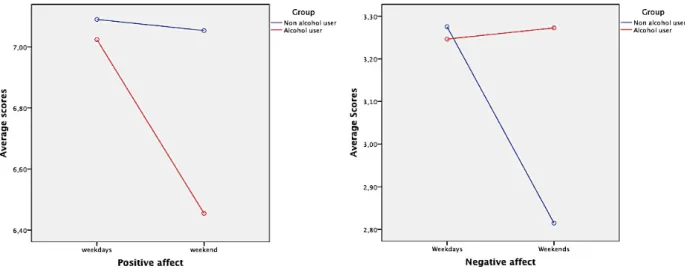
Plot lines seem to diverge specially on the weekend while they tend to converge over the weekdays. This is particularly true in the plot depicting negative affect. Average scores per day of the week per group as seen on table 3 also reveal that peaks and lowest values often occur during weekends. For this reason we fine-tuned our data analysis by computing an aggregate for weekdays and an aggregate for the weekend and explored the existence of differences between both groups and both moments.
Again, a mixed between-within subjects analysis of variance was conducted. Results show there was a marginally significant interaction effect between weekdays vs. weekends and the two groups, Wilk’s Lambda = .97, F(1,138) = 3.36, p = .06, partial eta square = .024.
Regarding the main effect for the time period, there was a significant main effect, Wilk’s Lambda = .96, F(1,138) = 4.34, p = .03, partial eta square = .031. The main effect for group revealed no significant results.
In the case of negative affect, results show an interaction effect between time and group showing that there is an impact of a variable over the other, Wilk’s Lambda = .96, F(1,136) = 5.12, p = .02, partial eta square = .036.
There was a significant main effect of the days of the week vs. weekend, Wilk’s Lambda = .97, F(1,136) = 4.07, p = .04, partial eta square = .029. On the other hand, there was no significant main effect for alcohol users vs. non users F(1,136) = .55, p = .45, partial eta square = .004, suggesting no differences between the two groups. Results are summarized on Table 4.
Table 4.
Mixed between-within ANOVA: interaction and main effects for positive and negative affect. Effect DFn DFd F p pes Positive Affect time 1.00 138 4.34 .03 * .031 group 1 138 1.61 .20 .012 time*group 1.00 138 3.36 .06 + .024 Negative affect time 1.00 136 4.07 .04 * .029 group 1 136 .55 0.45 time*group 1,00 136 5.12 .02 * .036 * p < .05 ; + p >.05 < .10
20
4. Discussion
Our findings suggest that, when considering a full week with no distinction in terms of weekdays and weekends, there are no significant differences between the group of adolescents who used alcohol and those who did not regarding their affective experience. In this case, using alcohol did not seem to have a significant impact on the emotional experience of our sample, as well as regarding the impact of the unfolding week. This could be partially explained by the fact that, when considering each of the seven days of the week, even though we might have strong differences between a particular day and the other, these differences are diluted in the overall results.
When fine-tuning our data, and clearly making the distinction between the two moments: weekdays and weekends, we found a weekend effect in terms of their emotional experience since values of affect (both positive and negative) differ significantly suggesting the impact of the weekend on the subjective experience of adolescents.
Figure 3. Positive and negative scores of affect (weekdays vs. weekends) for both groups
Our findings go in line with previous research that point out within-person variations in mood across the week and lend support for a weekend effect in mood (Ryan et al. 2010). When looking at the two moments (weekdays vs weekend), given the interaction effect, scores of positive affect differ in alcohol users and non users. We confirmed our hypothesis in the sense that adolescents who used alcohol showed lower levels of positive affect over the weekend and higher levels on weekdays. This could be explained having in account the possible occurrence of low mood characteristics after heavy drinking over the weekend. A study by Finlay et al (2012) shows students are more likely to engage in heavy drinking in the
weekend than on weekdays, even though this particular study includes Friday as part of the weekend. On the other hand, Csikszentmihalyi & Hunter (2002) advocate that particular activities are associated with varying degrees of happiness, which has a strong emotional component. Youth who spend more time in school and social activities are happier than those who spend less which could help to explain why we found higher values of positive affect over the weekdays. This difference could also be heightened by the peak of positive emotions occurring on Friday we found in our results.
In terms of negative affect, adolescents reveal significant differences between weekdays and weekends. Alcohol users contribute for this difference showing higher values of negative affect over the weekend as predicted. On the other hand, values of negative affect for the non alcohol group, reach a lower value over the weekend while, at the same time, score higher values of positive affect, once more confirming our hypothesis. These results could be accounted by the fact that weekdays are a time for scheduled work and school tasks which can bring about a sense of little freedom and autonomy, while weekends are traditionally associated with self-direction and leisure understood as a time which one can spend as one pleases.
Overall, average scores of positive and negative affect across the week seem to challenge the notion of “storm and stress” (Hall, 1904) in adolescence. Both alcohol users and non users score higher values of positive affect at any given day of the week. Once more, even though adolescence is a period of mental, physical, neurobiological and hormonal changes that often correspond with an increased drive toward independence and heightened emotionality, the majority of adolescents experience and emerge from this period in a healthy positive manner (Fonte, 2011; Casey et al, 2011), even after considering documented evidence that happiness decreases during the conflicted teenage years (Csikszentmihalyi, 2003).
ESM allowed a comprehensive insight into the emotional experience of participants. The fact that the answers were given in an ecological context, as they were being experienced by the participants at the moment of the beep, adds strength to the investigation and eliminates the possible bias of subjective interpretation traditionally found in one time measure self-reports (Scollon et al., 2003). The 4629 records of moments of the life of the participants, during the period of a full week, also brings the element of data richness and a better picture of their emotional inner world. Moreover, the use of ESM allowed for within-person analysis through which we were able to uncover patterns of affect as they occurred over each one of the days of the week.
22
From a prevention perspective, the results should draw our attention to the importance of facilitating experiences that bring about positive emotional outcomes. Park (2004) argues that positive affect mitigate the negative effects of stressful life events and work against the development of psychological problems among youth. Moreover from a health psychology point of view, positive emotions seem to play a role in the prevention of and in the recovery of physical conditions and diseases and so possibly contributes to an increase in life expectancy (Vázquez, 2009) as well as decreased symptoms in disease and pain (Cohen & Pressman, 2006).
Once more it seems important to highlight Fredrickson’s Broad-and-Build Theory (2009; 2011) which seems to confirm the importance of working in facilitating positive emotional experiences, particularly in the alcohol prevention field: “frequent experiences of positive emotions can trigger upward spirals between positive affect and expansive, creative thinking, which lead to personal growth and flourishing.” On the other hand negative affect promote narrow, pessimistic thinking which can lead to depression and have long been the focus of cognitive-behavioral therapy (Fredrickson, 2009).
In summary, we defend like Watson (2002) that understanding our mood systems and working with – not against – them, should be an important tool to help young people to increase positive affectivity significantly. This means to build resources for wellness for the present but also for the future.
Despite its contributions, this study has some limitations especially in the ability to fully describe the phenomena under study. Given the differences in affect, it fails to understand what activities alcohol users and non-users engage in over the weekdays and over the weekend. Literature on empirical evidence shows that among adolescents, certain activities are associated with lower or higher alcohol use indicators (Finlay et al. 2011) and so this could be a direction for further research.
Research also shows that adolescents who spend more time alone tend to score lower levels of happiness while being with friends corresponds to the highest (Csikszentmihalyi & Hunter, 2003). Is there a link between found differences in positive and negative affect over the week and the amount of time they spend alone vs accompanied in both groups? This particular aspect was not explored in this study. Hussong (2001), found that college students with less intimate and supportive friendships show risk for greater drinking following relative elevations in sadness and hostility. This is a clear direction for future research.
Considering the limitations and the results presented, it is one step further in the understanding of the emotional experience of adolescents in their everyday life and natural
context and may help to underline the need to promote positive emotional outcomes in alcohol prevention programs, school environment and life in general.
5. References
Almeida, L. & Freire, T. (2008). Metodologia da investigação em psicologia e educação (5ª edição). Braga: Psiquilíbrios.
Balsa, C. (2011). O Consumo de Bebidas Alcoólicas em Portugal. Prevalências e Padrões
de Consumo, 2001-2007. Estudos-Universidades. Instituto da Droga e da Toxicodependência,
I.P.
Casey, B. J. et al. (2011). Transitional and translational studies of risk for anxiety.
Depression and Anxiety 28: 18-28. Sackler Institute for Developmental Psychobiology, Weil Cornell Medical College, New York.
Christensen, T., Barret L., Bliss-Moreau, E., Lebo K. & Kaschub, C. 2003. A practical guide to experience-sampling procedures. Journal of Happiness Studies 4: 53-78, 2003: Netherlands.
Cohen, S. & Pressman, S. (2006) Positive Affect and Health. Current Directions in
Psychological Science. Association for Psychological Science. Vol. 15, No. 3, 122-125.
Constitution of the World Health Organization as adopted by the International Health Conference, New York, 19-22 June, 1946.
Csikszentmihalyi, M. & Hunter J. (2003). Happiness in everyday life: the uses of experience sampling. Journal of Happiness Studies 4: 185-199: Kluwer Academic Publishers: Netherlands.
Finlay, A. et al. (2012) Leisure Activities, the Social Weekend, and Alcohol Use: Evidence from a Daily Study of First-Year College Students. Journal of Studies on Alcohol
and Drugs. 73: 250-259.
Fonte, C. (2011). Qualidade da experiência subjectiva na vida quotidiana: experiências
óptimas/flow, lazer e consumo de substâncias na adolescência. Tese de doutoramento
apresentada à universidade do Minho.
Fonte, C., & Freire, T. (2008). Qualidade da experiência quotidiana, consumo de drogas e objetivos de vida em adolescentes: desenvolvimento positivo e implicações para a saúde.
Psicologia, Saúde & Doenças, 9 (Suplemento 1), 81.
Fredrickson, B. (2002). Positive emotions. In Handbook of Positive Psychology. Edited by: Snyder CR, Lopez SJ. New York: Oxford University Press; 2002: 120-134.
24
Freire, T. (2013). Leisure experience and Positive Identity Development in Adolescents.
Positive Leisure Science: from subjective Experience to social contexts. Springer.
Galinha, I. & Pais-Ribeiro, J. (2005). Contribuição para o estudo da versão portuguesa da Positive and Negative Affect Schedule (PANAS): I-Abordagem teórica ao conceito de afecto.
Análise Psicológica. 2 (XXIII): 209-218.
Hall GS. (1904). Adolescence: Its Psychology and Its Relation to Physiology,
Anthropology, Sociology, Sex, Crime, Religion, and Education. Vols. I and II. Englewood
Cliffs, NJ: Prentice-Hall.
Hektner, J.; Schimidt, J., & Csikszentmihalyi, M. (2007). Experience Sampling Method.
Measuring the quality of everyday life. Califórnia: Sage Publications, Inc.
Helliwell, J. & Wang, S. (2011) Weekends and Subjective Well-Being (preliminary). Retrieved on 31st May 2013 from www.researchgate.net.
Hibbell, Bjorn et al. (2012). The 2011 ESPAD Report: substance use among students in
36 European Countries. The Swedish Council for Information on Alcohol and Other Drugs
(CAN) and the authors. Sweden.
Hussong, A.; Hicks, R.; Levy, S. & Curran, P. (2001) Specifying the relations between affect and heavy alcohol use among young adults. Journal of Abnormal Psychology. American Psychological Association. Vol. 110, No. 3, 449-461.
Kennedy-Moore, E.; Greenberg, M.; Newman, M. & Stone, A. (1992) The Relationship between daily events and mood: the mood measure may matter. Motivation and Emotion. Plenum Publishing Corporation. Vol. 16, No. 2
Lima, I. & Freire, T. (2009). Qualidade da experiência subjectiva no quotidiano escolar de adolescentes: implicações desenvolvimentais e educacionais. Análise Psicológica. 4 (XVIII): 523-534.
Machado, C., Gomes J., & Freire, T. (2009). The Psycho beeper (versão 0.9) [Electronic beeper software]. Braga: Universidade do Minho.
Negreiros, J. (2001). Padrões e consequências do consumo de drogas em Matosinhos:
resultados na populace estudantil e em consumidores problemáticos. Matosinhos. Câmara
Municipal de Matosinhos.
Pallant, J. (2011) SPSS Survival Manual: a step by step guide to data analysis using SPSS. 4th edition. Allen Unwin: Australia.
Park, N. (2004). The role of subjective well-being in positive youth development. Annals
REIS, André et al. Prevalência da INGestão de Álcool nos Adolescentes: Estudo PINGA. Rev Port Clin Geral [online]. 2011, vol.27, n.4, pp. 338-346, consultado a 30 de Maio de 2013
em http://www.scielo.gpeari.mctes.pt
Ryan, R., Bernstein, J. & Brown, K. (2012). Weekends, work and well-being:
psychological need satisfactions and day of the week effects on mood, vitality, and physical symptoms. Journal of Social and Clinical Psychology, Vol. 29, Nº1, pp. 95-122.
Ryff, C & Singer, (2002). From social structure to biology: integrative science in pursuit of human health and well-being. In Handbook of Positive Psychology. Edited by: Snyder CR, Lopez SJ. New York: Oxford University Press; 2002: 106-119.
Sarafino, E. (2008). Health Psychology: biopsychosocial interactions, 6th edition. John Wiley & Sons, Inc.
Schulenberg, J.; Maggs, J., & Hurrelmann, K. (1997). Negotiating developmental transitions during adolescence and young adulthood: health risk and opportunities. In J. Schulenberg; J. Maggs & K. Hurrelmann (Eds.), Health risk and developmental transitions
during adolescence. (pp. 1-19). Cambridge: Cambridge University Press.
Scollon, C. N., Kim-Prieto, C., & Diener, E. (2003). Experience sampling: promises and pitfalls, strengths and weaknesses. Journal of Happiness Studies, 4, 5-34.
Simons, J., Gaher, M., Correia C., Hansen, c. & Christopher, M. (2005) An affective-motivational model of marijuana and alcohol problems among college students. Psychology of
Addictive Behaviors. American Psychological Association. Vol. 19, No. 3, 326-334.
Teixeira, José A. Carvalho. (2004). Psicologia da Saúde. Análise Psicológica. 3 (XXII): 441-448.
Vásquez, C. et al. (2009). Psychological well-being and health. Contributions of positive psychology. Annuary of Clinical and Health Psychology, 5: 15-27.
Watson, David. (2002). Positive Affectivity: the disposition to experience pleasurable emotional states. In Handbook of Positive Psychology. Edited by: Snyder CR, Lopez SJ. New York: Oxford University Press; 2002: 106-119.