MASTERS
INFORMATION SYSTEMS
’
MANAGEMENT
MASTERS
’
FINAL WORK
T
HESIS
A
PPLYING
C
ONFIGURATIONAL
T
HEORY
TO
U
NDERSTAND
M
OBILE
A
PP
S
UCCESS
R
ICARDO
F
ERNANDES
D
UARTE
MASTERS
INFORMATION SYSTEMS
’
MANAGEMENT
MASTERS
’
FINAL WORK
T
HESIS
A
PPLYING
C
ONFIGURATIONAL
T
HEORY
TO
U
NDERSTAND
M
OBILE
A
PP
S
UCCESS
R
ICARDO
F
ERNANDES
D
UARTE
S
UPERVISION
:
W
INNIE
P
ICOTO
I
Acknowledgements
II
Abstract
Smartphones are setting new sales records, and the number of apps available in online stores continues to grow, having reached a combined figure of 3.4 million apps (Statista, 2015), making this a desirable market for investors, companies, and developers. However, among all those apps, only a limited number succeeds. This study builds on the existing knowledge of mobile app success and contributes to enhance the existing literature proposing a configurational theory for mobile app success. To accomplish this, the fuzzy set qualitative comparative analysis (fsQCA) was applied to identify the antecedent conditions for mobile app success. Data from the top 100 ranked apps at App Store was collected. The fsQCA results supported the following propositions: (i) smaller package size, (ii) lower user reviews scores with higher languages supported and fewer versions supported, (iii) highly popular categories with higher user review scores and fewer languages supported, (iv) highly popular categories with higher number of versions supported and fewer languages supported, and (v) highly popular categories with higher user review scores and higher number of versions supported, are sufficient conditions for mobile app success. Interestingly, it was found that small package size is both a necessary and sufficient condition for mobile app success.
III
Resumo
Os smartphones estão a atingir novos recordes de vendas, e o número de aplicações disponíveis nas lojas continuam a crescer tendo atingido um total combinado de 3.4 milhões de aplicações (Statista, 2015), tornando este mercado apetecível para investidores, empresas, e developers. No entanto, de todas estas aplicações, apenas algumas são bem sucedidas. Este estudo baseia-se no conhecimento existente sobre sucesso de aplicações móveis e contribui para o conhecimento propondo uma teoria configuracional para o sucesso de aplicações móveis. Para atingir este objetivo é utilizada a análise comparativa qualitativa, na sua variante difusa (fsQCA), de modo a identificar as condições antecedentes para o sucesso de aplicações móveis. Foram extraídos os dados das 100 aplicações melhores classificadas no ranking da Apple App Store, e os resultados obtidos na análise fsQCA foram os seguintes: (i) aplicação pequena, (ii) baixa pontuação dos utilizadores com muitas línguas suportadas e poucas versões suportadas, (iii) categorias populares com alta pontuação dos utilizadores e poucas línguas suportadas, (iv) categorias populares com muitas versões suportadas e poucas línguas suportadas, e (v) categorias populares com alta pontuação dos utilizadores e muitas versões suportadas, são condições suficientes para o sucesso de aplicações móveis. Curiosamente, uma aplicação pequena é uma condição tanto necessária e suficiente para o sucesso de aplicações móveis.
IV
Contents
Acknowledgements ... I
Abstract ... II
Resumo ... III
1. Introduction ... 1
1.1. Motivation ... 1
1.2. Research question ... 2
1.3. Objectives ... 2
1.4. Research structure ... 4
2. Literature Review ... 5
2.1. Mobile Applications... 5
2.2. Mobile App Success ... 6
2.3. Configurational Theory for Mobile Apps Success ... 10
3. Methodology... 12
3.1. Data collection ... 13
3.2. Calibration of causal conditions ... 13
3.3. Construction of the truth table ... 13
3.4. Evaluation of consistency... 13
3.5. Logical reduction ... 14
V
3.7. Calibration of Set Memberships ... 14
3.8. Outcome for mobile apps success... 16
4. Results ... 17
4.1. Discussion ... 22
4.2. Conclusions ... 23
Bibliographic References ... 26
Index of tables
Table 1 - Analysed mobile app characteristics ... 8Table 2 - Calibration of set membership ... 15
Table 3- Truth table ... 18
Table 4 - Necessary conditions for mobile app success ... 19
Table 5- Configurations for mobile app success ... 21
List of abbreviations
API – Application Programming Interface
fsQCA – fuzzy set Qualitative Comparative Analysis GHLM – Generalized Hierarchical Linear Model IS – Information System
IT – Information Technology
VI OLS – Ordinary Least Squares
1
1.
Introduction
1.1.
Motivation
Mobile technology advancements are making mobile devices almost indispensable in our daily lives, leading to a proliferation of mobile apps that aim to address a vast array of functionalities and customer needs. The existence of such applications increases the value of smartphones to customers. Smartphones are setting new sales records, and the number of apps in online stores continues to grow, with a combined 3.4 million apps (Statista, 2015) in the most popular mobile application marketplaces, Google Play for Android devices, App Store for IOS devices and Windows Phone Store for Windows Phone (Wilcox & Voskoglou, 2014), making this a desirable market for investors, companies and developers. However, among all those apps, only a limited number of them succeed (Telang and Garg, 2013) making it important to understand which factors contribute to app success.
2 According to the existing literature, there are several measurable app characteristics that may positively influence its success: selling price, number of updates, different languages in which the app is available, number of operating system versions supported, the API functions used, and the package size (Dibia and Wagner, 2015; Lee and Raghu, 2014). Additionally, the popularity of the category where the app belongs appears to have a significant impact in app success (Lee and Raghu, 2014; Shen, 2015) as well as the user review score (Lee and Raghu, 2014).
Although some academic research about the relationship between app sales and rank position (Garg and Teland, 2013) or about app success factors does exist (Dibia and Wagner, 2015; Lee and Raghu, 2014), these have mainly focused on the developer perspective and applied OLS or GHLM to identify the antecedents for app success.
1.2.
Research question
This study focuses on the app characteristics and aims to answer the question:
What are the paths, or combinations of app characteristics, that lead to mobile app
success?
1.3.
Objectives
In order to answer the question, this thesis builds on the existing knowledge of mobile app success and aims to contribute to enhance the existing literature on mobile app success factors. It defines a configurational theory for mobile apps success, applying the fuzzy set qualitative comparative analysis (fsQCA) to identify the antecedent conditions for mobile apps success.
3 popularity and user review score, and was collected through the Apple iTunes website on October 12th 2015. The analysis focused on examining which determinants and sets of determinants are necessary and sufficient conditions for outcome app success. To achieve this, a qualitative approach was followed and fsQCA was used for the data analysis. This qualitative method allowed the identification of patterns that are the cause in cause-effect relationships (Fiss, 2011). Using this method instead of multiple regression analysis (MRA) allowed to show which combinations of factors influence the outcome app success, instead of a limited number of models in which each variable has a positive or negative effect for success (Woodside, 2013). Although initially developed for small to medium sets of data (Ragin, 2008) fsQCA can effectively be used for much larger sets of data (Feurer, Baumbach, & Woodside, 2015).
4
1.4.
Research structure
5
2.
Literature Review
2.1.
Mobile Applications
Native applications are developed using either the native programming language and Software Development Kit for each mobile platform (Swift for IOS, Java for Android, C# for Windows Phone) or using a third party development tool that converts the developed application to the native programming language. There are over 1000 third party tools and 74% of the developers interested in making money use at least one of them (Wilcox & Voskoglou, 2014). Hybrid applications, like web applications, are developed using HTML5 and a scripting language like JavaScript, but instead of being developed to run in the mobile browser, they are developed to be packaged as a native app by a third party tool like Titanium Appcelerator, Phonegap or Intel XDK, allowing the application to be published in the Mobile Application Marketplace.
Therefore, the emerging and growth of mobile application marketplaces where native and hybrid applications are made available is being witnessed. They are platform specific; Google Play for Android devices, App Store for IOS devices and Windows Phone Store for Windows Phone are the most popular (Wilcox & Voskoglou, 2014). There are over 3 million applications published amongst these 3 marketplaces (Statista, 2015), and an estimated number of 5.5 million developers (Wilcox, 2014).
6 Due to lack of data related to app downloads or sales, it is difficult to clearly understand market behaviour (Garg and Teland, 2013). Additionally, as users of mobile devices are dedicating more time to mobile apps than websites, organizations that seek competitive advantage must understand which factors may affect app success in order to develop adequate mobile strategies (Dibia and Wagner, 2015).
2.2.
Mobile App Success
For a long time, information systems success has been a topic of interest for academics and practitioners. Delone and Mclean (2003) IS success model is the most widely applied to define and measure IS success. The measurements can be classified in six categories: information quality, system quality, service quality, intention to use, user satisfaction and net benefits (Delone and Mclean, 2003). However, this model may not be appropriate to evaluate mobile app success (Dibia and Wagner, 2015), as the characteristics of mobile apps ecosystems are different from traditional IS applications in terms of development (through software development kits that facilitate mobile app development), distribution (attraction of all users to a single place making updates and marketing easier) and target (at the individual level only) (Dibia and Wagner, 2015). Although the data concerning the number of downloads and revenue for each app from the app stores is not publicly available, it may be inferred that a high rank position means an app is downloaded more often and thus generates more revenue (Garg and Teland, 2013). Teland and Garg (2013) also propose a method that uses the data available from the iTunes app store to infer the rank-demand relationship.
7 secret. The most important factors influencing ranking are number of downloads and revenue, both recent and aggregated, but also app launches, retention (uninstalls), social proof, number and value of reviews of users, keyword relevance, updates, and backlinks (Butters, 2014; Fuecks, 2015; Walz, 2015).
A relationship between top-ranked apps and the number of downloads has been previously established (Garg and Teland, 2013). Therefore the rank position of a mobile app may be considered as a proxy to its sales (Garg and Teland, 2013) and a measure for app success (Lee and Raghu, 2015; Dibia and Wagner, 2015). In the context of
mobile app, it is defined that “success is restricted to appearance/ reappearance of Apps
in the top-charts over time” (Lee and Raghu, 2015, p. 9). Dibia and Wagner (2015 p.
4305) define mobile app success “in terms of the usage audience which an app is able to
8 Package size
The size of the application downloadable package in megabytes
Supported languages
The number of languages in which the application is available in
Supported versions
Number of operating system versions the application supports
User review score Average review score in the App store
Category popularity
Percentage of published applications per category
Table 1 - Analysed mobile app characteristics
As stated, several factors have been studied in the literature as antecedents for mobile app success. For example, Song et al (2013) found that consumer rating and number of ratings are positively related with the number of downloads of an app. A study conducted by Lee and Raghu (2015) aims at understanding the relationship between
9 The popularity of the apps category may also be important to explain its success (Lee and Raghu, 2015, Shen, 2015). In fact, as of September 2015, the top ranked share of active apps from Apple App Store is categorized in games (22.21%), business (10.41%), and education (9.59%) (Statista, 2015). Therefore, if an app belongs to a popular category, it increases the odds in reaching the top rank applications (Lee and Raghu, 2015, Shen, 2015).
Another mobile app characteristic with public available information in the App Store is the number of versions supported. This indicates the number of different IOS versions to which the app is compatible to. According to Lee and Raghu (2015), that characteristic indicates how frequently the app has been updated and changes in apps may be defined as quality updates. Thus the number of versions supported can be seen as a measure of quality improvement. As users have access to that kind of information when they are making an app download, it is possible that this information influences the app success (Lee and Raghu, 2015). Additionally, the number of versions supported
by an app may be “an indicator of the utility provided by the application and how well it
integrates by the application and operating system functionalities” (Dibia and Wagner, 2015, p. 4308).
10 user review score is also expected to influence mobile app success. Regarding the number of languages supported, Dibia and Wagner (2015) found that app diversity (in terms of different geographic locations supported with specific language characteristics) to be a significant and positive antecedent for mobile app success. Package size is the application size in terms of megabytes and is analysed as a positive factor as it “may be a proxy for the richness of its content potential value thus reducing uncertainty about its
performance” (Dibia and Wagner, 2015 p. 4309). This variable depends on the
technology and development features used in the application creation. The fact that an app provides more functionality would increase its packaged size when compared to an app that must have network connections to perform some activities. However, even though larger applications may provide higher value for users, storage constraints on mobile devices may steer users to choose applications with smaller sizes (Dibia and Wagner, 2015).
2.3.
Configurational Theory for Mobile Apps Success
The study aims to understand alternative configurations of mobile app characteristics
that lead to the outcome “mobile app success”. According to Kulins et al. (2015, p.1),
“configurations allow picturing equifinality, that is, the possibility for several ways to
lead to the same outcome”. In the present study configurational theory is applied to
11 understanding of the complex interconnected factors that can lead to the success of a mobile app.
12
3.
Methodology
To analyse the configurations that lead to a successful outcome of mobile applications, the fuzzy-set qualitative comparative analysis is applied, such as previously used in several areas of management research (for example, Crilly et al. (2012), Fiss (2011), Misangyi and Achaya (2014)). This is a recent method which applies the Boolean logic of thinking to analyse qualitatively and systematically cases in order to explain an outcome of interest; fsQCA focuses on the analysis of set relations (Fuerer et al, 2015) and conceptualizes cases as combinations of attributes (Fiss, 2011) which define the combinations of necessary and sufficient conditions that lead to an outcome (dependent variable). According to Fiss (2011, p. 401), “set-theoretic methods thereby differ from conventional, variable-based approaches in that they do not disaggregate cases into independent, analytically separate aspects but instead treat configurations as different
types of cases.”
There are several advantages of this methodology: it can be applied to small samples, the conditions do not need to be linear or normal and it allows the identification of the configuration of antecedent conditions rather than individual antecedents (Feurer et al, 2015). Thus, fsQCA is applied to analyse the causal conditions that lead to the success of a mobile app and identify patterns that support the existence of causal relationships (Felício et al., 2015). The fsQCA 2.5 software is used to analyse the dataset.
13
3.1.
Data collection
Based on the existing literature, the publicly available information for each mobile app that may influence its success is defined. Then data for each app of the first 50 top ranked paid and free mobile applications is collected: price, user review score, package size, supported languages, supported versions and category popularity. In order to obtain the relevant data for each application the Apple iTunes Website was consulted.
3.2.
Calibration of causal conditions
The mobile app data is calibrated into fuzzy sets. In the calibration step, a membership score to each condition and for each case is assigned. Similarly, the outcome is also calibrated; in the present study, as all cases have some degree of success, with the position the in the ranking determining if its success value is closer to 1 (rank 1 in free and paid top lists) or 0.51 (rank 50 in free and paid top lists). The calibrated scores for the antecedent conditions are calculated in the fsQCA software;
3.3.
Construction of the truth table
After calibration, the resulted fuzzy sets are used to “construct a data matrix known as
truth table” (Fiss, 2011 p. 402) with 25 rows (5 is the number of antecedent conditions
in the model). Each row represents a combination of attributes and the truth table presents all possible logical combinations;
3.4.
Evaluation of consistency
“Consistency here refers to the degree to which cases correspond to the set-theoretic
14 consistency) to 1 (high consistency), and high consistency scores confirm that a certain configuration of antecedents conditions is sufficient to explain a given outcome;
3.5.
Logical reduction
Based on the Boolean algebra, the truth table rows are reduced to a simpler combination of antecedent conditions. After evaluating the consistency of each configuration, the coverage can be assessed in order to identify the irrelevant or redundant configurations, which should be deleted from results, leading to a less complex final solution.
3.6.
Sample
The Apple App Store is the selected store to conduct the present study. In fact, this store is the preferred platform in North America for developers at 42%, seconded by Google Play at 33% (Wilcox and Voskoglou, 2015). Data was collected for the top 100 ranked apps at App Store (USA data), namely the price, package size, supported languages, supported versions, category popularity and user review score. Data was manually collected through the Apple iTunes website on October 12th 2015. There is no available top list in the App Store that combines both free and paid apps, so data was collected for the top 50 apps of each chart. Due to the inexistence of this combined list it was not possible to access the influence of price in the success of an app.
3.7.
Calibration of Set Memberships
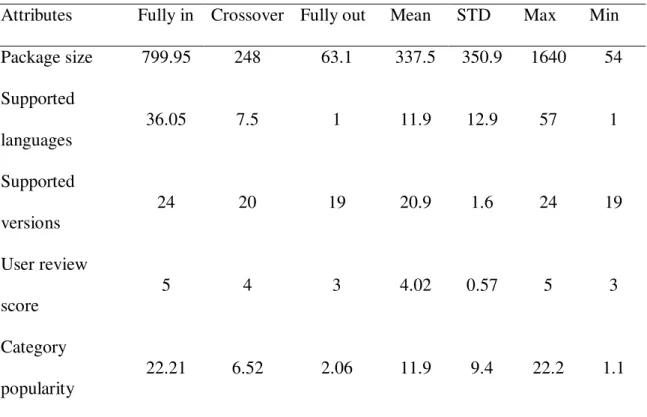
15 non-membership and 0.5 for the crossover point. Values of 0.5 were substituted by 0.499 (Ragin et al, 2006 and Crilly, 2012) because the cases with 0.5 are dropped of the solution by the software. If the “package size” is taken as an example, cases with package size value between 248 and 799.95 are calibrated with values between 0.5 and 1, cases with package size values between 63.1 and 248 are calibrated with values between 0 and 0.5, cases with package size values greater than 799.95 are calibrated with 1 (fully in membership) and finally, cases with package size values lower than 63.1 are calibrated with 0 (fully out membership). Table 2 presents the calibration of the set membership and the descriptive statistics for each attribute.
Attributes Fully in Crossover Fully out Mean STD Max Min
Package size 799.95 248 63.1 337.5 350.9 1640 54
Supported languages
36.05 7.5 1 11.9 12.9 57 1
Supported versions
24 20 19 20.9 1.6 24 19
User review score
5 4 3 4.02 0.57 5 3
Category popularity
22.21 6.52 2.06 11.9 9.4 22.2 1.1
Table 2 - Calibration of set membership
The package size is defined in Megabytes, the user review score can be between 0 and 5
16
3.8.
Outcome for mobile apps success
17
4.
Results
The previously mentioned measurable app characteristics that may positively influence its success are selling price, number of updates, different languages the app is available in, the number of operating system versions supported, the API functions used and the package size (Dibia and Wagner, 2015; Lee and Raghu, 2014), the popularity of the category (Lee and Raghu, 2014; Shen, 2015) and the user review score (Lee and Raghu, 2014).
The selling price in this analysis could not be considered due to the nonexistence of a single app chart that combines both free and paid apps. The number of updates and API functions used could not be obtained or inferred.
The five conditions are analysed and the Truth Table (Table 3) shows all the combinations of causal conditions that lead to the success outcome of 1. For each outcome, five conditions appear in the Truth Table making the total of 25 possible
18 Package size Supported languages Supported versions
User review
score
Category
popularity
Number Consistency
1 0 0 1 0 0 1 1
2 0 1 1 1 0 1 1
3 0 1 1 0 1 1 1
4 1 1 0 0 1 1 1
5 1 0 0 1 1 1 1
6 1 1 1 1 1 1 1
7 0 0 1 1 0 2 1
8 1 0 1 0 1 2 1
9 0 0 0 1 0 3 1
10 0 0 0 1 1 3 1
11 0 1 0 1 1 3 1
12 1 1 0 0 0 4 1
13 0 1 0 0 1 4 1
14 0 1 1 1 1 5 1
15 0 0 0 0 0 6 1
16 0 0 1 0 1 8 1
17 0 1 0 0 0 15 1
18 0 1 1 0 0 2 0.996
19 0 1 0 1 0 12 0.995
20 1 0 1 1 1 2 0.989
21 0 0 0 0 1 4 0.983
22 0 0 1 1 1 14 0.931
Table 3- Truth table
Note: Logical remainders are not listed.
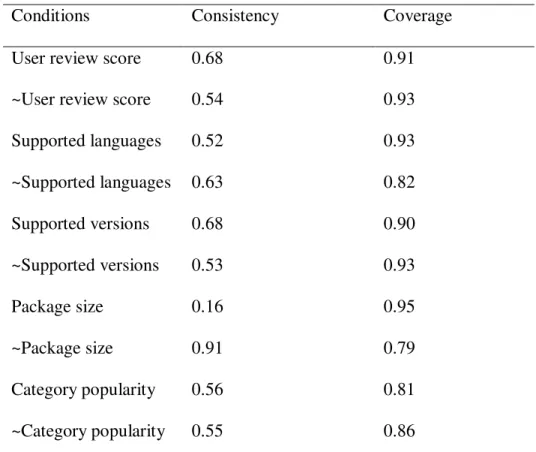
19 calculation for the necessary conditions was performed using the fsQCA software and table 4 presents the results for that analysis.
Conditions Consistency Coverage
User review score 0.68 0.91
~User review score 0.54 0.93
Supported languages 0.52 0.93
~Supported languages 0.63 0.82
Supported versions 0.68 0.90
~Supported versions 0.53 0.93
Package size 0.16 0.95
~Package size 0.91 0.79
Category popularity 0.56 0.81
~Category popularity 0.55 0.86
Table 4 - Necessary conditions for mobile app success
“~” means the absence of the condition in the case
It is shown that a small application package size is above the commonly used 0.9 threshold, and as so, a small application can be considered a necessary condition for application success.
After identifying the necessary conditions, it is analysed whether there any sufficient ones.
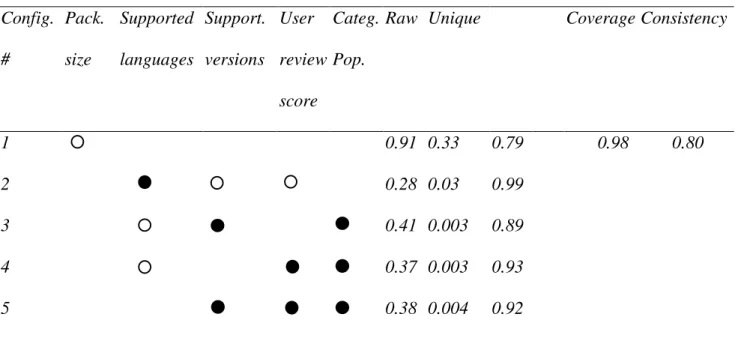
20 solution, the parsimonious solution includes all the configurations including the ones without solution, and the intermediate solution, which is the one to be used recommended by Ragin (2008) and includes the configurations selected by the researcher. In the present study, since all the configurations have at least one result, the complex and intermediate solutions are equal, and thus is the one presented in the results.
Table 4 presents the configurations for mobile app success. According to the results obtained, there are five possible configurations that lead to the success of mobile app that are considered to be sufficient conditions for mobile app success:
Solution 1: smaller package size (~Package size),
Solution 2: lower user reviews scores with higher languages supported and fewer versions supported (Supported languages*~Supported versions*~User review score),
Solution 3: highly popular categories with higher user review scores and fewer languages supported (~Supported languages*Supported versions*Category popularity),
Solution 4: highly popular categories with higher number of versions supported and fewer languages supported (~Supported languages*User review score*Category popularity),
21
Conditions Coverage Consistency Overall solution
Config. # Pack. size Supported languages Support. versions User review score Categ. Pop.
Raw Unique Coverage Consistency
1 0.91 0.33 0.79 0.98 0.80
2 0.28 0.03 0.99
3 0.41 0.003 0.89
4 0.37 0.003 0.93
5 0.38 0.004 0.92
Table 5- Configurations for mobile app success
Note: Presence is indicated by and absence is indicated by .
For each solution of the results, consistency is above 0.75 (table 5). The high consistency score confirms that the configurations of antecedent conditions are
sufficient to explain a given outcome “Ragin (2005, 2009)”. Coverage is another criteria
to evaluate the quality of results. It ranges from 0 to 1 and “refers to the extent to which
a configuration of antecedents accounts for high scores of the outcome set” (Fleurer et
al, 2015 p. 13). The overall coverage in the solution is 0.98 which means that the large majority of configurations are covered. One configuration has a unique coverage of 0.33, all other having a unique coverage below 0.1.
22 explained by the fact that 45 out of the 100 top apps are games, and in this category many casual, popular games have a small application package size.
In the second configuration the high number of supported languages stands out, and even though the number of supported versions and user review score are low, this path can lead to success. The data collected is from the US store, which means that in this case the availability of the app in different languages is a positive factor.
The third, fourth and fifth configurations share the category popularity, and the most popular category is games. These three configurations also share two out of three conditions: fewer supported languages, meaning the app is targeting specifically English speaking markets (all the top 100 applications are available in English), high number of supported versions which allow a bigger user base, including those with older devices to download the app, and high user review score which usually implies a well built and bug free application. Having two of the three latter characteristics is sufficient condition for success as long as the app belongs to a popular category.
4.1.
Discussion
23 but could attributed to the fact that the analysed store is the U.S. store and every application is available in English; 38 of the 100 applications are available only in English with a further 5 being available in only 1 other language. This can suggest that the apps are developed specifically for the US market potentially making them more successful there.
The configuration where the app is available in a high number of supported languages, the number of supported versions and user review score are low Supported languages * ~Supported versions * ~User review score suggests that these successful apps are built for the global market; they are complex apps that use the newer API functions of the latest IOS versions, and so are only available for the newer devices. The fact that these are targeting more than the U.S. market can lead to a low user review score. Interestingly, small application package size ~Package size is found to be both a necessary and sufficient condition for application success in the U.S App Store. This could be explained by the fact that 38 out of the top 100 applications are in the Games category and have a smaller application package size than the median.
4.2.
Conclusions
24 factors (Woodside and Zhang, 2013). For academics, it provides further support for the antecedents of mobile app success, contributing to uncover the underlying configurations that lead mobile apps to reach the top charts of app stores. For practitioners, it shows that a small package size is a necessary and sufficient condition to achieve success in the app stores. It also suggests alternative configurations leading to the success of mobile applications. This contribution in important to achieve a deeper knowledge of the field.
The results of this study suggest that, although not the only path, a small application package is the most common path to success. Many of the app publishers trying to succeed in the app store are either small companies or even solo developers (Wilcox & Voskoglou, 2015) that want to mimic what former low resource publishers have done, publishing small games that became an overnight success like the case of Flappy Bird in 2013, a very small and simple game that made it to the top in both US and Chinese
stores. Some of these small games are “clones” and copy part of the storyline,
functionality, name, or a combination of these characteristics from existing successful games as a way to try to push the applications to the top of the charts.
When approaching the development for the less popular categories and niche markets, multilingual support seems to be an important feature, and this makes sense because a low number of supported languages would restrict even more the potential users.
This study also has some limitations regarding its generalizability: the sample size and the typology of apps that constitute the sample restrict the generalizability of results. Additionally, data was collected on a single point of time. However, despite this limitation, app rankings may be considered fairly stable: on 13th March 2016, 5 months
26
Bibliographic References
Butters, K. (2014). How Does Google Play Rank Mobile Apps. Retrieved June 30, 2015, from
https://getappcase.com/blog/app-stores/how-does-google-play-rank-mobile-apps
Crilly, D., Zollo, M., & Hansen, M. T. (2012). Faking it or muddling through? Understanding decoupling in response to stakeholder pressures. Academy of Management Journal, 55 (6), 1429-1448.
Dibia, V., & Wagner, C. (2015). Success Within App Distribution Platforms : the Contribution
of App Diversity and App Cohesivity. 48th Havaii International Conference 4304-4313 doi:10.1109/HICSS.2015.515
Felício, J.A, Duarte, M. and Rodrigues, R. (2015). Global mindset and SME internationalization: A fuzzy-set QCA approach. Journal of Business Research (in press), http://dx.doi.org/10.1016/j.jbusres.2015.10.110
Feurer, S., Baumbach, E., & Woodside, A. (2015). Applying Configurational Theory to Build a Typology of Ethnocentric Consumers. Not yet Published.
Fiss, P. C. (2011). Building Better Casual Theories: a Fuzzy Set Approach To Typologies in Organizational Research. Academy of Management Journal, 54(2), 393–420. doi:10.5465/AMJ.2011.60263120
Fuecks, H. (2015). 11 App Store Ranking Factors. Retrieved June 30, 2015, from https://medium.com/@hfuecks/11-app-ranking-factors-8e4a8debdc67
Lee, G., & Raghu, T. S. (2014). Determinants of Mobile Apps Success : Evidence from App Store Market, Journal of Management Information Systems 31(2), 133-170. doi:10.2753/MIS0742-1222310206
Legewie, N., (2013), September. An introduction to applied data analysis with qualitative comparative analysis. In Forum Qualitative Sozialforschung/Forum: Qualitative Social Research (Vol. 14, No. 3).
Linares-Vásquez, . Bavota, G., Bernal-Cárdenas, C., Di Penta, M. Oliveto M. and Poshyvanyk, D. (2013). API change and fault proneness: a threat to the success of Android apps. In Proceedings of the 2013 9th Joint Meeting on Foundations of Software Engineering
(ESEC/FSE 2013), New York, NY, USA, 477-487.
DOI=http://dx.doi.org/10.1145/2491411.2491428
Liu, C. Z., Au, Y. A., & Choi, H. S. (2014). Effects of freemium strategy in the mobile app market: an empirical study of Google play. Journal of Management Information Systems, 31(3), 326-354.
Matos, G., M. Ferreira, P. and Krackhardt, D. (2014). Peer Influence in a Large Social Network,
27 Misangyi, V. and Acharya, A. (2014). Substitutes or Complements? A Configurational Examination of Corporate Governance Mechanisms. The Academy of Management Journal
57 (6), 1681-1705.
Ragin, C. C. (2000). Fuzzy-set social science. University of Chicago Press.
Ragin, C.C., (2005). From Fuzzy Sets to Crisp Truth Tables1.
Ragin, C. C., Drass, K. A., & Davey, S. (2006). Fuzzy-set/qualitative comparative analysis 2.0. Tucson, Arizona: Department of Sociology, University of Arizona.
Ragin, C. C. (2008). Redesigning social inquiry: Fuzzy sets and beyond. (Chicago Press, Ed.). Ragin, C.C. (2009), Qualitative comparative analysis using fuzzy sets (fsQCA), in Rihoux, B.
and Ragin, C.C. (Eds.), Configurational Comparative Methods: Qualitative Comparative Analysis (QCA) and Related Techniques, Thousand Oaks, CA: Sage Publications, pp. 87- 121.
Shen, C.C.G (2015) Users’ adoption of mobile applications: Product type and message
framing’s moderating effect. Journal of Business Research 68, 2317-2321
Song, Chihoon; Park, Kyungdo; and Kim, Byung Cho, (2013) Impact of Online Reviews on Mobile App Sales: Open Versus Closed Platform Comparison" PACIS 2013 Proceedings. Paper 12.
Statista. (2015). Number of apps available in leading app stores. Retrieved June 30, 2015, from http://www.statista.com/statistics/276623/number-of-apps-available-in-leading-app-stores/
Telang, R., and Garg, R. (2013). Inferring app demand from publicly available data. MIS Quarterly, 37(4), 1253–1264.
Walz, A. (2015). Deconstructing the App Store Rankings Formula with a Little Mad Science. Retrieved June 30, 2015, from https://moz.com/blog/app-store-rankings-formula-deconstructed-in-5-mad-science-experiments
Wilcox, M. (2014). App Economy Forecasts 2015 – 2017.
Wilcox, M., & Voskoglou, C. (2014). State of the Developer Nation Q3 2014. Wilcox, M., & Voskoglou, C. (2015). State of the Developer Nation Q1 2015.
Woodside, A.G. and Zhang, M., (2013). Cultural diversity and marketing transactions: Are market integration, large community size, and world religions necessary for fairness in ephemeral exchanges?. Psychology & Marketing, 30(3), pp.263-276
Woodside, A. G. (2013). Moving beyond multiple regression analysis to algorithms Calling for adoption of a paradigm shift from symmetric to assymetric thinking in data analysis crafting theory. Journal of Business Research.