Brazilian Journal of Physics, vol. 37, no. 2C, June, 2007 711
Event-by-Event Fluctuations of Transverse Momentum and Multiparticle
Clusters in Relativistic Heavy-Ion Collisions
∗W. Florkowski1,2, W. Broniowski1,2, B. Hiller3, and P. Bo˙zek2,4 1 Institute of Physics, ´Swie¸tokrzyska Academy,
ul. ´Swie¸tokrzyska 15, PL-25406 Kielce, Poland 2 The H. Niewodnicza´nski Institute of Nuclear Physics,
Polish Academy of Sciences, PL-31342 Krak ´ow, Poland 3 Centro de F´ısica Te´orica, Departamento de F´ısica,
University of Coimbra, P-3004-516 Portugal 4 Rzesz´ow University, PL-35959 Poland
Received on 10 October, 2006
We analyze the event-by-event fluctuations of mean transverse momentum measured recently by the PHENIX and STAR Collaborations at RHIC. We argue that the observed scaling of strength of dynamical fluctuations with the inverse number of particles can be naturally explained by formation of multiparticle clusters.
Keywords: Relativistic heavy-ion collisions; Event-by-event fluctuations; Particle correlations
I. INTRODUCTION
This paper is based on our recent analysis [1] of the event-by-event fluctuations of the mean transverse-momentum mea-sured by PHENIX [2] and STAR [3, 4] Collaborations at RHIC. The discussed new data has extended our knowledge of the phenomena studied intensely in recent years [5–20]. One of the central issues in this field is whether the pT
fluc-tuations at intermediate momenta result from jets [21, 22]. In this paper we argue that the observed scaling of strength of dy-namical fluctuations may be naturally explained by formation of multiparticle clusters. From our point of view, the explana-tion of the data in terms of quenched jets represents only one possible option, other physical mechanisms leading to cluster-ing also explain the data.
Our reasoning is based on the following three observations: i) the mean and the variance of the inclusive momentum dis-tribution are practically constant at low centrality parameters (c=0−30%),
hMi=const., σp=const., (1)
ii) the variance of the average momenta for the mixed events is practically equal to the variance of the inclusive distribution divided by the average multiplicity,
σmix
M ≃
σp
hni, (2)
finally,iii) the difference of the experimental and mixed-event variances of meanpT, denoted asσ2dyn, scales as inverse mul-tiplicity
σ2
dyn≡σ2M−σ
2,mix
M ∼
1
hni. (3)
∗Talk presented by WF at the XXXVI International Symposium on
Multipar-ticle Dynamics, Sept. 2 - 8, 2006, Paraty, Brazil. Research supported in part by the grants: POCI/FP/63412/2005 and POCI/FP/63930/2005.
As mentioned above, an explanation of this scaling can be provided by clustering in the expansion velocity. Moreover, the extracted value ofσdynis large at the expected scale pro-vided by the variance ofpT, which indicates that the clusters
should contain at least several particles in order to combina-torically enhance the magnitude to the observed level. This point is supported by the numerical calculations of the values ofσ2
dyncoming from the resonance decays and from thermal clusters in statistical models of heavy-ion collisions, which show that these values are very small [1, 23].
II. SIMPLE WAY OF DOING STATISTICAL ANALYSIS
In this Section we present elementary statistical consider-ations which form the basis of our treatment of the
fluctua-TABLE I: Analysis of the event-by-event fluctuations in the trans-verse momentum. Upper rows: the PHENIX experimental data at √
sNN=130 GeV [2]; middle rows: the mixed-event results; bottom rows: our way of looking at the data. One observes that to a good approximationσ2M,mix≃σ2
p/hniandσ2dyn= (σ2M−σ 2,mix
M )∼1/hni. Except for the first two rows, all values are given in MeV. The errors in the last row reflect the unknown round-off errors in the data of the upper and middle parts.
centrality 0-5% 0-10% 10-20% 20-30%
hni 59.6 53.9 36.6 25.0
σn 10.8 12.2 10.2 7.8
hMi 523 523 523 520
σp 290 290 290 289
σM 38.6 41.1 49.8 61.1
hMimix 523 523 523 520
σmix
M 37.8 40.3 48.8 60.0
σp q
1 hni+
σ2
n
hni3 38.2 40.5 49.8 60.8
σdyn p
712 W. Florkowski et al.
tions. We use the notation where the letter p denotes|~pT|,
pi is the value of p for the ith particle, and M=∑ni=1pi/n
is the mean transverse momentum in an event of multiplic-ityn. Consider events of multiplicityn and transverse mo-menta p1,p2, . . . ,pn. The multiplicity n and the momenta
are varying randomly from event to event. The probability density of occurrence of a given momentum configuration is P(n)ρn(p1, . . . ,pn), whereP(n)is the multiplicity distribution
andρn(p1, . . . ,pn)is the conditional probability distribution
of occurrence of p1, . . . ,pn in accepted events, provided we
have the multiplicityn. Note that in generalρdepends func-tionally onn, as indicated by the subscript. The normalization is
∑
n
P(n) =1,
Z
d p1. . .d pnρn(p1, . . . ,pn) =1. (4)
Themarginalprobability densities are defined as ρ(nn−k)(p1, . . . ,pn−k)≡
Z
d pn−k+1. . .d pnρn(p1, . . . ,pn), (5)
withk=1, . . . ,n−1. These are also normalized to unity, as follows from Eq. (4). Since the number of arguments distin-guishes the marginal distributionsρ(nn−k), in the following we
drop the superscript(n−k). Further, we introduce the follow-ing definitions
hpin ≡
Z
d pρn(p)p, (6)
varn(p) ≡
Z
d pρn(p) (p− hpin)2,
covn(p1,p2) ≡ Z
d p1d p2(p1− hpin) (p2− hpin)ρn(p1,p2). The subscriptnindicates that the averaging is taken in samples of multiplicityn. We note in passing that the commonly used inclusivedistributions are related to the marginal probability distributions in the following way:
ρin(x)≡
∑
n
P(n) Z
d p1. . .d pn n
∑
i=1
δ(x−pi)ρn(p1, . . . ,pn)
=
∑
n
nP(n)ρn(x), (7)
ρin(x,y)≡
∑
n
P(n) Z
d p1. . .d pn n
∑
i,j=1,j6=i
δ(x−pi)δ(y−pj)ρn(p1, . . . ,pn)
=
∑
n
n(n−1)P(n)ρn(x,y), (8)
which are normalized tohniandhn(n−1)i, respectively. For the variableM=∑ni=1pi/nwe find immediately
hMi =
∑
n
P(n) Z
d p1. . .d pnMρn(p1, . . . ,pn) (9)
=
∑
n
P(n)hpin,
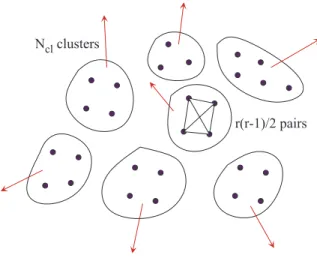
r ( r - 1 ) / 2 p a i r s N c l c l u s t e r s
FIG. 1: The cluster picture of correlations. Particles are grouped inNclclusters, containing on the averagerparticles. The particles within a cluster move at very similar collective velocities, indicated by arrows.
hM2i =
∑
n
P(n) Z
d p1. . .d pnM2ρn(p1, . . . ,pn)
=
∑
n
P(n) n hp
2
in (10)
+
∑
n
P(n) n2
"
n
∑
i,j=1,j6=i
covn(pi,pj) +n(n−1)hpi2n
#
.
III. ANALYSIS OF THE PHENIX DATA
At first we discuss the PHENIX measurement [2] of the event-by-event fluctuations of the mean transverse momen-tum at√sNN =130 GeV. We use the experimental fact that
the variance of the momentum distribution and its mean are independent of centrality (in the considered range), which al-lows us to replace the quantitieshpinbyhMiandhp2in−hpi2n
byσ2
pat the average multiplicity, denoted asσ2p,hni. In this
way we get
σ2
M=σ2p,hni
∑
nP(n) n +
∑
nP(n) n2
"
n
∑
i,j=1,j6=i
covn(pi,pj)
#
.(11)
In the mixed events, by construction, particles are not corre-lated, hence the covariance term in Eq. (11) vanishes and
σ2M,mix=σ2p,hni
∑
n
P(n) n ≃σ
2
p,hni
µ
1
hni+
σ2
n
hni3+. . .

, (12)
Brazilian Journal of Physics, vol. 37, no. 2C, June, 2007 713
mixing procedure, subtracting (12) from (11) yields
σ2dyn =
∑
n
P(n) n2
n
∑
i,j=1,j6=i
covn(pi,pj)
≃ 1
hni2
hni
∑
i,j=1,j6=i
covhni(pi,pj). (13)
IV. CLUSTER EXPLANATION
The scaling of the dynamical fluctuations withhni, see the last row of Table I and Eq. (3), may be regarded as a constraint restricting the behavior of the covariance term. For instance, one can immediately conclude that if all particles were corre-lated to each other,∑ni,j=1,j6=icovhni(pi,pj)would be
propor-tional to the number of pairs, andσdynwould not depend on hniat large multiplicities. A natural explanation of the scaling (3) comes from the cluster model, depicted in Fig. 1. The sys-tem is assumed to haveNclclusters, each containing (on the average)rparticles. Below we keepr=const.for simplicity (a more general case is discussed in Ref. [1]). The particles are correlated if and only if they belong to the same cluster, where the covariance per pair is 2 cov∗. The number of corre-lated pairs within a cluster isr(r−1)/2. Some particles may be unclustered, hence the ratio of clustered to all particles is hNclir/hni=α. If all particles are clustered thenα=1. With these assumptions Eq. (13) becomes
σ2 dyn=
α(r−1)
hni cov
∗, (14)
which complies to the scaling (3). An immediate conclusion here is that the ratioαcannot depend onhni(in the considered centrality range,c=0−30%) in order for the scaling to hold. The question now is whether we can use the above results to draw conclusions on effects of jets (minijets), which have been proposed as a possible explanation of the experimental
data even at the considered soft momenta [21]. Jets, when fragmenting, lead to clusters in the momentum space. The resulting full covariance from jets is thenNcl,jetj(j−1)cov
j
hni2,
whereNcl,jet is the number of clusters originating from jets, jis the average number of particles in the cluster, and 2 covj is the average covariance per pair. The total number of par-ticles produced from jets isNcl,jetj. On the other hand, the commonly accepted estimate of the dependence ofNcl,jetjon centrality is accounted for by the nuclear modification factor RAAmultiplied by the number of binary nucleon-nucleon
col-lisonsNbin. SinceRAAdepends on the ratiohni/hnipp, where
hnippis the multiplicity in the proton-proton collisions, in a
givenpT bin one finds
Ncl,jetj∼RAANbin= h ni Nbinhnipp
Nbin∼ hni, (15)
which complies to the scaling of Eq. (14).
V. CONCLUSIONS
The observed scaling of the dynamical fluctuations of mean transverse-momentum may be naturally explained by the clus-ter model. We emphasize that the scaling follows from the presence of clusters only, and is insensitive to the nature of their physical origin as long as one imposes the condition Ncl∼ hni.
The explanation of the observed data in terms of quenched jets agrees with the cluster picture. However, the explanation of the centrality dependence of thepT fluctuations in terms of
jets based solely on Eq. (15) is not decisive: any mechanism leading to clusters would do, for instance the thermal clusters discussed in Ref. [1] or mechanisms of Ref. [24]. Micro-scopic realistic estimates of the magnitude of covj and jare necessary in that regard, including the interplay of the jets and medium. In short, the nature of clusters remains an open issue. For the current status of this program the reader is referred to [22, 25].
[1] W. Broniowski, B. Hiller, W. Florkowski, and P. Bozek, Phys. Lett. B635, 290 (2006).
[2] K. Adcox,et al., PHENIX, Phys. Rev. C66, 024901 (2002). [3] J. Adams,et al., STAR, Phys. Rev. C71, 064906 (2005). [4] J. Adams,et al., STAR, Phys. Rev. C72, 044902 (2005). [5] M. Gazdzicki, S. Mrowczynski, Z. Phys. C54, 127 (1992). [6] L. Stodolsky, Phys. Rev. Lett.75, 1044 (1995).
[7] E. V. Shuryak, Phys. Lett. B423, 9 (1998). [8] S. Mrowczynski, Phys. Lett. B430, 9 (1998).
[9] M. A. Stephanov, K. Rajagopal, and E. V. Shuryak, Phys. Rev. D60, 114028 (1999).
[10] S. A. Voloshin, V. Koch, and H. G. Ritter, Phys. Rev. C60, 024901 (1999).
[11] H. Appelshauser,et al., NA49, Phys. Lett. B459, 679 (1999). [12] R. Korus, S. Mrowczynski, M. Rybczynski, and Z. Wlodarczyk,
Phys. Rev. C64, 054908 (2001).
[13] G. Baym, H. Heiselberg, Phys. Lett. B469, 7 (1999). [14] A. Bialas, V. Koch, Phys. Lett. B456, 1 (1999).
[15] M. Asakawa, U. W. Heinz, and B. Muller, Phys. Rev. Lett.85, 2072 (2000).
[16] H. Heiselberg, Phys. Rept.351, 161 (2001).
[17] C. Pruneau, S. Gavin, and S. Voloshin, Phys. Rev. C66, 044904 (2002).
[18] S. Jeon, V. Koch, inQuark-Gluon Plasma 3eds. R.C. Hwa and X.-N. Wang, World Scientific Singapore.
[19] S. Gavin, Phys. Rev. Lett.92, 162301 (2004).
[20] M. Abdel-Aziz, S. Gavin, Nucl. Phys, A774, 623 (2006). [21] S. S. Adler,et al., PHENIX, Phys. Rev. Lett.93, 092301 (2004). [22] Q.-J. Liu, T. A. Trainor, Phys. Lett. B567, 184 (2003). [23] A. Kisiel et al., Comput. Phys. Commun.174, 669 (2006). [24] J. Randrup, talk at the International Workshops on Critical Point
and Onset of Deconfinement, July 3-9, 2006, Florence, Italy . [25] International Workshops on Critical Point and