VARIATIONS OF MESOZOOPLANKTON COMPOSITION IN A
EUTROPHICATED SEMI-ENCLOSED SYSTEM
(ENCERRADA BAY, TIERRA DEL FUEGO, ARGENTINA)
Florencia Biancalana*1 and Amèrico I. Torres2
1Instituto Argentino de Oceanografía (IADO-CONICET)
(Con. La Carrindanga Km. 7,5 - CC 804 (B 8000 FWB) Bahía Blanca, Argentina)
2Centro Nacional Patagónico (CENPAT-CONICET)
(Bvd. Brown 2915, U9120ACD Puerto Madryn, Chubut, Argentina)
*Corresponding author: [email protected]
Anthropogenic eutrophication of coastal waters caused by sewage discharge and agricultural runoff is currently one of the most serious problems in the world (SMITH et al., 1999; CLOERN, 2001; TETT et al., 2003). The increase in primary productivity, which is accompanied by a deterioration of water and sediment quality, is due to nutrient and organic matter enrichment (NIXON, 1995; COSTANZO et al., 2001). The latter: i) favuors the conditions for phytoplankton bloom development, ii) increases the abundance of certain zooplankton taxa and iii) decreases zooplankton community diversity (SMITH et al., 1999; URIARTE; VILLATE, 2004; THOMPSON et al., 2007).
Bio-indicator species evidencing the environmental quality of the system can be found among zooplankton. For example, species belonging to the genera Acartia and Eurytemora have been associated with areas of human disturbance (UYE et al., 1992; BIANCHI et al., 2003; CAULLEAUD et al., 2009).
Encerrada Bay (EB) is located off the coast of Ushuaia city, Argentina (54º49S - 68º19W) and receives the discharge of three sewage effluents (Onas, Guaraní and Beban) and Buena Esperanza stream (BES) (Fig. 1). The latter transports thaw water from Martial glacier, which is enriched with wastewater from Ushuaia city. Buena Esperanza stream has a flow range between 0.3 and 3.0 m3seg-1 depending on rain
and thaw periods and the flow of the other effluents does not attain 0.01 m3 seg-1 (TORRES et al., 2009).
Encerrada Bay covers a total area of ~0.3 km2 and has
a medium depth of 0.8 m. It communicates with Ushuaia Bay (UB) through two 4.5 m long pathway vents (P1 and P2). Water exchange between EB and UB takes place through these vents at a rate of ~1 m3
seg-1 during semidiurnal tidal cycles. Water with low
nutrient concentration enters EB during flood tide and water with high nutrient concentration flows out of UB during ebb tide (TORRES et al., 2009).
The aim of the present study was to analyze EB mesozooplankton composition in the light of the physico-chemical parameters of the water column. Particular attention was paid to the presence of opportunistic species which adapt favourably to EB's environmental conditions.
Sampling was carried out in December, 2004 and March and September, 2005. Mesozooplankton samples were collected at ebb tide for 5 minutes using a 200 µm mesh-0.30 m open mouth net containing a mechanical RIGOSHA® flowmeter. Qualitative and quantitative analyses were carried out under a Wild M5 stereomicroscope. Organism count was made by means of aliquots extracted at random from the homogenized samples until 10% of each sample was completed (BOLTOVSKOY, 1981). Temperature, salinity, dissolved oxygen, pH, ammonium (NH4+),
nitrate+nitrite (NO3-), phosphate (PO4-3), silicate
(SiO3-2), chlorophyll a (chl. a) and phaeophytin values
were taken from Torres et al. (2009). Shannon-Wiener diversity (H'-log 2) and Simpson dominance (λ)
indexes (PIELOU, 1975) were calculated from mesozooplankton taxa and abundance using Primer 5 software (CLARKE; WARWICK, 1994).
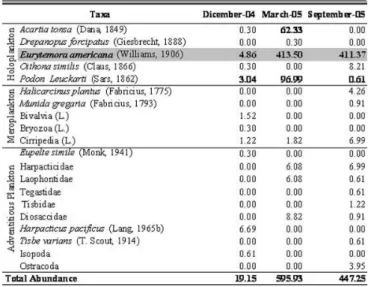
Twenty taxa corresponding to Arthropoda, Bryozoa and Mollusca phyla were found in the mesozooplankton samples. Holoplankton and meroplankton were represented by five taxa (Table 1). Ten taxa corresponded to adventitious plankton, eight of which belonged to Harpacticoida copepods. Taxa number was highest (13 taxa) in September and lowest (7 taxa) in March (Fig. 2). Total abundance ranged from 19.1 ind. m-3 (December) to 595.9 ind. m-3
(March) (Table 1). Whitin holoplankton, Eurytemora americana and Podon leuckarti evidenced highest abundance in March (413.5 ind. m-3 and 97.0 ind. m-3,
respectively) and both were present throughout the study period. Acartia tonsa was present in December and March, abundance being highest (62.3 ind. m-3) in
were present throughout the period studied. Abundance attained its highest values in September. On the other hand, adventitious plankton did not exceed 8.8 ind. m-3 (Diosaccidae family) (Table 1).
The highest Shannon diversity values (H'=2.5) and the
lowest Simpson dominance indexes (λ=0.2) were recorded in December (Fig. 2). An inverse pattern was observed in September and intermediate values of both indexes were found in March.
Table 1. Mesozooplankton abundance (ind. m-3) at P1 pathway vent in EB. L.: Larvae
Fig. 2. Taxa number (TN), Shannon Diversity index (H'), Simpson Dominance (λ), Total abundance and E. americana abundance (ind. m-3) in EB.
The physical, chemical and biological characteristics of the water mass passing through the vents were analyzed in detail by Torres et al. (2009). According to thoseauthors, NH4+ concentration in the
water mass coming from EB was high in December (60.9 µM) and March (59.5 µM) and it decreased in September (7.4 µM) while NO3- concentration
evidenced an inverse pattern (5.1; 7.6 and 18.9 µM, respectively). Furthermore, SiO3-2 (29.4 µM)
concentration was found to be highest and salinity values lowest in March coinciding with the rainy period. An inverse pattern was observed in September when there was no freshwater contribution from thaw water. It was also found that phosphate concentration did not exceed 3 µM. Chlorophyll a concentration increased in September (5.8 mg m-3) coincidentally
with the period of low temperature, low NH4+
concentration and high salinity values and NO3
-concentration. These nutrients did not evidence limited concentration and favoured the growth of macroalgae such as Ulva rigida, Enteromorpha intestinales, Cladophora falklandica, Porphyra woolhouseae and Pilayella littoralis. EB sediment presented anoxic conditions (redox potential ~-300 mV) and high organic matter content(7.8 - 18.9 %) (TORRES et al., 2009).
Zooplankton communities undergo changes firstly due to a decrease in total abundance and taxa number, and after to an increase in the abundance of some opportunistic species (decrease in the diversity index). This is a common phenomenon in EB as well as in areas affected by human disturbance
and/or eutrophication (SIOKOU-FRANGOU; PAPATHANASSIOU, 1991; PARK; MARSHALL, 2000). Taxa number and Shannon Diversity were lower in EB than at a station close to the connection between EB and UB during the same period. This could be indicative of the presence of an anthropogenic perturbation gradient which increases towards the connection between EB and UB. On the other hand, total mesozooplankton abundance was high mainly in March and September as a result of the presence of E. americana. In addition, the highest availability of nutrients in EB water together with favourable light and temperature conditions were found to facilitate the activity of primary producers, thus giving support to high mesozooplankton abundance values. E. americana is a herbivorous species (HOFFMEYER; PRADO-FIGEROA, 1997) which was introduced into the southern hemisphere and has been cited in Bahía Blanca estuary (HOFFMEYER, 1994) as well as in UB and
Golondrina bay (FERNÁNDEZ-SEVERINI;
HOFFMEYER, 2004; BIANCALANA, 2009). This species is well adapted to low temperatures and intermediate salinities (SAGE; HERMAN, 1972; AVENT, 1998), both of which are conditions that prevailed during March and September, when E. americana evidenced highest abundance.
demonstrated that an increase in temperature, photoperiod and radiation and a decrease in salinity augmented the abundance of both taxa (ROSENBERG; PALMA, 2003; HOFFMEYER et al., 2008). Although E. americana, A. tonsa and P. leuckarti have been associated with anthropogenic disturbance, the factibility of the co-existence of these three species could be due to differences in their feedingbehavior, A. tonsa and P. leuckarti being, in fact, omnivorous (JAGGER et al., 1999; KLEPPEL et al., 1988; HOFFMEYER; PRADO-FIGEROA, 1997; BIANCHI et al., 2003; HOFFMEYER, 2004). The decrease observed in their abundances in September could be associated with a change in salinity and temperature conditions. Meroplankton abundance was low and only Cirripedia larvae, which were probably associated with phytoplankton biomass, were found during the study period. Adventitious plankton, which could be associated with the presence of significant macroalgae biomass, was observed in March and September. Thus, the low grazing pressure was correlated with intermediate levels of chl. a, though not with high nutrient concentrations.
In view of the above, the gradual variability in mesozoplankton composition, diversity and abundance from EB to UB seems to respond not only to the availability of resources such as phytoplankton biomass but also to the changes in salinity and temperature in EB. This, in turn, seems to favour the presence of certain opportunistic taxa such as E. americana, P. leuckarti and A. tonsa that are potential bio-indicators and which seem to find in EB and in areas close to UB, conditions appropriate for their development (Biancalana, 2009). These species may therefore become useful water quality bio-indicators. The findings of this present study lead us to conclude that further research on samples from EB, as well as from the connecting area between EB and UB, should be conducted - taking into account particularly the changes occurring in the mesozooplankton community, with special emphasis on copepod species and their relationship to water quality.
A
CKNOWLEDGEMENTSFunds were provided by FONCYT-ANPCyT (PICTR090/2002). We are grateful to i) the staff of the Centro Austral de Investigaciones Científicas (CONICET) for their collaboration during the sampling period; ii) Lic. Alicia Nizovoy for her technical assistance in identifying algae species, and iii) Dr. M.S. Hoffmeyer and Dr. M.N. Gil for their suggestions and support during this research project.
R
EFERENCESBIANCHI, F.; ACRI, F.; BERNARDI AUBRY, F.; BERTON, A.; BOLDRIN, A.; CAMATTI, E.; CASSIN, D.; COMASCHI; A. Can plankton communities be considered as bio-indicators of water quality in the Lagoon of Venice? Mar. Pollut. Bull., v. 46, p. 964-971,
2003.
BOLTOVSKOY, D. Características biológicas del Atlántico Sudoccidental. In: BOLTOVSKOY, D. (Ed.). Atlas del zooplancton de Atlántico Sudoccidental y métodos de trabajo con el zooplancton marino. Mar del
Plata-INIDEP, 1981. p. 239-248.
CAULLEAUD, K.; FORGET-LERAY, J.; PELUHET, L.; LEMENACH, K.; SOUISSI S.; BUDZINSKI, H. Tidal influence on the distribution of hydrophobic organic contaminants in the Seine Estuary and biomarker responses on the copepod Eurytemora affinis. Environ. Pollut., v. 157, n. 1, p. 64-71, 2009.
CLARKE, K. R.; WARWICK, R. M. Change in marine communities: An approach to statistical analysis and interpretation. Cambridge, U. K.: Natural Environment Research Council, 1994. 126 p.
CLOERN, J. E. Our evolving conceptual model of the coastal eutrophication problem. Mar. Ecol. Prog. Ser., v. 210, p. 223-253, 2001.
COSTANZO, S. D.; ODONOHUE, M. J.; DENNISON, W. C.; LORENAGAN, N. R.; THOMAS, M. A new approach for detecting and mapping sewage impacts.
Mar. Pollut. Bull., v. 42, n. 2, p. 149-156, 2001. FERNÁNDEZ-SEVERINI, M. D.; HOFFMEYER, M. S.
Mesozooplankton assemblages in two different bays in the Beagle Channel (Argentina) during January, 2001.
Sci. Mar., v. 69, n. 2, p. 27-37, 2005.
HOFFMEYER, M. S. Seasonal succession of Copepoda in the Bahía Blanca estuary. Hydrobiologia, v. 292/293, p. 303-308, 1994.
HOFFMEYER, M. S. Decadal change in zooplankton seasonal succession in the Bahía Blanca estuary, Argentina, following introduction of two zooplankton species. J. Plankt. Res., v. 26, n. 2, p.1-9, 2004.
HOFFMEYER, M. S.; PRADO-FIGUEROA, M. Integumental structures in the oral field of Eurytemora affinis and Acartia tonsa (Copepoda, Calanoida) in relation to their trophic habits. Crustaceana, v. 70, p. 257-271, 1997.
HOFFMEYER, M. S.; BERASATEGUI, A. A.; BEIGT, D.; PICCOLO, M. C. Environmental regulation of the estuarine copepods Acartia tonsa and Eurytemora americana during coexistence period. J. mar. Bio. Ass. U.K., v. 89, n.2, p. 355-361, 2008.
JAGGER, Z. Selective stream transport of the flounder larvae (Platichthys flesus L.) in the Dolard (Ems Estuary). J. mar. Bio. Ass. U.K, v. 75, p. 3-13, 1999.
KLEPPEL, G. S.; FRAZELD, D.; PIEPER, R. E.; HOLLIDAY, D. V. Natural diets of zooplankton off southern California. Mar. Ecol. Prog. Ser., v. 49, p.
231-241, 1988.
PARK, G. S.; MARSHALL, H. G. Estuarine relationships between zooplankton community structure and trophic gradients. J. Plankt. Res., v. 22, p. 121-135, 2000. PIELOU, E. C. Ecological diversity. New York: J. Wiley,
1975. 165 p.
ROSENBERG, P.; PALMA, S. Cladóceros de los fiordos y canales patagónicos localizados entre le golfo de Penas y el estrecho de Magallanes. Inv. mar, v. 31, n. 1, p. 15-24, 2003.
SAGE, L. E.; HERMAN, S. S. Zooplankton of the Sandy Hook Bay Area, N.J. Chesapeake Sci.., v. 13, p. 29-39,
1972.
SIOKOU-FRANGOU, I.; Papathanassiou, E. Differentiation of zooplankton populations in a polluted area. Mar. Ecol. Prog. Ser., v. 76, p. 41-51, 1991.
SMITH, V. H.; TILMAN, G. D.; NEKOLA, J. C. Eutrophication: impacts of excess nutrient inputs on freshwater, marine, and terrestrial ecosystems. Environ. Pollut., v. 100, p. 179-196, 1999.
TETT, P.; GILPIN, L.; SVENDSEN, H.; ERLANDSSON, C. P.; LARSSON, U.; KRATZER, S.; FOUILLAND, E.; JANZEN, C.; LEE, J. Y.; GRENZ, C.; NEWTON, A.; FERREIRA, J. G.; FERNANDES, T.;SCORY, S. Eutrophication and some European waters of restricted exchange. Continent. Shelf Res., v. 23, p.1635-1671, 2003.
TORRES, A. I.; GIL, M. N.; AMÍN, O.; ESTEVES, J. L. Environmental Characterization of a Eutrophicated Semi-Enclosed System: Nutrient Budget (Encerrada Bay, Tierra del Fuego Island, Patagonia, Argentina). Water Air Soil Pollut., v. 204, p. 259-270, 2009.
THOMPSON, B.; ADELSBACH, T.; BROWN, C.; HUNT, J.; KUWABARA, J.; NEALE, J.; OHLENDORF, H.; SCHWARZBACH, S.; SPIES, R., TABERSKI, K. Biological effects of anthropogenic contaminants in the San Francisco Estuary. Environ. Pollut., v. 105, p.156-174, 2007.
URIARTE, I.; VILLATE, F. Effects of pollution on zooplankton abundance and distribution in two estuaries of the Basque coast (Bay of Biscay). Mar. Pollut. Bull., v. 49, p.220-228, 2004.
UYE, S.; AYAKI, Y.; ONBÉ, T. Seasonal geographical distribution of zooplankton in Hiroshima Bay and its adjacent waters, the inland Sea of Japan. J. Fac. appl. Biol. Sci., v. 31, p. 99-119, 1992.
Sources of Unpublished Material
AVENT, S. R. Distribution of Eurytemora americana
(Crustacea, Copepoda) in the Dwamish River estuary. Report of Project. School of Oceanography, University of Washington, USA, 1988. 15 p.
BIANCALANA, F. Dinámica del mesozooplancton y su regulación ambiental en las bahías Ushuaia y Golondrina. Ph. D. Thesis, Universidad Nacional del
Sur, Bahía Blanca, Buenos Aires, 2009. 195 p