Article
0103 - 5053 $6.00+0.00
*e-mail: [email protected]
Dipeptide Synthesis in Biphasic Medium: Evaluating the use of Commercial Porcine
Pancreatic Lipase Preparations and the Involvement of Contaminant Proteases
Cleber W. Liria, Carolina D. Romagna, Nicolas N. Rodovalho, Sandro R. Marana and M. Terêsa M. Miranda*
Departamento de Bioquímica, Instituto de Química, Universidade de São Paulo, CP 26077, 05513-970 São Paulo-SP, Brazil
Sínteses bem sucedidas de dipeptídeos a partir de Ac-L-Tyr-OEt ou Z-L-X-OMe (X: Asp,
Tyr, Phe, Arg, Lys ou Thr) e glicina amidada em meio reacional bifásico foram realizadas usando dois tipos de preparações comerciais de lipase pancreática suína (PPL) (bruta (cPPL) e purificada (pPPL)). Nas mesmas condições reacionais, a α-quimotripsina, protease pancreática que também apresenta atividade esterásica, catalisou a síntese de Ac-L-Tyr-Gly-NH2 com alta produtividade. Na maioria das sínteses também ocorreu a hidrólise do produto formado. Eletroforese em gel de poliacrilamida, ensaios enzimáticos com substratos cromogênicos específicos e cromatografia de exclusão molecular demonstraram que cPPL e pPPL apresentam proteases contaminantes e, portanto, atividades esterásica e amidásica. Em conjunto, esses resultados indicam que tais proteases, e não a PPL, possam ser os catalisadores majoritários da síntese da ligação peptídica quando ésteres de Nα-acil-L-aminoácidos e preparações comerciais de PPL são usados. Por outro
lado, tais dados não contradizem a possibilidade de usar cPPL como fonte barata de catalisadores para a síntese de dipeptídeos em condições reacionais brandas.
Dipeptide syntheses starting from Ac-L-Tyr-OEt or Z-L-X-OMe (X: Asp, Tyr, Phe, Arg, Lys or
Thr) and glycine amide in biphasic reaction media were achieved using two commercially available porcine pancreatic lipase (PPL) preparations (crude (cPPL) and purified PPL (pPPL)). Under the mild conditions employed, α-chymotrypsin, a pancreatic protease that also presents esterase activity, catalyzed Ac-L-Tyr-Gly-NH2 synthesis with high productivity. Product hydrolysis also
occurred in most of the syntheses studied. Polyacrylamide gel electrophoresis, enzymatic assays employing specific chromogenic substrates and size-exclusion chromatography revealed that cPPL and pPPL contain contaminant proteases and, therefore, exhibit esterase and amidase activities. Overall, these data indicate that those contaminants may be the main catalysts of peptide bond synthesis when Nα-blocked-L-amino acid esters andthe commercial PPL preparations are used.
On the other hand, such data do not contest the possibility of using such enzyme preparations as an inexpensive source of catalysts for dipeptide synthesis under soft conditions.
Keywords: biocatalysis, enzymes, peptide bond synthesis, n-hexane
Introduction
In the last decade, interest in environment friendly technologies has increased drastically. As a result, the ability of enzymes to catalyze reactions required for the manufacture of fine chemicals has been explored extensively.1
Proteases that also present esterase activity have been widely used to catalyze reactions related to peptide synthesis, such as ester hydrolysis, esterification, transesterification and peptide bond formation.2,3 However,
it is well known that the main concern in protease-catalyzed peptide bond synthesis is protease-catalyzed product consumption.4-6 Therefore, the following approaches
have been used to minimize such an undesirable reaction: (i) continuous removal of the product from the reaction
medium by precipitation7,8 or extraction;9 (ii) freezing of
the reaction;10 (iii)use of an esterified N-acyl-amino acid
or Nα-acyl-peptide as acyl donor;11 (iv) use of a mimetic
substrate;12 and (v) use of a chemically modified or mutant
protease.13
On the other hand, many authors have attempted to use other biocatalysts for peptide bond synthesis.14 Among
mediate the hydrolysis of triacylglycerides into mono, diacylglycerides, fatty acids and glycerol through the formation of an acyl-enzyme intermediate followed by deacylation with water.15 Indeed, it has been reported the
use of commercial lipases in peptide bond syntheses starting from Nα-blocked-amino acid esters (acyl donors) and amino
acid or peptide amides (acyl acceptors).16-19 Nevertheless,
many authors have claimed that these enzyme preparations present amidase activity, due to contaminant proteases.20,21
Hence, they could also lead to the undesired hydrolysis of the product formed.
Within this context and knowing that the market for fine chemicals such as synthetic peptidesis very healthy22
and requires cleaner technologies, we evaluated the use of porcine pancreatic lipase (PPL) preparations in peptide bond formation in biphasic reaction media as well as the involvement of the contaminant proteases in the process. For these purposes, two commercially available PPL preparations (crude, cPPL, and purified, pPPL) were used in dipeptide synthesis trials starting from a few Nα-blocked -L-amino acid esters (acyl donors) and glycine amide (acyl
acceptor), these enzyme preparations were analyzed by gel electrophoresis and had their lipase activity measured. cPPL was also assayed against chromogenic substrates typically recognized by proteases and submitted to size-exclusion liquid chromatography.
Experimental
Chemicals and enzymes
Crude PPL (cPPL; Type II, L-3126), Nα
-benzyloxycarbonyl-glycyl-L-phenylalanine (Z-Gly
-L-Phe) and the diagnostic kit for the standard titrimetric determination of lipase activity were obtained from Sigma Chemical Co. (St. Louis, MO, USA). The purified PPL (pPPL; IC398) was from Elastin Products Co. (Owensville, MO, USA). α-Chymotrypsin and trypsin were donated by Biobrás/Novo Nordisk Brazil (Montes Claros, Brazil). Tris(hydroxymethyl)aminomethane hydrochloride (Tris-HCl), spectroscopy-grade trifluoroacetic acid (TFA), analytical-grade n-hexane, synthesis-grade triethylamine
(TEA) and high-performance liquid chromatography (HPLC)-grade acetonitrile (ACN) were purchased from Merck KGaA (Darmstadt, Germany). The Nα-acyl-L-amino
acid esters Ac-Tyr-OEt, Z-Asp-OMe, Z-Phe-OMe, Z-
Thr-OMe, Z-Arg-OMe, Z-Lys-OMe (where, Ac is acetyl, Z
is benzyloxycarbonyl, Me is methyl, Tyr, Asp, Phe, Thr, Arg and Lys are tyrosine, aspartic acid, phenylalanine, threonine, arginine and lysine, respectively) and glycine amide hydrochloride (Gly-NH2.HCl) were acquired from
Bachem (Torrance, CA, USA). Nα-benzoyl-DL-arginine-p
-nitroanilide (Bz-DL-Arg-pNA) and Nα-benzoyl-L- tyrosine-p-nitroanilide (Bz-L-Tyr-pNA) were obtained from
Nakarai Chemicals Ltd. (Kyoto, Japan). The compound
p-nitrophenyl palmitate (pNPP) was purchased from Fluka
Reidel-deHaën (Seelze, Germany).
Lipase activity in cPPL and pPPL using olive oil as substrate
One milliliter of enzyme solution (2 mg mL-1 in
0.2 mol L-1 Tris-HCl buffer, pH 8), 2.5 mL of water, 1.0 mL of
buffer and 3.0 mL of 50% olive oil/water were incubated for 6 h at 37 °C under orbital shaking at 300 rpm. The amount of fatty acids formed in the mixture was determined by titration with 0.05 mol L-1 NaOH/water, using 0.9% thymolphthalein
as indicator.23 One unit of lipase activity was defined as
the amount of enzyme that, under test conditions, releases 1 µequiv. of fatty acid per hour. Therefore, lipase activity
was expressed as units per mg of solid (U mg-1).
Lipase activity in cPPL and pPPL using pNPP as substrate
Used only for qualitative purpose: to screen the fractions resultant from size-exclusion liquid chromatography of cPPL.24 pNPP (non-colored substrate; 75.5 mg)
was dissolved in isopropanol (100 mL). An aliquot of the resulting solution was diluted (1:10, v:v) in 55 mmol L-1 phosphate buffer, pH 7.0, containing 1.33%
4-(1,1,3,3-Tetramethylbutyl)phenyl-polyethyleneglycol (Triton X-100). Fifty microliters-aliquots of such mixture were dispensed into a 96-well microtiter plate. Enzyme solution (50 µL) previously incubated at 37 °C was added and the reaction was allowed to occur at 37 °C. The formation of the yellow product (pNP) was monitored spectrophotometrically at 420 nm.
Amidase activity against Bz-DL-Arg-pNA in cPPL
For the assay,25 2.5 mL of 4 mmol L-1 Bz-DL-Arg-pNA/
water and 0.3 mL of 0.03 mmol L-1 phosphate buffer,
pH 8, were placed in a 4.5-mL quartz cuvette. Reaction at room temperature was initiated by adding 0.2 mL of cPPL solution (12.5 µg mL-1 of 0.01 mol L-1 HCl/water).
Monitoring began immediately by following the increase of absorbance at 405 nm for 5 min on a Shimadzu UV-160 1PC spectrophotometer (Shimadzu, Kyoto, Japan) connected to a microcomputer. One unit of activity was defined as the amount of cPPL, which, under test conditions, catalyzed the transformation of 1 µmol of substrate per min. The enzyme activity was expressed as
Amidase activity against Bz-L-Tyr-pNA in cPPL
For the assay,26 2.8 mL of 12 mmol L-1 Bz-L- Tyr-pNA/70 mmol L-1 phosphate buffer, pH 7.6, were placed
in a 4.5 mL quartz cuvette. The reaction at 25 °C was initiated by adding 0.2 mL of cPPL solution (0.5 mg per
mL of 0.01 mol L-1 HCl/water). Monitoring was done as
explained above. The enzyme activity was calculated and expressed as described above.
Amidase activity against Z-Gly-L-Phe in cPPL
The dipeptide27 was dissolved in 20 µL of 80% n-hexane/0.5 mol L-1 Tris-HCl buffer, pH 8, providing a
0.02 mol L-1 solution. The reaction at 37 °C was started
by adding 1 mg of cPPL, followed by orbital shaking at 300 rpm and monitoring immediately and after 1 h. Briefly, the reaction medium was diluted with 980 µL of 50% ACN/0.1% TFA, pH 2.5. Duplicates were analyzed by reversed-phase (RP)-HPLC on a LDC Analytical system [a Constametric 3500, a Constametric 3200 pump, an AS 3000 Spectrasystem autosampler and an UV-Vis Spectromonitor, model 3100 (Thermo Separation Products, San Jose, CA, USA)] connected to a Vydac C18 (5 µm, 300 Å, 4.6 mm × 25.0 cm) column. The linear gradient employed ranged from 5 to 95% B in 30 min (solvent A: 0.1% TFA/water; solvent B: 60% ACN/solvent A) at a flow rate of 1 mL min-1. UV detection was at 210 nm. The
enzyme activity was calculated and expressed as described above.
Gel electrophoresis
The two commercial PPLs employed were analyzed by unidimensional polyacrylamide gel electrophoresis/ sodium dodecyl sulfate (SDS-PAGE) in a 15% polyacrylamide gel at pH 8.8, following the protocol described by Sambrook and coworkers.28 A commercially
available solution containing α-lactalbumin, trypsin inhibitor, carbonic anhydrase, ovalbumin, albumin, and phosphorylase B (14,400-97,000 Da) was used as source of molecular weight markers. Commercially available Candida cylindracea lipases (CCLs) were used
as references as they are considered highly purified. Purified pancreatic trypsin, α-chymotrypsin and carboxypeptidase A were used as authentic standards (proteases that could be present in cPPL and pPPL samples). Proteins were stained with Coomassie Blue R-250 and destained in water:methanol:acetic acid (5:4:1, by volume).
General procedure for peptide bond formation
The reaction was carried out in a volume of 20 µL at a controlled temperature for a given time under orbital shaking at 300 rpm. In a typical procedure, 16 µL of
n-hexane was added to the acyl donor and the acyl acceptor
(amounts required for a 0.05 mol L-1 and 0.5 mol L-1
final solution, respectively) placed in a plastic vial. TEA, equimolar to the acyl acceptor, was added to the resulting mixture. The reaction was started by adding 4 µL of cPPL or pPPL solution (0.25 mg of solid µL-1 of 0.5 mol L-1
Tris-HCl buffer, pH 8). It was ended by dilution with 980 µL of 50% ACN/0.1% TFA (only those with initial volumes intact: 0-80% n-hexane).
Product identification and quantification were achieved by loading an aliquot of the diluted reaction on a Vydac C18 column (5 µm, 300 Å, 4.6 mm × 25.0 cm) connected to the aforementioned LDC analytical HPLC system and eluting under the following conditions: linear gradient from 5 to 95% B in 30 min (solvent A: 0.1% TFA/water; solvent B: ACN/solvent A) at flow rate of 1 mL min-1. UV detection was at 210 nm. The peaks in
the chromatograms were identified by coelution with authentic standards and, in most of the cases, also by RP-HPLC coupled to a mass spectrometer (high resolution mass spectrometry using electrospray ionization; ESI-MS). The quantities of the acyl donor (Nα-acyl-L-amino
acid ester) and products (Nα-acyl-L-amino acid and/
or dipeptide) were calculated using standard curves (peak area vs. quantity) previously obtained. Exception
was made for Z-Asp-Gly-NH2 synthesis trials as we ended, diluted and analyzed the reaction media with initial volumes intact (only those containing 0-80%
n-hexane), identified the RP-HPLC peak corresponding
to the desired product (dipeptide), calculated its area and plotted each area obtained against each n-hexane
percentage employed to determine which would lead to the highest dipeptide synthesis yield.
The enzyme preparation employed in the synthesis of Z-L-Asp-Gly-NH2 was cPPL, the n-hexane contents were
0, 10, 40, 60, 70, 80, 90 and 100% and the temperature was 37 °C. Reactions were performed in duplicate for 0, 5, 10, 20, 30 and 40 min, and 1, 2, 3, 4, 5, 6, 8, 24 and 48 h.
As for the synthesis of Ac-L-Tyr-Gly-NH2 employing
cPPL, pPPL and α-chymotrypsin, all trials were performed in duplicate under the experimental conditions described in Table 1 for 0 and 5 min and 24, 48 and 72 h.
It should be noted that the minimum time required for the reaction mixture to reach 22 or 37 °C was 5 min and that standard deviations were calculated from the peptide synthesis yields obtained (whenever they exceeded 5%, the reactions were repeated).
Dipeptide purification and chemical characterization
The products were purified by RP-HPLC using the aforementioned column, equipment and linear gradient. Solvent B contained the following percentages of ACN: 40% (Z-L-Arg-Gly-NH2, Z-L-Lys-Gly-NH2 and Z-L-
Thr-Gly-NH2), 80% (Z-L-Tyr-Gly-NH2, Z-L-Phe-Gly-NH2);
20% (Ac-L-Tyr-Gly-NH2 and Z-L-Asp-Gly-NH2). The flow
rate was 1 mL min-1. UV detection was at 210 nm.
The identities of the purified peptides were determined by RP-HPLC coelution with authentic standards, total hydrolysis followed by amino acid analysis of the hydrolyzates obtained and by ESI-MS analysis. Peptide total acid hydrolysis was performed on a Waters Pico-Tag workstation (Milford, USA). The amino acid analysis of the hydrolyzate was performed with a Beckman model 7 300 automated amino acid analyzer (Palo Alto, USA). ESI-MS was performed by direct injection using a Quattro II triple quadrupole instrument (Micromass Ltd., Manchester, UK), positive module, cone voltage of 20 V and capillary voltage of 3 kV.
Size-exclusion liquid chromatography of cPPL
cPPL (13 mg) was dissolved in 50 mmol L-1 phosphate
buffer, pH 7.0 (1.5 mL) and loaded on a size-exclusion column (Superose 12 10/300 GL, 10 × 300-310 mm, 24 mL, 11 µm; Amersham Biosciences, Uppsala, Switzerland) connected to a fast protein liquid chromatography (FPLC) system (LKB, Pharmacia, Switzerland). Elution was
achieved with 50 mmol L-1 phosphate buffer, pH 7.0 at the
flow rate of 0.5 mL min-1. UV detection was at 280 nm.
All fractions collected were assayed on a microtiter plate against the following chromogenic substrates: pNPP (lipase
activity), Bz-L-Tyr-pNA (amidase activity) and Bz
-L,D-Arg-pNA (amidase activity). The microtiter plate reader
was a Biotek, model ELX 800.
Results
Synthesis of Z-L-Asp-Gly-NH2 using cPPL: efficiency as a
function of n-hexane content
The relatively low boiling point of n-hexane (69 °C)
and the very small volume of the reaction media (20 µL) strongly suggested that solvent evaporation could occur. Therefore, we monitored the volumes of all reaction media. While significant and moderate evaporation occurred in 100% and 90% n-hexane, respectively, no reduction of the
reaction media volume was observed in lower percentages (0-80%). Additionally, the acyl acceptor did not dissolve in pure n-hexane. Therefore, we did not analyze the
reaction media containing 100% and 90% n-hexane, and
considered reliable only the results obtained with 0-80%
n-hexane. Consequently, Figure 1 shows the time courses
of Z-L-Asp-Gly-NH2 synthesis in buffer containing 0 to
80% n-hexane. It can be seen that the maximum synthesis
yields were reached at 70-80%.
Synthesis of Ac-L-Tyr-Gly-NH
2 in 80% n-hexane using cPPL and pPPL: efficiency as a function of the ionization state, concentration of the acyl acceptor or temperature
The time courses of Ac-L-Tyr-Gly-NH2 syntheses in
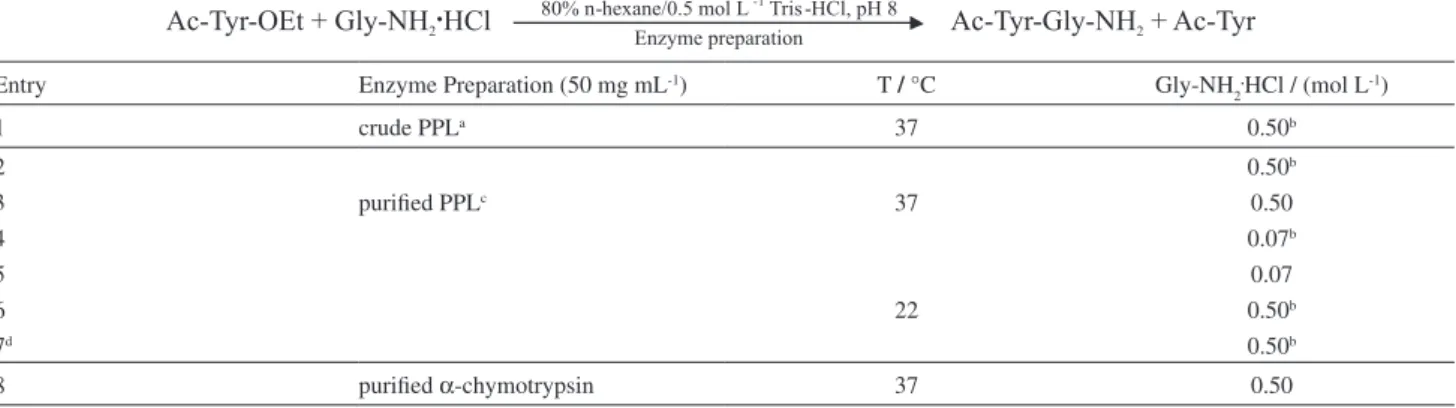
80% n-hexane/buffer at 37 °C, shown in Figure 2, reveal Table 1. Ac-Tyr-Gly-NH2 synthesis trials performed
Entry Enzyme Preparation (50 mg mL-1) T / °C Gly-NH
2
.HCl / (mol L-1)
1 crude PPLa 37 0.50b
2 0.50b
3 purified PPLc 37 0.50
4 0.07b
5 0.07
6 22 0.50b
7d 0.50b
8 purified α-chymotrypsin 37 0.50
Ac-Tyr-OEt concentration: 0.05 mol L-1; total volume: 20 µL; a,cLipase units in the reaction media: 48, 19 respectively; bGly-NH
2.HCl was pre-neutralized
that peptide bond was formed with approximately 86% yield in 5 min when the acyl acceptor was Gly-NH2 (Gly-NH2.HCl preneutralized with triethylamine) and the enzyme
preparation was cPPL or pPPL (entry 1 or 2 in Table 1). Concerning the trials at 37 °C using pPPL, reduction of Gly-NH2 concentration (7-fold; trial 4 in Table 1), use of Gly-NH2.HCl (trial 3) or reduction of Gly-NH
2.HCl
concentration (trial 5) led to coupling yields of 41, 57 or 32% in 5 min, respectively. On the other hand, a temperature reduction to 22 °C (trial 6) did not decrease the coupling yield. In buffer at 22 °C (trial 7), a monophasic reaction medium, the dipeptide synthesis yield reached 67% in 5 min. When the incubations were prolonged to 24, 48 and 72 h, consumption of the dipeptide formed was observed.
Synthesis of Ac-L-Tyr-Gly-NH2 in 80% n-hexane using
α-chymotrypsin as catalyst
The reaction carried-out in 80% n-hexane/buffer at
37 °C in the presence of purified α-chymotrypsin (trial 8
in Table 1) provided the desired dipeptide with 78% yield in 5 min.
Synthesis of Z-L-X-Gly-NH
2 (where X is Phe, Tyr, Thr, Arg, Lys and Asp) in 80% n-hexane using cPPL
As shown in Figure 3, Z-L-Phe-OMe, Z-L-Thr-OMe,
Z-L-Arg-OMe and Z-L-Lys-OMe also acted as acyl donors
in coupling reactions with Gly-NH2.HCl (neutralized with
equimolar amount of TEA) in the presence of cPPL. The reactions starting from Z-L-Tyr-OMe, Z-L-Phe-OMe, Z
-L-Arg-OMe and Z-L-Lys-OMe were faster than those starting
from Z-L-Thr-OMe and Z-L-Asp-OMe. As observed in
the Z-L-Tyr-Gly-NH2 synthesis trials, Z-L-Phe-Gly-NH2,
Z-L-Arg-Gly-NH2 and Z-L-Lys-Gly-NH2 formed in the
reaction media were partially hydrolyzed in long-term incubations (48-51 h).
Dipeptide characterization
Amino acid and ESI-MS analyses of purified dipeptides provided the following results. Found (Z-L-Asp-Gly-NH2):
Asp 1.0 (1.0), Gly 1.0 (1.0); [M + H]+ 323.0 (323.3); Ac-L-
Tyr-Gly-NH2: Tyr 0.9 (1.0), Gly 1.1 (1.0); [M + H]+ 280.2 (280.3);
Z-L-Arg-Gly-NH2:Arg 1.0 (1.0), Gly 0.9 (1.0); [M + H]+ 365.3
(365.2); Z-L-Lys-Gly-NH2: Lys 1.0 (1.0), Gly 1.1 (1.0); [M +
H]+ 337.0 (336.2); Z-L-Phe-Gly-NH
2: Phe 1.0 (1.0), Gly 1.1
(1.0); [M + H]+ 356.3 (355.4); Z-L-Tyr-Gly-NH
2:Tyr 1.0 (1.0),
Gly 1.0 (1.0); [M + H]+ 372.0 (371.4); Z-L-Thr-Gly-NH 2:Thr
0.9 (1.0), Gly 1.0 (1.0); [M + H]+ 310.2 (309.3).
Enzyme activity and analysis
cPPL was more effective in releasing fatty acids from the triacylglycerides contained in 50% olive oil (192 U per Figure 1. Effect of n-hexane content on the synthesis of Z-L-Asp-Gly-NH2
using crude porcine pancreatic lipase (cPPL).
Figure 2. Courses of Ac-L-Tyr-Gly-NH2 syntheses using crude and
purified porcine pancreatic lipases, entries 1-7 in Table 1.
Figure 3. Courses of Z-X-Gly-NH2 (where X = L-Phe, L-Tyr, L-Arg,
mg of protein) than pPPL (158 U per mg of protein). Crude
PPL showed activity against Bz-L-Tyr-pNA (56.2 U per mg
of protein), Bz-DL-Arg-pNA (72.5 U per mg of protein)
and Z-Gly-L-Phe (24.8 U per mg of protein).
The analysis by one-dimensional SDS-PAGE revealed that, as expected, owing to their source and description, the PPLs presented at least six bands in the gel while the CCLs exhibited only one or two (Figure 4). Surprisingly, pPPL was found to be as heterogeneous as cPPL. Considering the electrophoretic mobility, some of their contaminants migrated similarly to pancreatic α-chymotrypsin (25.2 kDa), trypsin (23.1 kDa) and carboxypeptidase A (35.3 kDa) (and, perhaps, carboxypeptidase B) or the lipase-like proteins previously detected in PPL extract29 whereas
others displayed electrophoretic mobilities compatible with compounds of lower molecular masses (pancreatic peptides or proteolysis products). The component with electrophoretic mobility close to that of the 97 kDa-marker may correspond to the cholesterol esterase.
Size-exclusion liquid chromatography of cPPL
The majority of the fractions eluted from the column were active against the substrate pNPP (lipase activity).
Only a few of them were active against the chromogenic substrate Bz-L-Tyr-pNA (fractions 67-84) or Bz-D,L-Arg-pNA (fractions 67-80).
Discussion
Although the literature is rich in reports on lipase-mediated esterification, amidation, ester hydrolysis and
transesterification involving amino acids (as examples, see references 30-33), far fewer articles focus on the use of lipases in peptide bond formation (see references 18 and 19 among the examples). It is noteworthy that the couplings already studied present the following characteristics: (i) they are medium- or
long-term reactions (hours or days); (ii) almost all involve
soluble substrates in monophasic media; (iii) they occur
under a wide variety of experimental conditions, hampering comparisons; iv) the majority employ crude PPL (cPPL),
which is particularly surprising because it has been claimed that this is a mixture of enzymes (PPL and contaminant proteases).20,21,29 So, the present systematic investigation
represents a significant step forward in the evaluation of peptide bond synthesis starting from Nα-blocked-amino acid
esters using commercial PPL preparations.
Development of a biphasic solvent system suitable for dipeptide synthesis using cPPL
It is well documented that, due to conformational changes, some lipases display sharply increased activity at the lipid-water interface or in a heterogeneous medium.34
Therefore, it seemed reasonable to seek a biphasic solvent system with the potential to create the interface capable of activating PPL. Based on the recognized high efficiency of cPPL in n-hexane,35 we considered that mixing this
organic solvent with 0.5 mol L-1 Tris-HCl buffer, pH 8, at
various volume ratios (ranging from 10-90%), would lead to a suitable solvent system for peptide bond formation using commercial PPLs. Additionally, we were interested in determining the best conditions to be used in the following steps of the present study.
Since amidated amino acids or peptides have been previously used in peptide bond formation catalyzed by cPPL,16-19,36 we selected Gly-NH
2.HCl to act as acyl acceptor
in the dipeptide synthesis studied. Based on the fact that Z
-L-Asp-OMe is a poor substrate for pancreatic proteases that also present esterase activity (α-chymotrypsin and trypsin), this Nα-blocked-L-amino acid ester was chosen to act as acyl
donor, so, at least theoretically, involvement of such enzymes in peptide bond formation would not be expected.
The formation of Z-L-Asp-Gly-NH2 (Figure 1) reached
the maximum yield in the mixtures containing 70-80%
n-hexane, result that was associated with the following
positive factors: high enzyme stability, PPL interfacial activation, high substrate solubility and decrease of acyl acceptor α-amine pK. Given that these biphasic mixtures have not been previously used as solvents for dipeptide synthesis involving lipase preparations, our work provided the first suggestion that 70-80% n-hexane/0.5 mol L-1
Tris-HCl buffer, pH 8, could be suitable for such purpose.
Figure 4. Coomassie blue-stained SDS-PAGE of the lipases employed:
lane 1: molecular weight standards (5 µL); lane 2: purified Candida
cylindracea lipase L-1754 (57.1 kDa; 80 ug); lane 3: purified Candida
cylindracea lipase L-9767 (57.1 kDa; 10 µg); lane 4: purified porcine
Besides, it showed that Z-L-Asp-OMe, which has been
reported as inappropriate acyl donor for dipeptide synthesis using cPPL,36 was suitable under the aforementioned
experimental conditions.
Syntheses of dipeptides in 80% n-hexane/buffer using cPPL or pPPL
The fact that we then used Ac-L-Tyr-OEt as an acyl
donor and observed that trial 1 (Table 1 and Figure 2) furnished Ac-L-Tyr-Gly-NH2 with high yield (86%) in 5 min,
indicated that: (i) 80% n-hexane/0.5 mol L-1 Tris-HCl buffer,
pH 8, was suitable for the synthesis of another dipeptide using the PPL preparations selected; (ii) Ac-L-Tyr-OEt was
a better acyl donor than Z-L-Asp-OMe. Thus, combining a
proper solvent system and a proper acyl donor, we reached the highest productivity reported so far for a dipeptide synthesis using a commercial PPL preparation.14,16,19,36
As the efficiency of an enzyme-mediated peptide bond formation may be also affected by other factors such as the sort of enzyme preparation, ionization state and concentration of the reagents and temperature, Ac -L-Tyr-Gly-NH2 synthesis in 80% n-hexane/buffer was
also performed using pPPL, instead of cPPL, in absence or presence of TEA, in two different concentrations of Gly-NH2.HCl and/or at 37 or 22 °C. Though peptide bond
synthesis was not influenced by temperature change, it was affected by the ionization state and concentration of the acyl acceptor. Thus, in the face of such good results, syntheses of Z-L-X-Gly-NH2 (where X was Phe, Tyr, Thr,
Arg and Lys) were performed in 80% n-hexane using cPPL.
Interestingly, time courses (Figure 3) were consistent with those obtained for the abovementioned syntheses: dipeptide productivity was high only when an N-acyl-L-amino acid
ester recognized as a good substrate of α-chymotrypsin (Z-L-Phe-OMe or Z-L-Tyr-OMe) or trypsin (Z-L-Lys-OMe
or Z-L-Arg-OMe) was used as acyl donor. Therefore, these
results showed that in the biphasic mixture studied either the low-priced cPPL or the expensive pPPL can be used for the synthesis of a variety of dipeptides. On the other hand, they suggested that α-chymotrypsin or trypsin may be involved in the process, which was supported by earlier data31-33 and our observation that slow hydrolysis of Ac
-L-Tyr-Gly-NH2, Z-L-Phe-Gly-NH2,Z-L-Tyr-Gly-NH2, Z-L
-Lys-Gly-NH2 and Z-L-Arg-Gly-NH2 occurred when their
synthesis reactions were prolonged (Figure 2).
Further support to this hypothesis was found by the verification that in 80% n-hexane/0.5 mol L-1 Tris-HCl
buffer, pH 8, purified α-chymotrypsin catalyzed the synthesis of Ac-L-Tyr-Gly-NH2 with very high productivity
starting from Z-L-Tyr-OMe (recognized to act as an
excellent acyl donor in α-chymotrypsin-catalyzed peptide bond syntheses37).
Analysis of cPPL and pPPL
The indication that proteinases could be involved in dipeptide synthesis using cPPL and pPPL prompted us to analyse these enzyme preparations. Firstly, we employed SDS-PAGE (widely used to evaluate the quality of protein preparations) with the aim to qualitatively show that cPPL and pPPL studied contained the desired lipase and several contaminant proteins. In this context, comparisons should be done only in terms of relative intensities of the bands seen in the same lane (Figure 4). The chemical heterogeneity observed for cPPL was expected and corroborated the data reported by Birner-Grünberger et al.21 (who developed
a specific method for determining lypolytic enzymes in commercial pancreatic lipase preparations) and by Segura
et al.29 (who reported the presence of 33 kDa and a 25 kDa
proteins in PPL extract). Nevertheless, the observation that the pPPL is as heterogeneous as cPPL was unexpected, hampering any possibility of using it to demonstrate with certainty whether PPL itself is able to catalyze dipeptide synthesis starting from Nα-blocked-amino acid esters.
Considering these results, we then assayed only cPPL against synthetic substrates of proteases,25-27 an approach
used in combination with SDS-PAGE20,21,38 to examine
enzyme preparations. The high activity of cPPL against Bz-L-Tyr-pNA, Bz-L,D-Arg-pNA and Z-Gly-Phe (usually employed to assay the amidase activity of the proteases chymotrypsin) trypsin and carboxypeptidase A, was consistent with the results reported by Maruyama et al.20 In
fact, these authors tested 13 commercial lipases, found that only PPL was active against Bz-L-Tyr-pNA and suggested that the peptidase activity of the commercial PPL was due to contamination by pancreatic α-chymotrypsin.
Finally, the existence of amidase activity in cPPL (perhaps due to the presence of α-chymotrypsin and trypsin) was confirmed by size-exclusion chromatography. As lipase activity was associated with a high variety of forms (probably aggregates or products of partial degradation) purification of PPL was not possible.
Conclusions
In this work, at least two dipeptide synthesis trials starting from Ac-L-Tyr-OEt and Gly-NH2 (one using cPPL
and the other employing pPPL) reached 86% yield in 5 min of reaction.39 Product consumption was observed when the
Z-L-Phe-OMe, Z-L-Arg-OMeor Z-L-Lys-OMe, but not
for those starting from Z-L-Asp-OMeand Z-L-Thr-OMe,
and Gly-NH2. Interestingly, Ac-L-Tyr-OEt, Z-L-Phe-OMe,
Z-L-Arg-OMe and Z-L-Lys-OMe, but not Z-L-Asp-OMe
and Z-L-Thr-OMe, are good substrates of the pancreatic
proteases with esterase activity α-chymotrypsin and/or trypsin. cPPL and pPPL used were found to be chemically heterogeneous and present amidase activity. Overall, these results indicated that PPL may not be the main enzyme involved in peptide bond synthesis starting from
Nα-blocked-L-amino acid esters and using commercial
PPL preparations. Despite it, such data do not contradict the possibility of using cPPL (an inexpensive source of esterases), rather than the purified pancreatic proteases for enantioselective preparation of di, tri- and tetrapeptides under very soft experimental conditions.
Acknowledgments
This work was funded by the Fundação de Amparo à Pesquisa do Estado de São Paulo (FAPESP, State of São Paulo Research Foundation, grant 00/05410-2). The authors are indebted to Fernanda M. Prado for her technical assistance in mass spectrometry.
References
1. Sheldon, R.A.; Arends, I.; Hanefeld, U.; Green Chemistry and
Catalysis, 1st ed., Wiley Interscience: Weinheim, 2007.
2. Clapes, P.; Adlercreutz, P.; Biochim. Biophys. Acta1991, 1118,
70.
3. Bordusa, F.; Chem. Rev. 2002, 102, 4817.
4. Kullmann, W.; Enzymatic Peptide Synthesis,1st ed., CRC Press
Inc.: Boca Raton, 1987.
5. Jakubke, H.D.; J. Chin. Chem. Soc.1994, 41, 355.
6. Kumar, D.; Bhalla, T.C.; Appl. Microbiol. Biotechnol.2005, 68, 726.
7. Miranda, M. T. M.; Cheng, E.; Muradian, J.; Seidel, W. F.; Tominaga, M.; Bioorg. Chem.1986, 14, 182.
8. Miranda, M. T. M.; Theobaldo, F. C.; Tominaga, M.; Int. J. Pept.
Protein Res.1991, 37, 451.
9. Klibanov, A. M.; Samokhin, G. P.; Martinek, K.; Berezin, I. V.;
Biotechnol. Bioeng. 1977, XIX, 1351.
10. Hänsler, M.; Jakubke, H. D.; J. Pept. Sci. 1996, 2, 279.
11. Miyazawa, T.; Hiramatsu, M.; Murashima, T.; Yamada, T.;
Biocatal. Biotransform. 2003, 21, 93.
12. Rall, K.; Bordusa, F.; J. Org. Chem.2002, 67, 9103. 13. Sears, P.; Wong, C. H.; Biotechnol. Prog.1996, 12, 423.
14. West, J. B.; Wong, C. H.; Tetrahedron Lett.1987, 28, 1629. 15. Rojas, C.; Wang, H. H.; Lively, C.R.; Gustafson, W.G.; Schulz,
L.O.; McFarland, J. T.; Biochemistry1989, 28,4475.
16. Margolin, A. L.; Klibanov, A. M.; J. Am. Chem. Soc.1987, 109, 3802.
17. Zhang, L. Q.; Zhang, Y. D.; Xu, L.; Li, X. L.; Yang, X. C.; Xu, G. L.; Wu, X. X.; Gao, H. Y.; Du, W. B.; Zhang, X. T.; Zhang, X. Z.; Enzyme Microb. Technol. 2001, 29, 129.
18. Huang, Y. B.; Cai, Y.; Yang, S.; Wang, H.; Hou, R. Z.; Xu, L.; Xiao-Xia, W.; Zhang, X. Z.; J. Biotechnol.2006, 125, 311. 19. Kawashiro, K.; Kaiso, K.; Minato, D.; Sugiyama, S.; Hayashi,
H.; Tetrahedron1993, 49, 4541.
20. Maruyama, T.; Nakajima, M.; Kondo, H.; Kawasaki, K.; Seki, M.; Goto, M. Enzyme Microb. Technol.2003, 32, 655. 21. Birner-Grünberger, R.; Scholze, H.; Faber, K.; Hermetter, A.;
Biotechnol. Bioeng.2004, 85, 147.
22. Loffet, A.; J. Pept. Sci.2002, 8, 1.
23. Tietz, N. W.; Fiereck, E. A.; Clin. Chim. Acta 1966, 13, 352. 24. Ruiz, C.; Falcocchio, S.; Xoxi, E.; Javier Pastor, F. I.; Diaz, P.;
Saso, L.; Biochim. Biophys. Acta2004, 1672, 184.
25. Erlanger, B. F.; Kokowsky, N.; Cohen, W.; Arch. Biochem.
Biophys.1961, 95, 271.
26. Bundy, H. F.; Arch. Biochem. Biophys. 1963, 102, 416.
27. Whitaker, J. R.; Biochem. Biophys. Res. Commun. 1966, 22, 6. 28. Sambrook, J.; Fritsch, E. F.; Maniatis, T. In Molecular Cloning:
A Laboratory Manual, 2nd ed., Cold Spring Harbor Laboratory
Press: New York, 1989, Ch.18.
29. Segura, R. L.; Betancor, L.; Palomo, J. M.; Hidalgo, A.; Fernández-Lorente, G.; Terreni, M.; Mateo, C.; Cortés, A.; Fernández-Lafuente, R.; Guisán, J. M.; Enzyme Microb.
Technol.2006, 39, 817.
30. Houng, J. Y.; Wu, M. L.; Chen, S. T.; Chirality1996, 8, 418. 31. Park, O. J.; Park, H. G.; Yang, J. W.; Biotechnol. Lett.1996, 18,
473.
32. Conde, S.; López-Serrano, P.; Eur. J. Org. Chem.2002, 2002,
922.
33. Chen, Z. Z.; Li, Y. M.; Peng, X.; Huang, F. R.; Zhao, Y. F.;
J. Mol. Catal. B: Enzym.2002, 18, 243.
34. Verger, R.; Trends Biotechnol. 1997, 15, 32.
35. Xu, J.; Gross, R. A.; Kaplan, D.L.; Swift, G.; Macromolecules 1996, 29, 3857.
36. So, J. E.; Kang, S. H.; Kim, B. G.; Enzyme Microb. Technol. 1998, 23, 211.
37. West, J. B.; Wong, C. H.; J. Org. Chem.1986, 51, 2728. 38. Mohamed, S. A.; Fahmy, A. S.; Mohamed, T. M.; Hamdy, S. M.;
Comp. Biochem. Physiol., Part B: Biochem. Mol. Biol. 2005,
142, 192.
39. Liria, C. W.; Miranda, M. T. M. In Peptides 2000; Martinez, J.; Fehrentz, J-A., eds.; EDK: Paris, 2001, p. 331.
Received: March 14, 2008
Web Release Date: October 2, 2008