Rev Bras Cir Plást. 2013;28(2):324-7
324
Sousa EC et al.
Multiple symmetric lipomatosis
Lipomatose simétrica múltipla
This study was performed at Santa Casa de Misericórdia of Itabuna, Itabuna, BA, Brazil.
Submitted to SGP (Sistema de Gestão de Publicações/Manager Publications System) of RBCP (Revista Brasileira de Cirurgia Plástica/Brazilian Journal of Plastic Surgery).
Article received: August 11, 2010 Article accepted: February 2, 2011
EmmanuEl Conrado SouSa1 FErnanda rodriguES
FErnandES2 raFaEl rEChtman3
Franco T et al. Vendramin FS et al.
CASE REPORT
ABSTRACT
Multiple symmetric lipomatosis, also called Madelung’s syndrome, is a rare disease charac terized by the accumulation of rapidly growing benign fat tissue, particularly in the cervical region, back, and more rarely in the extremities and face. It is generally associated with chronic alcoholism. Surgical treatment is palliative, and relapse is common. This paper reports the case of a patient with multiple symmetric lipomatosis followed by a review of the literature addressing the diagnosis and treatment of this condition.
Keywords: Multiple symmetrical lipomatosis. Lipomatosis. Adipose tissue/pathology.
RESUMO
A lipomatose simétrica múltipla ou síndrome de Madelung é uma doença rara, caracterizada por depósitos de tecido adiposo de caráter benigno, de rápido crescimento, principalmente em região cervical, dorso e, mais raramente, membros e face, em geral relacionados ao al coolismo crônico. O tratamento cirúrgico é paliativo e a recidiva é comum. Neste trabalho é relatado um caso de paciente portador de lipomatose simétrica múltipla, seguido de revisão de literatura enfocando diagnóstico e tratamento dessa afecção.
Descritores: Lipomatose simétrica múltipla. Lipomatose. Tecido adiposo/patologia.
1. Masters of Collective Health, Resident Professor of General Medicine, Santa Casa de Misericórdia of Itabuna, Itabuna, BA, Brazil. 2. Resident Physician of General Surgery, Santa Casa de Misericórdia of Itabuna, Itabuna, BA, Brazil.
3. Academic in Medicine, State University of Santa Cruz, Ilhéus, BA, Brazil.
INTRODUCTION
Multiple symmetric lipomatosis(MLS), also called Ma delung’s syndrome, is a rare entity of unknown etiology cha racterized by the symmetric and progressive accumulation of nonencapsulated lipomas1.
Lipomas initially exhibit rapid growth followed by a slow and progressive evolution. MLS mainly affects the neck, arms, thorax, armpits, abdomen, and thighs as well as deeper struc tures such as the retroperitoneum and medias tinum2. This condition is usually reported in adults between
30 and 60 years of age, affecting 15–30 fold more men than women; moreover, there are reported cases of the disease within families35.
According to the literature, 60%–90% of patients with MLS have a history of alcoholism6,7. Stopping alcohol con
sumption is associated with a discrete regression of fat ac cumulation; meanwhile, increased alcohol consumption appears to accelerate lipoma growth8. Hyperuricemia,
gout, liver disease, polyneuropathy, diabetes, and gluco se intole rance are occasionally identified in patients with MLS6; however, some reports suggest that fat tissue accu
mulation is metabolically unrelated and is not necessari ly accompanied by insulin resistance, possibly preventing li potoxicity9.
This paper reports the case of a patient with MLS who received surgical treatment. In addition, the literature concer ning this disease was reviewed.
CASE REPORT
Rev Bras Cir Plást. 2013;28(2):324-7 325 Multiple symmetric lipomatosis
and thoracic masses that had appeared 15 years ago. He had no complaints regarding other systems.
The nodules initially appeared in the suprasternal region, followed by the cervical region, back, abdomen, upper limbs, and submandibular region with rapid and painless growth but with increasing temperature. The patient had previously undergone 5 lipectomies that were followed by the growth of new masses.
On physical examination, the patient exhibited a good general condition, obesity, and presence of large lipomas in the face, submandibular, cervical, supraclavicular, and in fraclavicular regions as well as the thorax, abdomen, back, and upper limbs (Figures 1 to 3).
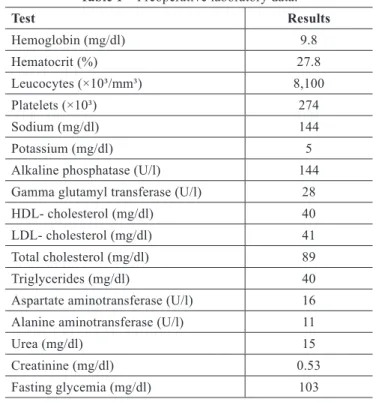
Abdominal ultrasonography showed a moderate degree of hepatic steatosis, a small calculus in the gallbladder, and an expansive formation in the abdominal wall over the iliac fossa, suggesting large lipomas. Mammary ultrasono graphy revealed an isodense expansive formation in the fat planes of the costal edges. Meanwhile, thyrocervical ul trasonography revealed a normalsized thyroid without adenomegaly and normal parotids. Laboratory test results are shown in Table 1.
The patient initially underwent lipectomy of the lower abdomen; 2 pieces of fat and subcutaneous tissue were re mo ved, weighing 10.3 kg and 5.6 kg, respectively. A simple
Figure 1 – Patient presenting with multiple symmetric lipomatosis, with accumulation of symmetric lipomas in the face, abdominal,
supraclavicular, and deltoid regions.
Figure 2 – Left-sided view of the patient presenting with MLS, showing a scar from a previous lipectomy
in the left lank.
Figure 3 – Posterior view of the patient presenting with multiple symmetric lipomatosis, showing the
Rev Bras Cir Plást. 2013;28(2):324-7
326
Sousa EC et al.
Table 1 – Preoperative laboratory data.
Test Results
Hemoglobin (mg/dl) 9.8
Hematocrit (%) 27.8
Leucocytes (×10³/mm³) 8,100
Platelets (×10³) 274
Sodium (mg/dl) 144
Potassium (mg/dl) 5
Alkaline phosphatase (U/l) 144
Gamma glutamyl transferase (U/l) 28
HDL cholesterol (mg/dl) 40
LDL cholesterol (mg/dl) 41
Total cholesterol (mg/dl) 89
Triglycerides (mg/dl) 40
Aspartate aminotransferase (U/l) 16
Alanine aminotransferase (U/l) 11
Urea (mg/dl) 15
Creatinine (mg/dl) 0.53
Fasting glycemia (mg/dl) 103
HDL: highdensity lipoprotein; LDL: lowdensity lipoprotein.
bilateral mastectomy was subsequently performed, and 2.4 kg and 2.8 kg fat and mammary tissue, respectively, were removed. Histopathologic examination yielded evidence of benign subcutaneous lipomas and hyperplasia in the mam mary tissue. The patient had an uneventful recovery.
All ethical norms regarding studies involving human beings were in accordance with the revised Declaration of Helsinki. The patient was invited to participate in the case report. He signed the Free Informed Consent Form that
guarantees conidentiality of personal data, and provided
au thorization to use his image.
DISCUSSION
MLS is a rare disease. It irst described by Benjamin
Brodie in 1846 in St. George Hospital in London and subse quently by Otto Madelung in 188810. In 1898, the disease was
deinedbyLaunoisandBensaudeinaseriesofpatientsas awell-deinedclinicalentityandtermedbenignsymmetric
lipomatosis8.
MLS is also known as Madelung’s disease, Launois–Ben saude disease, symmetric adenolipomatosis, diffuse sym metric lipomatosis, lipomatosis simplex indolens, multiple symmetric lipomatosis, cephalothoracic lipomatosis, and familial benign cervical lipomatosis10.
It is a rare disease that occurs more frequently in people living in countries near the Mediterranean region2. Approxi
mately 385 cases of the disease worldwide have been indexed in the MEDLINE database. Eight cases have been reported in
BrazilandpublishedinjournalsindexedbySciELO.
Although the etiology of the disease remains unknown, it seems to be associated with an alcoholinduced endocrine disorder and a mitochondrial enzyme disorder3.
Enzi et al.8 classify MLS into 2 types. In type I MLS, the
fat accumulations are limited, forming nonencapsulated masses that are distributed symmetrically in the upper re gion of the body. Lipomas are formed in the cervical region (“horse collar”), deltoids (pseudoathletic appearance), and back, giving the false impression that the pa tient has ky phosis of the spine (i.e., a humpback)4 like in the pre sent
case. In type II MLS, the distribution of lipomas is more diffuse. In many cases, the patient appears to have simple obesity. In addition to the upper part of the body, the inguinal and abdominal regions are frequently involved. However, there is no involvement of the mediastinum or compres sion of the aerodigestive tract. The body mass index is also increased4.
The differential diagnosis includes the following: sar
comatosis processes, angiolipoma, lipoblastoma,
neuroi-bromatosis, Dercum syndrome (i.e., painful lipomatosis)10,
Hanhart syndrome, polydysplasia syndrome, Cushing di sease, pseudoathletic appearance (in various forms of mus cular dystrophy), lymphoproliferative diseases, and thyroid diseases.
Complications of the disease are rarely reported and in clu de compression of the aerodigestive tract, causing dys p nea, dysphagia, and dysphonia. In serious cases, treatment involves surgical resection of the lipomatous tissue with the
optionofliposuctionintheiniltratedareas.Thecosmetic andfunctionalbeneitsofsurgicalresectionareoccasionally
temporary2, and surgical treatment of the disease tends to be
associated with increased recurrence5.
REFERENCES
1.SarraL,CarbajoJ,SilvaA,BitarJ.Lipomatosissimetricamultiple. Rev Cir Esp. 2007;81(3):1602.
2. Lee MS, Lee MH, Hur KB. Multiple symmetric lipomatosis. J Korean Med Sci. 1988;3(4):1637.
3. Hirose A, Okada Y, Morita E, Tanaka Y. Benign symmetric lipomatosis associated with alcoholism. Intern Med. 2006;45(17):10015.
4.BojanicP,SimovicI.Launois-Bensaudesyndrome(Madelung’sdisea-se). Dermatol Online J. 2001;7(2):9.
5. Kurzweg FT, Spencer R. Familial multiple lipomatosis. Am J Surg. 1951;82(6):7625.
6. Wu CS, Wang LF, Tsai KB, Tai CF, Kuo WR. Multiple symmetric li pomatosis (Madelung’s disease): report of two cases. Kaohsiung J Med Sci. 2004;20(3):1336.
Rev Bras Cir Plást. 2013;28(2):324-7 327 Multiple symmetric lipomatosis
8. Enzi G, Busetto L, Ceschin E, Coin A, Digito M, Pigozzo S. Multiple symmetric lipomatosis: clinical aspects and outcome in a longterm lon gitudinal study. Int J Obes Relat Metab Disord. 2002;26(2):25361. 9. Haap M, Siewecke C, Thamer C, Machann J, Schick F, Häring HU, et al.
Multiple symmetric lipomatosis: a paradigm of metabolically innocent obesity? Diabetes Care. 2004;27(3):7945.
10. Mayor M, Arillo A, Tiberio G. Lipomatose simétrica múltiple: a propó sito de un caso. An Sist Sanit Navar. 2006;29(3):4337.
Correspondence to: Fernanda Rodrigues Fernandes
Hospital Calixto Midlej Filho