S
ho
* e-mail: [email protected]
b
Departamento de Produtos Farmacêuticos, Faculdade de Farmácia, Universidade Federal de Minas Gerais, Av. Olegário Maciel 2360, 30180-112 Belo Horizonte - MG, Brazil
Relata-se no presente trabalho a síntese de δ-lactonas quirais derivadas de carboidratos, por meio de reações de ciclização radicalar regio- e estereosseletivas. A configuração do novo centro estereogênico depende da estrutura do carboidrato.
We describe in the present work the synthesis of carbohydrate-based chiral δ-lactones by regio-and stereoselective radical cyclization reactions. The configuration of the newly stereogenic center was found to depend on the structure of the carbohydrate moiety.
Keywords: radical cyclization, carbohydrate and δ-lactones
Introduction
Free radical cyclization has been applied extensively in natural product synthesis.1 A number of biologically
active natural products especially pheromones are lactones.2 In addition, lactones have assumed importance
as building blocks for the synthesis of natural products such as alkaloids, macrocyclic antibiotics and terpenoids. Because of the presence of often numerous chiral centers in natural products, diastereoselectivity is crucial in their synthesis.3
Carbohydrate have been used as “off-templates” for the stereoselective synthesis of chiral γ- and δ-lactones.4-6
In connection with our interest in free radical carbocyclization reactions from carbohydrates,7-9 we report
herein our results on the regio- and stereoselective synthesis of chiral δ-lactones by 6-exo-trig radical carbocyclization reactions on carbohydrate templates.
The iodo esters 1 to 4 were chosen as radical precursors. They are easily prepared in a few steps using classical carbohydrate chemistry and should allow the comparison of the influence of a pyranose versus a furanose template in the outcome of the radical carbocyclization reaction. The cinnamoyl and crotonyl moieties generate a new chiral
center upon cyclization. Hence, the stereoselectivity of the reaction can be evaluated.
Results and Discussion
Starting with known 1,2-O-isopropylidene-a-D
-xylofuranose (5)10 and methyl 2,3-di-O-benzyl-α-D
-glucopyranoside (6),11 the radical precursors 1 to 4 were
prepared in two steps namely, regioselective replacement of the primary hydroxyl group by iodide,12 followed by
esterification of the remaining hydroxyl group13 (Scheme).
The radical carbocyclization reactions of compounds
In all cases, products of completely stereoselective 6-exo-trig carbocyclization were formed in 1-30 % yield by addition of the alkyl radical to the α-position of α,β -unsaturated esters. The corresponding hydrogenolysis products were also isolated in 42-70 % yield (Figure 1).
The results are summarised in the Table 1.
Several authorsreported failure in attempting 5- and 6-exo-trig radical ring closure of ester derivatives due to the geometric constraints associated with the preferred s-Z conformation of the ester function.14-20 Thus, the successful
Table 1. Cyclization and reduction products from radical precursors
1 to 4
Radical Product (yield %)a Stereochemistry
Precursor δ-lactone reduction at α-Cb
1 9 (30) 13 (42) S
2 10 (15) 14 (66) S
3 11 (22) 15 (53) R
4 12 (1) 16 (70) R
a Yields after purification by column chromatography; b Deduced by
NOESY experiments.
Figure 1. Products of the reactions of precursors 1 to 4 with Bu3SnH.
C-5 of the radical esters in the furanose ring form may account for the better yields of cyclized products in this series.
The regioselectiviy of the reaction was deduced by analysis of the NMR spectra. In the case of the crotonyl radical precursors 2 and 4, the 6-exo-trig cyclization mode was indicated by the presence of the ethyl group signals in the 1H NMR spectra of the respective products 10 and 12.
For δ-lactones 9 and 11 the analysis of the 1H NMR
spectra was not conclusive. Thus, the connectivity was confirmed by analysis of HMBC contour plots, which showed coupling between H-5, H-5’ (lactone 9) and H-6, H-6’ (lactone 11) and the carbonyl carbon (Figure 2).
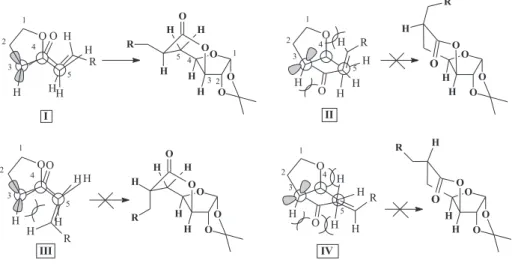
cyclization are shown in Figure 4. Conformer I is less sterically hindered than conformers II, III and IV and, in consequence, the corresponding transition state should be favoured. This explains the formation of δ-lactones 9
and 10.
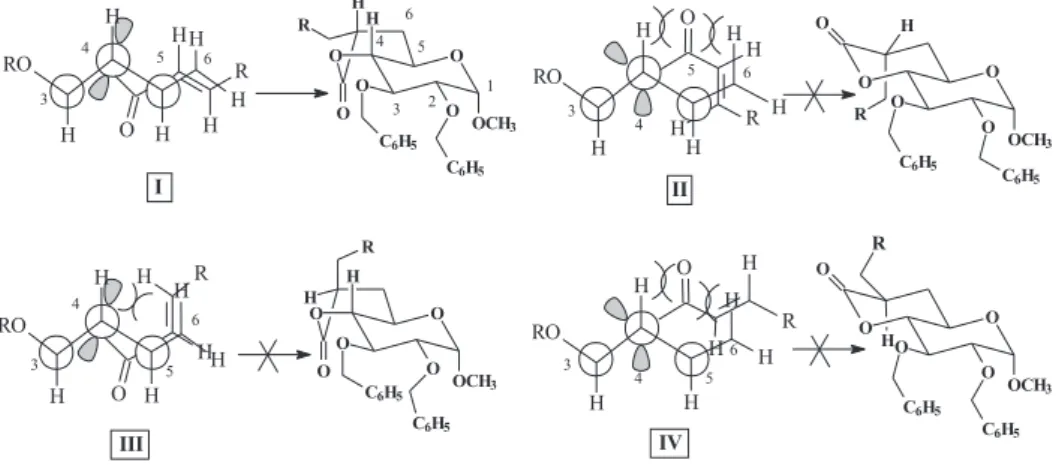
Similar arguments were used to rationalize the stereoselectivity observed in the cyclization of the radical esters in the pyranose ring form (Figure 5).
In conclusion, we describe herein the synthesis of carbohydrate-based δ-lactones with complete regio- and stereoselectivity. This is an example of the “off-template” induction by the carbohydrate moiety on the diastereofacial selection. The configuration of the newly
Figure 3. Correlation between H-4 and H-7 (pyranose ring forms) and H-3 and H-6 (furanose ring forms) observed by analysis of the NOESY contour maps.
Figure 2. Three-bond correlation between H-5, H-5’ (lactone 9) or H-6, H-6’ (lactone 11) and the carbonyl carbon observed by analy-sis of the HMBC contour maps.
formed stereogenic center is dependent on the nature of the carbohydrate. Totally different stereochemical outcome is observed changing from the pyranose to the furanose ring forms.
Experimental
General procedures
All melting points were determined on a Kofler Sybron apparatus and are uncorrected. Optical rotations were determined at 25 oC with a Bellingham & Stanley P20
Polarimeter. The NMR spectra were measured in deuteriochloroform or pyridine with TMS as the internal standard with a Bruker Avance DRX 400 or a Bruker Avance 200 instruments. Chemical shifts are given in δ scale and J values are given in Hz. Column chromatography was performed with silica gel 60, 70-230 mesh (Merck).
General procedure for the synthesis of the radical precursors
To a 0.05 mol L-1 solution of compound 710 or 822 in
methylene chloride was added 4-dimethylaminopyridine (0.15 equivalents), carboxylic acid (cinnamic or crotonic acid) (1.5 equivalents) and N,N’-dicyclohexyl-carbodiimide (1.5 equivalents). The solution was allowed to stand at room temperature for 4 h. The dicyclohexylurea which precipitates was removed by filtration. The filtrate was concentrated to give crude ester which was submitted to chromatography (hexane/EtOAc 8.5:1.5).
3-O-Cinnamoyl-5-deoxy-5-iodo-1,2-O-isopropylidene-α-D-xylofuranose (1). Following the general procedure, compound 710 (0.50 g, 1.7 mmol) was treated with
4-dimethylaminopyridine, cinnamic acid and
N,N’-dicyclohexylcarbodiimide. The oily residue was purified by column chromatography to give 1 (0.56 g, 79%) as a white solid: mp 115-116.8 ºC; [α]D25– 58 (c 2.0, CHCl
3);
δH (200 MHz, CDCl3) 7.74 (1 H, d, J7,6 16, 7-H) 7.56-7.40
(5 H, m, Ph), 6.44 (1 H, d, J6,7 16, 6-H), 6.0 (1 H, d, J1,2 3.6, 1-H), 5.46 (1 H, d, J3,4 3.2, 3-H), 4.64 (1 H, d, J2,1 3.6, 2-H), 4.61 (1 H, ddd, J4,3 3.2, J4,5 = J4,5’ 6.0, 4-H), 3.31-3.27 (2 H, m, 5-H and 5’-H), 1.56 (3 H, s, CH3), 1.33 (3 H, s, CH3); δC
(50 MHz, CDCl3) 165.47 (C=O), 146.45 (7-C), 133.91
(C ipso), 130.76-128.24 (Ph), 116.54 (6-C), 112.41
(C(CH3)2), 105.24 (1-C), 83.46 (2-C), 79.75 (4-C), 76.24 (3-C), 26.74, 26.22 (2 x CH3), -2.43 (5-C) (Found: C, 47.71; H, 4.37; Anal. Calc. for C17H19IO5: C, 47.44; H, 4.42 %).
3-O-Crotonyl-5-deoxy-5-iodo-1,2-O-isopropylidene-α
-D-xylofuranose (2). Following the general procedure, compound 710 (0.50 g, 1.7 mmol) was treated with
4-dimethylaminopyridine, crotonic acid and N,N’-dicyclohexylcarbodiimide. The oily residue was purified by column chromatography to give 2 (0.47 g, 77%) as a white solid: mp 65.4-65.7 ºC; [α]D25 – 65.3 (c 2.0, CHCl
3);
δH (200 MHz, CDCl3) 7.06 (1 H, dq, J7,8 6.9, J7,6 15.5, 7-H), 5.95 (1 H, d, J1,2 3.6, 1-H), 5.87 (1 H, dd, J6,8 1.6, J6,7 15.5, 6-H), 5.37 (1 H, d, J3,4 2.8, 3-H), 4.61-4.52 (2 H, m, 2-H and 4-H), 4.57 (1 H, d, J2,1 3.6, 2-H), 3.27 (1 H, dd, J5,4 6.6, J5,5’ 9.7, 5-H), 3.19 (1 H, dd, J5’,4 8.3, J5’,5 9.7, 5’-H), 1.92 (3 H, dd, J8,6 1.6, J8,7 6.9, 3 x 8-H), 1.54 (3 H, s, CH3), 1.31 (3 H, s, CH3); δC (50 MHz, CDCl3) 164.89 (C=O), 146.74 (7-C), 121.46 (6-C), 112.33 (C(CH3)2), 105.19 (1-C), 83.40 (2-C), 79.72 (4-C), 75.89 (3-C), 26.73, 26.19 (2 x CH3), 18.11 (8-C), -2.41 (5-C); (Found: C, 39.12; H, 4.36; Anal. Calc. for C12H17IO5: C, 39.13; H, 4.62 %).
Methyl 2,3-di-O-benzyl-4-O-cinnamoyl-6-deoxy-6-iodo-α-D-glucopyranoside (3). Following the general procedure, compound 822 (0.52 g, 1.1 mmol) was treated
(one of C ipso), 137.8 (other of C ipso), 134.0 (other of C ipso), 130.6-127.5 (Ph), 117.0 (7-C), 98.2 (1-C), 79.6 (2-C), 78.4 (3-(2-C), 75.3, 73.6 (2 x PhCH2O), 71.9 (4-C), 69.5 (5-C), 55.8 (OCH3), 4.5 (6-C); (Found: C, 58.36; H, 5.14; Anal. Calc. for C30H31IO6: C, 58.63; H, 5.05 %).
Methyl
2,3-di-O-benzyl-4-O-crotonyl-6-deoxy-6-iodo-α-D-glucopyranoside (4). Following the general procedure, compound 822 (0.39 g, 0.8 mmol) was treated
with 4-dimethylaminopyridine, crotonic acid and N,N’-dicyclohexylcarbodiimide. The oily residue was purified by column chromatography to give 4 (0.25 g, 56%) as a colorless oil: [α]D25– 20.2 (c 1.6, CHCl
3); δH (200 MHz,
CDCl3) 7.36-7.21 (10 H, m, Ph), 6.98 (1 H, dq, J8,9 6.9, J8,7 15.5, 8-H), 5.76 (1 H, dd, J7,9 1.7, J7,8 15.5, 7-H), 4.89-4.60 (5 H, m, 4 x CH2Ph, 4-H), 4.61 (1 H, d, J1,2 3.6, 1-H), 3.93 (1 H, t, J3,2 = J3,4 9.6, 3-H), 3.73 (1 H, td, J5,6’ 2.4, J5,4 = J5,6 9.6, 5-H), 3.57 (1 H, dd, J2,1 3.6, J2,3 9.6, 2-H), 3.47 (3 H, s, OCH3), 3.23 (1 H, dd, J6’,5 2.4, J6’,6 10.8, 6’-H), 3.05 (1 H, J6,5 9.6, J6,6’ 10.8, 6-H), 1.88 (3 H, dd, J9,7 1.6, J9,8 6.9, 3 x 9-H); δC (50
MHz, CDCl3) 165.20 (C=O), 146.29 (8-C), 138.25, 137.86 (2 x C ipso), 128.47-127.49 (Ph); 121.89 (7-C), 98.18 (1-C), 79.49 (2-(1-C), 78.57 (3-(1-C), 75.36, 73.55 (2 x PhCH2O), 73.37 (4-C), 69.56 (5-C), 55.72 (OCH3), 18.08 (C-9), 4.48 (6-C); (Found: C, 54.87; H, 5.22; Anal. Calc. for C25H29IO6: C, 54.35; H, 5.25 %).
General procedure for free radical cyclization
To a stirred, boiling solution of radical precursor in nitrogen-saturated benzene (0.01 mol L-1) was added a
solution of Bu3SnH (1.2 equivalents) and AIBN (cat.) in nitrogen-saturated benzene (0.2 mol.L-1) via an addition
funnel during 3 h. The reaction mixture was heated under reflux in nitrogen atmosphere for a further 1 h. After solvent removal the residue was dissolved in acetonitrile (50 mL). The solution was extracted three times with hexane (30 mL) to remove tin compounds. After evaporation of the acetonitrile the residue was chromatographed (hexane/ EtOAc 8:2).
Free radical cyclization of radical precursor 1. Starting from 1 (0.47 g, 1.1 mmol) and following the general
MHz, CDCl3) 172.92 (C=O), 138.45 (C ipso), 129.11,
128.60, 126.66 (Ph), 112.09 (C(CH3)2), 104.86 (1-C), 83.21 (2-C), 81.70 (3-C), 73.65 (4-C), 39.35 (6-C), 36.25 (7-C), 28.10 (5-C), 26.6, 26.2 (2 x CH3); (Found: C, 67.32; H, 6.64; Anal. Calc. for C17H20O5: C, 67.09; H, 6.62 %).
The uncyclized product 13 was obtained as a white solid; mp 67.9-69.3 ºC, lit23 73-75 ºC; [α]
D
25 +56 (c 1.14,
CHCl3), lit23 +44 (c 4.72, benzene); δ
H (200 MHz, CDCl3)
7.73 (1 H, d, J7,6 16.0, 7-H), 7.56-7.38 (5 H, m, Ph), 6.46 (1 H, d, J6,7 16.0, 6-H), 5.95 (1 H, d, J1,2 3.8, 1-H), 5.25 (1 H, d, J3,4 2.8, 3-H), 4.61 (1 H, d, J2,1 3.8, 2-H), 4.49 (1 H, qd, J4,3 2.8, J4,5 6.4, 4-H), 1.54 (3 H, s, CH3), 1.32 (3 H, s, CH3), 1.29 (3 H, d, J5,4 6.4, 3 x 5-H); δC (50 MHz, CDCl3) 165.66 (C=O),
145.86 (7-C), 133.94 (C ipso), 130.50, 128.83, 128.07 (Ph), 116.89 (6-C), 111.56 (C(CH3)2), 104.41 (1-C), 83.85 (2-C), 77.46 (3-C), 75.13 (4-C), 26.47, 26.04 (2 x CH3), 13.09 (5-C).
Free radical cyclization of radical precursor 2. Starting from 2 (0.50 g, 1.4 mmol) and following the general procedure, the δ-lactone 10 (0.05 g, 15%) and the uncyclized product 14 (0.22 g, 66%) were isolated. The δ -lactone 10 was obtained as a white solid; mp 91.5-93.4 ºC; [α]D25 +103 (c 1.3, CHCl
3); δH (200 MHz, CDCl3) 5.93 (1
H, d, J1,2 3.8, 1-H), 4.75 (1 H, d, J2,1 3.8, 2-H), 4.72-4.66 (1 H, m, 4-H), 4.57 (1 H, d, J3,4 2.8, 3-H), 2.52 (1 H, ddd, J5’,6 6.4,
J5’,4 8.9, J5’,5 14.1, 5’-H), 2.18 (1 H, dq, J6,5 = J6,7 = J6,7’ 6.4,
J6,5’ 12.9, 6-H), 1.89 (1 H, tdd, J7,6 6.4, J7,8(CH3) 7.6, J7,7’ 14,1,
7-H), 1.73-1.38 (5 H, m, 5-H, 7’-H and CH3), 1.33 (3 H, s, CH3), 1.00 (3 H, t, J8,7 = J8,7’ 7.6 Hz, 8-H (CH3); δC (50 MHz,
CDCl3) 173.37 (C=O), 111.98 (C(CH3)2), 104.77 (1-C), 83.06 (2-C), 81.39 (3-C), 72.06 (4-C), 38.73 (6-C), 28.44 (5-C), 26.54, 26.10 (2 x CH3), 22.88 (7-C), 11.24 (8-C); (Found: C, 59.62, H 7.35; Calc. for C12H18O5: C, 59.49, H, 7.49 %).
The uncyclized product 14 was obtained as an oil; [α]D +31.9 (c 2.8, benzene), lit23 +31.0 (c 2.8, benzene); δ
H
5-H (C5-H3)]; δC (50 MHz, CDCl3) 165.17 (C=O), 146.09 (7-C),
121.72 (6-C), 111.54 (C(CH3)2), 104.40 (1-C), 83.86 (2-C), 77.14 (3-C), 75.14 (4-C), 26.49, 26.05 (2 x CH3), 17.96 (8-C), 13.06 (5-C).
Free radical cyclization of radical precursor 3. Starting from 3 (0.40 g, 0.65 mmol) and following the general procedure, δ-lactone 11 (0.07 g, 22%) and the
uncyclized product 15 (0.17 g, 53%) were isolated.
The δ-lactone 11 was obtained as a white solid; mp 131.2-132.2 ºC; [α]D25 – 30 (c 0.8, CHCl
3); δH (400 MHz, Py)
7.56-7.24 (15 H, m, Ph), 5.07 (1 H, d, Jgem 11.6, one of PhCH2), 5.02 (1 H, d, Jgem 11.6, one of PhCH2), 4.95 (1 H, d, J1,2 3.6, 1-H), 4.84 (1 H, d, Jgem 12.0, one of PhCH2), 4.79 (1 H, d, Jgem 12.0, one of PhCH2), 4.42 (1 H, t, J4,3 = J4,5 9.2, 4-H), 4.24 (1 H, t, J3,4 = J3,2 9.2, 3-H), 3.95 (1 H, q, J5,4 = J5,6 =
J5,6’ 9.2, 5-H), 3.76 (1 H, dd, J2,1 3.6, J2,3 9.2, 2-H), 3.46 (1 H,
dd, J8,7 4.8, J8,8’ 13.8, 8-H), 3.41-3.33 (4H, m, 7-H and OCH3), 2.82 (1 H, dd, J8’,7 9.2, J8’,8 13.8, 8’-H), 2.02-1.88 (2 H, m, 6-H and 6’-6-H); δC (100 MHz, Py) 173.72 (C=O), 139.51,
139.46, 139.14 (3 x C ipso), 129.60-126.89 (Ph), 98.89 (1-C), 79.83 (2-(1-C), 79.15 (4-(1-C), 79.04 (3-(1-C), 75.20, 73.13 (2 x PHCH2O), 64.07 (5-C), 55.32 (OCH3), 38.62 (7-C), 37.28 (8-C), 29.63 (6-C).
The uncyclized product 15 was obtained as an oil; [α]D25
+ 12.5 (c 2.0, CHCl3); δH (400 MHz, CDCl3) 7.65 (1 H, d, J8,7
16.0, 8-H), 7.52-7.15 (15 H, m, Ph), 6.31 (1 H, d, J7,8 16.0, 7-H), 4.88 (1 H, t, J4,3 = J4,5 9.6, 4-H), 4.86 (1 H, d, Jgem 11.6, one of PhCH2), 4.81 (1 H, d, Jgem 12.4, one of PhCH2), 4.69-4.66 (2 H, m, 2 x PhCH2), 4.56 (1 H, d, J1,2 3.6, 1-H), 3.95 (1 H, t, J3,4 = J3,2 9.6, 3-H), 3.82 (1 H, qd, J5,6(CH3) 6.4, J5,4 9.6, 5-H), 3.61 (1 H, dd, J2,1 3.6, J2,3 9.6, 2-H), 3.40 (3 H, s, OCH3), 1.15 [3 H, d, J6(CH3),5 6.4, 6-H (CH3)]; δC (100 MHz, CDCl3) 165.85 (C=O), 145.26 (8-C), 138.57, 138.15, 134.37 (3 x C ipso), 128.87-127.38 (Ph), 117.79 (7-C), 98.23 (1-C), 80.04 (2-C), 79.01 (3-C), 75.28 (4-C), 75.23, 75.18 (2 x PhCH2O), 73.44 (5-C), 55.30 (OCH3), 17.39 (6-C).
Free radical cyclization of radical precursor 4. Starting from 4 (0.47 g, 0.85 mmol) and following the general procedure, δ-lactone 12 (0.004 g, 1%) and the uncyclized product 16 (0.25 g, 70%) were isolated.
The δ-lactone 12 was obtained as a white solid; δH (400
MHz, CDCl3) 7.30-7.39 (10 H, m, Ph), 4.93 (1 H, d, Jgem 10.8, one of PhCH2), 4.85 (1 H, d, Jgem 10.8, one of PhCH2), 4.83 (1 H, d, Jgem 12.0, one of PhCH2), 4.66 (1 H, d, Jgem 12.0, one of PhCH2), 4.55 (1 H, d, J1,2 3.6, 1-H), 4.04 (1 H, t, J4,3 = J4,5 9.2, 4-H), 4.01 (1 H, t, J3,4 = J3,2 9.2, 3-H), 3.86 (1 H, q, J5,4 = J5,6 =
J5,6’ 9.2, 5-H), 3.51 (1 H, dd, J2,1 3.6, J2,3 9.2, 2-H), 3.39 (3 H,
s, OCH3), 2.61-2.52 (1 H, m, 7-H), 2.05 (1 H, ddd, J6,5 9.2, J6,7 10.4, J6,6’ 13.5, 6-H), 1.96-1.79 (2 H, m, 6’-H and 8-H), 1.48 (1 H, double quintet, J8’,7 = J8’,9 (CH3) 7.6, J8’,8 14.3, 8’-H), 0.97 [3 H, t, J9(CH3),8 = J9(CH3),8’ 7.6, 9-H (CH3)]; δC (100 MHz, CDCl3)
173.63 (C=O), 138.43, 138.01 (2 x C ipso), 128.45-127.65 (Ph), 98.91 (1-C), 79.13 (4-C), 78.83 (3-C), 78.74 (2-C), 75.55, 73.75 (2 x PHCH2O), 63.65 (5-C), 55.57 (OCH3), 38.14 (7-C), 29.25 (6-(7-C), 23.87 (8-(7-C), 11.17 (9-C).
The uncyclized product 16 was obtained as an oil; [α]D25 +58.7 (c 2.0, CHCl
3); δH (200 MHz, CDCl3)
7.36-7.22 (10 H, m, Ph), 6.96 (1 H, dq, J8,9(CH3) 6.9, J8,7 15.5,8-H), 5.77 (1 H, dd, J7,9(CH3) 1.7, J7,8 15.5, 7-H), 4.86-4.61 (5 H, m, 4 x PhCH2 and 4-H), 4.54 (1 H, d, J1,2 3.6, 1-H), 3.90 (1 H, t, J3,4 = J3,2 9.4, 3-H), 3.81-3.70 (1 H, m, 5-H), 3.57 (1 H, dd, J2,1 3.6, J2,3 9.4, 2-H), 3.38 (3 H, s, OCH3), 1.87 [3 H, dd,
J9(CH3),7 1.7, J9(CH3),8 6.9, 9-H(CH3)], 1.12 [3 H, d, J6(CH3),5 6.2,
6-H (CH3)]; δC (50 MHz, CDCl3) 165.35 (C=O), 145.36
(8-C), 138.49, 138.02 (2 x C ipso), 128.37-127.35 (Ph), 122.30 (7-C), 98.11 (1-C), 79.74 (2-C), 78.99 (3-C), 75.17, 73.40 (2 x PhCH2O), 74.88 (4-C), 65.37 (5-C), 55.19 (OCH3), 17.97 [9-C (CH3)], 17.26 [6-C (CH3)].
Acknowledgements
We wish to thank Fundação de Amparo à Pesquisa do Estado de Minas Gerais (FAPEMIG) and Conselho Nacional de Desenvolvimento Científico e Tecnológico (CNPq) for financial support.
References
1. Jasperse, C. P.; Curran, D. P.; Fevig, T. L.; Chem. Rev.1991,
91, 1237.
2. Mori, K.; Tetrahedron1989, 45, 3233.
3. Koch, S. S. C.; Chamberline, A. R.; J. Org. Chem. 1993, 58, 2725.
4. Sharma, G. V. M.; Vepachedu, S. R.; Tetrahedron Lett. 1990,
31, 4931.
5. Xi, Z.; Agback, P.; Sandströn, A.; Chattopadhyaya, J.; Tetra-hedron 1991, 47, 9675.
6. Velázquez, S.; Camarasa, M. J.; Tetrahedron Asym. 1994, 5, 2141.
7. Prado, M. A. F.; Alves, R. J.; Souza Filho, J. D.; Alves, R. B.; Pedrosa, M. T. C.; Prado, R. F.; Faraco, A. A. G.; J. Chem. Soc., Perkin Trans. 1. 2000, 1853.
8. Binatti, I.; Prado, M. A. F.; Alves, R. J.; Souza Filho, J. D.; J. Braz. Chem. Soc. 2002, 13, 570.
9. Faraco, A. A. G.; Prado, M. A. F.; Alves, R. J.; Souza Filho, J. D.; Alves, R. B.; Faraco, R. F. P.; Synth. Commun. 2003, 33, in press.
10. Levene, P. A.; Raymond, A. L.; J. Biol. Chem. 1933, 102, 317. 11. Bell, D. J.; Lorber, J.; J. Chem. Soc. 1940, 453.
12. Garegg, P. J.; Samuelson, B. J.; J. Chem. Soc., Perkin Trans. 1. 1980, 2866.