Identification of candidate genes for lung cancer somatic mutation test kits
Yong Chen
#, Jian-Xin Shi
#, Xu-Feng Pan, Jian Feng and Heng Zhao
Thoracic Department, Shanghai Chest Hospital, Shanghai, China.
Abstract
Over the past three decades, mortality from lung cancer has sharply and continuously increased in China, ascending to the first cause of death among all types of cancer. The ability to identify the actual sequence of gene mutations may help doctors determine which mutations lead to precancerous lesions and which produce invasive carcinomas, especially using next-generation sequencing (NGS) technology. In this study, we analyzed the latest lung cancer data in the COSMIC database, in order to find genomic “hotspots” that are frequently mutated in human lung cancer genomes. The results revealed that the most frequently mutated lung cancer genes areEGFR, KRAS and TP53. In recent years,EGFR and KRAS lung cancer test kits have been utilized for detecting lung cancer patients, but they presented many disadvantages, as they proved to be of low sensitivity, labor-intensive and time-consuming. In this study, we constructed a more complete catalogue of lung cancer mutation events including 145 mutated genes. With the genes of this list it may be feasible to develop a NGS kit for lung cancer mutation detection.
Keywords: Lung cancer, Next-generation sequencing, Somatic mutation kit, COSMIC.
Received: January 15, 2013; Accepted: June 4, 2013.
Introduction
Lung cancer is the most common cancer in terms of incidence and mortality throughout the world, accounting for 13% of all cases and for 18% of deaths in 2008 (Jemalet al., 2011). In China, lung cancer rates are increasing be-cause smoking prevalence continues to either rise or show signs of stability (Youldenet al., 2008; Jemalet al., 2010). Lung cancer is most often diagnosed at late stages, when it has already presented local invasion and distal metastases (Perez-Moraleset al., 2011). Therefore, the identification of early molecular events inherent to lung tumorigenesis is an urgent need, so as to provide a basis for intervention in carcinogenesis.
All cancers arise as a result of the acquisition of a se-ries of fixed DNA sequence abnormalities, mutations, many of which ultimately confer a growth advantage to the cells in which they have occurred. Several mutated genes related to tumor growth, invasion or metastasis have been identified in lung cancer, and new agents that inhibit the ac-tivities of these genes have been developed, aiming to im-prove the outcome of lung cancer treatment (Dy and Adjei, 2002). Among these genes,EGFR(epidermal growth fac-tor recepfac-tor) is frequently overexpressed in non-small-cell lung cancer (NSCLC) (Rosellet al., 2009).EGFRtyrosine kinase inhibitors (e.g.Gefitinib and Erlotinib) have been
tested in trials for treating NSCLC (Fukuokaet al., 2003; Kriset al., 2003; Giacconeet al., 2004; Spigelet al., 2011; Liuet al., 2012). Furthermore,KRASandTP53gene muta-tions have been found in up to 30% of lung cancer cases and have been considered as predictive factors of poor progno-sis (Hunchareket al., 1999; Pao et al., 2005; Mogi and Kuwano, 2011).These frequently mutated genes can be used to design kits for early detection of carcinogenesis. For example, a kit from Life Technologies Corporation (Ion Ampli SeqTM) was designed to detect 739 COSMIC mutations in 604 loci from 46 oncogenes and tumor sup-pressor genes, with emphasis on the deep coverage of genes
KRAS,BRAFandEGFRfor the detection of somatic muta-tions in archived cancer samples.
In this study, we analyzed the latest data on lung can-cer, aiming to identify frequently mutating genomic “hotspot” regions in human lung cancer genes. The results are significant and promising, once the ability to identify the actual sequence of mutations may help determining which mutations lead to precancerous lesions and which produce invasive carcinomas. Thus, our study may contrib-ute to improve lung cancer diagnosis and design better prognosis kits.
Materials and Methods
Database of somatic mutations in cancer
The COSMIC (Catalogue of Somatic Mutations in Cancer) database (Forbes et al., 2011) was designed to store and display somatic mutation information and related
Send correspondence to Heng Zhao. Thoracic Department, Shang-hai Chest Hospital, No 241WestHuaiShang-hai Road, 200030 ShangShang-hai, China. Email: [email protected].
#
These authors contributed equally to this work and should be re-garded as co-first authors.
details and contains information on human cancers. The current release (v64) describes over 913,166 coding muta-tions of 24,394 genes from almost 847,698 tumor samples. To construct a complete dataset of cancer mutation infor-mation, we had to start by finding a complete catalogue of gene mutations in lung cancer patients. Therefore, we downloaded somatic mutation data from the COSMIC da-tabase. All genes selected for the COSMIC database came from studies in the literature and are somatically mutated in human cancer (Bamfordet al., 2004). Based on this author-ity resource, we constructed a complete dataset of cancer mutation information for the analysis described in the fol-lowing.
Lung cancer mutation extraction
As our aim was to collect data on lung cancer, we searched for mutation information in the web-software BioMart Central Portal. BioMart offers a one-stop shop so-lution to access a wide array of biological databases, such as the major biomolecular sequence, pathway and annota-tion databases such as Ensembl, Uniprot, Reactome, HGNC, Wormbase and PRIDE (Haideret al., 2009). We used the Cancer BioMart web-interfere, with the following criteria: 1. Primary site = “lung”; 2. Mutation ID is not empty. The first criterion ensures that the mutation occurs in lung tissues, and the second criterion helps excluding the samples without mutation in a specific gene. Thereby we obtained the list of mutations in lung cancer.
Mutation frequency calculation
In order to identify the most important mutated genes in lung cancer, we calculated the mutation frequency for each mutated gene. In this calculation, we considered the same sample used in different experiments as a different sample. For example, if a geneAKT1mutation was found in two different experiments, geneAKT1was assigned a mu-tation frequency of 2, even if both experiments were per-formed with samples from the same tissue of the same patient. Sometimes, frequencies are presented as percent-ages. In this study, however, we did not divide the fre-quency of 2 by the whole sample, because we focused only on how common the mutation is and how many of these mutations were identified. For example, if the mutation percentage was 100%, but the number of samples with the mutation was only 3, this gene was not accepted in our di-agnostic kit.
Protein-Protein Interaction (PPI) network
The number of mutation events in the list of lung can-cer mutations is very high, but some of these mutations are not found in lung cancer only. So, in order to find the key genes of this list, we analyzed the relationship between those genes. We started with the intent of using KEGG for digging into these relations. However, KEGG shows the very putative gene in a specific biological pathway, and
there are many genes which cannot be located in the accurate site in some pathways. For the past few years, PPI databases have become a major tool for digging into bio-logical relations. The great protein-protein interaction source offers a possible way of guessing their function through the interacted protein. If an interacted gene has a lung-regulated mechanism, the anchor gene will always show a similar function. Then, if all genes inputted to PPI have similar functions, there will be a regulation network among them.
As there are so many public PPI databases and each database has its own features, we combined the following databases, introduced by a former paper (Mathivananet al., 2006): HPRD, IntAct, MIPS, BIND, DIP, MINT, PDZBase and Reactome. Genes of the mutation list were mapped to these PPI databases and a PPI network was constructed. Thereafter, we found that some genes were isolated from the main network and could exclude them from our list of candidate genes for lung cancer. With this combined data-base, we were able to narrow down our lung cancer candi-date gene list as much as possible.
Results
The most complete catalogue of lung cancer mutation data
Using the methods described above, we obtained a complete list of lung cancer mutations (data not shown) comprising a total of 21,135 mutation events. To our best knowledge, this is the most complete and detailed cata-logue of mutation events associated with lung cancer. Al-most all the 21,135 listed events are somatic mutations, with only two exceptions: mutation c.1334_1335ins17 in geneFLCNis a confirmed germline mutation, and mutation
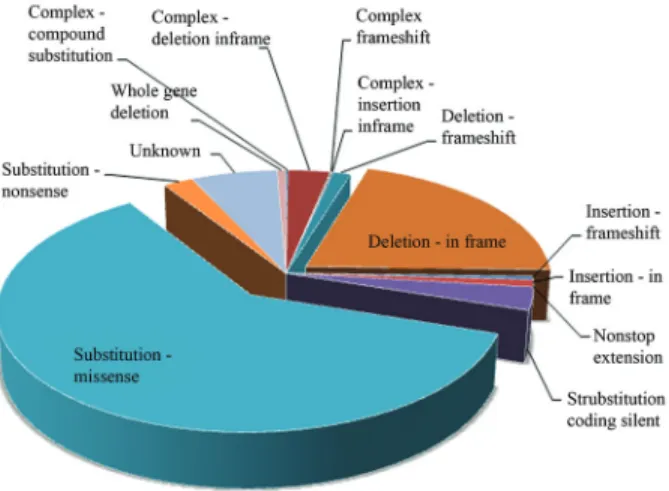
c.1579_1580GG > CT in geneSF3B1is a nonspecified type of mutation. To obtain a profile of the mutation type distri-bution in lung cancer, we calculated the statistical fre-quency of each mutation type, presented in Figure 1, showing that there are many mutation subtypes, such as missense, nonsense, deletions and insertions. Among them, the missense mutations accounted for the largest proportion (61%).
Calculation of mutation frequency in lung cancer
The gene mutation list contains 21,135 mutation events related to 20,906 unique samples. In order to screen the most important mutated genes, we calculated the muta-tion frequency of each gene in the list. Figure 2 illustrates the top 23 genes found in lung cancer, clearly showing that the most frequently mutated genes in lung cancer are
EGFR, KRAS and TP53, with a mutation frequency of
Figure 2- Top 23 most frequently mutated genes in lung cancer. The X-axis represents the top 23 genes and labels are the gene symbols. The Y-axis re-flects the total amount of mutation events occurred in these genes.
10957, 3106 and 2034, respectively. Next, the mutation events in each gene were sorted (Figure 3), this showing that the mutation type of each gene varies dramatically, even in the top 23 mutated genes. As shown in Figure 3,
geneTP53was the one with the largest number of mutation types, amounting to more than ten times the number of mu-tation types ofKRAS, although the mutation frequency of
KRASwas higher than that ofTP53.
Construction of the PPI network
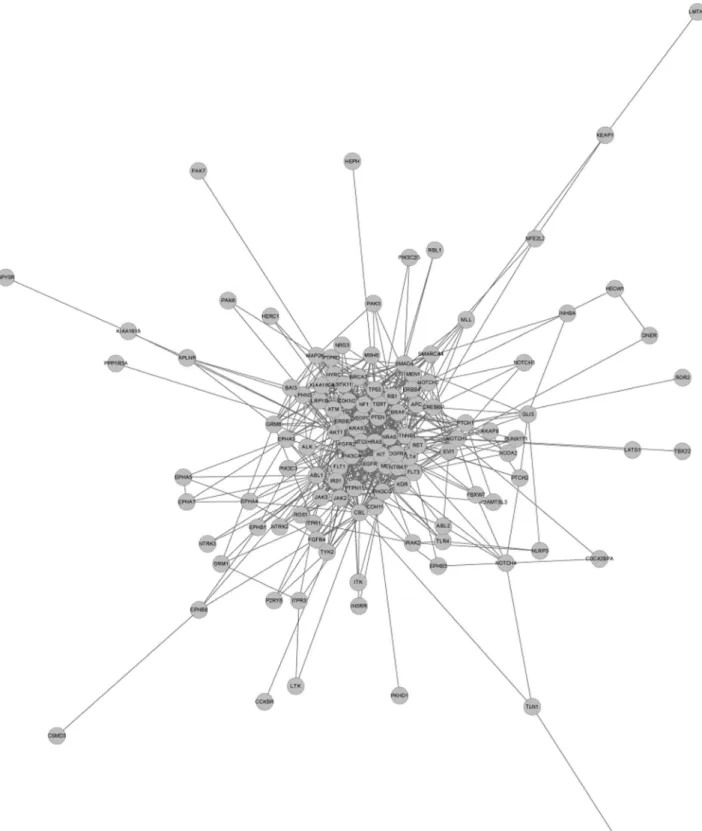
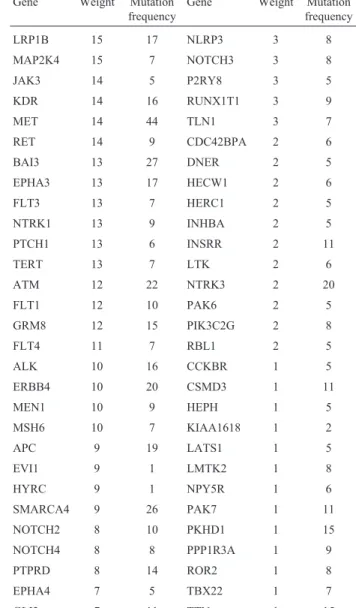
By mapping the mutated genes into PPI databases, we constructed a PPI network, shown in Figure 4. For a deep data-mining of this network, we calculated the interaction weight (numbers of neighbors) of each core node and visu-alized the relationships of weight and mutation event for each gene (Figure 5). Analyzing Table 1 and Figure 5, it be-comes evident that genes with high mutation frequencies also had higher interaction weights. For example, the top 3 mutated genesEGFR,KRASandTP53also had higher in-teraction weights: 32, 37 and 41, respectively. On the other hand, we noticed that some genes with relative lower muta-tion frequencies were the core nodes in the PPI network. For example, AKT1 has a high PPI weight (41) but a low mutation frequency (6).
Candidate genes for sequencing kits
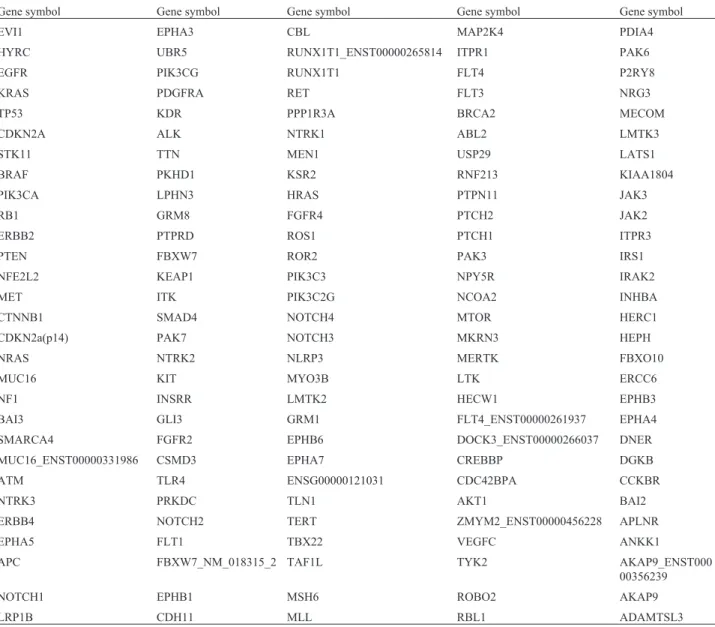
After mining the COSMIC database and analyzing the lung cancer PPI network, we screened the most impor-tant mutated genes in lung cancer based on one of the fol-lowing criteria: PPI weight > 7 and mutation frequency > 5. After selection, 145 genes meeting the cutoff criteria were screened out (Table 2). We consider that these mutated
genes could be used to design sequencing kits for diagnos-tic purposes.
Discussion
Many researchers have attempted to find a complete mutation profile of each cancer. In this study, we obtained a list of lung cancer mutations totaling 21,135 mutation events. We believe that to this date this list is the most com-plete and detailed catalogue of lung cancer mutation events available. Mutations from Stage I to Stage II, from cell line to biopsy, from small cell carcinoma to NSCLC, were al-most all included in this list.
As expected, by calculating the mutation frequency for each gene in this list, EGFR,KRAS andTP 53were found to be the top 3 most frequently mutated genes in lung cancer. In addition, these three genes were the hub nodes in the PPI network.EGFRandKRAShave been proved to be lung cancer oncogenes for years. An investigation done in 2004 on the gefitinib therapy effect found somatic muta-tions ofEGFRin 15 of 58 unselected tumors from Japan and in one out of 61 from the United States (Paezet al., 2004).EGFRhas since been accepted as a target for lung cancer therapy, andEGFRmutations may predict
ity to gefitinib. In recent years, developing EGFR muta-tions into a diagnostic target has been a research hotspot. In 2008, Maheswaranet al.(2008) used molecular character-ization of circulating tumor cells as a strategy for noninvasive serial monitoring of tumor genotypes during treatment. It is known that most lung adenocarcinoma-as-sociated EGFR mutations confer sensitivity to specific
EGFRtyrosine kinase inhibitors. Politi and Lynch (2012) found thatEGFRexon 19 insertion mutations are also sen-sitive to this class of drugs. All these findings suggest that lung cancer patients should be tested forEGFRmutations.
AfterEGFR, the second most important gene in the development of lung cancer isKRAS. As early as in 2001, Johnsonet al.(2001) found that mice carryingKRAS
muta-tions were highly predisposed to a range of tumor types, predominantly early-onset lung cancer. Furthermore, muta-tions ofKRASandEGFRcan be combined to predict prog-nosis. For example, Massarelli et al. (2007) found that patients with both EGFR mutation and increased EGFR
copy number had a > 99.7% chance of objective response to EGFR-TKI therapy, whereas patients withKRASmutation with or without increased EGFR copy number had a > 96.5% chance of disease progression. They concluded that theKRASmutation should be included as an indicator of resistance in the panel of markers used to predict re-sponse to EGFR-TKI lung cancer therapy. Based on the fact that these core genes in the PPI network are strongly
re-Table 1- Protein-protein interaction (PPI) network core genes, listed by gene symbol, weigh and mutation frequency.
Gene Weight Mutation frequency
Gene Weight Mutation frequency
PIK3CA 48 93 TYK2 7 5
AKT1 41 6 EPHB1 6 10
TP53 41 2034 ITPR1 6 7
HRAS 39 9 MLL 6 7
CTNNB1 37 34 APLNR 5 5
KRAS 37 3106 FGFR4 5 9
PTEN 36 62 IRAK2 5 5
NRAS 34 33 KIAA1804 5 5
EGFR 32 10957 PIK3C3 5 8
PTPN11 32 6 PTCH2 5 6
MTOR 31 6 ROS1 5 8
CBL 30 10 TLR4 5 10
PIK3CG 29 16 ABL2 4 7
ABL1 27 5 AKAP9 4 5
CDKN2A 26 310 CDH11 4 10
ERBB2 26 83 EPHA5 4 19
RB1 26 90 EPHA7 4 8
BRAF 25 130 EPHB6 4 8
NOTCH1 24 17 FBXW7 4 14
IRS1 22 5 GRM1 4 8
NF1 21 28 ITPR3 4 5
SMAD4 21 11 NRG3 4 5
CREBBP 19 6 NTRK2 4 11
PDGFRA 19 16 PAK3 4 6
BRCA2 18 7 ADAMTSL3 3 5
JAK2 18 5 EPHB3 3 5
KIT 18 11 ITK 3 12
STK11 18 172 KEAP1 3 12
LPHN3 17 15 NCOA2 3 6
FGFR2 15 11 NFE2L2 3 44
Gene Weight Mutation frequency
Gene Weight Mutation frequency
LRP1B 15 17 NLRP3 3 8
MAP2K4 15 7 NOTCH3 3 8
JAK3 14 5 P2RY8 3 5
KDR 14 16 RUNX1T1 3 9
MET 14 44 TLN1 3 7
RET 14 9 CDC42BPA 2 6
BAI3 13 27 DNER 2 5
EPHA3 13 17 HECW1 2 6
FLT3 13 7 HERC1 2 5
NTRK1 13 9 INHBA 2 5
PTCH1 13 6 INSRR 2 11
TERT 13 7 LTK 2 6
ATM 12 22 NTRK3 2 20
FLT1 12 10 PAK6 2 5
GRM8 12 15 PIK3C2G 2 8
FLT4 11 7 RBL1 2 5
ALK 10 16 CCKBR 1 5
ERBB4 10 20 CSMD3 1 11
MEN1 10 9 HEPH 1 5
MSH6 10 7 KIAA1618 1 2
APC 9 19 LATS1 1 5
EVI1 9 1 LMTK2 1 8
HYRC 9 1 NPY5R 1 6
SMARCA4 9 26 PAK7 1 11
NOTCH2 8 10 PKHD1 1 15
NOTCH4 8 8 PPP1R3A 1 9
PTPRD 8 14 ROR2 1 8
EPHA4 7 5 TBX22 1 7
lated to lung cancer, we believe that this PPI network con-tains the most important genes related to lung cancer.
Many companies detect lung cancer by only four so-matic gene mutations (EGFR,KRAS,BRAFandPI3K). As expected, these genes are all included in our list (Table 2; mutation frequency ofBRAF= 130, weight = 25; mutation frequency ofPI3K3A= 93, weight = 48).BRAFencodes a RAS-regulated kinase that mediates cell growth and the ac-tivation of the malignant transformation kinase pathway (Sithanandamet al., 1990). Broseet al.(2002) found that
BRAFmutations in human lung cancers may identify a sub-set of tumors sensitive to targeted therapy. Furthermore, an in vivo study with the inhibitor of the last of the four genes,
PI3K, aimed at testing its activity in lung cancer treatment (Engelmanet al., 2008), this leading to the conclusion that
inhibitors of the PI3K-mTOR pathway may be activated in cancers withPIK3CAmutations and, when combined with MEK inhibitors, may effectively treatKRASmutated lung cancers.
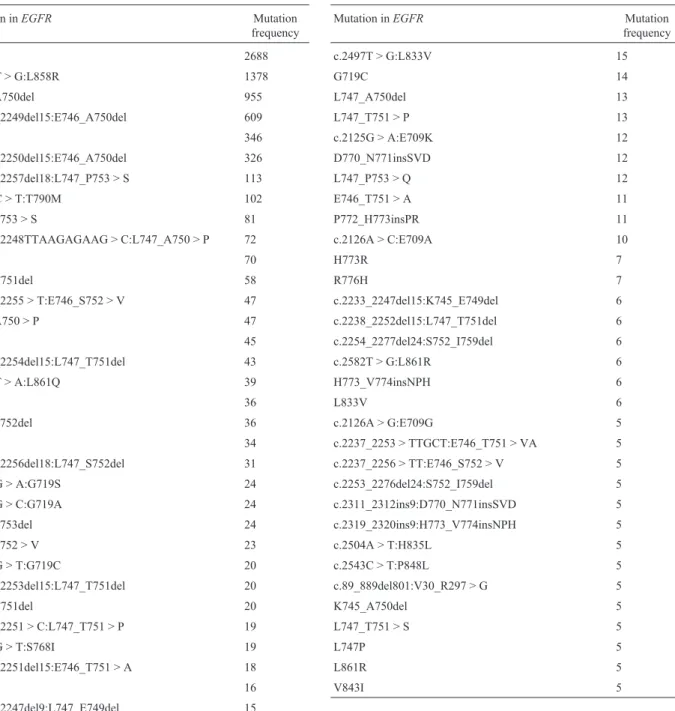
AsEGFRandKRASkits are widely used, we listed ourEGFRandKRASmutation events in Tables 3 and 4. In these tables, we sorted the mutations inEGFRandKRASby frequency, with “Y” meaning the typical mutation used in the detection kits supplied by many companies; and “-” meaning that the mutation has a location in the genome similar to some of the other detected mutations. But, first of all, “-” is an alert to the fact that there are many different kinds of mutation in the same region. Traditional methods such as PCR are unable to detect such complicated muta-tions. This is the first advantage that a Next-Generation
Se-Table 2- Genes with high mutation frequency in lung cancer (n = 145).
Gene symbol Gene symbol Gene symbol Gene symbol Gene symbol
EVI1 EPHA3 CBL MAP2K4 PDIA4
HYRC UBR5 RUNX1T1_ENST00000265814 ITPR1 PAK6
EGFR PIK3CG RUNX1T1 FLT4 P2RY8
KRAS PDGFRA RET FLT3 NRG3
TP53 KDR PPP1R3A BRCA2 MECOM
CDKN2A ALK NTRK1 ABL2 LMTK3
STK11 TTN MEN1 USP29 LATS1
BRAF PKHD1 KSR2 RNF213 KIAA1804
PIK3CA LPHN3 HRAS PTPN11 JAK3
RB1 GRM8 FGFR4 PTCH2 JAK2
ERBB2 PTPRD ROS1 PTCH1 ITPR3
PTEN FBXW7 ROR2 PAK3 IRS1
NFE2L2 KEAP1 PIK3C3 NPY5R IRAK2
MET ITK PIK3C2G NCOA2 INHBA
CTNNB1 SMAD4 NOTCH4 MTOR HERC1
CDKN2a(p14) PAK7 NOTCH3 MKRN3 HEPH
NRAS NTRK2 NLRP3 MERTK FBXO10
MUC16 KIT MYO3B LTK ERCC6
NF1 INSRR LMTK2 HECW1 EPHB3
BAI3 GLI3 GRM1 FLT4_ENST00000261937 EPHA4
SMARCA4 FGFR2 EPHB6 DOCK3_ENST00000266037 DNER
MUC16_ENST00000331986 CSMD3 EPHA7 CREBBP DGKB
ATM TLR4 ENSG00000121031 CDC42BPA CCKBR
NTRK3 PRKDC TLN1 AKT1 BAI2
ERBB4 NOTCH2 TERT ZMYM2_ENST00000456228 APLNR
EPHA5 FLT1 TBX22 VEGFC ANKK1
APC FBXW7_NM_018315_2 TAF1L TYK2 AKAP9_ENST000
00356239
NOTCH1 EPHB1 MSH6 ROBO2 AKAP9
quencing (NGS) technology can offer. Secondly, it is obvious that the frequent mutations represent a high per-centage in the three kits and, on the other hand, many muta-tions with frequencies below 30 are not listed in the three kits. The cost of detecting more than 100 mutations at the same time by PCR is very high, conferring NGS another ad-vantage over PCR detection.
It is really urgent to develop a NGS kit for detecting lung cancer mutations. Our genes for the sequencing kit can be designed for somatic mutation detection. The 145 gene
set comprises all of the somatic mutation detecting purpose genes - EGFR, KRAS, BRAF and PIK3CA (Saal et al., 2005) - and may provide a feasible choice for a NGS kit. With the progresses in sequencing technology, mutations in lung cancer patients can be detected in one day or even less time. This technology applied to cancer genome sequenc-ing can speed up cancer research, and the kit for diagnostic or recurrence evaluation should be introduced in clinical care as soon as possible, in order to offer patients a better chance of less suffering and a higher survival perspective.
Table 3- Mutation events forEGFRmutation kits.
Mutation inEGFR Mutation
frequency
L858R 2688
c.2573T > G:L858R 1378
E746_A750del 955
c.2235_2249del15:E746_A750del 609
T790M 346
c.2236_2250del15:E746_A750del 326
c.2240_2257del18:L747_P753 > S 113
c.2369C > T:T790M 102
L747_P753 > S 81
c.2239_2248TTAAGAGAAG > C:L747_A750 > P 72
L861Q 70
L747_T751del 58
c.2237_2255 > T:E746_S752 > V 47
L747_A750 > P 47
G719S 45
c.2240_2254del15:L747_T751del 43
c.2582T > A:L861Q 39
G719A 36
L747_S752del 36
S768I 34
c.2239_2256del18:L747_S752del 31
c.2155G > A:G719S 24
c.2156G > C:G719A 24
L747_P753del 24
E746_S752 > V 23
c.2155G > T:G719C 20
c.2239_2253del15:L747_T751del 20
E746_T751del 20
c.2239_2251 > C:L747_T751 > P 19
c.2303G > T:S768I 19
c.2237_2251del15:E746_T751 > A 18
G719? 16
c.2239_2247del9:L747_E749del 15
Mutation inEGFR Mutation
frequency
c.2497T > G:L833V 15
G719C 14
L747_A750del 13
L747_T751 > P 13
c.2125G > A:E709K 12
D770_N771insSVD 12
L747_P753 > Q 12
E746_T751 > A 11
P772_H773insPR 11
c.2126A > C:E709A 10
H773R 7
R776H 7
c.2233_2247del15:K745_E749del 6
c.2238_2252del15:L747_T751del 6
c.2254_2277del24:S752_I759del 6
c.2582T > G:L861R 6
H773_V774insNPH 6
L833V 6
c.2126A > G:E709G 5
c.2237_2253 > TTGCT:E746_T751 > VA 5
c.2237_2256 > TT:E746_S752 > V 5
c.2253_2276del24:S752_I759del 5
c.2311_2312ins9:D770_N771insSVD 5
c.2319_2320ins9:H773_V774insNPH 5
c.2504A > T:H835L 5
c.2543C > T:P848L 5
c.89_889del801:V30_R297 > G 5
K745_A750del 5
L747_T751 > S 5
L747P 5
L861R 5
References
Bamford S, Dawson E, Forbes S, Clements J, Pettett R, Dogan A, Flanagan A, Teague J, Futreal P and Stratton M (2004) The COSMIC (Catalogue of Somatic Mutations in Cancer) data-base and website. Br J Cancer 91:355-358.
Brose MS, Volpe P, Feldman M, Kumar M, Rishi I, Gerrero R, Einhorn E, Herlyn M, Minna J and Nicholson A (2002) BRAF and RAS mutations in human lung cancer and mela-noma. Cancer Res 62:6997.
Dy GK and Adjei AA (2002) Novel targets for lung cancer ther-apy: Part II. J Clin Oncol 20:3016-3028.
Engelman JA, Chen L, Tan X, Crosby K, Guimaraes AR, Upadhyay R, Maira M, McNamara K, Perera SA and Song Y (2008) Effective use of PI3K and MEK inhibitors to treat mutant Kras G12D and PIK3CA H1047R murine lung can-cers. Nat Med 14:1351-1356.
Forbes SA, Bindal N, Bamford S, Cole C, Kok CY, Beare D, Jia M, Shepherd R, Leung K and Menzies A (2011) COSMIC: Mining complete cancer genomes in the Catalogue of So-matic Mutations in Cancer. Nucleic Acids Res 39:D945-D950.
Fukuoka M, Yano S, Giaccone G, Tamura T, Nakagawa K, Douillard JY, Nishiwaki Y, Vansteenkiste J, Kudoh S, Ris-chin D,et al.(2003) Multi-institutional randomized phase II trial of gefitinib for previously treated patients with ad-vanced non-small-cell lung cancer (The IDEAL 1 Trial) [corrected]. J Clin Oncol 21:2237-2246.
Giaccone G, Herbst RS, Manegold C, Scagliotti G, Rosell R, Miller V, Natale RB, Schiller JH, Von Pawel J, Pluzanska A, et al.(2004). Gefitinib in combination with gemcitabine and cisplatin in advanced non-small-cell lung cancer: A phase III trial-INTACT 1. J Clin Oncol 22:777-784.
Haider S, Ballester B, Smedley D, Zhang J, Rice P and Kasprzyk A (2009) BioMart Central Portal - Unified access to biologi-cal data. Nucleic Acids Res 37:W23-W27.
Huncharek M, Muscat J and Geschwind JF (1999) K-ras onco-gene mutation as a prognostic marker in non-small cell lung cancer: A combined analysis of 881 cases. Carcinogenesis 20:1507-1510.
Jemal A, Bray F, Center MM, Ferlay J, Ward E and Forman D (2011) Global cancer statistics. CA Cancer J Clin 61:69-90. Jemal A, Center MM, DeSantis C and Ward EM (2010) Global
patterns of cancer incidence and mortality rates and trends. Cancer Epidemiol Biomarkers Prev 19:1893-1907. Johnson L, Mercer K, Greenbaum D, Bronson RT, Crowley D,
Tuveson DA and Jacks T (2001) Somatic activation of the K-ras oncogene causes early onset lung cancer in mice. Na-ture 410:1111-1116.
Kris MG, Natale RB, Herbst RS, Lynch Jr TJ, Prager D, Belani CP, Schiller JH, Kelly K, Spiridonidis H, Sandler A,et al. (2003) Efficacy of gefitinib, an inhibitor of the epidermal growth factor receptor tyrosine kinase, in symptomatic pa-tients with non-small cell lung cancer: A randomized trial. JAMA 290:2149-2158.
Liu G, Cheng D, Ding K, Le Maitre A, Liu N, Patel D, Chen Z, Seymour L, Shepherd FA and Tsao MS (2012) Pharma-cogenetic analysis of BR.21, a placebo-controlled random-ized phase III clinical trial of erlotinib in advanced non-small cell lung cancer. J Thorac Oncol 7:316-322.
Maheswaran S, Sequist LV, Nagrath S, Ulkus L, Brannigan B, Collura CV, Inserra E, Diederichs S, Iafrate AJ and Bell DW Table 4- Mutation events forKRASmutation kits.
Mutation inKRAS Mutation frequency
c.34G > T:G12C 1273
c.35G > T:G12V 625
c.35G > A:G12D 524
c.35G > C:G12A 202
c.34G > A:G12S 139
c.37G > T:G13C 99
c.38G > A:G13D 76
c.34G > C:G12R 69
c.34_35GG > TT:G12F 22
c.183A > T:Q61H 13
c.182A > T:Q61L 12
c.183A > C:Q61H 10
Q61H 10
c.182A > G:Q61R 9
G12D 9
c.181C > A:Q61K 6
c.37G > A:G13S 6
c.181C > G:Q61E 4
c.37G > C:G13R 3
G12F 3
c.182A > C:Q61P 2
c.198_199ins15:A66_M67insEEYSA 2
c.34_35GG > CT:G12L 2
c.35_36GT > AA:G12E 2
c.38_39GC > TT:G13V 2
G12A 2
G12C 2
G12V 2
L19F 2
c.15AT:K5N 1
c.180_181TC > CA:Q61K 1
c.205delG:D69fs*4 1
c.27T > C:V9V 1
c.31G > C:A11P 1
c.32C > T:A11V 1
c.34_36GGT > TGC:G12C 1
c.35_36GT > TC:G12V 1
c.35delG:G12fs*3 1
c.36T > C:G12G 1
c.38G > C:G13A 1
c.38G > T:G13V 1
c.52G > A:A18T 1
c.53C > A:A18D 1
G12_G13insG 1
G12S 1
(2008) Detection of mutations in EGFR in circulating lung-cancer cells. N Engl J Med 359:366-377.
Massarelli E, Varella-Garcia M, Tang X, Xavier AC, Ozburn NC, Liu DD, Bekele BN, Herbst RS and Wistuba II (2007) KRAS mutation is an important predictor of resistance to therapy with epidermal growth factor receptor tyrosine ki-nase inhibitors in non–small-cell lung cancer. Clin Cancer Res 13:2890-2896.
Mathivanan S, Periaswamy B, Gandhi T, Kandasamy K, Suresh S, Mohmood R, Ramachandra Y and Pandey A (2006) An evaluation of human protein-protein interaction data in the public domain. BMC Bioinformatics 7:S19.
Mogi A and Kuwano H (2011) TP53 mutations in nonsmall cell lung cancer. J Biomed Biotechnol 2011:583929.
Paez JG, Janne PA, Lee JC, Tracy S, Greulich H, Gabriel S, Herman P, Kaye FJ, Lindeman N, Boggon TJ,et al.(2004) EGFR mutations in lung cancer: Correlation with clinical re-sponse to gefitinib therapy. Science 304:1497-1500.
Pao W, Wang TY, Riely GJ, Miller VA, Pan Q, Ladanyi M, Zakowski MF, Heelan RT, Kris MG and Varmus HE (2005) KRAS mutations and primary resistance of lung adeno-carcinomas to gefitinib or erlotinib. PLoS Medicine 2:e17.
Perez-Morales R, Mendez-Ramirez I, Castro-Hernandez C, Mar-tinez-Ramirez OC, Gonsebatt ME and Rubio J (2011) Poly-morphisms associated with the risk of lung cancer in a healthy Mexican Mestizo population: Application of the ad-ditive model for cancer. Genet Mol Biol 34:546-552.
Politi K and Lynch TJ (2012) Two sides of the same coin: EGFR exon 19 deletions and insertions in lung cancer. Clin Cancer Res 18:1490-1492.
Rosell R, Moran T, Queralt C, Porta R, Cardenal F, Camps C, Majem M, Lopez-Vivanco G, Isla D, Provencio M,et al. (2009) Screening for epidermal growth factor receptor mu-tations in lung cancer. N Engl J Med 361:958-967. Saal LH, Holm K, Maurer M, Memeo L, Su T, Wang X, Yu JS,
Malmström PO, Mansukhani M and Enoksson J (2005) PIK3CA mutations correlate with hormone receptors, node metastasis, and ERBB2, and are mutually exclusive with PTEN loss in human breast carcinoma. Cancer Res 65:2554. Sithanandam G, Kolch W, Duh FM and Rapp UR (1990)
Com-plete coding sequence of a human B-raf cDNA and detection of B-raf protein kinase with isozyme specific antibodies. Oncogene 5:1775-1780.
Spigel DR, Burris 3rd HA, Greco FA, Shipley DL, Friedman EK, Waterhouse DM, Whorf RC, Mitchell RB, Daniel DB, Zangmeister J,et al.(2011) Randomized, double-blind, pla-cebo-controlled, phase II trial of sorafenib and erlotinib or erlotinib alone in previously treated advanced non-small-cell lung cancer. J Clin Oncol 29:2582-2589.
Youlden DR, Cramb SM and Baade PD (2008) The International Epidemiology of Lung Cancer: Geographical distribution and secular trends. J Thorac Oncol 3:819-831.
Internet Resources
COSMIC,http://www.sanger.ac.uk/genetics/CGP/cosmic (Dec.
12, 2012).
BioMart Central Portal, http://www. biomart.org (Dec. 20, 2012).
Associate Editor: Luís Carlos de Souza Ferreira