455 Mem Inst Oswaldo Cruz, Rio de Janeiro, Vol. 103(5): 455-462, August 2008
online | memorias.ioc.fiocruz.br
Regional pattern of the molecular types of
Cryptococcus neoformans
and
Cryptococcus gattii
in Brazil
Luciana Trilles/
1, Márcia dos Santos Lazéra, Bodo Wanke, Raquel Vasconcelos Oliveira
2,
Gláucia Gonçalves Barbosa, Marília Martins Nishikawa
3, Bernardina Penarrieta Morales,
Wieland Meyer
1Laboratório de Micologia 2Centro de Estatística e Documentação, Instituto de Pesquisa Cínica Evandro Chagas-Fiocruz, Av. Brasil 4365, 21040-900 Rio de Janeiro, RJ, Brasil 1Molecular Mycology Research Laboratory, Center for Infectious Diseases and Microbiology, Westmead Hospital, Westmead Millennium Institute, Western Clinical School, University of Sydney, Sydney, Austrália 3Departamento de
Microbiologia, Instituto Nacional de Controle de Qualidade em Saúde-Fiocruz, Rio de Janeiro, RJ, Brasil
The molecular types of 443 Brazilian isolates of
Cryptococcus neoformans
and
Cryptococcus gattii
were
ana-lyzed to determine their geographic distribution within Brazil and their underlying host conditions. The following
data, imported from previous epidemiological studies as well as two culture collections, were analyzed for: place of
isolation, source (clinical or environmental), host risk factors, species, serotype, mating type, and molecular type.
Molecular typing by PCR-fingerprinting using primers for the minisatellite-specific core sequence of the wild-type
phage M13 or microsatellites [(GACA)
4, (GTG)
5], restriction fragment length polymorphism of
URA5
gene analysis,
and/or amplified fragment length polymorphism (AFLP) identified eight major genotypes: VNI/AFLP1,
VNII/AFL-P1A, VNIII/AFLP2, and VNIV/AFLP3 for
C. neoformans,
and VGI/AFLP4, VGII/AFLP6, VGIII/AFLP5, and VGIV/
AFLP7 for
C. gattii.
The most common molecular type found in Brazil was VNI (64%), followed by VGII (21%), VNII
(5%), VGIII (4%), VGI and VNIV (3% each), and VNIII (< 1%). Primary cryptococcosis caused by the molecular
type VGII (serotype B, MAT
α
) prevails in immunocompetent hosts in the North and Northeast regions, disclosing an
endemic regional pattern for this specific molecular type in the Northern Brazil.
Key words:Cryptococcus neoformans - Cryptococcus gattii - molecular types - epidemiology - Brazil
Cryptococcosis is a life-threatening, systemic
my-cosis affecting humans and animals. It is acquired by
inhalation of viable propagules from the environment,
and the most common clinical manifestation of
crypto-coccosis is meningoencephalitis (Lin & Heitman 2006).
Cryptococcosis is caused by two different species of the
genus
Cryptococcus
:
C. neoformans
(serotypes A, D,
and hybrid AD) and
C. gattii
(serotypes B and C)
(Kwon-Chung et al. 2002). While
C. neoformans
infections
oc-cur worldwide and are an important cause of morbidity
and mortality in immunocompromised hosts (especially
AIDS-patients),
C. gattii
usually infects normal hosts
(Kwon-Chung & Bennett 1992, Lazéra et al. 2005) and
is considered to be a tropical disease. The ongoing
Van-couver Island outbreak in a temperate climate, however,
suggests that
C. gattii
can adapt to new environments
(Kidd et al. 2004).
In Brazil, cryptococcosis caused by
C. neoformans
occurs in all regions; however,
C. gattii
behaves as a
primary pathogen infecting native immunocompetent
hosts and mainly infects young people and children in
the North and Northeast (NE) regions of Brazil. In this
Financial support: CAPES, NH&MRC (ID 990738; ID 352303) + Corresponding author: [email protected] Received 30 January 2008
Accepted 9 July 2008
group of patients, the infection is characterized by a high
lethality rate that ranges from 40.6% to 56% (Correa et
al. 1999, Lazéra et al. 2005) and frequently causes
in-capacity (e.g., visual deficits or blindness) and
hydro-cephalus (Rozenbaum & Gonçalves 1994, Nishikawa et
al. 2003). Brazilian epidemiological data suggest a
geo-graphic, macroregional, north-south trend in
C. gattii
infections in Brazil. The Northern macro region (NM),
which is comprised of the states of Amazonas, Roraima,
Pernambuco, Piauí, and Bahia, is endemic for
C. gattii.
The Southern macro region (SM), which are represented
by the states of Mato Grosso do Sul, Minas Gerais, São
Paulo (SP), Rio de Janeiro (RJ), Paraná, and Rio Grande
do Sul (RS), show sporadic infections by
C. gattii.
Serotyping was largely used for epidemiological
studies of
C. gattii
and
C. neoformans
, but the lack of
an available commercial serotyping kits and the search
for a more reliable technique led to an increased use of
molecular tools. Additionally, the analysis of genotypes
within a species could answer several questions that may
impact management, therapy, surveillance, and
prophy-lactic actions. An attempt to standardize a technique for
a global molecular epidemiological survey of the agents
of cryptococcosis identified eight major molecular types
via PCR fingerprinting with the minisatellite-specific
core sequence of the wild-type phage M13 or
micro-satellites [(GACA)
4, (GTG)
5]. Thus,
C. neoformans
was
grouped into the types VNI (serotype A), VNII
(sero-type A), VNIII (sero(sero-type AD), and VNIV (sero(sero-type D);
C. gattii
was grouped into the types VGI, VGII, VGIII,
grouping has been confirmed by others using different
techniques, such as amplified fragment length
polymor-phism analysis (AFLP) (Boekhout et al. 2001),
restric-tion fragment length polymorphism analysis (RFLP) of
URA5
and
PLB1
genes (Latouche et al. 2003, Meyer et
al. 2003), and multilocus sequence typing (MLST)
(Lit-vintseva et al. 2006). Recently, AFLP and MLST have
revealed the existence of a new molecular type of
C.
neoformans
in Botswana (genotype VNB) that seems to
be geographically restricted to sub-Saharan Africa
(Lit-vintseva et al. 2006).
Although several previous studies have analyzed the
molecular types of Brazilian isolates according to the
previously described typing system (VNI/AFLP1, VNII/
AFLP1A, VNIII/AFLP2, VNIV/AFLP3, VGI/AFLP4,
VGII/AFLP6, VGIII/AFLP5, and VGIV/AFLP7 types),
they demonstrated only the presence of
C. neoformans
and
C. gattii
in certain cities or states (Casali et al. 2003,
Igreja et al. 2004, Abegg et al. 2006, Matsumoto et al.
2007). Even when more than one region was analyzed,
the number of isolates was limited (Trilles et al. 2003).
In the current study, the main objectives were to
obtain an up-to-date picture of the molecular type
dis-tribution of
C. gattii
and
C. neoformans
in Brazil and
correlate the genotypes to geographic regions and host
conditions by reanalyzing all of data from previously
published cryptococcal strains and combining them
with data obtained from new strains using statistics and
descriptive analysis.
MATERIALS AND METHODS
Data from 356 Brazilian isolates were imported from
different sources: (i) previous epidemiological studies
(Boekhout et al. 2001, Casali et al. 2003, Trilles et al.
2003, Meyer et al. 2003, Igreja et al. 2004, Katsu et al.
2004, Ribeiro et al. 2006), (ii) the database of the
Cryp-tococcal Culture Collection at Laboratório de
Micolo-gia, Instituto de Pesquisa Clínica Evandro Chagas, RJ,
and (iii) the database of the Australian Medical Fungal
Collection, at the Molecular Mycology Research
Labo-ratory at Westmead Hospital, Sydney, Australia.
The data collected for the current analysis included:
place of isolation, source (clinical or environmental), host
risk factors, species, serotype, mating type, and
molecu-lar type identified by PCR-fingerprinting,
URA5
-RFLP
according to Meyer et al. (2003), or AFLP according to
Boekhout et al. (2001). In addition to the imported data
described above, we determined the mating type,
sero-type, molecular sero-type, and polymorphisms of additional
87
C. gattii
and
C. neoformans
isolates.
Serotyping
- Serotyping was carried out using the
slide agglutination test according to the manufacturer’s
instructions (Crypto Check Iatron RM 304-K kit; Iatron
Laboratories, Tokyo, Japan).
Molecular typing
-
The 87 clinical and
environmen-tal Brazilian isolates were typed by
URA5
-RFLP and
PCR-fingerprinting using the minisatellite-specific core
sequence of the wild-type phage M13. The following
standard strains representing each molecular type were
included in the analysis: WM 148 (serotype A, VNI/
AFLP1), WM 626 (serotype A, VNII/AFLP1A), WM
628 (serotype AD, VNIII/AFLP2), WM 629 (serotype D,
VNIV/AFLP3), WM 179 (serotype B, VGI/AFLP4), WM
178 (serotype B, VGII/AFLP6), WM 175 (serotype B,
VGIII/AFLP5), and WM 779 (serotype C, VGIV/AFLP7)
(Meyer et al. 2003). The DNA was extracted as
previ-ously described (Meyer et al. 1999). The isolates were
grown on Sabouraud’s dextrose agar at 37°C for 48 h.
The tube containing the yeast cell pellet was frozen in
liquid nitrogen. The pellet was ground with a miniature
pestle, and 500 µl of cell lysis solution (0.5% sodium
do-decyl sulfate, 1.4% NaCl, 0.73% EDTA, and Tris-HCl
0.2M) was added to the frozen, ground cells. The tubes
were incubated for 5 min at room temperature with
con-stant shaking, and 500 µl phenol:chloroform:isoamyl
al-cohol (v:v:v 25:24:1) was added and mixed thoroughly
for 2 min to obtain a homogenous suspension. The tubes
were centrifuged for 20 min at 16,110
g
. After
centrifu-gation, the upper aqueous layer was transferred to a new
tube, an equal volume of chloroform:isoamyl alcohol
(v:v 24:1) was added, and the mixture was shaken and
centrifuged. To precipitate the genomic DNA, an equal
volume of isopropanol was added to the supernatant. The
mixture was then gently shaken and incubated at -20°C
for at least 1 h or overnight. The DNA pellet was washed
with 70% ethanol and suspended in 200 µl sterile,
deion-ized water at 4°C overnight.
PCR of the
URA5
gene was performed in a final
vol-ume of 50 µl. Each reaction contained 50 ng of DNA, 1
X PCR buffer [160 mM (NH
4)
2SO
4, 670 mM Tris-HCI
(pH8.8 at 25°C), 0.1% Tween-20 - Bioline], 0.2 mM
each of dATP, dCTP, dGTP, and dTTP (Roche
Diagnos-tics GmbH), 3 mM magnesium chloride, 1.5 U BioTaq
DNA polymerase (Bioline), and 50 ng of each primer
URA5 (5’ ATGTCCTCCCAAGCCCTCGACTCCG 3’)
and SJ01 (5’ TTAAGACCTCTGAACACCGTACTC 3’)
(Meyer et al. 2003). PCR was performed for 35 cycles in
a Perkin-Elmer thermal cycler (model 480) at 94°C with
a 2 min initial denaturation, 45 s denaturation at 94°C,
1 min annealing at 61°C, 2 min extension at 72°C, and
final extension cycle for 10 min at 72°C. A total of 30 µl
of PCR products were double digested with
Sau
96I
(10 U/µl) and
Hha
I (20 U/µl) for 3 h, and the fragments
were separated by 3% agarose gel electrophoresis at
100 V. RFLP patterns were assigned visually by
compari-son with patterns obtained from standard strains
(VNI-VNIV and VGI-VGIV).
457 Mem Inst Oswaldo Cruz, Rio de Janeiro, Vol. 103(5), August 2008
ethidium bromide in 1 X Tris-borate-EDTA (TBE)
buf-fer at 70 V for 9 h, and they were visualized under a
UV light (Meyer et al. 2003). PCR-fingerprinting
pro-files were visually compared to the standard strains to
determine the molecular types. The genetic relationships
of the isolates were analyzed using the 1D gel analysis
module (BioGalaxy, BioAware, Hannut, Belgium) in
BioloMICS version 7.5.30 (BioAware). Similarity
coef-ficients were calculated by using the Dice algorithm, and
cluster analyses were performed by the Unweighted Pair
Group Method with the Arithmetic mean (UPGMA).
AFLP analysis was performed according to the
AFLP Microbial Fingerprinting Protocol of the
manu-facturer (Applied Biosystems), and we used
Mse
I and
Eco
RI for the DNA restriction digestion (Boekhout et
al. 2001). The restriction ligation was performed using
1 unit
Mse
I, 5 units
Eco
RI, and 3 units T4 DNA ligase.
The first PCR procedure was performed with two
pre-selective primers (
Eco
RI core sequence and
Mse
I core
sequence) and the AFLP Amplification Core Mix from
the AFLP Microbial Fingerprinting Kit according to the
manual. A second PCR procedure used more selective
primers (
Eco
RI-AC FAM and
Mse
I-G).
Mating type
-
The mating type was determined by
PCR. MAT alpha-specific mating type primers were
MatalphaF (5’ CTTCACTGCCATCTTCACCA 3’) and
MatalphaR (5’ GACACAAAGGGTCATGCCA 3’), and
the amplification reactions were carried out according
to the procedure in Chaturvedi et al. (2000). MAT
a-spe-cific mating type primers were MFa2U (5’
ACACCGC-CTGTTACAATGGAC 3’) and MFa2L (5’
CAGCGTTT-GAAGATGGACTTT 3’) (Fraser et al. 2003), and the
amplifications reactions were performed according to
the procedure in Halliday and Carter (2003).
Statistical analysis
-
Statistical analysis of 443
C.
neoformans
and
C. gattii
isolates was performed using
SPSS version 11.0 software, and a p-value < 0.05 was
used to define significance. The most representative
mo-lecular types in terms of the numbers of isolates were
included in the logistical analysis. Univariate analysis
was performed using the Fisher’s exact and chi-square
tests. Odds ratio (OD) and 95% confidence intervals was
calculated to assess the univariate risk of a particular
molecular type or species occurring in a certain
geo-graphic area. The variables selected for the current study
were source, host factors, and region (NM or SM). Host
factors were analyzed according to the immunological
status of the patient as either immunocompetent, HIV
negative with no other conditions or
immunocompro-mised, HIV positive or other conditions (e.g.,
cortico-therapy and tumor). The complete data of the isolates are
shown in the supplementary data. A multivariate logistic
regression model was use to analyze 291 clinical
sam-ples and was calculated with SAS software version 8.0
using the Genmod procedure. The log-binomial model
was used for estimating the adjusted relative risk of the
most common molecular type of each species occurring
in different host conditions as well as different Brazilian
regions. The variables for which the Wald test showed a
p < 0.05 were included in the final model. Two models
were tested separately to examine the interactions
be-tween host factors and the macro region (i.e., VNI was
compared to all other molecular types, and VGII was
compared to all other molecular types).
RESULTS
A total of 443
C. neoformans
(n = 320) and
C. gattii
(n = 123) isolates from all Brazilian regions,
represent-ing 11 Brazilian states, were analyzed (Fig. 1). Data from
356 isolates were imported from previous studies and that
from 87 isolates were newly typed using the molecular
tools described above. Out of the 320
C. neoformans
iso-lates, 251 were clinical and 69 environmental isolates. Out
of the 123
C. gattii
isolates, 86 were clinical (84 human
and 2 veterinary) and 37 were environmental isolates.
Information regarding geographic origin was not
available for two isolates (0.5%). Mating type data was
available for 262 (59.1%) isolates, and 249 (95%) of these
were of mating type alpha. Ten isolates were of mating
type a (5 VNIV environmental and 5 VGII clinical
iso-lates, all from the NM). Host risk factor data were
avail-able for 293 of the 335 (87%) clinical isolates. The
distri-bution of the molecular types of the
Cryptococcus
species
complex in Brazil according to geographic region, mating
type, source, and host factors is shown on Table I.
Overall, the most common molecular types were VNI
(64%) and VGII (21%), followed by VNII (5%), VGIII
(4%), VGI and VNIV (3% each), and VNIII (< 1%). The
molecular type VGIV was not identified among the
stud-ied Brazilian isolates. Fig. 1 shows the distribution of
the molecular types according to the Brazilian states
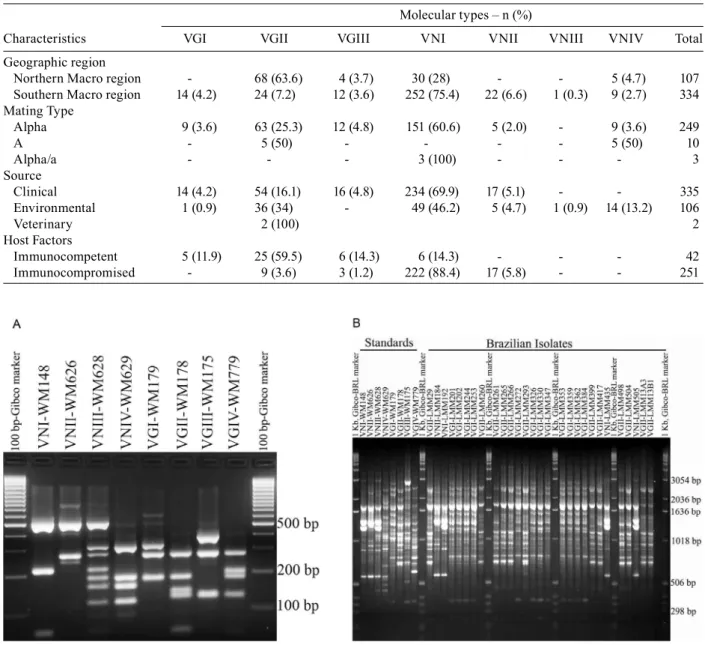
in-cluded in the analysis. Fig. 2A demonstrates the RFLP
profiles of the eight molecular types (VNI-VNIV,
VGI-VGIV) resulting from the
URA5
-RFLP technique using
the standards isolates, and Fig. 2B shows the PCR
fin-gerprinting profiles from the eight standards isolates as
well as a representative example of the Brazilian isolates.
Univariate analysis of the dataset showed that the OD of
an isolate being molecular type VNI or VGII (compared to
all other molecular types) varied according to the region
(NM or SM) when both clinical and environmental
data-sets were analyzed separately. Investigation of clinical
(OD 9.6; p < 0.001) and environmental (OD 2.4; p < 001)
samples suggests that the molecular type VGII is more
likely to occur in the NM. On the contrary, VNI isolates
are more likely to occur in the SM and show an OD of 1.5
for both clinical and environmental isolates (p < 0.001
and p = 0.018, respectively).
C. gattii
is 4.4 times more
likely to occur in the NM, whereas
C. neoformans
is 1.6
times more likely to occur in the SM (p < 0.001).
Fig. 2: A: restriction fragment length polymorphism (RFLP) profiles of URA5 gene obtained by double digestion of the gene with Sau96I and
HhaI of the standards isolates representing the eight molecular types VNI-VNIV and VGI-VGIV; B: banding patterns generated by PCR-finger-prints with the primer M13 obtained from a selection of Brazilian C. neoformans and C. gattii isolates, given as a representative example for the patterns obtained from clinical and environmental isolates. Standard patterns obtained from the reference strains of the eight major molecular types by PCR-fingerprinting with the microsatellite specific primer M13 (right-hand side of 2B).
TABLE I
Distribution of the molecular types according the main characteristics of 443 Brazilian isolates included in this study Molecular types – n (%)
Characteristics VGI VGII VGIII VNI VNII VNIII VNIV Total Geographic region
Northern Macro region - 68 (63.6) 4 (3.7) 30 (28) - - 5 (4.7) 107 Southern Macro region 14 (4.2) 24 (7.2) 12 (3.6) 252 (75.4) 22 (6.6) 1 (0.3) 9 (2.7) 334 Mating Type
Alpha 9 (3.6) 63 (25.3) 12 (4.8) 151 (60.6) 5 (2.0) - 9 (3.6) 249
A - 5 (50) - - - - 5 (50) 10
Alpha/a - - - 3 (100) - - - 3
Source
Clinical 14 (4.2) 54 (16.1) 16 (4.8) 234 (69.9) 17 (5.1) - - 335 Environmental 1 (0.9) 36 (34) - 49 (46.2) 5 (4.7) 1 (0.9) 14 (13.2) 106
Veterinary 2 (100) 2
Host Factors
Immunocompetent 5 (11.9) 25 (59.5) 6 (14.3) 6 (14.3) - - - 42 Immunocompromised - 9 (3.6) 3 (1.2) 222 (88.4) 17 (5.8) - - 251
459 Mem Inst Oswaldo Cruz, Rio de Janeiro, Vol. 103(5), August 2008
are located in the SM. This correlation may partially
ex-plain the predominance of VGII (
C. gattii
) in the NM.
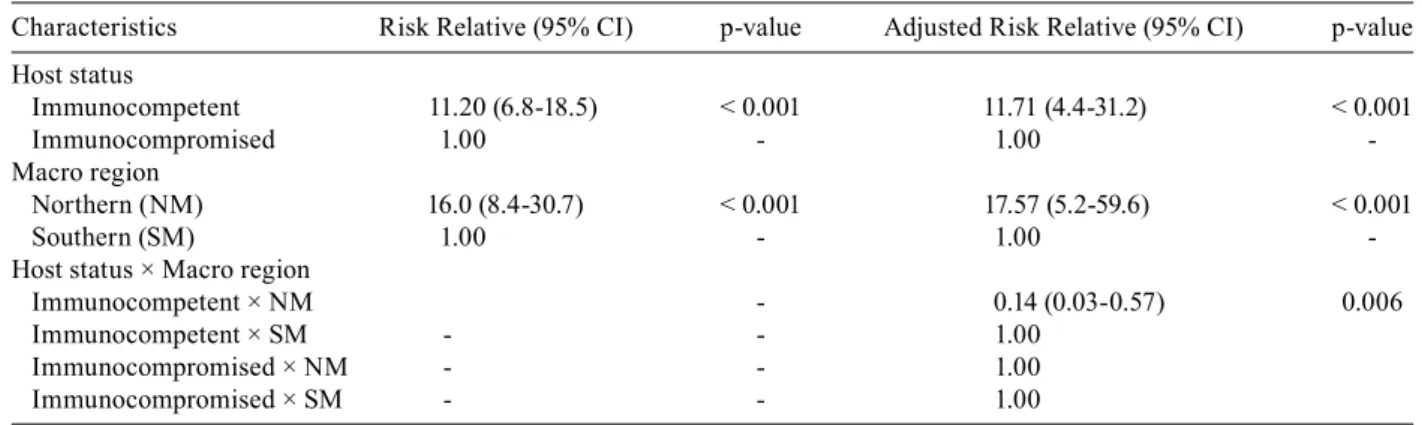
However, the Wald test for the VGII log-binomial model
showed that the geographic region and host condition
were significant predictors (p = 0.006) (Table III).
Al-though it is slightly higher, the relative risk is quite
simi-lar to the adjusted relative risk. Immunocompetent hosts
are ten times more likely to be infected by VGII than by
all other molecular types. The molecular type VGII is 16
times more likely to occur in the NR (Table III). Nine
out of 34 VGII (26%) clinical isolates were associated
with HIV infections; two of these were from the NM and
seven were from the SM.
Molecular polymorphisms identified via
PCR-fingerprinting using the primer M13 grouped the 87
isolates into the major molecular types of VNI, VNII,
VNIV, VGI, and VGII (Fig. 4). Overall, the similarity
of the
C. neoformans
isolates was 87%, whereas that of
the
C. gattii
isolates was 77%. According to the
band-ing pattern, VNI isolates (n = 25) were divided into six
subtypes: one major group comprised 50% of the VNI
isolates, three groups contained three or four isolates,
and two clinical isolates clustered individually. The
VNII isolates (n = 3) showed individual patterns. The
only three VNIV isolates analyzed by
PCR-fingerprint-ing showed a unique, identical bandPCR-fingerprint-ing pattern. The VGI
isolates (n = 13) were all from RJ (SN) and were divided
into one major group (10 isolates), and three clinical
iso-lates showed individual banding patterns. The highest
degree of polymorphism was observed among the VGII
isolates, which showed 14 individual patterns (1 major
group with 8 isolates and a second group with 6 isolates).
There was no association between these subtypes and
their geographical distribution.
TABLE II
Logistic regression model of probability of VNI occurrence in clinical samples according to the host status (n = 291) Host status Relative Risk (95% CI) p-value Adjusted Relative Risk (95% CI) p-value Immunocompromised 2.18 (1.7-2.9) < 0.001 6.19 (3.0-13.0) < 0.001
Immunocompetent 1.00 - 1.00
-CI: confidence interval.
TABLE III
Logistic regression model of probability of VGII occurrence in clinical samples with interactions between the predictors host status and macro region (n = 291)
Characteristics Risk Relative (95% CI) p-value Adjusted Risk Relative (95% CI) p-value Host status
Immunocompetent 11.20 (6.8-18.5) < 0.001 11.71 (4.4-31.2) < 0.001
Immunocompromised 1.00 - 1.00
-Macro region
Northern (NM) 16.0 (8.4-30.7) < 0.001 17.57 (5.2-59.6) < 0.001
Southern (SM) 1.00 - 1.00
-Host status × Macro region
Immunocompetent × NM - 0.14 (0.03-0.57) 0.006 Immunocompetent × SM - - 1.00
Immunocompromised × NM - - 1.00 Immunocompromised × SM - - 1.00 CI: confidence interval.
DISCUSSION
In this study, two major epidemiological trends were
identified in Brazil:
C. gattii
predominantly occurred in
the NM (OD 5.4; p < 0.001), and
C. neoformans
predom-inantly occurred in the SM (OD 2.6; p < 0.001). These
results are in agreement with a phenotypic study of 467
Brazilian
C. neoformans
isolates by Nishikawa et al.
(2003), which showed serotype A (
C. neoformans
)
asso-ciated with the Southeastern region (which is in the SM),
and serotype B (
C. gattii
) associated with the NE region
(which is in the NM) of Brazil.
C. neoformans
is the most common agent of
crypto-coccosis worldwide, and it mainly affects AIDS patients.
In Brazil, over 70% of AIDS patients live in the South
and Southeast regions (Brito et al. 2001). These regions
contain the largest cities of the country, and deforestation
and anthropic actions are more evident in them (Lazéra
et al. 2005, Pedroso et al. 2007). On the contrary,
C. gattii
affects mainly immunocompetent hosts and has a natural
habitat predominantly related to wood decay in tropical
and subtropical countries. The predominance of
C. gattii
as the main agent of cryptococcosis in the NM of Brazil
is reinforced by the similar results found during analysis
of the environmental isolates (OD 2.3; p < 0.001).
With regard to the molecular types of the NM and
SM of Brazil, no significant differences were observed
regarding the occurrence of VNI. VGII clearly occurs
endemically in the NM, where it is responsible for 89%
of the
C. gattii
infections. In the SM, only 43% of the
C. gattii
infections are caused by VGII. Moreover, the
Bra-zil (Rozenbaum & Gonçalves 1994, MS Lazéra,
unpub-lished data) who went to the large cities of the South in
search of better living conditions. This explanation may
also account for the VGII clinical isolates obtained in
other cities (e.g. São Paulo, the most important center
of internal migration in Brazil). Considering the large
Fig. 3: phenogram of PCR-fingerprinting profiles obtained with the M13 primer from 87 Brazilian isolates. The isolates clustered into five major groups corresponding to the molecular types: VNI, VNII and VNIV (C. neoformans), and VGI and VGII (C. gattii). The Brazilian
C. neoformans isolates generated 10 different bands pattern profiles, while the Brazilian C. gattii isolates formed 20 bands pattern profiles.
extent of inland migration, therefore, the molecular
types of clinical origin of a certain region should be
cor-related with the molecular typing of the environmental
isolates of that region. In the present study, 36 of the 37
C. gattii
environmental isolates were isolated in the NM.
All of these were VGII, which reinforces once again its
predominance in that region. The only environmental
C. gattii
isolate obtained in the SM was molecular type
VGI. However, the molecular type VGI was not detected
among the clinical and environmental isolates from the
NM, suggesting that this type may occur in higher
lati-tudes of tropical or subtropical regions. Similar results
were described by Escandón et. al. (2006) in Colombia,
where only one of 425 isolates of the
Cryptococcus
spe-cies complex was identified as VGI; the majority (99.2%)
of the
C. gattii
isolates were of the molecular type VGII.
Recent molecular typing studies in Brazil have shown
the presence of VNI and VNII in clinical samples and
VNI, VNIV, and VGI in environmental samples in the
SM (i.e. states of SP and RS) (Abegg et al. 2006, Ribeiro
et al. 2006, Matsumoto et al. 2007).
Studies of molecular polymorphisms in infective
agents have led to a better understanding of those agents’
epidemiology and may contribute to the evaluation of
interventions and treatments. Martins et al. (2007)
ana-lyzed serial isolates from HIV patients using pulsed field
gel electrophoresis and RAPD-PCR, and their findings
suggested that patients may be infected by more than
one isolate. Similarly, Almeida et al. (2007) used
RAPD-PCR to analyze primarily Brazilian
C. neoformans
iso-lates. These authors observed a high correlation
be-tween a distinct genetic profile in serial samples and
the tendency to become resistant to antifungal drugs. In
the current study, the molecular polymorphism analysis
showed a lower similarity rate (77%) among VGII than
VNI isolates (87%). The VGII isolates may have a higher
rate of mutation, which could produce a poorer response
to antifungal therapy (Yee-Chun et al. 2000).
Mat alpha cells are more virulent than Mat a cells.
As in the present study, these cells predominate in
clini-cal and environmental samples worldwide. In the NM
region, VGII Mat a was identified as agent of systemic
cryptococcosis in five immunocompetent patients. These
findings denote an uncommon picture of the
pathogen-esis of cryptococcosis and warrant further study to
elucidate the impact of the mating locus in
C. gattii
in-fections. The finding of both mating types in Brazilian
VGII isolates is of great interest in connection with the
search for the possible origin of the recent outbreak of
cryptococcosis on Vancouver Island British Columbia,
Canada. In this case, all isolates of the causative agent
were VGII Mat alpha strains (Kidd et al. 2004).
461 Mem Inst Oswaldo Cruz, Rio de Janeiro, Vol. 103(5), August 2008
The first VGII strain (LMM 293) identified in Brazil
was isolated in RJ in 1988 from a patient coming from
the NM. Brazil is a large continental country with many
different geographic and demographic patterns. In the
northern region, the Amazon rainforest encompasses
partially preserved wild areas surrounding urban cities
or settlements. In the NE region, the central semi-arid
area is covered by brushwood known as “caatinga”.
De-spite these differences, our results showed the occurrence
of
C. gattii
VGII in the environment of both regions. It
behaved as a primary pathogen of human infection in
native, normal hosts and primarily caused
meningoen-cephalitis, attaining a prevalence of 20 to 30% in
chil-dren and adolescents.
In accordance with the human infections by
C. gattii
VGII in the NM of Brazil, several genera of trees (e.g.,
Cassia
sp.,
Ficus
sp.,
Guetarda
sp.,
Erythrina
sp., and
Li-cania
sp.) can harbor this yeast in their hollows (Lazéra
et al. 1998, 2000, Fortes et al. 2001). Clinical isolates
are thus more likely to be found in deforestation areas,
which are located mainly on the border of rainforests.
A recent diagnosis (2006) of meningoencephalitis due
to a VGII strain in a 5-year-old child (not included in
the present analysis) who lived his entire life in RJ (SM)
suggests that the VGII type may be spreading from the
NM. It may be adapting to new areas in the SM due to
anthropic activity and global climatic changes. It is also
possible that this molecular type has long been present
at a low density in the SM, thereby causing occasional
human cases. Similarly, it has been suggested that
C.
gattii
VGII has recently colonized the temperate region
of Vancouver Island via unknown events and that
for-estry activities and the distribution of tree by-products
may have facilitated the mobility of
C. gattii
through
aerosolization and mechanical dispersal to non-endemic
areas within the Pacific Northwest (Fraser et al. 2005,
Kidd et al. 2007, Upton et al. 2007). This emphasizes the
need for an active surveillance program of new human
and animal infections by VGII strains in the SM.
It is very important to note that VGII is not a rare
gen-otype of
C. gattii
in South America. In fact, it behaves as a
primary fungal pathogen and causes endemic
cryptococ-cosis in immunocompetent hosts in the northern macro
region of Brazil, where it is particularly well-adapted to
environmental biotypes associated with wood decay. Our
findings suggest that this eco-epidemiological pattern of
the VGII genotype in Brazil is not a recent event and has
been recognized for at least the last 20 years.
REFERENCES
Abegg MA, Cella FL, Faganello J, Valente P, Schrank A, Vainstein MH 2006. Cryptococcus neoformans and Cryptococcus gattii
isolated from the excreta of psittaciformes in a southern Brazil-ian zoological garden. Mycopathologia 161: 83-91.
Boekhout T, Theelen B, Diaz M, Fell JW, Hop WC, Abeln EC, Dromer F, Meyer W 2001. Hybrid genotypes in the pathogenic yeast Cryptococcus neoformans. Microbiology 147: 891-907. Brito AM, Castilho EA, Szwarcwald CL 2001. AIDS e infecção pelo
HIV no Brasil: uma epidemia multifacetada. Rev Soc Bras Med Trop 34: 207-217.
Casali AK, Goulart L, Rosa e Silva LK, Ribeiro AM, Amaral AA, Alves SH, Schrank A, Meyer W, Vainstein MH 2003. Molecular typing of clinical and environmental Cryptococcus neoformans
isolates in the Brazilian state Rio Grande do Sul. FEMS Yeast Res 3: 405-415.
Chaturvedi S, Rodeghier B, Fan J, McClelland CM, Wickes BL, Chaturvedi V 2000. Direct PCR of Cryptococcus neoformans MATα and MATa pheromones to determine mating type, ploidy, and variety: a tool for epidemiological and molecular pathogen-esis studies. J Clin Microbiol 38: 2007-2009.
Correa MP, Oliveira EC, Duarte RR, Pardal PP, Oliveira FM, Severo LC 1999. Cryptococcosis in children in the State of Para, Brazil.
Rev Soc Bras Med Trop 32: 505-508.
Escandón P, Sanchez A, Martinez M, Meyer W, Castaneda E 2006. Molecular epidemiology of clinical and environmental isolates of the Cryptococcus neoformans species complex reveals a high genetic diversity and the presence of the molecular type VGII mating type a in Colombia. FEMS Yeast Res 6: 625-635. Fortes ST, Lazéra MS, Nishikawa MM, Macêdo RCL, Wanke B 2001.
First isolation of Cryptococcus neoformans var. gattii from a na-tive jungle tree in the Brazilian Amazon rainforest. Mycosis 44:
137-140.
Fraser JA, Giles SS, Wenink EC, Geunes-Boyer SG, Wright JR, Diez-mann S, Allen A, Stajich JE, Dietrich FS, Perfect JR, Heitman J 2005. Same-sex mating and the origin of the Vancouver Island
Cryptococcus gattii outbreak. Nature 27: 1360-1364.
Fraser JA, Subaran RL, Nichols CB, Heitman J 2003. Recapitulation of the sexual cycle of the primary fungal pathogen Cryptococcus neoformans var. gattii: Implications for an outbreak on Vancou-ver Island, Canada. Eukaryot Cell 2: 1036-1045.
Halliday CL, Carter DA 2003. Clonal reproduction and limited disper-sal in an environmental population of Cryptococcus neoformans
var. gattii Isolates from Australia. J Clin Microbiol 41: 703-711. Igreja RP, Lazéra MS, Wanke B, Galhardo MC, Kidd SE, Meyer W
2004. Molecular epidemiology of Cryptococcus neoformans iso-lates from AIDS patients of the Brazilian city, Rio de Janeiro.
Med Mycol 42: 229-238.
Katsu M, Kidd S, Ando A, Moretti-Branchini ML, Mikami Y, Nishimu-ra K, Meyer W 2004. The internal tNishimu-ranscribed spacers and 5.8S rRNA gene show extensive diversity among isolates of the Crypto-coccus neoformans species complex. FEMS Yeast Res 4: 377-388. Kidd SE, Bach PJ, Hingston AO, Mak S, Chow Y, MacDougall L,
Kronstad JW, Bartlett KH 2007. Cryptococcus gattii dispersal mechanisms, British Columbia, Canada. Emerg Infect Dis 13: 51-57.
Kidd SE, Hagen F, Tscharke RL, Huynh M, Bartlett KH, Fyfe M, Macdougall L, Boekhout T, Kwon-Chung KJ, Meyer W 2004. A rare genotype of Cryptococcus gattii caused the cryptococcosis outbreak on Vancouver Island (British Columbia, Canada). Proc Natl Acad Sci USA 101: 17258-17263.
Chung KJ, Bennett JE 1992. Cryptococcosis. In KJ Kwon-Chung, JE Bennett (eds.), Medical Mycology, Lea & Febiger, Philadelphia, p. 397-446.
Kwon-Chung KJ, Boekhout T, Fell JW, Diaz M 2002. (1557) Proposal to conserve the name Cryptococcus gattii against C. hondurianus
and C. bacillisporus (Basidiomycota, Hymenomycetes, Tremel-lonycetidae). Taxon 51: 804-806.
Latouche GN, Huynh M, Sorrell TC, Meyer W 2003. PCR-restriction fragment length polymorphism analysis of the phospholipase B (PLB1) gene for subtyping of Cryptococcus neoformans isolates.
Lazéra MS, Cavalcanti MAS, Londero AT, Trilles L, Nishikawa MM, Wanke B 2000. Possible primary ecologycal niche of Cryptococ-cus neoformans. Med Micol 38: 379-383.
Lazéra MS, Cavalcanti MAS, Trilles L, Nishikawa MM, Wanke B 1998. Cryptococcus neoformans var. gattii in a pottery tree hol-low - evidence for a natural habitat related to decaying wood. J Med Vet Mycol 36: 119-122.
Lazéra MS, Gutierrez-Galhardo MC, Cavalcanti MAS, Wanke B 2005. Criptococose. In: JR Coura (ed.), Dinâmica das doenças infecciosas e parasitárias, Guanabara Koogan, Rio de Janeiro, p. 1223-1236.
Lin X, Heitman J 2006. The biology of the Cryptococcus neoformans
species complex. Annu Rev Microbiol 60: 69-105.
Litvintseva AP, Thakur R, Vilgalys R, Mitchell TG 2006. Multilocus sequence typing reveals three genetic subpopulations of Crypto-coccusneoformans var. grubii (serotype A), including a unique population in Botswana. Genetics 172: 2223-2238.
Martins MA, Pappalardo MCSM, Melhem MSC, Pereira-Chioccola VL 2007. Molecular diversity of serial Cryptococcus neofor-mans isolates from AIDS patients in the city of São Paulo, Brazil.
Mem Inst Oswaldo Cruz 102: 777-784.
Matsumoto MT, Fusco-Almeida AM, Baeza LC, Melhem MS, Medes-Giannini MJ 2007. Genotyping, serotyping and determination of mating-type of Cryptococcus neoformans clinical isolates from São Paulo State, Brazil. Rev Inst Med Trop Sao Paulo 49: 41-47. Meyer W, Castañeda A, Jackson S, Huynh M, Castañeda E,
IberoAmerican Cryptococcal Study Group 2003. Molecular typ-ing of IberoAmerican Cryptococcus neoformans isolates. Emerg Infect Dis 9: 189-195.
Meyer W, Marszewska K, Amirmostofina M, Igreja RP, Hardtke C, Methling K, Viviani MA, Chindamporn A, Sukroongreung
S, John MA, Ellis DH, Sorrell TC 1999. Molecular typing of global isolates of Cryptococcus neoformans var. neoformans
by PCR-fingerprinting and RAPD. A pilot study to standardize techniques on which to base a detailed epidemiological survey.
Electrophoresis 20: 1790-1799.
Nishikawa MM, Lazera MS, Barbosa GG, Trilles L, Balassiano BR, Macedo RC, Bezerra CC, Pérez MA, Cardarelli P, Wanke B 2003. Serotyping of 467 Cryptococcus neoformans isolates from clini-cal and environmental sources in Brazil: analysis of host and re-gional patterns. J Clin Microbiol 41: 73-77.
Pedroso RS, Ferreira JC, Candido RC 2007. The isolation and char-acterization of virulence factors of Cryptococcus spp. from sap-rophytic sources in the city of Ribeirão Preto, São Paulo, Brazil.
Microbiol Res, in press.
Ribeiro AM, Silva LKR, Schrank IS, Schrank A, Meyer W, Vain-stein MH 2006. Isolation of Cryptococcus neoformans var. neo-formans serotype D from Eucalypts in South Brazil. Med Mycol 44: 707-713.
Rozenbaum R, Gonçalves AJ 1994. Clinical epidemiological study of 171 cases of cryptococcosis. Clin Infect Dis 18: 369-380. Trilles L, Lazéra MS, Wanke B, Theelen B, Boekhout T 2003. Genetic
characterization of environmental isolates of the Cryptococcus neoformans species complex from Brazil. Med Mycol 41: 383-390. Upton A, Fraser JA, Kidd SE, Bretz C, Bartlett KH, Heitman J, Marr KA 2007. First contemporary case of human infection with Cryp-tococcus gattii in Puget Sound: evidence for spread of the Van-couver Island outbreak. J Clin Microbiol 45: 3086-3088. Yee-Chun C, Shan-Chwen C, Chiang-Ching S, Chien-Ching H,
1
Mem Inst Oswaldo Cruz
, Rio de Janeiro, V
ol.
103
(5), August 2008
o
n
lin
e | m
em
o
ria
s.i
o
c.f
io
cr
u
z.b
r
Supplementary data
List of the Brazilian isolates and their respective data included in the analysis
LA code Original codes/others Serotype Molecular Type AFLP Typea Mating Type State Source Host Factors Reference
LA 70 HEC 4744, LMM 210 A VNI alpha RJ clinical HIV+ Med Mycol 2004; 42: 229-238
LA 71 HEC 4759, LMM 207 A VNI alpha RJ clinical HIV+ Med Mycol 2004; 42: 229-238
LA 88 HEC 3385, LMM 275 A VNI not typed RJ clinical HIV+ Med Mycol 2004; 42: 229-238
LA 89 HEC 3393, LMM 276 A VNI not typed RJ clinical HIV+ Med Mycol 2004; 42: 229-238
LA 90 HEC 3451, LMM 277 A VNI not typed RJ clinical HIV+ Med Mycol 2004; 42: 229-238
LA 64 HEC 4262, LMM 226 A VNI not typed RJ clinical HIV+ Med Mycol 2004; 42: 229-238
LA 65 HEC 4407, LMM 221 A VNI not typed RJ clinical HIV+ Med Mycol 2004; 42: 229-238
LA 66 HEC 4418, LMM 220 A VNI not typed RJ clinical HIV+ Med Mycol 2004; 42: 229-238
LA 67 HEC 4436, LMM 219 A VNI not typed RJ clinical HIV+ Med Mycol 2004; 42: 229-238
LA 68 HEC 4532, LMM 217 A VNI not typed RJ clinical HIV+ Med Mycol 2004; 42: 229-238
LA 69 HEC 4576, LMM 216 A VNI not typed RJ clinical HIV+ Med Mycol 2004; 42: 229-238
LA 72 HEC 4859, LMM 205 A VNI not typed RJ clinical HIV+ Med Mycol 2004; 42: 229-238
LA 97 HEC 5988, LMM 656 A VNI not typed RJ clinical HIV+ Med Mycol 2004; 42: 229-238
LA 98 HEC 6047, LMM 126 A VNI not typed RJ clinical HIV+ Med Mycol 2004; 42: 229-238
LA 99 HEC 6196, LMM 117 A VNI not typed RJ clinical HIV+ Med Mycol 2004; 42: 229-238
LA 91 HEC 7389, LMM 92 A VNI not typed RJ clinical HIV+ Med Mycol 2004; 42: 229-238
LA 92 HEC 7576, LMM 663 A VNI not typed RJ clinical HIV+ Med Mycol 2004; 42: 229-238
LA 94 HEC 7835, LMM 658 A VNI not typed RJ clinical HIV+ Med Mycol 2004; 42: 229-238
LA 95 HEC 7836, LMM 657 A VNI not typed RJ clinical HIV+ Med Mycol 2004; 42: 229-238
LA 96 HEC 8104, LMM 69 A VNI not typed RJ clinical HIV+ Med Mycol 2004; 42: 229-238
LA 93 HEC 8462, LMM 59 A VNI not typed RJ clinical HIV+ Med Mycol 2004; 42: 229-238
LA 100 HEC 10720, LMM 33 A VNI not typed RJ clinical HIV+ Med Mycol 2004; 42: 229-238
LA 82 HEC 10724, LMM 32 A VNI not typed RJ clinical HIV+ Med Mycol 2004; 42: 229-238
LA 83 HEC 10726, LMM 31 A VNI not typed RJ clinical HIV+ Med Mycol 2004; 42: 229-238
LA 85 HEC 11116, LMM 20 A VNI not typed RJ clinical HIV+ Med Mycol 2004; 42: 229-238
LA 86 HEC 11127, LMM 19 A VNI 1 not typed RJ clinical HIV+ Med Mycol 2004; 42: 229-238
LA 87 HEC 11376, LMM 13 A VNI not typed RJ clinical HIV+ Med Mycol 2004; 42: 229-238
LA 101 HEC 12284, LMM 228 A VNI not typed RJ clinical HIV+ Med Mycol 2004; 42: 229-238
LA 75 HEC 13245, LMM 529 A VNI not typed RJ clinical HIV+ Med Mycol 2004; 42: 229-238
LA 76 HEC 13247, LMM 617 A VNI not typed RJ clinical HIV+ Med Mycol 2004; 42: 229-238
LA 77 HEC 13249, LMM 673 A VNI not typed RJ clinical HIV+ Med Mycol 2004; 42: 229-238
LA 78 HEC 13262, LMM 619 A VNI not typed RJ clinical HIV+ Med Mycol 2004; 42: 229-238
LA 79 HEC 13341 A VNI not typed RJ clinical HIV+ Med Mycol 2004; 42: 229-238
LA 73 HEC 13670, LMM 550 A VNI not typed RJ clinical HIV+ Med Mycol 2004; 42: 229-238
LA 74 HEC 13722, LMM 555 A VNI not typed RJ clinical HIV+ Med Mycol 2004; 42: 229-238
HEC 13912 A VNI not typed RJ clinical HIV+ Med Mycol 2004; 42: 229-238
LA 81 HEC 14047, LMM 674 A VNI not typed RJ clinical HIV+ Med Mycol 2004; 42: 229-238
LA 108 HUCFF B-19/97 A VNI not typed RJ clinical HIV+ Med Mycol 2004; 42: 229-238
G
en
o
ty
p
es o
f
C
ry
p
toc
oc
cu
s
fr
om B
ra
zil • L
uci
an
a T
rill
es e
t a
l.
LA 109 HUCFF B-49/97 A VNI not typed RJ clinical HIV+ Med Mycol 2004; 42: 229-238
HUCFF B-229/96 A VNI not typed RJ clinical HIV+ Med Mycol 2004; 42: 229-238
LA 143 HUCFF B-294/97 A VNI not typed RJ clinical HIV+ Med Mycol 2004; 42: 229-238
LA 119 HUCFF B-444/94 A VNI not typed RJ clinical HIV+ Med Mycol 2004; 42: 229-238
LA 105 HUCFF B-493/96 A VNI not typed RJ clinical HIV+ Med Mycol 2004; 42: 229-238
LA 123 HUCFF B-545/96 A VNI not typed RJ clinical HIV+ Med Mycol 2004; 42: 229-238
LA 131 HUCFF B-573/96 A VNI not typed RJ clinical HIV+ Med Mycol 2004; 42: 229-238
LA 145 HUCFF B-605/97 A VNI not typed RJ clinical HIV+ Med Mycol 2004; 42: 229-238
LA 133 HUCFF B-683/96 A VNI not typed RJ clinical HIV+ Med Mycol 2004; 42: 229-238
LA 135 HUCFF B-960/96 A VNI not typed RJ clinical HIV+ Med Mycol 2004; 42: 229-238
LA 139 HUCFF B-1295/96 A VNI not typed RJ clinical HIV+ Med Mycol 2004; 42: 229-238
LA 118 HUCFF B-1616/93 A VNI not typed RJ clinical HIV+ Med Mycol 2004; 42: 229-238
LA 110 HUCFF B-2128/96 A VNI not typed RJ clinical HIV+ Med Mycol 2004; 42: 229-238
LA 137 HUCFF B-2202/96 A VNI not typed RJ clinical HIV+ Med Mycol 2004; 42: 229-238
LA 106 HUCFF B-2218/96 A VNI not typed RJ clinical HIV+ Med Mycol 2004; 42: 229-238
LA 107 HUCFF H-06/97 A VNI not typed RJ clinical HIV+ Med Mycol 2004; 42: 229-238
LA 140 HUCFF H-10/97 A VNI not typed RJ clinical HIV+ Med Mycol 2004; 42: 229-238
LA 113 HUCFF H-88/96 (15/2) A VNI not typed RJ clinical HIV+ Med Mycol 2004; 42: 229-238
LA 115 HUCFF H-88/96 (26/6) A VNI not typed RJ clinical HIV+ Med Mycol 2004; 42: 229-238
LA 142 HUCFF H-106/97 A VNI not typed RJ clinical HIV+ Med Mycol 2004; 42: 229-238
LA 128 HUCFF H-120/96 A VNI not typed RJ clinical HIV+ Med Mycol 2004; 42: 229-238
HUCFF H-137/96 A VNI not typed RJ clinical HIV+ Med Mycol 2004; 42: 229-238
LA 112 HUCFF H-146/97 A VNI not typed RJ clinical HIV+ Med Mycol 2004; 42: 229-238
LA 104 HUCFF H-154/96 A VNI not typed RJ clinical HIV+ Med Mycol 2004; 42: 229-238
LA 130 HUCFF H-165/96 A VNI not typed RJ clinical HIV+ Med Mycol 2004; 42: 229-238
HUCFF H-195/97 A VNI not typed RJ clinical HIV+ Med Mycol 2004; 42: 229-238
LA 132 HUCFF H-197/96 A VNI not typed RJ clinical HIV+ Med Mycol 2004; 42: 229-238
LA 134 HUCFF H-243/96 A VNI not typed RJ clinical HIV+ Med Mycol 2004; 42: 229-238
LA 111 HUCFF H-293/96 A VNI not typed RJ clinical HIV+ Med Mycol 2004; 42: 229-238
LA 136 HUCFF H-305/96 A VNI not typed RJ clinical HIV+ Med Mycol 2004; 42: 229-238
LA 138 HUCFF H-377/96 A VNI not typed RJ clinical HIV+ Med Mycol 2004; 42: 229-238
Hamdan F2’1 A VNI 1 alpha MG environmental N/A Microbiology 2001; 147: 891-907
Hamdan I3’1 A VNI 1 alpha MG environmental N/A Microbiology 2001; 147: 891-907
LA 419 not typed VNI alpha RJ environmental N/A Emerg Infect Dis 2003; 9: 189-195
LA 420 not typed VNI alpha RJ environmental N/A Emerg Infect Dis 2003; 9: 189-195
LA 421 not typed VNI alpha RJ environmental N/A Emerg Infect Dis 2003; 9: 189-195
LA 422 not typed VNI alpha RJ environmental N/A Emerg Infect Dis 2003; 9: 189-195
LA 147 RJ 62, LMM 381 A VNI 1 not typed RJ environmental N/A Med Mycol 2004; 42: 229-238;
Microbiology 2001; 147: 891-907
LA 148 RJ 63, LMM 380 A VNI 1 not typed RJ environmental N/A Med Mycol 2004; 42: 229-238;
Microbiology 2001; 147: 891-907
3
Mem Inst Oswaldo Cruz
, Rio de Janeiro, V
ol.
103
(5), August 2008
LA code Original codes/others Serotype Molecular Type AFLP Typea Mating Type State Source Host Factors Reference
LA 103 HUCFF B-175/97 A VNII not typed RJ clinical HIV+ Med Mycol 2004; 42: 229-238
LA 127 HUCFF B-308/96 A VNII not typed RJ clinical HIV+ Med Mycol 2004; 42: 229-238
LA 117 HUCFF B-583/97 A VNII not typed RJ clinical HIV+ Med Mycol 2004; 42: 229-238
LA 116 HUCFF B-1267/96 A VNII not typed RJ clinical HIV+ Med Mycol 2004; 42: 229-238
LA 125 HUCFF B-1396/95 A VNII not typed RJ clinical HIV+ Med Mycol 2004; 42: 229-238
LA 120 HUCFF B-1773/94 A VNII not typed RJ clinical HIV+ Med Mycol 2004; 42: 229-238
LA 126 HUCFF H-91/96 A VNII not typed RJ clinical HIV+ Med Mycol 2004; 42: 229-238
LA 121 HUCFF H-97/96 A VNII not typed RJ clinical HIV+ Med Mycol 2004; 42: 229-238
LA 124 HUCFF H-318/95 A VNII not typed RJ clinical HIV+ Med Mycol 2004; 42: 229-238
Hamdan C3-1 A VNII 1A alpha RJ environmental N/A FEMS Yeast Res 2004; 4: 377-388;
Microbiology 2001; 147: 891-907
LA 146 RJ 24, LMM 385 A VNII 1A alpha RJ environmental N/A Med Mycol 2004; 42: 229-238;
Microbiology 2001; 147: 891-907
LA 149 RJ 64, LMM 379 A VNII not typed RJ environmental N/A Med Mycol 2004; 42: 229-238
LA 150 HEC 3724, LMM 456 not typed VGI not typed RJ clinical unknown Med Mycol 2004; 42: 229-238
LA 84 HEC 11102, LMM 21 not typed VGII 6 alpha RJ clinical HIV+ FEMS Yeast Res 2004; 4: 377-388;
Med Mycol 2004; 42: 229-238
HEC 11241, LMM 16 not typed VGII not typed SP clinical HIV+ Med Mycol 2004; 42: 229-238
LA 55 LMM 417 B VGII 6 a PI clinical HIV- Emerg Infect Dis 2003; 9: 189-195
LA 57 LMM 506 B VGII not typed PI clinical HIV- Emerg Infect Dis 2003; 9: 189-195
LA 59 LMM 513 A VNI not typed PI clinical HIV- Emerg Infect Dis 2003; 9: 189-195
LA 61 LMM 557 not typed VGII not typed PI clinical HIV+ Emerg Infect Dis 2003; 9: 189-195
LA 346 481(5) A VNI not typed SP clinical HIV+ Emerg Infect Dis 2003; 9: 189-195
LA 347 482(5) A VNI not typed SP clinical HIV+ Emerg Infect Dis 2003; 9: 189-195
LA 348 540(9) A VNI not typed SP clinical HIV+ Emerg Infect Dis 2003; 9: 189-195
LA 349 541(9) A VNI not typed SP clinical HIV+ Emerg Infect Dis 2003; 9: 189-195
LA 350 14(9) A VNI not typed SP clinical HIV+ Emerg Infect Dis 2003; 9: 189-195
LA 351 13(11) A VNI not typed SP clinical HIV+ Emerg Infect Dis 2003; 9: 189-195
LA 352 49(11) A VNI not typed SP clinical HIV+ Emerg Infect Dis 2003; 9: 189-195
LA 353 98(17) A VNI not typed SP clinical HIV+ Emerg Infect Dis 2003; 9: 189-195
LA 354 14(17) A VNI not typed SP clinical HIV+ Emerg Infect Dis 2003; 9: 189-195
LA 355 221(23) A VNI not typed SP clinical HIV+ Emerg Infect Dis 2003; 9: 189-195
LA 356 18(23) A VNI not typed SP clinical HIV+ Emerg Infect Dis 2003; 9: 189-195
LA 357 222(24) A VNI not typed SP clinical HIV+ Emerg Infect Dis 2003; 9: 189-195
LA 358 65(24) A VNI not typed SP clinical HIV+ Emerg Infect Dis 2003; 9: 189-195
LA 359 62(27) A VNI not typed SP clinical HIV+ Emerg Infect Dis 2003; 9: 189-195
LA 360 66(27) A VNI not typed SP clinical HIV+ Emerg Infect Dis 2003; 9: 189-195
LA 361 67(27) A VNI not typed SP clinical HIV+ Emerg Infect Dis 2003; 9: 189-195
LA 363 1342 A VNI not typed SP clinical HIV+ Emerg Infect Dis 2003; 9: 189-195
LA 364 1755 A VNI not typed SP clinical HIV+ Emerg Infect Dis 2003; 9: 189-195
LA 365 1920 A VNI not typed SP clinical HIV+ Emerg Infect Dis 2003; 9: 189-195
G
en
o
ty
p
es o
f
C
ry
p
toc
oc
cu
s
fr
om B
ra
zil • L
uci
an
a T
rill
es e
t a
l.
LA 362 Bird1 B VGII not typed SP veterinary N/A Emerg Infect Dis 2003; 9: 189-195
LA 326 LCS-534 A VNI not typed SP clinical HIV+ Emerg Infect Dis 2003; 9: 189-195
LA 328 GFR-1505 A VNI not typed SP clinical HIV+ Emerg Infect Dis 2003; 9: 189-195
LA 329 AFG-34 A VNI not typed SP clinical HIV+ Emerg Infect Dis 2003; 9: 189-195
LA 330 AFG-14 A VNI not typed SP clinical HIV+ Emerg Infect Dis 2003; 9: 189-195
LA 331 CMS-1226 A VNI not typed SP clinical HIV+ Emerg Infect Dis 2003; 9: 189-195
LA 332 AFG-25/00 A VNI not typed SP clinical HIV+ Emerg Infect Dis 2003; 9: 189-195
LA 333 PRL-1133 A VNI not typed SP clinical HIV+ Emerg Infect Dis 2003; 9: 189-195
LA 334 JCJ-1157 A VNI not typed SP clinical HIV+ Emerg Infect Dis 2003; 9: 189-195
LA 335 MAAC-1866 A VNI not typed SP clinical HIV+ Emerg Infect Dis 2003; 9: 189-195
LA 336 VPD-25 A VNI not typed SP clinical HIV+ Emerg Infect Dis 2003; 9: 189-195
LA 337 AFG-09/00 not typed VGII not typed SP clinical HIV+ Emerg Infect Dis 2003; 9: 189-195
LA 338 AFG-15/00 not typed VGII not typed SP clinical HIV+ Emerg Infect Dis 2003; 9: 189-195
LA 339 LCS-394 A VNI not typed SP clinical HIV+ Emerg Infect Dis 2003; 9: 189-195
LA 340 IFOC-1446 A VNI not typed SP clinical HIV+ Emerg Infect Dis 2003; 9: 189-195
LA 341 MO-438 A VNI not typed SP clinical HIV+ Emerg Infect Dis 2003; 9: 189-195
LA 342 KSO-948 A VNI not typed SP clinical HIV+ Emerg Infect Dis 2003; 9: 189-195
LA 343 CSC-1016 A VNII not typed SP clinical HIV+ Emerg Infect Dis 2003; 9: 189-195
LA 344 MDS-949 A VNI not typed SP clinical HIV+ Emerg Infect Dis 2003; 9: 189-195
LA 345 MEM-1064 A VNI not typed SP clinical HIV+ Emerg Infect Dis 2003; 9: 189-195
LA 755 HC2 A VNI not typed RS clinical HIV+ Emerg Infect Dis 2003; 9: 189-195
LA 756 HC3 A VNII not typed RS clinical HIV+ Emerg Infect Dis 2003; 9: 189-195
LA 757 HC4 A VNI not typed RS clinical HIV+ Emerg Infect Dis 2003; 9: 189-195
LA 758 HC6 A VNI not typed RS clinical HIV+ Emerg Infect Dis 2003; 9: 189-195
LA 759 HC8 A VNI not typed RS clinical HIV+ Emerg Infect Dis 2003; 9: 189-195
LA 760 HC9 A VNI not typed RS clinical HIV+ Emerg Infect Dis 2003; 9: 189-195
LA 761 HC10 A VNI not typed RS clinical HIV+ Emerg Infect Dis 2003; 9: 189-195
LA 762 HC11 A VNI not typed RS clinical HIV+ Emerg Infect Dis 2003; 9: 189-195
LA 763 HC13 A VNI not typed RS clinical HIV+ Emerg Infect Dis 2003; 9: 189-195
LA 764 HC14 A VNI not typed RS clinical HIV+ Emerg Infect Dis 2003; 9: 189-195
LA 765 HC15 A VNI not typed RS clinical HIV+ Emerg Infect Dis 2003; 9: 189-195
LA 44 LMM 414 B VGII not typed PI environmental N/A Emerg Infect Dis 2003; 9: 189-195
LA 45 LMM 415 B VGII not typed PI environmental N/A Emerg Infect Dis 2003; 9: 189-195
LA 47 LMM 434 B VGII not typed PI environmental N/A Emerg Infect Dis 2003; 9: 189-195
LA 52 LMM 561 A VNI not typed PI environmental N/A Emerg Infect Dis 2003; 9: 189-195
LA 54 LMM 564 A VNI not typed PI environmental N/A Emerg Infect Dis 2003; 9: 189-195
LMM 9 AD VNII 1A alpha RJ clinical HIV+ Med Mycol 2003; 41: 383-390
LMM 23 B VGII 6 alpha PI clinical HIV- Med Mycol 2003; 41: 383-390
LMM 29 B VGII 6 alpha PI clinical HIV- Med Mycol 2003; 41: 383-390
LMM 34 A VNII 1A alpha RJ clinical HIV+ Med Mycol 2003; 41: 383-390
LMM 379 A VNII 1A alpha RJ environmental N/A Med Mycol 2003; 41: 383-390
5
Mem Inst Oswaldo Cruz
, Rio de Janeiro, V
ol.
103
(5), August 2008
LA code Original codes/others Serotype Molecular Type AFLP Typea Mating Type State Source Host Factors Reference
LMM 414 B VGII 6 alpha PI environmental N/A Med Mycol 2003; 41: 383-390
LMM 484.1 B VGII 6 alpha PI environmental N/A Med Mycol 2003; 41: 383-390
LMM 484.2 B VGII 6 alpha PI environmental N/A Med Mycol 2003; 41: 383-390
LMM 484.3 B VGII 6 alpha PI environmental N/A Med Mycol 2003; 41: 383-390
LMM 489 A VNI 1 alpha RJ environmental N/A Med Mycol 2003; 41: 383-390
LMM 495 A VNI 1 alpha RJ environmental N/A Med Mycol 2003; 41: 383-390
LMM 496 A VNI 1 alpha RJ environmental N/A Med Mycol 2003; 41: 383-390
LMM 498 B VGII 6 alpha PI environmental N/A Med Mycol 2003; 41: 383-390
LMM 526 A VNI 1 alpha AM environmental N/A Med Mycol 2003; 41: 383-390
LMM 527 A VNI 1 alpha AM environmental N/A Med Mycol 2003; 41: 383-390
LMM 544.1 A VNI 1 alpha RJ environmental N/A Med Mycol 2003; 41: 383-390
LMM 544.2 A VNI 1 alpha RJ environmental N/A Med Mycol 2003; 41: 383-390
LMM 547.1 B VGII 6 alpha PI environmental N/A Med Mycol 2003; 41: 383-390
LMM 547.2 B VGII 6 alpha PI environmental N/A Med Mycol 2003; 41: 383-390
LMM 547.3 B VGII 6 alpha PI environmental N/A Med Mycol 2003; 41: 383-390
LMM 547.4 B VGII 6 alpha PI environmental N/A Med Mycol 2003; 41: 383-390
LMM 547.5 B VGII 6 alpha PI environmental N/A Med Mycol 2003; 41: 383-390
LMM 547.6 B VGII 6 alpha PI environmental N/A Med Mycol 2003; 41: 383-390
LMM 547.7 B VGII 6 alpha PI environmental N/A Med Mycol 2003; 41: 383-390
LMM 547.9 B VGII 6 alpha PI environmental N/A Med Mycol 2003; 41: 383-390
LMM 547.10 B VGII 6 alpha PI environmental N/A Med Mycol 2003; 41: 383-390
LMM 547.11 B VGII 6 alpha PI environmental N/A Med Mycol 2003; 41: 383-390
LMM 547.13 B VGII 6 alpha PI environmental N/A Med Mycol 2003; 41: 383-390
LMM 547.14 B VGII 6 alpha PI environmental N/A Med Mycol 2003; 41: 383-390
LMM 547.15 B VGII 6 alpha PI environmental N/A Med Mycol 2003; 41: 383-390
LMM 547.16 B VGII 6 alpha PI environmental N/A Med Mycol 2003; 41: 383-390
LMM 547.17 B VGII 6 alpha PI environmental N/A Med Mycol 2003; 41: 383-390
LMM 547.18 D VNIV 2 a PI environmental N/A Med Mycol 2003; 41: 383-390
LMM 547.19 B VGII 6 alpha PI environmental N/A Med Mycol 2003; 41: 383-390
LMM 561.5 A VNI 1 alpha PI environmental N/A Med Mycol 2003; 41: 383-390
LMM 561.6 A VNI 1 alpha PI environmental N/A Med Mycol 2003; 41: 383-390
LMM 562.1 B VGII 6 alpha PI environmental N/A Med Mycol 2003; 41: 383-390
LMM 562.2 A VNI 1 alpha PI environmental N/A Med Mycol 2003; 41: 383-390
LMM 562.3 A VNI 1 alpha PI environmental N/A Med Mycol 2003; 41: 383-390
LMM 562.4 A VNI 1 alpha PI environmental N/A Med Mycol 2003; 41: 383-390
LMM 562.5 A VNI 1 alpha PI environmental N/A Med Mycol 2003; 41: 383-390
LMM 562.6 B VGII 6 alpha PI environmental N/A Med Mycol 2003; 41: 383-390
LMM 562.7 B VGII 6 alpha PI environmental N/A Med Mycol 2003; 41: 383-390
LMM 562.9 B VGII 6 alpha PI environmental N/A Med Mycol 2003; 41: 383-390
LMM 562.10 B VGII 6 alpha PI environmental N/A Med Mycol 2003; 41: 383-390
LMM 562.11 B VGII 6 alpha PI environmental N/A Med Mycol 2003; 41: 383-390
G
en
o
ty
p
es o
f
C
ry
p
toc
oc
cu
s
fr
om B
ra
zil • L
uci
an
a T
rill
es e
t a
l.
LMM 562.13 A VNI 1 alpha PI environmental N/A Med Mycol 2003; 41: 383-390
LMM 562.15 B VGII 6 alpha PI environmental N/A Med Mycol 2003; 41: 383-390
LMM 562.16 B VGII 6 alpha PI environmental N/A Med Mycol 2003; 41: 383-390
LMM 564.9 A VNI 1 alpha PI environmental N/A Med Mycol 2003; 41: 383-390
LMM 564.10 A VNI 1 alpha PI environmental N/A Med Mycol 2003; 41: 383-390
LMM 564.11 A VNI 1 alpha PI environmental N/A Med Mycol 2003; 41: 383-390
LMM 564.14 A VNI 1 alpha PI environmental N/A Med Mycol 2003; 41: 383-390
LMM 564.17 A VNI 1 alpha PI environmental N/A Med Mycol 2003; 41: 383-390
LMM 564.19 A VNI 1 alpha PI environmental N/A Med Mycol 2003; 41: 383-390
LMM 564.21 A VNI 1 alpha PI environmental N/A Med Mycol 2003; 41: 383-390
LMM 564.26 A VNI 1 alpha PI environmental N/A Med Mycol 2003; 41: 383-390
LMM 564.27 A VNI 1 alpha PI environmental N/A Med Mycol 2003; 41: 383-390
LMM 655 B VGII 6 alpha PI environmental N/A Med Mycol 2003; 41: 383-390
LMM 706 A VNI 1 alpha RS clinical unknown Med Mycol 2003; 41: 383-390
LMM 715 A VNI 1 alpha RS clinical unknown Med Mycol 2003; 41: 383-390
LMM 736 A VNI 1 alpha MS clinical HIV+ Med Mycol 2003; 41: 383-390
LMM 739 A VNI 1 alpha MS clinical HIV+ Med Mycol 2003; 41: 383-390
LMM 744 A VNI 1 alpha MS clinical HIV+ Med Mycol 2003; 41: 383-390
LMM 866 B VGII 6 alpha RR clinical HIV- Med Mycol 2003; 41: 383-390
LMM 876.1 D VNIV 2 a PI environmental N/A Med Mycol 2003; 41: 383-390
LMM 876.2 D VNIV 2 a PI environmental N/A Med Mycol 2003; 41: 383-390
LMM 878.3 A VNI 1 alpha PI environmental N/A Med Mycol 2003; 41: 383-390
LMM 878.4 A VNI 1 alpha PI environmental N/A Med Mycol 2003; 41: 383-390
LMM 916 C VGIII 5 alpha RJ clinical HIV- Med Mycol 2003; 41: 383-390
LMM 421 A VNI 1 not typed RJ environmental N/A Microbiology 2001; 147: 891-907
LMM 422 A VNI 1 not typed RJ environmental N/A Microbiology 2001; 147: 891-907
Hamdan 214-L A VNII 1A not typed MG clinical HIV+ Microbiology 2001; 147: 891-907
Hamdan 299 A VNII 1A not typed MG clinical HIV+ Microbiology 2001; 147: 891-907
Hamdan 822-B A VNI 1 not typed MG clinical HIV+ Microbiology 2001; 147: 891-907
Hamdan C31 A VNII 1A not typed MG clinical HIV+ Microbiology 2001; 147: 891-907
Hamdan MCP-2 A VNII 1A not typed MG environmental N/A Microbiology 2001; 147: 891-907
Hamdan WP A VNI 1 not typed MG clinical HIV+ Microbiology 2001; 147: 891-907
RV63642 A VNI 1 not typed clinical HIV+ Microbiology 2001; 147: 891-907
RV66095 B VGI 4A not typed clinical HIV- Microbiology 2001; 147: 891-907
IFM 5880, UFPR 2262 B VGI not typed PR clinical unknown FEMS Yeast Res 2004; 4: 377-388
IFM 48219, A465 B VGI not typed PR clinical unknown FEMS Yeast Res 2004; 4: 377-388
IFM 5883, UFPR 2527 B VGII not typed PE clinical unknown FEMS Yeast Res 2004; 4: 377-388
IFM 48213, FT 84 B VGII not typed PR clinical unknown FEMS Yeast Res 2004; 4: 377-388
IFM 48216, FT 119 B VGII not typed PR clinical unknown FEMS Yeast Res 2004; 4: 377-388
IFM 48221, A 288 B VGII not typed MG clinical unknown FEMS Yeast Res 2004; 4: 377-388
IFM 48297, FT 130 B VGII not typed PR clinical unknown FEMS Yeast Res 2004; 4: 377-388