Contents lists available atScienceDirect
Catalysis
Today
j o u r n a l h o m e p a g e :w w w . e l s e v i e r . c o m / l o c a t e / c a t t o d
Conversion
of
fatty
acids
into
hydrocarbon
fuels
based
on
a
sodium
carboxylate
intermediate
Deise
Morone
Perígolo
a,d,
Fabiano
Gomes
Ferreira
de
Paula
a,
Marcelo
Gonc¸
alves
Rosmaninho
b,
Patterson
Patrício
de
Souza
c,
Rochel
Montero
Lago
a,
Maria
Helena
Araujo
a,∗aDepartamentodeQuímica,UniversidadeFederaldeMinasGerais,BeloHorizonte,MG31270-901,Brazil bDepartamentodeQuímica,UniversidadeFederaldeOuroPreto,OuroPreto,MG,35400-000,Brazil
cDepartamentodeQuímica,CentroFederaldeEducac¸ãoTecnológicadeMinasGerais,BeloHorizonte,MG,30421-169,Brazil dInstitutoFederaldoMatoGrosso,CampusAvanc¸adodeDiamantino,Diamantino,MT,78402-000,Brazil
a
r
t
i
c
l
e
i
n
f
o
Articlehistory:
Received16December2015 Receivedinrevisedform27April2016 Accepted30April2016
Availableonlinexxx
Keywords: Freefattyacids Carboxylate Fuels
Sodiumhydroxide
a
b
s
t
r
a
c
t
Inthiswork,itwasinvestigatedtheconversionoffattyacidsintohydrocarbonbasedonthereactionwith
NaOHfollowedbyacontrolledthermaldecomposition.FTIR,Raman,UV–vis,XRD,TG-MS,SEM/TEM,CHN,
GC–MSshowedthatprecursorsbasedonNaOH/oleicacid(molarratios0.7,1.0,1.5and2.0)decomposed
at550◦Ctoproducethreefractions,i.e.liquid(5–37wt%),gas(52–70wt%)andsolid(10–31wt%).The
liquidfractionwascomposedofacomplexmixturecontainingmainlyaromaticcompounds.Ontheother
hand,themajorgasfractionshowedaremarkableselectivityforpropane(56–61wt%)withsomeC1,C2,
C4,H2andCOx.ThesolidfractionshowedthepresenceofNa2CO3,Na2Oandparticlesofamorphous
andgraphenelikecarbon.Upontreatmentat800◦CthecarbonatedecomposestoCO
2,oxidizesthe
carbonandregeneratedtheNa2Owhichcanpotentiallybeusedforanewreactioncycle.Theseresults
arepreliminarydiscussedintermsofacatalyticeffectofthebasicsodiumoxidetopromotecracking,
dehydrogenationandH-transferreactions.
©2016ElsevierB.V.Allrightsreserved.
1. Introduction
Theproduction offuels fromrenewable substrateshasbeen intensivelyinvestigated inthelastdecades[1].Theuseof veg-etableoilstoproducebiodiesel iscurrentlythemostimportant route[2–4].Thebiodieselproductionisusuallyperformedusing homogeneous(NaandKhydroxideoralkoxide)orheterogeneous basiccatalystsforthetransesterification[5–7].
Averyimportantcommoncontaminationinvegetableoilsis freefattyacids(FFA),forinstance,palm(Elaeisguineensis),macauba (Acrocomiaaculeata),pinhãomanso(Jatrophacurcas),usuallyhave highFFAcontents,e.g.20–70%[8].Soybeanusedoilwhichisavery importantwastecanalsohavefairlyhighconcentrationsofFFA, e.g.2–10%[9].ThepresenceoftheseFFAinconcentrationshigher than2%completelyhindersthebasiccatalysedbiodiesel produc-tionduetothealkalinecatalystsdeactivation,withtheformation ofsoap(fattyacidsalts),stableemulsionsandcomplicationsinthe
∗Correspondingauthor.
E-mailaddress:[email protected](M.H.Araujo).
purificationstep[6,10,11].Analternativeroutetodealwithacidic oilsconsistsinesterificationinthepresenceofhomogeneous[12] andheterogeneousacidiccatalyst[5–7].Insomecases,the veg-etableoilisfurtherhydrolyzedtoproduceFFAandthenesterified usingacidcatalysis[13].
Different approaches to produce fuels from FFA have been describedintheliteraturesuchasreformtohydrogen[14], cat-alytichydrodeoxygenation[15],hydrotreating[16]andcatalytic pyrolysisofsoaps[17–20].
Inthiswork,itisinvestigatedtheconversionoffreefattyacids contaminantsdirectlyintohydrocarbonfuels.Inthisprocess,the fattyacidreactswithNaOHtoformasodiumcarboxylate interme-diateasshowninEq.(1).
CnHmCOOH+NaOH→CnHmCOO−Na++H2O (1)
Thesodiumcarboxylatecanthenbethermallytreatedto decom-poseduetothestrongR-COO-Na+ionicinteractionthesodium cationcanretaintheoxideanion,andadeoxygenationmighttake place.Thedeoxygenationprocessofthecarboxylatecanleadtothe http://dx.doi.org/10.1016/j.cattod.2016.04.035
fragmentationoftheFFAmoleculeproducinghydrocarbon deriva-tivesandlikelycarbonoxidesandsodiumoxide(Eq.(2)).
CnHmCOO−
Na+
→hydrocarbons+COx+Na2O (2)
Hereon,adetailedinvestigationoftheprocessesdescribedin Eqs.(1)and(2) usingoleicacid(CH3(CH2)7CH CH(CH2)7COOH) andNaOHwithdifferentmolarratiosfollowedbythermal decom-positionisdescribedwiththecharacterizationofthedifferentsolid, liquidandgasproducts.
2. Experimental
Theprecursorsweresynthetized fromthereaction ofNaOH and oleic acid (OA) in different molar ratios (0.7, 1.0, 1.5 and 2.0).Theresultantmixturewastreatedat80◦Cfor24handthen
cooledinadesiccator.Thecarboxylatesaltswerecharacterizedby InfraredSpectroscopy(IR,Perkin-ElmerSpectrumGXFT-IR Sys-tem,4000–400cm−1,4cm−1ofresolution,64scans,KBrpellets) andThermogravimetricAnalysiscoupledtoMassEspectrometry inanargonfluxof20mLmin−1,temperaturerangeof40–900◦C
andheatingrateof5◦Cmin−1(TG-MS, NETZSCHthermobalance modelSTA449F3coupledwithmassspectrometerNETZSCH Aëo-losmodelQMS403CwithEIandquadrupoleanalyzer).
Forthethermaldecompositionexperiments,60–100mgofthe carboxylatesaltswereplacedin aclosedtubularquartzreactor (batch mode)connected with a condenser tocollectthe liquid productsandavolumetricsystemtomeasureandcollectthegas productsforGCanalysis.Thereactorwasheatedinaceramic fur-nacefromroomtemperatureto550and to900◦C,both witha
heatingrateof10◦Cmin−1.Thematerialswerekeptatthose tem-peraturesfor20min.Fromthisexperiment,threefractionswere obtained:solid,liquidandgaseous.
Thesolidproductsofthethermaldecompositionexperiments werecollectedandcharacterizedbyRamanspectroscopy(Bruker Senterra,CCDdetector,633nmand2mWLASER),X-Ray Diffrac-tion(XRD,ShimadzuXRD-7000,Cu(K␣)radiation,scanningrange 10–80◦, 4◦min−1), Thermogravimetric Analysis (TG, Shimadzu, modelDTG-60H,airornitrogenflowof50mLmin−1,temperature rangeof25–900◦Candheatingrateof10◦Cmin−1),Scanning
Elec-tronMicroscopy(SEM,Quanta200FEI)andTransmissionElectron Microscopy(TEM,TecnaiG2-20–SuperTwinFEI–200kV). More-over,thesolutionobtainedafterwashingthesolidwithwaterwas analyzedbyTotalOrganicCarbonAnalysis(TOC,Shimadzumodel TOC-VCPH,1000timesdilutionfactor).
Theliquid productscondensed in a trapduringthethermal decompositionexperiment werecollectedand characterizedby ElementalAnalysis(CHN,PerkinElmer),Infraredspectroscopyand GasChromatography coupledwithmass spectroscopy (GC–MS, AgilentmodelGC7890,HP-5column)coupledwithamass spec-trometermodel5975CwithEIandaquadrupoleanalyzer).
Thegas productsformedduring the thermal decomposition experimentwerecharacterizedbyGasChromatography(GC, Shi-madzuGC-2014ATFequippedwithmethanator,TCDandFID).
3. Resultsanddiscussion
3.1. Synthesisandcharacterizationoftheprecursors
TheprecursorsweresynthetizedfromthereactionofNaOHand oleicacid(OA)indifferentmolarratios(0.7,1.0,1.5and2.0)named hereonas0.7Na,1.0Na,1.5Naand2.0Na,respectively.
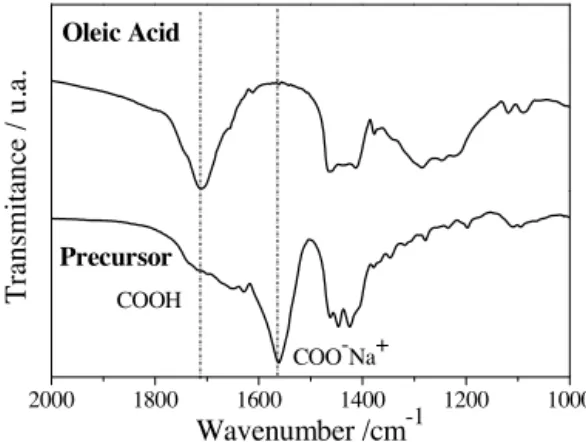
IRspectraoftheNaoleateprecursorsshowedthatthecarbonyl bandoftheoleicacidat1710cm−1stronglydecreasedwiththe appearanceofa newbandat1560cm−1 relatedtotheNa+ car-boxylatewhichsuggeststhatmostoftheoleicacidhasbeenreacted (Fig.1)[21].
2000 1800 1600 1400 1200 1000
Oleic Acid
COOH
COO-Na+
Wavenumber /cm
-1Precursor
Tr
an
smit
an
ce
/ u.a.
Fig.1. FT-IRspectraobtainedforprecursorsandoleicacid.
0 100 200 300 400 500 600 700 800 900 0
20 40 60 80 100
3rd loss 2nd loss
1st loss
W
ei
g
ht
l
o
ss
/
%
Temperature / °C
OA 2.0Na 1.5Na 1.0Na 0.7Na
OA Evaporation
Fig.2.TGanalysesobtainedfortheprecursorsandpureoleicacid.
Thetemperatureinwhichthecarboxylateswoulddecomposeto producehydrocarbonswasdeterminedbyaTGstudyunderargon atmosphere(Fig.2).
Thepureoleicacidpresentedasingleweightlossinthe temper-aturerangeofca.200–300◦Cduetoevaporation.Ontheotherhand,
theprecursorsshowedthreemainweightlossesintemperature rangesof100–400◦C,400–500◦Cand700–900◦C.Theprecursor
0.7Nashowedasignificantgradualweightlossbetween100and 350◦C,likely relatedtopartialoleic acidevaporationduetoits
highconcentrationandlowNa+content.Ontheotherhand,forthe 2.0Naprecursoraweightlossofca.10%(100–150◦C)wasobserved,
whichisprobablyrelatedtowatermoleculesduetohighNa+ con-tentonthesample.Thiseventwasfollowedbyasmallandgradual weightdecreaseofca.10%,upto400◦C.Fortheprecursors1.0Na,
1.5Naand2.0Na,asignificantweightlossofca.60%wasobserved between400and500◦C.Theseexothermicweightlosses(seeDTA
inSupplementarymaterial)arelikelyrelatedtothedecomposition oftheprecursors.
Athirdweightlosscanbeobservedattemperatureshigherthan 700◦CwhichcanberelatedtothecarbonatedecompositiontoCO2
andalsotoareported[22]reactionofsodiumcarbonatewith car-bon(Eq.(3))[22].Asexpected,thisweightlossincreaseswiththe increaseofNa+contentinthesamplee.g.3%for0.7Naand12%for 2.0Na.
Na2CO3(s)+2C(s)→ 3CO(g)+2Na(s) (3)
3.2. Investigationofthethermaldecompositionoftheprecursors
BasedontheTGresults,thethermaldecompositionofthe pre-cursorswasstudiedin atubularreactorintemperaturesof550 and900◦C.Theexperimentswerecarriedoutunderstaticargon
OA 0.7Na 1.0Na 1.5Na 2.0Na 0
20 40 60 80 100
Pr
odu
ct
s (% w
/w
)
Na:OA
Liquid Gas Solid
Fig.3.Productdistribution(wt%)forthethermaldecompositionofoleicacidand thedifferentprecursorsat550◦C.
Threefractionswereobtained:solid,liquidandgas.Itcanbe observedthatthepureoleicacidalmostcompletelyevaporates (about90%)withtheformationofverysmallamountofgas, prob-ablydue tosomedecomposition process.Foralltheprecursors investigated,thegasfractionwasthemainproduct,ca.52–70wt%. Theliquidfractionwasgenerallysmallexceptforthesample0.7Na oranylowersodiumcontent,whichisprobablyduetothe evapo-rationofoleicacid.Previousliteratureworksonthepyrolysisof differentNaand Casoapsin thepresence ofcatalystsorunder extremeconditions(heatingrateof1000◦Cs−1)showedmainly theformationofliquidproducts[17–20].
3.3. Characterizationofthesolidfraction
Thecompositionofthesolidfractionwasinvestigatedby dif-ferenttechniquessuchasXRD,Ramanspectroscopy,TG,SEMand TEM.
Fig.4. Ramanspectraforthesolidobtainedbythermaldecompositionat550◦
Cof theprecursorsandselectedTEMshowingcarbonandNa2CO3structures.
TheXRDpatternsobtainedforthegrey-blacksolidindicatedthe presenceofsodiumcarbonate(Na2CO3JCDPS37-451,see Supple-mentarymaterial).
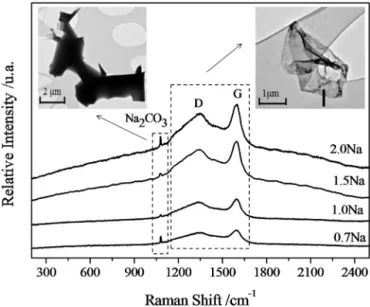
TheRamanspectra(Fig.4)ofthesolidsprecursorsshowedthree bands at1068,1350 and1588cm−1.The bandat1068cm−1 is relatedtothesymmetricstretchingofCObandfromNa2CO3[23]. TEMimages(seedetailinFig.4)showedmanysharpedgeddense structureslikelyrelatedtocrystallineNa2CO3.Thebandsat1350 and1588cm−1arereferredasDandGbands,respectively,typical forcarbonaceousmaterials[24].TheDbandisrelatedtothe pres-enceofdefectivecarbonstructureswhereastheGbandisrelatedto sp2moreorganizedgraphenecarbonstructures[25].Infact,TEM
Fig.5. SEMimagesforthecrudesolidobtainedbythermaldecompositionofallprecursorsat550◦
150 300 450 600 750 900 50
55 60 65 70 75 80 85 90 95 100
2.0Na 1.5Na
0.7Na
Wei
gh
t l
o
ss
/
%
Temperature / °C
1.0Na C + O2 -> CO2
Na2CO3 -> Na2O + CO2 2NaHCO3 -> Na2CO3 + CO2 + H2O
Fig.6.TGanalysesforthesolidfractionobtainedbythermaldecompositionofthe precursorsat550◦C.
images(seedetailinFig.4)clearlyshowedamorphousstructures andgraphenelikeparticlesrelatedtocarbon.
Afterwashingthesolidwithdilutedacid,thecarbonatebandin 1068cm−1wasremovedandonlytheDandGbandsareobserved (seeSupplementarymaterial).TEManalysesofthiswashedsample showedthedifferentcarbonamorphousandgraphenelike struc-tures(seeSupplementarymaterial).
SEMimages(Fig.5)showedneedle-shapedagglomerates struc-tureswhichareinagreementwithNa2CO3crystals[26–28].
Theamountofcarbonpresentinthesolidfractionwas deter-minedbytheweightlossintheTG(Fig.6)duetooxidationasshown inEq.(4).
C(s)+O2(g)→ CO2(g) (4)
Thecarbonoxidationwasobservedatrelativelylow temper-atures,i.e. 300–500◦C (Fig.6)compared to othercarbon based
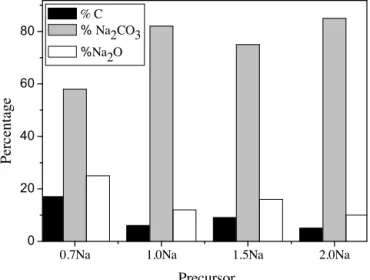
materials[29],which suggestsavery reactivedefective carbon. Accordingtotheobservedweightlosses,thecarboncontentswere 17,25, 9 and 5%for theprecursors0.7Na, 1.0Na,1.5Na,2.0Na, respectively.
Itcanalsobeobservedaweightlossattemperatureshigherthan 750◦Crelatedtocarbonatedecomposition[22].Thecarbonate
con-tentwasanalyzedbyTCafterdissolutionoftheNa2CO3inwater. Fig.7showsthecompositionofthesolidfractionestimatedbyTG andTC.Inallcases,theNa2CO3isthemainproductandthecarbon contentdecreasedasexcessofsodiumisusedinthereaction.Itis interestingtoobservethattheNa2Odoesnotseemtoincreasefor higherNacontentintheprecursor.Thisislikelyrelatedtothe cat-alyticeffectofexcesssodiumontheformationofmoresolidcarbon andalsomorecarbonate.
3.4. Characterizationoftheliquidproduct
TheliquidproductswereanalyzedbyCHNwhichshowed sim-ilarresultsforallsamples,i.e.65–76%Cand6–7%H.Thisgeneral compositionclearlysuggestsaveryhighC/Hratiowhichindicates thepresenceof aromaticcompounds.In fact IRspectra(Fig.8) showedbandsintherangeof3040–3290cm−1 relatedto C H stretching,1400and1650cm−1possiblyduetotheC Cstretching ofaromaticcompounds.Someofthespectrashowedasmallband at1718cm−1indicatingthepresenceoflowamountsofcarboxylic acids[30].Moreover,UV–visspectra(seeSupplementaryMaterial) showedbandsat340nmrelatedtoaromatics.
0.7Na 1.0Na 1.5Na 2.0Na
0 20 40 60 80
Precursor
Per
c
en
tag
e
% C % Na2CO3
%Na2O
Fig.7. Compositionofthesolidfraction.
4000
3500
3000
2500
2000
1500
1000
500
Tr
an
sm
it
an
ce
/ u
.a
.
0.7Na
C=C
OA
=CH
1.0Na
1.5Na
2.0Na
Wavenumber /cm
-1
Fig.8.FT-IRspectrafortheliquidfractionsobtainedbythethermaldecomposition ofthedifferentprecursors.
PreliminaryGC–MSshowed,besidesthepresenceofoleicacid, the formation of a complex mixture of differenthydrocarbons whichneedsamoredetailedcharacterization.
3.5. Characterizationofthegasfraction
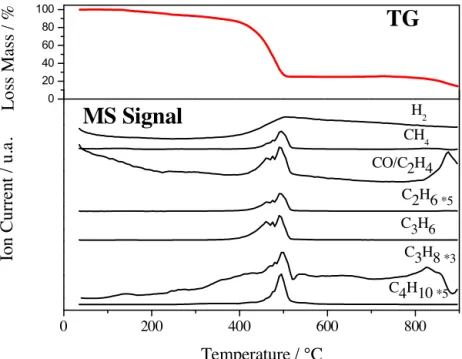
TG-MS analyses were carried out in order to detect the moleculesformedinthegasproductduringthethermal decompo-sition.Also,attheendoftheexperiments,thegaseswerecollected andanalyzedbyGC.TheTGMSobtainedresultsareshowninFig.9. TheobtainedspectrashowedtheformationofH2,CO,CO2and hydrocarbonsC1–C4forallprecursors(seetheotherTGMSprofiles inSupplementarymaterial).
TheGCanalysisshowedthat,at550◦C,thegasesformedwere
essentiallyhydrocarbons(60–70mol%),H2(20–32mol%)and car-bonoxides(Fig.10).Moreover,theselectivityforC3 washigher than90mol%amongthehydrocarbons.
Itisinterestingtoobservethatthegascompositionwerevery similarforalltheprecursorswithaslightincreaseinH2forhigher Nacontent.
Afterdecomposition at 550◦C thegasfrom thereactor was
0 20 40 60 80 100
0
200
400
600
800
Lo
ss
Ma
ss
/ %
TG
MS Signal
C4H10
*5C3H8
*3C
3
H
6
C2H6
*5Io
n
Cu
rre
nt
/
u.
a
.
Temperature / °C
H
2CH
4CO/C2H4
Fig.9.TG-MSspectrumoftheprecursor1.0Na.
0.7 Na 1.0 Na 1.5 Na 2.0 Na 0
10 20 30 40 50 60 70
Prec
ursor
Mo
l /
%
H2 H2
H2
H2
CO/
CO2 CO/ CO2
CO/
CO2 CO/ CO2 C3 C3
C3 C3
Fig.10.Gasfractioncomposition(mol%)at550◦C.
smallamountofgaswasproducedbetween550and900◦Cwhich
isinagreementwiththeTGweightlossobservedathigher tem-peratures.GCanalysisofthisgasshowedthepresenceofhydrogen, hydrocarbonsandcarbonoxides.
3.6. Generalconsiderations
Consideringtheinformationgatheredfromthemassbalance,GC andTGanalysesofthedifferentfractionsageneralideaofproduct distributionfortheprecursor2.0NaispresentedinFig.11.
Itcanbeobservedthatthesolidproductca.31wt%iscomposed mainlyofsodiumcarbonate,sodiumoxideandcarbon.TGresults showedthatattemperaturesnear800◦C thesodiumcarbonate
decomposesandoxidizesthecarbontoproduceCOandCO2and awhitepowdercomposedofNa2O.Themostimportantaspectof thisdecomposition/carbonoxidationistheregenerationofNa2O whichcanbereusedforanewreactionwithmorefattyacid.
Theliquidproductsareformedinrelativelysmallamountsand initialIR, UV and CG-MS analysessuggest thesignificant pres-enceofaromaticcompounds(seeSupplementarymaterial).Amore detailed characterization of this liquid fraction is necessary to envisagepotentialapplications,e.g.fuel,solvent,etc.
Themajorgasfraction,58wt%,wascomposedofpropaneand smallamountsofH2,C1,C2andC4.Thecarbondistributioninthe differentreactionproductsisshowninFig.12.
Itcanbeclearlyobservedthatalmost70%ofthecarbonatoms fromtheoleateendedupaspropaneandasignificantfractionof theCispresentintheliquidproducts.
Na
+Oleate
-Prec
ursor
(2.0Na)
550
oC
Soli
d
produ
cts
31 wt%
liquid
products
11 wt%
Gas
products
58 wt%
C
3: 50 wt%
C
1-C
4: 3 wt%
CO
x: 4 wt%
H
2: 1 wt%
Mainly
aromati
c
organics
Na
2CO
3: 26 wt%
Carbo
n: 2 wt%
Na
2O: 3 wt%
Na
2O
CO
2900
oC
Liquid
Solid
Gas
0 10 20 30 40 50 60 70
Li
qu
id
fr
ac
ti
o
n
CO /
CO
2
CH
4
, C
2
and
C4 C3
Car
b
on m
o
l /
%
Products
Ca
rb
o
n
Na
2
CO
3
Fig.12. Carbonatomsdistribution(mol%)inthedifferentproductsof2.0Na decom-positionat550◦
C.
Althoughthereactionmechanismisnotclear,apparentlya com-plexreactioninvolvingdifferentprocessesistakingplaceduring thedecompositionofthesodiumoleateprecursor.Fig.13shows somepossiblereactions.
Thehydrocarbonchainisfragmentingtoproducepropaneas themainproduct.Asimplecalculationshowsthatfromthe18C atoms,12Cwillresultin4propanemolecules.Theformationof highamountsofpropanefromC17H33chaininvolvesasignificant hydrogentransferamongthecarbons.Asaresultofthisprocess, partofthecarbonswillbeconvertedtoaromaticcompounds(as observedintheliquidfractionwithaC/Hrationear1/1)and a significantamountof solid carbon(char). Therefore, thesedata suggeststhatthesodiumoleateprecursordecomposes/cracks, pro-duces/transfershydrogenandaromatizetosmallmoleculesand solidcarbon
Itisinterestingtoobservethatsodiumhasafundamentalrole inthesereactions,sincepureoleicaciddoesnotdecomposesand onlyevaporates.ThestrongbasiccharacterofNa2Oformedinthe reactionlikelypromotescatalyticcrackingreactionsandalsotheH transferprocesses[31].
Thereasonfortheremarkableselectivityobservedforpropane is not clear and further investigation is necessary in order to
Fig.14. Formationanddecompositioncycleofsodiumoleate.
understandthepossiblereactionsteps,theinteractionofthealkyl chainwiththeNa+ion,thedehydrogenationandH-transfer pro-cesses.
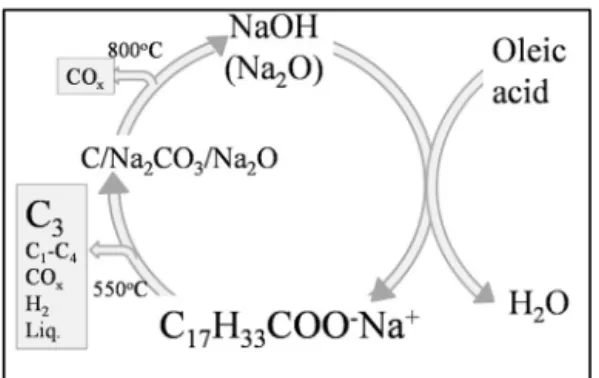
Theobtainedresultsalsopointtoapossiblecyclicprocesswhere thesodiumhydroxideoroxidecanberegeneratedandreusedfor anewreaction(Fig.14).
4. Conclusions
Thisworkshowsthatfreefattyacid,acommonand undesir-ablecontaminationpresentinvegetableoils,canbeconvertedto hydrocarbonsbyasimpleprocessofreactionwithNaOHfollowed byacontrolledthermaldecomposition.Inthisdecomposition pro-cessthesodiumoleateisconvertedwitharemarkableselectivityto propaneandinsmallamountsC1,C2,C4andH2,whichissimilarin severalaspectstoliquefiedpetroleumgas.Thisprocessalsoresults inaliquidmixturewitharomaticcompoundswithpotentialfor useasfuels.Thesodiumoxidecanberegeneratedattemperatures higherthan800◦Candreusedforanewreactioncycle.
Acknowledgements
TheauthorsacknowledgefinancialsupportfromCNPq,CAPES andFAPEMIG.Theauthorsalsowouldliketoacknowledgethe Cen-terofMicroscopyatUFMG.
AppendixA. Supplementarydata
Supplementarydataassociatedwiththisarticlecanbefound, intheonlineversion,athttp://dx.doi.org/10.1016/j.cattod.2016.04. 035.
References
[1]S.A.Hosseini,A.Niaei,D.Salari,M.C.Alvarez-Galvan,J.L.G.Fierro,Ceram.Int. 40(2014)6157–6163.
[2]P.Hernández-Hipólito,N.Juárez-Flores,E.Martínez-Klimova,A.
Gómez-Cortés,X.Bokhimi,L.Escobar-Alarcón,etal.,Catal.Today250(2015) 187–196.
[3]M.Manríquez-Ramírez,R.Gómez,J.G.Hernández-Cortez,A.Zú ˜niga-Moreno, C.M.Reza-SanGermán,S.O.Flores-Valle,Catal.Today212(2013)23–30. [4]A.Guldhe,P.Singh,S.Kumari,I.Rawat,K.Permaul,F.Bux,Renew.Energy85
(2016)1002–1010.
[5]A.P.C.Teixeira,E.M.Santos,A.F.P.Vieira,R.M.Lago,Chem.Eng.J.232(2013) 104–110.
[6]E.M.Santos,A.P.D.C.Teixeira,F.G.daSilva,T.E.Cibaka,M.H.Araujo,W.X.C. Oliveira,etal.,Fuel150(2015)408–414.
[7]C.VieiraGrossi,E.deOliveiraJardim,M.H.deAraújo,R.M.Lago,M.J.daSilva, Fuel89(2010)257–259.
[8]V.V.Kuss,A.V.Kuss,R.G.DaRosa,D.a.G.Aranda,Y.R.Cruz,Renew.Sustain. EnergyRev.50(2015)1013–1020.
[9]L.N.Silva,C.C.Cardoso,V.M.D.Pasa,Fuel166(2016)453–460. [10]H.V.Lee,J.C.Juan,Y.H.Taufiq-Yap,Renew.Energy74(2015)124–132. [11]L.Wang,X.Dong,H.Jiang,G.Li,M.Zhang,Bioresour.Technol.158(2014)
392–395.
[12]M.K.Lam,K.T.Lee,A.R.Mohamed,Biotechnol.Adv.28(2010)500–518. [13]J.M.Encinar,N.Sánchez,G.Martínez,L.García,Bioresour.Technol.102(2011)
10907–10914.
[14]R.Carde ˜na,G.Moreno,I.Valdez-Vazquez,G.Buitrón,Int.J.HydrogenEnergy (2015)1–12.
[15]K.Hengst,M.Arend,R.Pfützenreuter,W.F.Hoelderich,Appl.Catal.BEnviron. 174–175(2015)383–394.
[16]Y.Yang,Q.Wang,X.Zhang,L.Wang,G.Li,FuelProcess.Technol.116(2013) 165–174.
[17]H.Lappi,R.Alén,J.Anal.Appl.Pyrolysis91(2011)154–158.
[18]H.E.Lappi,R.J.Alén,BioResources6(2011)5121–5138comesources.com. [19]A.Demirbas,EnergyConvers.Manag.44(2003)2093–2109.
[20]C.-C.Chang,S.-W.Wan,Ind.Eng.Chem.39(1947)1543–1548. [21]F.Yu,Y.Wang,L.Zhang,G.Zhu,Miner.Eng.71(2015)7–12. [22]J.-W.Kim,H.-G.Lee,Metall.Mater.Trans.B32(2001)17–24. [23]S.Gunasekaran,G.Anbalagan,S.Pandi,J.RamanSpectrosc.37(2006)
892–899.
[24]M.S.Dresselhaus,G.Dresselhaus,R.Saito,A.Jorio,Phys.Rep.409(2005) 47–99.
[25]A.Ferrari,J.Robertson,Phys.Rev.B61(2000)14095–14107. [26]B.Holt,R.Lam,F.C.Meldrum,S.D.Stoyanov,V.N.Paunov,SoftMatter.3
(2007)188–190.
[27]J.Jiang,M.-R.Gao,Y.-H.Qiu,G.-S.Wang,L.Liu,G.-B.Cai,etal.,CrystEngComm 13(2011)952.
[28]M.Wang,H.K.Zou,L.Shao,J.F.Chen,PowderTechnol.142(2004)166–174. [29]J.P.C.Trigueiro,G.G.Silva,R.L.Lavall,C.a.Furtado,S.Oliveira,a.S.Ferlauto,
etal.,J.Nanosci.Nanotechnol.7(2007)3477–3486.
[30]L.C.deA.Barbosa,EspectroscopianoInfravermelhonacaracterizac¸ãode compostosorgânicos.1sted.,Vic¸osa,2007.