FREE THEMES
1 Departamento de Saúde Coletiva, Universidade Federal do Rio Grande do Norte (UFRN). Av. Senador Salgado Filho 3000, Lagoa Nova. 59078-970 Natal RN Brasil. flavitamachado@ yahoo.com.br 2 Departamento de Odontologia. Universidade do Estado do Rio Grande do Norte. Caicó RN Brasil. 3 Programa de Pós-Graduação em Saúde Coletiva, UFRN. Natal RN Brasil.
Indicators for teenager’s oral health’s surveillance
Abstract The existence of a few indicators that could guide the evaluation of oral health surveil-lance in the primary health care attention, mainly in adolescence life cycle, raised the realization of this study. To develop indicators to this end, it was conducted: document analysis to guide the devel-opment of a logic model and selection of data to compose indicators. This selection and validation of the logic model were performed by a group of four experts that, from the perspective of the modified Delphi method, analyzed if the model illustrated the activities, results and expected im-pact of a primary oral health service to enable the adolescents oral health surveillance and assigned points (0-10) to each data proposed. Then, those data judged important by the consensus of experts (média≥7; standard deviation <3) were used to construct indicators. After individual analysis and group discussions, the logical model and 36 of the 48 data, initially proposed, were consensually im-portant, resulting in 26 indicators. The indicators matrix intends to be a situational diagnostic tool to assess, plan and manage health actions to ad-olescents, but it can be used in other life cycles by its adaptation.
Key words Oral health, Information systems,
Adolescents, Public health surveillance
Flávia Christiane de Azevedo Machado 1
Georgia Costa de Araújo Souza 2
M
ac
ha
d
o FCA
Introduction
The purpose of the Health Information Systems (SUS) is to assess the territory´s health situation to support better decisions for health policy, planning, management, monitoring and evalua-tion of health programs; quantify/determine the volume of financial resources to be transferred to each service; as well as support epidemiological analysis and assessment1-3.
However, there are critical points regarding to some SIS in Brazil that need to be overcome in order for these SIS achieve their purpose. One of these nodes is the limitation of offer information needed by managers to guide priority actions due to biologists and fragmented vision about the health/disease process, still hegemonic within the SIS. This reflected in the predominance of1-5
disease indicators.
In this way, overcoming the limitations of the information must resound the ressignification of health where are present other dimensions in-cluding indicators that signals the real situation of the studied territory regarding the health-dis-ease process. In this sense, the indicators related to issues that permeate National Health Human-ization Policy (PNH) enable not only size chang-es in health-disease frameworks, but also include issues involved in the health work process6.
The PNH proposes developing relational technologies and sharing of management prac-tices and implement processes for monitoring and evaluation, emphasizing knowledge generat-ed in the Unifigenerat-ed Health System (SUS) and suc-cessful collective experiences. As a consequence, the capacity of intervention of the Health System on the sanitary reality will be amplified and im-proved, providing more subsidies for the con-cretization of the right to health7. Regarding to
oral health, regardless of the level of health care attention, analysis and use of information are still precarious. Historically, oral health infor-mation contained in health inforinfor-mation systems were mainly consolidated by information of outpatient production and few indicators pro-posed by the Pact for Basic Care8. In this sense,
the Performance Index of the Unified Health System (IDSUS), a synthetic indicator bench-marking built to enable a contextualized evalu-ation of SUS´s performance presents only three oral health indicators and all of them refer to primary health care: estimated population cover-age by the basic oral health teams; the collective action average of supervised tooth brushing and tooth extractions ratio in relation to individual
preventive and curative clinical procedures9. This
situation hinders the implementation of a health surveillance model attention as advocated by the SUS and an evaluation, not just in a normative way, of the effectiveness of oral health at the local level. In spite of advances , with the insertion of Oral Health Team in the Family Health Strategy and the establishment of a Brazilian Oral Health Policy (PNSB)10, the results are not yet visible in
the structuring of health services and do not pro-mote, as a matter of fact, significant changes in oral health care model11,12.
The existence of a few indicators that could guide the monitoring and evaluation of oral health actions at the local level and, potentially, to promote the implementation of the oral health surveillance model attention has raised the devel-opment of this study.
It was decided to prioritize adolescents from 15 to 19 years of age, since it is common for this group not to seek the health unit and tend to un-derestimate their health risk behaviors, since they generally feel invulnerable or minimally suscep-tible to them. However, when well-targeted, they are able to perpetuate healthy behaviors through-out life13.
In addition, despite a reduction in caries prev-alence among teenagers, the results of the latest national survey of oral health – SB Brazil 2010 – indicated that 18% of 12-year-old adolescents have never been to the dentist, untreated caries index of 44.5% among 15 to 19 years-old adoles-cents and 39% of them reported some difficulty to carry out activities related to mouth14.
Based on the above the aim of this study was to construct a matrix of indicators to support the construction of an Adolescent Oral Health Infor-mation System (SISBA).
Method
This is a development study that aims the system-atization of existing knowledge and the develop-ment of an intervention or of a measuring instru-ment15. In this case, the measuring instrument is
a matrix of indicators that can assess oral health services at the local level. Therefore, the evalua-tion of health services is the purpose of this study.
be-aúd
e C
ole
tiv
a,
23(1):187-202,
2018
have in order to achieve the expected results in a given organizational and policy context16. Thus,
the model of this research aims to illustrate the resources, activities and results required by Pri-mary Care Oral Health Teams Whose mission is to promote health, prevent disease and injuries and reduce morbidity.
To guide the construction of this model, it was carried out a literature and documental re-view of the National Health Humanization Pol-icy7, the Basic Care Notebook nº178, Brazilian
Oral Health Policy10, rulings by the Brazilian
Ministry of Health 267/200117 and articles related
to the subject investigated.
From the logical model it was identified crite-ria and data that could be used to construct indi-cators to integrate SISBA. These criteria and data were distributed in components and sub-com-ponents (proximal and distal) of an evaluation matrix. This matrix built by the researchers was submitted to a content validation process by four experts. The Group of experts was formed by teachers of undergraduate degree in dentistry and graduate studies in collective health of a fed-eral public University with experience in public health services and publications in the area of evaluation of oral health services. The experienc-es are related to coordination of epidemiological national and state surveys, insertion in the co-ordination of oral health of the State Secretariat of health and development of research and ex-tension actions on primary and secondary oral health in municipal scope. Thus, the principle for the selection of experts was the concrete em-pirical knowledge about oral health services, the academic experience and experience in services in management or assistance.
The group of experts was personally invited to participate and received by e-mail information about the study protocol for the construction of the SISBA evaluation matrix. Such matrix should be analyzed based on the following guiding ques-tion: to assess the oral health care of adolescents in primary health care, which criteria/data should be used to compose a health information system?
The evaluation matrix was composed from components and sub-components (keywords that aggregate a set of activities of the logical model) and criteria (the attribute structure, pro-cess or result used to measure the components)18,
in addition to the data required for definition of the criteria. To every one of the criteria was requested to experts the proposition of a grade
ranging from zero (maximum disagreement as to the inclusion of the criterion/data in the matrix) to 10 (maximum agreement about its inclusion). For validation of the evaluation matrix, it was opted for the “Delphi modified” method, which consists in the inclusion of at least one round of face-to-face discussion between experts1, through
association with the technique of consensus con-ference16. The study took a first round with the
application of the traditional Delphi technique, in which the experts evaluated individually the proposed matrix of SISBA, assigning each item of the matrix a value from zero (0) to 10 (ten). In addition, it was possible to include new criteria and their respective values19.
After the evaluation, the experts sent the ma-trix and their comments by email to researchers so that they proceed with the calculation of the average (importance attributed to each criterion/ data) and standard deviation (SD) (the degree of consensus of the experts as to the relevance of the criteria/data).
Secondly, the nominal group was performed, as advocated in the modified Delphi method. Therefore, there was a discussion about the rel-evance of the logical model and, then, of the cri-teria and data of the matrix, exposing visually, at the same time, to the experts the average and standard deviation calculated. Would also be dis-cussed the “new” criteria; however there was no proposition by experts.
After the discussion, this matrix was for-warded by e-mail to an individual reassessment by confirmation/assignment of notes. Then the experts returned this reassessment for the calcu-lation of the averages and the DP score assigned. The criteria/data with average ≥ 7 (criterion/im-portant data) and DP < 3 (consensus of experts) were kept in the matrix, and the other removed16.
The four experts invited to the study partici-pated in all phases of research and had a deadline of two weeks for evaluation of pre and post nom-inal group matrix.
After this phase of validation of the criteria and data, the group of researchers met to discuss and build indicators for evaluating and moni-toring issues related to oral health care model in the perspective of National Oral Health Policy and the National Health Humanization Policy. The indicators defined primed for simplicity of understanding, validity, and availability18. In this
M
ac
ha
d
o FCA
Results
The components of the logic model were built based on the pillars of basic care, Care coor-dination and longitudinality, Accessibility and Completeness of Attention8,20. Regarding the
sub-components, strategic management stands out, which is usually not discussed in the perspective of integrality of attention. However, take care and manage the health work process make up a single reality, since there is no way to change the modes to meet population health service without also change the logistics of work processes, the dynam-ics of team interaction, mechanisms for planning, decision-making, participation and assessment21.
The representation of the context through the National Health Humanization Policy (PNH) as the components and sub-components of the model were assigned as adequate by the experts. The PNH, as a transversal policy to all SUS poli-cies and programs, would have its principles and precepts (user embracement, participative man-agement, ambience, expanded and shared clinic, worker valorization and protection of the Rights of Users) as guiding principles of all policies Health, including the Smiling Brazil (Brasil Sor-ridente) – PNSB7.8.
Each of the components of the logical mod-el showed activities consistent with their imple-mentation in the daily routine of the Basic Health Units, with a view to obtaining results that will impact on the reduction of oral morbidity, quality of life improvement and empowerment (Figure 1). The logical model presented to the experts had its validity validated, since they identified plausi-bility among its constituent elements. Thus, it was possible to construct a coherent logical model of health surveillance, which includes health as a so-cial product, derived from the relationships pres-ent in a given political, economic, cultural and ideological scenario22.
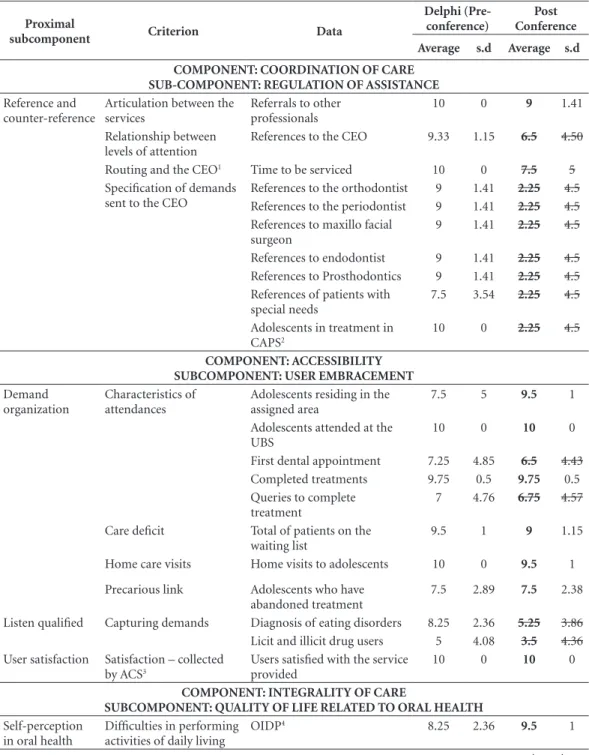
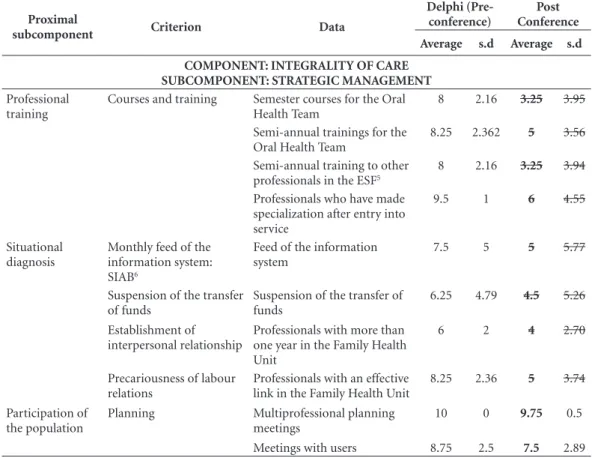
Regarding the results of the matrix judgment, these are presented according to the two evalua-tion moments performed by the experts. In the first moment of evaluation have been proposed 48 items that would respond to the proximal log-ical model subcomponents. Of this total, 36 con-sidered important in the evaluation of experts by consensus (average ≥ 7 and d. p < 3) as shown in Table 1.
In this first evaluation, there was data whose
experts judged measure questions already mea-sured by another element of the array, so, although valid, received low-scoring (adolescents residing in the area assigned, references to the care of patients
with special needs). Others considered valid, but difficult to measure (first dental appointment, que-ries to complete treatment, self-declaration of using drugs by the adolescents). However, there were data that, according to the evaluators, did not measure what was proposed, classified as non-valid ( pro-fessionals with more than one year in the unit, SIS feeding, suspension of the transfer of funds). Data entered into the subcomponent sanitation and en-vironment that could be picked up on other infor-mation systems and exceeded the governability of Basic Health Unit (UBS) received low scores (gar-bage collection, sewage network coverage, presence of fluoridated water and concentration of fluoride in the water).
In turn, in the second round of evaluation, 23 data were considered to be consensually import-ant. Specifically, there was the reaffirmation of the exclusion of the first dental appointment data and
queries for completion of treatment, as well as the full exclusion of the data contained in the criteria
garbage collection, sewage network, water supply; Monthly supply of SIS; Suspension of funding and Establishment of interpersonal relationship for the reasons already exposed.
Still, there was consensus about the exclusion of other criteria in full: 1- articulation between lev-els of care; 2- Referrence and counter reference to the CEO; 3- specification of demands sent to the CEO;
4- Capturing user needs; 5- Professional training; 6- Precariousness of labour relations.
Regarding the first three criteria, it was evalu-ated, respectively, that the number of references to the CEO would already be included in the crite-rion articulation between the services; the relevant for measuring the institution of reference and counter-reference would be the number of ref-erences itself and not the time interval in which these occurred; the data relating to dental special-ties of CEO, although important, were removed by also being referred to in criterion articulation between the services and the data referring to the treatments on the Psychosocial Care Centers (CAPS) were removed, because even though it specify a possible user need, not necessarily would identify activities or results related to oral health teams.
With regard to the Capturing users needs, it was discussed that there would be a low discrimi-natory power in situations of low frequency event (self-declaration of drugs) and that the number of diagnosis of eating disorders conducted by nutri-tionist and/or doctor arising from the referral by the Dentist (CD) would be included in the criterion
aúd
e C
ole
tiv
a,
23(1):187-202,
2018
The last twocriteria were excluded because they were judged as not valid. It was argued that the effective employment bonds do not, neces-sarily, be related to greater commitment to the work and, therefore, would not be a factor of
professional motivation. With regard to profes-sional training, it would not be congruent with an information system in the perspective of sur-veillance. This is possibly related to the prevalent view that information systems are characteristic
Figure 1. Logical model of oral health care of the adolescent in the family health strategy.
Components Subcomponents Activities Results Impact
R
ed
uc
tio
n o
f mo
rb
idit
y
Imp
ro
ve
me
nt o
f q
ualit
y o
f lif
e
Emp
o
w
er
me
nt
Improvement in the regulation
of care
Adherence of adolescents to dental care
Detection of drug abuse
Increased diagnosis and adherence to treatment of eating disorders Detection of oral diseases
Improving the quality of care
Reduction of oral diseases
Strategic planning and evaluation
of actions
Participative management Participation of the
population Situational
diagnosis Professional
training Multiprofessional
teams Sanitation and
environment Oral health care Epidemiological
surveys Self-perception in
oral health User satisfaction Qualified listening
Organization of demand Reference and counter-reference Regulation of
assistance
User embracement
Oral health-related quality of life
Promotion, prevention and
recovery
Intersectoral approach
Strategic management
Int
eg
ralit
y o
f car
e
A
cc
essib
ilit
y
C
o
o
rdinat
io
n o
f car
M
ac
ha
d
o FCA
of epidemiological surveillance and not health surveillance (epidemiological, sanitary, environ-mental, worker’s health together) nor of surveil-lance related to the health- Disease itself (health
surveillance). The latter related to health service available that would act as a social determinant.
After consolidated and validated criteria, were defined 26 indicators presented in Chart 1.
Table 1. Criteria and data organized according to the components and subcomponents deemed consensually important for subsidizing the construction of indicators to compose SISBA.
Proximal
subcomponent Criterion Data
Delphi (Pre-conference)
Post Conference
Average s.d Average s.d
COMPONENT: COORDINATION OF CARE SUB-COMPONENT: REGULATION OF ASSISTANCE
Reference and counter-reference
Articulation between the services
Referrals to other professionals
10 0 9 1.41
Relationship between levels of attention
References to the CEO 9.33 1.15 6.5 4.50
Routing and the CEO1 Time to be serviced 10 0 7.5 5
Specification of demands sent to the CEO
References to the orthodontist 9 1.41 2.25 4.5
References to the periodontist 9 1.41 2.25 4.5
References to maxillo facial surgeon
9 1.41 2.25 4.5
References to endodontist 9 1.41 2.25 4.5
References to Prosthodontics 9 1.41 2.25 4.5
References of patients with special needs
7.5 3.54 2.25 4.5
Adolescents in treatment in
CAPS2
10 0 2.25 4.5
COMPONENT: ACCESSIBILITY SUBCOMPONENT: USER EMBRACEMENT
Demand organization
Characteristics of attendances
Adolescents residing in the assigned area
7.5 5 9.5 1
Adolescents attended at the UBS
10 0 10 0
First dental appointment 7.25 4.85 6.5 4.43
Completed treatments 9.75 0.5 9.75 0.5
Queries to complete treatment
7 4.76 6.75 4.57
Care deficit Total of patients on the
waiting list
9.5 1 9 1.15
Home care visits Home visits to adolescents 10 0 9.5 1
Precarious link Adolescents who have
abandoned treatment
7.5 2.89 7.5 2.38
Listen qualified Capturing demands Diagnosis of eating disorders 8.25 2.36 5.25 3.86
Licit and illicit drug users 5 4.08 3.5 4.36
User satisfaction Satisfaction – collected
by ACS3
Users satisfied with the service provided
10 0 10 0
COMPONENT: INTEGRALITY OF CARE
SUBCOMPONENT: QUALITY OF LIFE RELATED TO ORAL HEALTH
Self-perception in oral health
Difficulties in performing activities of daily living
OIDP4 8.25 2.36 9.5 1
aúd
e C
ole
tiv
a,
23(1):187-202,
2018
Discussion
The SISBA aims to constitute a situational di-agnosis tool for the planning and programming of health actions aimed at teenagers, but with a good adaptation can subsidize the construction of systems to other life cycles. However, your main purpose is to provide an assessment on the effectiveness of the model health monitoring in the context of local health units and, therefore, the experience of the principles and values of the PNH in health care and in the management of care. The health surveillance constitutes a mod-el of analysis that uses the territory as a space of reference, highlighting the importance to
consid-er the hetconsid-erogeneity of the population as to their needs and access to health services23.
The definition of adolescence as a priority of the SISBA cycle related to the global context of demographic and epidemiological transition characterized by the decrease of fertility rates, increased life expectancy and a higher incidence of chronic diseases/contagious face and appear-ance of the harms to health as being responsible for significant morbidities24 population. In this
sense, one can infer some increased costs of pub-lic health assistance, if there is a longevity associ-ated with quality of life25. We must promote and
develop health promotion policies targeted both the ageing population as it possibly age. In this
Proximal
subcomponent Criterion Data
Delphi (Pre-conference)
Post Conference
Average s.d Average s.d
COMPONENT: INTEGRALITY OF CARE
SUBCOMPONENT: PROMOTION, PREVENTION AND RECOVERY
Epidemiology Epidemiological surveys Procedure performed in social
spaces
10 0 10 0
Oral health care Supervised brushing Collective actions carried out
by the Oral Health Team
10 0 9.75 0.5
Assistance actions carried out in social facilities
Non-invasive procedures* 10 0 9.75 0.5
Actions by the Oral Health Team
Biopsies 10 0 10 0
Oral cavity adequacy Dental restoration 10 0 10 0
Prevention of oral cancer Tooth extractions 9.67 0.58 10 0
Curative actions Dental scaling 9.75 0.5 10 0
Dental trauma 9.67 0.58 10 0
Emergencies 9.67 0.58 10 0
Non-elective health action Traumatismo dentário 9.67 0.58 10 0
9.67 0.58 10 0
COMPONENT: INTEGRALITY OF CARE SUBCOMPONENT: INTERSECTORAL APPROACH
Sanitation and environment
Garbage collection, sewage network, water supply
Garbage collection 7.5 5 4 4.90
Coverage of the sewage network in municipality
7.5 5 4 4.90
Presence of fluoridated water 7.5 5 5 5.77
Concentration of fluoride in water
7 4.76 5 5.77
Multiprofessional teams
Actions carried out by multidisciplinary team
Collective actions carried out with multidisciplinary team
10 0 10 0
it continues
M
ac
ha
d
o FCA
sense, the cycle of adolescence would be adapt to the practices of promotion of healthy habits for active ageing, cognitive and motor development characteristic of this phase promotes susceptibil-ity to social behavior changes and your lifelong conservation13,26. So, schedule actions for the
res-olution of the accumulated needs in adolescents configured in a matter of public health.
Oral health, notes the need to facilitate strat-egies to combat poor adolescents access to dental services, especially at the age of 15 to 19 years, characterized as a second phase of adolescence. According to data from the SB Brazil 2010, 65.1% of teenagers between 15 and 19 years autorefer-iram need for dental treatment, 24.7% reported toothache in the 6 months prior to the survey
and 13.6% of those teens never consulted with the dentist. It also observed that the 12 years, 43.5% of the people are free of dental caries in permanent dentition, while the 15 to 19 years, this percentage is 23.9%14.
The second phase of adolescence builds up larger assistance needs in relation to the first phase. This, possibly, occurs by difficulty of Gen-eral access to dental care services that culminates in an increasing morbidity over the life of the individual but also to the hegemonic assistance model. In Brazil, for many decades, predomi-nated in the public service the dental care mod-el curativista and mutilator. In this panorama, a care model called Incremental System geared to schoolchildren in the age group of six to 14 years,
Proximal
subcomponent Criterion Data
Delphi (Pre-conference)
Post Conference
Average s.d Average s.d
COMPONENT: INTEGRALITY OF CARE SUBCOMPONENT: STRATEGIC MANAGEMENT
Professional training
Courses and training Semester courses for the Oral
Health Team
8 2.16 3.25 3.95
Semi-annual trainings for the Oral Health Team
8.25 2.362 5 3.56
Semi-annual training to other
professionals in the ESF5
8 2.16 3.25 3.94
Professionals who have made specialization after entry into service
9.5 1 6 4.55
Situational diagnosis
Monthly feed of the information system:
SIAB6
Feed of the information system
7.5 5 5 5.77
Suspension of the transfer of funds
Suspension of the transfer of funds
6.25 4.79 4.5 5.26
Establishment of interpersonal relationship
Professionals with more than one year in the Family Health Unit
6 2 4 2.70
Precariousness of labour relations
Professionals with an effective link in the Family Health Unit
8.25 2.36 5 3.74
Participation of the population
Planning Multiprofessional planning
meetings
10 0 9.75 0.5
Meetings with users 8.75 2.5 7.5 2.89
* Non-invasive procedures: cariostatic application for tooth, Topical Application of Fluoride individual, plaque disclosure, provisional restoration.
1 CEO: Center of Dental Specialties; 2 CAPS: Center for Psychosocial Care; 3 ACS: Community Health Agent; 4 OIDP: Oral Impact on Daily Performance - Checking for difficulty in performing activities to: eat, talk, smile, study, sleep, maintain mood, socially relate, perform mouth hygiene due to a problem in the mouth, tooth or prosthesis, and attributed motive to this difficulty. This information should be collected before and at the end of treatment; 5 ESF: Family Health Team; 6 SIAB: Basic Attention Information System.
aúd
e C
ole
tiv
a,
23(1):187-202,
2018
Chart 1. Indicators, objectives, sources and methods of calculation defined by consensus to compose the SISBA, organized according to the proximal subcomponents and criteria of the logical model.
Criterion Bookmark Objective Source Method of calculation
Proximal subcomponent: Reference and counter reference Articulation
between services
Proportion of adolescents referred by the dentist to other professionals in Primary Care
To quantify references to other professionals in Primary Care from the perspective of teamwork and intersectoral approach
SIA1
SIAB2
Number of referrals of adolescents conducted by the dentist to other Primary Care professionals divided by the total number of Primary Care attendances x 100 (every six months)
Proximal subcomponent: Demand organization Characteristics of
health care
Proportion of adolescents resident in the assigned
area attended by OHT3
To quantify the access demand within the group of adolescents
SIAB
IBGE4
Number of first dental appointments in adolescents divided by the total of adolescents x 100 (every six months) Proportion of adolescents
attended by OHT
To quantify the frequency of access of adolescents in the general population
SIAB Total number of first dental
appointments in adolescents divided by the total number of first dental appointments in the general population x 100 (every six months) Proportion of dental care
completed in adolescents
To evaluate the efficaciousness of access within the group of adolescents
PMAQ5
(modified)
Number of completed treatments in adolescents divided by the number of first dental appointments in adolescents x 100 (every six months) Deficits of
attendances
Proportion of adolescents attended by OHT in the universe of demands
Check the service deficit SIAB
Primary data
Total number of first dental appointments in adolescents divided by the number of patients on the waiting list x 100 (every six months)
Home visits Proportion of home care
visits of OHT targeting adolescents
To identify new forms of care, breaking with the passivity of the traditional units of primary care and establishing linkages and approaches with adolescents and their families, interacting with home spaces
Primary source (adapted from SIAB)
Number of home care visits of the OHT to the adolescents divided by the number of home visits performed x 100 (every six months)
Precariousness of labour relations
Proportion of adolescents who have left the dental treatment program
To identify the abandonment of adolescents to dental treatment
Primary source SIAB
Number of adolescents who have left the treatment divided by the number of first dental appointments in adolescents x 100 (every six months)
Proximal subcomponent: User satisfaction Satisfaction –
collected by ACS6
Proportion of adolescents satisfied with the attendance of OHT
To measure the satisfaction of adolescents with the attendance by OHT
PMAQ Number of adolescents users satisfied
with the service provided by OHT divided by the total number of first dental appointments in adolescents x 100 (every six months)
Proximal subcomponent: Self-perception in oral health Difficulties in
performing activities of daily living
OIDP7 Check efficaciousness
of attention; To identify difficulties by adolescents even after completion of dental care, from the perspective of qualified listening
SIAB Number of adolescents who reported
some difficulty related to mouth divided by the number of complete dental treatments in adolescents x 100 (every six months)
M
ac
ha
d
o FCA
which lasted for more than 40 years. In this way, one can say that the other population groups were underserved public dental policy, being restricted to emergency calls and not conservatives27.
In order to exercise, in fact, actions based on the Health Surveillance model, democratic and participatory practices are required, in the form of teamwork, directed to populations for which responsibility for oral health care assumed, con-sidering the dynamics in the Territory in which these populations live. In addition, it is necessary to institute an information-valued culture in organizations to verify the implementation and implementation of this model in health work processes. One of the ways to consider the dyna-micity of the territory is to use epidemiology as a situational diagnostic tool for planning health actions in28 health.
Criterion Bookmark Objective Source Method of calculation
Proximal subcomponent: Epidemiology
Oral needs surveys Coverage of
epidemiological surveys of oral health
To articulate health services to social facilities with the intersectoral approach
Primary sources; SIA
Number of school adolescents participating in an epidemiological survey of oral health divided by the total number of adolescents enrolled in schools x 100 (every six months) Proportion of adolescents
with oral needs detected in epidemiological surveys
To articulate health services to social facilities with the intersectoral approach
Primary sources; SIA
Number of school adolescents with dental treatment needs identified in epidemiological surveys divided by the number of adolescents investigated in epidemiological surveys of oral health at school x 100 (every six months) Proportion of adolescents
who accessed the dental service with oral needs collected in epidemiological surveys
Verify the effectiveness of intersectoral approach in expanding access to the service
PMAQ; Primary data
Total number of first dental appointments in adolescents per semester divided by the number of adolescents with oral health needs identified in surveys x 100 (every six months)
Proximal subcomponent: Oral health Care Supervised
brushing
Coverage of supervised dental brushing in adolescents
To verify coverage of supervised brushing in the adolescent population
SIAB IBGE
Number of adolescents participating in the supervised brushing dental collective action divided by the total number of adolescents in the area x 100 (every six months)
Assistance actions carried out in social facilities
Coverage of educational actions of oral health in adolescents by the multiprofessional team
To verify coverage of oral health educational actions in adolescents from the perspective of multidisciplinary teamwork
Primary source
Number of educational actions directed to the adolescent carried out with the participation of multiprofessional team
Chart 1. continuation
Under such aspect, the epidemiology would be a technology, according to the design of Meh-ry29, which could increase the scope of the
orga-nizational mission of health care, health care. For this, the information produced should focus on the Health Sciences ‘reference’, transposing the genesis of information immersed in the ‘refer-ence’ Disease Sciences in order to contemplate the complexity of specific processes of health/ disease/care31.
Factors related to the work process from the perspective of health surveillance referred to the SISBA. These factors relate to implementation of a health care network, modus operandi of assis-tance (actions developed by the capture of the demand analysis of the services performed and epidemiological surveys) and management ser-vices.
aúd
e C
ole
tiv
a,
23(1):187-202,
2018
Criterion Bookmark Objective Source Method of calculation
Actions taken by OHT
Coverage of educational actions of oral health in adolescents
To verify coverage of oral health education in adolescents
Primary source
Number of adolescents who participated in educational activities of oral health conducted by OHT divided by the total number of adolescents in the area x 100 (every six months)
Oral cavity adequacy
Average noninvasive procedures performed at school and in other social spaces in adolescents
To verify the effectiveness of
intersectoral approach in expanding access to the service
Primary sources; SIA
Number of adolescents who underwent oral procedures at school and in other social spaces divided by the total number of adolescents of the area x 100 (every six months) Proportion of
non-invasive procedures in adolescents
To observe the modification of a curativist for a preventive model
SIA (Colussi and Calvo,
2011)33
Number of non-invasive procedures in adolescents divided by total procedures in adolescents x 100 (every six months)
Preventive actions of oral cancer
Proportion of biopsies performed in adolescents
Capture demands SIA Number of biopsies on soft tissues of the
mouth made in adolescents divided by the number of dental care performed in adolescents x 100 (every six months)
Curative actions Proportion of restorative
procedures in adolescents
Capture demands SIA Number of dental restorations performed
in adolescents divided by the number of dental care performed in adolescents x 100 (every six months)
Proportion of dental extractions performed in adolescents
Capture demands SIA Number of tooth extractions (deciduous
and permanent teeth) performed in adolescents divided by the number of dental care performed in adolescents x 100 (every six months)
Proportion of dental scaling conducted in adolescents
Capture demands SIA Number of dental scaling conducted in
adolescents divided by the number of dental care performed in adolescents x 100 (every six months)
Non-elective health action
Proportion of trauma cases in adolescents
Capture demands SIA Number of dent-alveolar traumatisms
cases in adolescents divided by the number of dental care performed in adolescents x 100 (every six months) Proportion of emergency
consultations in adolescents
Capture demands SIA Number of dental consultations of
urgency in adolescents divided by the number of dental care performed in adolescents x 100 (every six months) Proximal subcomponent: Multiprofessional teams
Actions carried out by multiprofessional team
Coverage of actions carried out by multiprofessional team
To verify coverage of actions carried out by multiprofessional team
Primary source
Number of adolescents who participated in actions carried out by multiprofessional team divided by the total of adolescents in the area x 100 (every six months)
Chart 1. continuation
As for management, the SISBA includes the participatory strategic planning consistent with the prospect d the co-management. The
co-man-agement is a way of managing which includes thinking and make collective, setting into an éti-copolítica directive to democratize relations in
M
ac
ha
d
o FCA
Criterion Bookmark Objective Source Method of calculation
Proximal subcomponent: Participation of the population
Planning Proportion of
multiprofessional planning meetings
To capture demands Primary
source
Number of multiprofessional
planning meetings of the ESF8 divided
by the number of meetings (every six months)
Proportion of meetings with users to grasp problems and guide planning
To capture problems and guide planning in the context of co-management and user participation
SIA Number of meetings held by the ACS
which participation of 10 or more people, with a minimum duration of
30 minutes in order to disseminate information, discuss strategies of
overcoming health problems or to contribute to the community organization divided by the number
of scheduled meetings (every six months)
1SIA: Outpatient Information System; 2SIAB: Basic Attention Information System; 3OHT: Oral Health Team; 4IBGE: Brazilian Institute of Geography and Statistics; 5PMAQ: National Program for Improving Access and Quality of Primary Care; 6ACS: Community Health Agent; 7OIDP: Oral Impact on Daily Performance; 8ESF: Family Health Team.
Chart 1. continuation
the health field31. With regard to the MOS, the
SISBA includes indicators to check the modifi-cation of a model of attention curativista to the preventivista, the breadth of access to this atten-tion, the actions taken by the service (both in your physical space as social equipment by the community) for the raising demands and for the assistance itself.
Regarding the establishment of a network of the search SISBA to evaluate specific points of oral health care Network, notably, the articula-tion between the APS and Secondary attenarticula-tion represented by the CEO. This is because these are more technological density levels demand-ed by Brazilians. However, even not including indicators related to other points of attention (tertiary and Quaternary), the SISBA may raise evaluations elsewhere in operating the network structure (support; logistics systems; governance system)24. This is because finding a poor
articula-tion between the APS and the services, you must get the whys and certainly, other factors should investigated. In fact, in an assessment it is neces-sary to select the indicators to be monitored so that these signals the possible problems the effec-tiveness and efficiency of the service in the midst of the impracticality of periodically reviewing a large number of indicators.
SISBA indicators relate the reference and contrarreferência (01), organization of demand
(06), users’ Satisfaction (01), Self-perception in oral health (01), epidemiology (03), oral health care (11), multiprofessional Teams (01) and (02). These issues are widely cited in the literature as relevant to an assessment of services in support of quality, but are not encompassed by national SIS used to assess oral health services32,33.
Nev-ertheless, 26 indicators selected to compose the SISBA, 11 have your construction based on pri-mary data need to be collected by the service.
However, many of the indicators SISBA are built based on data recorded routinely for oral health teams in the information systems of the SUS. However, these data are not used as a subsi-dy to build guiding work process indicators and, consequently, as management tools and manage-ment. In this sense, Bueno et al.32 to propose
in-dicators to support an assessment of oral health services of Cambé (Paraná), of 13 indicators val-idated, eight had as information sources national SIS. It should stressed that this study aimed to develop and validate indicators for evaluating oral health service specific municipal and not compose indicators for basic care in a generic way. Such aspect is relevant, because it denotes the difference in the composition of the groups selected to validate the indicators.
param-aúd
e C
ole
tiv
a,
23(1):187-202,
2018
eters and goals where the involvement of directly involved in service is essential. Already Bueno et al.32 included in workshops for logical model
val-idation and array of indicators, professionals in the city of Salvador in performance in assistance and coordination. In the same sense, Colussi and Calvo30 to develop a model to assess the quality
of the basic buccal health attention and test your applicability in Santa Catarina municipalities of different sizes, also involved insertion service professionals (08 dentists with expertise in State management, in teaching or in research in Santa Catarina for over four years, with experience in health assessment).
As for the SISBA, it believed in your validity in assessing the oral health care of adolescents in primary health care, once the indicators present-ed significant the importance values (average) and concurrence (standard deviation) of the evaluators. Of 48 posts data to trial of 12 experts, submitted after the second evaluation round, av-erage 10 (very important) and standard deviation zero (total consensus). The smallest average and standard deviation were relating to data: teenag-ers who left treatment (average: 7.5; standard de-viation: 2.38) and (meetings with users (average: 7.5; standard deviation: 2.89). Even the scores were lower due to the difficulty of assessing the abandonment of treatment and low frequency of meetings with user participation. Thus, the data considered important, more difficult to measure. Therefore, the array of SISBA offers the potential to provide an assessment in data reliability from the relevance of the composition of the Group of experts and of the degree of agreement of the same obtained in the study.
With regard to the argument of the infre-quent use of the information, Martino34 shows
that the municipalities in your most do not use indicators, other than those agreed upon by the Ministry of health and State departments, expressing a practice of using information for planning, control and evaluation of the actions of oral health has not assimilated. Thus, infers that the use of indicators to occur by governmen-tal requirements and not on the initiative of the services.
Amid the need to elucidate how the oral problems interfere with the growth and devel-opment of adolescents, to establish strategies to combat these problems and to establish param-eters of oral health, the development of technol-ogies such as the SISBA is essential, since it seeks to enable a decentralization of local information for the strategic planning and programming of
actions considering the characteristics and pe-culiarities of the territory and your population assigned.
However, the SISBA seeks to break away from the prospect of SIS epidemiological essentially requiring a change of perception about the sev-eral purposes that an SIS may have for improving the work process. Including, the SISBA requires modifications to the infrastructure of the UBS, seen that demand the use of information tech-nology (hardware, software, internet). This im-plies that the professionals have knowledge, skills and affinity with the field of information tech-nology so that they can feed the system, consoli-date the data and analyze it. However, these issues already discuss in Brazil. In this regard, initiatives such as the SISAB35 provide the supply of
micro-computers to UBS, while permanent education policy36 assumes work process improvements
in-cluding the use of information and communica-tion technologies.
The challenge of SISBA is the ability to use your in any locale, giving Brazilian external valid-ity. This is possible, to the extent that your array of indicators built based on guiding Machado of PNSB. Therefore, depending on the reality of the territory that will applied, you can add or reduce indicators. The criteria for this should be the agreement of these indicators with the actors in-volved in the process of work considering, among other factors, your validity and feasibility32.
Even the argument above relates to a limita-tion of the study is the non-applicalimita-tion of the array of SISBA to verify your applicability on the spot. However, this was not the objective of this work which consisted essentially in build a log-ical model illustrating how should be the oper-ation of a service of oral health basic attention focused on adolescent oral health surveillance and, under this approach, propose indicators to check how much the service would be approach-ing this model of attention. However, amid the challenge of the legitimacy of the SISBA, it is necessary an evaluative research about your ser-vices and deployment prior to this analysis, de-velop workshops where the SISBA can deployed to compromise the standards and goals of each indicator with the professionals of these services. Therefore, this study aims to conduct other stud-ies showing that research strategstud-ies and valua-tion, in fact, have a procedural character.
M
ac
ha
d
o FCA
will contribute to the monitoring of oral health services and for the use of information by pro-fessionals, as a tool for assessing and planning the health teams. Your bookmarks can used to evaluate the impact of actions implemented by the health teams for building and analyzing a local historic series. Distal level, compete for the implementation of the right to health, in par-ticular, the adolescents and the equity of health policies. This is because Brazil has the challenge of instituting policies, programs and actions to the groups once excluded, in order to minimize social inequalities in health.
Collaborations
aúd
e C
ole
tiv
a,
23(1):187-202,
2018
References
1. Lima CRA, Schramm JMA, Coeli CM, Silva MEM. Re-visão das dimensões de qualidade dos dados e métodos aplicados na avaliação dos sistemas de informação em saúde. Cad Saude Publica 2009; 25(10):2095-2109. 2. Vidor AC, Fisher PD, Bordin R. Utilização dos sistemas
de informação em saúde em municípios gaúchos de pequeno porte. Rev Saude Publica 2011; 45(1):24-30. 3. Jorge MHPM, Laurenti R, Gotielb SLD. Avaliação dos
sistemas de informação em saúde no Brasil. Cad Saúde
Colet 2010; 18(1):7-18.
4. Lima-Costa MF, Turci MA, Macinko J. Estratégia Saúde da Família em comparação a outras fontes de atenção: indicadores de uso e qualidade dos serviços de saúde em Belo Horizonte, Minas Gerais, Brasil. Cad Saude
Publica 2013: 29(7):1370-1380.
5. Moraes IHS,Gómez MNG. Informação e informáti-ca em saúde: informáti-caleidoscópio contemporâneo da saúde.
Cien Saude Colet 2007; 12(3):553-565.
6. Santos-Filho SB. Perspectivas da avaliação na Polí-tica Nacional de Humanização em Saúde: aspectos conceituais e metodológicos. Cien Saude Colet 2007; 12(4):999-1010.
7. Brasil. Ministério da Saúde (MS). Política Nacional de
Humanização. Brasília: MS; 2010.
8. Brasil. Ministério da Saúde (MS). Cadernos de Atenção
Básica, n. 17. (Série A. Normas e Manuais Técnicos).
Brasília: MS; 2006.
9. Brasil. Ministério da Saúde (MS). Programa de
Avalia-ção para QualificaAvalia-ção do Sistema Único de Saúde.
Brasí-lia: MS; 2011. 26 p.
10. Brasil. Ministério da Saúde (MS). Diretrizes da Política
Nacional de Saúde Bucal. Brasília: MS; 2004.
11. Souza TMS, Roncalli AG. Saúde bucal no Programa Saúde da Família: uma avaliação do modelo assisten-cial. Cad Saude Publica 2007; 23(11):2727-2739. 12. Pereira CRS, Roncalli AG, Cangussu MCT, Noro LRA,
Patrício AAR, Lima KC. Impacto da Estratégia Saúde da Família sobre indicadores de saúde bucal: análise em municípios do Nordeste brasileiro com mais de 100 mil habitantes. Cad Saude Publica 2012; 28(3):449-462. 13. Garbin CAS, Garbin AJI, Mimaz SAS, Gonçalves PE.
A saúde na percepção do adolescente. Physis 2009; 19(1):227-238.
14. Brasil. Ministério da Saúde (MS). SB Brasil 2010, uma
pesquisa nacional de saúde bucal - principais resultados.
Brasília: MS; 2011.
15. Contandriopoulos AP, Champagne F, Potvin L, Denis JL, Boyle P. Saber preparar uma pesquisa: definição,
es-trutura, financiamento. São Paulo, Rio de Janeiro:
Edi-tora Hucitec, Abrasco; 1994.
16. Souza LEPF, Vieira-da-Silva LM, Hartz ZM. A Confe-rência de consenso sobre a imagem-objetivo da descen-tralização da atenção à saúde no Brasil. In: Hartz ZMA, Vieira-da-Silva LM, organizadoras. Avaliação em saúde: dos modelos teóricos à prática na avaliação de programas
e sistemas de saúde. Salvador, Rio de Janeiro: EDUFBA,
Editora Fiocruz; 2005. p. 65-102.
17. Brasil. Ministério da Saúde (MS). Portaria nº 267, de 6 de março de 2001. Dispõe sobre a reorganização das ações de saúde bucal na atenção básica: portaria de normas e diretrizes da saúde bucal. Diário Oficial da
União 2001; 7 mar.
18. Bezerra LCA, Alves CKA, Reis YAC, Samico I, Felisberto E, Carvalho ALB, Silva GS. Identificação e caracteriza-ção dos elementos constituintes de uma intervencaracteriza-ção: pré-avaliação da política ParticipaSUS. Cien Saude Co-let 2012; 17(4):883-900.
19. Valdés MG, Marín MS. Empleo del método Delphi en investigaciones sobre salud publicadas en revistas científicas cubanas. Rev. cuba. inf. cienc. salud. 2013; 24(2):133-144.
20. Andrade LOM, Barreto ICHC, Coelho LCA. A Estra-tégia Saúde da Família e o SUS. In: Rouquayrol MZ, Gurgel M, organizadores. Epidemiologia & Saúde. Rio de Janeiro: Medbook; 2013. p. 601-621.
21. Benevides R, Passos E. Humanização na saúde: um novo modismo? Interface (Botucatu) 2005; 9(17):389-406.
22. Santiago AC, Fracolli LA, Zoboli ELCP, Silva RMV. Indicadores sociais e de saúde para a operacionaliza-ção da Vigilância à Saúde. Rev Esc Enferm USP 2008; 42(4):798-803.
23. Monkem M, Barcellos C. Vigilância em saúde e ter-ritório utilizado. Cad Saude Publica 2005; 21(3):898-906.
24. Mendes EV. As redes de atenção à saúde. Cien Saude
Colet 2010; 15(5):2297-2305.
25. Veras R. Envelhecimento populacional contemporâ-neo: demandas, desafios e inovações. Rev Saude Publica
2009; 43(3):548-554.
26. Vettore MV, Moysés SJ, Sardinha LMV, Iser BPM. Condição socioeconômica, frequência de escovação dentária e comportamentos em saúde em adolescentes brasileiros: uma análise a partir da Pesquisa Nacional
de Saúde do Escolar (PeNSE). Cad Saude Publica 2012;
28(Supl.):S101-S113.
27. Costa JFR, Chagas LD, organizadores. A política nacio-nal de saúde bucal do Brasil: registro de uma conquista
histórica. Brasília: Organização Pan-Americana da
Saú-de; 2006.
28. Areaza ALV. Epidemiologia crítica: por uma práxis te-órica do saber agir. Cien Saude Colet 2012; 17(4):1001-1013.
29. Mehry EE. Saúde: a cartografia do trabalho vivo. 2ª ed. São Paulo: Hucitec; 2005.
30. Almeida Filho N. A ciência da saúde.São Paulo: Hu-citec; 2000.
31. Brasil. Ministério da Saúde (MS). Secretaria de Atenção à Saúde. Política Nacional de Humanização da Atenção e Gestão do SUS. Gestão participativa e cogestão. Brasí-lia: MS; 2009.
32. Bueno VLRC, Cordoni Júnior L, Mesas AE. Desenvolvi-mento de indicadores para avaliação de serviço público de odontologia. Cien Saude Colet 2011; 16(7):3069-3082.
33. Colussi CF, Calvo MCM. Modelo de avaliação da saú-de bucal na atenção básica. Cad Saude Publica 2011; 27(9):1731-1745.
34. Martino FS. Análise dos sistemas de informação e pro-posta de indicadores de saúde bucal a serem utilizados
pelos municípios da região de Osasco [dissertação]. São
M
ac
ha
d
o FCA
35. Brasil. E-SUS Sistema Integrado de Gestão da Saúde
[2015]. [acessado 2015 fev 14]. Disponível em: http:// www.rgesus.com.br/index.php/esus.html
36. Brasil. Portaria GM/MS nº 1.996, de 20 de agosto de 2007. Dispõe sobre as diretrizes para a implementa-ção da Política Nacional de Educaimplementa-ção Permanente em Saúde e dá outras providências. Diário Oficial da União
2007; 22 ago.
37. Cunha RE. Cartão Nacional de Saúde – os desafios da concepção e implantação de um sistema nacional de captura de informações de atendimento em saúde.
Cien Saude Colet 2002; 7(4):860-878.
Article submitted 04/08/2015 Approved 24/11/2015