235
1. Dentist Graduated by the State University of Paraíba (UEPB). Campina Grande, PB, Brazil.
2. Dentists. Professors of the Department of Dentistry, State University of Paraíba (UEPB). Campina Grande, PB, Brazil. 3. Dentist. Master Student in Dentistry, State University of Pa-raíba (UEPB). Campina Grande, PB, Brazil.
4. Dentist. Master Student in Dentistry, State University of Pa-raíba (UEPB). Campina Grande, PB, Brazil. Professor of the Federal University of Campina Grande (UFCG). Cajazeiras, PB, Brazil.
Correspondence to:
Armiliana Soares Nascimento, M.D.
Rua Isabel Cristina Barbosa Dias, 126 – Araxá 58404-178 Campina Grande, PB.
Phone: (83) 8819-6222
E-mail: [email protected]
Prevalence of temporomandibular joint dysfunction and different
levels of anxiety among college students*
Prevalência da disfunção temporomandibular e de diferentes níveis de ansiedade em
estudantes universitários
Berta Priscilla Nogueira Bezerra
1, Ana Isabella Arruda Meira Ribeiro
2, Alcione Barbosa Lira de Farias
2, Alan
Bruno Lira de Farias
2, Luciana de Barros Correia Fontes
2, Silvio Romero do Nascimento
2, Armiliana Soares
Nascimento
3, Maria Soraya Pereira Franco Adriano
4* Received from the Department of Dentistry, State University of Paraíba (UEPB). Campina Grande, PB.
SUMMARY
BACKGROUND AND OBJECTIVES: Orofacial pain is receiving more public health attention due to its increasing incidence, the involvement of increasingly younger age groups, its possible association to mental health and its implications on the quality of life of affect-ed patients. This research aimaffect-ed at evaluating the preva-lence of temporomandibular joint dysfunction (TMJD) and of different levels of anxiety among students of Bio-logical Sciences, Physical Education, Nursing, Pharma-cy, Physical Therapy, Dentistry and Psychology of the State University of Paraíba.
METHOD: Transversal study with inductive approach and descriptive and inferential statistical analysis in-volving 336 college students. Data were collected by the Anamnesis Index and the State-Trait Anxiety Inventory (IDATE). Pearson’s Chi-square and Fisher Exact tests
were used with a conidence interval of 95%.
RESULTS: TMJD was mild in 48.2% of individuals,
moderate in 11.3% and severe in 3%. TMJD was more
frequent among single individuals, females and those between 18 and 22 years of age, with emotional stress
symptoms. Physical therapy students had a signiicantly
higher need for TMJD treatment and the highest levels of anxiety.
CONCLUSION: There has been a high incidence of TMJD among college students of different courses, with higher prevalence among Physical Therapy students. Keywords: Anxiety, Health Sciences students, Prevalence, Temporomandibular joint dysfunction syndrome.
RESUMO
JUSTIFICATIVA E OBJETIVOS: A dor orofacial tem merecido maior ênfase em saúde pública, pela sua incidência crescente, a abrangência de grupos etários cada vez mais precoces, uma associação possível com a saúde mental e as implicações na qualidade de vida dos acometidos. Esta pesquisa teve como objetivo avaliar a prevalência da disfunção temporomandibular (DTM) e dos diferentes níveis de ansiedade, em acadêmicos dos cursos de Ciências Biológicas, Educação Física, Enfer-magem, Farmácia, Fisioterapia, Odontologia e Psicolo-gia da Universidade Estadual da Paraíba.
MÉTODO: Estudo transversal, com abordagem indu-tiva e análise estatística descriindu-tiva e inferencial com 336 acadêmicos. Para a coleta dos dados, aplicaram-se for-mulários contendo o Índice Anamnésico, e o Inventário de Ansiedade Traço-Estado (IDATE). Utilizaram-se os testes Qui-quadrado de Pearson e Exato de Fisher,
ad-otando-se um intervalo de coniança de 95%.
RESULTADOS: 48,2% dos indivíduos apresentavam
DTM leve, 11,3% moderada e 3% grave. A DTM foi
femi-nino, na faixa etária dos 18 aos 22 anos, com sintoma de tensão emocional. Os acadêmicos de Fisioterapia
apresentaram signiicativamente maior necessidade de
tratamento para DTM e valores mais elevados do nível de ansiedade.
CONCLUSÃO: Identiicou-se elevada incidência de DTM nos acadêmicos dos diversos cursos, com prevalência maior nos de Fisioterapia.
Descritores: Ansiedade, Estudantes de Ciências da Saúde, Prevalência, Síndrome da disfunção da articu-lação temporomandibular.
INTRODUCTION
Temporomandibular dysfunctions (TMD) are disorders involving masticatory muscles, the temporomandibular joint (TMJ) and its associated structures. Such changes affect a large part of the population and may be related to unpleasant signs and symptoms, such masticatory muscles or TMJ pain, joint noises, mouth opening limi-tations, gum retraction, inadequate occlusion, auditory disorders, headache, and sensitivity in all stomatognath-ic and cervstomatognath-ical system, among others1,2.
The increased incidence of TMD-related chronic orofa-cial pain and its repercussion on quality of life (QL) of individuals have deserved attention of public health in-vestigations. It is known that such conditions are associ-ated to multifactorial etiology, with pathophysiological, social, cultural and psychological components, giving more importance to the latter3.
Involved psychological factors in TMD situations may be divided into behavioral, such as bruxism, emotional, such as stress, anxiety and depression, and cognitive, with memory-related aspects. Anxiety disorders are a major challenge for modern society, especially in the ar-eas of attention to human beings, rar-eason why there is an increasing search for the understanding of factors which may trigger stress and its implications4.
Health professionals have high levels of anxiety, which starts during graduation years and brings repercussions not only in academic performance, but also in increased risk for other diseases5.
For early diagnosis and possibility of intervention, it is necessary to identify risk groups through accurate tools
to establish the epidemiological proile of the problem6. In this context, and considering information gaps about TMD and anxiety among Biological and Health Scienc-es students, this study was developed.
This study aimed at evaluating the prevalence of TMD and different levels of anxiety among students of the
METHOD
This is a transversal study with inductive and qualitative approach, with data descriptive and inferential analysis. The study involved graduation courses in Biological Sciences, Physical Education, Nursing, Pharmacy, Phys-ical Therapy, Dentistry and Psychology, belonging to the Center of Biological and Health Sciences (CCBS), State University of Paraíba (UEPB), in Campina Grande.
To deine sample size, the universe of 2507 students of both genders enrolled during the irst semester of
2009 was considered. Inclusion criterion was age above 18 years.
The list of investigated variables included: TMD pres-ence, degree and symptoms, levels of anxiety, age group, gender, marital status, graduation course and year of the related course being attended.
Data collection technique was extensive direct obser-vation, during breaks between classes, for each depart-ment. To evaluate TMD degree, a card with personal data was used, which had a form with the DMF Anamnestic Index. To be able to classify TMD degree, values from zero to 10 were attributed to each question, so that “yes” had score 10; “sometimes”, 5 and “no” corresponded to zero. After adding all results, it was possible to establish TMD degree of severity presented by participants. Ac-cording to patterns determined by the index, zero from 15 was considered no TMD; 20 to 40 with mild TMD; 45 to 65, moderate TMD; and 70 to 100, severe TMD. The self-applicable Anxiety State-Trait Inventory (ASTI) was applied. This inventory is made up of two different scales prepared to measure anxiety state (Part I) and trait (Part II). In part I, State scale requires par-ticipants to describe how do they feel “now, in this mo-ment” with regard to the 20 items presented in a 4-point Likert scale: 1 – no for sure; 2 – a little; 3 – a lot; 4 – a great deal.
Similarly in Part II, Trait scale was also made up of 20 items, but participants were oriented to answer how “they feel in general” according to a new 4-point Likert scale: 1 – almost never; 2 – sometimes; 3 – frequently; 4 – almost always. Each scale had 20 statements and par-ticipants would score each answer from 1 to 4, obtaining
a inal score which could be at least 20 and at the utmost
80. Low scores meant low levels of anxiety and high scores meant high levels of anxiety. For evaluation of results, the following characterization according to theo-retical and methodological referential was considered: 20 to 40 = low level of anxiety; 41 to 60 = moderate level of anxiety; 61 to 80 = high level of anxiety.
sta-tistic techniques, adopting a conidence interval of 95%,
with the aid of the SPSS software (Statistical Package for Social Science), release 13.0.
This study was approved by the Research Ethics Com-mittee, UEPB, under protocol CAAE 0548.0.133.000-08 after previous signature of the Free and Informed Consent Term, according to Resolution 196/96 of the Brazilian National Health Council.
RESULTS
From a universe of 2507 students, total sample involved 336 students aged between 18 and 38 years, distributed among UEPB CCBS graduation courses.
As to age groups, 42% of volunteers had 23 to 27 years of age, 41.3% 18 to 22 years of age, 11.9% 28 to 32 years of age and 4.8% 33 to 38 years of age. According to gender, 64.3% were females and 35.7% were males. According to marital status, 91.4% were single and 8.6%
were married or with stable union.
With regard to the graduation course attended, 19.4% belonged to Nursing, followed by 19% Biological Sci
-ences, 15.5% Physical Education, 13.4% Psychology, 11.9% Physical Therapy and 10.4% respectively for
Pharmacy and Dentistry.
Taking into consideration the moment of the course,
21% of participants were equally distributed between the irst and fourth year of each course and 13.2% be
-longed to the ifth year.
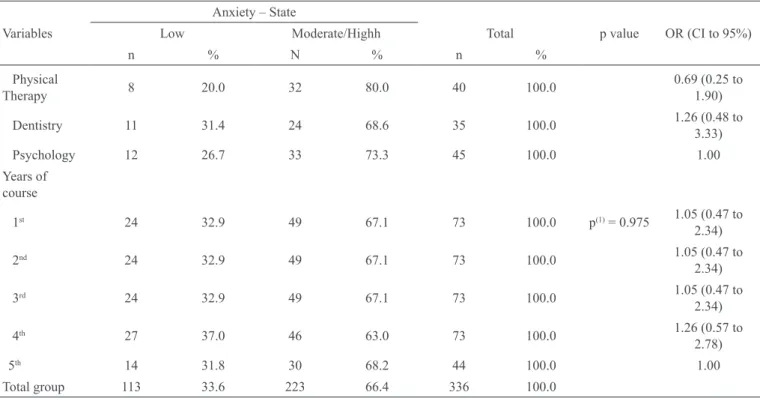
The prevalence of TMD in its different degrees was
es-tablished in 62.5% of students with such condition and 37.5% without it. Among those with TMD, 48.2% had it mild, 11.3% moderate and just 3% had severe TMD. There were statistically signiicant differences between
the prevalence of TMD and the course variable (p < 0.05). According to the attended course, it has been ob-served that Biological Sciences students, daily shift, had the highest prevalence of TMD while Physical Educa-tion had the lowest.
According to table 1, absence of TMD was higher for
males (42.5%), as well as the mildest degree of this dys
-function (51.7%), being not only the moderate degree (15.7%) but also the severe degree (3.3%) signiicantly
higher for females. In addition, it has been observed that the absence of TMD has prevailed among Physical
Education students (55.8%), mild TMD was more fre -quent among Biological Sciences, daily shift, students
(63.9%), while Physical Therapy was the course with the
largest number of students needing treatment (moderate
and severe TMD, with 15% and 7.5%, respectively).
Table 1 – Evaluation of temporomandibular dysfunction degrees.
Variables
Temporomandibular Dysfunction
No TMD Mild Moderate Severe Total p
value
n % N % N % n % N %
Age group
18 to 22 46 33.1 70 50.4 22 15.8 1 0.7 139 100.0 p
(1)
= 0.137
23 to 27 55 39.0 66 46.8 12 8.5 8 5.7 141 100.0
28 to 32 16 40.0 19 47.5 4 10.0 1 2.5 40 100.0
33 to 38 9 56.3 7 43.7 - - - - 16 100.0
Gender
Male 51 42.5 62 51.7 4 3.3 3 2.5 120 100.0 p
(2) =
0.006*
Female 75 34.7 100 46.3 34 15.7 7 3.3 216 100.0
Marital status
Single 113 36.8 152 49.5 35 11.4 7 2.3 307 100.0 p
(1)
= 0.075
Married 13 44.9 10 34.5 3 10.3 3 10.3 29 100.0
Table 2 – Evaluation of the anxiety scale-state according to course and course moment.
Anxiety – State
Variables Low Moderate/Highh Total p value OR (CI to 95%)
n % N % n %
Courses
Biology Day 10 27.8 26 72.2 36 100.0 p
(1) =
0.033*
1.06 (0.40 to 2.83)
Biology
Evening 10 35.7 18 64.3 28 100.0
1.53 (0.55 to 4.22)
Physical
Education 28 53.8 24 46.2 52 100.0
3.21 (1.36 to 7.56)
Nursing 24 36.9 41 63.1 65 100.0 1.61 (0.70 to
3.70)
Pharmacy 10 28.6 25 71.4 35 100.0 1.10 (0.41 to
2.95) Courses
Biology Day 6 16.7 23 63.9 7 19.4 - - 36 100.0 p
(3) =
0.010*
Biology
Evening 12 42.9 11 39.3 3 10.7 2 7.1 28 100.0
Phisical
Education 29 55.8 16 30.8 6 11.5 1 1.9 52 100.0
Nursing 26 40.0 32 49.2 7 10.8 - - 65 100.0
Pharmacy 12 34.3 19 54.3 2 5.7 2 5.7 35 100.0
Physical
Therapy 10 25.0 21 52.5 6 15.0 3 7.5 40 100.0
Dentistry 10 28.6 20 57.1 5 14.3 - - 35 100.0
Psychology 21 46.8 20 44.4 2 4.4 2 4.4 45 100.0
Year of the course
1st 23 31.5 41 56.2 7 9.6 2 2.7 73 100.0 p (3)
= 0.670
2nd 28 38.3 33 45.2 11 15.1 1 1.4 73 100.0
3rd 23 31.5 37 50.7 10 13.7 3 4.1 73 100.0
4th 34 46.6 29 39.7 7 9.6 3 4.1 73 100.0
5th 18 40.9 22 50.0 3 6.8 1 2.3 44 100.0
Total group 126 37.5 162 48.2 38 11.3 10 3.0 336 100.0
* = Signiicant difference at 5.0%; (1) = Fisher’s Exact test; (2) = Pearson’s Chi-square test; (3) = Likelihood test.
Table 1 – continuance
Variables
Temporomandibular Dysfunction
No TMD Mild Moderate Severe Total p
value
continues... Table 3 – Evaluation of anxiety scale-trait according to course and course moment.
Anxiety – Trait
Variables Low Moderate/High Total p value OR (CI to
95%)
n % N % n %
Courses
Biology day 7 19.4 29 80.6 36 100.0 p(1) = 0.838 1.12 (0.36 to
3.44)
Biology
evening 8 28.6 20 71.4 28 100.0
1.85 (0.60 to 5.68)
Physical
education 13 25.0 39 75.0 52 100.0
1.54 (0.57 to 4.15)
Nursing 17 26.2 48 73.8 65 100.0 1.64 (0.64 to
4.21)
Pharmacy 7 20.0 28 80.0 35 100.0 1.16 (0.38 to
3.57)
Physical
therapy 6 15.0 34 85.0 40 100.0
0.82 (0.26 to 2.59)
Dentistry 8 22.9 27 77.1 35 100.0 1.37 (0.46 to
4.11)
Psychology 8 17.8 37 82.2 45 100.0 1.00
Years of course
1st 16 21.9 57 78.1 73 100.0 p(1) = 0.550 1.00
Physical
Therapy 8 20.0 32 80.0 40 100.0
0.69 (0.25 to 1.90)
Dentistry 11 31.4 24 68.6 35 100.0 1.26 (0.48 to
3.33)
Psychology 12 26.7 33 73.3 45 100.0 1.00
Years of course
1st 24 32.9 49 67.1 73 100.0 p(1) = 0.975 1.05 (0.47 to
2.34)
2nd 24 32.9 49 67.1 73 100.0 1.05 (0.47 to
2.34)
3rd 24 32.9 49 67.1 73 100.0 1.05 (0.47 to
2.34)
4th 27 37.0 46 63.0 73 100.0 1.26 (0.57 to
2.78)
5th 14 31.8 30 68.2 44 100.0 1.00
Total group 113 33.6 223 66.4 336 100.0
* = Signiicant difference to 5.0%; (1) = Pearson’s Chi-square test.
Table 2 – continuance
Anxiety – State
Variables Low Moderate/Highh Total p value OR (CI to 95%)
Table 4 – Prevalence of temporomandibular dysfunction according to levels of anxiety.
TMD
Level of
anxiety Yes No Total p value OR (CI to 95%)
N % n % n %
Anxiety-state
Low 61 54.0 52 46.0 113 100.0 p
(1) =
0.022* 1.00
Moderate/
High 149 66.8 74 33.2 223 100.0
1.72 (1.08 to 2.73)
Anxiety-trait
Low 38 51.4 36 48.6 74 100.0 p
(1) =
0.025* 1.00
Moderate/
High 172 65.6 90 34.4 262 100.0
1.81 (1.07 to 3.05)
Total Group 210 62.5 126 37.5 336 100.0
* = Signiicant difference to 5.0%; (1) = Pearson’s Chi-square test.
2nd 13 17.8 60 82.2 73 100.0 0.77 (0.34 to
1.75)
3rd 14 19.2 59 80.8 73 100.0 0.85 (0.38 to
1.89)
4th 21 28.8 52 71.2 73 100.0 1.44 (0.68 to
3.05)
5th 10 22.7 34 77.3 44 100.0 1.05 (0.43 to
2.57)
Total group 74 22.0 262 78.0 336 100.0
(1): Pearson’s Chi-square test.
Table 3 – continuance
Ansiedade – Traço
Variables Baixo Médio/Alto Total Valor de p OR (IC to
95%)
Table 5 – Temporomandibular dysfunction degrees according to the level of anxiety.
DTM
Variables No TMD Mild Moderate Severe Total p value
n % n % n % n % N %
Anxiety-state
Low 52 46.0 52 46.0 8 7.1 1 0.9 113 100.0 p(1) =
0.036*
Moderate/ High
74 33.2 110 49.3 30 13.5 9 4.0 223 100.0
Anxiety-trait
Low 36 48.6 30 40.5 7 9.5 1 1.4 74 100.0 p(1) =
0.163
Moderate/ High
90 34.4 132 50.4 31 11.8 9 3.4 262 100.0
Total Group
126 37.5 162 48.2 38 11.3 10 3.0 336 100.0
(*) = Signiicant difference to 5.0%; (1) = Pearson’s Chi-square test.
DMF Anamnestic Index results have identiied in a
larger percentage the subjective symptom of emotional
stress (61.3%), according to the self-perception of re -spondents as stressed people, followed by nape or neck
pain (47.3%), frequent headache (45.2%), habit of grind
-ing or clench-ing the teeth (36.3%), TMJ noise (35.8%),
lack of a good contact between upper and lower teeth
during mouth closing (32.7%), tiredness or discomfort when chewing (25.3%), earache (23.5%), mouth open
-ing dificulties (14.9%) and dificulty to perform other mandible movements (13.7%).
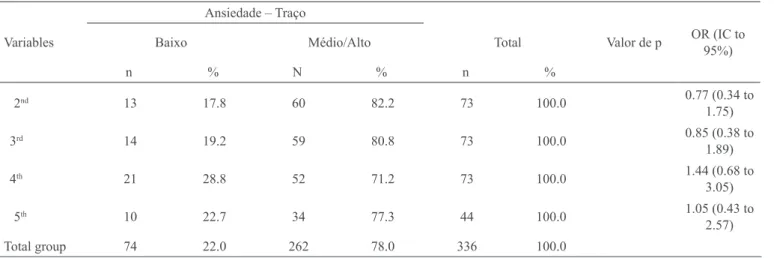
In evaluating different levels of anxiety, it was observed that the anxiety-state index (at the moment of the
re-search) was moderate for 66.1% of students, low for 33.6% and high for 0.3%. According to the anxiety-trait analysis (in general), 77% of students had moderate lev
-els, 22% low levels and 0.3% high levels.
In analyzing the prevalence of levels of anxiety in
differ-ent courses and years, there has only been a signiicant
association between anxiety-state and the course. There
have been no statistically signiicant differences among
remaining variables (Tables 2 and 3).
The relationship between levels of anxiety and TMD
is shown in table 4, where statistically signiicant dif
-ferences were observed among described variables (both anxiety-state index and anxiety trait index). It was observed a higher prevalence of moderate / high level for TMD individuals and of low level for TMD-free individuals.
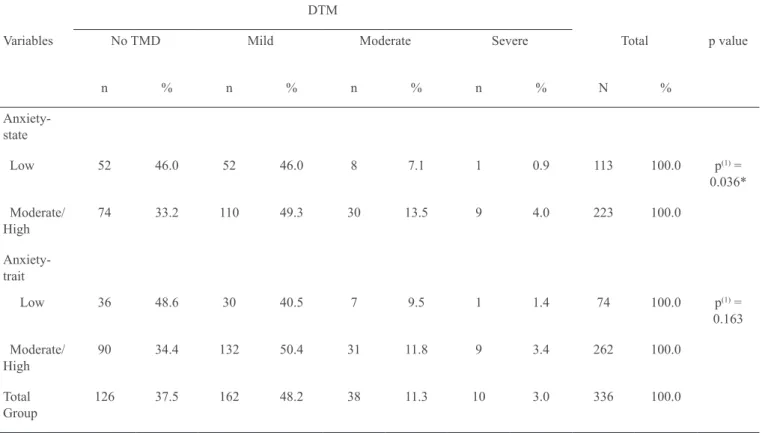
When relating TMD degrees and the levels of anxiety,
it was observed that there has only been signiicant as -sociation between TMD degrees and anxiety-state (p < 0.05), so that moderate / high level was more frequent in mild TMD individuals and the highest percentage differ-ence was seen in the moderate level, as shown in table 5.
DISCUSSION
The identiication of possible TMD signs and symptoms
is a major resource to early diagnose this dysfunction. In this context, the use of indices has been widely spread in the literature, especially when validated, easy to ap-ply and interpret and aiming at standardization for data comparison7-9.
The inluence of stress and anxiety on pressure pain
especially due to the level of performance demands dur-ing this university phase as a fundamental factor for fu-ture professional perspectives14,15.
The prevalence of TMD among college students
estab-lished by this study (62.5%) was similar to a study where 69.23% of the students had TMD signs or symptoms16. There has been agreement in the order of frequency, ac-cording to degrees, but with different percentages, being
most mild (61.33%) followed by moderate (27.08%) and severe (11.28%) degrees.
In a different research17, authors have recorded a lower
TMD incidence among graduation students (53.21%).
They have also stressed a higher prevalence and severity of this disorder among female college students. It has to be stressed, however, that mean age of investigated students in this study was 20 years.
The higher prevalence of TMD among females might be related to gender physiological differences, such as: hormonal variations, lower muscle structure and pain threshold, emphasizing that we still need further investi-gations on the subject18.
With regard to marital status, data of another research19 have stressed that most individuals with TMD were sin-gle with no children, which is in line with our results.
CONCLUSION
Most students investigated had TMD in its different de-grees, with a decreasing frequency among mild, moder-ate and severe degrees. Among them, Physical Therapy
students had signiicantly higher need for TMD treat -ment and higher levels of anxiety.
REFERENCES
1. Al-Ani Z, Gray R. TMD current concepts: 1. An update. Dent Update 2007;34(6):278-88.
2. Barbería E, Fernández-Frías C, Suárez-Clúa C, et al. Analysis of anxiety variables in dental students. Int Dent J. 2004;54(6):445-9.
3. Barbosa TS, Miyakoda LS, Pocztaruk RL, et al. Tem-poromandibular disorders and bruxism in childhood and adolescence: review of the literature. Int J Pediatr Otorhi-nolarynol. 2008;73(3):299-314.
4. Cestari K, Camparis CM. Fatores psicológicos: sua im-portância no diagnóstico das desordens temporomandibulares. J Bras Oclusão, ATM & Dor Orofacial. 2002;2(5):54-60. 5. Fernandes AUR, Garcia AR, Zuim PRJ, et al. Desordem temporomandibular e ansiedade em graduandos de odonto-logia. Ciênc Odontol Bras. 2007;10(1):70-7.
psicológicos relacionados à sintomatologia crônica das de-sordens temporomandibulares – revisão de literatura. RFO UPF. 2009;14(3):262-7.
7. Fonseca DM, Bonfante G, Valle AL, et al. Diagnós-tico pela anamnese da disfunção craniomandibular. RGO. 1994;42(1):23-8.
8. Feteih RM. Signs and symptoms of temporomandibu-lar disorders and oral parafunctions in urban Saudi Arabian adolescents: a research report. Head Face Med. 2006;2:25. 9. Ichesco E, Quintero A, Clauw DJ, et al. Altered func-tional connectivity between the insula and the cingulated cortex in patients with temporomandibular disorder: a pilot study. Headache. 2012;52(3):441-54.
10. Jesus LA, Martins MD, Andrade DV, et al. Estudo transversal da prevalência de disfunção temporomandibu-lar e bruxismo em estudantes universitários. Terap Man. 2009;7(29):11-4.
11. Nomura K, Vitri M, Oliveira AS, et al. Use the Fon-seca’s questionnaire to assess the prevalence and severity of temporomandibular disorders in brazilian dental under-graduates. Braz Dent J. 2007;18(2):163-7.
12. Okeson JP. Joint intracapsular disorders: diagnostic and nonsurgical management considerations. Dent Clin North. 2007;51(1):85-103.
13. de Oliveira AS, Dias EM, Contato RG, et al. Prevalence study of temporomandibular disorder in Brazilian college students. Braz Oral Res. 2006;20(1):3-7.
14. Pedroni CR, Oliveira SD, Guaratini MI. Prevalence study of temporomandibular disorders in university stu-dents. J Oral Rehabil. 2003;30(3):283-9.
15. Pimentel PHWG, Miranda Coelho Júnior LGTde,
Cal-das Júnior AF, et al. Peril demográico dos pacientes aten -didos no Centro de Controle da Dor Orofacial da Faculdade de Odontologia de Pernambuco. Rev Cir Traumatol Buco-Maxilo-Fac. 2008;8(2):69-76.
16. Spielberger CD. State-trait anxiety inventory: a com-prehensive bibliography. 2nd ed. Florida: Consulting Psy-chologists Press; 1989.
17. Tjakkes GH, Reinders JJ, Tenvergert EM, et al. TMD pain: the effect on health related quality of life and the
inluence of pain duration. Health Qual Life Outcomes.
2010;8:46.
18. Vedolin GM, Lobato VV, Conti PC, et al. The impact of stress and anxiety on the pressure pain threshold of myofas-cial pain patients. J Oral Rehabil. 2009;36(5):313-2. 19. Venancio RA, Camparis CM. Estudo da relação entre fatores psicossociais e desordens têmporo-mandibulares. Rev Bras Odont. 2002;59(3):152-5.