Bariatric surgery: is admission to the intensive care
unit necessary?
Cirurgia bariátrica: existe necessidade de internação em unidade
de terapia intensiva?
INTRODUCTION
Worldwide over a million people are overweight or obese(1) and of late this
pathology has reached epidemic proportions.(2,3)
Treatment of obesity with improvement in the way of life and quality of the diet, as well as treatment with drugs often are disappointing and with recurrence. In such cases surgical treatment is required and bariatric surgery has been increasingly used in the last years.(2,4,5)
Although, in general, primary bariatric surgery is well tolerated, its asso-ciation with postoperative complication is well known, occasionally requiring
elective or emergency intensive care(2,5,6-8) In literature, few studies describe
management of the obese patient in the intensive care unit (ICU). Obesity was not included in the predictive variables of clinical outcome in the prog-nostic indices, Acute Physiological and Chronic Heatlh Evaluation II and III
(APACHE II and III) or Simpliied Acute Physiology Score (SAPS).(7)
Saulo Maia D’Avila Melo1,
Fernando Antônio Rabelo de Vasconcelos2, Valdinaldo Aragão
de Melo3, Fábio Almeida Santos4,
Raimundo Sotero de Menezes Filho5, Bárbara Santana D’Avila
Melo6
1. Master, Physician from the Intensive Care Unit, Hospital Universitário da Universidade Federal de Sergipe – UFS - Aracaju (SE), Brazil.
2. Physician Intensive Care Unit, Hospital de Urgência de Sergipe da Universidade Federal de Sergipe – UFS - Aracaju (SE), Brazil.
3. PhD Adjunct Professor from the Medicine Department, Universidade Federal de Sergipe - UFS - Aracaju (SE), Brazil.
4. Physician form the Integrated Service of Gastroenterology and Obesidity from Hospital São Lucas - Aracaju (SE), Brazil.
5. Physician from the Centro de Diabetes de Sergipe – Aracaju (SE), Brazil.
6. Medical Student at the Centro Universitário Serra dos Órgãos – Teresópolis (RJ), Brazil.
ABSTRACT
Objective: he purpose of this study was to determine the place of stay at postoperative and to verify medical-surgical complications that would justi-fy admission to the intensive care unit, including death.
Methods: Cross-over, prospective, open study that evaluated 120 patients who were submitted to primary bariat-ric surgery by video laparoscopy from May 2007 to April 2008 in a tertiary hospital. he Aldrete Kroulik index was used for release from the post-anesthe-sia recovery room and to deine where the patient should be routinely referred for postoperative.
Results: Among the 120 patients, 83 were women and 37 men with a mean age ranging from 35.4 ± 10.5 years (18 to 66 years), body mass in-dex 45.6 ± 10.5. The time between
hospital admission and start of gery was 140.7 ± 81.8 minutes, sur-gery time was 105 ± 28.6 minutes, time of post-anesthesia recovery room was between 125 ± 38 minutes and length of hospital stay was 47.7 ± 12.4 hours, with 100% of the patients walking in 24 hours. The Aldrete and Kroulik index in the post-anesthesia recovery room achieved scores of 10 to 120 minutes in all patients, with a 100% survival.
Conclusion: Using the Aldrete and Kroulik index in the post-anesthesia of gastric bypass by video laparoscopy in primary bariatric surgery, no patient was admitted in intensive care unit and no major complication was observed.
Keywords: Bariatric surgery; Gastro-plasty; Obesity/surgery; Obesity, morbid/ surgery; Postoperative care / Postoperative period
Received from Hospital São Lucas and Universidade Federal de Sergipe - UFS - Aracaju (SE), Brazil.
Submitted on October 12, 2008 Accepted on June 17, 2009
Author for correspondence:
Saulo Maia D’Avila Melo
Rua José Olívio do Nascimento, 82 - Ed. Parque da Sementeira - Apt. 201 - Bairro Jardins
CEP: 49025-730 –Aracaju (SE), Brazil. Phone: (79) 9971-3316 / 3214-3593 (telefax ) an 3214-3491
Studies reporting indications for admission to ICU at postoperative of bariatric surgery and its prevalence are scarce. here is no standardized algorithm for elec-tive admission to the ICU or semi-intensive unit at bariatric postoperative. he decision is based on discus-sion among the assisting medical team according to the patient’s respiratory restrictions or some surgical com-plication.(2,9)
Stay in the ICU increases hospital costs,(2) further,
indication for admission in the ICU should be carefully considered, as the number of ICU beds is small for the great demand in public and private services.
A cross over study was carried out to determine the place of referral at postoperative of primary bariatric surgery, assessing the clinical-surgical complications that would justify admission in a semi-intensive care unit and/ or ICU healthcare professionals involved, time of surgery, length of stay in the recovery room at post-anesthesia (PARR) , early walking time at postop-erative, length of hospital stay and mortality.
METHODS
he survey was irst approved by the Research with
Human Beings Ethics Committee of the Universidade Federal de Sergipe/UFS (CAAE-0050.0.107.000-07 as the hospital does not have a Research Ethics Commit-tee. Patients signed an informed term of consent.
he survey was carried out at Hospital São Lucas, Aracaju-SE, Brazil. It is a tertiary, private hospital with 180 beds and 12 ICU beds. Study design was cross sec-tional, prospective, open and included patients referred and submitted to primary bariatric surgery performed by the Comprehensive Gastroentherology and Obesity Service (GOS) between May 2007 and April 2008. Indi-cation of sugery for treatment of obesity and the herein deinitions used follow the World Health Organization and Health Ministry criteria: body mass index (BMI)
above 40 kg/m2 or BMI above 35 kg/m2 associated with
comorbidities of diicult clinical control such as: sleep apnea, diabetes mellitus type 2, arterial hypertension, dyslipidemia, diiculty in walking, coronary disease, lower limbs venous our lymphatic obstruction, pulmo-nary hypotension and obesety cardiomyopathy. Persons under 18 years of age and patients who did not want to participate in the survey were excluded. All patients were previously assessed and released as outpatients for primary bariatric surgery by the surgery team (surgeon and anesthetist) and endocrinologist with some pa-tients assessed by specialists (cardiologist, lung
special-ist, etc.) when necessary. Nutrition and psychology ser-vices of GOS carried out preparation and orientation of the pre- and postoperative for all patients. Bearers
of BMI≥ 60 kg/m2 were oriented to lose at least 5% of
their weight before surgery. Diet with calorie restric-tions on the days before surgery and liquid diet during three days prior to surgery was given to all patients. he time between hospital admission, onset of surgery (induction, anesthesia) time of surgery and time of stay in the PARR were established in minutes, while time of hospital stay was established in hours.
Midazolam, 15 mg orally was given as pre-anesthe-sia medication in the bed on admission to the surgery room, minutes before surgery. Surgical anesthetic risk
was established by the American Society of
Anesthesiolo-gists (ASA) with a I to V classiication. Peripheral venous access was the elected administration route. Continu-ous monitoring comprised electrocardiography, non invasive arterial pressure, pulse oximetry, body temature, capnometry and capnography. Surgery was per-formed under general anesthesia, using for induction fentanyl 0.1 to 0.2 mcg / kg, a single dose of clonidine 1 to 2 mg / kg and propofol 5 mcg / ml of blood con-centration by infusion pump and for maintenance of anesthesia propofol 2 to 3 mcg / ml of blood concen-tration and fentanyl 0.1 to 0.2 mcg / kg every hour, if necessary. Cisatracurium 0.01 to 0.02 mg / Kg / hour was used for muscle relaxation. Morphine sulphate 10 mg intramuscular and ondansetron 4mg venous were administered at the end of surgery.
During surgery, patients were positioned in dorsal, horizontal decubitus and secured on the table by a strap at hip level. At onset of the surgery, patients were po-sitioned with the head at a 30° slope until end of the surgery. Surgical procedure was performed by video laparoscopy using the gastric bypass technique.
Antimicrobial prophylaxis was performed with a single dose of intravenous ampicillin associated to sul-bactram (3 g) and for venous tromboembolism prophy-laxis (40mg) of subcutaneous enoxaparina was used and begun in the daycare service, one day before surgery and another dose (40mg) at anesthesia induction. Enox-aparina 40mg subcutaneous daily was maintained dur-ing hospital stay and at home after hospital discharge
until the 15th day, for 15 days total time of
often after discharge were standardized.
Anesthesia was discontinued at the time of pneu-moperitoneum disinsulation and skin suture. Tracheal extubation was carried out in the surgery room with the patient awake, with coughing relex present and cap-nography and pulse oximetry parameters within nor-mality.
Next, the patient was forwarded to PARR with follow-up of the anesthesia team and monitoring with continued electrocardiography, non invasive arterial pressure and pulse oximetry. Upon admission to PARR and every 30, 60, 120 and 180 minutes, Aldrete e
Kroulik(10) measurements were taken (Chart 1).
Venti-latory support was established using low and /or high low oxygen therapy, non invasive mechanical ventila-tion and invasive mechanical ventilaventila-tion. Length of stay in PARR was veriied in minutes.
Chart 1 - Aldrete and Kroulik Index
Assessment items Condition Grade Muscle activity moves 4 extremities 2
moves 2 extremities 1 moves 0 extremities 0
Breathing deep, copugh 2
Limited, dyspnea 1
apnea 0
Consciousness fully awake 2
Awakens when called 1 Does not respond to call 0 Circulation (AP) ± 20 % of pre-anesthesia level 2
± 20 % to 49 % of pre-anesthe-sia level
1
± 50 % of pre-anesthesia level 0 SpO2 maintains SpO2 > 92% in
am-bient air
2
maintains SpO2 > 90% with O2 1 maintains SpO2 < 90% with O2 0
SpO2 – peripheral oxygen saturation; AP – arterial pressure.
Patients were released from PARR when the Aldrete
and Kroulik) index reached a total of 10 points (scale
from 0 to 10). After discharge from PARR, monitor-ing of vital signs (non invasive arterial pressure, body temperature, heart and respiratory rates) was measured at the place of stay upon patient’s arrival and every 6 hours.
Postoperative prescription was standardized with venous hydration, 1 g intravenous (iv) dipyrone ev-ery 6 hours, non-steroid hormone anti- inlammatory (Parecoxib) 40mg iv per day, ondanstron 4mg iv every
8 hours, pantopropazol 40 mg iv per day and iprat-ropium bromide by aerosol 0.250 mg every six hours. Nalbuphine hydrochloride 20mg IV was used in case of no pain relief with standardized drugs.
Hypertensive patients, with pneumopathy and diabetes were controlled with protocols prescribed in daycare by their physicians during pre-operative assess-ment. Liquid diet was released in the irst 24 hours of postoperative. Respiratory and motor physiotherapy were carried out twice a day.
Time period from onset of early walking after sur-gery was assessed and deined by the healthcare pro-fessional that made one or more visits during patients stay. Veriication was made of the clinical and/or sur-gical complications at intra and postoperative and re-operation that would justify admission to
semi-inten-sive units or ICU, that occurred until the 30th day of
surgery. Patients were discharged, as soon as they had abdominal function and accepted the prescribed diet. hey accomplished their time of post surgery recovery at home and follow-up in the daycare with fortnightly
visit s until the 30th postoperative day.
Statistical analysis of obtained data was stored in a standardized database using the software Excel, version 2003, transferred to the program Statistical Package for Social Sciences (SPSS), version 13 and analyzed, Quan-titative variables were described in mean and standard deviation an the categorical by simple and relative fre-quencies.
RESULTS
he sample studied comprised 120 patients, 83
women and 37 men, with a mean age of 35.4 ± 10.5
years (18 to 66 years), with 12.5% (15) over 50 years of age. he mean BMI was of 45.6 ± 5.1 (35 to 67). he group of grade III obese was 88.4% (106) with 1.6% (2) patients with a BMI ≥ 60 Kg / m². Comorbidi-ties were found in 85.83 % (103), with 16.0% (19) of patients with one comorbidity, 25.0 % (30) with two and 44.4% (54) patients with three or more
comor-bidities.Among comorbidities 51.2% (61) were bearers
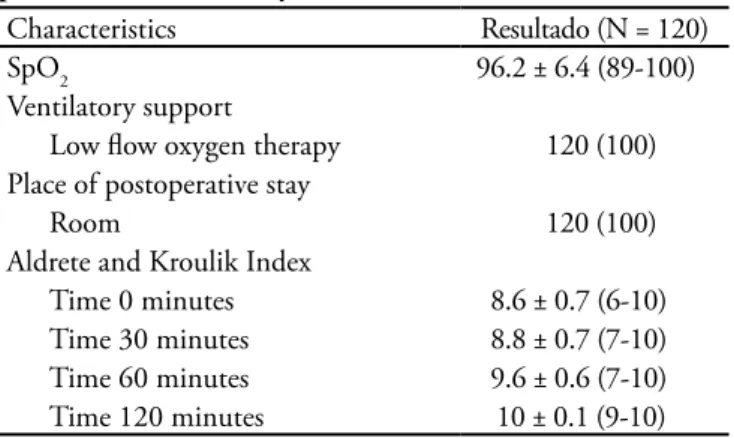
Primary bariatric surgery by videolaparoscopy with the gastric bypass technique was performed in 100% (120) of the patients. Table 2 summarized mean time between hospital admission and onset of surgery, time of surgery, length of stay in PARR and time of walk-ing after surgery. Table 3 summarizes peripheral oxygen saturation (SpO2), ventilation support and the Aldrete and Kroulik index in PARR. In PARR, 100% of
pa-Table 3 – Characteristics of peripheral oxygen saturation, ventilatory support and Aldrete and Kroulik index in the post-anesthesia recovery room
Characteristics Resultado (N = 120)
SpO2 96.2 ± 6.4 (89-100)
Ventilatory support
Low low oxygen therapy 120 (100) Place of postoperative stay
Room 120 (100)
Aldrete and Kroulik Index
Time 0 minutes 8.6 ± 0.7 (6-10) Time 30 minutes 8.8 ± 0.7 (7-10) Time 60 minutes 9.6 ± 0.6 (7-10) Time 120 minutes 10 ± 0.1 (9-10)
SpO2 – peripheral oxygen saturation; PARR- post-anesthesia recovery room Values expressed in mean ± standard deviation (minimum and maximum) or number of cases (%).
Table 1 – Demographic, anthropometric characteristics aracterísticas demográficas, antropométricas, comorbidity and American Society of Anesthesiologists
Characteristics Result (N =120)
Age (years) 35.4 ± 10.5 (18 – 66) Gender
Male 37 (30.8)
Female 83 (69.2)
Obesity grade
Grade III 106 (88.4)
Grade II 14 (11.6)
BMI 45.6 ± 5.1 (35- 67)
Comorbidity 103 (85.83)
Hypertense 61 (51.2)
Hepatic steatosis 54 (45.0)
Arthropathy 18 (15.0)
Diabetics 13 (11.3)
OSAS 9 (7.5)
Others* 16 (13.33)
ASA
ASA II 67 (55.8)
ASA III 53 (44.2)
BMI: Body Mass Index; OSAS – Obstructive sleep apnea syndrome; ASA - American Society of Anesthesiologists. *Others – dyslipidemia, gastroesophageal relux disease, asthma, anxiety, depression and hypo-thyroidism. Values expressed in mean ± standard deviation (minimum and maximum) or number of cases (%).
Table 2 – Characteristics of times of admission-surgery, surgery, post-anesthesia recovery room, hospital and early walking
Characteristics Results (N = 120) Time between admission and onset
of surgery (minutes)
140.7 ± 81.8 (45.5–184)
Time of surgery (minutes) 105 ± 28.6 (80–120) Time in the PARR (minutes) 125 ± 38 (68–150) Time of hospital stay (hours) 47.7 ± 12.4 (43–48) Time of walking after surgery
Up to 12 hours 47 (39.2)
Up to 24 hours 120 (100)
PARR - post-anesthesia recovery room. Values expressed in mean ± stan-dard deviation (minimum and maximum) or number of cases (%).
tients received low low oxygen therapy (≤ 5 liters /min-ute) with mean SpO2 by pulse oximetry of 95.5 ± 2.9%
(89 to 100). None of the patients required invasive or
not invasive mechanical ventilation in PARR. Oxygen therapy was withdrawn after 120 minutes when
main-tenance of SpO2 ≥ 92% was observed. Aldrete and
Kroulik index with a total score of 10 points and clini-cal stability of patients by monitoring of vital signs and clinical reassessment by the anesthetist was checked. Considering these parameters, patients were moved to their room with stable clinical parameters.
he healthcare professionals who followed-up post-operative were the physiotherapist with one or more visits in 100% of cases, with two sessions per day , psy-chologists in 40% (48) and nutritionist in 10.8% (13). Physiotherapists performed respiratory, motor physio-therapy, encouraged and assisted in walking to all pa-tients, in the room and corridors of the wing. Only four patients, 3.33% (4) requested presence of the on duty clinical physician for simple events such as abdominal distension, abdominal pain and sleeping troubles. Only one patient in PARR who had already used non inva-sive ventilation (NIV) at home, had it in the room un-der guidance of the physiotherapy service.
No clinical or surgical complications were found at
intra and postoperative until the 30th day, that would
justify admission in the ICU for any of the patients. Oxygen therapy was not used nor pulse oximetry in the room. Physiotherapy service measured pulse oxymetry
during the two daily sessions, and SpO2 below 92 %
capable, with 100% of them walking in the irst 24 hours, of these 39.2% (47) walked in the irst 12 hours in the room.
DISCUSSION
he signiicant growth of the obese population, even
in developed countries(11) led to an increase of hospital
admissions due to obese related pathology in
semi-in-tensive care and ICU.(5) Estimated prevalence of obesity
in ICU rests upon the studied population ranging from 5.4% in trauma ICU, 17.1% at heart surgery
postop-erative and about 25% in clinical or surgical ICU.(12)
Because of the growing number of indications and performance of bariatric surgeries, more obese patients
are being admitted ton the ICU.(5) Sometimes,
compli-cations at the intra and postoperative of primary bariat-ric surgery or even presence of severe comorbidities may
require intensive care, elective or emergency,(2) however
there are few studies establishing prevalence or cause of indication for admission to the ICU at postoperative of bariatric surgery.(5)
Currently, place of stay in the irst 48 hours of post-operative of bartiatic surgery remains controversial in literature and the decision to admit to the ICU relies upon discussion and good sense of the assisting medical team according to the clinical limitation of the patient
or even because of some surgical complication.(2,9 )
Among factors predisposing to admission in the ICU are mentioned: male gender, age ≥ 50 years BMI ≥ 60 Kg/m², diabetes mellitus, OSAS, cardiopathies, venous diiculty and complications in the intra or immediate
postoperative(5,9) mainly due to respiratory
complica-tions such as pneumonia, thromboembolic disease, re-spiratory failure requiring mechanical ventilation and to a lesser extent, respiratory arrest.(2,9,13 )
Postoperative complications and stay in the ICU
in-crease hospital costs.(2) he opposite is also true, fewer
complications reduce hospital stay and therefore lessen hospital costs.(14)
Some studies reported a range of 5 to 24% of pa-tients submitted to bariatric surgery who required ICU for more than 24 hours.(2,9,13,15,16)
Bariatric surgery by videolaparoscopy showed better results when compared to open surgery, with shorter length of stay in PARR and hospital in addition to less time with venous catheter, with a statistical signiicance.
(14) All our patients were operated by videolaparoscopy.
Mean time of surgery in our study was 105.0 ± 28.6 minutes, compatible with literature, with a mean time
of 120 minutes(17,18) and our length of hospital stay was
only 47.7 ± 12.4 hours, much shorter than that in lit-erature , which ranged from an average of 2.3 to 10 days.(18,19)
he Aldrete and Kroulik(10) index used as a routine by
anesthetists at immediate postoperative reached a total score of 10 points in all our patients after 120 minutes in PARR, allowing release of all patents to the room
in the wing. he Aldrete and Kroulik(10) index analyzes
ive items whose replies are scored from zero to two. A total of eight to ten points in the Aldrete and Kroulik index permits safe discharge of patients from PARR to the ward (Chart 1).
During the irst 24 hours of postoperative major complications take place, requiring closer attention to monitoring of the clinical parameters. In the room, vital signs of our patients remained stable, and the standard-ized medical prescribed by the surgical team for post-operative was maintained, with monitoring performed properly by the nursing team.
Obesity is the most important isolated risk factor
for thromboembolitic disease.(5,20) Prevalence of
pulmo-nary thromboembolism (PTE) in bariatric surgery is low, from 0 to 4.78% according to the used prophy-laxis,(2,5,16,19) however, it is the most common cause of
death at the postoperative and an independent factor
of mortality in bariatric surgery.(5)
Review of literature reports that more than 95% of papers presented cite some prophylaxis for the throm-boembolitic disease at postoperative of bariatric surgery, by means of early walking, use of elastic stockings, air
bags and low molecular weight heparin (LMWH).(5)
At postoperative, obese present diicult early mobili-zation. Immobility increases risk of adverse thromboem-bolitic events, especially in surgeries of the upper abdo-men.(14) On the other hand, early walking reduces the
risk of pulmonary thromboembolism and other respira-tory problems at postoperative afording and improving lung expansion, minimizing and reverting actelectasias
formed by the prolonged decubitus in the bed.(5)
Patients in the ICU, even if their clinical conditions allow, have diiculty with early walking, due to limita-tion of the physical space in most of these units, lack of standardization and encouragement by the healthcare professional working there.
ate-lactasias, decreases lung expansion and intestinal peri-stalsis, also diiculties for performance of physiological activities (urinate and defecate) in addition to afecting self–esteem. he physiotherapy service has an impor-tant participation in the early walking of our patients, contributing to avert these complications.
Our patients walked early, with 100% of cases walk-ing in the irst 24 hours and of these 39.2% (47) in the irst 12 hours (Table 2). It is noteworthy that early walk-ing is the main goal to prevent thromboembolitic dis-ease. No data were found in literature on how long, after bariatric surgery, these patients began walking and it is cited and advised that walking starts as soon as possible.
Time from hospital admission to onset of surgery of our patients was very short 140.7 ± 81.8 minutes, and also on this subject no data were found in literature. Carrying out early surgery, soon after admission is a conduct that avoids these obese resting in bed to aid prophylaxis for thromboembolitic disease.
Mortality rates at postoperative of bariatric surgery
are variable, ranging from 0 to 2.9%(2,6,14) and is more
prevalent in bearers of PTE, patients admitted to the
ICU and those requiring reoperation.(12,19,21)
In our survey there was no mortality, nor any event of thromboembolism, furthermore, no admission to the ICU. Only one patient required reoperation and was admitted to a room; other simple surgical compli-cations (seromas, hematomas, partial dehiscence of the suture, phlebitis) were controlled at daycare level. In our casuistry, use of a prophylaxis protocol for preven-tion of thromboembolitic disease (not pharmacological and pharmacological) and of other respiratory compli-cations was essential for absence of mortality.
Participation of the multidisciplinary team carrying out a careful preoperative at daycare level associated to good working conditions in the institution, ensured successful hospital treatment of these patients in the rooms and may have contributed to a signiicant de-crease of length of hospital stay and therefore, dede-crease of hospital costs.
CONCLUSION
By using the Aldrete and Kroulik index in PARR of gastric bypass by videolaparoscopy in primary bariatric surgery, none of the patients was admitted to the ICU and no major complication was observed.
RESUMO
Objetivos: Determinar o local de internação no pós-operatório de cirurgia bariátrica primária e veriicar as com-plicações clínicas-cirúrgicas que justiicassem internação em unidade de terapia intensiva, inclusive morte.
Métodos: Estudo transversal, prospectivo, aberto, sendo avaliados 120 pacientes submetidos à cirurgia bariátrica pri-mária por vídeolaparoscopia no período de maio de 2007 a abril de 2008 em um hospital terciário. Utilizou-se o índice de Aldrete e Kroulik para liberação da sala de recuperação pós-anestésica e deinição do local de encaminhamento no pós-operatório.
Resultados: Entre os 120 pacientes, havia 83 mulheres e 37 homens, com média de idade 35,4 ± 10,5 anos (18 a 66 anos), índice de massa corpórea médio 45,6 ± 10,5. O tempo entre admissão hospitalar e inicio da cirurgia foi de 140,7 ± 81,8 minutos, o tempo cirúrgico 105,0 ± 28,6 mi-nutos, o tempo de permanência na sala de recuperação pós-anestésica foi 125,0 ± 38,0 minutos e tempo de internação hospitalar 47,7 ± 12,4 horas, com 100% dos pacientes de-ambulando em 24 horas. O índice de Aldrete e Kroulik da sala de recuperação pós-anestésica alcançou pontuação de 10 com 120 minutos em todos os pacientes, com sobrevida de 100%.
Conclusão: Com o uso do índice Aldrete e Kroulik na sala de recuperação pós-anestésica de bypass gástrico por videolaparoscopia em cirurgia bariátrica primária, nenhum paciente foi internado em unidade de terapia intensiva e ne-nhuma complicação maior foi observada.
Descritores: Cirurgia bariátrica; Gastroplastia; Obesi-dade/cirurgia; Obesidade mórbida/cirurgia; Cuidados pós-operatórios; Período pós-operatório
REFERENCES
1. Poulain M, Doucet M, Major GC, Drapeau V, Sériès F, Boulet LP, et al. he efect of obesity on chronic respi-ratory diseases: pathophysiology and therapeutic strate-gies. CMAJ. 2006;174(9):1293-9. Comment in: CMAJ. 2007;176(8):1130.
2. Cendán JC, Abu-aouf D, Gabrielli A, Caruso LJ, Rout WR, Hocking MP, Layon AJ. Utilization of intensive care resour-ces in bariatric surgery. Obes Surg. 2005;15(9):1247-51. 3. American Heart Association Nutrition Committee,
Nutrition Committee. Circulation. 2006;114(1):82-96. Erratum in: Circulation. 2006;114(23):e629. Circulation. 2006;114(1):e27.
4. Snow V, Barry P, Fitterman N, Qaseem A, Weiss K; Cli-nical Eicacy Assessment Subcommittee of the American College of Physicians. Pharmacologic and surgical mana-gement of obesity in primary care: a clinical practice guide-line from the American College of Physicans. Ann Intern Med. 2005;142(7): 525-31.
5. Pieracci FM, Barie PS, Pomp A. Critical care of the baria-tric patient. 2006;34(6):1796-804.
6. Trus TL, Pope GD, Finlayson SR. National trends in uti-lization and outcomes of bariatric surgery. Surg Endosc. 2005;19(5):616-20.
7. Varon J, Marik P. Management of the obese critically ill patient. Crit Care Clin. 2001;17(1):187-200.
8. Ray DE, Matchett SC, Backer K, Wasser T, Young MJ. he efect of body mass index on patient outcomes in a medical ICU. Chest. 2005;127(6):2125-31.
9. Helling TS, Willoughby TL, Maxield DM, Ryan P. De-terminants of the need for intensive care and prolonged mechanical ventilation in patients undergoing bariatric surgery. Obes Surg. 2004;14(8):1036-41.
10. Aldrete JA. A post-anesthesia recovery score revisited. J Clin Anesth. 1995;7(1):89-91.
11. Poirier P, Giles TD, Bray GA, Hong Y, Stern JS, Pi-Sunyer FX, Eckel RH. Obesity and cardiovascular disease: patho-physiology, evaluation, and efect of weight loss. Arterios-cler hromb Vasc Biol. 2006;26(5):968-76. Review. 12. Jofe A, Wood K. Obesity in critical care. Curr Opin
Anaesthesiol. 2007;20(2):113-8.
13. Poulose BK, Griin MR, Zhu Y, Smalley W, Richards WO, Wright JK, et al. National analysis of adverse patient safety
events in bariatric surgery. Am Surg. 2005;71(5):406-13. 14. Juvin P, Marmuse JP, Delerme S, Lecomte P, Mantz J,
Demetriou M, Desmonts JM. Post-operative course after conventional or laparoscopic gastroplasty in morbidly obe-se patients. Eur J Anaesthesiol. 1999;16(6):400-3. 15. Nguyen NT, Goldman C, Rosenquist CJ, Arango A, Cole
CJ, Lee SJ, Wolfe BM. Laparoscopic versus open gastric bypass: a randomized study of outcomes, quality of life, and costs. Ann Surg. 2001;234(3):279-89; discussion 289-91. 16. Livingston EH, Huerta S, Arthur D, Lee S, De Shields S,
Heber D. Male gender is a predictor for morbidity and age a predictor of mortality for patients undergoing gastric bypass surgery. Ann Surg. 2002;236(5):576-82.
17. Doolen JL, Miller SK. Primary care management of pa-tients following bariatric surgery. J Am Acad Nurse Pract. 2005;17(11):446-50.
18. Kalfarentzos F, Stavropoulou F, Yarmenitis S, Kehagias I, Karamesini M, Dimitrakopoulos A, Maniati A. Prophyla-xis of venous thromboembolism using two diferent doses of low-molecular-weight heparin (nadroparin) in baria-tric surgery: a prospective randomized trial. Obes Surg. 2001;11(6):670-6.
19. Hamad GG, Choban PS. Enoxaparin for thrombopro-phylaxis in morbidly obese patients undergoing bariatric surgery: indings of the prophylaxis against VTE outcomes in bariatric surgery patients receiving enoxaparin (PRO-BE) study. Obes Surg. 2005;15(10):1368-74.
20. Koenig SM. Pulmonary complications of obesity. Am J Med Sci. 2001;321(4):249-79.