130
Revista da Sociedade Brasileira de Medicina Tropical 45(1):130-131, jan-fev, 2012
1.Departamento de Cirurgia Pediátrica, Santa Casa de Franca, Franca, SP. Address to: Dr. Robson Azevedo Dutra. Av. Lázaro de Souza Campos 990, 14401-295 Franca, SP, Brasil.
Phone: 55 16 3711-4000
e-mail: [email protected] Received in 26/03/2011
Accepted in 20/10/2011
Case Report/Relato de Caso
INTRODUCTION
CASE REPORT
Splenectomy in
a patient with treatment-resistant
visceral leishmaniasis:
a case report
A esplenectomia na leishmaniose visceral refratária ao tratamento clínico: relato de caso
Robson Azevedo Dutra
1, Laura Ferreira Dutra
1, Milene de Oliveira Reis
1and Raul Coelho Lambert
1ABSTACT
Visceral leishmaniasis (VL), also known as Kala-azar, is a systemic infection caused by a protozoan (Leishmania) and, in its classic form, is a serious illness associated with malnutrition, anemia, hepatosplenomegaly, infectious processes and coagulopathies. he efect of splenectomy in patients with visceral leishmaniasis is not well deined; however, it is known that the spleen is the largest reservoir of infected cells belonging to the reticulo endothelial system. herefore, the surgical procedure is an option for the debulking of parasites, providing a cure for refractory VL and minimizing the complications of hypersplenism.
Keywords: Splenectomy. Leishmaniasis. Hypersplenism.
RESUMO
A leishmaniose visceral (LV) ou calazar é uma infecção sistêmica causada por um protozoário (Leishmania) e na sua forma clássica é uma doença grave. Cursa com desnutrição, anemia, hepatoesplenomegalia, processos infecciosos e coagulopatias. O papel da esplenectomia em pacientes com leishmaniose visceral não é bem deinido; entretanto, sabe-se que o baço é o maior reservatório de células parasitadas do sistema reticulo endotelial e o procedimento cirúrgico é, dessa forma, uma opção para debulking de parasitas, propiciando a cura da LV refratária e minimizando as complicações do hiperesplenismo.
Palavras-chaves: Esplenectomia. Leishmaniose. Hiperesplenismo.
Visceral leishmaniasis (VL), also known as Kala-azar, is a systemic infection caused by a protozoan of the family Trypanosomatidae, genus Leishmania, which has two forms: a flagellated form or promastigote, found in the digestive tract of the insect vector, and a nonlagellated form or amastigote, which is an obligate intracellular form that is found in the cells of the mononuclear phagocytic system of the vertebrate host. he primary vector is Lutzomyia, for which the dog is the reservoir and humans are the inal host. Visceral leishmaniasis is one of the six most important endemic diseases in the world, given its incidence and high mortality rates in untreated individuals, malnourished children and HIV-positive individuals. he disease exists in all continents except Australia and Antarctica1.
Visceral leishmaniasis has been documented in all regions of Brazil except the southern region. he disease occurs in rural and urban areas of Cities such as Rio de Janeiro/RJ, Belo Horizonte/ MG, Araçatuba/SP, and Corumbá/MS. Currently in Brazil, VL is
registered in 19 of 27 states2. he classic symptoms consist of fever,
sweating, adynamia, hepatosplenomegaly, malnutrition, cough, diarrhea, abdominal pain and distention, edema and ascites3. he
diagnosis is based on the presence of the parasite in the bone marrow, spleen, liver, or lymph nodes. Several tests have been developed for the serologic diagnosis of VL, including molecular biology techniques4. Meglumine antimoniate remains the irst-choice drug for
treatment, and amphotericin B is the second-line drug used in cases of meglumine antimoniate resistance5,6. he efect of splenectomy on
VL is unknown. he importance of splenectomy has been described in the treatment of VL vases refractory to medical treatment, with relative success7. his case report aims to demonstrate that in certain
circumstances splenectomy can minimize the complications of hypersplenism and provide a cure for refractory VL.
The patient was JESB, 12 years old, born at Ipubi, PE, and a resident of Igarapava, State of São Paulo, Brazil.
In February 2008, this patient was admitted to Santa Casa de Franca/SP, with anemia (hemoglobin: 7.7g/dl), leukopenia (total leukocytes: 1,900), hepatosplenomegaly and malnutrition. Bone marrow aspiration revealed inclusions of Leishmania in macrophages. Meglumine antimoniatetreatment was performed for a 30-day period. In January 2010, the patient returned to the hospital with a high fever and severe epistaxis. he patient’s hemoglobin was 5.8g/dl, total leukocytes were 2,800, the prothrombin activity was 40%, and the platelet count was 50,000. He received 2 units of blood via transfusion, antibiotic therapy and a new cycle of meglumine antimoniate.
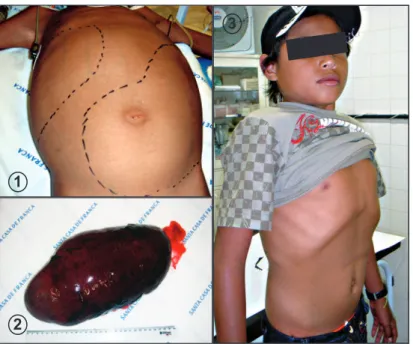
In March 2010, the patient experienced a new epistaxis with abdominal pain, fever and asthenia. His hemoglobin was 5.2g/dl, total leucocytes were 1,700, the prothrombin activity was 30%, and the platelet count was 45,000. he hepatosplenomegaly was very signiicant (Figure 1).
131
2Dutra A et al - Splenectomy and visceral leishmaniasis
DISCUSSION REFERENCES
FIGURE 1 - Malnutrition and hepatosplenomegaly.
FIGURE 2 - Spleen: 2.700g, 28cm long, 18cm wide and 10cm thick. FIGURE 3 -Two months ater splenectomy.
Visceral leishmaniasis is a serious illness that is associated with protein-calorie malnutrition, anemia, hepatosplenomegaly, hypersplenism, infectious processes and coagulopathies. The main causes of death include infection, bleeding, anemia and liver failure. Visceral leishmaniasis is fatal in approximately 50% of cases. When assessing the response to medical treatment, patients can be considered to be cured at the end of therapy when they present with no fever, a decrease in splenomegaly of at least 40% of the initial value, improvements in both the general condition and laboratory exam results, and no reappearance of signs and symptoms within six months7.
he patient covered herein did not exhibit clinical or laboratorial improvements despite the two cycles of meglumine antimoniate treatment and one cycle of treatment with liposomal amphotericin B. Kumar et al reported a case involving multiple relapses and a multi-drug unresponsive disease that was successfully treated with combination therapy8.
he efect of splenectomy in patients with visceral leishmaniasis is not well deined. he success of the splenectomy in our patient might be due to the removal of large masses of parasites from the system and the correction of the hypersplenism9,10. here have been
two reported cases in which parasites remained present in the lymph nodes ater clinical cure1, demonstrating that the reticuloendothelial
system, especially the spleen, can be a reservoir of infected cells. Mukhopadhyay et al.11 reported six patients with drug-resistant VL
who were submited to elective splenectomy.
In the presence of severe splenomegaly, the levels of drugs in the spleen for the treatment of VL may not be suiciently high to eradicate the parasite and cure the disease. herefore, splenectomy may be indicated in cases of serious cytopenia, if periodic blood transfusions are required, and in the cases of recurrent VL.
his case report highlights that splenectomy may be an option for the debulking of parasites in cases of severe splenomegaly, thus minimizing the complications of hypersplenism and providing a cure for refractory VL12.
1. Dereure J, Duong TH, Lavabre-Bertrand T, Cartron T, Bastides F, Richard-Lenoble D, et al. Visceral leishmaniasis. Persistence of parasites in lymph nodes ater clinical cure. J Infect 2003; 47:77-81.
2. Ministério da Saúde. Fundação Nacional de Saúde (FUNASA). Controle, diagnóstico e tratamento da leishmaniose visceral (calazar): Normas Técnicas. Brasília; Ministério da Saúde; 1999.
3. Badaró R, Jones TC, Lourenço B. A prospective study of visceral leishmaniasis in an endemic area of Brazil. J Infect Dis 1986; 154:639-649.
4. Arias JR, Monteiro OS, Zicker F. he reemergence of visceral leishmaniasis in Brazil. Emerg Infect Dis 1996; 2:145-146.
5. Queiroz MJA, Alves JGB, Correia JB. Leishmaniose visceral: características clínico-epidemiológicas em crianças de área endêmica. J Pediatr 2004; 80; 141-146.
6. Santos MA, Marques RC, Farias CA, Vasconcelos DM, Stewart JM, Costa DL, et al. Predictors of a unsatisfatory response to pentavalent antimony in the treatment of the American visceral leishmaniasis. Rev Soc Bras Med Trop 2002; 35:629-633. 7. Brustoloni YW, Cunha RV, Consolo LZZ, Oliveira ALL, Dorval MEC, Oshiro ET. Treatment of visceral leishmaniasis in children in the Central-West Region of Brazil. Infection 2010; 38:261-267.
8. Kumar N, Kumar Sinha P, Pandey K, Verma N, Shekhar Lal C, Ranjan A, et al. A rare case of Visceral leishmaniasis with multiple relapse and multi-drug unresponsive: successfully treated with combination therapy. Int J Clin Pharm 2001; 33:726-729.
9. Napier LE. Splenectomy in the treatment of Kala-azar. J Trop.Med Hyg 1949; 52:243-248
10. Rees PH, Kages PA, Kyambi JM, Ayim EN, Bhat KM. Eetinck JKM. Splenectomy in Kala-azar. Trop Geogr Med 1984; 36:285-292
11. Mukhopadhyay B, Sarkar AK, Dasgupta A, Mukhopadhyay M, Chowdhury MM, Sarkar S. Drug - resistant childhood visceral leishmaniasis. Is splenectomy a solution? Pediatr Surg Int 1993; 8:314-315.
12. Lyngdoh E, Jain SC, Barua P. Splenectomy in treatment of drug-resistant Kalazar. J Indian Med Assoc 1971; 57:458-461.
1