Cop
yright
© ABE&M t
odos os dir
eit
os r
eser
vados
.
349 Arq Bras Endocrinol Metab. 2011;55/5
clinical case report
Correspondence to:
Ana Carla Montenegro
Received on Feb/2/2011 Accepted on May/24/2011
1 Universidade Federal
de Pernambuco (UFPE), Recife, PE, Brazil
2 Instituto de Medicina Integrada
Prof. Fernando Figueira (Imip), Recife, PE, Brazil
3 Universidade de Pernambuco
(UPE), Medical School, Recife, PE, Brazil
First description of
pseudohypoparathyroidism with
frontal lobe calciication and
normal serum calcium at the initial
manifestation in an otherwise
healthy seven-year-old girl
Calciicação do lobo frontal e normocalcemia como primeira manifestação de pseudo-hipoparatiroidismo em uma criança aparentemente saudável
Ana Carla Montenegro1, Thais Gelenske2, Érico Higino de Carvalho2, Francisco Bandeira3, Everton Sougey1
SUMMARY
Pseudohypoparathyroidism (PHP) is characterized by resistance to the peripheral action of para-thyroid hormone. We present a case of a seven-year-old girl who was admitted at the service of Ins-tituto Materno Infantil de Pernambuco, IMIP, with motor episodes affecting the arms. Her calcium level was normal. Computed tomography showed calcifications in frontal lobes and basal ganglia. After six years: calcium was 5.5 mg/dL; phosphorus, 8.3 mg/dL and serum parathyroid hormone was 1,318 pg/mL. Pseudohypoparathyroidism diagnosis was considered. This is the first description of a case of pseudohypoparathyroidism without Albright’s stigma, with cerebral calcification, and no calcium abnormalities at the initial clinical manifestation. Arq Bras Endocrinol Metab. 2011;55(5):349-52
SUMÁRIO
Pseudo-hipoparatiroidismo (PHP) é uma doença caracterizada pela resistência periférica à ação do hormônio da paratireoide. Apresentamos um caso de uma menina de 7 anos de idade que foi aten-dida no serviço do Instituto Materno Infantil de Pernambuco, IMIP, com crises motoras dos braços. O cálcio era normal. A tomografia computadorizada mostrou calcificações nos lobos frontais e gânglios da base. Depois de seis anos: cálcio era 5,5 mg/dl, fósforo, 8,3 mg/dl e paratormônio sé-rico, 1.318 pg/ml. Diagnóstico de pseudo-hipoparatiroidismo foi considerado. Este relato descreve o primeiro caso de pseudo-hipoparatiroidismo sem estigma Albright, com calcificação cerebral e sem alterações de cálcio na manifestação clínica inicial. Arq Bras Endocrinol Metab. 2011;55(5):349-52
INTRODUCTION
P
seudohypoparathyroidism (PHP) is a rare disease characterized by resistance to the peripheral action of parathyroid hormone. PHP presents laboratory ab-normalities characteristic of hypoparathyroidism (hypo-calcemia and hyperphosphatemia), but with high levels of parathyroid hormone (PTH). The irst description of the disease was done by Fuller Albright in 1942, who reported the cases of three patients with labora-tory hypocalcemia who did not return to normal afterCop
yright
© ABE&M t
odos os dir
eit
os r
eser
vados
.
350 Arq Bras Endocrinol Metab. 2011;55/5
PHP, frontal calciication and normocalcemia
a decreased response of renal cAMP in PHP types Ia and Ib, and absence of phosphaturia in types I and II (3). Cerebral calciication of basal ganglia in states of hy-poparathyroidism is not uncommon (4). In pseudohy-poparathyroidism, occurrence of localized intracerebral calciication in basal ganglia is seen in around 50% of the cases (5) and, in most of these cases, clinical stigma of AHO is associated with such indings (4,6). However, cerebral cortex calciication is rare in cases of pseudohy-poparathyroidism: there are few reports in the literature (2,7,8) and, to our knowledge, only three cases have been unrelated to the clinical indings typical of AHO, although all of them presented hypocalcemia at the time of diagnosis. The present study is the irst description of a PHP case associated with cerebral calciication in basal ganglia and cerebral frontal cortex, with movement dis-orders as the sole clinical and laboratorial manifestation.
CASE REPORT
A seven-year-old girl was admitted for the irst time in April 1996 at the pediatric neurology service of the Mother-Child Institute of Pernambuco (Instituto Ma-terno Infantil de Pernambuco, IMIP), with motor epi-sodes affecting the arms. The patient started to present this condition one month before coming to the IMIP. The episode consisted of laccid arms and deviation of the head and eyes to the right. According to the girl’s mother, the spasms were frequent and could happen up to ten times a day, without any triggering factors.
The girl had been healthy up to then, with physi-cal and intellectual development compatible with her chronological age. Clinical examination did not show any abnormalities other than the neurological condi-tion. There were no reports of any endocrine or neu-rological diseases in the family. There were no reports of physical changes that would be consistent with syn-dromes associated with hypoparathyroidism or pseudo-hypoparathyroidism.
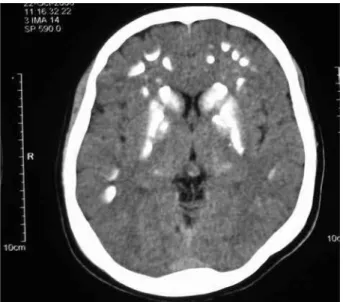
Dietary intake of calcium was normal for the age. Se-rum electrolyte measurements were as follows: calcium, 8 mg/dL (reference: 8.0 to 10.6 mg/dL); phosphorus, 6.6 mg/dL (reference: 2.3 to 5.0 mg/dL) (Figure 1). Results for the other electrolytes, kidney function and liver function tests were normal. Computed tomogra-phy of the cranium showed calciications in the sub-cortical white matter of frontal lobes, and caudate and lenticular nuclei (Figure 2). Examination of the retina was normal.
Figure 2. Computed tomography of the cranium showing calcifications in the subcortical white matter of the frontal lobes.
Figure 1. Calcium and phosphorus levels (mg/dl) in the patient with pseudohypoparathyroidism that were presented at the mother-child Hospital of Pernambuco (Instituto Materno Infantil de Pernambuco), Brazil.
Diagnosis of partial epilepsy was considered, and treatment with carbamazepine was started. After initial improvement, the patient started again to present mo-tor episodes affecting the arms. The laccid nature was replaced by random movements of the arms, but inter-vals between the episodes were longer. Two years after starting to present the disease, arm movements intensi-ied and took on characteristics resembling ballismus, with leg and trunk movements, which made it dificult for the girl to maintain an erect posture (chorea, ath-etosis and dystonia). These episodes lasted for around ive minutes. A new computed tomography scan was done and did not show any other abnormalities.
Analysis of cerebrospinal luid presented the follow-ing indfollow-ings: two cells; proteins 48 mg%. The electroen-cephalogram showed bursts of polymorphic slow waves (theta) in the right hemicranium projection. Serum electrolyte indings were: calcium, 8.9 mg/dL;
phos-1996 1998 2001 2002 2006 10
9 8 7 6 5 4 3 2 1 0
Calcium
Levels of calcium and phosporus, mg/dl
Cop
yright
© ABE&M t
odos os dir
eit
os r
eser
vados
.
351 Arq Bras Endocrinol Metab. 2011;55/5
PHP, frontal calciication and normocalcemia
phorus, 6.7 mg/dL. Other medications were intro-duced in association with carbamazepine, in an attempt to improve paroxysmal choreoathetosis. Acetazolamide led to almost complete control over the episodes.
After three years of follow-up, the patient started again to present carpal spasms. Laboratory tests were re-peated, and values were as follows: calcium, 8.2 mg/dL; phosphorus, 6.7 mg/dL; urinary calcium, 65 mg/24 hours (reference: 50 to 150 mg/24 hours); urinary phosphorus, 92.8 mg/24h.
Radiography of her hands and wrists to identify bone age showed values compatible with her chronological age. Patient showed spontaneous and progressive im-provement, and previous medications were maintained.
During the following year, new symptoms appeared. The girl (who was now 11 years old) reported painful cramps in her hands, particularly when exposed to cold. Physical examination was positive for Chvostek’s sign, Trousseau’s sign and clouding of the crystalline lens. Laboratory tests presented new biochemical values: calcium, 5.5 mg/dL; phosphorus, 8.3 mg/dL; urinary calcium, 5 mg/24 hours. Kidney and liver function were normal.
The pediatric endocrinology team was asked to re-evaluate the patient, and serum parathyroid hormone (PTH) value was 1,318 pg/mL (reference: 10 to 65 pg/dL). Diagnosis was hypothesized to be pseudohy-poparathyroidism, and the patient was started in cal-cium citrate and calcal-cium chelate therapy. Calcitriol was administered after serum phosphorus level dropped in order to prevent precipitation of calcium phosphate in the tissues. After starting these medications, pain and motor symptoms improved. The patient made correct use of the medications for a few months and then her follow-up became irregular.
Follow-up four years later
Four years after the presumptive diagnosis of pseudo-hypoparathyroidism, the patient was lost to follow-up. She then came back to the pediatric neurology servi-ce with signiicant worsening of the intensity and fre-quency of her carpal and tarsal spasms. She said that she had not adhered to the medication. A new computed tomography scan of the cranium was performed, and showed that cerebral calciications had now extended to the cerebellum. On this occasion, new laboratory test results were: calcium, 7.8 mg/dL; phosphorus, 8.5 mg/dL; PTH, 1,217 pg/dL. She was started on the medications again and the symptoms receded.
DISCUSSION
Clinical expression of pseudohypoparathyroidism is va-riable. Most of the cases of this rare disorder that have been described are associated with somatic indings of AHO, with varying degrees of mental retardation (3). Cerebral calciications primarily involve the basal gan-glia and rarely extend to other regions of the brain. The exact pathogenesis of this phenomenon is poorly dei-ned, but it is believed that a nonspeciic process of ce-rebral calciication occurs, starting in the basal ganglia in the early phases of the disease, and possibly affecting other regions of the brain. When cerebral abnormali-ties are discovered, hypocalcemia is identiied associa-ted with the condition, which leads to investigation of parathormone deiciency.
The case reported here presented certain peculiari-ties. The patient’s irst clinical manifestation was motor, affecting her arms; initial investigation revealed intra-cerebral calciications in the basal ganglia and cortical region; and no abnormalities of serum calcium were identiied in laboratory tests, despite normal calcium intake for the age. The patient did not present any phe-notypic characteristic that would identify AHO, either. She had normal weight and height.
To our knowledge, there are other three cases in the literature in which pseudohypoparathyroidism was associated with intracerebral calciications, without the clinical stigma of AHO (5,8). However, those patients presented hypocalcemia at the time of diagnosis, which enabled identiication of pseudohypoparathyroidism, and treatment started immediately. In contrast, in the case of our patient, calcium level abnormalities oc-curred three years after the onset of neurological mani-festations. Normocalcemia could be justiied by a selec-tive action of PTH in bone tissue, as described in some cases of PHP type Ib (1).
Cop
yright
© ABE&M t
odos os dir
eit
os r
eser
vados
.
352 Arq Bras Endocrinol Metab. 2011;55/5
is an idiopathic form of calciication of the basal ganglia that occurs with advanced age (11). States of hypopara-thyroidism and pseudohypoparahypopara-thyroidism may also be associated with calciications in basal ganglia. More ad-vanced imaging techniques have demonstrated that the incidence of calciications in this site is more frequent than it was believed. It has been estimated that between 0.3% and 1.5% of the basal ganglia calciications are in-cidentally identiied on computed tomography scans of the cranium (12). These calciications most often oc-cur symmetrically in the basal ganglia, bilaterally affect-ing the putamen, globus pallidus and, occasionally, the dentate nucleus. They may extend to the white matter and thalamus, thus causing focal and diffuse neurologi-cal manifestations (12). In states of pseudohypopara-thyroidism, extension to the cortical matter is rarely identiied (7).
In the present case, in addition to the unusual in-volvement of the frontal cortical region in a case of pseudohypoparathyroidism with cerebral calciication, our patient’s clinical manifestations was only motor. No neuropsychiatric or cognitive disorder was identiied.
In conclusion, the present report is the irst descrip-tion of a pseudohypoparathyroidism case in the litera-ture without the stigma of Albright’s osteodystrophy, with calciication of cerebral cortex and basal ganglia, initial clinical manifestation that was exclusively motor, and absence of serum calcium abnormalities.
Disclosure: no potential conlict of interest relevant to this article was reported.
REFERENCES
1. Maeda SS, Fortes EM, Oliveira UM, Borba VCZ, Castro L. Hypopa-rathyroidism and pseudohypopaHypopa-rathyroidism. Arq Bras Endocri-nol Metabol. 2006;50:664-73.
2. Ellie E, Jullien J, Ferrer X, Riss I, Durquety MC. Extensive cerebral calcification and retinal changes in pseudohypoparathyroidism. J Neurol. 1989;236:432-4.
3. Gelfand IM, Eugster EA, Dimeglio LA. Presentation and clinical progression of pseudohypoparathyroidism with multi-hormone resistance and hereditary osteodystrophy: A case series. J Pediatr. 2000;4:397-400.
4. Illum F, Dupont E. Prevalences of CT-detected calcification in the basal ganglia in idiopathic hypoparathyroidism and pseudohypo-parathyroidism. Neuroradiology. 1985;1:32-7.
5. Siejka SJ, Knezevic WV, Pullan PT. Dystonia and intracerebral cal-cification: pseudohypoparathyroidism presenting in an eleven--year-old-girl. Aust N Z J Med. 1988;18:607-9.
6. Cordero MM, Mories MT, Burgo RM, Fraile AL, Corrales JJ, Miralles JM. Calcificaciones readiológicas heterotópicas em dos hermanos com pseudohipoparatiroidismo. Rev Neurol. 2000;4:397-400. 7. Bloom RA, Rubinger D, Pogrund H. Frontal lobe calcification in
hypoparathyroidism states. 1983;1:65-68.
8. Guberman A, Jaworski ZFC. Pseudohypoparathyroidism and epilepsy: diagnostic value of computerized cranial tomography. Epilepsia. 1979;20:541-53.
9. Cavalcanti-Mendes GA, Carvalho GT, Christo PP, Malloy-Diniz LF, Sousa AA. An unusual case of Fahr’s disease. Arq Neuropsiquiatr. 2009;67(2-B):516-8.
10. Lauterbach EC, Cumming JL, Duff J, Coffey E, Kaufer D, Lovell M, et al. Neuropsychiatric correlates and treatment of lenticulostria-tal diseases: a review of the literature and overview of research opportunities in Huntington’s, Wilson’s, and Fahr’s diseases. A re-port of the ANPA committee on research. J Neuropsychiatry Clin Neurosci. 1998;10:249-66.
11. Cheong SK, Chan DKY. An elderly woman with calcification of the basal ganglia who presented with shuffling gait: a review with a case report. Asian J Gerontol Geriatr. 2006;1:54-6.
12. Basak RC. A case report of basal ganglia calcification. OMJ. 2009;24(3):200-22.