Rev Odontol UNESP. 2016 July-Aug; 45(4): 189-194 © 2016 - ISSN 1807-2577
ORIGINAL ARTICLE
Doi: http://dx.doi.org/10.1590/1807-2577.23315
Efect of Simvastatin on induced apical periodontitis in rats:
a tomographic and biochemical analysis
Efeito da Sinvastatina sobre a periodontite apical induzida em ratos: análise radiográica e bioquímica
Jussara Machado PEREIRA
a, Alex SEMENOFF-SEGUNDO
a, Natalino Francisco da SILVA
a,
Álvaro Henrique BORGES
a, Tereza Aparecida Delle Vedove SEMENOFF
a*
aFaculdade de Odontologia, UNIC – Universidade de Cuiabá, Cuiabá, MT, Brasil
Resumo
Introdução: A sinvastatina é uma das várias estatinas utilizadas no tratamento da hipercolesterolemia e, na odontologia, alguns estudos têm buscado relacioná-la ao reparo ósseo. Objetivo: Avaliar o efeito da sinvastatina na progressão da periodontite apical induzida em ratos. Material e método: Para tanto, 36 ratos Wistar, previamente selecionados, foram divididos em 3 grupos (N=12). Grupo Controle (GC); Grupo Periodontite Apical (GPA); Grupo Periodontite Apical Associada à Sinvastatina (GPAS). No primeiro dia do ensaio o GPA e o GPAS foram anestesiados e submetidos à abertura coronária do primeiro molar inferior direito. Durante trinta dias, o GPAS recebeu diariamente 6mg de sinvastatina, através de gavagem. No trigésimo primeiro dia, todos os grupos foram submetidos à coleta de sangue e a eutanásia. As mandíbulas foram removidas e fixadas em formol. Para a mensuração das regiões periapicais, foram realizadas tomografias. Além disso, avaliou-se a massa corporal, glicemia e o lipidograma. Os dados foram submetidos à análise estatística ANOVA de uma via e teste Post Hoc de Tukey (p<0,05). Resultado: Os resultados demonstram que o GPA (3,42±0,65) apresentou os maiores perímetros para espaço do ligamento periapical, seguido pelo GPAS (1,54±0,78) e GC (0,64±0,24), respectivamente (p<0,05). Em relação ao lipidograma percebe-se o efeito da sinvastatina avaliando-se a quantidade de glicose, triglicérides, HDL, VLDL (p<0,05). Para a massa corporal o GPA foi o que mais ganhou peso (264,75±44,11); seguido pelo GC (252,00±44,36); e GPAS (245,41±42,56). Os três grupos apresentaram diferenças estatísticas entre si, de forma decrescente (p<0,05). Conclusão: O uso da sinvastatina diminuiu a progressão do aumento do espaço do ligamento periapical em ratos.
Descritores: Sinvastatina; ratos; periodontite apical; endodontia.
Abstract
Introduction: Simvastatin is one of several statins that are used to treat hypercholesterolemia, and in dentistry, few studies have attempted to associate the administration of this compound with bone repair. Objective: To evaluate the effect of simvastatin on the progression of induced apical periodontitis in rats. Material and method: To this end, 36 male Wistar rats were divided into 3 groups (N=12): Induced Apical Periodontitis Associated with Simvastatin Group (APSG N=12), Induced Periodontitis Apical Induced Group (APG N=12) and Negative Control Group (CG). On the first day, APG and APSG were anesthetized, and the coronal opening of the mandibular first molar was performed. For thirty days, the APSG received 6 mg of simvastatin daily via gavage. On the thirty-first day, all groups underwent blood collection and euthanasia. The jaws were removed and fixed in formalin. CT scans were performed to measure the periapical regions. In addition, the body mass and lipid profile were analyzed. The data were subjected to statistical analysis (ANOVA and Tukey’s test). Result: The APG (3.42±0.65) showed the highest perimeters for the space periapical ligament, followed by APSG (1.54±0.78) and CG (0.64±0.24) (p<0.05). The lipid profile revealed the effect of simvastatin on the amount of glucose, triglycerides, HDL, and VLDL (p<0.05). Body mass APG showed the most weight gain (264.75±44.11), followed by CG (252.00±44.36) and APSG (245.41±42.56). The three groups showed significant differences in decreasing order (p<0.05). Conclusion: The use of simvastatin decreased the progression of the increasing periapical ligament space in rats.
Pereira, Semenof-Segundo, Silva et al. Rev Odontol UNESP. 2016 July-Aug; 45(4): 189-194 190
INTRODUCTION
Even with the advent of modern techniques for the prevention and treatment of many diseases, oral health is still considered a problem worldwide1. he most common oral diseases include tooth decay and periodontitis1,2. he focus on infection-induced bioilm in the oral cavity3 is an important element in the inlammatory response generated by the body4 and results in other problems associated with the well-being and health of the person5.
Simvastatin (SVT) is one of several statins used for the treatment of hypercholesterolemia, i.e., the bloodstream cholesterol levels that can cause serious damage to health, such as cardiovascular disease6.
he systemic mechanism of action of SVT has recently been explored7, but care should be taken because this drug has been shown to lead to the accumulation of cholesterol and chemical by-products. Despite the proven beneits, similar to most drugs, the prolonged use of SVT has been associated with side efects8.
In dentistry, several studies have attempted to associate SVT with repair and bone regeneration9,10, which are urgently needed in the dental clinic, particularly when there is a need to use dental implants. Indeed, many studies have attempted to provide a better understanding of the mechanisms of SVT, which acts locally in the cascade of immuno-inlammatory diseases11. hus, the use of SVT as an adjunct in the treatment of marginal periodontitis has recently become a research ield12,13.
Studies concerning apical periodontitis induction are relevant14 and are being conducted to obtain a better understanding of the pathogenesis of this disease. he efect of simvastatin on induced apical periodontal diseases in rat has been proposed as a plausible15,16 contribution to research information that cannot be used in human subjects12.
hus, understanding the action of the systematic (oral) use of simvastatin in the periapical region is relevant and important, particularly when examined in an animal model to obtain relevant information on this subject14,16. hus, the objective of the present study was to evaluate the efects of simvastatin on induced apical periodontitis progression in rats.
MATERIAL AND METHOD
Initially, 36 male, adult Novegicus Wistar rats at 2 months of age, with an initial weight of approximately 210 grams, were selected for the Veterinary Hospital Vivarium at the University of Cuiabá – UNIC, Campus Beira Rio, Cuiabá MT. hese animals underwent acclimation to the new environment for two weeks and were maintained in nine housing boxes (polyethylene 60 × 40 × 35) at four animals per cage, with standard diet and water ad libitum under a light/dark cycle of 12 hours, 23 °C and humidity 60% (CEUA - UNIC protocol 003/2014).
A technical assistant unaware of the research objectives in the three groups randomly distributed the animals into 3 groups: Induced Apical Periodontitis Associated with Simvastatin Group (APSG N=12); Induced Apical Periodontitis Group (APG N=12) and Negative Control Group (CG).
For apical periodontitis induction, all animals, except the CG group, received anesthesia via the intramuscular administration of 0.1 ml of ketamine hydrochloride (Dopalen, Agribrands, Animal Health, Paulinia, SP, Brazil) with 0.05 ml of xylazine hydrochloride (Rompun, Bayer, Animal Health, São Paulo, SP, Brazil) for every 100 grams of body weight17.
A round diamond bur was selected (1011-KG - Sorensen, Cotia, SP, Brazil), and it was adapted to a dental high speed rotation motor and used on the occlusal surface of the irst lower right molar to pierce enamel and dentine and promote access to the pulp chamber. Ater surgery, a dose of dipyrone (2.5 mg for each 100 g of body weight) was intramuscularly injected into each animal from APG and APSG. he CG did not receive any intervention but were maintained in the same environment as the other groups.
Ater the induction of apical periodontitis, the animals APSG were administered a daily intake of six milligrams of simvastatin (Capsules with 6 mg, Natupharma - Handling of Pharmacy, Cuiabá- MT) using a gavage procedure via 10-ml syringe (BD Brazil, Curitiba-PR) coupled to a 10-cm cannula for injection (18G Scalp vein, Venescalp, Feira de Santana - BA, Brazil). he uninterrupted drug administration occurred for 30 days. he APG group underwent the same treatment procedure but with saline.
At 30 days ater gavage, the animals were again anesthetized through an intramuscular injection of 0.1 ml of ketamine hydrochloride (Dopalen, Agribrands. Animal Health, Paulinia, SP, Brazil) with 0.05 ml of xylazine hydrochloride (Rompun Bayer, Animal Health, São Paulo, SP, Brazil) per 100 g of corporal weight17. Following the administration of anesthesia, the skin of the abdominal wall was incised diagonally at the abdomen base, forming a “V” ater the displacement of the skin to the abdominal cavity. he internal organs were displaced to visualize the vena cava. Blood was collected by puncture of the vena cava using a 25 × 7 needle (Vacutainer - Becton Dickinson, Plymouth, UK) in a 5-ml tube.
Immediately at the end of each blood collection, euthanasia was performed by excess anesthesia. Immediately thereater, the mandibles were removed and ixed in 10% formalin for 48 hours.
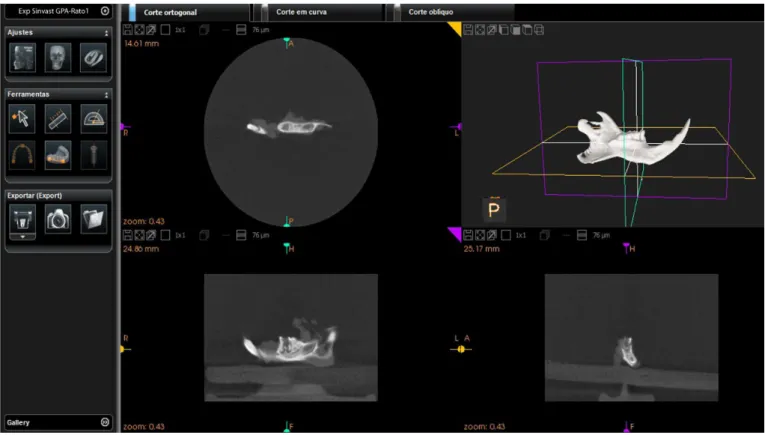
Ater ixation, the samples were scanned using a Kodak 9000 C3K, 60 KV, 5 MA tomographic apparatus. Initially, a sagittal plane of the apical region of each of the roots of the lower right irst molar (Figures 1 and 2) through the axial acquisition protocol spacing between cuts of 0.76 mm with a pixel size of 0.332, resolution of 13,072 pixels/mm 60 kV and 20 mA, 10 cm FOV, and voxel size of 0.08 × 0.08 × 0.08 mm using the Kodak Dental Imaging Sotware program (3d module v 2.4 Kodak Dental Systems, Atlanta, GA, USA).
A single evaluator unaware of the research groups calibrated the perimeters of the lesions. he perimeters of each root lesions were summed and divided by the number of measured lesions, producing an average per animal.
he blood parameters were observed ater measuring the quantities of glucose, HDL, VLDL, LDL and triglycerides.
For statistical analysis, the original data were subjected to preliminary testing to verify the normality of the sample (Shapiro-Wilk). Comparisons among the mean images, animal weights and biochemical data were performed using univariate analysis of variance (ANOVA) test with Tukey’s post hoc (IBM SPSS Statistics Version 20).
To assess the calibrations of a single study investigator unaware of the study groups, we used Student’s t test. he signiicance level for all tests was 5%, with a mean standard error of 0.035 mm.
RESULT
he perimeters of the periapical ligament spaces in the irst molars were measured. he results demonstrated that APG had highest apical lesion progressions, followed by APSG and GC, respectively, with statistical diferences observed between the groups (p<0.05) (Table 1).
Regarding blood biochemistry, the drug action was observed in several tests compared with the APG and CG. With respect to the glucose, triglycerides, HDL and VHDL variables, the medication demonstrated direct action compared with other groups (p<0.05). However, the variables for cholesterol and LDL showed no signiicant diferences between the groups (p>0.05) (Table 2).
Regarding the weight diferences of these animals, a signiicant diference was observed between the groups, with the following decreasing order: APG, CG and APSG (p<0.05) (Table 3).
DISCUSSION
he aim of the present study was to obtain an understanding of the biological plausibility of the induced apical periodontitis progression associated with simvastatin drug use. he results demonstrated that this modulation ofers an interesting initial tool for drug use in the treatment of periapical disease in rats.
Figure 1. Demonstrative igure of the tomographic images selected or perimeter analysis of increased apical ligament spaces.
Figure 2. CT scan of the induced apical periodontitis associated with the simvastatin Group (APSG) and increased apical ligaments of the lower irst molar.
Table 1. Means and Standard Deviations of the periapical ligament perimeters
Groups N Means (mm) Standard Deviations
CG 12 0.64A 243.55 APSG 12 1.54B 780.34 APG 12 3.42C 655.51
Pereira, Semenof-Segundo, Silva et al. Rev Odontol UNESP. 2016 July-Aug; 45(4): 189-194 192
Currently, obesity afects much of the population17 and causes serious problems related to cardiovascular disease6, diabetes, chronic kidney disease, stroke, and other associated diseases18. Previous studies have suggested a relationship between inlammation and overweight or even morbid obesity in humans19. Indeed, fat cells, through the production of interleukins called adipokines and, more speciically, resistin, leptin and adiponectin, interfere with inlammatory processes associated with the use of simvastatin for the treatment of apical lesions20. Because simvastatin plays a role in the reduction of inlammation, it is possible to decrease the amount of cholesterols and interleukins to prevent bone resorption.
Recent epidemiological data have indicated a weak relationship between obesity and dentistry21, but the plausibility of this hypothesis needs further evidence to clarify this issue22,23. Notably, individuals who regularly permanently use simvastatin have shown a signiicant decrease in blood cholesterol levels and a consequent reduction of inlammation in the body and medical complications associated with obesity. Based on this inding, research concerning the use of simvastatin and evaluation of oral health indicators, as conducted in the present study, could provide important data for understanding the cause/efect relationship between pulp tissue aggression and apical lesion progression.20,21
Alterations in the cardiovascular system have been associated with dyslipidemia worldwide24. To treat these complications, simvastatin, a member of the statins group, has been widely used due to its low cost, easy acquisition and few side efects25. Among its many demonstrated functions, simvastatin reduces the lipids in the bloodstream and has been associated with decreased and modulated inlammatory processes25, apoptosis regulation, and changes in ibroblast function and bone formation11. Despite not having original indications, simvastatin has recently been explored for its physical and chemical properties in dentistry26,27. However, the pharmacokinetics of this drug should be considered to maximize the results, particularly concerning security in the use of this compound.
he systemic indings are relevant. he biochemical results presented in the present study showed clear systemic changes
Table 3. Means and Standard Deviations of the weight diferences (in grams) between the inal and initial measurements of the animals in APSG, APG and CG (N=12)
Groups
Mean of Initial Weight
Mean of Final
Weight
Diference of Final and Initial
Weight
Standard Deviations
GC 216.44A 287.56A 71.12A 12.51 GPAS 213.80A 277.02B 63.22B 10.96 GPA 218.22A 311.28C 93.06C 15.50
Capital letters A, B and C demonstrate signiicant diferences between the groups. APSG – Apical Periodontitis associated with Simvastatin Group; APG – Apical Periodontitis Group; CG – Control group. (One-way ANOVA p<0.05).
Table 2. Means and Standard Deviations of the lipid components and glucose measured in blood tests for the animals in APSG, APG and CG
Variable Groups N Mean mg/dL Standard Deviations
Glucose
CG 12 152.46A 26.76 APSG 10 110.79B 14.32 APG 10 145.53A 19.74
Cholesterol
CG 12 98.80A 20.20 APSG 10 86.04A 15.02 APG 10 92.29A 18.10
Triglycerides
CG 12 98.90A 19.62 APSG 10 75.50B 28.12 APG 10 93.81A 23.14
HDL
CG 12 47.50A 4.57 APSG 10 43.16A 5.42 APG 10 30.97B 7.96
LDL
CG 12 31.52A 8.05 APSG 10 27.73A 14.10 APG 10 28.61A 11.97
VLDL
CG 12 19.78A 3.92 APSG 10 13.39B 5.62 APG 10 15.10B 3.49
in the blood volume of most of the indicators analyzed. No side efects were observed in the animals examined in the present study. We also considered the central nervous system behavior through labyrinth devices in high cross and open ields28 and systemic indicators of drinking water, food and clinical symptoms, such as weight loss and diarrhea.
he hypothesis that simvastatin reduces the amount of inlammatory interleukins is based on the reduction of these inlammatory products and by-products in the bloodstream. Inlammatory interleukins provide the local reduction of inlammation, even in the face of an infectious process13. his feature is important because stimulation of the immune inlammatory system results in the avoidance of the action of the bioilm in the progression of infectious diseases29,30. hus, two studies have suggested the use of this drug in the treatment of diseases, such as apical periodontitis15,16.
he pathogenesis of endodontic diseases remains unknown in many respects. However, in general, endodontic diseases result from bioilm formation by microorganisms such as Candida albicans, Enterococcus faecalis30, and Porphiromona endodontalis31. he inclusion of simvastatin in this infectious-inlammatory process will provide additional information on the action of this drug in the periodontium, achieving a methodology for the use of this medication and proper dosage to provide periapical-induced disease modulation, as analyzed using an experimental rat model.
Other clinical and laboratory relevant issues include the simvastatin dose (six milligrams) used in the present study, as established in previous pilot studies and supported by previously published manuscripts9,16.
In addition, the target of the lipid and glucose proile changed both in the pilot study period and during the experimental phase of the study. Among the present indings, inlammatory processes leading to signiicant systemic changes, such as changes in weight and blood, were observed, revealing that simvastatin acts in any inlammatory process, including the oral cavity.
Notably, between the collection and arrival of the blood in the laboratory, the hemolysis of two samples from APSG and two samples from APG was observed. While no animals died during the experiment, the sample size of the groups decreased, despite the suicient sample strength.
Indeed, these results are interesting and provide plausible information for clinical studies to increase the current understanding of the dynamics underlying the action mechanisms of a drug already established in the market, showing low cost, reasonable accessibility and diminished side efects.
CONCLUSION
Based on these results, we concluded that simvastatin use results in smaller apical ligament spaces subjected to the induction of periapical disease in the teeth of rats.
ACKNOWLEDGEMENTS
he authors would like to thank the Master in Integrated Dental Sciences, University of Cuiabá - UNIC for supporting this manuscript and the Radiology Clinic CEDROC for providing the data for the present study.
REFERENCES
1. Beikler T, Flemmig TF. Oral biofilm-associated diseases: trends and implications for quality of life, systemic health and expenditures. Periodontol 2000. 2011 Feb;55(1):87-103. http://dx.doi.org/10.1111/j.1600-0757.2010.00360.x. PMid:21134230.
2. Opperman RV, Hass AN, Rösing CK, Susin C. Epidemiology of periodontal diseases in adults from Latin America. Periodontol 2000. 2015 Feb;67(1):13-33. http://dx.doi.org/10.1111/prd.12061. PMid:25494596.
3. Socransky SS, Haffajee AD. Periodontal microbial ecology. Periodontol 2000. 2005;38(1):135-87. http://dx.doi.org/10.1111/j.1600-0757.2005.00107.x. PMid:15853940.
4. Page RC, Kornman KS. The pathogenesis of human periodontitis: an introduction. Periodontol 2000. 1997 Jun;14(1):9-11. http://dx.doi. org/10.1111/j.1600-0757.1997.tb00189.x. PMid:9567963.
5. Zenthöfer A, Rammelsberg P, Cabrera T, Schröder J, Hassel AJ. Determinants of oral health-related quality of life of the institutionalized elderly. Psychogeriatrics. 2014 Dec;14(4):247-54. http://dx.doi.org/10.1111/psyg.12077. PMid:25495087.
6. Delahoy PJ, Magliano DJ, Webb K, Grobler M, Liew D. The relationship between reduction in low-density lipoprotein cholesterol by statins and reduction in risk of cardiovascular outcomes: an updated meta-analysis. Clin Ther. 2009 Feb;31(2):236-44. http://dx.doi.org/10.1016/j. clinthera.2009.02.017. PMid:19302897.
7. Chataway J, Schuerer N, Alsanousi A, Chan D, MacManus D, Hunter K, et al. Effect of high-dose simvastatin on brain atrophy and disability in secondary progressive multiple sclerosis (MS-STAT): a randomised, placebo-controlled, phase 2 trial. Lancet. 2014 Jun;383(9936):2213-21. http://dx.doi.org/10.1016/S0140-6736(13)62242-4. PMid:24655729.
8. Thompson PD, Clarkson P, Karas RH. Statin-associated myopathy. JAMA. 2003 Apr;289(13):1681-90. http://dx.doi.org/10.1001/jama.289.13.1681. PMid:12672737.
9. Du Z, Chen J, Yan F, Xiao Y. Effects of simvastatin on bone healing around titanium implants in osteoporotic rats. Clin Oral Implants Res. 2009 Feb;20(2):145-50. http://dx.doi.org/10.1111/j.1600-0501.2008.01630.x. PMid:19077150.
10. Faraco-Schwed FN, Mangueira LM, Ribeiro JV, Antao ADS, Shibli JA. Removal torque analysis of implants in rabbit tibia after topical application of simvastatin gel. J Oral Implantol. 2014 Feb;40(1):53-9. http://dx.doi.org/10.1563/AAID-JOI-D-11-00128. PMid:22106989. 11. Alam S, Ueki K, Nakagawa K, Marukawa K, Hashiba Y, Yamamoto E, et al. Statin induced bone morphogenetic protein (BMP)-2 expression
Pereira, Semenof-Segundo, Silva et al. Rev Odontol UNESP. 2016 July-Aug; 45(4): 189-194 194
12. Xu XC, Chen H, Zhang X, Zhai ZJ, Liu XQ, Qin A, et al. Simvastatin prevents alveolar bone loss in an experimental rat model of periodontitis after ovariectomy. J Transl Med. 2014 Oct;12(1):284. http://dx.doi.org/10.1186/s12967-014-0284-0. PMid:25269614.
13. Rao NS, Pradeep AR, Bajaj P, Kumari M, Naik SB. Simvastatin local drug delivery in smokers with chronic periodontitis: a randomized controlled clinical trial. Aust Dent J. 2013 Jun;58(2):156-62. http://dx.doi.org/10.1111/adj.12042. PMid:23713634.
14. Kakehashi S, Stanley HR, Fitzgerald RJ. The effects of surgical exposures of dental pulps in germ-free and conventional laboratory rats. Oral Surg Oral Med Oral Pathol. 1965 Sep;20(3):340-9. http://dx.doi.org/10.1016/0030-4220(65)90166-0. PMid:14342926.
15. Lin SK, Kok SH, Lee YL, Hou KL, Lin YT, Chen MH, et al. Simvastatin as a novel strategy to alleviate periapical lesions. J Endod. 2009 May;35(5):657-62. http://dx.doi.org/10.1016/j.joen.2009.02.004. PMid:19410078.
16. Lai EH, Hong CY, Kok SH, Hou KL, Chao LH, Lin LD, et al. Simvastatin alleviates the progression of periapical lesions by modulating autophagy and apoptosis in osteoblasts. J Endod. 2012 Jun;38(6):757-63. http://dx.doi.org/10.1016/j.joen.2012.02.023. PMid:22595108. 17. Ogdén CL, Carroll MD, Kit BK, Flegal KM. Prevalence of childhood and adult obesity in the United States, 2011-2012. JAMA. 2014
Feb;311(8):806-14. http://dx.doi.org/10.1001/jama.2014.732. PMid:24570244.
18. Stępień A, Stępień M, Wlazeł RN, Paradowski M, Banach M, Rysz J. Assessment of the relationship between lipid parameters and obesity indices in non-diabetic obese patients: a preliminary report. Med Sci Monit. 2014 Dec;20:2683-8. http://dx.doi.org/10.12659/MSM.890845. PMid:25512170.
19. Vendrell J, Broch M, Vilarrasa N, Molina A, Gómez JM, Gutiérrez C, et al. Resistin, adiponectin, ghrelin, leptin, and proinflammatory cytokines: relationships in obesity. Obes Res. 2004 Jun;12(6):962-71. http://dx.doi.org/10.1038/oby.2004.118. PMid:15229336.
20. Ryu ST, Park SO, Kim SH. The relation of serum adiponectin and resistin concentrations with metabolic risk factors. J Korean Soc Endocrinol. 2005 Oct;20(5):444-51. http://dx.doi.org/10.3803/jkes.2005.20.5.444.
21. Dahiya P, Kamal R, Gupta R. Obesity, periodontal and general health: Relationship and management. Indian J Endocrinol Metab. 2012 Jan-Feb;16(1):88-93. http://dx.doi.org/10.4103/2230-8210.91200. PMid:22276257.
22. Silva-Sanigorski AM, Waters E, Calache H, Smith M, Gold L, Gussy M, et al. Splash!: a prospective birth cohort study of the impact of environmental, social and family-level influences on child oral health and obesity related risk factors and outcomes. BMC Public Health. 2011 Jun;11(1):505. http://dx.doi.org/10.1186/1471-2458-11-505. PMid:21708037.
23. Wang CJ, Li YQ, Wang L, Li LL, Guo YR, Zhang LY, et al. Development and evaluation of a simple and effective prediction approach for identifying those at high risk of dyslipidemia in rural adult residents. PLoS One. 2012;7(8):e43834. http://dx.doi.org/10.1371/journal. pone.0043834. PMid:22952780.
24. Ying R, Yuan Y, Qin YF, Tian D, Feng L, Guo ZG, et al. The combination of L-4F and simvastatin stimulate cholesterol efflux and related proteins expressions to reduce atherosclerotic lesions in apoE knockout mice. Lipids Health Dis. 2013 Dec;12(1):180. http://dx.doi. org/10.1186/1476-511X-12-180. PMid:24314261.
25. Esposito E, Rinaldi B, Mazzon E, Donniacuo M, Impellizzeri D, Paterniti I, et al. Anti-inflammatory effect of simvastatin in an experimental model of spinal cord trauma: involvement of PPAR-α. J Neuroinflammation. 2012 Apr;9(1):81. http://dx.doi.org/10.1186/1742-2094-9-81. PMid:22537532.
26. Park JB. The use of simvastatin in bone regeneration. Med Oral Patol Oral Cir Bucal. 2009 Sep;14(9):e485-8. PMid:19415061.
27. Wu Z, Liu C, Zang G, Sun H. The effect of simvastatin on remodelling of the alveolar bone following tooth extraction. Int J Oral Maxillofac Surg. 2008 Feb;37(2):170-6. http://dx.doi.org/10.1016/j.ijom.2007.06.018. PMid:17804200.
28. Breivik T, Stephan M, Brabant GE, Straub RH, Pabst R, von Hörsten S. Postnatal lipopolysaccharide-induced illness predisposes to periodontal disease in adulthood. Brain Behav Immun. 2002 Aug;16(4):421-38. http://dx.doi.org/10.1006/brbi.2001.0642. PMid:12096888.
29. Jiang Y, Magli L, Russo M. Bacterium-dependent induction of cytokines in mononuclear cells and their pathologic consequences in vivo.
Infect Immun. 1999 May;67(5):2125-30. PMid:10225864.
30. Segura-Egea JJ, Castellanos-Cosano L, Machuca G, López-López J, Martín-González J, Velasco-Ortega E, et al. Diabetes mellitus, periapical inflammation and endodontic treatment outcome. Med Oral Patol Oral Cir Bucal. 2012 Mar;17(2):e356-61. http://dx.doi.org/10.4317/ medoral.17452. PMid:22143698.
31. Siqueira JF Jr, Rôças IN. Microbiology and treatment of acute apical abscesses. Clin Microbiol Rev. 2013 Apr;26(2):255-73. http://dx.doi. org/10.1128/CMR.00082-12. PMid:23554416.
CONFLICTS OF INTERESTS
he authors declare no conlicts of interest.
*CORRESPONDING AUTHOR
Tereza Aparecida Delle Vedove Semenof, Departamento de Pós-graduação, UNIC – Universidade de Cuiabá, Avenida Manoel José de Arruda, 3100, Jardim Europa, 78065-900 Cuiabá - MT, Brasil, e-mail: [email protected]