Beatriz Helena CarliniI Telmo Mota RonzaniII
Leonardo Fernandes MartinsIII
Henrique Pinto GomideIII
Isabel Cristina Weiss de SouzaIII,IV
I Alcohol and Drug Abuse Institute. University of Washington. Seattle, WA, United States
II Departamento de Psicologia. Universidade Federal de Juiz de Fora. Juiz de Fora, MG, Brasil
III Centro de Pesquisa, Intervenção e Avaliação em Álcool e outras Drogas (CREPEIA). Instituto de Ciências Humanas. Universidade Federal de Juiz de Fora. Juiz de Fora, MG, Brasil
IV Programa de Pós-Graduação em Psicobiologia. Universidade Federal de São Paulo. São Paulo, SP, Brasil
Correspondence: Beatriz H Carlini
Alcohol and Drug Abuse Institute - ADAI University of Washington
1107 NE 45th St, suite 120 Seattle, WA, 98105 E-mail: [email protected] Received: 1/19/2012 Approved: 6/5/2012
Article available from: www.scielo.br/rsp
Demand for and availability of
online support to stop smoking
Suporte online para parar de fumar
ABSTRACT
OBJECTIVES: Estimate the frequency of online searches on the topic of smoking and analyze the quality of online resources available to smokers interested in giving up smoking.
METHODS: Search engines were used to revise searches and online resources
related to stopping smoking in Brazil in 2010. The number of searches was determined using analytical tools available on Google Ads; the number and type of sites were determined by replicating the search patterns of internet users. The sites were classifi ed according to content (advertising, library of articles and other). The quality of the sites was analyzed using the Smoking Treatment Scale- Content (STS-C) and the Smoking Treatment Scale - Rating (STS-R).
RESULTS: A total of 642,446 searches was carried out. Around a third of the 113 sites encountered were of the ‘library’ type, i.e. they only contained articles, followed by sites containing clinical advertising (18.6) and professional education (10.6). Thirteen of the sites offered advice on quitting directed at smokers. The majority of the sites did not contain evidence-based information, were not interactive and did not have the possibility of communicating with users after the fi rst contact. Other limitations we came across were a lack of fi nancial disclosure as well as no guarantee of privacy concerning information obtained and no distinction made between editorial content and advertisements.
CONCLUSIONS: There is a disparity between the high demand for online support in giving up smoking and the scarcity of quality online resources for smokers. It is necessary to develop interactive, customized online resources based on evidence and random clinical testing in order to improve the support available to Brazilian smokers.
By 2030, over 8 million people worldwide will die annually from tobacco, and 80% of these premature deaths will occur in developing countries.14 According
to the National Institute of Cancer in Brazil, 17.6% of the Brazilian population (15 years or older) are tobacco users.a Helping smokers quit through behavioral,
phar-macological, and population-based approaches is a core article of the World Health Organization Framework
Convention on Tobacco Control (FCTC).13 It is
impor-tant to identify strategies that can enhance access to treatment among smokers in developing societies to reduce tobacco prevalence, morbidity, and mortality.
In developed societies, Web-Assisted Tobacco Interventions (WATIs) are an important option for smokers interested in getting support to quit smoking. Current web-based technology has the capability to
RESUMO
OBJETIVO Estimar a frequência de buscas online sobre tabagismo e analisar a qualidade dos recursos online de apoio para tabagistas interessados em parar de fumar.
MÉTODOS: Revisão de buscas e recursos online relacionados à cessação de tabaco no Brasil em 2010, utilizando ferramentas de busca. O número de buscas foi determinado via ferramentas de análise do Google Ads; número e o tipo de sites foram determinados pela reprodução de padrões de busca de usuários de internet. Os sites foram classifi cados de acordo com seu conteúdo (propagandas, biblioteca de artigos e outros). A qualidade dos sites foi analisada utilizando-se a Smoking Treatment Scale- Content (STS-C) e Smoking Treatment Scale - Rating (STS-R).
RESULTADOS: Foram realizadas 642.446 buscas. Cerca de um terço dos 113 sites encontrados foram do tipo “biblioteca”, i.e., continham somente artigos, seguidos por sites com propagandas de clínicas (18,6%) e educação profi ssional (10,6%). Treze sites ofereciam intervenções diretas para tabagistas. A maioria desses sites não era baseada em evidências, oferecia baixas interatividade e capacidade de customização nem tinha ferramentas de comunicação com seus usuários depois do primeiro contato. Outras limitações detectadas foram omissão das fontes de fi nanciamento, além de ausência de garantia de sigilo das informações obtidas e de distinção entre conteúdo editorial e de anúncios comerciais.
CONCLUSÕES: Há disparidade entre a alta demanda para apoio online para cessação do tabaco e a esparsa disponibilidade de intervenções online de qualidade para tabagistas. O desenvolvimento de intervenções online interativas, customizadas, baseadas em evidências e testadas em ensaios clínicos randomizados é necessário para o avanço no suporte oferecido a fumantes no Brasil.
DESCRITORES: Abandono do Hábito de Fumar, métodos. Internet. Informação de Saúde ao Consumidor. Telemedicina.
INTRODUCTION
a Instituto Brasileiro de Geografi a e Estatística. Tabagismo: 2008 - Pesquisa Nacional por Amostra de Domicílios. Rio de Janeiro; 2009.
translate evidence-based clinicians’ guidelines on stopping smoking into internet-supported activities customized to smokers’ needs. Clinical trials5,10 and one
meta-analysis6 suggest WATIs can be an effective tool
in supporting adult smokers interested in quitting. The potential of WATIs in helping smokers in developing societies to successfully quit smoking depends on levels of internet access in a given country, interest/demand of internet users for this kind of resource and the avail-ability of web-based interventions using evidence-based approaches to stopping smoking.
Tobacco use causes an estimated 200,000 deaths per year in Brazil12 and almost half of Brazilian smokers
try to quit smoking in a given year.a Brazil is in ideal
internet user population in the world, with 76 millionb
in 2009; while disparities exist among sub-populations, the gap has been narrowing among some underserved groups such as those living in rural areas or with low
levels of formal education.c A second reason is that
tobacco cessation treatment is available through the Brazilian National Health System (SUS, Sistema Único de Saúde) and provided at no cost.d Brazil also has a
tobacco quitline, which provides recorded informa-tion on smoking and health and receives an average of 2 million calls per year.e Interest in internet-based
resources for stopping smoking in Brazil is most likely not due to lack of options through traditionally deliv-ered services.
This study aimed to analyze the demand for online stop smoking information and support, and the quality of WATIs in Brazil.
METHODS
The search terms were chosen by consensus among the study team (all Brazilian nationals). They were “Pare de fumar” (stop smoking), “Tratamento tabagismo” (smoking treatment), “Tabagismo” (tobacco depen-dence), “Como parar de fumar” (how to quit smoking) and “Deixar de fumar” (give up smoking).
We used Google Ad Words traffi c estimator (https:// adwords.google.com.br), a tool available in the search engine Google, aimed at assisting potential customers in making decisions on budget, key words and exposure of advertisement through Google Brazil. This tool was used to determine the number of searches performed in Brazilian Portuguese, within Brazilian territory, with the key words described above, in 2010. Bing and Yahoo did not offer similar services in Brazil.
We performed searches using our key words to identify social network activities on two sites: Facebook (30.9 million users in Brazil) and Orkut (29 million users in Brazil).f
We identifi ed tobacco cessation-related websites by mimicking the search patterns used by most internet users (only one search engine, only fi rst page of results).3,11
The search engines used were: Google, Yahoo! and Bing with pre-selected language options for Portuguese and Brazilian Portuguese. Redundancies were eliminated.
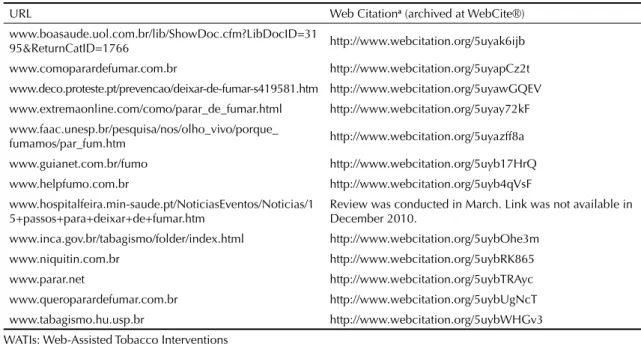
Websites were classifi ed as: 1) product sales only (no treatment components were available on the website itself), 2) libraries (sites that contained smoking-related articles but no clear organization or guidance for a smoker wishing to quit), 3) links to other sites, including references to hotline phone numbers and bookstores such as Amazon.com, 4) clinics and practitioners advertising, 5) advocacy sites, 6) professional education designed for health care providers, 7) non-Portuguese sites or abandoned websites (e.g., a return of “404 fi le not found” or similar error message), 8) site content not smoking-related and 9) WATIs, defi ned as the “provi-sion of organized, directive information and support
services relevant to the process of quitting smoking”2
(Table 1).
We used the Smoking Treatment Scale- Content (STS-C) and the Smoking Treatment Scale- Rating
(STS-R) developed by Bock and collaborators1,2 to
assess the content coverage, interactivity and accuracy.
STS-C is a 12-item checklist developed to document the extent to which each website covered material related to key components of treatment as described in the US Public Health Service Clinical Practice Guideline (PHS
Guidelines) for the treatment of tobacco dependence.4
The 12 items on the STS-C are: (1-2) advise every smoker to quit smoking (subdivided into two categories: clear/strong and personalized), (3) assess readiness to quit, (4-5) assist with a quit plan (subdivided into three actions related to setting a quit date and seven topics for providing practical counseling), (6) provide intra-treatment social support, (7) recommend use of approved pharmacotherapy, (8) arrange follow-up, and four areas aimed at enhancing motivation to quit by discussing the (9) relevance of quitting smoking, (10) the risks of continued smoking, (11) the rewards of quitting, and (12) the potential roadblocks or barriers to quitting smoking.
STS-R provides numeric ratings of quality of coverage for each of the key components of treatment docu-mented in the STS-C. Each website received ratings for coverage, accuracy, and interactivity. Coverage ratings were used to indicate the relative depth and breadth of the information provided in each topic area. Ratings use a 5-point scale, ranging from 1 (not mentioned) to 5 (extensive information given). Accuracy was rated on a 3-point scale (3 = totally correct; 2 = mostly correct; and
b Central Intelligence Agency (CIA). The World Factbook 2010. Washington, DC: Central Intelligence Agency; 2010 [cited 2011 Aug 31]. Available from: https://www.cia.gov/library/publications/the-world-factbook/geos/br.html
c Barbosa AF, coordinator. Survey on the use of information and communication technologies in Brazil: ICT Households and ICT Enterprises 2010. São Paulo: Comitê Gestor da Internet no Brasil; 2011.
d Instituto Nacional do Câncer (Brasil), Coordenação Nacional de Prevenção e Vigilância, Divisão de Controle do Tabagismo e Outros Fatores de Risco. Processo de implantação do tratamento para deixar de fumar no SUS. Rio de Janeiro: INCa; 2006.
e Ministério da Saúde (Brasil). Secretaria de Gestão Estratégica e Participativa, Departamento de Ouvidoria do SUS. Relatório Temático: Tabagismo. 2010. Brasília (DF): Ministério da Saúde; 2011 [cited 2011 Aug 30]. Available from: http://portal.saude.gov.br/portal/arquivos/pdf/ relatorio_tabagismo_2010.pdf
1 = signifi cant misinformation or potentially dangerous errors). Reviewers also rated (yes; no) whether the website incorporated a user-interactive feature for key treatment components (personalized feedback, email follow-up, etc.).
We used criteria developed by the Health on the Net Foundation (HON), a non-profi t, non-governmental organization, accredited to the Economic and Social Council of the United Nations6 to analyze credibility
and trustworthiness. Five criteria used were: informa-tion must be authoritative; the purpose of the website must be stated; confi dentiality policies must be clearly described; website contact details must be accessible; sites must declare sources of funding and the
adver-tising policy must be displayed.g Three HON criteria
were not included in the analysis as they were related to scientifi c quality of the content, and therefore redundant with the analysis on content accuracy described above.
Internet search data was collected on August 2011, rela-tive to 2010. Website searches were conducted between February and March 2010.
Websites identifi ed were classifi ed by at least two of the four authors of this manuscript. Discrepancies were discussed and resolved by involving a third author, when necessary.
The content and quality of the WATIs identifi ed were independently reviewed by two investigators (fi rst
two authors, both PhDs with research experience in substance abuse treatment, including tobacco depen-dence). The two reviewers discussed their independent ratings, identifi ed discrepancies and reached consensus. The information credibility and trustworthiness of the websites were analyzed independently by two authors. Ratings were compared and discrepancies were resolved by consensus.
RESULTS
An average of 618,500 computer-based and 23,946 mobile telephone-based stop smoking-related searches were conducted in Brazil per month in 2010 (Table 2).
We identifi ed 12 tobacco-related online communities in Orkut, with 36,535 members. Facebook had 31 pages on the same topic, with low participation (207 members, 872 friends and 2,389 “likes”).
One hundred and thirteen unique websites were identifi ed using the procedures described. The most frequent type of website identifi ed was “library-type” containing a collection of random articles on tobacco use prevention and treatment (29.2%), followed by clinical services advertising (18.6%), WATIs (11.5%) and professional education (10.6%). The remaining were invalid links, product sales and sites in languages other than Portuguese.
Table 1. Web-assisted tobacco interventions (WATIs) selected and reviewed. Brazil, 2010.
URL Web Citationa (archived at WebCite®)
www.boasaude.uol.com.br/lib/ShowDoc.cfm?LibDocID=31
95&ReturnCatID=1766 http://www.webcitation.org/5uyak6ijb
www.comoparardefumar.com.br http://www.webcitation.org/5uyapCz2t www.deco.proteste.pt/prevencao/deixar-de-fumar-s419581.htm http://www.webcitation.org/5uyawGQEV www.extremaonline.com/como/parar_de_fumar.html http://www.webcitation.org/5uyay72kF www.faac.unesp.br/pesquisa/nos/olho_vivo/porque_
fumamos/par_fum.htm http://www.webcitation.org/5uyazff8a
www.guianet.com.br/fumo http://www.webcitation.org/5uyb17HrQ www.helpfumo.com.br http://www.webcitation.org/5uyb4qVsF www.hospitalfeira.min-saude.pt/NoticiasEventos/Noticias/1
5+passos+para+deixar+de+fumar.htm Review was conducted in March. Link was not available in December 2010. www.inca.gov.br/tabagismo/folder/index.html http://www.webcitation.org/5uybOhe3m
www.niquitin.com.br http://www.webcitation.org/5uybRK865 www.parar.net http://www.webcitation.org/5uybTRAyc www.queroparardefumar.com.br http://www.webcitation.org/5uybUgNcT www.tabagismo.hu.usp.br http://www.webcitation.org/5uybWHGv3 WATIs: Web-Assisted Tobacco Interventions
a WebCite® is an on-demand archiving system for web references (cited webpages and websites, or other kinds of digital
objects accessible via the internet), which can be used by authors, editors, and publishers of scholarly papers and books, to ensure that cited web material will remain available to readers in the future. http://www.webcitation.org/
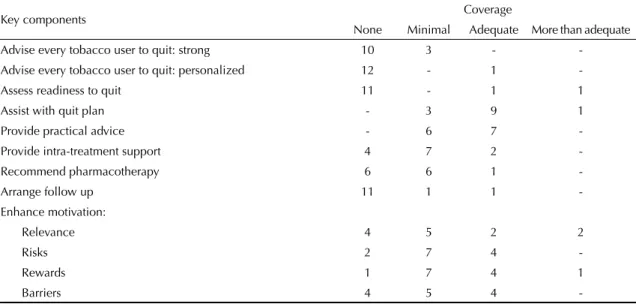
Two topics were covered by all 13 WATIs identifi ed: “Assistance in quitting” and “Practical counseling” (Table 3). These were also the only topics for which the majority of websites displayed adequate coverage (nine and seven of 13, respectively). Pharmacotherapy was recommended by seven of the 13 WATIs analyzed; mostly with minimal content (only one was rated “adequate” for this topic).
Other topics addressed by the majority of the sites were related to motivation to quit (risks, rewards and barriers associated with the quitting process). The content of these topics were mostly rated as “minimal” (Table 3).
The coverage of the subtopics addressed in the compo-nent “Assistance in Quitting” did not present wide variation among the WATIs analyzed: 12 mentioned both the importance of setting up a quit date and making changes before quitting, while ten introduced the notion of planning to quit. The component “Practical Counseling” presented a little more variation: 12 websites recommended getting prepared to face chal-lenges and triggers to relapse, nine sharing the deci-sion to quit with family and friends, nine removing tobacco products from the immediate environment, nine stressed the importance of total abstinence after the quit
date, and eight recommended avoiding alcohol in the fi rst weeks after quitting. Five offered practical advice on how to relate to other smokers in the household and four suggested users refl ect on prior attempts quitting.
The coverage for intra-treatment support was mostly minimum, with only a sentence or two encouraging the patient in the quit attempt and expressing caring and concern (four) or encouraging the smoker to talk about the quitting process (fi ve).
No websites had content related to arranging outside support such as chat rooms or internet buddies. The absence of this subcomponent was congruent with the lack of provision for follow-up by 11 websites.
No websites included in the study showed adequate coverage of all key treatment components recom-mended by the PHS Guidelines (Table 3).
The majority of WATIs analyzed (eight) lacked any interactive features and no customization capabilities. Three WATIs presented one interactive feature, related to delivering results of nicotine dependence tests. Two websites included several interactive components, making it possible to tailor the content delivered according to smokers’ response.
Table 2. Google-based internet searches utilizing terms related to stopping smoking. Brazil,a 2010 (monthly average).
Components of advice on stopping smoking Computer Mobile telephone Total
How to quit smoking 417,500 19,700 437,200
Tobacco dependence 165,000 2,900 167,900
How to stop/ give up smoking 33,100 1,300 34,400
Tobacco dependence treatment 2,900 46,000 2,946
Total 618,500 23,946 642,446
a In Brazilian Portuguese
Table 3. Website coverage of key components of tobacco dependence treatment (absolute numbers; total = 13). Brazil, 2010.
Key components Coverage
None Minimal Adequate More than adequate
Advise every tobacco user to quit: strong 10 3 -
-Advise every tobacco user to quit: personalized 12 - 1
-Assess readiness to quit 11 - 1 1
Assist with quit plan - 3 9 1
Provide practical advice - 6 7
-Provide intra-treatment support 4 7 2
-Recommend pharmacotherapy 6 6 1
-Arrange follow up 11 1 1
-Enhance motivation:
Relevance 4 5 2 2
Risks 2 7 4
-Rewards 1 7 4 1
-Most WATIs displayed accurate content, except for two websites: One website recommended a 12-month process of tapering before quitting, hiding one’s deci-sion to quit from friends and family, and advice to simply enjoy smoking a cigarette in the event of a lapse after one’s quit date. These recommendations confl ict
with Brazilian Clinical Guidelinesd and the US PHS
Clinical Guidelines.4 A second website stated: “After
thinking through the pros and cons of smoking, if you decide not to quit, go ahead and continue smoking”, instead of providing information on the important benefi ts of quitting and encouraging smokers to make a decision to quit.
Other mistakes were related to suggestions that phar-macotherapy was not helpful in the process of quitting and/or comparing approved pharmacotherapy for stop-ping smoking to non-evidence-based methods such as hypnosis.
The WATIs analyzed presented signifi cant credibility and trustworthiness issues. The majority of websites did not clarify their privacy policies (Table 4). When privacy statements were available, they were not necessarily assuring users their data would remain private. One website requested full name, complete address and the register (Natural Persons Register), the Brazilian equiva-lent of Social Security Number) for website access. These requirements were followed by a disclaimer stating the data could be used “by the pharmaceutical company who sponsored the site or by companies they contract with to respond to user’s requests or to contact users in order to improve their services.”
Lack of advertisement policy statements were also common, as six out of the eight websites displaying ads made no distinction between editorial content and paid advertisements.
Other issues less frequently detected were a lack of authorship and/or credentials, no fi nancial disclosure and absence of valid contact addresses for further ques-tions (Table 4).
DISCUSSION
The 113 websites identifi ed presented mostly random collections of information and articles, provider’s advertising or health professional education. Thirteen websites offered systematic support for quitting (WATIs).
WATIs – if developed according to evidence-based guidelines – can become one more source of informa-tion on tobacco dependence and encouragement to quit among the growing segment of Brazilian smokers who have access to, and use, the internet. This does not mean that WATI should be seen as the solution to tobacco cessation support in Brazil, a country where tobacco cessation treatment can be obtained at no cost through SUS. An important limitation of WATI is that, despite the continuing growth of internet access and utilization in Brazil, signifi cant disparities in access still exist, particularly in rural areas and among socioeconomically
disadvantaged groups.c
Demand for online stop smoking information, services and support is high in Brazil, surpassing half a million online searches per month. Such high interest suggests that WATIs can play an important role in comple-menting or enhancing stop smoking resources already available through SUS or offer evidence-based support for those not able or interested in attending traditional face-to-face interventions. Two recent regional surveys suggest that health care providers in Brazil make strong moral judgments about smokers: tobacco use ranked fi rst in moral judgment among health providers, when compared with marijuana and cocaine use, alcohol dependence, aids, obesity, depression, Hansen’s disease and schizophrenia.9,h Educating providers on the
impor-tance of providing non-judgmental support to those affected by tobacco dependence should be a national priority. The internet has the ability to provide some level of anonymity for smokers who may experience moral judgment from clinicians. Moreover, the internet is versatile, as it can be accessed at any time of day, without needing to leave the house. Tobacco cessation
Table 4. Credibility and trustworthiness indicators of 13 WATIs in Portuguese, according to Health on the Net Foundation items. Brazil, 2010.
Indicators No Yes Comments
Privacy – describe how data is handled, cookie technology 7 4 2 not applicable – only PDF link Advertising policy – distinguish editorial content from
advertisements 6 2 5 does not apply – no advertisement
Authorship- Identify authors and their credentials 5 8
-Transparency – valid email contact for further inquiry 4 9
-Financial disclosure – identify sources of funding 4 9
-WATIs: Web-Assisted Tobacco Interventions
support through SUS, although of high quality and provided at no cost, is available only during business hours and requires travelling to an accredited center to participate in group counseling.
Despite the potential of WATIs in broadening Brazilian smokers’ options of support for giving up, our study suggests that WATIs currently available are neither appropriate nor suffi cient to have a positive health impact on rates of giving up smoking. Future studies should develop and test the feasibility and acceptability of evidence-based Portuguese-language WATIs among different segments of Brazilian society (including different age, educational and income groups, urban vs. rural, etc.), followed by rigorous controlled trials to determine its effi cacy among diverse populations.
Brazilian WATIs provided adequate content in two areas: how to develop a quitting plan and practical counseling. Other key elements of evidence-based inter-ventions were not present, such as follow up or provi-sion of intra-treatment support (Table 3). Portuguese WATIs tended to not disclose on confi dentiality and advertisement policies, making it diffi cult for their potential users to make decisions about the safety of downloading materials or providing email to get support for quitting (Table 4).
Several of our fi ndings for WATIs in Portuguese are similar to Bock et al for WATIs in English in 2007:2,3 a)
most of the websites identifi ed did not offer systematic support for quitting; b) the capacity of the internet to customize and tailor interventions was underutilized in the sites analyzed; and c) follow-up after fi rst interven-tion was not common. Despite these similarities, some WATIs in English displayed extensive coverage of key elements of evidence-based tobacco cessation and used
interactive features to customize support,2 which we did
not fi nd in Brazilian WATIs.
These fi ndings document a missed opportunity to make evidence-based support available online to Brazilian smokers, given that 45.6% of Brazilian smokers reported attempting to quit in the past 12 months, the majority without guided support.a
This study has limitations, including the inability to determine the socioeconomic characteristics of those looking for tobacco information through online chan-nels in Brazil and lack of information on utilization patterns of the websites identifi ed.
This study documents a high demand for tobacco cessation related information in Brazil and the lack of availability of online resources that can respond effec-tively to this demand. The development of WATIs that comply with clinical guidelines for stopping smoking and the conducting of randomized trials to determine WATIs’ effi cacy among Brazilian Portuguese-speakers smokers are the recommended next steps for advancing our knowledge in this area.
ACKNOWLEDGEMENTS
1. Bock BC, Graham AL, Sciamanna CN, Krishnamoorthy J, Whiteley J, Carmona-Barros R, et al. Smoking cessation treatment on the Internet: content, quality, and usability.
Nicotine Tob Res. 2004;6(2):207-19. DOI:10.1080/14622200410001676332 2. Bock BC, Graham AL, Whiteley JA, Stoddard JL.
A review of web-assisted tobacco interventions (WATIs). J Med Internet Res. 2008;10(5):e39. DOI:10.2196/jmir.989
3. Eysenbach G, Köhler C. How do consumers search for and appraise health information on the world wide web? Qualitative study using focus groups, usability tests, and in-depth interviews. BMJ.2002;324(7337):573-7. DOI:10.1136/bmj.324.7337.573
4. Fiore MC, Jaén CR, Baker TB, Bailey WC, Benowitz NL, Curry SJ, et al. Treating tobacco use and dependence: 2008 Update; clinical practice guideline. Rockville: US US Department of Health and Human Services; 2008.
5. Muñoz RF, Barrera AZ, Delucchi K, Penilla C, Torres LD, Pérez-Stable EJ. International Spanish/English Internet smoking cessation trial yields 20% abstinence rates at 1 year. Nicotine Tob Res. 2009;11(9):1025-34. DOI:10.1093/ntr/ntp090
6. Myung SK, McDonnell DD, Kazinets G, Seo HG, Moskowitz JM. Effects of Web- and computer-based smoking cessation programs: meta-analysis of randomized controlled trials.
Arch Intern Med. 2009;169(10):929-37. DOI:10.1001/archinternmed.2009.109 7. Riper H, Spek V, Boon B, Conijn B, Kramer J,
Martin-Abello K, Smit F. Effectiveness of E-self-help
interventions for curbing adult problem drinking: a meta-analysis. J Med Internet Res. 2011;13(2):e42. DOI:10.2196/jmir.1691
8. Ronzani TM, Higgins-Biddle J, Furtado EF. Stigmatization of alcohol and other drug users by primary care providers in Southeast Brazil. Soc Sci Med. 2009;69(7):1080-4. DOI:10.1016/j.socscimed.2009.07.026
9. Ruwaard J, Schrieken B, Schrijver M, Broeksteeg J, Dekker J, Vermeulen H, et al. Standardized web-based cognitive behavioural therapy of mild to moderate depression: a randomized controlled trial with a long-term follow-up. Cogn Behav Ther.2009;38(4):206-21. DOI:10.1080/16506070802408086
10. Seidman DF, Westmaas JL, Goldband S, Rabius V, Katkin ES, Pike KJ, et al. Randomized controlled trial of an interactive internet smoking cessation program with long term follow-up. Ann Behav Med. 2010;39(1):48-60. DOI:10.1007/s12160-010-9167-7
11. Singh PM, Wight CA, Sercinoglu O, Wilson DC, Boytsov A, Raizada MN. Language preferences on websites and in Google searches for human health and food information. J Med Internet Res.
2007;9(2):e18. DOI:10.2196/jmir.9.2.e18
12. World Health Organization. The world health report: 2002: reducing risks, promoting healthy life. Geneva; 2002.
13. World Health Organization. WHO Framework Convention on Tobacco Control. Geneva; 2003.
14. World Health Organization. WHO report on the global tobacco epidemic, 2011: warning about the dangers of tobacco. Geneva; 2011.
REFERENCES
The authors declare no confl icts of interest.
Corrigenda
Rev Saude Publica. 2012;46(3):1074
Correspondência (nome do destinatário) | Correspondence (recipient’s name):
Onde se lê | Where it reads
Beatriz H Carlin
Leia-se | It should read
Beatriz H Carlini
Rev Saude Publica. 2012;46(3):1080
Inclusão de Agradecimentos | Inclusion of Acknowledgements:
Leia-se | It should read
Acknowledgements
Dr. Beth Bock, Associate Professor of Psychiatry & Human Behavior at Brown Medical School and the Miriam Hospital for sharing the standardized forms STS-C and STS-R used in this paper. Support from Conselho