INTRODUCTION
Article/Artigo
Evaluation of the use of real-time PCR for human T cell lymphotropic
virus 1 and 2 as a conirmatory test in screening for blood donors
Análise do uso da PCR em tempo real para HTLV-1 e 2 como teste conirmatório na triagem
de doadores de sangue
Rafaela Gomes Andrade
1,2, Maísa Aparecida Ribeiro
1,2, Maria Sueli Silva Namen-Lopes
1,2, Sônia Mara Nunes
Silva
1, Fernando Valadares Basques
1, João Gabriel Ribas
1, Anna Bárbara de Freitas Carneiro-Proieti
1,2and
Marina Lobato Martins
1,2ABSTACT
Introduction: HTLV-1/2 screening among blood donors commonly utilizes an enzyme-linked immunosorbent assay (EIA), followed by a conirmatory method such as Western blot (WB) if the EIA is positive. However, this algorithm yields a high rate of inconclusive results, and is expensive. Methods: Two qualitative real-time PCR assays were developed to detect HTLV-1 and 2, and a total of 318 samples were tested (152 blood donors, 108 asymptomatic carriers, 26 HAM/TSP patients and 30 seronegative individuals). Results: he sensitivity and speciicity of PCR in comparison with WB results were 99.4% and 98.5%, respectively. PCR tests were more eicient for identifying the virus type, detecting HTLV-2 infection and deining inconclusive cases. Conclusions: Because real-time PCR is sensitive and practical and costs much less than WB, this technique can be used as a conirmatory test for HTLV in blood banks, as a replacement for WB.
Key-words: HTLV. Blood donors. Real-time PCR. Western blot.
RESUMO
Introdução: A triagem para HTLV-1/2 em doadores de sangue geralmente utiliza imunoensaio enzimático, seguido de um método conirmatório como Western blot quando o EIA é positivo, mas este algoritmo mostra alta taxa de resultados inconclusivos, e elevado custo. Métodos: Dois ensaios qualitativos de PCR em tempo real foram desenvolvidos para detectar HTLV-1 e 2 e um total de 318 amostras foram testadas por PCR (152 de doadores de sangue, 108 de portadores assintomáticos, 26 de pacientes HAM/TSP e 30 de indivíduos soronegativos). Resultados:
A sensibilidade e especiicidade das PCR em relação aos resultados de WB foram de 99,4% e 98,5%, respectivamente. As PCR foram mais eicientes em identiicar o tipo viral, a infecção pelo HTLV-2 e úteis para deinir casos inconclusivos. Conclusões: Por serem sensíveis, práticas e de custo muito inferior ao do WB, as técnicas de PCR em tempo real podem ser usadas como teste conirmatório do HTLV em bancos de sangue, em substituição ao WB.
Palavras-chaves: HTLV. Doadores de sangue. PCR em tempo real. Western blot.
1. Minas Gerais State Blood Center, Belo Horizonte, MG, Brazil. 2. Interdisciplinary HTLV Research Group, Belo Horizonte, MG, Brazil.
Address to: Drª Marina Lobato Martins. Gerência de Desenvolvimento Técnico Cientíico. Fundação HEMOMINAS. Al. Ezequiel Dias 321, 30130-110 Belo Horizonte, MG.
Phone: 55 31 3248-4587; Fax: 55 31 3284-9579 e-mail: [email protected]
Received in 24/09/2009 Accepted in 04/02/2010
he human T cell lymphotropic virus (HTLV) is nowadays classiied into four types: 1, 2, 3 and 4. he type 1 virus (HTLV-1) has been identiied on all ive continents, and its areas of great prevalence include Japan, Sub-Saharan Africa, Caribbean basin, South America, Melanesia and the Middle East1. he
type 2 virus (HTLV-2) is endemic in African and American Indian populations2,3, and its worldwide
distribution has been ascribed to transmission among intravenous drug users. HTLV-3 and 4 have recently been discovered in a rural area of southern Cameroon4 and, at present, they are restricted to
that region.
HTLV-1 is etiologically associated with adult T cell leukemia5 and with HTLV-associated myelopathy/
tropical spastic paraparesis (HAM/TSP)6, which is a
chronic neurological inlammatory disease of slow progression. Other inlammatory diseases such as uveitis, polymyositis, arthritis and alveolitis7, as well
as infective dermatitis8 and some types of skin lesions9,
are also associated with type 1. Approximately 95% of HTLV-1 carriers remain asymptomatic throughout their lives, whereas about 5% develop diseases associated with the virus.
Some studies have reported cases of HAM/TSP-like manifestations, as well as greater susceptibility to bacterial infections, in carriers of HTLV-210.
HTLV-1 and 2 are transmitted sexually and vertically (by breastfeeding)11, as well as being
transmited parenterally, by contaminated blood transfusion12, sharing of contaminated needles and
syringes13, or transplantation of infected organs and
tissues14.
METHODS
in Indian tribes, although it is also found in urban populations, particularly among intravenous drug users16. Blood donor screening
for HTLV was introduced in Brazil in November 1993.
According to the Brazilian standard, screening for HTLV-1/2 among blood donors must be done by a highly sensitive test such as an enzyme-linked immunosorbent assay (EIA) or a chemical luminescence test. Use of a second test to confirm the reactivity of a sample is not mandatory. The majority of blood banks use EIA as screening test for HTLV-1/2. If the test result is positive or indeterminate, the sample is tested again using EIA in duplicate. If it remains positive or indeterminate, the associated blood products are discarded. The donor is asked to provide a second sample, and if it is EIA-positive or indeterminate, a Western blot (WB) test is used to confirm the serological status. This algorithm has a high cost, making the use of WB unviable for many Brazilian blood centers. In addition, it generates a relatively high rate of inconclusive results, due especially to the indeterminate nature of WB results17-20.
Detection of the viral genome of samples using PCR is a gold standard with high sensitivity and speciicity. Its use, which was initially restricted to research studies, is becoming more and more applicable to routine services due to reductions in the costs of molecular biology reagents and the introduction of real-time PCR methods. Several studies have described diferent real-time PCR protocols for HTLV-1/2 with the aim of quantifying the proviral load21-23, which is considered to be a risk marker for the development
of virus-associated diseases.
Differently from the previous studies, we evaluated the performance of two qualitative real-time PCR protocols for speciic detection of HTLV-1 and HTLV-2 that might present high sensitivity and low cost, in order to increase the viability of their use as routine conirmatory tests in blood banks.
Samples
We tested a total of 318 blood samples collected in Vacutainer® tubes containing EDTA. One hundred and fifty-two (47.7%) samples were obtained from blood donors whose initial test results had been EIA-positive or indeterminate for HTLV-1/2, and who returned to the Hemominas Foundation to have a second sample collected and tested by EIA and WB. he remaining 166 (52.3%) samples were from GIPH (Interdisciplinary HTLV Research Group) cohort participants. his cohort is following up HTLV-positive/ indeterminate blood donors at the Blood Center of Belo Horizonte (part of the Hemominas Foundation), and also includes seronegative blood donors and HAM/TSP patients from the Sarah Network of Rehabilitation Hospitals (Belo Horizonte, State of Minas Gerais). The samples from the cohort included asymptomatic carriers (n = 108), HAM/TSP patients (n = 26), and seronegative individuals (n = 30), along with two individuals whose serological tests were inconclusive (EIA positive/WB indeterminate).
Serological tests for HTLV-1/2
During the study period (2007 to 2008), two HTLV-1/2 EIA kits were used for screening tests: Murex HTLV-I+II (Murex Biotech Ltd, UK) and Ortho HTLV-I/HTLV-II Ab-Capture ELISA Test System (Ortho Clinical Diagnostics Inc., USA). These kits use recombinant antigens and synthetic peptides, respectively. he tests
were conducted in accordance with the manufacturer’s instructions. Serum samples with OD/CO (optical density sample/cutof) lower than 0.8 were considered negative. Results between 0.8 and 1.2 were deemed indeterminate, and results greater than or equal to 1.2 were considered positive for HTLV-1/2. A WB kit (WB HTLV 2.4, Genelabs Diagnostics, USA) was used as a conirmatory test and the results were interpreted in accordance with the manufacturer’s criteria, as follows: (1) HTLV-1 positive: GAG reactivity (p19 with or without p24) and two ENV bands (GD21 and rgp46-I); (2) HTLV-2 positive: GAG reactivity (p24 with or without p19) and two ENV bands (GD21 and rgp46-II); (3) HTLV-positive without virus type: GAG reactivity (p19 and p24) and ENV (GD21); (4) indeterminate: detection of speciic bands without fulilling the criteria of positivity for HTLV-1/2; or (5) negative: without reactivity for any speciic HTLV bands.
Real-time PCR for HTLV-1 and 2
Peripheral blood DNA was extracted and purified in columns (QIAamp DNA Blood kit, QIAGEN GmbH, Hilden, Germany), in accordance with the manufacturer’s instructions. We performed two qualitative molecular tests for speciic detection of HTLV-1 and HTLV-2, using real-time PCR with TaqMan chemistry. One reaction was designed to detect both HTLV-1 and the human albumin gene. Because this was a qualitative assay, human gene ampliication was used as a control for ampliication of the DNA sample and not for estimating the input of the cells present in each sample. he primers and probe for the albumin gene ampliication were applied at a lower concentration than that used to amplify the viral gene, in order to avoid competition for reagents during the reaction. HTLV-2 detection was performed in a separate reaction vessel, but using the same HTLV-1 PCR temperature conditions, which enabled testing for both virus types simultaneously.
The primers and probes were as previously described24.
DNA (5μml) was used in the HTLV-1 reaction, presenting a inal volume of 25μl consisting of 12.5μl of TaqMan PCR Master Mix (Applied Biosystems, CA, USA), 250nM of HTLV-1F (5’-GAACGCTCTAATGGCATTCTTAAAACC–3’), 250nM of HTLV-1R (5’-GTGGTGATGTCCATAGGGCTAT–3’) and 200nM of HTLV-1P (5’-FAM-ACAAACCCGACCTACCC-MGB-3’) for HTLV-1 pol region amplification; and 150nM of ALB-F (5’-GCTCAACTCCCTATGCTATCACA–3’), 150nM of ALB-R (5’-GGGCATGACAGGTTTTGCAATATTA–3’) and 100nM of ALB-P (5’-VIC-TGTGGGCTGTAATCAT-MGB-3’) for human albumin gene ampliication.
he reaction to detect HTLV-2 (pol region) was performed using 5μl of DNA in a volume of 25μl containing 12.5μl of TaqMan PCR Master Mix (Applied Biosystems, CA, USA), 250nM of HTLV-2F (5’-CAACCCCACCAGCTCAGG–3’), 250nM of HTLV-2R (5’-GGGAAGGTAGGACAGTCTAGTAGATA–3’) and 250nM of HTLV-2P (5’-FAM-TCGAGAGAACCAATGGTATAAT-MGB- 3’).
Both reactions were performed in the ABI 7,300 apparatus (Applied Biosystems, CA, USA), under the following cycle conditions: 2 min at 50oC and 10 min at 95oC, followed by 45 cycles
of 15s at 95oC and 1 min at 60oC. DNA from the MT2 cell line, which
RESULTS
DISCUSSION
Ethics commitee approval
his study was approved by the Ethics Commitee for Research Involving Human Beings of the Hemominas Foundation.
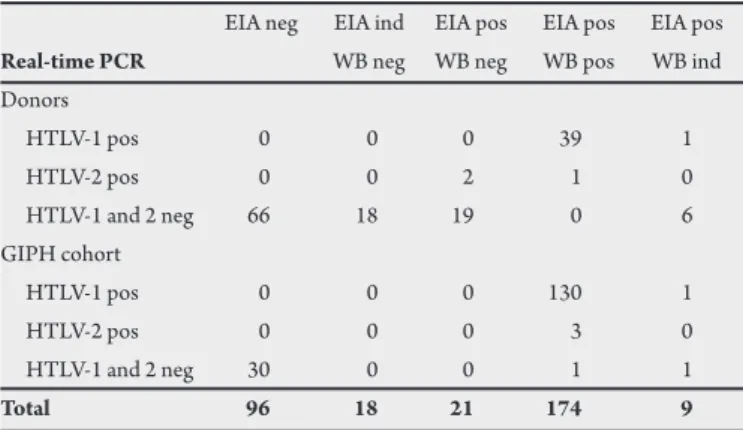
he real-time PCR results for HTLV-1 and HTLV-2 from the 318 samples tested are shown in Table 1, according to the serological results. Taking into account the samples that were WB-positive (n = 174) or negative (n = 39), and the ones that were EIA-negative (n = 96) but were not tested using WB, the sensitivity and speciicity of the PCR were 99.4% and 98.5%, respectively.
TABLE 1 - Real-time PCR results for HTLV-1 and HTLV-2, according to serological results of the analyzed samples.
EIA neg EIA ind EIA pos EIA pos EIA pos
Real-time PCR WB neg WB neg WB pos WB ind
Donors
HTLV-1 pos 0 0 0 39 1
HTLV-2 pos 0 0 2 1 0
HTLV-1 and 2 neg 66 18 19 0 6
GIPH cohort
HTLV-1 pos 0 0 0 130 1
HTLV-2 pos 0 0 0 3 0
HTLV-1 and 2 neg 30 0 0 1 1
Total 96 18 21 174 9
pos: positive, neg: negative, ind: indeterminate.
EIA: enzyme-linked immunosorbent assay, WB: Western blot, GIPH: Interdisciplinary HTLV Research Group.
TABLE 2 – Serological and molecular results for HTLV-1 and 2 on an individual in the GIPH cohort with HTLV-indeterminate WB results, Belo Horizonte, Brazil.
Real-time PCR
Date EIA (OD/CO)* WB HTLV-1 HTLV-2
Nov 23, 2007 positive (6.1) GD21 + rgp46-I not done not done Feb 11, 2008 positive (8.5) GD21 + rgp46-I positive negative Apr 17, 2008 positive (6.9) GD21 + rgp46-I positive negative *OD/CO: optical density/sample cutof, EIA: enzyme-linked immunosorbent assay, WB: Western blot.
We found only one false-negative PCR result. his was from a sample from a GIPH cohort participant, an asymptomatic 38-year-old male whose EIA and WB tests done in 2004 and 2008 were positive for HTLV-1. he samples collected in 2004, 2007 and 2008 were tested by means of nested PCR for HTLV-1 at the time of collection, but they were negative. he last sample collected from this individual (in 2008) was tested using real-time PCR, but it was also negative.
Two other results were discordant between the molecular and WB tests. In these cases, the samples were EIA-positive (OD/CO of 25.1 and 2.5), but with a negative result from WB. We tested these samples twice using PCR and they were both negative for HTLV-1 and positive for HTLV-2, thus suggesting that WB failed to detect the type 2 virus.
We also analyzed nine samples that were EIA-positive and WB-indeterminate. Seven were negative for HTLV-1 and 2 using PCR, while two were positive for HTLV-1. One of these samples was from a GIPH cohort participant who had been followed up. As shown in Table 2, he had been tested three times using EIA and WB over a ive-month period, maintaining the indeterminate patern on WB. Nevertheless, PCR conirmed the presence of virus infection in his irst sample.
Out of the 40 blood donor samples that were both EIA and WB-positive (excluding the two individuals who were WB-negative and PCR-positive for HTLV-2), two (5%) did not present reactivity on WB for either of the recombinant proteins (rgp46-I and rgp46-II) that deine whether the infection consists of HTLV type 1 or type 2, respectively. his discrimination was possible through using PCR, such that both samples yielded positive results for HTLV-1.
Among the asymptomatic carriers and HAM/TSP patients from the GIPH cohort, only three (1.7%) were positive for HTLV-2 on PCR; all the rest (98.3%) being identiied as infected by HTLV-1. In the 42 blood donors who were PCR positive, we identiied three cases (7.1%) of HTLV-2 infection (two of which were not detected on WB), and all the remaining cases (92.9%) showed evidence of infection by type 1 virus (HTLV-1).
In order to diagnose HTLV infections, both the ability to detect them and the capability to diferentiate between types 1 and 2 are required. he strategies currently used in Brazilianblood banks for such detection are based on serological tests (EIA followed by WB). he development of new EIA kits for HTLV that use recombinant proteins and synthetic peptides has increased the sensitivity and speciicity of such kits, in comparison with kits that use viral lysate25-27.
In contrast, the WB test for HTLV-1/2 has shown litle development over recent years, and is unsuitable for blood banks because of its high costs and high proportion of indeterminate results28-32. his
situation suggests that there is a need to conirm virus infection by means of molecular tests.
In this study, we evaluated two qualitative analyses for HTLV proviral DNA, using real-time PCR. he assays proved to be highly sensitive and speciic for HTLV-1 and 2 in the great majority of samples. he results indicated that WB failed to detect infection by HTLV type 2, and this was also observed in two other cases that were not included in this study. Previous studies have shown that the conirmatory sensitivity of WB for HTLV-2 is worse than for HTLV-1 and presents a greater frequency of indeterminate or false negative results28-31.
Two (5%) out of the 40 WB-positive samples from blood donors did not present reactivity in the WB test for either of the recombinant proteins (rgp46-I or rgp46-II). his distinction was only possible through using the PCR, thus showing one more advantage of the PCR test in comparison with WB. In addition to conirmation of the presence of the virus, it is very important to diferentiate between HTLV-1 and HTLV-2, because the virus types present associations with diferent outcome diseases.
FINANCIAL SUPPORT ACKNOWLEDGMENTS
CONFLICT OF INTEREST
he authors declare that there is no conlict of interest.
REFERENCES
in donor counseling. In general, indeterminate WB indings do not represent current HTLV infection33, but in high-risk populations
or in endemic areas, an indeterminate WB result may represent a case at the seroconversion stage20,34. By using real-time PCR in
the present study, we found nine samples that were EIA-positive and WB-indeterminate, and two of them (22.2%) were positive for HTLV-1. he data showed that PCR was able to deine cases with inconclusive serological tests, thereby identifying the current viral infection status, because proviral DNA can be detected before an immune response intense enough to be detected in the WB serological test has developed. The proportion of true positive individuals among the indeterminate cases emphasizes the need for caution when considering the indeterminate cases in our population as false-reactive ones.
Countries such as France, Germany and the USA have introduced NAT (nucleic acid testing) for identifying the HIV and HCV genomes during blood donor screening, with the objective of diminishing the immunological window and increasing the safety of transfusions. Unlike the use of NAT for HIV and HCV, we proposed the use of PCR for HTLV testing in routine blood donor screening, only for conirmatory tests on samples that are EIA-positive or indeterminate. Replacing WB with PCR would lead to improvement of the sensitivity and reduction of the costs of the screening. hus, our approach was to develop a qualitative assay, diferently from many real-time PCR tests, which were designed to quantify the proviral load of HTLV-1/2. Because of the sensitivity, simplicity, rapidity in obtaining results and lower cost (approximately one tenth of the cost of WB) of real-time PCR, qualitative PCR assays for HTLV-1 and 2 were shown to be viable as conirmatory tests in blood banks.
Dr. Sam Charache for critically reviewing the manuscript, and the members of GIPH for their cooperation.
Research Support Foundation of the State of Minas Gerais (Fundação de Amparo à Pesquisa do Estado de Minas Gerais; FAPEMIG) and the Hemominas Foundation.
1. Proietti FA, Carneiro-Proietti AB, Catalan-Soares BC, Murphy EL. Global epidemiology of HTLV-I infection and associated diseases. Oncogene 2005; 24:6058-6068.
2. Hall WW, Kubo T, Ijichi S, Takahashi H, Zhu SW. Human T-cell leukemia/ lymphoma virus, type II (HTLV-II): emergence of an important newly recognized pathogen. Sem Virol 1994; 5:165-178.
3. Maloney E, Biggar RJ, Neel JV, Taylor ME, Hahn BH, Shaw GM, et al. Endemic human T cell lymphotropic virus type II infection among isolate Brazilian amerindians. J Infect Dis 1992; 166:100-107.
4. Mahieux R, Gessain A. he human HTLV-3 and HTLV-4 retroviruses: new members of the HTLV family. Pathol Biol 2009; 57:161-166.
5. Tsukasaki K, Hermine O, Bazarbachi A, Ratner L, Ramos JC, Harrington Jr W, et al. Deinition, prognostic factors, treatment, and response criteria of adult T-cell leukemia-lymphoma: a proposal from an international consensus meeting. J Clin Oncol 2009; 27:453-459.
6. De Castro-Costa CM, Araújo AQ, Barreto MM, Takayanagui OM, Sohler MP, da Silva EL, et al. Proposal for diagnostic criteria of tropical spastic paraparesis/ HTLV-I-associated myelopathy (TSP/HAM). AIDS Res Hum Retroviruses 2006; 22:931-935.
7. Carneiro-Proieti AB, Ribas JG, Catalan-Soares BC, Martins ML, Brito-Melo GE, Martins-Filho AO, et al. Infecção e doença pelo vírus linfotrópicos humanos de células T (HTLV-I/II) no Brasil. Rev Soc Bras Med Trop 2002; 35:499-508. 8. Farre L, de Oliveira MF, Primo J, Vandamme AM, Van Weyenbergh J, Bitencourt
AL. Early sequential development of infective dermatitis, human T cell lymphotropic virus type 1-associated myelopathy, and adult T cell leukemia/ lymphoma. Clin Infect Dis 2008; 46:440-442.
9. Nobre V, Guedes AC, Proieti FA, Martins ML, Nassif G, Serufo JC, et al. Increased prevalence of human T cell lymphotropic virus type 1 in patients atending a Brazilian dermatology clinic. Intervirology 2007; 50:316-318.
10. Roucoux DF, Murphy EL. he epidemiology and disease outcomes of human T-lymphotropic virus type II. AIDS Rev 2004; 6:144-154.
11. Take H, Umemoto M, Kusuhara K, Kuraya K. Trasmission routes of HTLV-I: an analysis of 66 families. Jpn J Cancer Res 1993; 84:1265-1267.
12. Okochi K, Sato H, Hinuma Y. A retrospective study on transmission of adult T-cell leukemia virus by blood transfusion: seroconversion in recipients. Vox Sang 1984; 46:245-253.
13. Manns A, Miley WJ, Wilks RJ, Morgan OS, Hanchard B, Wharfe G, et al. Quantitative proviral DNA and antibody levels in the natural history of HTLV-I infection. J Infect Dis 1999; 180:1487-1493.
14. Zarranz Imirizaldu JJ, Gomez Esteban JC, Rouco Axpe I, Perez Concha T, Velasco Juanes F, Allue Susaeta I, et al. Post-transplantation HTLV-1 myelopathy in three recipients from a single donor. J Neurol Neurosurg Psychiatry 2003; 74:1080-1084.
15. Catalan-Soares B, Carneiro-Proieti ABF, Proieti FA. Heterogeneous geographic distribution of human T-cell lymphotropic viruses I and II (HTLV-I/II): serological screening prevalence rates in blood donors from large urban areas in Brazil. Cad Saúde Pública 2005; 21:926-931.
16. Alcantara LC, Shindo N, Van Dooren S, Salemi M, Costa MC, Kashima S, et al. Brazilian HTLV type 2a strains from intravenous drug users (IDUs) appear to have originated from two sources: Brazilian Amerindians and European/North American IDUs. AIDS Res Hum Retroviruses 2003; 19:519-523.
17. Berini CA, Eirin ME, Pando MA, Biglione MM. Human T-cell lymphotropic virus types I and II (HTLV-I and -II) infection among seroindeterminate cases in Argentina. J Med Virol 2007; 79:69-73.
18. Césaire R, Bera O, Maier H, Lezin A, Martial J, Ouka M, et al. Seroindeterminate paterns and seroconversions to human T-lymphotropic virus type I positivity in blood donors from Martinique, French West Indies. Transfusion 1999; 39:1145-1149.
19. Jacob F, Santos-Fortuna E, Azevedo RS, Caterino-de-Araújo A. Performances of HTLV serological tests in diagnosing HTLV infection in high-risk population of São Paulo, Brazil. Rev Inst Med Trop São Paulo 2007; 49:361-364.
20. Mauclère P, Le Hesran JY, Mahieux R, Salla R, Mfoupouendoun J, Abada ET, et al. Demographic, ethnic, and geographic diferences between human T cell lymphotropic virus (HTLV) type I-seropositive carriers and persons with HTLV-I Gag-indeterminate Western blots in Central Africa. J Infect Dis 1997; 176:505-509.
21. Kamihira S, Dateki N, Sugahara K, Hayashi T, Harasawa H, Minami S, et al. Signiicance of HTLV-1 proviral load quantiication by real time PCR as a surrogate marker for HTLV-1-infected cell count. Clin Lab Haematol 2003; 25:111-117.
22. Lee T-H, Chafets DM, Busch MP, Murphy EL. Quantitation of HTLV-I and II proviral load using real time quantitative PCR with SYBR Green chemistry. J Clin Virol 2004; 31:275-282.
24. Tamegão-Lopes BP, Rezende PR, Maradei-Pereira LMC, Lemos JAR. Carga proviral do HTLV-1 e HTLV-2: um método simples através da PCR quantitativa em tempo real. Rev Soc Bras Med Trop 2006; 39:548-552.
25. Andersson S, horstensson R, Ramirez KG, Krook A, von Sydow M, Dias F, et al. Comparative evaluation of 14 immunoassays for the detection of antibodies to the human T-lymphotropic virus types I and II using panels of sera from Sweden and West Africa. Transfusion 1999; 39:845-851.
26. horstensson R, Albert J, Andersson S. Strategies for diagnosis of HTLV-I and HTLV-II. Transfusion 2002; 42:780-791.
27. Vrielink H, Reesink H, Habibuw M, Schuller M, van der Meer C, Lelie P. Comparison of four HTLV-I and HTLV-I + II ELISAs. Vox Sang 1999; 76:187-191.
28. Liu H, Shah M, Stramer SL, Chen W, Weibblen BJ, Murphy EL. Sensitivity and speciicity of human T-lymphotropic virus (HTLV) types I and II polymerase chain reaction and several serologic assays in screening a population with a high prevalence of HTLV-I/II. Transfusion 1999; 39:1185-1193.
29. Morimoto HK, Morimoto AA, Reiche EM, Ueda LT, Matsuo T, Reiche FV, et al. Diiculties in the diagnosis of HTLV-2 infection in HIV/AIDS patients from Brazil: comparative performances of serologic and molecular assays, and detection of HTLV-2b subtype. Rev Inst Med Trop São Paulo 2007; 49:225-230. 30. Poiesz BJ, Dube S, Choi D, Esteban E, Ferrer J, Leon-Ponte M, et al. Comparative
perfomances of an HTLV-I/II EIA and other serologic and PCR assays on samples from persons at risk for HTLV-II infection. Transfusion 2000; 40:924-930. 31. Zehender G, De Maddalena C, Gianotto M, Cavalli B, Santambrogio S,
Orso M, et al. High prevalence of false-negative anti-HTLV type I/II enzyme-linked immunosorbent assay results in HIV type I-positive patients. AIDS Res Human Retrovirol 1997; 13:1141-1146.
32. Zaaijer HL, Cuypers HTM, Dudok De Wit C, Lelie PN. Results of 1-year screening of donors in the Netherlands for human T-lymphotropic virus (HTLV) type I: signiicance of Western blot paterns for conirmation of HTLV infection. Transfusion 1994; 34:877-880.
33. Busch MP, Switzer WM, Murphy EL, homson R, Heneine W. Absence of evidence of infection with divergent primate T-lymphotropic viruses in United States blood donors who have seroindeterminate HTLV test results. Transfusion 2000; 40:443-449.