C a r i o c a C a r i o c a C a r i o c a C a r i o c a C a r i o c a
Severity assessment of acute pancreatitis: applying Marshall scoring system 325
Rev. Col. Bras. Cir. 2015; 42(5): 325-327
Original Article Original Article Original Article Original Article Original Article
DOI: 10.1590/0100-69912015005010
Severity assessment of acute pancreatitis: applying Marshall
Severity assessment of acute pancreatitis: applying Marshall
Severity assessment of acute pancreatitis: applying Marshall
Severity assessment of acute pancreatitis: applying Marshall
Severity assessment of acute pancreatitis: applying Marshall
scoring system
scoring system
scoring system
scoring system
scoring system
Avaliação da gravidade da pancreatite aguda: aplicando o sistema de
Avaliação da gravidade da pancreatite aguda: aplicando o sistema de
Avaliação da gravidade da pancreatite aguda: aplicando o sistema de
Avaliação da gravidade da pancreatite aguda: aplicando o sistema de
Avaliação da gravidade da pancreatite aguda: aplicando o sistema de
pontuação de Marshall
pontuação de Marshall
pontuação de Marshall
pontuação de Marshall
pontuação de Marshall
ANDRÉ LANZA CARIOCA1; DEBORA RODRIGUES JOZALA1; LUCAS OLIVEIRADE BEM1; JOSE MAURODA SILVA RODRIGUES, TCBC-SP1
A B S T R A C T A B S T R A C T A B S T R A C T A B S T R A C T A B S T R A C T
Objective: Objective: Objective: Objective:
Objective: To analyze the effectiveness of the Marshall scoring system to evaluate the severity of acute pancreatitis (AP). Methods
Methods Methods Methods
Methods: We performed a prospective, observational study in 39 patients with AP evaluated by the Marshall scoring system and the Ranson criteria (admission and 48 hours). We assessed the progression of the disease for seven days and compared the data of the two criteria. ResultsResultsResultsResultsResults: Seven patients died during the observation period and one died afterwards. All deaths had shown failure of at least one system by the Marshall method. ConclusionConclusionConclusionConclusionConclusion: The Marshall scoring system may be used as an effective and simplified application method to assess the severity of acute pancreatitis.
Key words: Key words: Key words: Key words:
Key words: Pancreatitis. Multiple Organ Failure. Organ Dysfunction Scores. Pancreatitis, Acute Necrotizing.
1. Departamento de Cirurgia Faculdade de Ciências Médicas e da Saúde (FCMS) – PUCSP, SP, Brasil.
INTRODUCTION
INTRODUCTION
INTRODUCTION
INTRODUCTION
INTRODUCTION
A
cute pancreatitis (AP) is defined as an acute inflammatory process of the pancreas, which can also involve peripancreatic areas or more distant organs, being most commonly caused by gallstones and chronic alcohol consumption1. Its clinical presentation involves abdominal pain in the epigastric and periumbilical region, with referral, for example, to the lumbar region. Nausea, vomiting and fever often accompany the clinical setting and hypotension may be present due to liquid sequestration2.The clinical course of AP is variable, since there are cases of complete resolution and those of occurrence of multiple organ failure, which can be lethal. The determination of AP’s severity is essential in view of the prognosis and proper treatment selection3. Accordingly, various classifications have been proposed to determine the severity of each clinical situation, the one of Atlanta4 being the most used.
Currently, it is assumed that the number of affected organs, the start time and duration of organ dysfunction influence AP’s evolution, which diverges from the Atlanta classification, which includes only the presence or absence of such condition5-7.
Regarding severe AP, the Atlanta classification establishes the Ranson8 or APACHE II9 criteria for characterization of severity. These methods, however, have limitations reported by other studies10-15. In 2008, the review of the Atlanta classifivcation16 defined the severity of acute
pancreatitis, at least in the first week, is based on clinical components and suggested that the persistence of a systemic inflammatory response syndrome and / or organ failure should be considered.
The dysfunction or organ failure is recognized as the most important determinant of prognosis in the early stage17 and is possibly related to bacterial and endotoxin translocation that favor the evolution of the clinical picture for sepsis and for multiple organ failure syndrome. Moreover, there are claims that, in severe AP, there is activation of reflex anti-inflammatory response and reduced immune capacity, which predisposes to organ failure and secondary infections2,18.
For the definition of organ failure, the revision of the Atlanta classification suggested the Marshall scoring system19, establishing a score >2 to determine the failure of an organ. It uses pO2 / FiO2 as parameters for the respiratory system, serum creatinine in mmol / L or mg / dL for renal evaluation and systolic blood pressure in mmHg for the cardiovascular system. This system has been chosen by some authors 11,16,20 due to its convenience.
This paper aims to examine the effectiveness of the Marshall scoring system in evaluating AP severity.
METHODS
METHODS
METHODS
METHODS
METHODS
326
Rev. Col. Bras. Cir. 2015; 42(5): 325-327
C a r i o c a C a r i o c aC a r i o c a C a r i o c a C a r i o c a Severity assessment of acute pancreatitis: applying Marshall scoring system
the Conjunto Hospitalar de Sorocaba. Sociodemographic, clinical, laboratory and radiological data were collected daily by consulting their medical records for up to seven days for all cases. The Ranson and Marshall scoring systems were applied in all patients and compared using the McNemar chi-square test. The research project number 14260 was approved by the Ethics in Human Research Committee of the Faculdade de Ciências Médicas e da Saúde at PUC-SP.
RESULTS
RESULTS
RESULTS
RESULTS
RESULTS
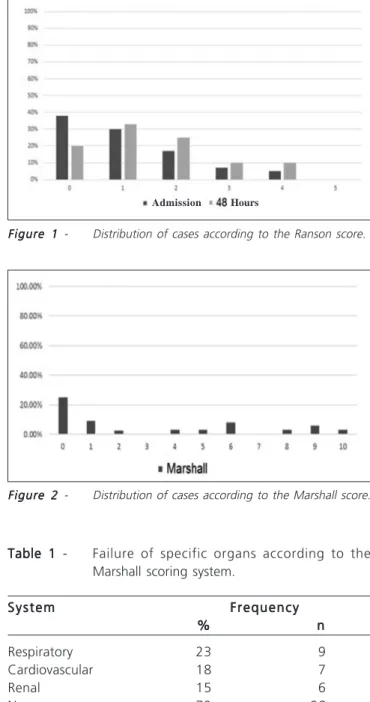
The patients’ ages ranged from 20 to 88 years, 17 were men, and 22, women. The Ranson score mode at admission was zero, and at 48 hours, one (Figure 1). The Marshall system mode was zero (Figure 2).
Of the 39 patients observed, 11 were classified with severe acute pancreatitis by the Marshall system (score >2) and eight patients by the Ranson score (score
>3), with agreement between the two scoring systems in seven cases. When applying the McNemar chi-square test, we found c2 = 1.8 with p = 0.1797, there hence being
agreement between the results presented by both systems (p> 0.05).
Seven patients died in one week and one died after this. Of those who died in seven days, all had some type of organ failure by the Marshall scoring system. Nine patients developed respiratory failure, seven cardiovascular failure and six, kidney failure (Table 1).
Among the patients who died in seven days, three had Ranson score >3 at admission and four showed score >3 in 48 hours. Among those who died, four had high Marshall and Ranson scores, with disagreement only in three cases, in which there were low Ranson scores, but high Marshall ones.
DISCUSSION
DISCUSSION
DISCUSSION
DISCUSSION
DISCUSSION
Several classifications are presented in the literature in an attempt to determine AP severity. The Atlant classification 4 was introduced in 1992 and defined the categories of mild and severe AP. The latter was defined as pancreatitis associated with organ failure or local complications. Organ failure, according to this system, is defined by shock, respiratory failure, renal failure and gastrointestinal bleeding (more than 500 ml / 24 hours). Necrosis, abscess, pseudocyst are among the possible local complications.
The definition for severe AP proposed by the review of the Atlanta classification16 includes persistent systemic inflammatory response and / or development of organ failure. We observed seven patients with organ failure among the dead in a week of hospitalization. However, despite its use established in the Atlanta classification4, it is
Figure 2 Figure 2 Figure 2
Figure 2 Figure 2 - Distribution of cases according to the Marshall score. Figure 1
Figure 1 Figure 1
Figure 1 Figure 1 - Distribution of cases according to the Ranson score.
Table 1 Table 1 Table 1
Table 1 Table 1 - Failure of specific organs according to the Marshall scoring system.
S y s t e m S y s t e mS y s t e m
S y s t e mS y s t e m FrequencyFrequencyFrequencyFrequencyFrequency %
% % %
% nnnnn
Respiratory 23 9
Cardiovascular 18 7
Renal 15 6
None 72 28
Source: medical records of Conjunto Hospitalar de Sorocaba.
a method that requires 48 hours to complete the evaluation, hampering the analysis within the first 24 hours, which is important in view of the prevention of possible adverse events10-12.
Besides the Ranson scoring system, the Atlanta classification also proposes the APACHE II score9, which can be used before 24 hours and correlates better with prognosis. However, it is complex, it requires more time for execution, and does not properly diagnose necrotizing pancreatitis at admission13-15.
Already pointed out and used in other studies as a way to assess AP severity, the Marshall scoring system emerged in the literature as a better applicability proposal
C a r i o c a C a r i o c a C a r i o c a C a r i o c a C a r i o c a
Severity assessment of acute pancreatitis: applying Marshall scoring system 327
Rev. Col. Bras. Cir. 2015; 42(5): 325-327
due to its ease of use16,20,21. Moreover, its specificity is greater than 90% for predicting AP severity at 24 and 48 hours21.
We also found correlation of high Ranson scores with high Marshall scores. Thus, considering that the determination of gravity is essential to the proposed treatment and that this, in turn, is critical for prognosis, it is necessary to use methods that render the best classification in AP cases. When considering organ dysfunction or failure as the central prognostic factor, methods that cover these characteristics have been used with excellent results. In
our study, the strong correlation of scores with clinical outcome confirms the effectiveness of the aforementioned method with regard to the classification of AP severity.
Considering that the Marshall scoring system corresponded with the clinical course of AP patients and the need for a method to evaluate organ failure in determining AP severity, we conclude that the Marshall scoring system can be used as an effective and simplified application method to assess the severity of acute pancreatitis.
R E S U M O R E S U M O R E S U M O R E S U M O R E S U M O
Objetivo: Objetivo: Objetivo: Objetivo:
Objetivo: analisar a eficácia do sistema de pontuação de Marshall na avaliação da gravidade da pancreatite aguda. Métodos:Métodos:Métodos:Métodos:Métodos: foi realizado um estudo prospectivo e observacional em 39 pacientes com PA, avaliados pelo sistema de pontuação dos critérios de Marshall e Ranson (admissão e 48 horas). Foi avaliada a evolução do quadro clínico durante sete dias e comparados os dados dos dois critérios. Resultados:Resultados:Resultados:Resultados:Resultados: sete pacientes morreram durante o período de observação e um morreu após esse período. Todos os óbitos possuíam, pelo sistema de Marshall, falência de pelo menos um sistema. Conclusão:Conclusão:Conclusão:Conclusão:Conclusão: concluímos que o sistema de pontuação de Marshall pode ser utilizado, por ser um método eficaz e de aplicação simplificada, para avaliar a gravidade da pancreatite aguda.
Descritores: Descritores: Descritores: Descritores:
Descritores: Pancreatite. Insuficiência de Múltiplos Órgãos. Escores de Disfunção Orgânica. Pancreatite Necrosante Aguda.
REFERENCES
REFERENCES
REFERENCES
REFERENCES
REFERENCES
1. Carroll JK, Herrick B, Gipson T, Lee SP. Acute pancreatitis: diagnosis, prognosis, and treatment. Am Fam Physician. 2007;75(10):1513-20.
2. Beger HG, Rau BM. Severe acute pancreatitis: Clinical course and management. World J Gastroenterol. 2007;13(38):5043-51. 3. Mayumi T, Takada T, Kawarada Y, Hirata K, Yoshida M, Sekimoto
M, et al. Management strategy for acute pancreatitis in the JPN Guidelines. J Hepatobiliary Pancreat Surg. 2006;13(1):61-7. 4. Bradley EL 3rd. A clinically based classification system for acute
pancreatitis. Summary of the International Symposium on Acute Pancreatitis, Atlanta, Ga, September 11 through 13, 1992. Arch Surg. 1993;128(5):586-90.
5. Petrov MS, Windsor JA. Classification of the severity of acute pancreatitis: how many categories make sense? Am J Gastroenterol. 2010;105(1):74-6.
6. Lankisch PG. Natural course of acute pancreatitis: what we know today and what we ought to know for tomorrow. Pancreas. 2009;38(5):494-8.
7. Buter A, Imrie CW, Carter CR, Evans S, McKay CJ. Dynamic nature of early organ dysfunction determines outcome in acute pancreatitis. Br J Surg. 2002;89(3):298-302.
8. Ranson JH, Rifkind KM, Roses DF, Fink SD, Eng K, Spencer FC. Prognostic signs and the role of operative management in acute pancreatitis. Surg Gynecol Obstet. 1974;139(1):69-81.
9. Knaus WA, Draper EA, Wagner DP, Zimmerman JE. APACHE II: a severity of disease classification system. Crit Care Med. 1985;13(10):818-29.
10. Hirota M, Takada T, Kawarada Y, Hirata K, Mayumi T, Yoshida M, et al. JPN Guidelines for the management of acute pancreatitis: severity assessment of acute pancreatitis. J Hepatobiliary Pancreat Surg. 2006;13(1):33-41.
11. Singh VK, Wu BU, Bollen TL, Repas K, Maurer R, Johannes RS, et al. A prospective evaluation of the bedside index for severity in acute pancreatitis score in assessing mortality and intermediate markers of severity in acute pancreatitis. Am J Gastroenterol. 2009;104(4):966-71.
12. Banks PA, Freeman ML; Practice Parameters Committee of the American College of Gastroenterology. Practice guidelines in acute pancreatitis. Am J Gastroenterol. 2006;101(10):2379-400. 13. Rosa I, Pais MJ, Fátima C, Queiroz A. Pancreatite aguda:
actualização e proposta de protocolo de aborgadem. Acta Med Port. 2004;17(4):317-24.
14. Lankisch PG, Warnecke B, Bruns D, Werner HM, Grossmann F, Struckmann K, et al. The APACHE II score is unreliable to diagnose necrotizing pancreatitis on admission to hospital. Pancreas. 2002;24(3):217-22.
15. Stevens T, Parsi MA, Walsh RM. Acute pancreatitis: problems in adherence to guidelines. Cleve Clin J Med. 2009;76(12):697-704. 16. Acute Pancreatitis Working Group. Revision of the Atlanta
classification of acute pancreatitis (3rd (revision). 2008.
17. Dimagno MJ, Wamsteker EJ, Debenedet AT. Advances in managing acute pancreatitis. F1000 Med Rep. 2009;1:59.
18. Mentula P, Kylänpää ML, Kemppainen E, Jansson SE, Sarna S, Puolakkainen P, et al. Plasma anti-inflammatory cytokines and monocyte human leucocyte antigen-DR expression in patients with acute pancreatitis. Scand J Gastroenterol. 2004;39(2):178-87. 19. Marshall JC, Cook DJ, Christou NV, Bernard GR, Sprung CL, Sibbald
WJ. Multiple organ dysfunction score: a reliable descriptor of a complex clinical outcome. Crit Care Med. 1995;23(10):1638-52. 20. Johnson CD, Abu-Hilal M. Persistent organ failure during the first
week as a marker of fatal outcome in acute pancreatitis. Gut. 2004;53(9):1340-4.
21. Campos T, Parreira JG, Assef JC, Rizoli S, Nascimento B, Fraga GP. Classificação de gravidade na pancreatite aguda. Rev Col Bras Cir. 2013;40(2):164-8.
Received at: 05/11/2014
Accepted for publication: 21/01/2015 Conflict of interest: none.
Source of funding: none.
Mailing address: Mailing address: Mailing address: Mailing address: Mailing address: Lucas Oliveira de Bem