24
Rev. Col. Bras. Cir. 2011; 38(1): 024-027
M o t t i n M o t t i n M o t t i n M o t t i n M o t t i n Using the Prolene Hernia System (PHS) for inguinal hernia repairOriginal ArticleOriginal ArticleOriginal ArticleOriginal ArticleOriginal Article
Using the Prolene Hernia System (PHS) for inguinal hernia repair
Using the Prolene Hernia System (PHS) for inguinal hernia repair
Using the Prolene Hernia System (PHS) for inguinal hernia repair
Using the Prolene Hernia System (PHS) for inguinal hernia repair
Using the Prolene Hernia System (PHS) for inguinal hernia repair
Utilização do Sistema Prolene de Hérnia (SPH) para o reparo de hérnias
Utilização do Sistema Prolene de Hérnia (SPH) para o reparo de hérnias
Utilização do Sistema Prolene de Hérnia (SPH) para o reparo de hérnias
Utilização do Sistema Prolene de Hérnia (SPH) para o reparo de hérnias
Utilização do Sistema Prolene de Hérnia (SPH) para o reparo de hérnias
inguinais
inguinais
inguinais
inguinais
inguinais
CLÁUDIO CORÁ MOTTIN, TCBC-RS1; RAFAEL JACQUES RAMOS2; MAURÍCIO JACQUES RAMOS3
A B S T R A C T A B S T R A C T A B S T R A C T A B S T R A C T A B S T R A C T
Objective: Objective: Objective: Objective:
Objective: To assess immediate postoperative and late complications in patients with inguinal hernia undergoing surgical correction by Gilbert1 technique, using the Prolene Hernia System (PHS). Methods:Methods:Methods:Methods:Methods: We surveyed all patients undergoing inguinal hernia repair
with PHS mesh at The Sao Lucas Hospital – PUCRS, from January 2001 to october 2006. Information was retrospectively collected through telephone calls and chart review. The protocol for data collection included epidemiological aspects, as well as immediate and late complications. Results:Results:Results:Results: ninety-six patients were enrolled. We identified six (6.25%) complications in different patients, none ofResults: which resulting in death. Two patients (2.08%) had seroma; hematoma was identified in one patient (1.04%); one patient (1.04%) had wound infection. Two patients (2.08%) had scrotal edema. After a mean follow up of 49.25 months (range 16 to 86.12) two patients (2.08%) had chronic pain and one patient (1.04%) had hernia recurrence twenty-six months after surgery. Conclusion:Conclusion:Conclusion:Conclusion:Conclusion: The repair of inguinal hernia with PHS is a safe, effective and reproducible method, with low complication and recurrence rates or long term symptoms.
Key words Key words Key words Key words
Key words: inguinal hernia. Surgery. Surgical mesh. Polypropylenes. Treatment outcome.
Work performed at the Department of General and Digestive System Surgery of the Hospital São Lucas, PUCRS, Porto Alegre – Rio Grande do Sul, Brazil.
1. Associate Professor, School of Medicine, PUC-RS-BR; 2. Surgeon Digestive System, Hospital São Lucas, PUC-RS-BR; 3. Master’s Degree in Surgery, UFRGS-RS-BR.
INTRODUCTION
INTRODUCTION
INTRODUCTION
INTRODUCTION
INTRODUCTION
T
he inguinal hernias are among the most common problems faced by surgeons. The tension-free repair, originally described by Lichtenstein in 19891, has becomethe most often used procedure in relation to conventional repairs in the last 15 years due to its technical simplicity and low recurrence rates2.
Several techniques based on the tension-free concept have been developed. The most commonly used besides the Lichtenstein’s3 include: plug and mesh4,
transabdominal pre-peritoneal5 or totally extra-peritoneal6
laparoscopic repair, pre-peritoneal repair of Nyhus7 and,
most recently in 1999, the results published by Gilbert8 of
a new technique for repair of inguinal hernias. This technique employs a polypropylene mesh, known as Prolene Hernia System (PHS), which combines three mechanisms of action. In this study of Gilbert et al8, the
use of PHS mesh resulted in no recurrence and in a 5.8% rate of complications, including seroma, hematoma and infection8.
The results on the PHS mesh are still scarce in the long term due to the short interval in which this method has been applied. Studies comparing PHS and Lichtenstein techniques show promising results, such as reduction in
operative time, less pain in the postoperative follow-up and early return of patients to their usual activities9,10.
This study aims to assess the immediate and late postoperative complications in patients with inguinal hernia undergoing surgical correction by the technique of Gilbert2,8,
using the Prolene Hernia System (PHS).
METHODS
METHODS
METHODS
METHODS
METHODS
This is a retrospective and descriptive study. Through a list of patient’s registries, telephone calls and chart reviews, we investigated all patients who were submitted to inguinal hernia repair with PHS mesh from January 2001 to October 2006. All patients underwent physical examination. The study was approved by the Ethics and Scientific Institution.
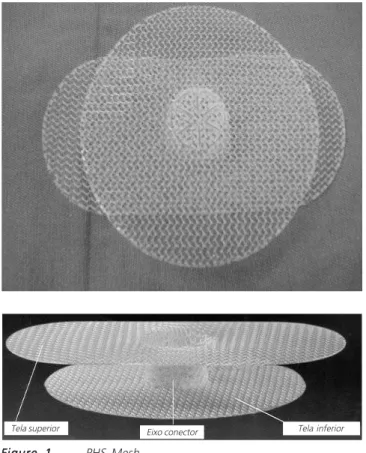
Ninety-six patients admitted to Hospital São Lucas, PUCRS, with inguinal hernia (direct, indirect or mixed) were subjected to surgery with the Gilbert technique using PHS (Figure 1). Exclusion criteria were: age below 18 years, multiple surgical procedures in the groin, recurrent hernia, femoral hernia and strangulated hernia.
M o t t i n M o t t i n M o t t i n M o t t i n M o t t i n
Using the Prolene Hernia System (PHS) for inguinal hernia repair 25
Rev. Col. Bras. Cir. 2011; 38(1): 024-027 (local anesthesia with sedation, regional anesthesia or
ge-neral anesthesia). Prophylactic antibiotic, intravenous cefoxitin 2g, was used in all patients, 30 minutes before surgery. The PHS was used in all study patients, according to the technique described by Gilbert8.
The protocol for data collection included the epidemiological aspects, as well as early and late complications (bleeding, hematoma, wound infection, mesh infection, seroma, scrotal edema, chronic pain) and recurrence rate. The severity of these complications were categorized as grade 1, 2, 3 or 4, following the CTC-AE model (Common Terminology Criteria for Adverse Events), version 3.011.
RESULTS
RESULTS
RESULTS
RESULTS
RESULTS
The demographic characteristics are listed in table 1.
Six complications were identified in different patients; no deaths, though. Two patients (2.08%) had seroma (grades 1 and 2), one patient (1.04%) with he-matoma (grade 2), one patient with wound infection (gra-de 1) treated with antibiotics, without withdrawal of the mesh or re-intervention. Two patients (2.08%) had scrotal edema.
The hernia of one patient (1.04%) recurred 26 months after surgery. The type of the initial hernia was direct.
Chronic pain was identified in two patients (2.08%), characterized as pain or discomfort that may affect daily activities. In seven patients, we identified discomfort as an occasional pain with no change in daily activities. No patient had incapacitating symptoms.
DISCUSSION
DISCUSSION
DISCUSSION
DISCUSSION
DISCUSSION
The use of polypropylene mesh, based on the tension-free concept, was a major breakthrough in the repair of inguinal hernias. Popularized by Lichtenstein and improved by other surgeons, it is now used in most of hernia repairs in adults. The technique developed by Gilbert8 uses
the mesh with three-dimensional theoretical effect on strengthening and maintaining the posterior wall of the inguinal canal without tension, covering the “myopectineal orifice”.
The concept of myopectineal orifice, developed in 1956 by Henri Fruchaud12, allowed the understanding
that the inguinal canal is only one component of a potentially more fragile larger area located in the lower abdominal wall. Its boundaries are formed inferiorly by the superior pubic ramus periosteum; superiorly, by the internal oblique and transverse muscles; medially, by the rectus muscle; and laterally, by the iliopsoas muscle and iliac fascia. It is also divided in superior and inferior plans by the inguinal ligament (anteriorly) and the ileopubic tract (posteriorly).
The use of a three-dimensional mesh (PHS) is intended to include the myofascial defect, enclosing occult femoral or pre-vascular hernias. Its design incorporates a circular preperitoneal layer, a shaft connector, protecting the inner ring with an effect similar to the technique of plug and mesh4,13 and, finally, a layer above that, which is
fixed in the posterior wall of the inguinal canal (transversalis fascia), following the principle of hydrostatic pressure of Pascal, allowing the intra-abdominal pressure to keep the mesh safely in place14,15.
There are few randomized studies comparing repair with PHS with other techniques14-17. Nienhuijs et al
Table 1 Table 1 Table 1 Table 1
-Table 1 - Demographic characteristics of 96 patients.
96 hernias
Men/women 86 / 10
Mean age (years) 56,9 (18-86) Hernia location
Left 39
Right 54
Bilateral 3
Hernia type
Indirect 61
Direct 23
Mixed (direct and indirect) 12
Tela superior Eixo conector Tela inferior
Figure 1 Figure 1 Figure 1 Figure 1
26
Rev. Col. Bras. Cir. 2011; 38(1): 024-027
M o t t i n M o t t i n M o t t i n M o t t i n M o t t i n Using the Prolene Hernia System (PHS) for inguinal hernia repair
found no difference between postoperative pain and chronic pain when compared to Lichtenstein, but the quality of life after three months was worse in the PHS group17. Kingsnorth
et al reported a shorter operative time, less pain in the immediate postoperative period and an earlier return to normal activities with PHS when compared to patients who were submitted to Lichtenstein10. Similar results were
obtained by Vironen et al, except for postoperative pain, which was similar in both groups16. Another study, published
by Sanjay et al, also showed no difference between PHS and Lichtenstein technique as for pain scores, complications, return to activities, chronic pain and recurrence14. Chauhan
et al have recently published initial results comparing the use of conventional PHS with an adapted two-dimensional mesh made from two Prolene meshes connected by a Prolene suture, finding no significant difference between the two groups as for complications and recurrence15.
Specifically for recurrence, one should pay attention to interpretation of the following reasons: first, some groups of patients are over-selected (excluding obese subjects, recurrent or large hernias); second, the still short follow-up time for identification of potential recurrences; and third, some follow-up data were completed by telephone and not by physical examination.
In this study, we evaluated 96 patients undergoing inguinal hernia repair using PHS mesh from
January 2001 to October 2006, with a mean follow up of 49.25 months. The rate of postoperative complications was 6.25% (six patients). No complications were considered serious according to the classification used, based on CTC-AE version 3.011. All complications were treated medically or with wound exploration (seroma and infection), without need for surgical re-exploration for removal or repositioning of the mesh.
The use of mesh repairs, everyday more frequent, caused the appearance of a new clinical syndrome: inguinodinia. Only two patients in our series presented with chronic pain or discomfort. Reviewed literature showed no specific studies focusing on pain after PHS repair, although there are several publications indicating the occurrence of chronic pain after hernia surgery. Chronic pain was observed in 2.1-7.2% of patients after conventional repair (without mesh), 0.7-9 . 7 % a f t e r L i c h t e n s t e i n r e p a i r , 3 . 3 % a f t e r extraperitoneal laparoscopic repair (TEP) and 3.8-8.9% after plug repair4,18. Our results are comparable to
published data, with low complication and recurrence rates3,8 10,15,17,19 22.
Surgical treatment of inguinal hernia using three-dimensional mesh is safe, effective, reproducible and displays low complications, recurrence or symptoms incidences in the long term.
R E S U M O R E S U M O R E S U M O R E S U M O R E S U M O
Objetivo Objetivo Objetivo Objetivo
Objetivo: Aferir complicações pós-operatórias imediatas e tardias em pacientes portadores de hérnia inguinal, submetidos à correção cirúrgica pela técnica de Gilbert1, com utilização do Sistema Prolene de Hérnia (SPH). MétodosMétodosMétodosMétodos: Foram pesquisados todosMétodos os pacientes submetidos à herniorrafia inguinal com tela PHS no Hospital São Lucas da PUCRS no período de janeiro de 2001 até ourubro de 2006. As informações foram coletadas de modo retrospectivo, através de contato telefônico e revisão de prontuários. O protocolo de coleta de dados contemplou os aspectos epidemiológicos, bem como as complicações imediatas e tardias. Resulta-Resulta-Resulta-Resulta- Resulta-dos
dos dos dos
dos: Foram incluídos 96 pacientes. Foram identificadas seis (6,25%) complicações, em pacientes distintos; nenhuma complicação com óbito. Dois pacientes (2,08%) apresentaram seroma; hematoma foi identificado em um paciente (1,04%); um paciente (1,04%) apresentou infecção de ferida operatória. Dois pacientes (2,08%) apresentaram edema escrotal. Após seguimento médio de 49,25 meses (16-86,12) dois pacientes (2,08%) apresentaram dor crônica e um paciente (1,04%) apresentou recorrência, com vinte e seis meses de pós-operatório. ConclusãoConclusãoConclusãoConclusãoConclusão: O reparo de hérnias inguinais com tela PHS é um método seguro, eficaz, facilmente reprodutível e com baixas taxas de complicações, recorrência ou sintomas em longo prazo.
Descritores Descritores Descritores Descritores
Descritores: Hérnia inguinal. Cirurgia. Telas cirúrgicas. Polipropilenos. Resultado de tratamento.
REFERENCES
REFERENCES
REFERENCES
REFERENCES
REFERENCES
1. Lichtenstein IL, Shulman AG, Amid PK, Montllor MM. The tension-free hernioplasty. Am J Surg. 1989 ;157(2):188-93.
2. Hasegawa S, Yoshikawa T, Yamamoto Y, Ishiwa N, Morinaga S, Noguchi Y, Ito H, Wada N, Inui K, Imada T, Rino Y, Takanashi Y. Long-term outcome after hernia repair with the prolene hernia system. Surg Today. 2006;36(12):1058-62.
3. Amid PK. Lichtenstein tension-free hernioplasty. In: Baker RJ, Fisher JE. Mastery of Surgery. 4th ed. Philadelphia: Lippincott Willwiam
and Wilkins; 2001. p.1968-82.
4. Corbitt JD Jr. Transabdominal preperitoneal herniorrhaphy. Surg Laparosc Endosc. 1993;3(4):328-32.
5. Ferzli GS, Massad A, Albert P. Extraperitoneal endoscopic inguinal hernia repair. J Laparoendosc Surg. 1992;2(6):281-6.
6. Nyhus LM, Pollak R, Bombeck CT, Donahue PE. The preperitoneal approach and prosthetic buttress repair for recurrent hernia. The evolution of a technique. Ann Surg. 1988;208(6):733-7. 7. Gilbert AI, Graham MF, Voigt WJ. A bilayer patch device for
inguinal hernia repair. Hernia. 1999;3(3):161-6. DOI: 10.1007/ BF01195319.
8. Mayagoitia JC.Inguinal hernioplasty with the prolene hernia system. Hernia. 2004;8(1):64-6.
M o t t i n M o t t i n M o t t i n M o t t i n M o t t i n
Using the Prolene Hernia System (PHS) for inguinal hernia repair 27
Rev. Col. Bras. Cir. 2011; 38(1): 024-027
10. Cancer Therapy Evaluation Program, Common Terminology Criteria for Adverse Events. Version 3.0. Disponível em http:// ctep.cancer.gov/protocolDevelopment/electronic_applications/ docs/ctcae_index.pdf
11. Stoppa R, Wantz GE. Henri Fruchaud (1894-1960): A man of bravery, an anatomist a surgeon. Hernia. 1998;2(1):45-7.DOI: 10.1007/BF01207775.
12. Rutkow IM. The PerFix plug repair for groin hernias. Surg. Clin North Am. 2003;83(5):1079-98.
13. Sanjay P, Harris D, Jones P, Woodward A. Randomized controlled trial comparing prolene hernia system and Lichtenstein method for inguinal hernia repair. ANZ J Surg. 2006;76(7):548-52.DOI: 10.1111/j.1445-2197.2006.03774.x
14. Chauhan A, Tiwari, S, Gupta A. Study of efficacy of bilayer mesh device versus conventional polypropelene hernia system in inguinal hernia repair: early results. World J Surg. 2007;31(6):1356-9; discussion 1360-1.
15. Vironen J, Nieminen J, Eklund A, Paavolainen P. Randomized clinical trial of Lichtenstein patch or Prolene Hernia System for inguinal hernia repair. Br J Surg. 2006;93(1):33-9.
16. Nienhuijs SW, van Oort I, Keemers-Gels ME, Strobbe LJ, Rosman C. Randomized trial comparing the Prolene Hernia System, mesh plug repair and Lichtenstein method for open inguinal hernia repair. Br J Surg. 2005;92(1):33-8.
17. Nienhuijs SW, Boelens OB, Strobbe LJ. Pain after anterior mesh hernia repair. J Am Coll Surg. 2005;200(6):885-9.
18. Yamamoto S, Maeda T, Uchida Y, Yabe S, Nakano M, Sakano S, Yamamoto M. Open tension-free mesh repair for adult inguinal hernia: eight years of experience in a community hospital. Asian J Surg. 2002;25(2):121-5.
19. Huang CS, Huang CC, Lien HH. Prolene hernia system compared with mesh plug technique: a prospective study of short- to mid-term outcomes in primary groin hernia repair. Hernia. 2005;9(2):167-71.
20. Awad SS, Yallampalli S, Srour AM, Bellows CF, Albo D, Berger DH. Improved outcomes with the Prolene Hernia System mesh compared with the time-honored Lichtenstein onlay mesh repair for inguinal hernia repair. Am J Surg. 2007;193(6):697-701. 21. Suárez-Flores D, Mayagoitia-González JC, Oropeza-Navarrete,
LM. Institutional experience with Prolene Hernia System in hernia surgery. Cir Cir. 2007;75(3):169-74.
Received 14/01/2010
Accepted for publication 16/03/2010 Conflict of interest: none
Source of funding: none
How to cite this article: How to cite this article: How to cite this article: How to cite this article: How to cite this article:
Mottin CC, Ramos RJ, Ramos MJ. Using the prolene hernia system (phs) for inguinal hernia repair. Rev Col Bras Cir. [periódico na Internet] 2011; 38(1). Disponível em URL: http://www.scielo.br/rcbc