Is reiki or prayer efective in relieving pain during
hospitalization for cesarean? A systematic review and
meta-analysis of randomized controlled trials
O
reiki
ou a oração são efetivos no alívio da dor durante a internação da cesariana?
Uma revisão sistemática e metanálise de ensaios clínicos randomizados
Guilherme Augusto Rago Ferraz
I, Meline Rosseto Kron Rodrigues
I, Silvana Andrea Molina Lima
II, Marcelo Aparecido Ferraz
Lima
III, Gabriela Lopes Maia
IV, Carlos Alberto Pilan Neto
V, Michelle Sako Omodei
VI, Ana Cláudia Molina
VII, Regina El Dib
VIII,
Marilza Vieira Cunha Rudge
IXUniversidade Estadual Paulista (UNESP), Botucatu (SP), Brazil
ABSTRACT
CONTEXT AND OBJECTIVE: This systematic review compared reiki and prayer with drug use for relieving
pain during hospitalization for cesarean, given that the popularity of integrative medicine and spiritual healing has been increasing. It had the aim of evaluating whether reiki or prayer is efective in relieving pain during cesarean section.
DESIGN AND SETTING: Systematic review with meta-analysis conducted at Botucatu Medical School,
UNESP, São Paulo, Brazil.
METHODS: The following databases were searched up to March 2016: MEDLINE, Embase, LILACS and
CENTRAL. Randomized controlled trials published in English or Portuguese were included in the review. Two reviewers independently screened eligible articles, extracted data and assessed the risk of bias. A GRADE table was produced to evaluate the risk of bias.
RESULTS: There was evidence with a high risk of bias showing a statistically signiicant decrease in pain
score through use of reiki and prayer, in relation to the protocol group: mean diference = -1.68; 95% conidence interval: -1.92 to -1.43; P < 0.00001; I2 = 92%. Furthermore, there was no statistically signiicant
diference in heart rate or systolic or diastolic blood pressure.
CONCLUSION: Evidence with a high risk of bias suggested that reiki and prayer meditation might be
associated with pain reduction.
RESUMO
CONTEXTO E OBJETIVO: Esta revisão sistemática comparou o reiki e a oração ao uso de medicamentos, a
im de aliviar a dor durante a internação para cesariana, visto que há um aumento na popularidade da me-dicina integrativa e cura espiritual. Esta revisão teve como objetivo avaliar se o reiki ou oração são eicazes no alívio da dor durante a cesariana.
TIPO DE ESTUDO E LOCAL: Revisão sistemática com metanálise realizada na Faculdade de Medicina de
Botucatu UNESP, São Paulo, Brasil.
MÉTODOS: As seguintes bases de dados foram pesquisadas até março de 2016: MEDLINE, Embase, LILACS
e CENTRAL. Nesse sentido, foram incluídos ensaios clínicos randomizados publicados em inglês e portu-guês. Dois revisores rastrearam independentemente artigos elegíveis, extraíram dados e avaliaram o risco de viés. A tabela GRADE foi realizada para avaliar o risco de viés.
RESULTADOS: Evidências com alto índice de viés encontraram uma diminuição estatisticamente
signiica-tiva na redução da dor (diferença média = -1,68; intervalo de coniança de 95%: -1,92 a -1,43; P < 0,00001; I2 = 92%), com o uso de reiki e oração comparado com o grupo protocolar. Além disso, não houve
diferen-ça estatisticamente signiicativa na frequência cardíaca, pressão arterial sistólica e diastólica.
CONCLUSÃO: Evidência com alto risco de viés sugeriu que reiki e meditação oração podem ser associadas
com a redução da dor.
IMSc. PhD’s Student, Postgraduate Program
on Gynecology, Obstetrics and Mastology, Universidade Estadual Paulista (UNESP), Botucatu (SP), Brazil.
IIPhD. Assistant Professor, Department of
Nursing, Universidade Estadual Paulista (UNESP), Botucatu (SP), Brazil.
IIIBA. Master’s Student, Postgraduate Program
on Public Health, Universidade Estadual Paulista (UNESP), Botucatu (SP), Brazil.
IVUndergraduate Nursing Student, Faculdade
Marechal Rondon (FMR), São Manoel (SP), Brazil.
VUndergraduate Medical Student, Universidade
Federal de Minas Gerais (UFMG), Belo Horizonte (MG), Brazil.
VIMD. Physician. Department of Gynecology
and Obstetrics, Universidade Estadual Paulista (UNESP), Botucatu (SP), Brazil.
VIIPhD. Nurse, Botucatu Outpatient Clinics, Municipal
Authority of Botucatu, Botucatu (SP), Brazil.
VIIIPhD. Assistant Professor, Institute of Science
and Technology, Department of Biosciences and Oral Diagnosis, Universidade Estadual Paulista (UNESP), São José dos Campos (SP), Brazil, and Research collaborator, Institute of Urology, McMaster University, Hamilton, Ontario, Canada.
IXMD, PhD. Titular Professor, Department of
Gynecology and Obstetrics, Universidade Estadual Paulista (UNESP), Botucatu (SP), Brazil.
KEY WORDS:
Spirituality. Delivery, obstetric. Complementary therapies. Risk factors.
Review.
PALAVRAS-CHAVE:
ORIGINAL ARTICLE | Ferraz GAR, Rodrigues MRK, Lima SAM, Lima MAF, Maia GL, Pilan Neto CA, Omodei MS, Molina AC, El Dib R, Rudge MVC
INTRODUCTION
Complementary therapies have been practiced since ancient times, but there is still little scientiic evidence on their real eiciency. Most of these therapies originated from oriental cultures, such as in India with Ayurveda treatments; China with acupuncture and moxibustion ther-apies; and Japan with reiki therapy. Moreover, complementary thera-pies are implemented both alone and alongside conventional medi-cine. hus, complementary therapies tend to take a holistic approach in order to treat the entire person, i.e. body, mind and soul. In other words, they use a comprehensive set of techniques, such as meditation, body therapies, energy manipulation, art and music therapy, dietary therapy and other procedures that involve healthcare, according to the National Center for Complementary and Alternative Medicine.1-5
Reiki is an ancient Japanese form of hands-on healing. he term comes from combining two Japanese words: rei, a universal spirit; and ki, meaning universal life energy.1 Despite being a Japanese form of healing, use of reiki has already spread worldwide. It is mainly used for pain relief.2 Additionally, prayer meditation is also considered to be an adjunctive therapy involving a non-invasive method with a low-cost procedure.5 hus, it improves psychologi-cal, social, spiritual and physical health by means of nourishing the environment through peacefulness and mindfulness.6,7
A previous systematic review of clinical trials2 compared reiki therapy with the usual care or with placebo among women undergoing breast biopsy, women with abdominal hysterectomies, cancer patients, individuals with depression, and chronically ill patients. However, that review seemed to have serious limitations with regard to its method-ological aspects. For example, it presented a variety of conditions, i.e. 12 articles were included and therefore 12 diferent types of conditions, but there were no data on pregnant women. In other words, the review was quite generalist. Moreover, it did not use the GRADE approach to rate the quality of scientiic evidence. Consequently, the review was unable to provide any conclusion about the efectiveness of reiki and the sug-gestion made was that new studies on this topic would be necessary.
In the literature, a few studies1-11 have reported that spirituality and complementary therapies have provided improvements regarding quality of life and beneits in relation to several health conditions.6-8 Moreover, it has been suggested that non-pharmacological practices could be considered in order to reduce excessive use of allopathic medication in obstetrics and consequently to reduce the costs of care.
OBJECTIVE
he aim of this systematic review of randomized controlled trials (RCTs) was to evaluate whether reiki or prayer meditation is efective for controlling pain among women undergoing cesarean section.
METHODS
he Cochrane Handbook for Intervention Reviews12 guided our choice of methods. Our reporting adhered to the Preferred
Reporting Items for Systematic Reviews and Meta-analysis (PRISMA) statement.13
Eligibility criteria
We included RCTs or quasi-RCTs that compared reiki therapy and prayer meditation with the usual care among pregnant women undergoing cesarean section, including any of the following mater-nal outcomes before and ater receiving the intervention or usual care: pain control; heart rate; diastolic and systolic blood pressure; or medication intake. Furthermore, a single study9 recorded post-partum physical activities through the Milestone questionnaire.
Data source and searches
Pertinent literature was identiied through MEDLINE (from 1966 to March 2016); Embase (from 1980 to March 2016); LILACS (from 1982 to March 2016); and Cochrane controlled trials (CENTRAL) (up to March 2016), using the terms spiritu-ality, reiki, prayer, cesarean and labor pain (Table 1). he data-gathering was restricted to Portuguese and English-language studies. here were no publication status restrictions. A review of relevant references in previous systematic review articles1,2 and primary studies3-11 was conducted.
Selection of studies
Randomized controlled trials or quasi-RCTs published in English or Portuguese were included. Two reviewers, working inde-pendently, screened all titles and abstracts that were identiied through the literature search. Furthermore, they selected poten-tial studies by obtaining the full-text articles, and then evaluated them, in accordance with the eligibility criteria.
Data extraction and risk-of-bias assessment
Two reviewers independently screened all the potential quanti-tative results or critical data from some preselected studies, with regard to the participants, interventions, control conditions, out-come measurements and results. Subsequently, disagreements between the reviewers were discussed with the ninth author, in order to reach a consensus.
Certainty of evidence
he reviewers used the Grading of Recommendations for Assessment, Development and Evaluation (GRADE) method-ology to rate the certainty of scientiic evidence for each out-come, which was categorized as high, moderate, low or very low.15 he GRADE approach assessed the following: overall risk of bias,16 imprecision,17 inconsistency,18 indirectness19 and publi-cation bias.20 hus, the results were summarized in an evidence table, i.e. as a GRADE evidence proile.
he reviewers independently assessed eligibility, risk of bias and data abstraction. Disagreements were resolved by reaching a consensus or by obtaining a third reviewer’s opinion if needed.
Data synthesis and statistical analysis
We pooled the data to calculate pooled risk ratios (RRs) or mean diferences, with 95% conidence intervals (CIs), using a ixed-efect model by considering the last follow-up outcome that had been measured in each study included. We assessed heterogene-ity by means of the I2 statistic and evaluated the quality of the evi-dence by using the GRADE method. All of the analyses were con-ducted using the Review Manager (RevMan) sotware.21
RESULTS
Selection of titles
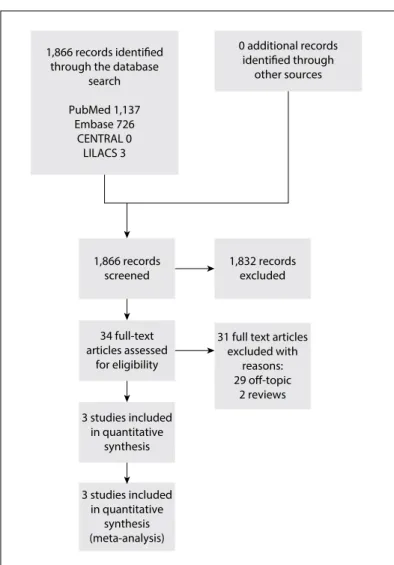
A total of 1,866 titles were identiied in the databases cited above, but only 34 studies were selected for detailed evaluation.12 Ultimately, it was found that only three studies that included 343 patients were eligible for the current review (Figure 1).
Table 1. Search strategies used in MEDLINE (via PubMed), CENTRAL, LILACS and Embase
MEDLINE via PubMed
#1”Spirituality”[Mesh] OR Spiritualities OR “Reiki”[Mesh] OR “`Touch, Therapeutic” OR “Laying on of Hands” OR “Prayer Healing”[Mesh] OR “Faith Healing” OR “Prayer”[Mesh] OR Beliefs OR “Spiritual Healing”[Mesh] OR “Spiritual Therapies” #2”Cesarean”[Mesh] OR “Cesarean Sections” OR “Cesarean Section” OR “Abdominal Deliveries” OR “Abdominal Delivery” OR “Caesarean Section” OR “Caesarean Sections” OR C-Section OR “C Section” OR C-Sections OR “Post caesarean Section”. #3”Pain, Labor”[Mesh] OR “Obstetric Pain” OR “Pain, Obstetric”
STRATEGY: #1 AND #2 AND #3
CENTRAL
“Spirituality” OR “Spiritualities” OR “Reiki” OR (‘Touch, Therapeutic” OR “Laying on of Hands” OR “Prayer Healing” OR “Faith Healing”) OR “Prayer” OR “Beliefs” OR “(Spiritual Healing” OR “Spiritual Therapies”) AND “Cesarean” OR (“Cesarean Sections” OR “Cesarean Section” OR “Abdominal Deliveries” OR “Abdominal Delivery” OR “Caesarean Section” OR “Caesarean Sections” OR C-Section OR “C Section” OR C-Sections OR “Post caesarean Section”) AND “Pain, Labor” OR (“Obstetric Pain” OR “Pain, Obstetric”)
LILACS
Espiritualidade OR Reiki OR (Toque terapêutico) OR (Superposição de mãos) OR (Cura Espiritual) OR (Terapias espirituais) OR (Cura pela Fé) AND Cesárea OR (Parto Abdominal) OR (Parto Obstétrico) AND (Dor do Trabalho de Parto) OR (Dores do Trabalho de Parto) OR (Dor de Parto) OR (Dores de Parto) OR (Dores do Parto)
Embase
#1 ‘reiki’/exp OR
#2‘religion/exp OR ‘prayer’ #3 ‘spirituality’/exp
#4 ‘cesarean section’/exp OR ‘birth’ OR ‘abdominal operation’ OR ‘birth, caesarean’ OR ‘caesarean birth’ OR ‘caesarean section’ OR ‘caesarian birth’ OR ‘caesarian section’ OR ‘cesarean delivery’ OR ‘cesarean section’ OR ‘repeat; cesarian section’ OR ‘elective repeat cesarean section’ OR ‘sectio caesarea’
#5 ‘labor pain’/exp OR ‘delivery pain’ OR ‘labour pain’ OR ‘pain, delivery’ OR ‘pain, labor’ OR ‘pain, labour’ STRATEGY: #1 OR #2 OR #3 AND #4 AND #5
1,866 records identified through the database
search
PubMed 1,137 Embase 726
CENTRAL 0 LILACS 3
1,866 records screened
34 full-text articles assessed
for eligibility
3 studies included in quantitative
synthesis
3 studies included in quantitative
synthesis (meta-analysis)
1,832 records excluded
31 full text articles excluded with
reasons: 29 off-topic
2 reviews
0 additional records identified through
other sources
ORIGINAL ARTICLE | Ferraz GAR, Rodrigues MRK, Lima SAM, Lima MAF, Maia GL, Pilan Neto CA, Omodei MS, Molina AC, El Dib R, Rudge MVC
hese studies presented diferent interventions, i.e. distant reiki,9 regular reiki10 and prayer meditation,11 but they all presented a similar outcome, i.e. they measured pain through a visual ana-logue scale (VAS) and also measured heart rate and diastolic and systolic blood pressure. In the literature, all reiki healers consider that distant reiki9 and regular reiki10 are the same, with the only diference that in one, the patient`s physical body is absent, while it is present in the other.1,2,9
Although prayer meditation11 may seem to have been the odd one out, we analyzed this study in depth and decided to plot it together with the two reiki studies,9,10 because all the information from this study with regard to the prayer meditation background, the objectives of the study and the methods used to evaluate the intervention were in line with these other studies.9,10 Moreover, these factors were in line with our aim in this systematic review, which was to evaluate perceived pain among women undergoing cesarean section. Moreover, both reiki and prayer meditation are non-invasive and non-pharmacological practices, and both of them can be considered to be spiritual interventions.1,2,9-11
Study characteristics
Table 2 describes the characteristics of the studies relating to
their designs, settings, numbers of participants, interventions and usual care treatments received by the patients; and according to the hospital protocol, mean age, inclusion and exclusion criteria and follow-up ater caesarean section. One study was conducted in Canada,9 and the other two were conducted in the Middle East, in Turkey10 and Iran.11 he sample sizes ranged from 409 to 8011 pregnant women aged in their twenties or thirties. All the studies included pregnant women undergoing cesarean section.
he following exclusions of patients were made in one or more of these studies: previous experience with reiki;9,10 perception of pain on a visual analogue scale (VAS) > 3;11 not planning to use standard postoperative pain medication;10,11 not being able to answer the questions;9-11 visual and hearing impairment;10,11 any compli-cations during anesthesia or surgery;10,11 history of drug abuse;10,11 operation performed under spinal and epidural anesthesia;10 use of patient-controlled analgesia in the treatment;10 and presence of any psychiatric disease or allergy to analgesic drugs.10 he length of the follow-up ranged from 6 hours to 3 days.
Risk-of-bias assessment
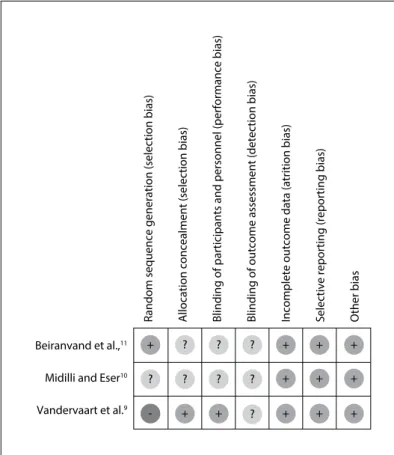
Figure 2 describes the risk-of-bias assessment for RCTs.
he overall methodological quality of the studies examined was evenly separated into unclear and low risk-of-bias catego-ries. However, the main concern was the risk of bias relating to random sequence generation in the study by Vandervaart et al.9 Additionally, the allocation concealment and blinding of par-ticipants/personnel were uncertain in the studies by Midilli and
Eser10 and Beiranvand et al.11 Finally, none of the three studies9-11 showed any certainty with regard to blinding of the outcome assessment.
Efects of reiki and prayer meditation: meta-analysis
Pain score
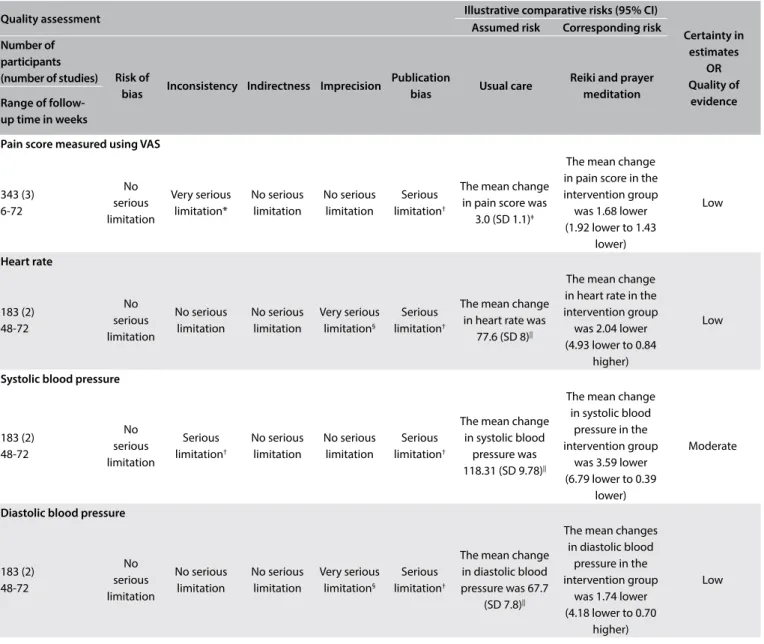
Regarding the pain scores measured by means of a VAS in the overall analysis, the results from three RCTs9-11 found a statisti-cally signiicant diference favoring reiki and prayer meditation over the usual care: mean diference (MD) = -1.68; 95% coni-dence interval (CI): -1.92 to -1.43; P < 0.00001; I2 = 92%. In rela-tion to the following subcategories, we also found statistically signiicant diferences favoring the integrative practices over the usual care: prayer meditation (MD = -1.70; 95% CI: -2.00 to -1.40; P < 0.00001; I2 = not applicable); and reiki (MD = -2.52; 95% CI: -3.07 to -1.97; P < 0.00001; I2 = not applicable). However, there was no statistically signiicant diference between the dis-tant and regular reiki groups: MD = -0.20; 95% CI: -0.90 to 0.50; P = 0.58; I2 = not applicable. he certainty of the evidence was downrated to low because of inconsistency and publication bias
(Figure 3, Table 3).
Heart rate
With regard to heart rate in the overall analysis, the results from two RCTs9,10 did not show any statistically significant dif-ference that favored regular reiki and distant reiki over the usual care: MD = -2.04; 95% CI: -4.93 to 0.84; P = 0.41; I2 = 0%. Therefore, we found no statistically significant differ-ence favoring reiki over the usual care: MD = -3.58; 95% CI: -8.26 to 1.10; P = 0.17; I2 = not applicable. In addition, there was no statistically significant difference between the distant and regular reiki groups: MD = -1.10; 95% CI: -4.76 to 2.56; P = 0.17; I2 = not applicable. The certainty of the evidence was downrated to low because of imprecision and publication bias
(Figure 4, Table 3).
Diastolic blood pressure
Table 2. Study characteristics relating to setting, number of participants, mean age, intervention and control groups, inclusion and exclusion criteria, assessed outcomes and follow-up after caesarean section
Author Location Participants (n)* Mean age study group (n)Intervention in
Intervention in control group (n) Inclusion criteria Exclusion criteria Measured outcomes Follow-up (hours) Midilli
and Eser10 Turkey 100
Reiki: 27.61† Usual care: 27.61† Usual care (specified)‡ and
reiki therapy for 30 minutes for
two days (n = 50)
Usual care (specified)‡
and 30 minutes of
rest for 2 days (n = 50)
Planned or unplanned cesarean delivery; age between 18-45 years; length of stay of at least two days at the hospital; orientation to place and time; operation performed
under general anesthesia; and only
using a nonopioid analgesic drug prescribed by a doctor (diclofenac 75 mg/3 ml,
intramuscularly).
Operation performed under spinal and epidural anesthesia; any psychiatric disease
or allergy to analgesic drugs; hearing and visual impairment; previous experience
with reiki; serious complication with the
patient or infant(s) during or after cesarean
delivery; or use of a patient controlled analgesia in treatment.
Pain intensity from horizontal VAS (0-10); anxiety from STAI; hemodynamic parameter score. 48 Beiranvand
et al.11 Iran 160
Prayer: 27.4 Usual
care: 29.4
Usual care (not specified) and pray meditation
therapy for 20 minutes after cesarean section
(n = 80)
Usual care (not specified) (n = 80)
Muslim women candidates for cesarean
surgery under spinal anesthesia, with mild
pain (VAS < 1-3).
Muslim women with VAS > 3; hearing disorder; history of drug
abuse; administration of analgesics; any complications during anesthesia or surgery; or being unable to answer the questions.
Pain score from VAS < 3; blood pressure (diastolic and systolic); heart rate; mother´s respiratory rate; PONV; and relaxation. 6 Vandervaart
et al.9 Canada 83
Reiki: 35.1 Usual care: 32.9 Usual medical and nursing care according to Pfannenstiel protocol in association with distant reiki sessions, one each morning (30 minutes before the cesarean section morning; second and third sessions were administered on
the following mornings at about 8 am)
(n = 42)
Usual medical and nursing care according to Pfannenstiel protocol
(n = 41)
Pregnant women
Patients with previous experience of reiki; or not planning to use
postoperative pain medication; or being unable to answer the
questions.
AUC for pain (in motion) for days 1-3 from VAS; AUC for pain (in motion) for
days 1, 2 and 3, separately; mean VAS (in motion) on days
1-3; mean VAS (at rest) on days 1-3; number of patients in need
of opioid pain medication; adverse events to opioids, such as constipation,
itchiness; mother´s respiratory rate; heart rate; blood pressure; and time of first activity (e.g. first hunger, first walk) from
Milestone questionnaire.
72
n: number; RCT: randomized controlled trial; ml: milliliter, mg: milligram; VAS: visual analogue scale; STAI: State-Trait Anxiety Inventory; cm: centimeters; PONV: incidence of postoperative nausea and vomiting. *Randomized participants; †Patients were equalized according to age into two groups
(18-31 and 32-45 years old); ‡Day 1 (24 hours after operation): Patients were given the first dose of the standard analgesic (intramuscularly, 75 mg/3 ml
ORIGINAL ARTICLE | Ferraz GAR, Rodrigues MRK, Lima SAM, Lima MAF, Maia GL, Pilan Neto CA, Omodei MS, Molina AC, El Dib R, Rudge MVC
Systolic blood pressure
In the overall analysis with regard to systolic blood pressure, the results from two RCTs9,10 showed that there was no statis-tically signiicant diference favoring reiki over the usual care: MD = -3.59; 95% CI: -6.79 to 0.39; P = 0.03; I2 = 26%. herefore, we also found no statistically signiicant diference favoring reiki over the usual care: MD = -1.71; 95% CI: -6.21 to 2.79; P = 0.25; I2 = not applicable. In addition, there was no statistically signii-cant diference between the distant reiki and regular reiki groups: MD = -5.50; 95% CI: -10.04 to -0.96 P = 0.25; I2 = not applicable. he certainty of the evidence was downrated to moderate because of inconsistency and publication bias (Figure 6, Table 3).
Efect of irst-time activity through the Milestone questionnaire and patients’ need for opioids in the Vandervaart study9
Regarding the activity milestone questionnaire, which is used among women ater elective caesarean to evaluate the rate of heal-ing, a single RCT9 showed that there was no statistically signii-cant diference between distant reiki and the usual care in any of the following categories: time to irst hunger; time to irst eating of solid food; time to irst latus; time to irst bowel movement; time to irst spontaneous voiding; and time to irst ambulation
(Figure 1). Moreover, the same study9 described the patients’ need
for opioids, but showed that there was no statistically signiicant Beiranvand et al.,11
Midilli and Eser10
Vandervaart et al.9
Random sequence generation (selection bias) Allocation concealment (selection bias) Blinding of participants and personnel (performance bias) Blinding of outcome assessment (detection bias) Incomplete outcome data (atrition bias) Selective reporting (reporting bias) Other bias
+ + + +
+ + +
+ + +
+ +
-?
? ?
? ?
? ?
?
Figure 2. Risk-of-bias assessment.
Study or subgroup Mean
1.24 3.1 1.3
Favours Reiki and prayer Favours usual care Mean diference
SD Total Mean
3.76 3.3 3
SD
1.61 1.7 1.1
Total Weight IV, fixed, 95% CI
Mean difference IV, fixed, 95% CI
-1.70 [-2.00, -1.40] -1.70 [-2.00, -1.40]
-0.20 [-0.90, -0.50] -0.20 [-0.90, -0.50]
-2.52 [-3.07, -1.97] -2.52 [-3.07, -1.97]
Favours Reiki & prayer
-4 -2 0 2 4
Favours usual care 100.0%
100.0%
100.0% 100.0%
100.0% 100.0% 45 45 40 40 80 80
45 45 40 40 80 80
0.99 1.5 0.8
1.2.3 Reiki
Test for overall effect: Z = 8.94 (P < 0.00001) Heterogeneity: not applicable
Subtotal (95% CI) Midilli and Eser10
Teste for overall effect: Z = 0.56 (P = 0.58) Heterogeneity: not applicable
Subtotal (95% CI) Vandervaart et al.9
1.2.2 Distant Reiki
Test for overall effect: Z = 11.18 (P < 0.00001) Heterogeneity: not applicable
Subtotal (95% CI) Beiranvand et al.11
1.2.1 Prayer meditation
Total (95% CI) 165 165 100.0% -1.68 [-1.92, -1.43] Heterogeneity: Chi2 = 25.95, df = 2 (P < 0.00001); I2 = 92%
Test for overall effect: Z = 13.39 (P < 0.00001)
Test for subgroup differences: Chi2 = 25.95, df = 2 (P < 0.00001), I2 = 92.3%
Table 3. GRADE evidence profile for continuous outcomes: complementary alternative medicine for cesarean section
Quality assessment Illustrative comparative risks (95% CI)
Certainty in estimates
OR Quality of
evidence Assumed risk Corresponding risk
Number of participants
(number of studies) Risk of
bias Inconsistency Indirectness Imprecision
Publication
bias Usual care
Reiki and prayer meditation Range of
follow-up time in weeks
Pain score measured using VAS
343 (3) 6-72
No serious limitation
Very serious limitation*
No serious limitation
No serious limitation
Serious limitation†
The mean change in pain score was
3.0 (SD 1.1)‡
The mean change in pain score in the intervention group was 1.68 lower (1.92 lower to 1.43
lower)
Low
Heart rate
183 (2) 48-72
No serious limitation
No serious limitation
No serious limitation
Very serious limitation§
Serious limitation†
The mean change in heart rate was
77.6 (SD 8)||
The mean change in heart rate in the intervention group was 2.04 lower (4.93 lower to 0.84
higher)
Low
Systolic blood pressure
183 (2) 48-72
No serious limitation
Serious limitation†
No serious limitation
No serious limitation
Serious limitation†
The mean change in systolic blood
pressure was 118.31 (SD 9.78)||
The mean change in systolic blood
pressure in the intervention group
was 3.59 lower (6.79 lower to 0.39
lower)
Moderate
Diastolic blood pressure
183 (2) 48-72
No serious limitation
No serious limitation
No serious limitation
Very serious limitation§
Serious limitation†
The mean change in diastolic blood pressure was 67.7
(SD 7.8)||
The mean changes in diastolic blood
pressure in the intervention group
was 1.74 lower (4.18 lower to 0.70
higher)
Low
CAM = complementary alternative medicine; SD = standard deviation; std. = standardized; VAS = visual analogue scale.
*There was substantial heterogeneity (I2 = 92.3%) among the diferent interventions used in the studies included (i.e. distant reiki; reiki; and prayer meditation); †There was heterogeneity (I2 = 26%) among the diferent interventions used in the studies included (i.e. distant reiki; reiki; and prayer meditation). ‡Baseline
risk estimates for pain come from control arm of study by Beiranvand et al.11 (largest randomized trial in the meta-analysis); §95% CI for absolute efects
include beneit and harm. ||Baseline risk estimates for heart rate, systolic and diastolic blood pressure come from control arm of study by Midilli et al.10 (largest
randomized trial in the meta analysis).
Study or subgroup Mean
76.5 86.13
Reiki Usual care Mean difference SD
8.7 10.61
Total
40
85 45
Mean
77.6 89.71
SD
8 12.02
Total
40
85 45
Weight
62.1%
100.0% 37.9%
IV, fixed, 95% CI
Mean difference IV, fixed, 95% CI -3.58 [-8.26, -1.10]
-1.10 [-4.76, 2.56]
-2.04 [-4.93, 0.48]
Favours Reiki
-10 -5 0 5 10
Favours usual care Heterogeneity: Chi2 = 0.67, df = 1 (P < 0.41), I2 = 0%
Midilli and Eser10
Total (95% CI) Vandervaart et al.9
Test for overall effect: Z = 1.39 (P < 0.17)
ORIGINAL ARTICLE | Ferraz GAR, Rodrigues MRK, Lima SAM, Lima MAF, Maia GL, Pilan Neto CA, Omodei MS, Molina AC, El Dib R, Rudge MVC
Study or subgroup Mean
64.9 68.51
Reiki Usual care Mean difference SD
7.6 8.51
Total
40
85 45
Mean
67.7 69.09
SD
7.8 8.55
Total
40
85 45
Weight
52.2%
100.0% 47.8%
IV, fixed, 95% CI
Mean difference IV, fixed, 95% CI -0.58 [-4.10, 2.94]
-2.80 [-6.17, 0.57]
-1.74 [-4.18, 0.70]
Favours Reiki
-10 -5 0 5 10
Favours usual care Heterogeneity: Chi2 = 0.80, df = 1 (P < 0.37), I2 = 0%
Midilli and Eser10
Total (95% CI) Vandervaart et al.9
Test for overall effect: Z = 1.40 (P < 0.16)
Figure 5. Meta-analysis on diastolic blood pressure.
Figure 6. Meta-analysis on systolic blood pressure.
Study or subgroup Mean
106.4 116.6
Reiki Usual care Mean difference SD
9.7 11.91
Total
40
85 45
Mean
111.9 118.31
SD
11 9.78
Total
40
85 45
Weight
49.5%
100.0% 50.5%
IV, fixed, 95% CI
Mean difference IV, fixed, 95% CI -1.71 [-6.21, 2.79]
-5.50 [-10.04, 0.96]
-3.59 [-6.79, -0.39]
Favours Reiki
-50 -25 0 25 50
Favours usual care Heterogeneity: Chi2 = 1.35, df = 1 (P < 0.25), I2 = 26%
Midilli and Eser10
Total (95% CI) Vandervaart et al.9
Test for overall effect: Z = 2.20 (P < 0.03)
diference between distant reiki and the usual care on the day of admission to hospital (relative risk, RR = 0.81; 95% CI: 0.66 to 1.30; P = 0.64; I2 = not applicable); or on the next day (RR = 1.22; 95% CI: 0.74 to 1.63; P = 0.65; I2 = not applicable) (Figure 2).
DISCUSSION
his study evaluated the use of reiki and prayer meditation for pain control among women undergoing caesarean section. It was the irst-ever study to evaluate spiritual healing in relation to this issue, given that most previous studies and reviews focused on severe chronically ill patients and their quality of life.1-7
It should be noted that a language restriction had to be imposed during the selection process due to lack of funds to pay for translation services prior to the search. Thus, it was necessary to restrict the current systematic review to English and Portuguese-language studies were assessed from the out-set. However, no study was excluded because it was written in another language, because no such studies were found through the search methods.
A recent study22 showed that around 26% of women in the United States received spiritual healing treatment if they were non-smokers, non-drinkers or low-risk drinkers, had symp-toms of severe tiredness, depression, anxiety, diagnosed cancer or major illnesses. In another study on women in the southern
and midwestern United States regions (i.e. extremely religious areas) the proportion that received prayers for health was esti-mated to be 53%.23 he fact that the study by Beiranvand et al.11 presented a signiicant outcome, i.e. pain control among women undergoing caesarean sections, with high follow-up rates, may have been due the presence of highly religious women in their sample. According to Bell et al.,23 people who usually use prayer meditation are also likely to use some other form of comple-mentary or alternative medicine (e.g. reiki or acupuncture). Additionally, the more religious the people are, the more likely it is that they will use preventive healthcare.20
Among the studies included, some limitations were reported, as follows: the sample size;9-11 presence of only one reiki therapist;9 absence of information about the mechanism of action of distant reiki;9 use of shared rooms;10 and a noisy environment.10 In addi-tion to the methodological limitaaddi-tions, this current review also pre-sented a limitation relating to the results obtained through meta-analysis: although the perceived pain seemed to have decreased signiicantly, the heterogeneity of results was extremely high, i.e. I2 = 92% (Figure 3). his can be explained by the fact that there were three diferent types of intervention.
adjunctive therapy within many cultures.11,20,23,24 hus, both prayer meditation and reiki are forms of spiritual healing. According to Benor,24 spiritual healing is deined as a systematic and purpose-ful intervention by practitioners that has the aim of helping other people to improve their health condition through focused intention, which can include hand contact or hand movement. hus, these three studies9-11 presenting similar methodological aspects and outcomes were plotted together. Within systematic reviews, it is known that meta-analyses that included less than 10 studies can-not to estimate heterogeneity.
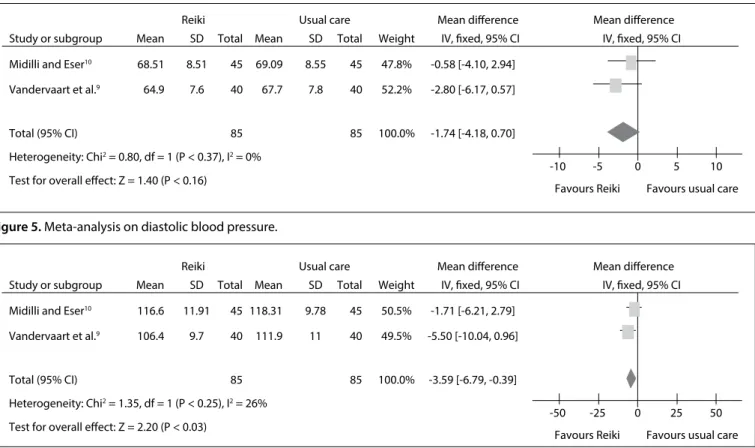
he meta-analysis did not show any statistical signiicant dif-ferences from before to ater the treatments, either in the inter-vention or in the usual care group, regarding heart rate (Figure 4), diastolic and systolic blood pressure (Figures 5 and 6, respec-tively). In other words, these results were concordant with those of the previous review.2 However, to reach deinitive conclusions regarding the efectiveness of such therapies, larger populations in good RCTs are needed.
With regard to the methodological aspects, the present review noted that there were risks of bias relating to random sequence generation;9 allocation concealment;10,11 blinding of participants/ personnel;10,11 and blinding of outcome assessment. his concern corroborates what was reported in the systematic review on reiki conducted by Vandervaart:2 all of the 12 studies included had fail-ings in at least in one of the following areas: randomization, blind-ing and accountability of all patients. herefore, both reviews can be classiied as presenting low-quality evidence, and the main issue in this regard is the poor evidence from the RCTs. We sent emails to the respective corresponding authors of the studies selected for this review,9-11 regarding points in these studies that were unclear to us or not reported, but no replies had been received by the time of submitting this review.
he previous review2 attempted to evaluate the efectiveness of reiki therapy under several conditions and presented 31 diferent outcomes within the 12 studies included. Not all of these studies were RCTs; no meta-analysis was performed, and the indings were based on Jadad scores. he previous review also did not include any study on pregnant women undergoing a cesarean section. On the other hand, the present systematic review included three studies9-11 in which there were similarities regarding methods, outcomes and popula-tions, based our evidence from the GRADE proile for continuous outcomes (Table 3), and this review also included a meta-analysis. Additionally, the major limitation of the current study was that only a very small number of studies considering spiritual healing approaches to pain management ater cesarean section have been published. herefore, there is still a need for high-quality RCTs on this issue, with the aim of assessing the real efectiveness of reiki and prayer meditation in relation to pain control among women undergoing cesarean section.
CONCLUSION
Low-certainty evidence suggested that use of reiki and prayer meditation might be associated with pain reduction.
REFERENCES
1. Lee MS, Pittler MH, Ernst E. Efects of reiki in clinical practice: a systematic review of randomized clinical trials. Int J Clin Pract.
2008;62(6):947-54.
2. vanderVaart S, Gijsen VM, de Wildt SN, Koren G. A systematic review of the therapeutic effects of Reiki. J Altern Complement Med. 2009;15(11):1157-69.
3. Esmail N. Complementary and alternative medicine in Canada: trends in use and public attitudes, 1997-2006. Vancouver: The Fraser Institute; 2007. Available from: https://www.fraserinstitute.org/sites/default/iles/ ComplementaryAlternativeMedicine.pdf. Accessed in 2016 (Dec 13).
4. Vitale A. An integrative review of Reiki touch therapy research. Holist Nurs Pract. 2007;21(4):167-79; quiz 180-1.
5. National Center for Complementary and Integrative Health. Reiki: in Depth. Available from: https://nccih.nih.gov/health/reiki/introduction.
htm. Accessed in 2016 (Dec 13).
6. Sitepu NF. Efect of zikir meditation on post operative pain among muslim patients undergoing abdominal surgery, Medan, Indonesia. Thailand: Prince of Songkla University; 2009. Available from: http://kb.psu.ac.th/
psukb/bitstream/2010/5953/1/313829.pdf. Accessed in 2016 (Dec 13). 7. Abdel-Khalek AM, Lester D. Religiosity, health, and psychopathology
in two cultures: Kuwait and USA. Mental Health, Religion & Culture. 2007;10(5):537-50.
8. Syed IB. Spiritual Medicine in the History of Islamic Medicine. Intermational Society for the History of Islamic Medicine. 2003;2(1):45-9. Available from: http://www.ishim.net/ishimj/4/08.pdf. Accessed in 2016 (Dec 13).
9. Vandervaart S, Berger H, Tam C, et al. The efect of distant reiki on pain in women after elective Caesarean section: a double-blinded randomized controlled trial. BMJ Open. 2011;1(1):e000021.
10. Midilli TS, Eser I. Efects of Reiki on Post-caesarean Delivery Pain, Anxiety,
and Hemodynamic Parameters: A Randomized, Controlled Clinical Trial. Pain Manag Nurs. 2015;16(3):388-99.
11. Beiranvand S, Noparast M, Eslamizade N, Saeedikia S. The efects of religion and spirituality on postoperative pain, hemodynamic
functioning and anxiety after cesarean section. Acta Med Iran. 2014;52(12):909-15.
12. Higgins JPT, Green S. Cochrane Handbook for Systematic Reviews of Interventions Version 5.1.0. The Cochrane Collaboration; 2011. Available
from http://handbook.cochrane.org/. Accessed in 2016 (Dec 13). 13. Moher D, Liberati A, Tetzlaf J, Altman DG; PRISMA Group. Preferred
reporting items for systematic reviews and meta-analyses: the PRISMA statement. BMJ. 2009;339:b2535.
ORIGINAL ARTICLE | Ferraz GAR, Rodrigues MRK, Lima SAM, Lima MAF, Maia GL, Pilan Neto CA, Omodei MS, Molina AC, El Dib R, Rudge MVC
15. Guyatt GH, Oxman AD, Vist GE, et al. GRADE: an emerging consensus on rating quality of evidence and strength of recommendations. BMJ. 2008;336(7650):924-6.
16. Guyatt GH, Oxman AD, Vist G, et al. GRADE guidelines: 4. Rating the quality of evidence--study limitations (risk of bias). J Clin Epidemiol. 2011;64(4):407-15.
17. Guyatt GH, Oxman AD, Kunz R, et al. GRADE guidelines: 6.
Rating the quality of evidence--imprecision. J Clin Epidemiol. 2011;64(12):1283-93.
18. Guyatt GH, Oxman AD, Kunz R, et al. GRADE guidelines: 7. Rating the quality of evidence--inconsistency. J Clin Epidemiol.
2011;64(12):1294-302.
19. Guyatt GH, Oxman AD, Kunz R, et al. GRADE guidelines: 8. Rating the quality of evidence--indirectness. J Clin Epidemiol. 2011;64(12):1303-10.
20. Guyatt GH, Oxman AD, Montori V, et al. GRADE guidelines: 5. Rating the quality of evidence--publication bias. J Clin Epidemiol. 2011;64(12):1277-82.
21. Cochrane Community. RevMan 5.3 User Guide. Copenhagen: Cochrane
Collaboration; 2011. Available from: http://community.cochrane.org/ sites/default/iles/uploads/inline-iles/RevMan_5.3_User_Guide.pdf. Accessed in 2016 (Dec 13).
22. Rao A, Sibbritt D, Phillips JL, Hickman LD. Prayer or spiritual healing
as adjuncts to conventional care: a cross sectional analysis of prevalence and characteristics of use among women. BMJ Open. 2015;5(6):e007345.
23. Bell RA, Suerken C, Quandt SA, et al. Prayer for health among
U.S. adults: the 2002 National Health Interview Survey. Journal of Evidence-Based Complementary & Alternative Medicine. 2005;10(3):175-88. Available from: http://journals.sagepub.com/doi/ pdf/10.1177/1533210105285445. Accessed in 2016 (Dec 13).
24. Benor DJ. Spiritual healing: scientiic validation of a healing revolution. Southield: Vision Publications, 2001.
Acknowledgements: The authors would like to thank the Ministry of Science, Technology and Innovation, through its Coordination Oice for the Improvement of Higher Education Personnel (CAPES), and the National Council for Scientiic and Technological Development (CNPq) for the scholarship granted for the studies.
Sources of funding: Regina El Dib received a scholarship from the Brazilian National Research Council (Conselho Nacional de Desenvolvimento Cientíico e Tecnológico, CNPq, number 310953/2015-4).
Conlict of interest: None
Date of first submission: October 11, 2016
Last received: October 31, 2016
Accepted: November 3, 2016
Address for correspondence:
Guilherme Augusto Rago Ferraz
Obstetrics and Mastology, Universidade Estadual Paulista (UNESP)
Av. Prof. Montenegro, Rubião Junior District s/no
Botucatu (SP) — Brasil CEP 18618-970 Tel. (+55 14) 3880-1400
Cel. (+55 14) 98174-6951