THE EFFECTS OF LABORATORY INQUIRE-BASED EXPERIMENTS AND COMPUTER SIMULATIONS
ON HIGH SCHOOL STUDENTS‘ PERFORMANCE AND COGNITIVE LOAD IN PHYSICS TEACHING*
Branka Radulović**andMaja Stojanović
Faculty of Sciences, University of Novi Sad, Serbia
Vera Županec
Faculty of Sciences, University of Novi Sad, Serbia
Abstract. The main goal of this study was to examine the extent to which different teaching instructions focused on the application of laboratory inquire-based experi-ments (LIBEs) and interactive computer based simulations (ICBSs) improved un-derstanding of physical contents in high school students, compared to traditional teaching approach. Additionally, the study examined how the applied instructions influenced students’ assessment of invested cognitive load. A convenience sample of this research included 187 high school students. A multiple-choice test of knowledge was used as a measuring instrument for the students’ performance. Each task in the test was followed by the five-point Likert-type scale for the evaluation of invested cognitive load. In addition to descriptive statistics, determination of significant dif-ferences in performance and cognitive load as well as the calculation of instructional efficiency of applied instructional design, computed one-factor analysis of variance and Tukey’s post-hoc test. The findings indicate that teaching instructions based on the use of LIBEs and ICBSs equally contribute to an increase in students’
perform-∗Note. This article is the result of the project “The Quality of Education System in Serbia from European Perspective” (No. 179010) financially supported by the Ministry of Educa-tion, Science and Technological Development of the Republic of Serbia.
Jasna Milošević, Court Interpreter and Translator for the English Language at the High Court in Novi Sad, appointed by the Decision of The Provincial Secretariat for Regulations, Admin-istration and National Minorities, Republic of Serbia, Autonomous Province of Vojvodina, No. 101-74-00102/2007-01, dated on 26/03/2008
(http://www.puma.vojvodina.gov.rs/tumaci_detail.php?ID_tumaci=485&ID_jezik=1)
ance and the reduction of cognitive load unlike traditional teaching of Physics. The results obtained by the students from the LIBEs and ICBSs groups for calculated instructional efficiency suggest that the applied teaching strategies represent effec-tive teaching instructions.
Keywords: Physics teaching, computer based simulations, laboratory inquire-based experiments, students’ performance, cognitive load.
INTRODUCTION
Teaching practice shows that the educational process at schools in the Repub-lic of Serbia is generally implemented in the traditional way, where a teacher dominates in the classroom, while a student has a passive role that requires a reproduction of memorized facts. The main reason for such situation is inert-ness and unwillinginert-ness of teachers to adopt innovative strategies as a basic and daily requirement of the educational process (Adamov, Segedinac, Halaši & Olić, 2015). In order to eliminate the negative effects of such education sys-tem, in recent years there have been perceived attempts to change the school, insisting on the creation of conditions that promote new approaches in teach-ing and learnteach-ing in order to advance the quality of teachteach-ing and improve the knowledge and motivation of students to learn. In terms of contemporary teaching of natural sciences, there is no longer the question of whether to ap-ply the models of work that imap-ply the use of laboratory inquire-based experi-ments and computer technology, but the main task is to reach the appropriate solutions, as well as how to apply them in the context of certain subject con-tents, in order to make learning more efficient.
Since teaching science is generally based on concepts, laboratory
in-quire-based experimentsand observations should become a constituent part
of instruction in the classroom, providing students to visualize these concepts in their minds.The results of using experiments in Physics teaching are the following: better understanding of natural phenomena, identification and un-derstanding of cause-and-effect relationship of natural phenomena, develop-ment of concepts based on the principle from simple to complex, adoption of permanent knowledge in relation to traditionally acquired knowledge, trans-formation of the acquired knowledge into skills and habits, etc. (Obradović & Rančić, 2012). Inquire-based experiments serve to lead students to question the contradictions they form in their minds, and attach meaning to concepts in this way (Gunstone & Champagne, 1990). In other words, students become aware of phenomena occuring in nature, question them, and experiment to test their way for finding solutions.
on Internet, which could be used by physics teachers at classes when they teach lectures and carry out experiments. Computer simulations offer ideal-ized, dynamic and visual representations of physical phenomena and experi-ments which would be dangerous, costly, or otherwise not feasible in school laboratory (Hennessy, Wishart, Whitelock, Deaney, Brawn, Velle, McFar-lane, Ruthven & Winterbottom, 2007). Since the computer simulations show simplified versions of the natural world, they can focus students’ attention more directly on the desired phenomenon (de Jong & Van Joolingen, 1998; Perkins, Adams, Dubson, Finklestein, Reid & Wiemen 2006; Wiemen, Per-kins & Adams, 2008). Additionally, computer simulations may allow students to visualize objects and processes that are normally beyond the users’ control in the natural world (de Jong, Linn & Zacharia, 2013). They allow students to confront their own beliefs by working with and receiving immediate feedback about original and/or real data, and making personalized problem-solving de-cisions (Hargrave & Kenton, 2000; Lee, 1999). In comparison with textbooks and lectures, a learning environment with a computer simulations has the advantages that students can systematically explore hypothetical situations, interact with a simplified version of a process or system, change the time-scale of events, and practice tasks and solve problems in a realistic environ-ment without stress (Rutten, van Joolingen & van der Veen, 2012). According to Psycharis (Psycharis, 2011), effective computer simulations are built upon “mathematical models’ in order to accurately depict the phenomena or proc-esses to be studied, and a well-designed computer simulations can engage the learner in interaction by helping the learner to predict the course and results of certain actions, understand why observed events occur, explore the effects of modifying preliminary conclusions, and stimulate critical thinking.
The instructional efficiency of a teaching method measured by a com-bination of the students’ performance and invested mental effort was intro-duced by Paas and Van Merrienboer (Paas & Van Merriënboer, 1993). Their calculation yields a two-dimensional instructional efficiency measure, and its successful implementation has been widely documented in the literature (lyuga, Chandler & Sweller, 1999; Ka(lyuga, Chandler & Sweller, 2000; Ka-lyuga, Chandler & Sweller, 2001; Pass et al., 2003; Plass, Moreno & Brunken, 2010; Tindall-Ford, Chandler & Sweller, 1997).
Therefore, it could be considered that it is necessary to conduct a re-search on the instruction efficiency of laboratory experiments and simulation measured by the achievement and cognitive load in the implementation of particular Physics contents in relation to the traditional teaching. The main goal of this research was to examine the extent to which different instruc-tional approachers focused on the application of LIBEs and ICBSs improved understanding of physical contents in the high school students, compared to traditional teaching approach, as well as to examine how the applied instruc-tions influenced students’ assessment of invested cognitive load.
LITERATURE REVIEW
lev-els of knowledge and concerning permanence of the acquired knowledge in comparison to the control classes.
Although laboratory experimental activities have long (thirty years) tra-dition, and a distinctive and central role in the science curriculum, they are still not applied sufficiently in the Republic of Serbia according to research TIMSS 2007 (Verbić, Bojović & Milin, 2011). The reasons for inappropriate application of experiments in Physics teaching in our schools are probably the following: lack of functional Physics laboratory, inappropriate equipment for Physics practical activities, insufficient knowledge of Physics teachers to apply laboratory inquire-based experiments in class, not recognizing the importance of using the experiments in teaching Physics, or a lack of teach-ers’ motivation for more meaningful implementation of the instruction. These may be contributing to low level of performance of students in Physics, which has been confirmed in all previously implemented TIMSS research.
In order to overcome negative effects of the lack of laboratory experi-ments on students’ learning outcomes in teaching Physics, multiple studies have emphasized a positive effect of using computer simulations and experi-ment animations in enhancing learning of Physics. Many of these studies are focused on knowledge acquisition of specific contents: in mechanics (Gorsky & Finegold, 1992), kinematics (Grayson & McDermott, 1996), electric circuits (Azar & Sengülec, 2011; Lea, Thacker, Kim & Miller, 1996; Ronen & Eliahu, 2000), electricity (Jaakkola & Nurmi, 2008), optics (Eylon, Ronen & Gan-iel, 1996; Goldberg, 1997), waves (Grayson, 1996), thermal Physics (Russell, Lucas & McRobbie, 2004). Tao and Gunstone (1999) argued that simulations had the additional advantage since they required from students to inquire into the presented event, alter values of variables, initiate processes, probe condi-tions, and observe the results of these actions.Although the conducted studies included simulations which contributed to improving Physics education, other investigations reported less impressive results in the use of computer simu-lations in science teaching (Sarabando, Cravino & Soares, 2014; Steinberg, 2000). Further investigation also showed that the use of computer simula-tions was less effective than the traditional instruction and laboratory inquire-based experiments (Marshall & Young, 2006). Despite high expectations for the computer simulations, it is not possible to guarantee a general conclusion about their effectiveness (Yaman, Nerdel & Bayrhuber, 2008).
Subotica, which showed that students had difficulties to understand the way of presentation of liquid surface as tensioned membrane.
METHODOLOGY
Research Design. The experimental research design followed by researchers was the pretest/posttest equivalent groups design. The experimental groups (E1 i E2) consisted of students from one school, while the control group (C) consisted of students from another school. Hence the students from experi-mental and control groups did not communicate with each other. Since stu-dents of E1 and E2 groups attended the same school, their potential mutual communication represented a limitation of the study. At the beginning of the research, all three groups of students showed equal average score achieved in the pretest, which made them equivalent. During the research, the experi-mental groups differed by the applied treatment (an instructional approach). LIBEs teaching was applied in the experimental group of students (E1), ICB-Ss was applied in the second experimental group of students (E2) and the traditional teaching was applied in the control group of students (C). One the same teacher of physics, who is a coauthor of this paper, taught three groups of students by presenting the teaching contents ‘Surface Energy and Surface Tension’ in three different instructional approaches (the process of work was described in the Research Procedure). Upon the finalization of the content teaching, students from all three groups took the final test in the same day.
Research Questions. In line with the aim of the research, the following research questions have been formulated:
1. Do the instructional approaches based on the application of LIBEs and ICBSs increase students’ performance in the field of Surface Energy and Surface Tension, compared to traditional teaching ap-proach?
2. Do the instructional approaches based on the application of LIBEs and ICBSs reduce extraneous cognitive load that needs to be invest-ed while solving problems in the field of Surface Energy and Surface Tension, compared to traditional teaching approach?
3. Based on the obtained results of the students’ performance and their self-assessment of their invested mental effort, as an aspect of cogni-tive load, it is necessary to determine which teaching strategies are effective models for teaching Physics. Based on this self-assessment of cognitive load, it is necessary to determine which teaching strate-gies are efficient models for learning Physics.
year and their age was from 16 to 17. In order to calculate the sample size we used the application http://www.raosoft.com/samplesize.html. The maximum sample of all the students of Mathematics and Science High Schools from Novi Sad was around 300 students, and our sample of 187 students represented a convenience sample), since it was in range from 169 to 207 students. The range borders were defined with the confidence level of 95%, i.e. 99%.
Research Instruments. The instruments which were designed and applied in the research were the pretest and the posttest.The tests measured students’ knowledge and mental effort as an aspect of cognitive load. Each of the two applied tests was in the form of a multiple-choice test and contained 10 tasks. All the tasks consisted of four distractors respectively and the one keyed re-sponse. In each test, every correctly solved task was scored with two points, so the maximum possible achievement per test was 20 points.
The first test (pre-test) tested the students of E1, E2 and C groups in order to synchronize previous knowledge of students in all three groups. This test covered the topic Fluid Mechanics. The second test (post-test) was conducted after the implementation of the topic Surface Energy and Surface Tension in different teaching instructions in E1, E2 and C groups, and it tested the knowledge in this topic.
Pre-test and post-test assurance parameters were evaluated by three uni-versity professors which were experts in the field of Physics teaching method-ology, three Physics teacher and one Psychology teacher. The applied meas-uring instruments indicated satisfactory metric characteristics. The internal consistency expressed by Cronbach α coefficient for post-test was 0.7, indicat-ing acceptable reliability (Loewenthal, 2001). To determine the quality of the post-test, there was also calculated the item difficulty index (P). The average value difficulty index was 0.51 for the final measuring. It means that ap-plied post-test contained the tasks if the acceptable level of difficulty (Ding, Chabay, Sherwood & Beichner, 2006).
detecting relatively small differences in mental effort. Another advantage of self-rating scales is the fact that they do not intefere with the task performance as the other methods do (Kalyuga, Chandler & Sweller, 2001). Accordingly, in this study each task on the post-test was followed by the Five Point Likert-type Scales with descriptors: very easy (code 1); easy (code 2); neither easy nor difficult (code 3); difficult (code 4); very difficult (code 5). For each task, students were asked to evaluate the mental effort they invested during their solving the tasks.
Data collection and procedure. The experiment was carried out in the school year 2013/2014, during regular Physics classes, on the contents of the lesson subtopic Surface Energy and Surface Tension, in the second semester of the second grade of high school.At the beginning of the research, prior to teaching the subtopic Surface Energy and Surface Tension, two experimental and one control group of students were tested with the pretest in order to syn-chronize previous knowledge of students in all three groups. After pretesting, teaching of the subtopic Surface Energy and Surface Tension was implement-ed with the experimental models in Group E1 (LIBEs) and Group E2 (ICBSs), and the control model in Group C.
In Group E1 (LIBEs) there was used Physics equipment for hands-on experiment. The teacher first explained the task of the experiment. The stu-dents were grouped. Four stustu-dents were assigned to each group. Each group was given a required utensils for the experiment, and set up the experiment according to the teacher’s instructions. During the experiment the teacher was actively interfered in what the students were doing, directing them to the proper explanations of observed phenomena (surface tension, capillary phenomena). Students were asked to present their observations on each task of the experiment in the notebook. In the final part of the class, each group of students presented the results of their work and actively participated in discussions related to the teaching topic.
During the instruction in Group E2 (ICBSs), the teacher first presented appropriate online computer simulations and animations (2 28 Surface Ten-sion; Surface TenTen-sion; 7.2 Surfactants and Surface Tension). Then, the stu-dents were encouraged to express their observations in relation to the pre-sented simulations and animations, and asked to explain observed physical phenomena. In this part of the class the teacher had the role of a facilitator and a guide, directing students to proper explanations of the phenomena. Then the students in a dialogue with the teacher made the connection between the ob-served phenomena and the physical phenomena, which occur in the everyday life (the life of insects on the liquid surface; oil droplets on the water surface; a soap bubble).
teacher, and responding by students. Teaching aids and devices used in the research were a textbook, blackboard and chalk.
At class, after the implementation of the topic Surface Energy and Sur-face Tension in different ways, the posttest was conducted in all three groups of students at the same time, with the aim of analyzing differences in the achievement and cognitive load among the groups of students concerning the topic.
Data Analysis. In addition to the descriptive statistics, determination of significant differences in performance and cognitive load, as well as the cal-culation of instructional efficiency of applied instructional design, computed one-factor analysis of variance and Tukey’s post-hoc test. All analyses were conducted in SPSS 12.0 software.
Limitations and delimmitations. The following limitations could be ob-served regarding this study:
(1) Samples were selected by a convenience sampling procedure. (2) This study included only two high schools and contents of Surface
Energy and Surface Tension for the second grade of high school in the Republic of Serbia. Accordingly, the results cannot be generalized to other physical topics.
(3) Students from the experimental groups were required to have greater activity and harder work during the research, in comparison to students from the control group.
(4) Students from all three groups were informed in advance that their achievement was going to be tested by the knowledge tests after the implementation of the topic Surface Energy and Surface Tension. (5) We used mental effort as an aspect of cognitive load, while indirect
method of subjective measure was applied for measuring.
(6) Knowing the mental effort, the instructional efficacy was calculated, which was the main goal of the research.
RESULTS AND DISCUSSION
LIBEs and ICBSs Impacts on Student’s Performance
One-way ANOVA was used to examine the potential effects of LIBEs and ICBSs on Student’s Performance in teaching Surface Energy and Surface Tension, in comparison to the traditional instruction. The results of One-way ANOVA showed that there were statistically significant differences among the three groups in the achievement on the posttest (F(2,184)= 9.05; p=0,0002<0,05). Figure 1 illustrates the distribution of students’ scores on the posttest in three groups in a diagram.
Figure 1. Distribution of students’ performance on posttest for E1, E2 and C groups
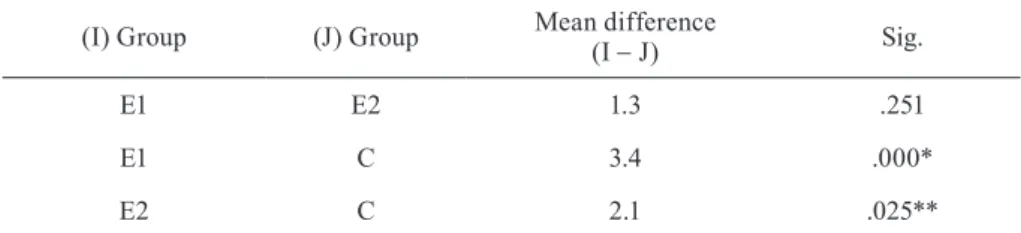
This diagram shows that the score of students of two experimental groups (Е1 and Е2) is shifted toward higher results, while it is shifted toward lower results in the group C. Students from E1 group achieved 11.7 points (58.5%) in average on the posttest, what was about the same result as students from E2 group (10.4 points, 52%), while the average success of students from C Group was 8.3 points (41.5%). Therefore, students from the experimental groups achieved higher scores than students from the control group. In order to determine between which groups there was a statistically significant dif-ference in the achievement on the posttest, there was used a post hoc analysis, i.e. Tukey’s test, which results were summarized in Table 1.
This diagram shows that the score of students of two experimental groups (Е1 and Е2) is
shifted toward higher results, while it is shifted toward lower results in the group C. Students
from E1 group achieved 11.7 points (58.5%) in average on the posttest, what was about the
same result as students from E2 group (10.4 points, 52%), while the average success of
students from C Group was 8.3 points (41.5%). Therefore, students from the experimental
groups achieved higher scores than students from the control group. In order to determine
between which groups there was a statistically significant difference in the achievement on
the posttest, there was used a post hoc analysis, i.e. Tukey s test, which results were
ʼ
summarized in Table 1.
Table 1. Results of comparing the group pairs on the posttest of knowledge
regarding the achievement (Tukey HSD)
(I) Group
(J) Group
Mean difference
(I
J)
Sig.
E1
E2
1.3
.251
E1
C
3.4
.000*
E2
C
2.1
.025**
Legend. *p< ,001; **p< ,05
On the posttest, Tukey s test showed
ʼ
that there was a statistically significant difference in the
students’ achievement between the experimental groups (E1 and E2) and C group in favor of
E1 and E2 groups. Comparing the average achievement of students E2 in relation to E1
group, the obtained difference was not statistically significant (1.3 points in favor of E2
group). Therefore, students who studied the topic Surface Energy and Surface Tension, made
significantly better progress by applying LIBEs and ICBSs, compared to students who learnt
Table 1: Results of comparing the group pairs on the posttest of knowledge regarding the achievement (Tukey HSD)
(I) Group (J) Group Mean difference(I − J) Sig.
E1 E2 1.3 .251
E1 C 3.4 .000*
E2 C 2.1 .025**
Legend. *p< ,001; **p< ,05
On the posttest, Tukey’s test showed that there was a statistically significant difference in the students’ achievement between the experimental groups (E1 and E2) and C group in favor of E1 and E2 groups. Comparing the average achievement of students E2 in relation to E1 group, the obtained difference was not statistically significant (1.3 points in favor of E2 group). Therefore, students who studied the topic Surface Energy and Surface Tension, made significantly better progress by applying LIBEs and ICBSs, compared to stu-dents who learnt the same content in the frontal form of instruction. Use of experiments for Physics teaching has been very favorable since Physics is an experimental science. Therefore, such method moves students closer to the way of scientific observation of physical phenomena. Multimedia is shown as favorable, since informatics revolution is involved into each aspect of life, and students are in a position to have greater amount of information. The use of innovations for Physics teaching is important when the final results are higher achievements of students.
LIBEs and ICBSs Impact on Student’s Cognitive Load
In order to examine the efficiency of LIBEs and ICBSs compared to tradi-tional teaching, according to the criterion of the cognitive load of students, the posttest assessed the invested cognitive load of students. If an educational strategy ensures high performance of students along with low values of cog-nitive load, it is considered to have a high instructional efficiency.
Figure 2: Distribution of students’ assessments of invested cognitive load оn posttest for E1, E2 and C groups
As it is seen in Figure 2, the mean value of self-perceived cognitive load of students from experimental groups (Е1 and Е2) is shifted toward lower values, while in group C, it is shifted toward higher results. Mean values are 3.30 for E1 group, 3.53 for E2 group and 3.68 for C group. These results are consistent with the results obtained for achievements. Namely, the students in E1 and E2 who accomplished higher average achievement than students in C group considered that less cognitive load was needed to be invested in order to solve the test tasks then students in C group. Unlike them, the students from C group, who had lower average achievements, considered that more cognitive load was needed for solving identical tasks. The obtained data
indi-cated that use of innovation during teaching (LIBEs and ICBSs)was
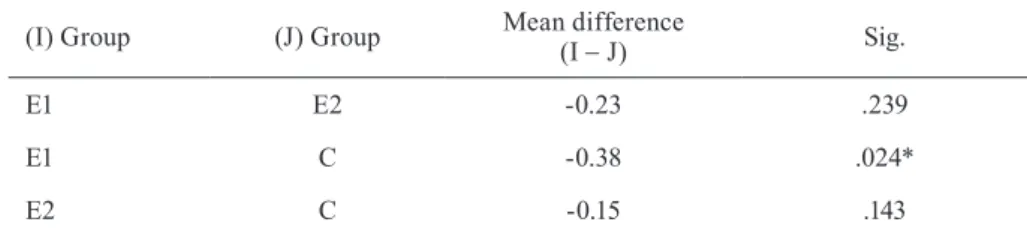
favour-able regarding decreased cognitive load for students. In order to determine a significance of differences in the invested cognitive load in three groups, the results of Tukey’s test are shown in Table 2.
As it is seen in Figure 2, the mean value of self-perceived cognitive load of students from
experimental groups (Е1 and Е2) is shifted toward lower values, while in group C, it is shifted
toward higher results. Mean values are 3.30 for E1 group, 3.53 for E2 group and 3.68 for C
group. These results are consistent with the results obtained for achievements. Namely, the
students in E1 and E2 who accomplished higher average achievement than students in C
group considered that less cognitive load was needed to be invested in order to solve the test
tasks then students in C group. Unlike them, the students from C group, who had lower
average achievements, considered that more cognitive load was needed for solving identical
tasks. The obtained data indicated that use of innovation during teaching (LIBEs and ICBSs)
was favourable regarding decreased cognitive load for students. In order to determine a
significance of differences in the invested cognitive load in three groups, the results of
Tukey’s test are shown in Table 2.
Table 2. Results of comparing the group pairs on the posttest regarding the cognitive load (Tukey HSD)
(I) Group (J) Group Mean difference(I
J) Sig.
E1 E2 -0.23 .239
E1 C -0.38 .024*
E2 C -0.15 .143
Legend. *p< ,05
Table 2: Results of comparing the group pairs on the posttest regarding the cognitive load (Tukey HSD)
(I) Group (J) Group Mean difference(I − J) Sig.
E1 E2 -0.23 .239
E1 C -0.38 .024*
E2 C -0.15 .143
Legend. *p< ,05
The results of this test (Table 2) showed that the statistically significant dif-ferences in the invested cognitive load in solving the tasks on the posttest occurred only among students from E1 and C groups. Comparing the differ-ences in the invested cognitive load between students from E1 and E2 groups, as well as from groups E2 and C, it could be concluded that they were not statistically significant. Application of ICBSs, and specially LIBEs, in learn-ing Physical contents, enables students to master the terminology with less cognitive load, transform expressions, and apply them to everyday life situa-tions. Students from E1 and E2 groups mastered the topic Surface Energy and Surface Tension on three cognitive domains with less invested cognitive load. In the domain of Knowing of the facts, E1 and E2 groups easier adopted the meaning of the term surface tension, and main features of the phenomenon, being enabled to distinguish adhesion and cohesion forces. In the domain of Understanding the concepts, with a bit of effort, the the experimental group of students could explain the reason why it was difficult to separate two paral-lel glass plates by vertical dispositioning if there was a small amount of water between them, etc. In the domain of Application of knowledge, it was possible to determine the coefficient of surface tension of water by using a thin metal ring hanged on an elastic spring, or to determine the fluid step height in the capillary that was open at both ends.
Comparative review of the instructional efficiency of LIBEs,
ICBSs and a traditional teaching approach
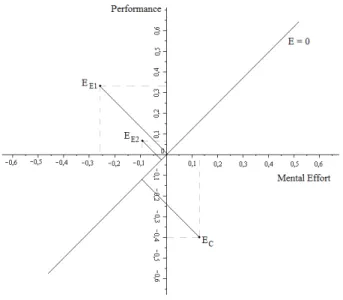
To compare the efficiency of the applied teaching models, based on achieve-ment (performances) of students and their invested cognitive load, there has been used the method suggested by Paas and Van Merrienboer (1993). Effi-ciency is calculated according to the formula , where Rz is a standard-ized value of self-perceived cognitive load and Pz is a standardized value of the students’ performances. A sign of efficiency is defined according to the position of a point relating to the line Е=0, which indicates zero efficiency. Values in the left quadrant indicate an increase in the instructional efficiency
The results of this test (Table 2) showed that the statistically significant differences in the invested cognitive load in solving the tasks on the posttest occurred only among students from E1 and C groups. Comparing the differences in the invested cognitive load between students from E1 and E2 groups, as well as from groups E2 and C, it could be concluded that they were not statistically significant. Application of ICBSs, and specially LIBEs, in learning Physical contents, enables students to master the terminology with less cognitive load, transform expressions, and apply them to everyday life situations. Students from E1 and E2 groups mastered the topic Surface Energy and Surface Tension on three cognitive domains with less invested cognitive load. In the domain of Knowing of the facts, E1 and E2 groups easier adopted the meaning of the term surface tension, and main features of the phenomenon, being enabled to distinguish adhesion and cohesion forces. In the domain of Understanding the concepts, with a bit of effort, the the experimental group of students could explain the reason why it was difficult to separate two parallel glass plates by vertical dispositioning if there was a small amount of water between them, etc. In the domain of Application of knowledge, it was possible to determine the coefficient of surface tension of water by using a thin metal ring hanged on an elastic spring, or to determine the fluid step height in the capillary that was open at both ends.
Comparative review of the instructional efficiency of LIBEs, ICBSs and a traditional teaching approach
To compare the efficiency of the applied teaching models, based on achievement (performances) of students and their invested cognitive load, there has been used the method suggested by Paas and Van Merrienboer (1993). Efficiency is calculated according to the
formula 2
z z P R
E ,, where Rz is a standardized value of self-perceived cognitive load and
Pz is a standardized value of the students’ performances. A sign of efficiency is defined
according to the position of a point relating to the line Е=0, which indicates zero efficiency. Values in the left quadrant indicate an increase in the instructional efficiency (higher performances and lower cognitive load), while values in the lower right quadrant indicate a decrease in efficiency (lower performance and higher cognitive load). Relative efficiency of a teaching strategy is calculated as a distance of the obtained point from the line E=0.
(higher performances and lower cognitive load), while values in the lower right quadrant indicate a decrease in efficiency (lower performance and high-er cognitive load). Relative efficiency of a teaching strategy is calculated as a distance of the obtained point from the line E=0.
Figure 3: Graph of instructional efficiency for the LIBEs (E1),
ICBSs(E2) and traditional teaching (C)
The obtained values for efficiency in LIBEs conditions (ЕЕ1=0.42) and ICBSs conditions (ЕЕ2=0.11), which dots are placed in the upper left quadrant, in-dicate a highly effective instructional strategies. Comparing the efficiency of these two experimental teaching strategies, LIBEs is more efficient for learning and understanding Physics. Unlike the experimental strategies, the E value obtained for C group (ЕС=0.41), which dot is placed in the lower right quadrant, indicates that traditional teaching of Physics is less efficient than ICBSs, and especially from LIBEs.
The quantitative results of this study suggest that laboratory inquire-based experiments and interactive computer inquire-based simulations at the Phys-ics classes contribute to significantly better understanding of the content Surface Energy and Surface Tension, what was confirmed by significantly higher score achieved in E1 and E2 groups of students in relation to the score achieved in C group. Application of LIBEs and ICBSs enables students to learn terms, transform expressions and apply them in a realistic life envi-ronment. In addition, on the basis of the results for evaluation of invested cognitive load, it has been concluded that the students from E1 and E2 groups assess that they invest less cognitive load when solving tasks in
compari-Figure 3. Graph of instructional efficiency for the LIBEs (E1), ICBSs(E2) and traditional teaching (C)
The obtained values for efficiency in LIBEs conditions (ЕЕ1=0.42) and ICBSs conditions
(ЕЕ2=0.11), which dots are placed in the upper left quadrant, indicate a highly effective
instructional strategies. Comparing the efficiency of these two experimental teaching strategies, LIBEs is more efficient for learning and understanding Physics. Unlike the
experimental strategies, the E value obtained for C group (ЕС= -0.41), which dot is placed in
the lower right quadrant, indicates that traditional teaching of Physics is less efficient than ICBSs, and especially from LIBEs.
The quantitative results of this study suggest that laboratory inquire-based experiments and interactive computer based simulations at the Physics classes contribute to significantly better understanding of the content Surface Energy and Surface Tension, what was confirmed by significantly higher score achieved in E1 and E2 groups of students in relation to the score achieved in C group. Application of LIBEs and ICBSs enables students to learn terms, transform expressions and apply them in a realistic life environment. In addition, on the basis of the results for evaluation of invested cognitive load, it has been concluded that the students
son to the students from C group. These findings, which are in line with the previous research (Kalyuga, 2008; Lee, Plass & Homer, 2006; Radulović & Stojanović, 2015; Renkl & Atkinson, 2003; Renkl, Gruber, Weber, Lerche & Schweizer, 2003) indicate that teaching instructions based on the use of labo-ratory inquire-based experiments and interactive computer based simulations equally contribute to an increase in students’ performance, and the reduction of cognitive load unlike traditional teaching of Physics. The results obtained in this research prove that the instructive strategies are based primarily on the experiments, and then on simulations of the efficient teaching models when learning Physics.
CONCLUSION
The study examined the extent to which different teaching instructions fo-cused on the application of laboratory inquire-based experiments and interac-tive computer based simulations improved understanding of physical contents in high school students, compared to traditional teaching approach. It also examined how the applied instructions influenced the students’ assessment of invested cognitive load. Understanding the contents in Physics was measured by the students’ scores obtained on the posttest of knowledge, while the stu-dents’ invested cognitive load in solving the test was measured by the method of their self-assessment of the difficulty of the task on a five-point Likert scale. The method Paas & Van Merrienboer (1993) was used to compare the efficiency of applied teaching strategies, based on the students’ achievement and their invested mental effort.
The findings revealed that the students who were taught with the applica-tion of LIBEs and ICBSs made statistically significant achievements in their test scores, in comparison to the students from C group. Differences in the achievement of students from LIBEs group and ICBSs group on the posttest of knowledge were not statistically significant, what indicates approximately equal importance of both teaching strategies in teaching Physics. The analy-sis of the mental effort self-assessment scale leads to the conclusion that the students of LIBEs group invested significantly less effort in resolving the posttest, in comparison to the students of ICBSs group and C group. Relative instructive efficiency for LIBEs and ICBSs, which is calculated on the basis of the results of the posttest and the cognitive load of students, has a positive value, which is higher than the obtained value for the efficiency of traditional teaching. Comparing the efficiency of two experimental methods, the teach-ing model based on the application of LIBEs is more efficient than the ICBSs application.
also in relation to the average scale, inevitably suggests that our students in Physics class should have much more activities to prepare and conduct hands-on experiments and work in small groups. This would enable development of critical thinking and improvement of their own cognition through coopera-tion, as well as exchange of knowledge with others.
References
Adamov, J., Segedinac, M., Halaši, T. & Olić, S. (2015). Učenički mini-projekti o transportu tečnosti u živim sistemima (Small projects of children on the transport of fluids in live systems). Vaspitanje i obrazovanje, 4, 59–71.
Ayres, P. (2006). Using subjective measures to detect variations of intrinsic cognitive load wuthin problems. Learning and Instruction, 16(5), 389–400.
Azar, A. & Sengülec, Ö. A. (2011). Computer-assisted and laboratory-assisted teaching meth-ods in physics teaching: The effect on student physics achievement and attitude toward physics. Eurasian Journal of Physics and Chemistry Education, 10(1), 43–50.
Benson, A. A. & Nkiruka, C. (2013). Improving students’ learning outcomes in practical physics: which is better? Computer simulates experiment or hands-on experiment?
IOSR Journal of Research & Method in Education, 2(6), 18–26.
Butts, D. P., Koballa, T. R. & Elliot, T. D. (1997). Does participating in an undergraduate elementary science methods course make a difference? Journal of Elementary Science Education, 9(2), 1–17.
Choi, H-H., van Merriёnboer, J. J. G. & Paas, F. (2014). Effects of the physical environment on cognitive load and learning: Towards a new model of cognitive load. Educational
Psychology Review, 26(2), 225–244. DOI 10.1007/s10648-014-9262-6.
Clark, R., Nguyen, F. & Sweller, C. (2006). Efficiency in learning: Evidence-based guidelines to manage cognitive load. San Francisco, CA: Pfeiffer.
Cziprok, C. D., Popescu, F. F., Pop, A. I. & Variu, A. (2015). Conceptual maps and integrated experiments for teaching/learning physics of photonic devices. Procedia – Social and Behavioral Sciences, 191, 512–518.
de Jong, T. & Van Joolingen, W. R. (1998). Scientific discovery learning with computer simu-lations of conceptual domains. Review of Educational Research, 68(2), 179–201. de Jong, T. (2010). Cognitive load theory, educational research, and instructional design:
Some food for thought. Instructional science, 38(2), 105–134.
de Jong, T., Linn, M. C. & Zacharia, Z. C. (2013). Physical and virtual laboratories in science and engineering education. Science, 340, 305–308.
de Waard, D. (1996). The measurement of driver’s mental workload (PhD thesis). Haren, NL: Traffic Research Centre, University of Groningen.
Ding, L. Chabay, R., Sherwood, B. & Beichner, R. (2006). Evaluating an electricity and mag-netism assessment tool: Brief electricity and magmag-netism assessment. Physical Review Special Topics – Physics Education Research, 2. Retrived, July 29th, 2016 from http://
journals.aps.org/prper/pdf/10.1103/PhysRevSTPER.2.010105
Ertepinar, H. & Geban, O. (1996). Effect of instruction supplied with the investigative-ori-ented laboratory approach on achievement in a sciience course. Educational Research,
38(3), 333–341.
Eylon, B. S., Ronen, M. & Ganiel, U. (1996). Computer simulations as tools for teaching and learning: Using a simulation environment in optics. Journal of Science Education and Technology, 5(2), 93–110.
Goldberg, F. (1997). Constructing physics understanding in a computer-supported learning environment. AIP Conference Proceedings, 399, 903–911.
Gorsky, P. & Finegold, M. (1992). Using computer simulations to restructure students’ con-ception of force. Journal of Computers in Mathematics and Science Teaching, 11, 163– 178.
Grayson, D. J. (1996). Using education research to develop waves courseware. Computer in Physics, 10(1), 30–37.
Grayson, D. J. & McDermott, L. C. (1996). Use of the computer for research on student think-ing in physics. American Journal of Physics, 64(5), 557–565.
Gunstone, R. F. & Champagne, A. B. (1990). Promoting conceptual change in the labora-tory. In E. Hegarty-Hazel (Ed.), The student laboratory and the science curriculum (pp. 159–182). Routledge: London.
Hargrave, C. & Kenton, J. (2000). Preinstructional simulations: Implications for science classroom teaching. Journal of Computers in Mathematics and Science Teaching, 19(1), 47–58.
Hennessy, S., Wishart, J., Whitelock, D., Deaney, R., Brawn, R., Velle, L., McFarlane, A., Ruthven, K. & Winterbottom, M. (2007). Pedagogical approaches for technology-inte-grated science teaching. Computers & Education, 48(1), 137–152.
Jaakkola, T. & Nurmi, S. (2008). Fostering elementary school students’ understanding of sim-ple electricity by combining simulation and laboratory activities. Journal of Computer Assisted Learning, 24(4), 271–283.
Kalyuga, S., Chandler, P. & Sweller, J. (1999). Managing split-attention and redundancy in multimedia instruction. Applied Cognitive Psychology, 13(4), 351–371.
Kalyuga, S. (2008). Relative effectiveness of animated and static diagrams: An effect of learner prior knowledge. Computers in Human Behavior, 23(1), 852–861.
Kalyuga, S., Chandler, P. & Sweller, J. (2000). Incorporating learner experience into the de-sign of multimedia instruction. Journal of Educational Psychology, 92(1), 126–136. Kalyuga, S., Chandler, P. & Sweller, J. (2001). Learner experience and efficiency of
instruc-tional guidance. Educational Psychology, 2(1), 5–23.
Kuka, M. (1999). How can laboratory and experimental method influence students achieve-ment in teaching process. Nastava i vaspitanje, 48(3–4), 326–351.
Lea, M., Thacker, B. A., Kim, E. & Miller, K. M. (1996). Computer assisted assessment of student understanding in physics. Computers in Physics, 10(1), 30–37.
Lee, H., Plass, J. L. & Homer, B. D. (2006). Optimizing cognitive load for learning from com-puter-based science simulations. Journal of Educational Psychology, 98(4), 902–913. Lee, J. (1999). Effectiveness of computer-based instructional simulation: A meta-analysis.
International Journal of Instructional Media, 26(1), 71–85.
Loewenthal, K. M. (2001). An introduction to psychological tests and scales (2nd Edition).
Hove, UK: Psychology Press.
Marshall, J. A. & Young, E. S. (2006). Preservice teachers’ theory development in physical and simulated environments. Journal of Research in Science Teaching, 43(9), 907–937. Obadović, D. & Rančić, I. (2012). Praktikum jednostavnih eksperimenata u nastavi fizike.
Novi Sad: Prirodno-matematički fakultet.
Paas, F. & Van Merriënboer, J. J. G. (1993). The efficiency of instructional conditions: An approach to combine mental effort and performance measures. Human Factors: The Journal of the Human Factors and Ergonomics, 35(4), 737–743.
Paas, F. & Van Merriënboer, J. J. G. (1994). Instructional control of cognitive load in the train-ing of complex cognitive tasks. Educational Psychology Review, 6(4), 51–71.
Perkins, K., Adams, W., Dubson, M., Finklestein, N., Reid, S. & Wiemen, C. (2006). Interac-tive simulations for teaching and learning physics. The Physics Teacher, 44(1), 18–23.
Plass, J. L., Moreno, R. & Brunken, R. (2010). Introduction. In J. L. Plass, R. Moreno, R. Brunken (Ed.), Cognitive load theory (pp. 1–6). New York: Cambridge University Press.
Psycharis, S. (2011). The computational experiment and its effects on approach to learning and beliefs on physics. Computers & Education, 56(3), 547–555.
Radulović, B. & Stojanović, M. (2015). Determination instructions efficiency of teaching methods in teaching physics in the case of teaching unit „Viscosity. Newtonian and Stokes Law“. Acta Didactica Napocensia, 8(2), 61–68.
Renkl, A. & Atkinson, R. K. (2003). Structuring the transition from example study to prob-lem solving in cognitive skill acquisition: A cognitive load perspective. Educational Psychologist, 38(1), 15–22.
Renkl, A., Gruber, H., Weber, S., Lerche, T. & Schweizer, K. (2003). Cognitive load beim Lernen aus Lösungsbeispielen [Cognitive load during learning from worked-out exam-ples]. Zeitschrift für Pädagogische Psychologie, 17(2), 93–101.
Ronen, M. & Eliahu, M. (2000). Simulation, a bridge between theory and reality: The case of electric circuits. Journal of Computer Assisted Learning, 16(1), 14–26.
Russell, D. W., Lucas, K. B. & McRobbie C. J. (2004). Role of the microcomputer-based labo-ratory display in supporting the construction of new understandings in thermal physics.
Journal of Research in Science Teaching, 41(2), 165–185.
Rutten, N., van Joolingen, W. R. & van der Veen, J. T. (2012). The learning effects of computer simulatons in science education. Computers & Education, 58(1), 136–153.
Sarabando, C., Cravino, J. & Soares, A. (2014). Contribution of a computer simulation to students’ learning of the physics concepts of weight and mass. Procedia Technology,
13, 112–121.
Steinberg, R. N. (2000). Computers in teaching science: To stimulate or not to stimulate?.
American Journal of Physics, 68(7), S37-S41.
Sweller, J., Ayres, P. & Kalyuga, S. (2011). Cognitive load theory. Springer, New York. Tindall-Ford, S., Chandler, P. & Sweller, J. (1997). When two sensory modes are better than
one. Journal of Experimental Psychology: Applied, 3(4), 257–287.
Trundle, K. C. & Bell, R. L. (2010). The use of a computer simulation to promote conceptual change: a quasi-experimental study. Computers & Education, 54(4), 1078–1088.
Van Heuvelen, A. (1997). Using interactive simulations to enhance conceptual development and problem solving skills. In AIP Conference Proceedings (pp. 1119–1136). IOP Insti-tute of Physics Publishing LTD.
Verbić, S., Bojović, V. & Milin, V. (2011). Postignuće učenika i nastava fizike. U S. Gašić-Pavišić & D. Stanković (ur.), TIMSS 2007 u Srbiji (str. 69–96). Beograd: Institut za pedagoška istraživanja.
Wiemen, C. E., Perkins, K. K. & Adams, W. K. (2008). Oersted Medal Lecture 2007: Inter-active simulations for teaching physics: What works, what doesn’t, and why. American Journal of Physics, 76(4), 393–399.
Yaman, M., Nerdel, C. & Bayrhuber, H. (2008). The effects of instructional support and learn-er intlearn-erests when learning using computlearn-er simulations. Computers & Education, 51(4), 1784–1794.
ЕФЕКТИ ПРИМЕНЕ ЛАБОРАТОРИЈСКИХ ИСТРАЖИВАЧКИХ ЕКСПЕРИМЕНАТА И КОМПЈУТЕРСКИХ СИМУЛАЦИЈА НА ПОСТИГНУЋА И КОГНИТИВНО ОПТЕРЕЋЕЊЕ УЧЕНИКА
СРЕДЊЕ ШКОЛЕ У НАСТАВИ ФИЗИКЕ
Бранка РадуловићиМаја Стојановић
Природно-математички факултет, Универзитет у Новом Саду, Србија
Вера Жупанец
Природно-математички факултет, Универзитет у Новом Саду, Србија
Апстракт
Основни циљ овог истраживања био је да се испита у којој мери ће различите наставне инструкције, фокусиране на примени лабораторијских истраживач-ких експеримената и компјутерсистраживач-ких симулација, побољшати разумевање на-ставних садржаја из физике код ученика средње школе. Такође је циљ био и да се испита како примењене наставне инструкције утичу на когнитивно опте-рећење ученика. Истраживање је спроведено на пригодном узорку од 187 уче-ника средње школе. Тест који је садржао задатке вишеструког избора коришћен је као инструмент за мерење образовних постигнућа ученика. У оквиру сваког задатка налазила се Ликертова петостепена скала за процену когнитивног оп-терећења. Да би била утврђена значајност разлика у постигнућу и когнитивном напору ученика између група, као и за прорачун инструкционе ефикасности примењених наставних модела, поред дескриптивне статистике, примењене су једнофакторска анализа варијансе и Такијев тест контрастирања. Резултати су показали да инструкционе стратегије, које су засноване на коришћењу ла-бораторијских истраживачких експеримената и компјутерским симулацијама, подједнако доприносе бољем ученичком постигнућу уз истовремено смањење когнитивног оптерећења, у односу на традиционални приступ настави физике. Резултати инструкционе ефикасности добијени код ученика експериментал-них група потврђују да примењене наставне стратегије представљају ефикасне наставне моделе.
ЭФФЕКТЫ ПРИМЕНЕНИЯ ЛАБОРАТОРНЫХ ИССЛЕДОВАТЕЛЬСКИХ ЭСПЕРИМЕНТОВ И КОМПЬЮТЕРНЫХ СИММУЛЯЦИЙ НА ПОСТИЖЕНИЯ И КОГНИТИВНУЮ НАГРУЗКУ УЧАЩИХСЯ
СРЕДНИХ ШКОЛ В ОБУЧЕНИИ ФИЗИКЕ
Бранка Радулович и Майя Стоянович
Естественно-математический факультет, Новисадский Университет, Сербия
Вера Жупанец
Естественно-математический факультет, Новисадский Университет, Сербия
Аннотация
Основная цель данного исследования – выявить, в какой степени разные учеб-ные инструкции, направленучеб-ные на применение лабораторных исследователь-ских экспериментов и компьютерных симмуляций, оптимизируют понимание учебных содержаний по физике у учащихся средних школ. Целью исследова-телей также было выявление воздействия примененных учебных инструкций на когнитивную нагрузку учащихся. Исследование было проведено на корпу-се 187 учащихся средних школ. Тест, составленный из задач выбора одной из данной возможности, использовался в качестве инструмента для измерения образовательных постижений учащихся. В рамках каждой задачи применя-лась пятистепенная шкала Ликкерта для оценки когнитивной нагрузки. В це-лях выявления нагрузки была выявлена значимость отличий в постижениях и в когнитивном напряжении учащихся между группами, а в целях выявления инструкционной эффективности использованных учебных моделей, помимо дескриптивной статистики, было применены однофакторный анализ вари-ансы и тест сопоставления Такки. Результатя показали, что инструкционные стратегии, которые основываются на использовании лабораторных исследова-тельских эксперименов и компьютерных симмуляций, в одинаковой степени содействуют улучшению постижений учащихся с одновременным уменьше-нием когнитивной нагрузки, по сравнению с традиционным подходом препо-даванию физики. Результаты инструкционной эффективности, полуьенные у учащихся из экспериментальных групп, подтверждают, что использованные стратегии обучения являются эффектыми учебными моделями.