Pages: 70-75 DOI: 10.13057/biodiv/d120203
Polymorphic sequence in the ND3 region of Java endemic Ploceidae
birds mitochondrial DNA
R. SUSANTI♥
Department of Biology, Faculty of Mathematics and Natural Sciences, Semarang State University. Bld. D6, Fl. 1. Sekaran Campus, Gunungpati, Semarang 50229, Central Java, Indonesia. Tel & Fax. +62-24-8508033. ♥email: [email protected]; [email protected]
Manuscript received: 22 July 2010. Revision accepted: 14 February 2011.
ABSTRACT
Susanti R (2011) Polymorphic sequence in the ND3 region of Java endemicPloceidae birds mitochondrial DNA. Biodiversitas 12: 70-75. As part of biodiversity, Ploceidae bird family must be kept away from extinction and degradation of gene-diversity. This research was aimed to analyze ND3 gene from mitochondrial DNA of Java Island endemic of Ploceidae bird. Each species of Ploceidae birds family was identified based on their morphological character, then the blood sample was taken from the birds nail vein. DNA was isolated from blood using Dixit method. Fragment of ND3 gene was amplified using PCR method with specific primer pairs and sequenced using dideoxy termination method with ABI automatic sequencer. Multiple alignment of ND3 nucleotide sequences were analyzed using ClustalW of MEGA-3.1 program. Estimation of genetic distance and phylogenetic tree construction were analyzed with Neighbor-Joining method and calculation of distance matrix with Kimura 2 –parameter. The result of Java Island endemic of Ploceidae bird family exploration showed that Erythrura hyperythra and Lonchura ferruginosa can not be found anymore in nature, but the Lonchura malacca that are not actually Java island endemic was also found. Nucleotide sequence of mitochondrial ND3 gene of Ploceidae bird family showed a quite high polymorphism, with 122 substitutions from 334 nucleotides analyzed.Phylogenetic tree of nucleotide sequence of Ploceidae bird family formed 2 clusters. One cluster consisted of the Ploceushypoxanthus, Ploceus philippinus, Ploceus manyar and Passer montanus, and the others species were included in the second cluster. ND3 gene sequence data from this Ploceidae family need to be analyzed further to see possible relationship with a particular phenotype.
Key words: Ploceidae, ND3 gene, mitochondrial DNA.
INTRODUCTION
Indonesia is rich countries in biodiversity of birds, 1539 species of birds have spread in various regions in Indonesia. Indonesian endemic birds recorded around 494 species spread across the island of Java, consists of 368 species of settlers birds and 126 species visitors (nomads) birds (McKinnon et al. 1993). Latest publication from the International Union for Conservation of Natural Resources (IUCN) in 2000 stated that Indonesia has 324 bird species including the red list of threatened species (Dono 2002). Ploceidae bird family in Indonesia consist of approximately 41 species and 13 species of which was located on the island of Java (Iskandar 1989; McKinnon et al. 1993). Although until now, only Java sparrow (Padda oryzivora) that experienced a shift from an agricultural pest predator, but the decline in the number of the population of other bird speciesof this family should be considered.
As part of biodiversity, Ploceidae birds family needs to be protected from extinction and decline in species diversity. Members of Ploceidae birds family increasingly difficult to find in nature all around us, so it needs to promote conservation. One effort to provide the basis of germplasm conservation strategy is through the study of genetic diversity (Susanto et al. 2004). According Wartono et al. (2000), the concept of conservation today is directed to gene conservation. This is partly because the gene is the
basic unit in natural selection and gene variations are directly related to individual fitness or adaptability to environmental conditions. Animal adaptation to the environment can result in unique combinations of alleles for a particular type, and the circumstances in this difficult re-formed. The types that are different from other types needed to be conserved genes and gene combinations that bring very useful in the future (Christianti et al. 2003). The benefits of genetic diversity in the future, efforts to save biodiversity from extinction should be done immediately. Preservation of biodiversity, including genetic resources will ensure the availability of genetic material for the development of science and technology.
variation of DNA does not necessarily indicate protein variations (Christianti et al. 2003). The use of DNA as a genetic marker, providing more accurate data and can immediately detects the variation in the genetic material.
Mitochondrial DNA (mtDNA) are easily extracted, relatively small size (Shadel and Clayton 1997), has a mutation rate ten times faster than nuclear DNA (Christianti et al. 2003), and contain more variation than nuclear DNA (Wood and Phua (1996), so widely used in the analysis of genetic diversity. The variation of human mtDNA variation shows the effect on health-related phenotypes, such as involvement in degenerative diseases, aging and reproduction properties. Pedigree maternal affect growth, reproduction and lactation, even reported that the mtDNA variation associated with milk production in dairy cows. To study the effect of mtDNA on the phenotype required the listing of several generations of phenotypic data (Christianti et al. 2003).
Sequences of mtDNA encodes seven subunits of complex I (NADH dehydrogenase), electron transport chain (oxidative phosphorylation), a subunit of complex III (cytochrome b-c1 complex), three subunits of complex IV (cytochrome oxidase) and two subunits of ATP synthase complex. OXPHOS disease is a clinical illness associated with the components of oxidative phosphorylation. Mutations in the gene of NADH dehydrogenase subunit 4 (ND4) reported Wallace et al. (1995) causes the disease's hereditary optic neuropathy leber (LHON). ND3 gene is a gene that encodes the enzyme NADH dehydrogenase subunit 3, which is one of the seven subunits of complex I subunits of oxidative phosphorylation (Marks et al. 1996).
Previous research indicates that some birds Java Sparrow (Padda oryzivora) showed the diversity of ND3 gene sequences (Susanti 2008). Diversity of information based on ND3 gene sequence analysis is the underlying basis for detecting the gene mutations that occur from generation to generation, and also genetic diversity is the basis for studying the relationship between diversity ND3 gene sequences with a particular phenotype such as resistance to disease.
MATERIALS AND METHODS
Ploceidae birds
Twelve species birds of the endemic Java island Ploceidae used in this study: Amandava amandava,
Erythrura hyperythra, Erythrura prasina, Lonchura
ferruginosa, Lonchura leucogastra, Lonchura
leucogastroides, Lonchura maja, Lonchura malacca,
Lonchura punctulata, Padda oryzivora, Passer montanus,
Ploceus hypoxanthus, Ploceus manyar, and Ploceus philippinus. Each species of Ploceidae bird family was identified based on their morphological character, then the blood sample was taken from the birds nail vein.
Amplification of ND3 gene
DNA was isolated from blood using Dixit method. The polymerase chain reaction (PCR) amplification was prepared at amount of 30 μl with composition of 15 μL 2x
reaction mix buffer (Fermentas), 10 pmol of primers H11151 dan L10775, 0.6 μL of genomic DNA (12 ng/μL), and ultrapure H2O until reaching 30 μL. Primer used was
the primer pair that flanking cleavage site region, they are H11151 (5’GATTTGAGCCGAAATCAAC 3’) and L10775 (5’GACCAATCTTTAAAATCTGG 3’). PCR program consists of, pre-denaturation 95oC for 5 minutes, 40 cycles consist of denaturation 95oC for 30 seconds, annealing 58oC for 30 seconds, extension 72oC for 1 minutes, and post-extension 72oC for 10 minutes (Sulandari and Zein 2002). The specific DNA band resulted from PCR was identified by electrophoresis on 2% agarose gel.
Sequencing and phylogenetic analysis
The PCR products were then sequenced using dideoxy termination method with ABI automatic sequencer (Applied Biosystems). Nucleotide sequence of mitochondrial ND3 gene of Ploceidae birds submitted to GeneBank. Multiple alignment of nucleotide sequences were analyzed using ClustalW of MEGA 3.1 program. Estimation of genetic distance and phylogenetic tree construction were analyzed with Neighbor-Joining method and calculation of distance matrix with Kimura 2-parameter.
RESULTS AND DISCUSSION
The result of Java Island endemic of Ploceidae birds family exploration showed that Erythrura hyperythra and
Lonchura ferruginosa were not found anymore in nature, but the Lonchura malacca that was not Java island endemic (McKinnon et al. 1993) was observed. The loss of two birds species are likely due to population changes in bird habitat ecosystem. As one component of the environment, birds can be used directly or indirectly as an environmental bioindicator to detect environmental changes and can reflect the stability of the habitat. Bird life depends on vegetation, soil and water. The diversity of vegetation and its density determines the number and level of diversity of bird species (Hardy et al. 1987; Peakall and Boyd 1987; Rutschke,1987). Plants to be much visited by birds and a comfortable place for birds. In addition to the nest and food sources for birds, plants give birds protection from sunlight intensity, stress, excessive heat, low humidity and predators attack (Soendjoto and Gunawan 2003). The loss of bird populations may also be caused by the arrest by humans, because the Ploceidae bird families are eating seeds that are commonly founded in agricultural land to a height of 1500m so easily captured. This is reinforced by the fact that these birds was traded in bird markets in some regions and exported to Japan, Europe and America (Iskandar 2005). Population might also be due to the limited use of pesticides on agricultural land resulting in lower levels of pesticide contamination due to bird health.
GenBank with accession numbers EF102496-EF1022485. Nucleotide alignment with ClustalW (MEGA 3.1) indicated that 122 substitution from 334 nucleotides analyzed (Figure 2).
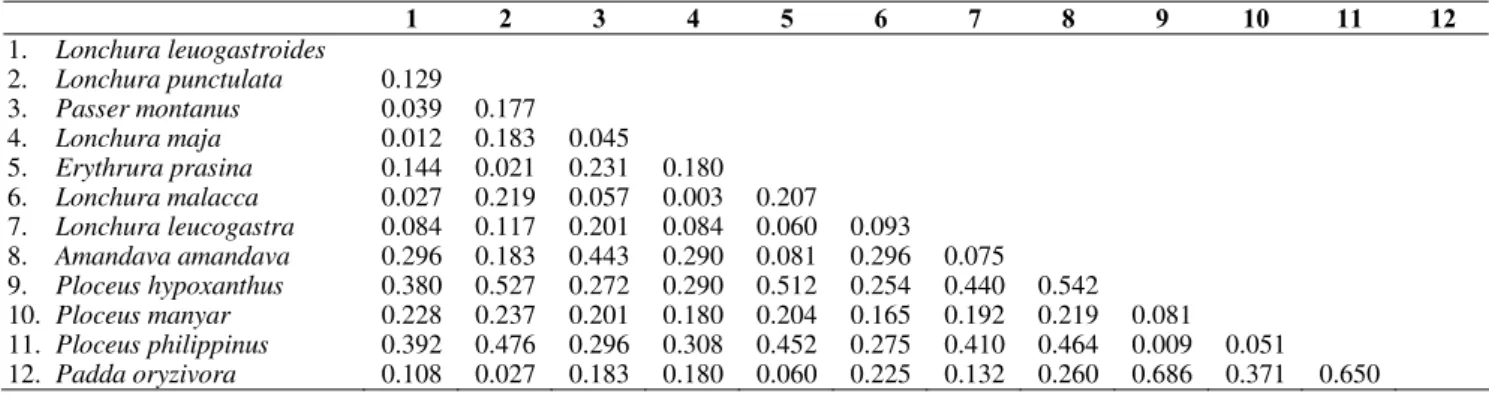
ND3 gene nucleotide analysis using ClustalW program (MEGA 3.1) shows that the 334 nucleotide, there were 142 polymorphic sites (Figure 2). Genetic distance and nucleotide sequence phylogeny was analyzed using neighbor-Joining method and calculation of distance matrix with Kimura 2-parameter model (Kimura 1980), successively seen in Table 1 and Figure 3. Result of phylogenetic analysis indicated that all Ploceidae bird family form two distinct sublineages. One cluster
consisted of the Ploceus
hypoxanthus, Ploceus philippinus,
Ploceus manyar and Passer
montanus, and the others species birds of this study include in the seccond cluster (Figure 3).
Mitochondrial DNA has a mutation rate ten times faster than nuclear DNA (Christianti et al. 2003). Most of the mitochondrial gene coding for a mitochondrial protein. Subunit of cytochrom-c oxidase, cytochrome b, and ribosomal genes are widely used in studies of population genetics and phylogeny (Shearer et al. 2002). Genetic diversity based on mtDNA sequence has been successfully carried out on fruit-eating bats (Chinorax Melanochephalus) (Zein and Maharadatunkamsi 2003), bats (Wilkinson et al. 1997), woodpekers (Prychitko and Moore 2000), mammals (Gemmell et al. 1996) and birds (Tuinen et al. 2000). Polymorphism of mtDNA also occur in horses (Ishida et al. 1994), sheep (Heindleder et al. 1991), goats
(Upholt and Dawid 1977), buffalo (Bhat et al. 1990) and cows (Christianti et al. 2003). The variation of fragment displacement-loop (D-loop) have been reported between species, even within a species (Gemmell et al. 1996; Wood and Phua 1996; Wilkinson et al. 1997). D-loop fragment is the initiator of transcription and replication (Linberg 1989). Christianti et al.( 2003) reported that the D-loop fragment influence the fertility of livestock, milk production, milk fat percentage and health of livestock.
Reported that the ND3 gene sequences in 46 species of birds have one extra nucleotide at position 174. Excess
base is one causes the shift (frameshift) nucleotide bases behind him so that formed two stop codons in the downstream part ND3 gene, resulting in premature translational stops and produces only 68 amino acids (should be 117 amino acids) (Mindell et al. 1998 ). Frameshift due to the substitution of one nucleotide bases mengasilkan different proteins, which may also influence its activity as an enzyme in oxidative phosphorylation. ND3 gene sequence data from Ploceidae families need to be analyzed in further research on possible relationship with a particular phenotype.
1 2 3 4 5 6 7 8 9 10 11 L 13
Figure 1. Electrophoregram of ND3 gene PCR of Ploceidae birds using L10775 and H11151 primer (product 400bp). Well M: DNA ladder 100bp. Well 1-11, 13 : sample of Ploceidae birds
Erythrura prasina
Amandava amandava
Lonchura punctulata
Padda oryzivora
Lonchura leucogastroides
Lonchura leucogastra
Lonchura maja
Lonchura malacca
Passer montanus
Ploceus hypoxanthus
Ploceus manyar
Ploceus philippinus
Goose(NC004539)
0.1
Tabel 1. Genetic distance of Ploceidae mitochondrial ND3 nucleotide sequence by using the neighbor-joining method and calculation of distance matrix with Kimura 2 –parameter
1 2 3 4 5 6 7 8 9 10 11 12
1. Lonchura leuogastroides
2. Lonchura punctulata 0.129 3. Passer montanus 0.039 0.177 4. Lonchura maja 0.012 0.183 0.045 5. Erythrura prasina 0.144 0.021 0.231 0.180 6. Lonchura malacca 0.027 0.219 0.057 0.003 0.207 7. Lonchura leucogastra 0.084 0.117 0.201 0.084 0.060 0.093
8. Amandava amandava 0.296 0.183 0.443 0.290 0.081 0.296 0.075 9. Ploceus hypoxanthus 0.380 0.527 0.272 0.290 0.512 0.254 0.440 0.542 10. Ploceus manyar 0.228 0.237 0.201 0.180 0.204 0.165 0.192 0.219 0.081 11. Ploceus philippinus 0.392 0.476 0.296 0.308 0.452 0.275 0.410 0.464 0.009 0.051 12. Padda oryzivora 0.108 0.027 0.183 0.180 0.060 0.225 0.132 0.260 0.686 0.371 0.650
#Lonchura leucogastroides ATT CTA GTC CTC CTT GGG TTC ATT CGT ATA CGA GTC CTA [ 39] #Lonchura punctulata ... ... ... ... ... ... ... ... ... ... .T. ... ... [ 39] #Passer montanus ... ... ... ... ... ..A ... ... ... ... ... ... .G. [ 39] #Lonchura maja ... ... ... ... ... ... ... ... ... ... ... ... ... [ 39] #Erythrura prasina ... ... ... ... ... ... ... ... ... ... .TC ... ... [ 39] #Lonchura malacca ... ... ... ... ... ... ... ... ... ... ... ... ... [ 39] #Lonchura leucogastra ... ... ... ... A.. ... ... ... ... ... ... ... ... [ 39] #Amandava amandava ... ... ... ... ... ... ... ... ... ... .TC ... ... [ 39] #Ploceus hypoxanthus ... ... ... ... ... C.A ... ... T.. ... ... ... ... [ 39] #Ploceus manyar ... ... ... ... ... C.A ... ... T.. ... ... ... ... [ 39] #Ploceus philippinus ... ... ... ... ... C.A ... ... T.. ... ... ... ... [ 39] #Padda oryzivora ... ... ... ... ... ... ... ... ... ... ... ... ... [ 39]
#Lonchura leucogastroides GTG TCA GGA GGA GGA TTA GTG TGG AGG CTC ATG TTA GGG [ 78] #Lonchura punctulata ... ... .T. ... ... ... ... ... ... ... ... ... ... [ 78] #Passer montanus .A. .G. ... .T. .A. ... ..A G.. .A. ... .G. .C. .A. [ 78] #Lonchura maja ... ... .T. ... ... ... ... ... ... ... ... C.. ... [ 78] #Erythrura prasina ... ... .T. ... ... ... ... ... ... ... ... .G. ... [ 78] #Lonchura malacca ... ... .T. ... ... ... ... ... ... ... ... C.. ... [ 78] #Lonchura leucogastra ... ... .T. ... ... ... ... ... ... ... ... C.. .T. [ 78] #Amandava amandava ... ... ... ... ... ... .A. GC. ... ... ... .G. C.. [ 78] #Ploceus hypoxanthus ... .G. .A. .A. ... ... ..A GA. ... ... .G. A.. ... [ 78] #Ploceus manyar ... .G. .A. .AT ... ... ..A GA. ... ... .G. A.. ... [ 78] #Ploceus philippinus ... .G. .A. .A. ... ... ..A GA. ... .C. .G. A.. ... [ 78] #Padda oryzivora ... .T. .T. AT. ... .C. ... ... ... ... ... ... ... [ 78]
#Lonchura leucogastroides TGG TGA TGG GAG ATT GAA GTT GGA TGG CTC ATG GTA GGG [117] #Lonchura punctulata ... ... ... ... ... ... ..C .A. .T. ... ... ... ... [117] #Passer montanus ... ... ... .G. ... .T. ... ..G ... ... ... ... .T. [117] #Lonchura maja ... ..G ... ... ... ... ... ..G .T. ... ... ... ... [117] #Erythrura prasina ... ... ... ... ... ... ..C .A. .T. ... ... ... ... [117] #Lonchura malacca ... ..G ... ... ... ... ... ..G .T. ... ... ... ... [117] #Lonchura leucogastra ... ..G ... ... ... ... ... ..G .T. ... ... ... ... [117] #Amandava amandava ... .AT ... ... ... ... ..C .A. .T. ... ... ... ... [117] #Ploceus hypoxanthus ... .TG ... .G. ... .G. ... ... .T. ... .C. ... .A. [117] #Ploceus manyar ... .TG ..A .G. ... .G. ... ... .T. ... .C. ... .A. [117] #Ploceus philippinus ... .TG ... .G. ... .G. ... ... .T. ... .C. ... .A. [117] #Padda oryzivora .AT ..G .A. .G. ... .G. ... .A. ... ... ... ... ... [117]
#Lonchura leucogastroides GCA GTA GTA GGG CGA TTT CTA GGT CGA ATA GTA GGA ATA [156] #Lonchura punctulata .T. ... ... ... ... ... ... ... .A. ... .A. ... ... [156] #Passer montanus .T. .G. .C. ... ... ... ... ... ... ... .G. ... ... [156] #Lonchura maja ... ... ... ... ... ... ... ... ... ... ... ... ... [156] #Erythrura prasina .T. ... ... ... ... ... ... ... .A. ... .A. ... ... [156] #Lonchura malacca ... ... ... ... ... ... ... ... ... ... ... ... ... [156] #Lonchura leucogastra ... ... .A. ... ... ... ... ... ... ... ... ... ... [156] #Amandava amandava CT. ... ... ... T.. ... ... ... .AT ... .AC T.. ... [156] #Ploceus hypoxanthus .A. .G. .A. ... ... ... ... A.. ... ... ... A.. .C. [156] #Ploceus manyar .A. .G. .A. .C. ... ... ... AT. ... T.. ... A.. .C. [156] #Ploceus philippinus .A. .G. .A. ... ... ... ... AT. ... ... ... A.. .C. [156] #Padda oryzivora .A. ... ... ... ... ... ... ... .A. ... ... ... ... [156]
#Lonchura malacca ... .G. ... ... ... ... ... ... ... ... ... ... ... [195] #Lonchura leucogastra ... CG. ... ... .C. ... ... ... ... ..T ... ... ..A [195] #Amandava amandava .A. .G. ... ... ... .TC ... ... ... ... ... ... ... [195] #Ploceus hypoxanthus ... ... ... ... ... ... .T. .G. ... ... .A. .C. ... [195] #Ploceus manyar ... ... ..G ... ... ... .T. .G. ... ... .G. .C. ... [195] #Ploceus philippinus ... ... ... ... ... ... .T. .G. ... ... .G. .C. ... [195] #Padda oryzivora .A. .G. ... ... ... ... .T. ... ... ... ... ... ... [195]
#Lonchura leucogastroides GAG CAG ATC CCA GGG GGT CAA ATC CAC ATT CGT ATG GGG [234] #Lonchura punctulata ... .G. ... .T. ... ... .G. ... ... ... ... ... ... [234] #Passer montanus ... .T. .G. .T. ... ... ... ... .G. ... ... ... ... [234] #Lonchura maja .G. .G. .C. ... ... ... ... ... ... ... ... ... ... [234] #Erythrura prasina ... GG. ... .T. ... ... .G. ... ... ..C ... ... ... [234] #Lonchura malacca .G. .G. .C. ... ... ... ... ... ... ... ... ... ... [234] #Lonchura leucogastra .G. .G. .CT ... ..C ... ... ... ... ... ... ... C.. [234] #Amandava amandava ... A.. ... .T. ... ... .G. ... ... ..C ... ... ... [234] #Ploceus hypoxanthus .G. ... ... .T. ... ... .G. ... ... ... ... ... ... [234] #Ploceus manyar .G. ... ... .T. ... ... AG. ... ... ... ... ... A.. [234] #Ploceus philippinus .G. ... ... .T. ... ... AG. ... ... ... ... ... A.. [234] #Padda oryzivora .G. .G. ... .T. ... ... .G. ... ... ... ... ... .A. [234]
#Lonchura leucogastroides ATA GTT TTC TGC GTC TGG GTT TGT TTG GGC AAG TCA GAG [273] #Lonchura punctulata ... ... ... ..A ... ... ... GA. ... ... T.. ... ..A [273] #Passer montanus ... ... ... ..G ... ... ... .A. ... ... T.. ... ..A [273] #Lonchura maja ... ... ... ..A ... ... ... AA. ... ... T.. ... ..A [273] #Erythrura prasina ... ... ... .AA ... ... ... GA. ... ... T.. ... ..A [273] #Lonchura malacca .C. ... ... ..A ... ... ... AA. ... ... T.. ... ..A [273] #Lonchura leucogastra ... ... ... ..A T.. ... ... AA. ... ... TC. ... ..A [273] #Amandava amandava ... .GG CC. .AA ... ... ... GA. ... ... T.. ... ..A [273] #Ploceus hypoxanthus .C. ... ... C.G ... C.. ... .A. ... ... T.. ... ..A [273] #Ploceus manyar .C. ... ... C.G ... CT. ... .A. ... ... T.. ... ..A [273] #Ploceus philippinus .C. ... ... C.G ... C.. ... .A. ... ... T.. ... ..A [273] #Padda oryzivora ... ... ... ..G A.. ... ... .A. ... ... T.. ... ..A [273]
#Lonchura leucogastroides GTT TAA CGC GAT TAG GAG GGT GCT TAG GGC TGT GGA TAG [312] #Lonchura punctulata .C. ... G.T .G. ... ..T .A. ... ... ... ... T.. ... [312] #Passer montanus ... ..G GCT .G. ... T.. TA. ... ... .A. GAA T.. A.. [312] #Lonchura maja ... ..G G.T .G. C.. ..C AA. ... ... ... ... ... ..A [312] #Erythrura prasina .C. ... G.T .G. ..T C.T .A. ... ... ... ... T.. ..T [312] #Lonchura malacca ... ..G G.T .G. C.. ..C AA. ... ... ... ... ... ..A [312] #Lonchura leucogastra ... ..G G.T .G. C.. ..C AA. .T. ... ... ... C.. ..T [312] #Amandava amandava .C. ... GTT .G. ..T C.T .A. ... ... ... ... T.. ..T [312] #Ploceus hypoxanthus ... ..G G.T .G. ... .G. CA. ... ... .AA AAA ... ..C [312] #Ploceus manyar ... ..G G.T .G. ... .G. CA. ... ... .AA AAA ... ..C [312] #Ploceus philippinus ... ..G G.T .G. ... .G. CA. ... ... .AA AAA ... ..C [312] #Padda oryzivora ... ..G G.T .G. ... .GC AA. ... ... ..T ..C ... ... [312]
#Lonchura leucogastroides GGT TAG TAT GAA TAT AAT TAT G [334] #Lonchura punctulata ... G.A ... ... ... ... ... . [334] #Passer montanus TT. ... ... ... ..G ... ... . [334] #Lonchura maja ... G.A C.. ... ... ... ... . [334] #Erythrura prasina ... G.A ... .C. ... ... ... . [334] #Lonchura malacca ... G.A C.. ... ... ... ... . [334] #Lonchura leucogastra ... G.A C.. ... ... ... ... . [334] #Amandava amandava ... G.A ... .C. ... ... ... . [334] #Ploceus hypoxanthus .C. CCA G.G CT. ..G ... AGG . [334] #Ploceus manyar TC. GCA G.G CT. ... ... AGG . [334] #Ploceus philippinus TC. CCA G.G CT. ..G ... AGG . [334] #Padda oryzivora ... G.A ... ... ... G.. ... . [334]
Figure 2. Polymorphism of the ND3 fragment gene sequences of Ploceidae birds (GenBank ID: EF1022485-EF102496)
CONCLUSION
Nucleotide alignment of Ploceidae ND3 gene fragment have high polymorphism, with 122 substitutions from 334 nucleotides analyzed. Phylogenetic tree of nucleotide sequence of Ploceidae bird family form 2 clusters. One cluster consisted of the Ploceus hypoxanthus, Ploceus philippinus, Ploceus manyar and Passer montanus, and the others were included in the seccond cluster. Nucleotide sequence of ND3 gene of this Ploceidae bird family needs
to be analysed furtherto elucidate the possibility of its relationship with certain phenotype
ACKNOWLEDGMENTS
REFERENCES
Bath PP, Mishra BP, Bath PN (1990) Polymotphism of mitocondrial DNA (mtDNA) in cattle and buffaloes. Biochem Genet 28: 331-318 Christianti T, Sutarno, Etikawati N (2003) Identification of polymorphism
sequence in the D-Loop region of Benggala cow mitochondrial DNA. BioSmart 5: 73-77 [Indonesia]
Gemmell NJ, Western PS, Watson JM, Geaves JAM (1996) Evolution of the mammalian mitochondrial control region-comparison of control region sequences between Monotreme and Therian mammals. Mol Biol Evol 13: 798-808.
Hardy AR, Stanley PI, Smith PWG (1987) Birds as indicators of the intensity of use of agricultural pesticides in the UK. In: Diamond AW, Fillon FL (eds). The value of birds. ICBP Technical Publication No. 6.: International Council for Bird Protection. Cambridge
Heindleder S, Hecht W, Dzapo V, Wassmuth R (1991) Ovine mitochondrial DNA: restriction enzyme analysis, mapping, and sequencing data. Anim Genet 23: 151-160
Ishida N, Hasegawa T, Takeda K, Sakagami M, Onishi A, Inameru S, Komatsu M (1994) Polymorphic sequence in the D-Loop region of equine mitochondrial DNA. Anim Genet 25: 215-221.
Iskandar J (1989) The common bird species in Indonesia. Djambatan. Jakarta. [Indonesia]
IUCN [International Union for Conservation of Nature and Natural Resources]. 2000. The 2000 IUCN Red list of threatened species. http://www.redlist. org.html
Linberg GL (1989) Sequence heterogeneity of bovine mitochondrial DNA. Iowa State University. Iowa
Mackinnon J, Phillipps K, van Balen B (1993) The birds in Sumatra, Java, Bali and Kalimantan. Translated by: Rahardjaningtrah W, Adikerana A, Martodihardjo P, Supardiyono EK, vanBalen B. Center of research and Development of Biology LIPI. Jakarta [Indonesia]
Marks DB, Marks AD, Smith CM (1996) Basic medical biochemistry. Translated by: Brahm UP. EGC. Jakarta. [Indonesia]
McCouch SR, Tanksley SD (1991) Development and use of restriction fragment length polymorphism in rice breeding genetics. CAB International. Wallingford.
Mindell DP, Sorenson MD, Dimcheff DE (1998) An extra nucleotid is not translated in mitochondrial ND3 of some birds and tuurtles. Mol Biol Evol15: 1568-1571.
Peakall DB, Boyd H (1987) Birds as bio-indicators of environmental condition. In: Diamond AW and Fillon FL (ed). The value of birds. ICBP Technical Publication No. 6.: International Council for Bird Protection. Cambridge
Prychitko TM, Moore WS (2000) Comparative evolution of the mitochondrial cytochrome b gene and nuclear B-fibrinogen intron 7 in woodpeckers. Mol Biol Evol 17: 1101-1111.
Rahayu SE (1998) Phylogenetic of seven species of Familia Columbidae pigeons birds based on morphological characteristics and blood protein polymorphism. [Thesis]. Gadjah Mada University. Yogyakarta. [Indonesia]
Rutschke E (1987) Waterfowl as bio-indicators.In: Diamond AW, Fillon FL (eds). The value of birds. ICBP Technical Publication No. 6. International Council for Bird Protection. Cambridge.
Shadel GS, Clayton DA (1997) Mitochondrial DNA maintenance in vertebrata. Ann Rev Biochem 66: 409-435
Shearer TL, Oppen MJHV, Romano SL, Worheide G (2002) Slow mitochondrial DNA sequence evolution in the Anthazoa (Cnidaria). Mol Ecol 11:2474-2487.
Soendjoto MA, Gunawan (2003) Bird diversity in six types of habitat PT Inhutani I Labanan concession East Kalimantan. Biodiversitas 4: 103-111. [Indonesia]
Sulandari S, Zein MSA (2002) Preliminary study for DNA sequence characterization of Eagles (Accipitridae). Technical report. Center of Research and Development of Biology LIPI. Bogor. [Indonesia] Susanti R (2008) Molecular analisys of Java Sparrow (Padda oryzivora)
ND3 gene. Biosfera 25: 56-65 [Indonesia]
Susanto AH, Amurwanto A, Nuryanto A (2004) Fish genetic diversity study of anguilla in the region to support biodiversity conservation efforts. Biosfera21: 9-16 [Indonesia]
Tuinen MV, Sibley CG, Hedges SB (2000) The early history of modern birds inferred from DNA sequences of nuclear and mitochondrial ribosomal genes. Mol Biol Evol 17:451-457
Upholt WB, Dawid IB (1977). Mapping of mitochondrial DNA of individual sheep and goats rapid evolution in the D-Loop region. Cell. 11: 571-583.
Wallace DC, Lott MT, Brown MD, Huoponen K, Torroni A (1995). Human Mitochondrial Genome database. The Human Data Base Project. Department of genetics and Molecular Medicine Emory. University of Atlanta. Emory, USA.
Wartono H, Pouyaud L, Hadie LE (2000). Conservation strategy through mtDNA analysis approach: a case study on fish (Clarias batrachus) in Java. Proceeding of national seminary on fish biodiversity. Study Center of Biological Science Bogor Agriculture Institute-Japan International Cooperation Agency (JICA). Bogor, 6 Juni 2000 [Indonesia]
Wilkinson GS, Mayer F, Kerth G, Petri B (1997) Evolution of repeat sequence arrays in the D-Loop region of bat mitochondrial DNA. Genetics 146: 1035-1048.
Wood NJ, Phua SH (1996) Variation in the control region sequence of the sheep mitochondrial genome. Animal Genetics 27:25-33.
Zein MSA, Maharadatunkamsi (2003) Analysis of mitochondrial DNA 12SrRNA gene eaters fruit bats Chinorax melanocephalus
(Chiroptera: Pteropodidae) in the Halimun Mountain National Park. Biota 8: 17-26. [Indonesia]