Licenciado sob uma Licença Creative Commons DO): http://dx.doi.org. . / - . . .AO
[T]
Handgrip strength, functionality and plasma
levels of IL-6 in elderly women
[)]
Força de preensão manual, funcionalidade e
níveis plasmáticos de IL-6 em idosas
[A]
Daniele S. Pereira[a], Viviane F. Cipriano[b], Juleimar S. C. Amorim[c], Bárbara Z. Queiroz[b],
Diogo C. Felício[b], Leani S. M. Pereira[b]*
[a] Universidade Federal de Alfenas Unifal , Alfenas, MG, Brazil
[b] Universidade Federal de Minas Gerais UFMG , Belo (orizonte, MG, Brazil [c] Universidade Estadual de Londrina UEL , Londrina, PR, Brazil
[R]
Abstract
Introduction: Aging is associated with a chronic low-grade inflammatory process characterized by an
in-creased production of inflammatory mediators. These elevated levels are predictors for muscle function sarcopenia and deterioration of physical performance in the elderly. Objective: To investigate the
correla-tion between sarcopenia, funccorrela-tional capacity, and interleukin- levels. Materials and methods: This
cross-sectional study assessed a convenience sample of elderly individuals n = using a handgrip dynamom-eter JAMAR™ , and the functional capacity test was performed by sitting and standing. )nterleukin- levels were determined using high sensitivity EL)SA kits. Spearman correlation coefficient was used to assess the correlation between these variables, at a significance level α of . . Results: There was significant
* DSP: PhD, e-mail: [email protected] VFC: specialist, e-mail: [email protected] JSCA: MSc, e-mail: [email protected] BZQ: PhD, e-mail: [email protected]
478
inverse correlation between strength and function rS = - . , p = . such that elderly individuals with lower peak force took longer to perform the sit-to-stand test, in contrast with the relationship between plasma interleukin- levels and strength rS = - . , p = . or functionality rS = - . , p = . .
Conclusion: The outcome measures analyzed could predict the decline in muscle strength and functional
capacity, and may be indicative of sarcopenia in elderly individuals. There was no correlation between the interleukin- levels and the grip strength and functional capacity of the sample investigated.
[P]
Keywords: Sarcopenia. Muscle strength dynamometer. )nterleukin- . Aged.
]
[B]Resumo
Introdução: O envelhecimento está relacionado a uma ativação crônica sublimiar do processo inflamatório, com aumento da produção de mediadores inflamatórios, cujos níveis elevados são preditores do declínio da função muscular (sarcopenia) e capacidade funcional na população idosa. Objetivo: Verificar a correlação entre sarcopenia, capacidade funcional e interleucina-6. Materiais e métodos: Estudo transversal, amostra de conveniência de idosas da comunidade (n = 130), em que se avaliou a força de preensão manual com dina-mômetro de JAMAR®, e a capacidade funcional pelo teste de sentar e levantar da cadeira cinco vezes. A inter-leucina-6 foi analisada por meio de kits de alta sensibilidade, pelo método de ELISA. Utilizou-se o coeficiente de Spearman para verificar a correlação entre as variáveis, considerando o nível de significância (α) de 0,05. Resultados: Houve correlação significativa e inversa entre a força manual e o teste funcional (rS = -0,273; p = 0,002), ou seja, idosas com menores picos de força apresentaram pior desempenho no teste de sentar e levantar. Não foi observada correlação entre as demais variáveis: índices plasmáticos de interleucina-6 e força (rS =-0,043; p = 0,624) e funcionalidade (rS = -0,060; p = 0,501). Conclusão: As medidas de desfechos analisa-das conseguiram rastrear a diminuição da força muscular e da capacidade funcional, podendo ser indicativas de sarcopenia em idosas. Os níveis de interleucina-6 não se correlacionaram com a força de preensão manual e com a capacidade funcional na amostra avaliada. [K]
Palavras-chave: Sarcopenia. Dinamômetro de força muscular. Interleucina-6. Idosos.
Introduction
)n contrast to developed countries, Brazil’s aging population has increased rapidly over the last few decades . Elderly individuals experience not only various age-related conditions, but also a physiologi-cal process known as senescence, which can consid-erably worsen their clinical conditions . Among these, sarcopenia is particularly important.
Sarcopenia is characterized by the slow and pro-gressive loss of muscle mass, strength, quality, and quantity, independent of the presence of diseases, even in physically active individuals . (owever, the mechanisms underlying sarcopenia are unclear, and it is also unclear if it causes or is caused by other medical conditions in elderly individuals.
There is evidence that inflammatory mediators such as tumor necrosis factor-alpha TNF-α , inter-leukin )L- , C-reactive protein, and )L- interact
with the hormonal changes inherent to aging, thus causing a decline in physical activity and fat replace-ment ofmuscles , which simultaneously lead to volumetric muscle loss . (igh levels of these cyto-kines were established as predictors of chronic dis-eases, functional disability, and death among elderly individuals . TNF-α and )L- are highly specific to stimulating myosin proteolysis of the heavy chain and synergistically contribute to the worsening of sarcopenia .
to the )nternational Classification of Functioning, Disability and (ealth model proposed by the World (ealth Organization W(O . The sit-to-stand test STS using a chair and handgrip strength (GS have been identified as strong predictors of disability and sarcopenia in senescence .
A widely used tool for estimating overall muscle strength in elderly individuals ,(GS has shown a positive correlation to self-perceived fatigue and increasing plasma levels of )L- , )L- , and )FN-γ in elderly individuals , . There is a statistical-ly significant relationship between morbidity ,
, longevity , and emotional and overall health statusand mortality , . )n contrast, the SST incorporates a routine activity performed in daily life, which provides important information on the muscle power of the lower limbs and balance . Any changes in performance are correlated to falls . Both tests are quick, easy to perform in clinical practice, and can be performed in a confined space. They measure muscle strength of the lower limbs , functionality , mobility , , and accel-erated decline in activities of daily living ADL . The direct clinical consequences of sarcopenia include physical and functional disability, decline in quality of life and independence , and impaired performance of the ADL such as mobility and gait speed. Physical disability is considered one of the worst consequences of aging, and its prevention is a research priority .
Given the impact of sarcopenia on the functional capacity of elderly individuals and the influence of inflammatory mediators on these changes, the aim of this study was to investigate the correlation be-tween sarcopenia, as assessed by (GS and SST, and the )L- plasma levels. These complex interrelation-ships are significant for identifying sarcopenic indi-viduals through their functional limitations, as well as determining the relationship between disability and the silent effects of inflammatory mediators dur-ing senescence. )n addition, sarcopenic elderly indi-viduals are at risk of age-related diseases, because of changes related to exacerbated immunosenescence. We hypothesized that (GS and STS results are related to changes in plasma levels of cytokines. (owever, if unverified, it would indicate that other factors such as specific sample characteristics may influence the relationship between the studied variables.
Materials and methods
Study design and ethical aspects
This observational cross-sectional included a sample of elderly women living in the city of Belo (orizonte. After approval by the ethics committee of UFMG ET)C: / , all participants read and signed informed consent forms agreeing to partici-pate in the study.
Subjects
The sample selection was conducted by conve-nience with the participants recruited from health centers and elderly social groups, and through publi-cation in local newspapers n = . The participants were aged ≥ years, sedentary, and residents of the community.
The exclusion criteria were cognitive changes determined by the mini-mental state examination, considering the cut-off points proposed by Bertolucci et al. points, illiterate; points, individuals with < years of education; points, individuals with ≥ years of education ; severe sensory changes that prevented test application; any type of inflamma-tory disease in the acute phase; neoplasia within the last years; use of anti-inflammatory drugs or drugs targeting the immune system; and history of ortho-pedic surgery, fracture in the last months, or am-putation of the upper and lower limbs. One hundred and thirty-four elderly women underwent screening, among whom three were excluded . % because of cognitive impairment, whereas one . % had a history of neoplasia. Therefore, participants were finally in the study.
Instruments
480
(GS was measured using the JAMAR™ dynamom-eter, model PC J), standardized by Rantanen et al. , following the measurement recommenda-tions by Figueiredo et al. . Three maximum grip maneuvers were performed with the dominant hand, with one minute of rest between maneuvers. The av-erage of the three measurements was reported in kilogram/force kgf . (igh test-retest r ≥ . and inter-rater r ≥ . reliability was reported for (GS was measured using Jamar™ .
Functional capacity of the elderly was evaluated by performing the SST. The women were seated in a -cm-high chair, with straight back without arm-rest, arms crossed over the trunk, hips and knees flexed at º, and feet flat on the floor. They were then instructed to stand up and sit down on the chair five times, each time at the highest possible speed. Meanwhile, the time spent in seconds to perform the task was recorded. Longer times to complete the task indicated worse functional capacity.
Procedures
For measurement of the serum )L- levels, mL of blood was collected from the ulnar vein of the par-ticipants in vacutainers containing sodium citrate in a sterile environment. The procedure was performed by a qualified professional in the morning between : and : to avoid the influence of circadian cycle changes. After collection, the vacutainers tubes were processed and centrifuged Fanem at , rpm for minutes. The plasma was removed in a laminar flow using previously siliconized Pasteur pi-pettes, placed in sterile Eppendorf tubes, and stored in a freezer at - °C. )L- concentrations were analyzed using high sensitivity enzyme-linked immunosorbent assay kits Quantikine (S, R&D Systems Minneapolis). The sample analysis was performed using a microplate reader set to nm, with wavelength correction at nm. The review process was conducted in the Pain and )nflammation Laboratory and Aging Studies, Department of Physiotherapy of UFMG.
Statistical analysis
Descriptive statistical analysis was performed us-ing measures of central tendency mean and median and variability range and standard deviation . The
Kolmogorov-Smirnov test was used for distribution analysis of the normal data. Since both STS and )L- were not normally distributed, non-parametric tests were used for statistical analysis.
The Spearman correlation coefficient was used to verify the correlation between the STS results, (GS, and plasma levels of )L- , considering a significance level α of . . Statistical analyses were carried out using the Statistical Package for Social Sciences SPSS; version . , Windows environment .
Results
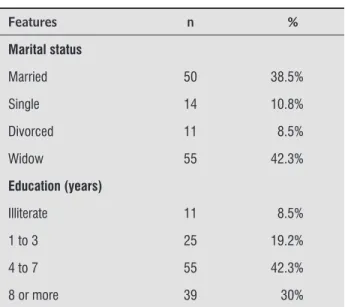
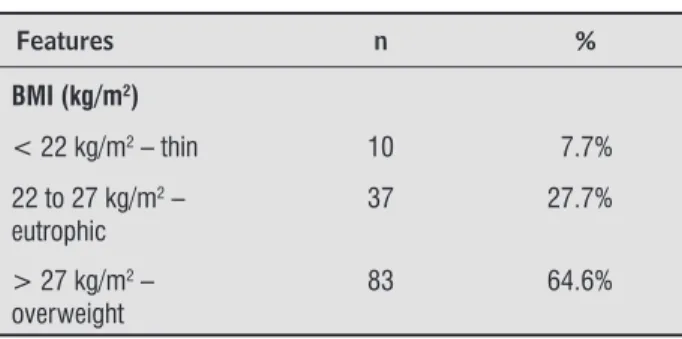
The age of the volunteers ranged from to years, with a mean of . . years. Most women were married n = ; . % , overweight n = ; . % with a body mass index > kg/m , and had low plasma )L- mean . pg/mL levels. The sociodemographic and clinical characteristics of the study sample and the mean (GS, STS results, and plasma )L- levels are presented in Tables and
, respectively.
The results showed a significant inverse correla-tion between the (GS and STS results rS= - . ; p =
. , such that elderly women with lower (GS had worse performance on the STS more time to com-plete the test . There was no significant correlation between the plasma )L- levels and (GS rS = - . ; p = . or SST rS = - . ; p = . results.
Table 1 - Sociodemographic and clinical characteristics of the study participants
Features n %
Marital status
Married 50 38.5%
Single 14 10.8%
Divorced 11 8.5%
Widow 55 42.3%
Education (years)
Illiterate 11 8.5%
1 to 3 25 19.2%
4 to 7 55 42.3%
8 or more 39 30%
Table 1 - Sociodemographic and clinical characteristics of the study participants
Features n %
BMI (kg/m2)
< 22 kg/m2 – thin 10 7.7%
22 to 27 kg/m2 –
eutrophic
37 27.7%
> 27 kg/m2 –
overweight
83 64.6%
Note: % = percentage relative to the total number of elderly individu-als; BMI = body mass index.
(Conclusion)
Table 2 - Interleukin-6 levels and functional capacity of the study participants
Features n Mean (+SD) Variation
IL-6 (pg/mL) 130 2.15 (± 1.75) 0.14 – 8.80
HGS (kgf) 130 21.7 (± 4.6) 10 – 34.6
SST (seconds) 130 15.3 (± 3.8) 9.0 – 26.2
Note: SD = Standard deviation; IL-6 = interleukin-6; HGS = handgrip strength; SST = sit-to-stand test..
Discussion
Aging-associated sarcopenia is a slow, progressive, and seemingly inevitable process. )t directly influenc-es the functional capacity of elderly individuals, and leads to a deterioration in health , , . We found an inverse correlation between (GS and performance on the STS, which demonstrates that elderly women with lower muscle upper limb strength take longer time to perform the lower limb functional capacity test. A study by Visser et al. previously investi-gated a sample of elderly patients aged > years and found similar results. An association between decreased (GS and a longer STS time was observed after statistical adjustment for age and height.
Decreased (GS has been previously identified as strong biomarker for aging , , , indicating a negative impact of muscle strength loss on functional capacity . This measure provides an approxima-tion of total body muscle force as it correlates with elbow flexion strength, extension force of the leg, and trunk strength .
There is an association between reduced (GS and difficulty in performing ADL . (GS appears to be an interesting predictor of mobility reduction. An investigation of , elderly participants, aimed at evaluating (GS to predict limitation in mobility among individuals aged ≥ years, revealed that a kgf cut-off point % sensitivity and % specificity was sufficient for determining women at risk of deterioration in mobility . Similarly in a study including healthy elderly individuals aged – years, Choquette et al. and Visser et al. revealed a positive correlation of mobility with (GS and running speed. According to Sallinen et al. , the linear relationship between muscle strength and mobility is better detectable among frail elderly individuals.
Studies indicate that muscle strength of both low-er and upplow-er limbs can be affected by the increase in )L- levels . Studies that assessed the correlation between knee flexion and extension strength using isokinetic dynamometer, gait speed, functional ca-pacity test STS , and plasma levels of )L- , confirm that there is a negative correlation between these cytokines and the worst (GS torque peaks in elder-ly individuals. Unlike functional tests of gait speed and sitting and standing, there was no correlation demonstrated, indicating that functionality encompasses a harmonious integration of various sensory motor systems and not only muscle tissue. Furthermore, results of the study by Oliveira et al. indicated a catabolic action of inflammatory cytokines on muscle fibers. A study by Lustosa et al. that assessed muscle strength with an isokinetic dynamometer considered the gold standard tool for this measure revealed an association between in-creased inflammatory cytokines and low muscular and functional performance in elderly individuals. )t also demonstrated that exercise interventions may reverse the state of increased production of these cy-tokines. )ncreased levels of inflammatory mediators, particularly )L- , have been associated with reduction in (GS among elderly women .
482
decreased muscle strength and functional capacity in older adults, whereas other authors report that )L- levels > . pg/mL or > . pg/mL were predictive of functional limitations , . )n the present study, the mean serum )L- level was . pg/mL.
The conflicting results observed in studies are probably due to the differences in sample charac-teristics, such as comorbidities, socioeconomic status, education level, and physical activity level. )n this study, we selected elderly individuals, who despite being sedentary were active and performed ADL in-dependently. The literature suggests that physically active individuals, although sedentary, lave lower plasma )L- concentrations.
The limitations of this study include the conve-nience method of sampling and inclusion of only fe-male participants, which limit external validity and prevent generalization of results. )n addition, the cross-sectional design does not allow causal inferences about the relationships between the studied variables.
Conclusion
This study showed a significant and inverse cor-relation between (GS and performance on the sit-to-stand test in elderly women. With the use of these simple and inexpensive tests, we could monitor the decrease in muscle strength and functional capacity, two variables that can be indicative of sarcopenia in elderly individuals when diminished. Plasma )L- level showed no significant correlation with (GS and SST. Future studies that control for the factors that influence the production of inflammatory markers, such as physical activity level, are needed to broad-en the understanding of the effect of )L- on muscle strength and functional capacity of functionally in-dependent elderly individuals.
References
. Caramano AA. Envelhecimento da população brasilei-ra: uma contribuição demográfica. )n: Freitas EV, Py L, editores. Tratado de geriatria e gerontologia. Rio de Janeiro: Guanabara Koogan; . p. - .
. Rosa NMB, Queiroz BZ, Pereira DS, Santos MLS, Oliveira DM, Narciso FM, et al. )nterleukin- plasma levels and socioeconomic status in Brazilian elderly community-dwelling women. Arch Gerontol Geriatr.
; : - .
. Doherty TJ. )nvited review: aging and sarcope-nia. J Appl Physiol. ; : - .
. Visser M, Goodpaster B(, Kritchevsky SB, Newman AB, Nevitt M, Rubin SM. Muscle mass, muscle strength, and muscle fat infiltration as predictors of incident mobility limitations in well-functioning older per-sons. J Gerontol A Biol Sci Med Sci. ; : - . . Ferrucci L, (arris TB, Guralnik JM, Tracy RP, Corti
MC, Cohen (J, et al. Serum )L- level and the devel-opment of disability in older persons. J Am Geriatri Soc. ; : - .
. Woo J, Leung J, Kwok T. BM), body composition, and physical functioning in older adults. Obesity Silver Spring . ; : - .
. Organização Mundial da Saúde; Organização Pan-Americana da Saúde. C)F: Classificação )nternacional de Funcionalidade, )ncapacidade e Saúde. São Paulo: Edusp; .
. Vreede PL, Samson MM, van Meeteren NLU, Duursma SA, Verhaar (JJ. Functional-task exercise versus re-sistance strength exercise to improve daily function in older women: A feasibility study. Arch Phys Med Rehabil. ; : - .
. Rantanen T, Era P, (eikkinen E. Maximal isometric strength and mobility among -year-old men and women. Age Ageing. ; : - .
. Silva JP, Pereira DS, Coelho FM, Lustosa LP, Dias JMD, Pereira LSM. Fatores clínicos, funcionais e inflamatóri-os associadinflamatóri-os à fadiga muscular e à fadiga autoper-cebida em idosas da comunidade. Rev Bras Fisioter.
; : - .
. Xin DL, (arris MY, Wade CK, Amin M, Barr AE, Barbe MF. Aging enhances serum cytokine response but not task-induced grip strength declines in a rat model of work-related musculoskeletal disorders. BMC Mus-culoskelet Disord. ; : .
. Lauretani F, Russo CR, Bandinelli S, Bartali B, Cavazzini C, Di )orio A. Age-associated changes in skeletal muscles and their effect on mobility: an operational diagnosis of sarcopenia. J Appl Physiol. ; : - . . Rantanen T, Volpato S, Ferrucci L, (eikkinen E, Fried
LP, Guralnik JM. (andgrip strength and cause-specific and total mortality in older disabled women: exploring the mechanism. J Am Geriatr Soc. ; : - . . Rantanen T, Masaki K, (e Q, Ross GW, Willcox BJ, White
L. Midlife muscle strength and human longevity up to age years: a -year prospective study among a decedent cohort. Age Dordr . ; : - . . Taekema DG, Gussekloo J, Maier AB, Westendorp RG,
Craen AJ. (andgrip strength as a predictor of func-tional, psychological and social health: a prospective population-based study among the oldest old. Age Ageing. ; : - .
. Xue QL, Beamer BA, Chaves P(M, Guralnik JM, Fried LP. (eterogeneity in rate of decline in grip, hip, and knee strength and the risk of all-cause mortality: The Women’s (ealth and Aging Study )). J Am Geriatr Soc.
; : - .
. Bernardi M, Rosponi A, Castellano V, Rodio A, Trabal-lesi M, Delussu AS, et al. Determinants of sit to stand capability in the motor impaired elderly. J Electro-myogr Kinesiol. ; : - .
. Farias DL, Teixeira TG, Tibana RA, Balsamo S, Prestes J. A força de preensão manual é preditora do desem-penho da força muscular de membros superiores e inferiores em mulheres sedentárias. Motricidade.
; S : - .
. Geraldes AAR, Oliveira ARM, Albuquerque RB, Car-valho JM, Farinatti PTV. A força de preensão manual é boa preditora do desempenho funcional de idosos frágeis: um estudo correlacional múltiplo. Rev Bras Med Esporte. ; : - .
. Sallinen J, Stenholm S, Rantanen T, (eliövaara M, Sainio P, Koskinen S. (and-grip strength cut-points to screen older persons at risk for mobility limita-tion. J Am Geriatr Soc. ; : - .
. Choquette S, Bouchard DR, Doyon CY, Sénéchal M, Bro-chu M, Dionne )J. Relative strength as a determinant of mobility in elders - years of age. A NuAge study: nutrition as a determinant of successful aging. J Nutr (ealth Aging. ; : - .
. Bertolucci P(, Brucki SM, Campacci SR, Juliano Y. O Mini-Exame do Estado Mental em uma população geral: impacto da escolaridade. Arq Neuro-Psiquiatria.
; : - .
. Figueiredo )M, Sampaio RF, Mancini MC, Silva FCM, Souza MAP. Teste de força de preensão utilizando o dinamômetro Jamar. Acta Fisiatr. ; : - . . Visser M, Deeg DJ(, Lips P, (arris TB, Bouter LM.
Skeletal muscle mass and muscle strength in rela-tion to lower-extremity performance in elder men and women. J Am Geriatr Soc. ; : - . . Oliveira DM, Narciso FM, Santos ML, Pereira DS,
Coel-ho FM, Dias JM, et al. Muscle strength but not func-tional capacity is associated with plasma interleukin- levels of community-dwelling elderly women. Braz J Med Biol Res. ; : - .
. Lustosa LP, Pereira LSM, Coelho FM, Pereira DS, Silva JP, Parentoni AN, et al. )mpact of an exercise program on muscular and functional performance and plasma levels of interleukin and soluble receptor tumor necrosis factor in prefrail community-dwelling older women: a randomized clinical trial. Arq Phys Med Rehabil. ; : - .
. Cesari M, Penninx BW, Pahor M, Lauretani F, Corsi AM, Rhys WG, et al. )nflammatory markers and physi-cal performance in older persons: the )nC()ANT) study. J Gerontol A Biol Sci Med Sci. ; : - . . Ferrucci L, Pennix BWJ(, Volpato S, (arris TB,
Banden-Roche K, Balfour J, et al. Change in muscle strength explains accelerated decline of physical func-tion in older women with high interleukin- serum levels. J Am Geriatr Soc. ; : - .
Received: / /
Recebido: / /
Approved: / /