Morphological variation in Paspalum nicorae Parodi accessions,
a promising forage
Camila Aparecida de Oliveira dos Reis
1; Miguel Dall’Agnol
2; Carlos Nabinger
2;
Maria
Teresa Schifino-Wittmann
2*
1
UFRGS/FA – Programa de Pós-Graduação em Zootecnia. 2
UFRGS/FA – Depto. de Plantas Forrageiras e Agrometeorologia, C.P. 15100 – 91501-970 – Porto Alegre, RS – Brasil.
*Corresponding author <[email protected]>
ABSTRACT: Paspalum nicorae Parodi is a perennial, apomictic tetraploid forage species, native in the state of Rio Grande do Sul, Brazil, with grazing tolerance and adapted to sandy soils and moderate droughts. As a first step to future breeding, a morphological characterization regarding leaf hairiness, sheath, leaf and central venation color, growing habit, plant height, raceme number and length, and leaf length and width was performed in 53 accessions from Rio Grande do Sul that are part of a Paspalum species breeding program. 35.84% of the accessions had completely hairy leaves, 73.58% had green sheath, 54.71% whitish central venation, 50.94% decumbent habit. Leaf color was estimated by two methods, color chart and colorimeter. The accessions were classified as 76.92% green, 13.45% greenish yellow and 9.62% as grayish green by the first, and 59.62% grayish, 32.69% grayish yellow, 5.77% yellow and 1.92% dark grayish by the second method. Raceme length ranged from 9.40 to 1.30 cm, number of racemes from one to six (48.73% of the accessions had four racemes), leaf length and width from 36.13 to 13.06 cm and 0.67 to 0.36 cm, respectively, and plant height from 115.70 to 29.00 cm. Therefore, a large morphological variation among accessions was detected, with no relation to geographical location but indicating a high potential use in plant breeding programs.
Key words: apomixis, forage grass, morphology, plant breeding
Variação morfológica em acessos de Paspalum nicorae Parodi,
forrageira promissora
RESUMO: Paspalum nicorae Parodi é uma forrageira perene, apomítica, tetraplóide, nativa no Rio Grande do Sul, com tolerância ao pastejo e adaptada a solos arenosos e a secas moderadas. Como passo inicial para o melhoramento, uma caracterização morfológica considerando pilosidade da folha, cor da bainha, da folha e da nervura central, hábito de crescimento, altura da planta, número e comprimento de racemos, comprimento e largura da folha foi realizada em 53 acessos coletados no Rio Grande do Sul, Brasil, que são parte de um programa de melhoramento de espécies de Paspalum. Os resultados mostraram que 35,84% dos acessos tinham folhas completamente pilosas, 73,58% tinham bainha verde, 54,71% venação central esbranquiçada e 50,94% hábito decumbente. A cor da folha foi estimada por dois métodos, cartela de cores e colorímetro Os acessos foram classificados como 76,92% verdes, 13,45% amarelo esverdeados e 9,62% como verde acinzentados pelo primeiro, e 59,62% acinzentados, 32,69% amarelo acinzentados, 5,77% amarelos e 1,92% cinza escuros pelo segundo método. O comprimento do racemo variou de 9,40 a 1,30 cm, o número de racemos de um a seis (sendo que 48,73% dos acessos tinham quatro racemos), o comprimento e a largura da folha de 36,13 a 13,06 cm e 0,67 a 0,36 cm, respectivamente e a altura da planta de 115,70 a 29,00 cm. Portanto, grande variação morfológica foi detectada entre os acessos, sem relação com localização geográfica, mas indicando alta potencialidade de utilização em programas de melhoramento.
Palavras-chave: apomixia, gramínea forrageira, morfologia, melhoramento
Introduction
Many of the 400 species of genus Paspalum L., most of them native to tropical and sub-tropical Americas (Moraes-Fernandes et al., 1968) are important forages, as the well studied P. notatum Flügge (Pedreira and Pedreira, 2006), due to quality, productivity and toler-ance to environmental stresses (Valls, 2000). About 75% of the described Paspalum species occur in Brazil, in a wide range of ecological conditions as part of several
(Burson and Bennet 1970). The importance of P. nicorae
is due not only to its good quality and forage yield po-tential but also because it has a high popo-tential to be used for the recovery and conservation of degraded soil, as mentioned by several authors (Burson and Bennett, 1970; Prestes et al., 1976; Pizzarro, 2000; Boldrini, 2006; Dall’Agnol et al., 2006). In Rio Grande do Sul, P. nicorae
is generally found in sandy soils, indicating a potential to tolerate drought and low-fertility soils, and has a high response to fertilization (Nabinger and Dall´Agnol, 2008) and in such areas it could be a promising forage. However, detailed morphological and agronomic evalu-ations of a high number of accessions are needed to as-sess the real potential of the species.
The objective of this study was to investigate mor-phological variation for several characteristics in a col-lection of 53 P. nicorae accessions that are part of a breed-ing project includbreed-ing several Paspalum species. This same collection has been cytogenetically analyzed by Reis et al. (2008).
Material and Methods
The 53 original individual plants were collected in 17 sites in Rio Grande do Sul, Southern Brazil (Table 1). Plants with different characteristics were chosen by the collectors in each site in order to collect a representa-tive sample of the local existing variability. Plants were transferred to pots filled with soil and kept as part of a germplasm collection. The accessions (each of the 53 plants represents an accession) are identified in the col-lection by the species’ name, the collector´s number and collection site (Table 1) and numbered for working pur-poses. Later, as the original plants were well grown, they were vegetatively replicated. After the plants had flow-ered, their taxonomic status was confirmed. All the ac-cessions are tetraploid (2n = 40 chromosomes) as deter-mined by Reis et al. (2008).
The following morphological characters were ana-lyzed: leaf hairiness (HAI), leaf color (CCLCOL by the color chart and COLLCOL by the colorimeter meth-ods, as explained below) sheath color (SCOL), central venation color (CVCOL), growing habit (HAB), plant height (PHEI), raceme number (RNUM), raceme length (RLEN), and leaf length (LLEN) and leaf width (LWID). For four of the characteristics not all of the 53 acces-sions were examined: RNUM (39 accesacces-sions), CCLCOL and COLLCOL (52 accessions each), LLEN and LWID (50 accessions).
For leaf length (LLEN) and leaf width (LWID) evalu-ation, marked tillers were used. For each accession three tillers (representing the replications) were marked and all the completely expanded leaves were measured weekly for nine weeks (from March 3rd to April 27th,
2007). Leaf hairiness (HAI), was estimated on the upper side of the leaf blade, on a 1 to 5 scale: 1 (no hairs); 2 (25% of the blade with hairs); 3 (50%); 4 (75%) and 5 (100%). Leaf color by the color chart method (CCLCOL) was determined using three color groups of the R.S.H
Color Chart of the Royal Horticultural Society of Lon-don: green group (chart sub-groups 1 to 5), yellow green group (chart sub-groups 6 to 8) and grayish green group (chart sub-groups 9 to 10). Leaf color by the colorimeter method (COLLCOL) was determined with a MINOLTA CR-300 colorimeter (Konika Minolta, USA) and using the CIE (Comission International de l´Éclairage) L*a*b System: the values were divided in four groups, 1- dark grayish (values 1 -10), 2- light gray-ish (11-20), 3- graygray-ish yellow (21-30) and 4- yellowgray-ish (31-40). Sheath color (SCOL) and central venation color (CVCOL) were estimated visually, and considered to be green (1) or violet (2) and whitish (1) or greenish (2), re-spectively. Growing habit (HAB) was classified as erect (1) or decumbent (2). Raceme number (RNUM) and length (RELN) were determined during the peak of flow-ering in totally expanded inflorescences. Plant height (PHEI) was determined by measuring the plant from the soil to the highest leaf, once a week, from February 8th
to April 27th, 2007, after a preliminary cut (January 25th,
2007) to standardize initial height. Leaf length and width (LLEN and LWID) were determined at the end of the evaluation period, by measuring all the leaves of each of the three tillers per accession.
Data were analyzed by a descriptive statistics (such as averages, standard deviations etc.).
Results and Discussion
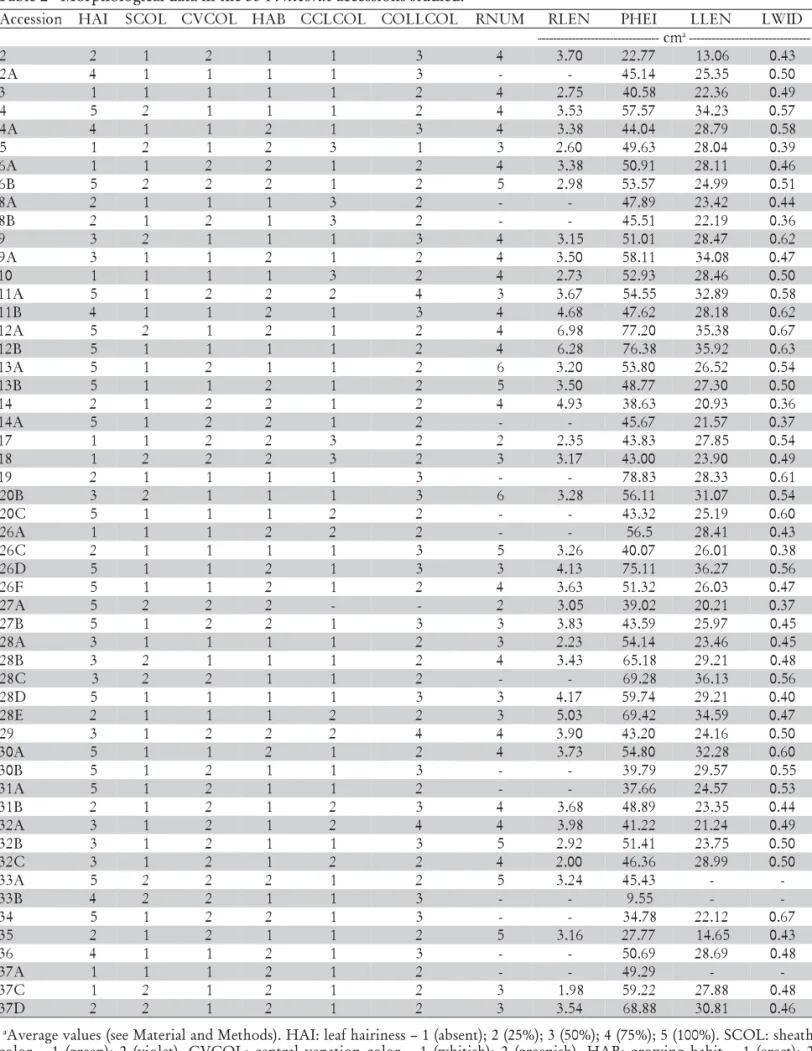
The present work is the first one to present a de-tailed analysis of morphological variation for several qualitative and quantitative characteristics of a large number of P. nicorae accessions (Tables 2, 3, 4 and 5).
Regarding leaf hairiness, 16.98% of the accessions had completely glabrous leaves and 35.84% completely hairy leaves (Table 2). Therefore, most of the P. nicorae acces-sions examined were hairy. Barreto (1974) described the species as having hairy or glabrous leaves and Burkart (1969) refers to lightly hairy to subglabrous leaves, sel-dom very hairy. Boldrini et al. (2005) also mentioned gla-brous and hairy biotypes. The present work is the first one to describe variation in degrees of leaf hairiness.
aMD–Miguel Dall’Agnol; CN–Carlos Nabinger; DN–Danilo Menezes Sant’Anna; s/n- not numbered.
Table 1 - List of the 53 accessions of P. nicorae analyzed. n
o i s s e c c
A Collectora Collectionsite Geographicalcoordinates
2 MD,CNs/n Cristal Lat-31º00'00';'Long-52º03'00'' A
2 MD,CNs/n
3 MD,CNs/n SãoLourenço Lat-31º21'55';'Long-51º58'42'' 4 MD,CNs/n CapãodoLeão Lat-31º45'46';'Long-52º29'02''
A
4 MD,CNs/n
5 MD,CNs/n
A
6 MD,CNs/n PinheiroMachado Lat-31º34'40';'Long-53º22'51'' B
6 MD,CNs/n
A
8 MD,CNs/n
B
8 MD,CNs/n
9 MD,CNs/n PinheiroMachado/Candiota Lat-31º33'28';'Long-53º40'22'' A
9 MD,CNs/n
0
1 MD,CNs/n HulhaNegra/Candiota Lat-31º24'14';'Long-53º52'08'' A
1
1 MD,CNs/n Bagé Lat-31º19'51';'Long-54º06'25''
B 1
1 MD,CNs/n
A 2
1 MD,CNs/n DomPedrito Lat-30º58'59';'Long-54º40'22'' B
2
1 MD,CNs/n
A 3
1 MD,CNs/n
B 3
1 MD,CNs/n
4
1 MD,CNs/n DomPedrito/SantanadoLivramento Lat-30º53'27';'Long-55º31'58'' A
4
1 MD,CNs/n
7
1 MD,CNs/n SantanadoLivramento Lat-30º53'27';'Long-55º31'58'' 8
1 MD,CNs/n
9
1 MD,CNs/n
B 0
2 MD,CNs/n
C 0
2 MD,CNs/n
A 6
2 MD,CNs/n Alegrete Lat-29º47'02';'Long-55º47'28'' C
6
2 MD,CNs/n
D 6
2 MD,CNs/n
F 6
2 MD,CNs/n
A 7
2 MD,CNs/n
B 7
2 MD,CNs/n
A 8
2 MD,CNs/n RosáriodoSul Lat-30º15'28';'Long-54º54'50'' B
8
2 MD,CNs/n
C 8
2 MD,CNs/n
D 8
2 MD,CNs/n
E 8
2 MD,CNs/n
9
2 MD,CNs/n
A 0
3 MD,CNs/n SãoGabriel Lat-30º20'09';'Long-54º19'12'' B
0
3 MD,CNs/n
A 1
3 MD,CNs/n
B 1
3 MD,CNs/n
A 2
3 MD,CNs/n SantaMargaridadoSul Lat-30º20'09';'Long-54º19'12'' B
2
3 MD,CNs/n
C 2
3 MD,CNs/n
A 3
3 MD,CNs/n VilaNovadoSul Lat-30º20'24';'Long-54º04'48'' B
3
3 MD,CNs/n
4
3 MD,CNs/n
5
3 MD,CNs/n EldoradodoSul Lat-30º05'02';'Long-51º36'57'' 6
3 MD,CNs/n
A 7
3 DNs/n Viamão Lat-30º04'51';'Long-51º01'22''
C 7
3 DNs/n
D 7
Table 2 - Morphological data in the 53 P. nicorae accessions studied.
aAverage values (see Material and Methods). HAI: leaf hairiness – 1 (absent); 2 (25%); 3 (50%); 4 (75%); 5 (100%). SCOL: sheath
color – 1 (green); 2 (violet). CVCOL: central venation color – 1 (whitish); 2 (greenish). HAB: growing habit – 1 (erect); 2 (decumbent). CCLCOL: leaf color by color chart – 1 (green group); 2 (yellow green group); 3 (grayish green group). COLLCOL: leaf color by colorimeter - 1 (dark grayish); 2 (light grayish); 3 (grayish yellow); 4 (yellowish). RNUM: raceme number. RLEN: raceme length. LLEN: leaf length. LWID: leaf width.
n o i s s e c c
A HAI SCOL CVCOL HAB CCLCOL COLLCOL RNUM RLEN PHEI LLEN LWID m
c
-- a-------------------------------
-2 2 1 2 1 1 3 4 3.70 22.77 13.06 0.43 A
2 4 1 1 1 1 3 - - 45.14 25.35 0.50
3 1 1 1 1 1 2 4 2.75 40.58 22.36 0.49 4 5 2 1 1 1 2 4 3.53 57.57 34.23 0.57
A
4 4 1 1 2 1 3 4 3.38 44.04 28.79 0.58 5 1 2 1 2 3 1 3 2.60 49.63 28.04 0.39
A
6 1 1 2 2 1 2 4 3.38 50.91 28.11 0.46 B
6 5 2 2 2 1 2 5 2.98 53.57 24.99 0.51 A
8 2 1 1 1 3 2 - - 47.89 23.42 0.44
B
8 2 1 2 1 3 2 - - 45.51 22.19 0.36
9 3 2 1 1 1 3 4 3.15 51.01 28.47 0.62 A
9 3 1 1 2 1 2 4 3.50 58.11 34.08 0.47 0
1 1 1 1 1 3 2 4 2.73 52.93 28.46 0.50 A
1
1 5 1 2 2 2 4 3 3.67 54.55 32.89 0.58 B
1
1 4 1 1 2 1 3 4 4.68 47.62 28.18 0.62 A
2
1 5 2 1 2 1 2 4 6.98 77.20 35.38 0.67 B
2
1 5 1 1 1 1 2 4 6.28 76.38 35.92 0.63 A
3
1 5 1 2 1 1 2 6 3.20 53.80 26.52 0.54 B
3
1 5 1 1 2 1 2 5 3.50 48.77 27.30 0.50 4
1 2 1 2 2 1 2 4 4.93 38.63 20.93 0.36 A
4
1 5 1 2 2 1 2 - - 45.67 21.57 0.37
7
1 1 1 2 2 3 2 2 2.35 43.83 27.85 0.54 8
1 1 2 2 2 3 2 3 3.17 43.00 23.90 0.49 9
1 2 1 1 1 1 3 - - 78.83 28.33 0.61
B 0
2 3 2 1 1 1 3 6 3.28 56.11 31.07 0.54 C
0
2 5 1 1 1 2 2 - - 43.32 25.19 0.60
A 6
2 1 1 1 2 2 2 - - 56.5 28.41 0.43
C 6
2 2 1 1 1 1 3 5 3.26 40.07 26.01 0.38 D
6
2 5 1 1 2 1 3 3 4.13 75.11 36.27 0.56 F
6
2 5 1 1 2 1 2 4 3.63 51.32 26.03 0.47 A
7
2 5 2 2 2 - - 2 3.05 39.02 20.21 0.37 B
7
2 5 1 2 2 1 3 3 3.83 43.59 25.97 0.45 A
8
2 3 1 1 1 1 2 3 2.23 54.14 23.46 0.45 B
8
2 3 2 1 1 1 2 4 3.43 65.18 29.21 0.48 C
8
2 3 2 2 1 1 2 - - 69.28 36.13 0.56
D 8
2 5 1 1 1 1 3 3 4.17 59.74 29.21 0.40 E
8
2 2 1 1 1 2 2 3 5.03 69.42 34.59 0.47 9
2 3 1 2 2 2 4 4 3.90 43.20 24.16 0.50 A
0
3 5 1 1 2 1 2 4 3.73 54.80 32.28 0.60 B
0
3 5 1 2 1 1 3 - - 39.79 29.57 0.55
A 1
3 5 1 2 1 1 2 - - 37.66 24.57 0.53
B 1
3 2 1 2 1 2 3 4 3.68 48.89 23.35 0.44 A
2
3 3 1 2 1 2 4 4 3.98 41.22 21.24 0.49 B
2
3 3 1 2 1 1 3 5 2.92 51.41 23.75 0.50 C
2
3 3 1 2 1 2 2 4 2.00 46.36 28.99 0.50 A
3
3 5 2 2 2 1 2 5 3.24 45.43 -
-B 3
3 4 2 2 1 1 3 - - 9.55 -
-4
3 5 1 2 2 1 3 - - 34.78 22.12 0.67
5
3 2 1 2 1 1 2 5 3.16 27.77 14.65 0.43 6
3 4 1 1 2 1 3 - - 50.69 28.69 0.48
A 7
3 1 1 1 2 1 2 - - 49.29 -
-C 7
3 1 2 1 2 1 2 3 1.98 59.22 27.88 0.48 D
7
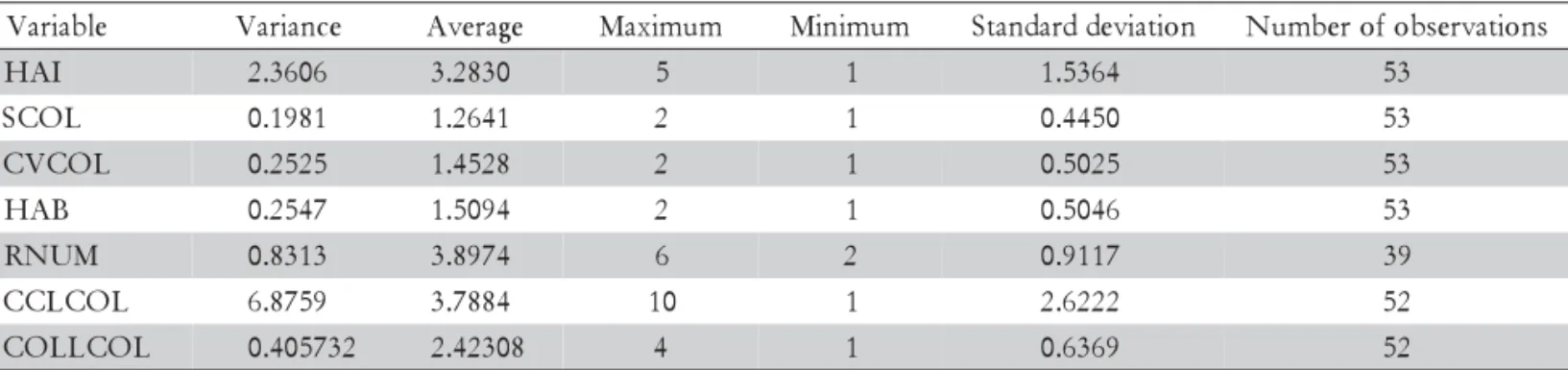
Table 3 - Descriptive statistics for the seven quantitative characteristics analyzed in P. Nicorae.
e l b a i r a
V Variance Average Maximum Minimum Standarddeviation Numberofobservations I
A
H 2.3606 3.2830 5 1 1.5364 53
L O C
S 0.1981 1.2641 2 1 0.4450 53
L O C V
C 0.2525 1.4528 2 1 0.5025 53
B A
H 0.2547 1.5094 2 1 0.5046 53
M U N
R 0.8313 3.8974 6 2 0.9117 39
L O C L C
C 6.8759 3.7884 10 1 2.6222 52
L O C L L O
C 0.405732 2.42308 4 1 0.6369 52
HAI: leaf hairiness – 1 (absent); 2 (25%); 3 (50%); 4 (75%); 5 (100%). SCOL: sheath color – 1 (green); 2 (violet). CVCOL: central venation color – 1 (whitish); 2 (greenish). HAB: growing habit – 1 (erect); 2 (decumbent). RNUM: raceme number. CCLCOL: leaf color by color chart – 1-5 (green group); 6-8 (yellow green group); 9-10 (grayish green group). COLLCOL: leaf color by colorimeter - 1 (dark grayish); 2 (light grayish); 3 (grayish yellow); 4 (yellowish).
the central venation was whitish in 54.71% and greenish in 45.29% of the accessions (Table 2).
Regarding growing habit, 50.94% of the accessions had a decumbent while 49.06% had an erect habit (Table 2). Raceme number and length varied greatly among the accessions analyzed. Number of racemes ranged from two to six: 48.72% of the accessions had four, 25.64% three, 15.38% five, 5.13% two and 5.13% six racemes (Table 2). Burkart (1969), Barreto (1974) and Boldrini et al. (2005) described P. nicorae as having from two to five racemes. This is also the first report of six racemes (in two out of 53 of the accessions examined) in the species. Raceme length (average values) ranged from 1.98 to 6.98 cm (Table 2). Barreto (1974) reported racemes from two to five cm in P. nicorae, while Burkart (1969) referred to 1.5 to 6.5 cm.
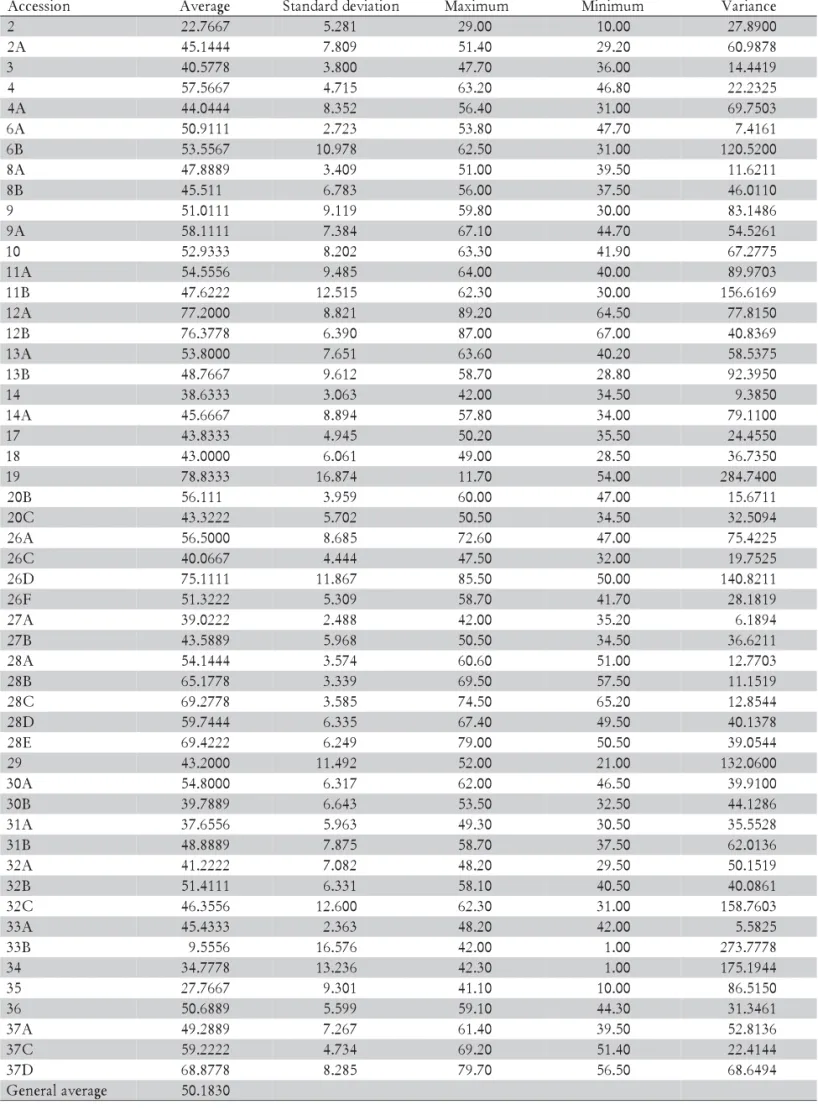
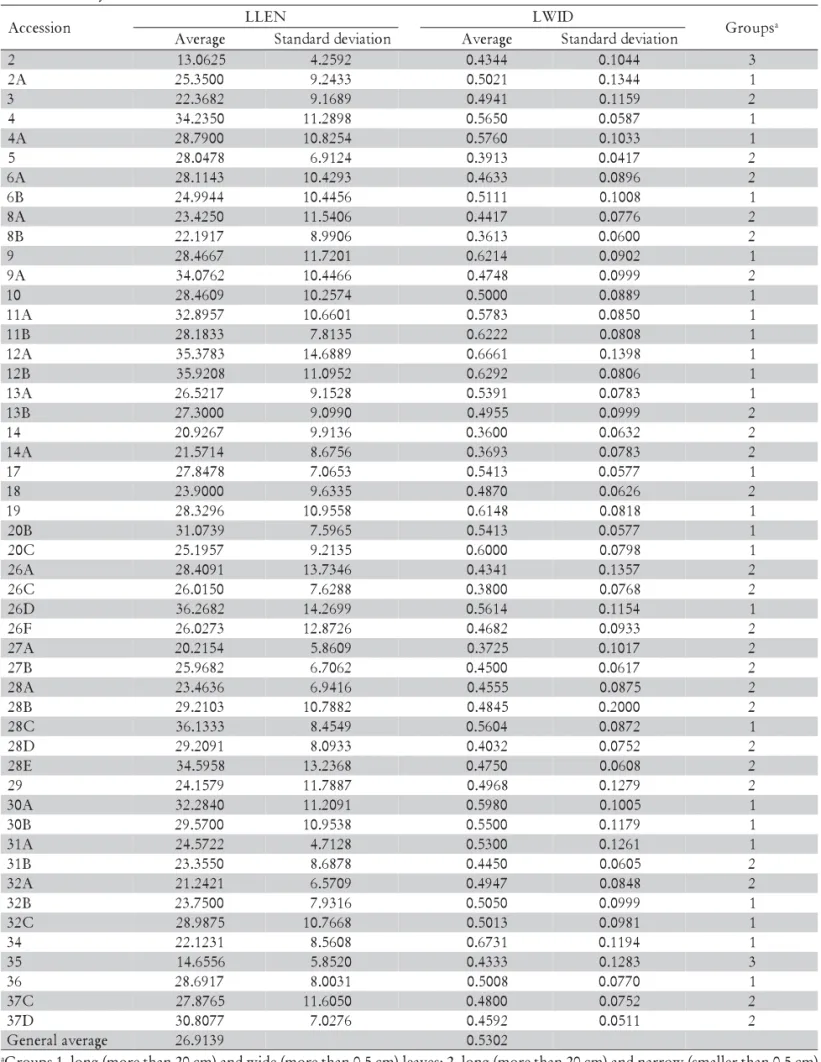
Plant height (average values) among accessions ranged from 22.77 to 77.20 cm (Tables 2 and 4), agreeing with Burkart (1969) who described plants ranging from 20 to 70 cm high. Average leaf length and width among accessions ranged from 13.06 to 36.27 cm and from 0.36 to 0.67 cm, respectively (Tables 2 and 5). Burkart (1969) reported leaf width in P. nicorae as ranging from 0.4 to 0.5 cm. Leaf length and width divided the accessions ba-sically in three groups: one (50.00% of the accessions) with long (more than 20 cm) and wide (more than 0.5 cm) leaves, the second (46.15% of the accessions) with long (more than 20 cm) and narrow (smaller than 0.5 cm) leaves and the third (3.85% of the accessions, represent-ing two accessions), with small (less than 20 cm) and nar-row (smaller than 0.5 cm) leaves.
No relations between a specific geographical loca-tion and a given characteristic was verified, for the quan-titative as well as for the qualitative characteristics (Tables 1 and 2). For example, the different leaf colors and growing habits were found in accessions spread all over the collection area; on the other hand, two acces-sions (11 A and 11B) collected in the same locality had different leaf colors by both the color chart and the colo-rimeter methods and other two, also collected at the same place (12A and 12B) had a decumbent (12A) and an erect (12B) habit. Plants belonging to the three groups
of leaf length-width were also found all over the collec-tion area.
That variation exists in apomictic species and is well known and reported for several species (Asker and Jerling, 1982). For example, in a germplasm collection of Paspalum notatum, in which morphological, agronomical and molecular variation among different accessions have been reported, Dahmer et al. (2008) found great variability in meiotic configurations among the apomictic tetraploid accessions. Reis et al. (2008), work-ing with the same 53 accessions of P. nicorae examined here, observed that, despite the absence of variability in chromosome numbers, the frequencies of different chro-mosome associations varied among accessions.
The high variation found among accessions, as well as the fact that accessions of the same collection site dif-fered in some characteristics, can be explained by adap-tation to the local where plants grow but also by the apomictic mode of reproduction of P. nicorae. As apomictic species do not depend on sexual reproduction for survival, any new neutral variation (in the sense that it does not hinder the plant survival or adaptation), that has appeared by mutation or by rare recombination events during the evolutionary history of the population may be maintained. Therefore, plants with different phenotypes may propagate by the apomictic seeds or by vegetative propagation (or even by residual sexuality when it does exist), forming a pool of different clones in a given area (Asker and Jerling, 1982). Many of the characteristics analyzed for P. nicorae, as leaf color, sheath and central venation color, among others, are most probably not related to plant adaptation, which could explain the high variation not only among acces-sions but also between accesacces-sions of the same collection site. Furthermore, the existence of sexual types, not yet found for P. nicorae but already reported in other
Paspalum species (Quarín and Normann, 1990), would allow the continuous formation of new apomictic types through hybridization with true apomictics.
Table 4 - Descriptive statistics for the qualitative characteristic PHEI - plant height (cm) analyzed in P. nicorae.
n o i s s e c c
A Average Standarddeviation Maximum Minimum Variance
2 22.7667 5.281 29.00 10.00 27.8900
A
2 45.1444 7.809 51.40 29.20 60.9878
3 40.5778 3.800 47.70 36.00 14.4419
4 57.5667 4.715 63.20 46.80 22.2325
A
4 44.0444 8.352 56.40 31.00 69.7503
A
6 50.9111 2.723 53.80 47.70 7.4161
B
6 53.5567 10.978 62.50 31.00 120.5200
A
8 47.8889 3.409 51.00 39.50 11.6211
B
8 45.511 6.783 56.00 37.50 46.0110
9 51.0111 9.119 59.80 30.00 83.1486
A
9 58.1111 7.384 67.10 44.70 54.5261
0
1 52.9333 8.202 63.30 41.90 67.2775
A 1
1 54.5556 9.485 64.00 40.00 89.9703
B 1
1 47.6222 12.515 62.30 30.00 156.6169
A 2
1 77.2000 8.821 89.20 64.50 77.8150
B 2
1 76.3778 6.390 87.00 67.00 40.8369
A 3
1 53.8000 7.651 63.60 40.20 58.5375
B 3
1 48.7667 9.612 58.70 28.80 92.3950
4
1 38.6333 3.063 42.00 34.50 9.3850
A 4
1 45.6667 8.894 57.80 34.00 79.1100
7
1 43.8333 4.945 50.20 35.50 24.4550
8
1 43.0000 6.061 49.00 28.50 36.7350
9
1 78.8333 16.874 11.70 54.00 284.7400
B 0
2 56.111 3.959 60.00 47.00 15.6711
C 0
2 43.3222 5.702 50.50 34.50 32.5094
A 6
2 56.5000 8.685 72.60 47.00 75.4225
C 6
2 40.0667 4.444 47.50 32.00 19.7525
D 6
2 75.1111 11.867 85.50 50.00 140.8211
F 6
2 51.3222 5.309 58.70 41.70 28.1819
A 7
2 39.0222 2.488 42.00 35.20 6.1894
B 7
2 43.5889 5.968 50.50 34.50 36.6211
A 8
2 54.1444 3.574 60.60 51.00 12.7703
B 8
2 65.1778 3.339 69.50 57.50 11.1519
C 8
2 69.2778 3.585 74.50 65.20 12.8544
D 8
2 59.7444 6.335 67.40 49.50 40.1378
E 8
2 69.4222 6.249 79.00 50.50 39.0544
9
2 43.2000 11.492 52.00 21.00 132.0600
A 0
3 54.8000 6.317 62.00 46.50 39.9100
B 0
3 39.7889 6.643 53.50 32.50 44.1286
A 1
3 37.6556 5.963 49.30 30.50 35.5528
B 1
3 48.8889 7.875 58.70 37.50 62.0136
A 2
3 41.2222 7.082 48.20 29.50 50.1519
B 2
3 51.4111 6.331 58.10 40.50 40.0861
C 2
3 46.3556 12.600 62.30 31.00 158.7603
A 3
3 45.4333 2.363 48.20 42.00 5.5825
B 3
3 9.5556 16.576 42.00 1.00 273.7778
4
3 34.7778 13.236 42.30 1.00 175.1944
5
3 27.7667 9.301 41.10 10.00 86.5150
6
3 50.6889 5.599 59.10 44.30 31.3461
A 7
3 49.2889 7.267 61.40 39.50 52.8136
C 7
3 59.2222 4.734 69.20 51.40 22.4144
D 7
3 68.8778 8.285 79.70 56.50 68.6494
e g a r e v a l a r e n e
Table 5 - Descriptive statistics for the qualitative characteristics LLEN- leaf length (cm) and LWID- leaf width (cm) analyzed in P. nicorae.
aGroups 1- long (more than 20 cm) and wide (more than 0.5 cm) leaves; 2- long (more than 20 cm) and narrow (smaller than 0.5 cm)
leaves; 3- and the small (less than 20 cm) and narrow (smaller than 0.5 cm) leaves.
n o i s s e c c
A LLEN LWID Groupsa
e g a r e v
A Standarddeviation Average Standarddeviation
2 13.0625 4.2592 0.4344 0.1044 3
A
2 25.3500 9.2433 0.5021 0.1344 1
3 22.3682 9.1689 0.4941 0.1159 2
4 34.2350 11.2898 0.5650 0.0587 1
A
4 28.7900 10.8254 0.5760 0.1033 1
5 28.0478 6.9124 0.3913 0.0417 2
A
6 28.1143 10.4293 0.4633 0.0896 2
B
6 24.9944 10.4456 0.5111 0.1008 1
A
8 23.4250 11.5406 0.4417 0.0776 2
B
8 22.1917 8.9906 0.3613 0.0600 2
9 28.4667 11.7201 0.6214 0.0902 1
A
9 34.0762 10.4466 0.4748 0.0999 2
0
1 28.4609 10.2574 0.5000 0.0889 1
A 1
1 32.8957 10.6601 0.5783 0.0850 1
B 1
1 28.1833 7.8135 0.6222 0.0808 1
A 2
1 35.3783 14.6889 0.6661 0.1398 1
B 2
1 35.9208 11.0952 0.6292 0.0806 1
A 3
1 26.5217 9.1528 0.5391 0.0783 1
B 3
1 27.3000 9.0990 0.4955 0.0999 2
4
1 20.9267 9.9136 0.3600 0.0632 2
A 4
1 21.5714 8.6756 0.3693 0.0783 2
7
1 27.8478 7.0653 0.5413 0.0577 1
8
1 23.9000 9.6335 0.4870 0.0626 2
9
1 28.3296 10.9558 0.6148 0.0818 1
B 0
2 31.0739 7.5965 0.5413 0.0577 1
C 0
2 25.1957 9.2135 0.6000 0.0798 1
A 6
2 28.4091 13.7346 0.4341 0.1357 2
C 6
2 26.0150 7.6288 0.3800 0.0768 2
D 6
2 36.2682 14.2699 0.5614 0.1154 1
F 6
2 26.0273 12.8726 0.4682 0.0933 2
A 7
2 20.2154 5.8609 0.3725 0.1017 2
B 7
2 25.9682 6.7062 0.4500 0.0617 2
A 8
2 23.4636 6.9416 0.4555 0.0875 2
B 8
2 29.2103 10.7882 0.4845 0.2000 2
C 8
2 36.1333 8.4549 0.5604 0.0872 1
D 8
2 29.2091 8.0933 0.4032 0.0752 2
E 8
2 34.5958 13.2368 0.4750 0.0608 2
9
2 24.1579 11.7887 0.4968 0.1279 2
A 0
3 32.2840 11.2091 0.5980 0.1005 1
B 0
3 29.5700 10.9538 0.5500 0.1179 1
A 1
3 24.5722 4.7128 0.5300 0.1261 1
B 1
3 23.3550 8.6878 0.4450 0.0605 2
A 2
3 21.2421 6.5709 0.4947 0.0848 2
B 2
3 23.7500 7.9316 0.5050 0.0999 1
C 2
3 28.9875 10.7668 0.5013 0.0981 1
4
3 22.1231 8.5608 0.6731 0.1194 1
5
3 14.6556 5.8520 0.4333 0.1283 3
6
3 28.6917 8.0031 0.5008 0.0770 1
C 7
3 27.8765 11.6050 0.4800 0.0752 2
D 7
3 30.8077 7.0276 0.4592 0.0511 2
e g a r e v a l a r e n e
Conclusions
There is a high morphological variation for all char-acteristics analyzed among the P. nicorae accessions stud-ied, but is not related to their geographical location.
This richness of variation represents an extremely valuable source to select better accessions to be used as forage plants.
Acknowledgements
To Conselho Nacional de Desenvolvimento Científico e Tecnológico (CNPq, Brazil), Coordenação de Aperfeiçoamento de Pessoal de Nível Superior (CAPES, Brazil) and Fundação de Amparo à Pesquisa do Estado do Rio Grande do Sul (FAPERGS, Brazil), for financial support and grants, Dr. Ilsi Iob Boldrini for taxonomic identification of the plants and MSc. Danilo Menezes Sant’Anna for help in the collections.
References
Asker, S.E.; Jerling, L. 1982. Apomixis in plants. CRC Press, Boca Raton, FL, USA.
Barreto, I.L. 1974. O gênero Paspalum (Gramineae) no Rio Grande do Sul. UFRGS, Porto Alegre, RS, Brazil.
Boldrini, I.I. 2006. Biodiversidade dos campos sulinos. p. 11-24. In: Dall’Agnol, M.; Nabinger, C.; Rosa, L.M.; Silva, J.L.S.; Santos, D.T.; Santos, R.J., eds. Anais do I Simpósio de Forrageiras e Produção Animal. Faculdade de Agronomia, UFRGS, Porto Alegre, RS, Brasil.
Boldrini, I.I.; Longhi-Wagner, H.M.; Boechat, S.C. 2005. Morfologia e taxonomia de gramíneas sul-riograndenses. UFRGS, Porto Alegre, RS, Brasil.
Botelho, M.R.; Dalmolin, R.S.D.; Pedron, F.A.; Azevedo, A.C.; Rodrigues, R.B.; Miguel, P. 2006. Color measurement in soils from Rio Grande do Sul State with Munsell charts and by colorimetry. Ciência Rural 36: 1179-1185 (in Portuguese, with abstract in English).
Burkart, A. 1969. Flora ilustrada de Entre Rios-Gramineae. INTA, Buenos Aires, Argentina.
Burson, B.L.; Bennett, H.W. 1970. Cytology, method of reproduction, and fertility of Brunswickgrass, Paspalum nicorae Parodi. Crop Science 10: 184 -187.
Callegaro, J.M.; Pezzi, E.; Bender, R.J. 2002. Use of modified atmosphere storage on postharvest quality of strawberries. Pesquisa Agropecuária Brasileira 37: 1049-1055 (in Portuguese, with abstract in English).
Dahmer, N.; Schifino-Wittmann, M.T.; Dall´Agnol, M.; Castro, B. 2008. Cytogenetic data for Paspalum notatum Flügge accessions. Scientia Agricola 65: 381-388.
Dall’Agnol, M.; Steiner, M.G.; Baréa, K.; Scheffer-Basso, S.M. 2006. Perspectivas de lançamento de cultivares de espécies forrageiras nativas: o gênero Paspalum. p.149-162. In: Dall’Agnol, M.; Nabinger, C.; Rosa, L.M.; Silva, J.L.S.; Santos, D.T.; Santos, R.J., eds. 2006. Anais do I Simpósio de Forrageiras e Produção Animal. Faculdade de Agronomia, UFRGS, Porto Alegre, RS, Brasil.
Moraes-Fernandes, M.I.B.; Barreto, I.L.; Salzano, F.M. 1968. Cytogenetic, ecologic and morphologic studies in Brazilian forms of Paspalum dilatatum. Canadian Journal of Genetics and Cytology 10:131-138.
Moraes-Fernandes, M.I.B.; Barreto, I.L., Salzano, F.M.; Sacchet; A.M.O.F. 1974. Cytological and evolutionary relationships in Brazilian forms of Paspalum (Gramineae). Caryologia27: 455-465. Nabinger, C.; Dall’Agnol, M. 2008. Principais gramíneas nativas do RS: características gerais, distribuição e potencial forrageiro.p. 7-54. In: Dall’Agnol, M.; Nabinger, C.; Santos, R.J., eds. 2008. Anais do III Simpósio de Forrageiras e Produção Animal. Faculdade de Agronomia, UFRGS, Porto Alegre, RS, Brasil.
Pagliarini, M.S.; Carraro, L.R.; Freitas, P.M.; Adamowski, E.V. Batista, L.A.R.; Valls, J. F. M. 2001. Cytogenetic characterization of Brazilian Paspalum accessions. Hereditas 135: 27-34.
Pedreira, C.G.S.; Pedreira, B.C. 2006. A grama-forquilha (Paspalum notatum). p. 115-148. In: Dall’Agnol, M.; Nabinger, C.; Rosa, L.M.; Silva, J.L.S.; Santos, D.T.; Santos, R.J., eds. 2006. Anais do I Simpósio de Forrageiras e Produção Animal. Faculdade de Agronomia, UFRGS, Porto Alegre, RS, Brasil.
Pizzarro, E.A. 2000. Potencial forrajero del género Paspalum. Pasturas Tropicales 22: 38-46.
Prestes, P.J.Q.; Freitas, E.A.G.; Barreto, I.L. 1976. Hábito vegetativo e variação estacional do valor nutritivo das principais gramíneas da pastagem nativa do Rio Grande do Sul. Anuário Técnico do Instituto de Pesquisas Zootécnicas “Francisco Osório”3: 516-531.
Quarín, C.L.; Norrmann, G.A. 1990. Interspecific hybrids between five Paspalum species. Botanical Gazette 151: 366-369. Reis, C.A.O.; Schifino-Wittmann, M.T.; Dall´Agnol, M. 2008.
Cytogenetic characterization of a collection of Paspalum nicorae Parodi accessions. Crop Breeding and Applied Biotechnology 8: 212-218.
Valls, J.F.M. 2000. Impacto do conhecimento citogenético na taxonomia de Paspalum e Axonopus (Gramineae). p.15-21.In: Cavalcanti, T.B.; Walter, B.M.T., eds. Tópicos atuais em botânica. Embrapa-Cenargen, Brasília, DF, Brasil.