Specific structural features of syndecans
and heparan sulfate chains are needed
for cell signaling
Departamento de Bioquímica, Escola Paulista de Medicina, Universidade Federal de São Paulo, São Paulo, SP, Brasil C.C. Lopes,
C.P. Dietrich and H.B. Nader
Abstract
The syndecans, heparan sulfate proteoglycans, are abundant mol-ecules associated with the cell surface and extracellular matrix and consist of a protein core to which heparan sulfate chains are covalently attached. Each of the syndecan core proteins has a short cytoplasmic domain that binds cytosolic regulatory factors. The syndecans also contain highly conserved transmembrane domains and extracellular domains for which important activities are becoming known. These protein domains locate the syndecan on cell surface sites during development and tumor formation where they interact with other receptors to regulate signaling and cytoskeletal organization. The functions of cell surface heparan sulfate proteoglycan have been centered on the role of heparan sulfate chains, located on the outer side of the cell surface, in the binding of a wide array of ligands, including extracellular matrix proteins and soluble growth factors. More re-cently, the core proteins of the syndecan family transmembrane proteoglycans have also been shown to be involved in cell signaling through interaction with integrins and tyrosine kinase receptors. Correspondence
C.C. Lopes
Departamento de Bioquímica EPM, UNIFESP
Rua 3 de Maio, 100 04044-020 São Paulo, SP Brasil
Fax: +55-11-5573-6407 E-mail: [email protected]
Research supported by CAPES, CNPq, and FAPESP.
Received June 30, 2005 Accepted November 8, 2005
Key words
•Syndecans •Heparan sulfate
proteoglycans
•Protein kinase C •Growth factors •Cell signaling
Introduction
Proteoglycans are molecules composed of a protein core to which glycosaminogly-can chains are covalently attached. The syn-decans consist of a family of highly con-served type I transmembrane heparan sulfate proteoglycans that are expressed in a devel-opmental and cell type-specific pattern (1-4). The amino-terminal sequence of the core protein is followed by an ectodomain con-taining Ser-Gly consensus sequences for gly-cosaminoglycan attachment, a single highly conserved transmembrane domain and a short
vi-tronectin, laminins, and the fibrillar colla-gens (1-3,8-12). In addition, several papers have described high affinity association of heparin-like molecules with growth factors, implying that the effects of heparan sulfate on cell growth are likely to be mediated by growth factors (13-18). This review focuses on the possible roles of syndecan core pro-teins and heparan sulfate chains in cell sig-naling.
Structure of syndecans
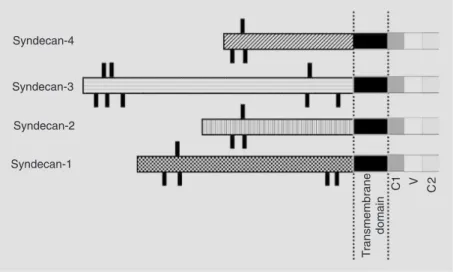
The syndecan core proteins consist of a family of four distinct genes in vertebrates. The data regarding the sequence of Droso-phila syndecan as well as chromosomal lo-cations and exon organization, suggest that the gene family arose by gene duplication and divergent evolution from a single ances-tral gene, and that syndecan-1 and -3 and syndecan-2 and -4 represent subfamilies. Each gene product is a single type I mem-brane-spanning protein with an apparently extended extracellular domain of varying size that contains covalently attached hepa-ran sulfate chains distal from the plasma membrane (3) (Figure 1).
The syndecans are membrane proteins that do not contain cysteine residues and show few but important structural similari-ties. Structural variabilities are mainly found in the extracellular domains (ectodomains), that are among the most rapidly diverging vertebrate proteins with the exception of their regions for GAG attachment, cell inter-action, proteolytic cleavage site, and oligo-merization. These domains contain se-quences of Ser-Gly-X-Gly preceded by an acidic amino acid, being consensus sequences for the glycosylation of heparan sulfate chains. Also, protease cleavage sites com-posed of basic amino acids are found close to the transmembrane portion of the protein core and are related to shedding of the pro-teoglycan from the cell surface (Figure 1). The transmembrane domains are relatively stable evolutionarily, since only a few amino acids differ among the vertebrate sequences. These domains contain regions for interac-tions with other membrane proteins and for localization to distinct membrane compart-ments.
The cytoplasmic domains contain two invariant regions, a membrane proximal com-mon region (C1) containing a serine and a tyrosine and a C-terminal common region (C2), separated by a region (V) of variable length and composition (Figures 1 and 2). The C2 region shows an EFYA sequence at the C-terminus that can bind to the PDZ domain present in specific proteins. PDZ domains, named for PSD-95, Discs-large, and Zonula occludens-1 proteins, bind spe-cific C-terminal sequences and organize and assemble protein complexes on the inner surface of the plasma membrane and are thought to link membrane components to the underlying actin-containing cytoskeleton (Figure 2). The variable (V) region is dis-tinct for each of the 4 family members, but its syndecan specific identity is conserved across species (3). The function of this do-main is largely unknown except for syndecan-4, where it is responsible for the assembly of
syndecan-4 tetramers with phosphatidylino-sitol 4,5-bisphosphate (PIP2) and activated
protein kinase C-α (PKC-α) in focal
adhe-sions (19,20).
Dramatic changes in syndecan expres-sion occur during development and are asso-ciated with morphological transitions, cell differentiation, or changes in tissue organi-zation (21).
Syndecans in cell adhesion
Intact proteoglycan is mandatory for cell adhesion and migration since these processes require both heparan sulfate-ligand binding and interactions of the core protein with cytoskeletal and/or signaling molecules. The cytoplasmic domain of syndecan interacts with a number of signaling and structural proteins, and both extracellular and cyto-plasmic domains are necessary for the acti-vation of transmembrane receptors. All mam-malian syndecan cytoplasmic domains con-tain a conserved EFYA sequence at the C-terminus, which can bind PDZ domain-con-taining scaffold proteins (CASK and synte-nin) and coordinate clustering of receptors and connection to the actin cytoskeleton (Fig-ure 2). As already mentioned, proteins bear-ing the PDZ domain are implicated in orga-nizing signaling complexes at specific sites of the membrane, such as cell junctions (20, 22).
In vitro studies indicate that all synde-cans can interact with CASK, and may form similar complexes in different contexts. CASK forms a ternary complex with synde-can-2 and protein 4.1, possibly linking the extracellular membrane and the cytoskel-eton (23). Syndecan-2 and CASK co-local-ize in rat brain neuronal synapses, suggest-ing involvement in signalsuggest-ing at synaptic junc-tions (24). This complex also seems to be crucial for maturation of dendritic spines of rat hippocampal neurons (25).
The involvement of proteoglycans in cy-toskeletal organization has been proposed in
Figure 2. Syndecan core protein structure. The extracellular domains of the four vertebrate syndecans contain several sites for heparan sulfate chain attachment. The transmembrane domain is highly conserved among the family members. The cytoplasmic domains contain regions (C1 and C2) that are exactly conserved in each of the four syndecans (the exception being a conservative substitution of arginine for lysine in syndecan-2). These flank a central variable (V) region that is distinct for each family member. Synd = syndecan.
domain of type V collagen (α4 chain). This
process leads to actin assembly, tyrosine phosphorylation, as well as activation of the Erk1/Erk2 protein kinases (29).
The best evidence for a specific role of syndecans in cell adhesion comes from stud-ies of focal adhesion formation. Focal adhe-sions are specialized zones of tight cell-matrix interaction located at the termini of actin stress fibers, and are important signal-ing centers, where integrins and heparan sulfate proteoglycans cooperate to connect extracellular matrix and cytoskeleton (30,31) (Figure 3).
Syndecan-4 is a peculiar transmembrane heparan sulfate proteoglycan present together with integrins in focal adhesion on different substrates (fibronectin, laminin, vitronectin, or type I collagen) of a number of cell types. The syndecan-4 C1 and V regions bind syndesmos, a paxillin-binding protein that
may serve to link syndecan-4 to the cyto-skeleton. α-Actinin has also been recently
shown to bind the V region of syndecan-4 (19).
Primary fibroblasts attach and spread fol-lowing integrin ligation, but do not form focal adhesions in the absence of a heparin-biding domain of fibronectin, implying re-quirement of heparan sulfate proteoglycan (3,19,32). Recruitment of syndecan-4 into focal adhesions may be dependent on acti-vation of PKC. A connection was estab-lished between the V region of syndecan-4 and PKC-α localization and activation,
con-sistent with a role for this kinase in fibroblast focal adhesion assembly (19,32).
Syndecan-4 and PKC activation
A family of serine/threonine kinases col-lectively known as PKC are involved in the regulation of a variety of cell functions in-cluding proliferation, gene expression, cell cycle, differentiation, cytoskeletal organiza-tion, cell migraorganiza-tion, cell adhesion, and apop-tosis. In the syndecan family, syndecan-4 is the one related to PKC activation. Syndecan-4 cytoplasmic domain interacts with PKC-α
(19,32-34) and activates its kinase activity in the presence of PIP2in vitro (21,34). In
vivo, syndecan-4 also interacts with PKC-α
and this interaction regulates localization of PKC-αinto the cytoskeleton, resulting in a
sustained PKC activity (34).
Oligomerization of syndecan-4 cytoplas-mic domains results from the interaction with PIP2 (32). Studies have shown that the
dimer formed by the syndecan-4 V region can bind PIP2 and is stabilized by the
inter-action (35). However, the number of dimers and PIP2 molecules involved in a single
signaling complex remains to be determined. Nevertheless, it is clear that oligomerization of the syndecan-4 proteoglycan not only drives focal adhesion formation but also pro-vides a platform for the binding and activa-tion of PKC-α (Figure 3).
Figure 3. Some of the activities involving syndecans. Syndecans modulate growth factor signaling (A) and participate in cell adhesion (B). A, Binding to syndecans can regulate growth factor interactions with tyrosine kinase receptors. The model shows heparan sulfate (HS) chains mediating dimerization of fibroblast growth factor (FGF)-2 and subsequently FGF receptors (FGFR), promoting the formation of a signaling complex and tyrosine kinase signal transduction. Multiple syndecans were shown to support FGF biological activities. B, Focal adhesion is a specialized membrane complex in which integrins and syndecan cooperate to connect extracellular matrix and cytoskeleton. The syndecan involved ap-pears to be exclusively syndecan-4. PIP2 = phosphatidylinositol 4,5-bisphosphate; PKC-α
Work with fusion proteins and synthetic peptides shows that oligomerized, but not monomeric, cytoplasmic domains of synde-can-4 can bind PKC-α directly through the
PKC-α catalytic domain, which in turns
re-sults in direct activation of PKC-α in the
absence of other mediators and superactiva-tion in their presence. The combinasuperactiva-tion of the syndecan-4 cytoplasmic domain, PIP2
and PKC-α yields a potent signaling
com-plex, in which levels of PKC-α activity are
as high as can be achieved using conven-tional activators. The signaling activity of the cytoplasmic tail of syndecan-4 seems to be supported by PIP2 that serves as a binding
interface, an essential co-factor for PKC-α
activation and a facilitator for the multimer-ization of the tail (33-36). These properties are regulated by the phosphorylation of a specific serine residue located close to the N-terminus of the PIP2 binding motif (35).
PKC-δ, rather than PKC-α that associates
with the domain in focal adhesions, appears to be responsible for the phosphorylation event (36). Once phosphorylated, the af-finity of the cytoplasmic tail for PIP2 and its
capacity to oligomerize and activate PKC-α
in the presence of PIP2 are sharply reduced
(33). The association of syndecan-4 with PKC-α puts the proteoglycan in a category
similar to other transmembrane receptors, such as integrin, which do not possess intrin-sic catalytic activity, but are associated with kinases or phosphatases.
Syndecans and growth factor signaling
Growth factors are polypeptide molecules that elicit several responses in target cells. These responses include proliferation, dif-ferentiation, survival, and apoptosis of the cells. A large number of growth factors are known to bind syndecans through their hep-aran sulfate chains (37), including members of the fibroblast growth factor (FGF) family. FGF binds to the extracellular domain of its
receptor, which is a transmembrane mole-cule with protein-tyrosine kinase activity in the cytoplasmic region. After growth factor binding, the dimerization of the receptor occurs, followed by autophosphorylation of the intracellular domain of the receptor. This process will initiate a signal transduction cascade which will generate signals that reach the nucleus, activating the expression of spe-cific genes and leading to the cellular re-sponse (Figure 3).
As co-receptors, syndecans increase the local concentrations of growth factors and promote receptor dimerization (3). Heparan sulfate proteoglycan mediates the binding of FGF to its high affinity receptor, which has tyrosine kinase activity (13). Syndecan-4 over-expression enhances FGF-2 signaling, and chimeric receptors composed of the syndecan-4 cytoplasmic domain and hepa-ran sulfate-substituted extracellular domains enhance the cellular response to FGF, but this is not the case for chimeras lacking the cytoplasmic domain (38,39), a fact implying the importance of syndecan-4 cytoplasmic domain-mediated PKC activation in FGF signaling. In contrast, there is no clear evi-dence for syndecan-2 regulation of FGF sig-naling in fibroblasts. However, syndecan-2 in activated human macrophages can selec-tively bind FGF-2, vascular endothelial growth factor and heparin-binding endothe-lial growth factor. These results imply a key role for syndecan-2 in the delivery of se-questered growth factors by inflammatory macrophages for productive binding to their appropriate target cells in vivo (37).
syndecan-2 can bind and regulate the signaling of tumor growth factor-ß, and the binding is through the ectodomain of the core protein, with the heparan sulfate chains having only a minor role. The binding is independent of the cytoplasmic domain (42).
Syndecan-1 is also implicated in growth factor signaling. Hepatocyte growth factor binding to syndecan-1 promotes activation of PI3-kinase and mitogen-activated protein kinase pathways. Soluble syndecan-1 ap-pears to act as a carrier for hepatocyte growth factor in vivo and has been implicated in the pathology of myeloma by modulating cy-tokine activity within the bone marrow (43). Syndecan-1, over-expressed on 3T3 cells has been shown to inhibit FGF-2 signaling. Syndecan-1 induction in S115 mammary carcinoma cells can prevent the androgen-induced transformation of these cells and this can be accomplished by adding the soluble ectodomain of syndecan-1 from nor-mal NMuMG mammary epithelial cells, sug-gesting disruption of an autocrine signaling pathway that may involve FGF-2, FGF-8 or other heparin-binding growth factors (44).
Members of the FGF family mediate, at least in part, the outgrowth of the mesoderm of the developing limb bud in response to the apical ectodermal ridge. It has been shown that syndecan-3 plays an essential role in this process, mediating the interaction of the FGFs produced by the apical ectodermal ridge with the underlying mesoderm of the limb bud. In addition, syndecan-3 also is a cell-surface receptor for heparin-binding growth factor-associated molecule (HB-GAM) and is implicated in the activity of this molecule on neurite outgrowth. On the other hand, it should be mentioned that HB-GAM interacts with the heparan sulfate chains of syndecan-3. Syndecan-3 is a re-ceptor for HB-GAM which promotes neu-rite outgrowth. This requires c-Src and Fyn tyrosine kinase activity, and involves cor-tactin and tubulin. All of these molecules co-immunoprecipitate with the cytoplasmic
do-main of syndecan-3, suggesting the assem-bly or activation of a tyrosine kinase-con-taining cytoplasmic complex (38,45,46).
Furthermore, syndecans are shed from cell surfaces via cleavage of their ectodomain. Syndecan shedding releases the ectodomain as a soluble regulatory macromolecule. Syn-decan-1 and -4 ectodomains in wound fluids bind to growth factors, proteases and prote-ase inhibitors. FGF-2, which is dependent on heparan sulfate for its activity, is inhib-ited by binding to the glycosaminoglycan of the soluble syndecan-1 ectodomain. Cleav-age of these heparan sulfate chains by physi-ological heparinase produces soluble frag-ments that greatly enhance FGF-2 activity. Thus, it is not known under what circum-stances a proteoglycan may be inhibitory or stimulatory to growth factor signaling (22, 47).
Heparan sulfate chains and cell signaling
Ligand binding was once thought to be a relatively nonspecific ionic interaction be-tween negatively charged heparin and hepa-ran sulfate and positively charged domains of proteins. However, many ligands require specific sequences of well-defined length and structure. Nowadays, several lines of evidence suggest that the structural pecu-liarities may be related to heparan sulfate functions. As already mentioned, heparan sulfate proteoglycans are present on the cell surface of mammalian cells in culture and in most vertebrate and invertebrate tissues (1, 2,9).
sul-fates are composed of alternating units of α
-D-glucosamine and uronic acid (ß-D-glucu-ronic or α-L-iduronic acid) and the
hex-osamine is either N-acetylated or N-sulfated and/or 6-O-sulfated. Uronic acid can also be 2-O sulfated. The heparan sulfates exhibit a peculiar structural variability (degree of N -sulfation/N-acetylation and 6-O-sulfation as well as the ratio of glucuronic acid and iduronic acid) according to the tissue and species of origin. Sequence analyses of hep-aran sulfates have shown that all of them are co-polymers consisting of several oligosac-charide regions with distinct disacoligosac-charide composition (Figure 4). These differences could explain, for example, the preferential binding of growth factors to some cells but not to others.
The action of heparan sulfate chains as positive modulators of cell proliferation is due to the capacity of the compound to bind and act as a co-receptor for growth factors. They potentiate the action of low concentra-tions of growth factor by enhancing the for-mation of growth factor-receptor complexes. Sulfated oligosaccharides obtained from heparin and heparan sulfate potentiate the mitogenic activity of FGF-1 on 3T3 fibro-blasts. Although heparan sulfates extracted from several mammalian tissues potentiated the mitogenic activity of FGF-1, in general, they were less efficient than heparin on a mass basis. On the other hand, an oligosac-charide obtained from heparan sulfate after digestion with heparitinase I is more active than the intact molecule, reaching a potenti-ating effect equivalent to that of heparin, whereas an N-acetylated oligosaccharide iso-lated after nitrous acid degradation is inac-tive. The results indicate that the mitogenic activity of FGF-1 is primarily potentiated through the interaction of more sulfated re-gions of the heparan sulfate chains as well as the presence of conformationally flexible iduronic acid residues. Curiously, heparan sulfate prepared from 3T3-conditioned cul-ture medium proved to be more efficient
Table 1. Comparison of heparin and heparan sulfate.
Parameter Heparin Heparan sulfate
Potassium acetate (2 M, pH 5.7, 4ºC) Insoluble Soluble
Band formation in electrofocusing +
-Electrophoretic mobility (agarose)
Barbital 1.0 0.7
Diaminopropane 1.0 1.0
Barium - diaminopropane 1.0 2.0
Metachromatic activity (nm) 505 525
Sulfate/hexosamine ratios 2.4-2.8a 0.8-1.8b
Anticoagulant activity (USP/mg) 60-320 <5c
Degradation
Heparinase + less than 5%d
Heparitinase I - +
Heparitinase II + +
Cellular localization
Granules +
-Cell surface - +
Extracellular matrix - +
Binding
Antithrombin + less than 5%
Growth factors + +
Data from aRef. 48, bRef. 2, cRef. 49; dheparan sulfate obtained from endothelial cells
in culture is degraded by heparinase to the extent of 20% (Ref. 50).
Figure 4.Proposed general structure of heparan sulfate and sites of cleavage of heparitinase I, heparitinase II, heparinase, and nitrous acid (for details, see Ref. 15). GlcNAc = 2-acetamido α-D-glucopyranose; GlcNAc,6S = 2-acetamido α-D-glucopyranose-6-O-sulfate; GlcNS = 2-N-sulfoamino α-D-glucopyranose; GlcNS,6S = 2-N-sulfoamino α -D-glucopyra-nose-6-O-sulfate; GlcUA = ß-D-glucopyranosyl uronic acid; IdoUA = α-L-idopyranosyl uronic acid; IdoUA,2S = α-L-idopyranosyl uronic acid 2-O-sulfate.
than heparin both on a mass and molar basis. These results suggest that there is specificity for this interaction, favoring the structural specificity of this process (14). In this re-gard, it has been shown that N-sulfate groups and saccharides containing iduronic acid
binding of human skin fibroblast heparan sulfate to FGF-2 and the sequence of an oligosaccharide with similar affinity for the growth factor as the parent molecule has been determined (51).
It has been demonstrated that N-sulfate groups are most important, followed by 2-O -and 6-O-sulfate groups, for binding to neu-regulin-1 (NRG-1) and blocking erbB re-ceptor phosphorylation. Inhibition of sulfa-tion through the use of chlorate or selective blockade of N-sulfation with a siRNA di-rected against the enzyme that promotes N -sulfation resulted in decreased NRG-1-in-duced erbB receptor activation. This speci-ficity provides a means by which tissues can localize and potentiate NRG-1 signaling through modifications in glycosaminogly-can composition (52).
Recently, it has been shown that the bind-ing of endostatin to endothelial heparan sul-fate shows a differential requirement for specific sulfate groups. The results indicate that 6-O-sulfates play a dominant role in selectivity and 2-O-sulfates are not strictly essential (53).
Using chlorate-treated rat mammary fi-broblasts, FGF-2 and heparin-derived oli-gosaccharides, dependence on the size of the fragment was demonstrated for the stimulus of DNA synthesis and phosphorylation of p42/44 mitogen-activated protein kinase. However, tetra- to octa-saccharides were less potent in proliferation assays than deca- and longer oligosaccharides. Furthermore, there was no correlation between the binding pa-rameters and the potency of the oligosaccha-rides in DNA synthesis assays (54).
The phorbol ester, phorbol 12-myristate 13-acetate (PMA), was first known for its tumor-promoting activity, and only later was it recognized as a strong and specific activa-tor of PKC, mimicking the natural modula-tor of this enzyme, i.e., diacylglycerol. We have reported that PMA specifically stimu-lates the synthesis of heparan sulfate proteo-glycan from endothelial cells, an effect that
is likely to be mediated by PKC activation. Staurosporine, a potent kinase inhibitor, abol-ishes the effect of PMA, whereas activation of the cAMP/PKA pathway by both forsko-lin and/or 8-BrcAMP is not effective in trig-gering stimulation of heparan sulfate proteo-glycan (syndecan-4) synthesis. Furthermore, 18-h PMA pre-treatment, that presumably down-regulates PKC, renders endothelial cells resistant to a second PMA treatment. The most remarkable aspect of these results, however, was the correlation between stim-ulation of heparan sulfate proteoglycan syn-thesis and the blockade of G1-S phase
transi-tion, both triggered by PMA (55,56). The combination of orto-phenyl-ß-D-xylosides with PMA produced some cumulative ef-fect. PMA stimulates the synthesis of hepa-ran sulfate mainly at the G1 phase, whereas
the greatest enhancement of synthesis pro-duced by the xylosides is in the S phase of the endothelial cell cycle (57).
Future directions
mu-tations have been identified in the homo-logue of UDP-D-glucose dehydrogenase, which produces UDP-glucuronic acid ( sug-arless, sgl) (58) and in the N-deacetylase/N -sulfotransferase homologue (sulfateless, sfl) (59). In either sgl or sf l mutant embryos, Wingless (Wg), a member of the Wnt fam-ily, FGF and Hedgehog (Hh) signaling path-ways are impaired. The phenotype associ-ated with these mutations is severe and cor-responds to complete loss of activity of these pathways, indicating that the heparan sul-fates are essential for signaling of growth factors and morphogens. Mouse embryos homozygous for a mutation in the gene cod-ing for heparan sulfate 2-O-sulfotransferase, also present multiple developmental abnor-malities including lack of kidney induction. The abnormalities are probably due to com-promised activities of heparan sulfate and growth factors in organogenesis (60).
As already noted, heparan sulfate chains are consistently found in members of the family of transmembrane proteoglycans, known as syndecans. Syndecans participate in a variety of physiological processes. They appear at the early stages of development, and the glycosaminoglycan chains vary ac-cording to the tissue and species of origin.
Structural modifications are found in dis-eases, especially in neoplastic transforma-tion. Recent advances in syndecan research suggest that the core proteins of these pro-teoglycans are involved in many signaling functions that translate information to the cytosol from binding events of their heparan sulfate chains during developmental pro-cesses. The mechanism by which syndecans can act as co-receptors with integrins re-mains unknown, but recent studies point to the syndecan extracellular protein domains, that appear to complement the binding inter-actions of their attached heparan sulfate chains. Syndecan-4 can also interact with PKC and stimulate its activity. The synde-cans modulate the actions of a wide variety of heparan sulfate-binding proteins.
Understanding the mechanisms by which the syndecans participate in signal transduc-tion pathways and questransduc-tions addressing the manner in which the enzymes related to the biosynthesis of these compounds are located in the cell or in the Golgi complex, what kind of cluster they form, and how they actually synthesize the sugar chain, are the new fron-tier for this area, and may lead to novel therapeutic strategies for the control of tu-mor cell invasion and metastasis.
References
1. Dietrich CP, Nader HB & Straus AH (1983). Structural differences of heparan sulfates according to the tissue and species of origin.
Biochemical and Biophysical Reserch Communications, 111: 865-871.
2. Dietrich CP, Tersariol ILS, Toma L et al. (1998). Structure of hepa-ran sulfate: identification of variable and constant oligosaccharide domains in eight heparan sulfates of different origins. Cellular and Molecular Biology, 44: 417-429.
3. Bernfield M, Gotte M, Park PW et al. (1999). Functions of cell surface heparan sulfate proteoglycans. Annual Review of Biochem-istry, 68: 729-777.
4. Kim CW, Goldberger OA, Gallo RI et al. (1994). Members of the syndecan family of heparan sulfate proteoglycans are expressed in distinct cell-, tissue-, and development-specific patterns. Molecular Biology of the Cell, 5: 797-805.
5. Ueno M, Yamada S, Zako M et al. (2001). Structural
characteriza-tion of heparan sulfate and chondroitin sulfate of syndecan-1 puri-fied from normal murine mammary gland epithelial cells. Common phosphorylation of xylose and differential sulfation of galactose in the protein linkage region tetrasaccharide sequence. Journal of Biological Chemistry,276: 29134-29140.
6. Sanderson RD (2001). Heparan sulfate proteoglycans in invasion and metastasis. Seminars in Cell and Developmental Biology,12: 89-98.
7. Sasisekharan R, Shriver Z, Venkataraman G et al. (2002). Roles of heparan sulphate glycosaminoglycans in cancer. Nature Reviews. Cancer, 2: 521-528.
8. Dietrich CP, Sampaio LO, Toledo OM et al. (1977). Cell recognition and adhesiveness: a possible biological role for the sulfated muco-polysaccharides. Biochemical and Biophysical Research Communi-cations, 75: 329-336.
cell growth mediated by sulfated glycosaminoglycans. Brazilian Journal of Medical and Biological Research, 17: 5-15.
10. Fransson LA (1989). Heparan sulphate proteoglycans: structure and properties. In: Lane DA & Lindhal U (Editors), Heparin. Chemi-cal and BiologiChemi-cal Properties and CliniChemi-cal Applications. Edward Arnold, London, UK.
11. Tumova S, Woods A & Couchman JR (2000). Heparan sulfate proteoglycans on the cell surface: versatile coordinators of cellular functions. International Journal of Biochemistry and Cell Biology, 32: 268-288.
12. Thodeti CK, Albrechtsen R, Grauslund M et al. (2003). ADAM12/ syndecan-4 signaling promotes beta(1) integrin-dependent cell spreading through protein kinase C alpha and RhoA. Journal of Biological Chemistry,278: 9576-9584.
13. Yayon A, Klagsbrun M, Esko JD et al. (1991). Cell surface heparin-like molecules are required for binding of basic fibroblast growth factor to its high affinity receptor. Cell, 64: 841-848.
14. Gambarini AG, Miyamoto CA, Lima GA et al. (1993). Mitogenic activity of acidic fibroblast growth factor is enhanced by highly sulfated oligosaccharides derived from heparin and heparan sulfate.
Molecular and Cellular Biochemistry, 124: 121-129.
15. Schlessinger J, Lax I & Lemmon M (1995). Regulation of growth factor activation by proteoglycans: what is the role of the low affinity receptors? Cell, 83: 357-360.
16. Porcionatto MA, Nader HB & Dietrich CP (1999). Heparan sulfate and cell division. Brazilian Journal of Medical and Biological Re-search, 32: 539-544.
17. Lin X (2004). Functions of heparan sulfate proteoglycans in cell signaling during development. Development, 131: 6009-6021. 18. Presta M, Dell’era P, Mitola S et al. (2005). Fibroblast growth factor/
fibroblast growth factor receptor system in angiogenesis. Cytokine and Growth Factor Reviews, 16: 159-178.
19. Woods A & Couchman JR (2001). Syndecan-4 and focal adhesion function. Current Opinion in Cell Biology, 13: 578-583.
20. Rapraeger AC & Otto VL (1998). Molecular interactions of the syndecan core proteins. Current Opinion in Cell Biology, 10: 620-628.
21. Beauvais DM & Rapraeger AC (2004). Syndecans in tumor cell adhesion and signaling. Reproductive Biology and Endocrinology, 2: 1-12.
22. Bass MD & Humphries MJ (2002). Cytoplasmic interactions of syndecan-4 orchestrate adhesion receptor and growth factor recep-tor signaling. Biochemical Journal, 368: 1-15.
23. Cohen AR, Wood DF, Marfatia SM et al. (1998). Human CASK/LIN-2 binds syndecan-CASK/LIN-2 and protein 4.1 and localizes to the basolateral membrane of epithelial cells. Journal of Cell Biology, 142: 129-138. 24. Hsueh YP, Yang FC, Kharazia V et al. (1998). Direct interaction of CASK/LIN-2 and syndecan heparan sulfate proteoglycan and their overlapping distribution in neuronal synapses. Journal of Cell Biol-ogy, 142: 139-151.
25. Ethell IM & Yamaguchi Y (1999). Cell surface heparan sulfate pro-teoglycan syndecan-2 induces the maturation of dendritic spines in rat hippocampal neurons. Journal of Cell Biology, 144: 575-586. 26. Carey DJ (1997). Syndecans: multifunctional cell-surface
co-recep-tors. Biochemical Journal, 327: 1-16.
27. Adams JC, Kureishy N & Taylor AL (2001). A role for syndecan-1 in coupling fascin spike formation by thrombospondin-1. Journal of Cell Biology, 152: 1169-1182.
28. Halpain S (2000). Actin and the agile spine: how and why do dendritic spines dance? Trends in Neurosciences, 23: 141-146. 29. Erdman R, Stahl RC, Rothblum K et al. (2002). Schwann cell
adhe-sion to a novel heparan sulfate binding site in the N-terminal domain of alpha 4 type V collagen is mediated by syndecan-3. Journal of Biological Chemistry, 277: 7619-7625.
30. Yoneda A & Couchman JR (2003). Regulation of cytoskeletal organ-ization by syndecan transmembrane proteoglycans. Matrix Biology, 22: 25-33.
31. Baciu PC, Saoncella S, Lee SH et al. (2000). Syndesmos, a protein that interacts with the cytoplasmic domain of syndecan-4, mediates cell spreading and actin cytoskeletal organization. Journal of Cell Science,113: 315-324.
32. Oh ES & Couchman JR (2004). Syndecans-2 and -4; close cousins, but not identical twins. Molecular Cell, 17: 181-187.
33. Lim ST, Longley RI, Couchman JR et al. (2003). Direct binding of syndecan-4 cytoplasmic domain to the catalytic domain of protein kinase Cα(PKCα) increases focal adhesion localization of PKCα.
Journal of Biological Chemistry, 278: 13795-13802.
34. Simons M & Horowitz A (2001). Syndecan-4-mediated signaling.
Cell Signal,13: 855-862.
35. Keum E, Kim Y, Kim J et al. (2004). Syndecan-4 regulates localiza-tion, activity and stability of protein kinase C-alpha. Biochemical Journal, 378: 1007-1014.
36. Murakami M, Horowitz A, Tang S et al. (2002). Protein kinase C (PKC)-δregulates PKC-αactivity in a syndecan-4-dependent man-ner. Journal of Biological Chemistry, 277: 20367-20371.
37. Gotte M (2003). Syndecans in inflammation. FASEB Journal, 17: 575-591.
38. Volk R, Schwartz JJ, Li J et al. (1999). The role of syndecan cytoplasmic domain in basic fibroblast growth factor-dependent sig-nal transduction. Journal of Biological Chemistry, 274: 24417-24424. 39. Horowitz A, Tkachenko E & Simons M (2002). Fibroblast growth factor-specific modulation of cellular response by syndecan-4. Jour-nal of Biological Chemistry, 157: 715-725.
40. Zvibel I, Brill S, Halpern Z et al. (2001). Soluble and matrix-associ-ated heparan sulfate proteoglycans increase expression of erb-B2 and erb-B3 in colon cancer cell lines. International Journal of Can-cer, 91: 316-321.
41. Modrowski D, Basle M, Lomri A et al. (2000). Syndecan-2 is in-volved in the mitogenic activity and signaling of granulocyte-macro-phage colony-stimulating factor in osteoblasts. Journal of Biological Chemistry, 275: 9178-9185.
42. Chen L, Klass C & Woods A (2004). Syndecan-2 regulates trans-forming growth factor-beta signaling. Journal of Biological Chemis-try, 279: 15715-15718.
43. Derksen PW, Keehnen RM, Evers LM et al. (2002). Cell surface proteoglycan syndecan-1 mediates hepatocyte growth factor bind-ing and promotes Met signalbind-ing in multiple myeloma. Blood,99: 1405-1410.
44. Jaakkola P & Jalkanen M (1999). Transcriptional regulation of syn-decan-1 expression by growth factors. Progress in Nucleic Acid Research and Molecular Biology, 63: 109-138.
45. Kosher RA (1998). Syndecan-3 in limb skeletal development. Mi-croscopy Research and Technique, 43: 123-130.
46. Kinnunen T, Raulo E, Nolo R et al. (1996). Neurite outgrowth in brain neurons induced by heparin-binding growth-associated molecule (HB-GAM) depends on the specific interaction of HB-GAM with heparan sulfate at the cell surface. Journal of Biological Chemistry, 271: 2243-2248.
47. Rapraeger AC (2001). Molecular interactions of syndecans during development. Seminars in Cell and Developmental Biology, 12: 107-116.
biological role of heparin. In: Lane DA & Lindhal U (Editors), Hepa-rin. Chemical and Biological Properties Clinical Applications. Ed-ward Arnold, London, UK.
49. Nader HB, Lopes CC, Rocha HA et al. (2004). Heparins and heparinoids: occurrence, structure and mechanism of antithrom-botic and hemorrhagic activities. Current Pharmaceutical Design, 10: 951-966.
50. Nader HB, Dietrich CP, Buonassisi V et al. (1987). Heparin se-quences in the heparan sulfate chains of an endothelial cell proteo-glycan. Proceedings of the National Academy of Sciences, USA, 84: 3565-3569.
51. Turnbull JE, Fernig DG, Ke Y et al. (1992). Identification of the basic fibroblast growth factor binding sequence in fibroblast heparan sul-fate. Journal of Biological Chemistry, 267: 10337-10341.
52. Pankonin MS, Gallagher JT & Loeb JA (2005). Specific structural features of heparan sulfate proteoglycans potentiate neuregulin-1 signaling. Journal of Biological Chemistry, 280: 383-388.
53. Blackhall FH, Merry CLR, Lyon M et al. (2003). Binding of endostatin to endothelial heparan sulphate shows a differential requirement for specific sulphates. Biochemical Journal, 375: 131-139.
54. Delehedde M, Lyon M, Gallagher JT et al. (2002). Fibroblast growth factor-2 binds to small heparin-derived oligosaccharides and stimu-lates a sustained phosphorylation of p42/44 mitogen-activated pro-tein kinase and proliferation of rat mammary fibroblasts.
Biochemi-cal Journal, 366: 235-244.
55. Porcionatto MA, Pinto CR, Dietrich CP et al. (1994). Heparan sulfate proteoglycan and control of cell proliferation: enhanced synthesis induced by phorbol ester (PMA) during G(1)-phase. Brazilian Jour-nal of Medical and Biological Research, 27: 2185-2190.
56. Porcionatto MA, Moreira CR, Armelin HA et al. (1998). Stimulation of heparan sulfate proteoglycan synthesis and secretion during G1
phase induced by growth factors and PMA. Journal of Cellular Biochemistry, 70: 563-572.
57. Moreira CR, Lopes CC, Cuccovia IM et al. (2004). Heparan sulfate and control of endothelial cell proliferation: increased synthesis during the S phase of the cell cycle and inhibition of thymidine incorporation induced by ortho-nitrophenyl-beta-D-xylose. Biochimi-ca et BiophysiBiochimi-ca Acta, 1673: 178-185.
58. Binari RC, Staveley BE, Johnson WA et al.(1997). Genetic evi-dence that heparin-like glycosaminoglycans are involved in wing-less signaling. Development, 124: 2623-2632.
59. Lin X & Perrimon N (1999). Dally cooperates with Drosophila Frizzled 2 to transduce Wingless signaling. Nature, 400: 281-284.