ISSN 0100-879X
BIOMEDICAL SCIENCES
AND
CLINICAL INVESTIGATION
www.bjournal.com.br
www.bjournal.com.br
Volume 43 (11) 1010-1134 November 2010
Institutional Sponsors
The Brazilian Journal of Medical and Biological Research is partially financed by
Hotsite of proteomics metabolomics developped by:
Braz J Med Biol Res, November 2010, Volume 43(11)1109-1115
doi: 10.1590/S0100-879X2010007500107
In vivo fluctuation of Tax, Foxp3, CTLA-4, and GITR mRNA
+ +
expression in CD4 CD25 T cells of patients with human
T-lymphotropic virus type 1-associated myelopathy
In vivo
fluctuation of Tax, Foxp3, CTLA-4,
and GITR mRNA expression in CD4
+
CD25
+
T cells of patients with human
T-lymphotropic
virus type 1-associated myelopathy
E. Ramirez
1,2, L. Cartier
3, L. Rodriguez
4, C. Alberti
1,2,5and M.A. Valenzuela
51Departamento de Virología, Instituto de Salud Pública de Chile, Santiago, Chile 2Programa de Virología, Instituto de Ciencias Biomédicas, 3Departamento de Ciencias Neurológicas, Facultad de Medicina, Universidad de Chile, Santiago, Chile 4Sección de Bioestadística, Instituto de Salud Pública de Chile, Santiago, Chile 5Departamento de Bioquímica y Biología Molecular, Facultad de Ciencias Químicas y Farmacéuticas,
Universidad de Chile, Santiago, Chile
Abstract
HTLV-1 Tax expression exerts an inhibitory effect on the Foxp3 transcription factor in CD4+CD25+ T-regulatory cells (Treg). For
a better understanding of the role of Tax mRNA in the gene expression of cellular markers we measured Tax, Foxp3, CTLA-4, GITR, TGF-β, and IL-10 mRNA in Treg cells of 50 patients with human T-lymphotropic virus type 1 (HTLV-1)-associated myelopathy/tropical spastic paraparesis (HAM/TSP; 27 women and 23 men; mean age: 56.7 years). The control group consisted of 23 non-infected subjects (12 women and 11 men) with a mean age of 51.3 years. Real-time PCR was used to measure mRNA of Tax proteins and several cellular markers of Treg function. Determinations revealed a high level of Tax mRNA in HAM/TSP (124.35 copies/100 CD4+CD25+ T cells). Foxp3, GITR, and CTLA-4 mRNA levels were lower in HAM/TSP patients (mean ± SD,
22.07 ± 0.78, 9.63 ± 0.36, and 4.54 ± 0.39, respectively) than in non-infected controls (47.15 ± 12.94, 22.14 ± 1.91, and 21.07 ± 2.31). Both groups had similar levels of TGF-β and IL-10. An inverse relationship was found between Tax levels and Foxp3, CTLA-4, and GITR levels. Conversely, there was a direct correlation between levels of Foxp3, GITR, and CTLA-4. Disease severity and evolution time did not correlate with Tax or Foxp3 levels. The present results suggest that Tax and Foxp3 mRNA vary with the same degree of disease severity in HAM/TSP patients. Tax fluctuations may affect CTLA-4 and GITR expression via the Foxp3 pathway, causing virus-induced dysfunction of CD4+CD25+ T cells in HAM/TSP patients.
Key words: HTLV-1-associated myelopathy/tropical spastic paraparesis; Tax; Foxp3; CTLA-4; GITR mRNA expression
Introduction
Correspondence: E. Ramirez, Departamento de Virología, Instituto de Salud Pública de Chile, Avenida Marathon, 1000, Ñuñoa, Santiago, Chile. Fax: +56-2-350-7583. E-mail: [email protected]
Received May 24, 2010. Accepted September 27, 2010. Available online October 8, 2010. Published November 12, 2010. Human T-lymphotropic virus type 1 (HTLV-1) is the
retrovirus causing adult T-cell leukemia (ATL) and HTLV-1-associated myelopathy/tropical spastic paraparesis (HAM/ TSP) (1-3). The latter is a neurological disease defined as a progressive and slow spastic paraparesis without remittance. The demyelinization of the pyramidal tract is the main feature of this progressive neurological disease (4).
According to available data, Tax protein may play a major role in the development of HAM/TSP, regulating multiple cel
-lular responses by protein-protein interactions with various host cell factors. HTLV-1-mediated activation of the host T cell is primarily induced by the viral Tax protein, which influ
-ences transcriptional activation, signal transduction, cell cycle
control, and apoptosis (5,6).
A correlation has been suggested between HTLV-1 Tax mRNA and disease severity (7). However, practically no longitudinal studies have characterized Tax mRNA expres
-sion in relation to HTLV-1 proviral DNA load and disease progression in HAM/TSP patients. We found wide temporal variation in the provirus load and TaxmRNA expression in patients, independent of functional damage (8).
The main reservoir of HTLV-1 in HAM/TSP patients is the CD4+CD25+ T-regulatory cell population (Treg cells) (9). In
addition, Tax-specific inhibition of Foxp3 mRNA expression may be associated with the suppression of CD4+CD25+ T
1110 E. Ramirez et al.
function (9,10). Foxp3 is critical for the development and function of Treg, with Foxp3 reduction and Treg dysfunc
-tion being associated with autoimmune diseases such as multiple sclerosis, myasthenia gravis, and type 1 diabetes (11-13). A TGF-β-mediated signaling has been associated with the induction and maintenance of Foxp3 and Treg dif
-ferentiation (14,15). Recent studies suggest that the Tax protein could affect TGF -β signaling by inhibiting the gene expression controlled by this factor (16). However, CD4+ T
cells of HAM/TSP patients apparently do not respond to the antiproliferative effects of in vitro TGF-β (17). The molecular
mechanisms involved in the suppression of HTLV-1-infected Treg cell have not yet been elucidated.
For a better understanding of the mechanisms involved in the suppression of Treg cells by HTLV-1 infection, we mea
-sured Tax, Foxp3, CTLA-4, GITR, TGF-β, and IL-10 mRNA
in CD4+CD25+ T cells of HAM/TSP patients and compared
them with non-infected controls.
Material and Methods
Patients and samples
A total of 73 individuals were studied: 50 HTLV-1 seroposi
-tive HAM/TSP patients and 23 non-infected controls (blood do
-nors). All subjects gave written informed consent to participate, and the study was approved by the El Salvador Hospital Ethics Committee. All subjects resided in Santiago of Chile and had Spanish ethnic background. We confirmed HTLV-1 infection by immunofluorescence and PCR assays (18). The diagnosis of HAM/TSP was made according to the World Health Organiza
-tion guidelines (19). Other known causes (i.e., multiple sclerosis, spinal cord compression) of progressive spastic paraparesis were excluded according to clinical presentation and according to clinical, neurophysiological, radiological, immunological, and cerebrospinal fluid cytochemical studies (20). We performed hematological analysis to detect leukemic lymphocytes. The functional status of the patients was measured by the expanded disability status scale (EDSS) and the march scale of eight functional levels (21).
The HAM/TSP group was composed of 27 women and 23 men, mean age 56.7 ± 9.9 years, age range 24-73 years, with a mean evolution time of 10.4 ± 7.1 years (range 2-30 years). Sixty percent of the patients had sensory failure, and 42% had any other associated diseases: 13 patients with dacryosialad
-enitis and 8 with cutaneous lymphoma. The control group was composed of 12 women and 11 men, mean age 51.3 ± 7.8 years, age range 30-64 years.
We obtained a blood sample (15 mL) from each subject to study Tax, Foxp3, CTLA-4, GITR, IL-10, and TGF-β mRNA
expression. PBMCs were obtained by centrifugation on Ficoll-Hypaque gradients. Cells were cryopreserved in liquid nitrogen until used.
Isolation of CD4+CD25+ T cells
CD4+ T cells were positively isolated from cryopreserved
PBMC with the Dynal CD4+ Positive Isolation Kit (Invitrogen
Dynal, Norway) according to manufacturer instructions. CD25+ cellswere enriched with PE-anti-CD25 and anti-PE magnetic beads(Miltenyi Biotec, Germany) using the Midi-MACSsystem
(Miltenyi Biotec). The purity of the resulting CD4+CD25+ T cells
was shown to be 90% by flow cytometry.
Real-time RT-PCR of Tax mRNA
RNA was extracted from Treg cells using the RNeasy Mini Kit (Qiagen, USA) according to manufacturer instructions. RT-PCR was performed using the LightCycler, one-step RNA Amplification Kit SYBR Green I (Roche Molecular Systems, Inc., USA). Primers (Invitrogen, USA)for the amplification of HTLV-1 TaxmRNA have been previously described (7). The forward primer RPX-3 (5096-5115; 5’-ATCCCGTGG AGACTCCTCAA-3’) and the reverse primer RPX-4+3 (7360-7338; 5’-CCAAACACGTAGACTGGGTATCC-3’) were located upstream and downstream of the second splice junc
-tion site of HTLV-1 pX (tax/rex) mRNA, respectively. Primers
(Invitrogen)for the amplification ofFoxp3, CTLA-4, GITR,
IL-10, and TGF-β mRNA have been previously described (9,22,23). We used primers for the human housekeeping gene hypoxanthine ribosyl transferase (HPRT; BiosChile IGSA, Chile) for internal calibration (24). RT-PCR conditions were as follows: 50 ng RNA was added to a 20-µL reaction mixture containing 1X LightCycler - RT-PCR Reaction Mix SYBR Green I, 1X Resolution solution, and 1X LightCycler - RT-PCR Enzyme Mix, 6.0 mM MgCl2, 0.5 mM of each
primer. The thermal cycler conditions were 15 min at 55°C for cDNA synthesis, followed by 45 cycles of 10 s at 95°C (denaturation), 5 s at 55°C (annealing), and 7 s at 72°C (extension).
Standard curves for the calculation of HTLV-1 TaxmRNA and HPRT mRNA were generated using cDNA from MT-2 cells. MT-2 cDNA was 10-fold serially diluted with diethyl pyrocarbonate (DEPC) H2O to a 10-5 dilution, and a sample
of cDNA from 100 ng of RNA per reaction was amplified. When a serial dilution of 100 to 10-5 MT-2 cDNA was used
as template for the real-time PCR, a specific signal was observed in contrast to negative controls. The threshold cycle (Ct) values were used to plot a standard curve in which Ct decreased in linear proportion to the log of the template copy number.
All assays were carried out in triplicate and the aver
-age value was used for calculations. The relative HTLV-1 Tax, Foxp3, IL-10, TGF-β, CTLA-4, and GITR mRNA
levels were calculated by the following formulas: Tax = (value
of tax) / (value of HPRT) x 10,000, and Foxp3 = 2(Ct value
of HPRT - Ct value of Foxp3), IL-10 = 2(Ct value of HPRT - Ct value of IL-10), TGF-β = 2 (Ct value of HPRT - Ct value of TGF-β), CTLA-4 =
2(Ct value of HPRT - Ct value of CTLA-4), GITR = 2(Ct value of HPRT
- Ct value of GITR).
Statistical analysis
the statistical package Stata version 9.1. We obtained the least-squares regression and three-dimensional graphics with the Statgraphics Centurion XV package, using the regression and graphic modules from the General Linear Model. We used robust estimators (median absolute difference) when some outliers could generate a strong deformation of the regression curves. The original data were sorted in an Excel file and then copied to the relevant statistical packages. The accurate P values were calculated with the WHATIS module from the WINPEPI program.
Results
Levels of Tax, Foxp3, CTLA-4, GITR, IL-10, and TGF-β
mRNA in samples from HAM/TSP patients and controls
Table 1 shows the mean values and standard deviation of the levels of Tax, Foxp3, CTLA-4, GITR, IL-10, and TGF-β mRNA in CD4+CD25+ T cells of patients and controls. Tax
mRNA was present in the cells of all HAM/TSP patients. The average ofTax in T cells of patients was 124.35 ± 40.17 copies/100 CD4+CD25+ T cells. The average of Foxp3
mRNA was lower in HAM/TSP patients (22.07 ± 0.78 cop
-ies/100 CD4+CD25+ T cells) than in T cells of non-infected
controls (47.15 ± 12.94 copies/100 CD4+CD25+ T cells).
The mean values of GITR and CTLA-4 mRNA were also lower in T cells of HAM/TSP patients (9.63 ± 0.36 and 4.54 ± 0.39, respectively) than in non-infected controls (22.14 ± 1.91 and 21.07 ± 2.31, respectively). The mean values and the standard deviation of TGF-β (1.92 ± 0.12 and 1.83 ± 0.12) and IL-10 (2.38 ± 0.11 and 2.51 ± 0.17) mRNA were not statistically different in both groups.
Correlation of Tax with Foxp3, CTLA-4 and GITR mRNA in T cells of HAM/TSP patients
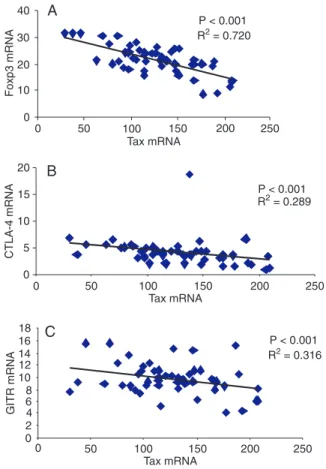
Regression analyses were performed on data from HAM/ TSP patients to evaluate the possible correlation between Taxand Foxp3, CTLA-4 and GITR mRNA (Figure 1). A strong
negative association was found between Taxand Foxp3, which fitted a linear model equation: Foxp3 mRNA = 32.549 - 0.0888 x mRNA Tax, with P < 0.001 (Figure 1A). Tax had a negative linear regression with CTLA-4 according to the following equation: CTLA-4 mRNA = 6.1954 - 0.0168 x Tax mRNA (Figure 1B). An inverse association between Tax and GITR mRNA fitted the following linear regression equation: GITR mRNA = 12.133 - 0.019 x Tax mRNA (Figure 1C). On the other hand, no correlation was detected between Tax and TGF-β or IL-10 mRNA (data not shown).
Correlation between patients and controls regarding Foxp3, CTLA-4 and GITR mRNA
Both groups showed linear correlations between Foxp3 and CTLA-4. Figure 2 shows the positive regression curve
Figure 1. Correlation of Tax mRNA expression in CD4+CD25+ T cells from HAM/TSP patients with those of three genes. Tax, Foxp3, CTLA-4, and GITR mRNA levels were measured in 50 Chilean HAM/TSP patients. A, Correlation between Tax and Foxp3 mRNA levels; B, correlation between Tax and CTLA-4 mRNA levels; C, correlation between Tax and GITR mRNA levels. Correlation was calculated by the Pearson method. HAM/TSP = human T-lymphotropic virus type 1 (HTLV-1)-associated myel
-opathy/tropical spastic paraparesis. Data are reported as Tax, Foxp3, CTLA-4, and GITR RNA copy numbers/100 CD4+CD25+ T cells.
Table 1. Tax, Foxp3, TGF-β, IL-10, GITR, and CTLA-4 mRNA
expression in CD4+CD25+ T cells from HAM/TSP patients and non-infected controls.
HAM/TSP (N = 50) Non-infected control (N = 23)
Tax 124.35 ± 40.17 0
Foxp3 22.07 ± 0.7836* 47.15 ± 12.94
TGF-β 1.92 ± 0.1231 1.83 ± 0.1205
IL-10 2.38 ± 0.1132 2.51 ± 0.1703
GITR 9.63 ± 0.3611* 22.14 ± 1.907
CTLA-4 4.54 ± 0.3908* 21.07 ± 2.311
1112 E. Ramirez et al.
exhibited by HAM/TSP data, with a lower slope than that exhibited by non-infected controls. This means that patients had a smaller CTLA-4 increase with the same Foxp3 varia
-tion than controls. For both patients and controls, linear
model equations were obtained, illustrating relationships of Foxp3 vs GITR mRNA, and GITR vs CTLA-4 mRNA (data
not shown). The regression curves for patients exhibited lower slopes than those for controls. Foxp3, CTLA-4 and GITR mRNA did not correlate with TGF-β or IL-10 mRNA in either group.
Tax and Foxp3 mRNA levels in T cells of HAM/TSP patients with varying severity of disease
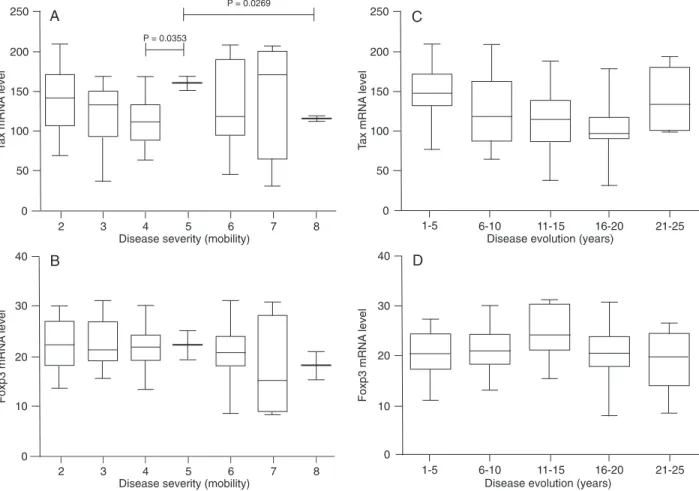
The level of Tax mRNA did not correlate with the se
-verity of disease in HAM/TSP patients (Figure 3A). No statistically significant difference was detected between Tax level and most degrees of disease severity (Figure 3A). Significant differences were detected between patients
Figure 2. Correlation between Foxp3 and CTLA-4 expression
in CD4+CD25+ T cells from 50 HAM/TSP patients. Correlation was calculated by the Pearson method. HAM/TSP = human T-lymphotropic virus type 1 (HTLV-1)-associated myelopathy/tropi
-cal spastic paraparesis. Data are reported as Foxp3 and CTLA-4 RNA copy numbers/100 CD4+CD25+ T cells.
with efficient spastic gait with support (stage 4) and those with inefficient spastic gait without support (stage 5). In addition, significant differences were found in T cells of patients with inefficient spastic gait without support (stage 5) and bedridden patients with global difficulty (stage 8). Similarly, Foxp3 mRNA levels did not change in any of the six clinical stages of HAM/TSP patients (Figure 3B). No association between Tax or Foxp3 mRNA levels and disease evolution was detected, since Tax and Foxp3 mRNA expressions were not significantly different in T cells of HAM/TSP patients with 5, 10, or 20 years of disease (Figure 3C and D, respectively).
Discussion
The decrease of Foxp3, which plays a key role in Treg deregulation, could cause a loss of Treg suppressive ability (25,26). In T cells ofHAM/TSP patients, this phenomenon has been suggested to be an important mechanism of viral pathogenesis (27). Within the context of HTLV-I, the fre
-quency of non-infected CD4+CD25+ Treg lymphocytes can
be an important marker of the efficiency of T cell-mediated immune control (10). The transfection of the HTLV-1 tax
gene into purified CD4+CD25+ T cells from non-infected
healthy donors caused a decrease in Foxp3 expression. Thus, in T cells ofHAM/TSP patients, Tax transactivation might be associated with a Foxp3 reduction both in mRNA expression and protein synthesis (9). Despite the cardinal role of lymphocytes in controlling the immune response, the molecular mechanisms involved in the interaction between Foxp3 and Tax remain unknown.
The suppression exerted by Treg lymphocytesmight be mediated by soluble factors acting both at long and short distances. Cytokines such as IL-10 and TGF-β have been related to the development of HAM/TSP (28). The levels of TGF-β receptor II (TGF-βRII) as well as Smad7 (a TGF-β-inducible gene) could be reduced in CD4+ T cells of HAM/TSP patients compared with healthy
donors (16). Moreover, the TGF-βRII expression would be inversely correlated with HTLV-1 proviral load (16). These observations suggest that dysregulation of TGF-β signaling and silencing of downstream TGF-β-responsive genes, including Foxp3, could be involved in the patho
-genesis of HAM/TSP. However, other studies have found no correlation of IL-10 and TGF-β1 mRNA with Foxp3 levels, or their correlation with HTLV-1-infected cell lysis (10). CD4+Foxp3+ cells probably exert their regulatory
effect on HTLV-1-specific CD8(+) T cells by a cell contact
mechanism, with or without the involvement of cytokines. Our findings suggest that IL-10 and TGF-β have little in
-volvement in the progression of HAM/TSP since TGF-β and IL-10 mRNA values are similar in T cells of both HAM/ TSP patients and controls (Table 1).
A direct correlation between the progression of HAM/
TSP and both proviral load and Tax mRNA levels has been reported (7). High levels of proviral DNA or Tax mRNA have been detected in patients with important neurologi
-cal involvement when compared to asymptomatic carriers (10,29,30). Tax mRNA has been suggested to be a predic
-tor of HAM/TSP progression (7). However, no correlation was recently found between Tax mRNA and disease se
-verity in Japanese patients (31). In the HAM/TSP patients studied here, we found a variability in Tax mRNA, which prevented us from demonstrating a correlation between this parameter and the progression or duration of disease. Similarly, other researchers have found highly variable Tax RNA levels in the T cells of these patients. Japanese and American investigators have found 39.3 and 100% Tax mRNA in all patients analyzed, respectively (7,31). These discrepancies could be attributed to host genetic and virological factors, such as HLA haplotypes, quantity of soluble suppressive proteins, CD8+ T-cell responses, and
Tax genomic sequences (32). In our study, we detected Tax mRNA in all HAM/TSP patients. This suggests that the presence of Tax rather than its amount is required for the maintenance of HAM/TSP. We found a highly signifi
-cant negative association between Tax and Foxp3 in the T cells of HAM/TSP patients. Foxp3 mRNA in HAM/TSP patients was lower than in non-infected controls (Table 1), in agreement with data reported by other investiga
-tors (10,27).
In addition, we detected a direct correlation between the levels of Foxp3, CTLA-4 and GITR. To our knowledge, this finding has not been reported before. These results suggest a probable suppressive mechanism mediated by cell-to-cell interactions. According to a previous report, the expression of inhibitory molecules in the Treg cell membrane, such as CTLA-4, could be significant in the suppressive effect of Tregs(25). CTLA-4 has been shown to trigger the induction of the activation of indoleamine 2,3-dioxygenase (IDO) when it interacts with its ligands in dendritic cells (33). IDO catalyzes the conversion of tryptophan to kynurenine and other metabolites, which have potent immunosuppressive effects on the local en
-vironment of dendritic cells.
Undoubtedly, our findings need further in-depth stud
-ies, ideally monitoring the patient’s condition with serial samples to assess the temporal dynamics of Foxp3 mRNA. Additionally, we believe that variations in Foxp3 mRNA levels could be an important molecular marker for the assessment of the progression of HAM/TSP.
Acknowledgments
We would like to thank Mr. Claudio Telha for a criti
-cal reading of the manuscript. Research supported by Fondecyt #1080396 from the Comisión Nacional de Inves
1114 E. Ramirez et al.
1. Gessain A, Barin F, Vernant JC, Gout O, Maurs L, Calender A, et al. Antibodies to human T-lymphotropic virus type-I in patients with tropical spastic paraparesis. Lancet 1985; 2:
407-410.
2. Osame M, Usuku K, Izumo S, Ijichi N, Amitani H, Igata A, et al. HTLV-I associated myelopathy, a new clinical entity. Lancet 1986; 1: 1031-1032.
3. Yoshida M, Miyoshi I, Hinuma Y. Isolation and characteriza
-tion of retrovirus from cell lines of human adult T-cell leuke
-mia and its implication in the disease. Proc Natl Acad Sci U S A 1982; 79: 2031-2035.
4. Cartier LM, Cea JG, Vergara C, Araya F, Born P. Clinical and neuropathological study of six patients with spastic parapa
-resis associated with HTLV-I: an axomyelinic degeneration of the central nervous system. J Neuropathol Exp Neurol 1997; 56: 403-413.
5. Grassmann R, Aboud M, Jeang KT. Molecular mechanisms of cellular transformation by HTLV-1 Tax. Oncogene 2005; 24: 5976-5985.
6. Jeang KT. Functional activities of the human T-cell leukemia virus type I Tax oncoprotein: cellular signaling through NF-kappa B. Cytokine Growth Factor Rev 2001; 12: 207-217. 7. Yamano Y, Nagai M, Brennan M, Mora CA, Soldan SS,
Tomaru U, et al. Correlation of human T-cell lymphotropic virus type 1 (HTLV-1) mRNA with proviral DNA load, virus-specific CD8+ T cells, and disease severity in HTLV-1-asso -ciated myelopathy (HAM/TSP). Blood 2002; 99: 88-94. 8. Ramirez E, Cartier L, Torres M, Barria M. Temporal dynamics
of human T-lymphotropic virus type I tax mRNA and proviral DNA load in peripheral blood mononuclear cells of human T-lymphotropic virus type I-associated myelopathy patients. J Med Virol 2007; 79: 782-790.
9. Yamano Y, Takenouchi N, Li HC, Tomaru U, Yao K, Grant CW, et al. Virus-induced dysfunction of CD4+CD25+ T cells in patients with HTLV-I-associated neuroimmunological
disease. J Clin Invest 2005; 115: 1361-1368.
10. Toulza F, Heaps A, Tanaka Y, Taylor GP, Bangham CR. High frequency of CD4+FoxP3+ cells in HTLV-1 infection: inverse correlation with HTLV-1-specific CTL response. Blood 2008;
111: 5047-5053.
11. Balandina A, Lecart S, Dartevelle P, Saoudi A, Berrih-Aknin S. Functional defect of regulatory CD4(+)CD25+ T cells in the thymus of patients with autoimmune myasthenia gravis. Blood 2005; 105: 735-741.
12. Lindley S, Dayan CM, Bishop A, Roep BO, Peakman M, Tree TI. Defective suppressor function in CD4(+)CD25(+) T-cells from patients with type 1 diabetes. Diabetes 2005; 54:
92-99.
13. Viglietta V, Baecher-Allan C, Weiner HL, Hafler DA. Loss of functional suppression by CD4+CD25+ regulatory T cells in patients with multiple sclerosis. J Exp Med 2004; 199:
971-979.
14. Fantini MC, Becker C, Monteleone G, Pallone F, Galle PR, Neurath MF. Cutting edge: TGF-beta induces a regulatory phenotype in CD4+. J Immunol 2004; 172: 5149-5153. 15. Marie JC, Letterio JJ, Gavin M, Rudensky AY. TGF-beta1
maintains suppressor function and Foxp3 expression in CD4+CD25+ regulatory T cells. J Exp Med 2005; 201: 1061-1067.
16. Grant C, Oh U, Yao K, Yamano Y, Jacobson S. Dysregula
-tion of TGF-beta signaling and regulatory and effector T-cell function in virus-induced neuroinflammatory disease. Blood 2008; 111: 5601-5609.
17. Nagai M, Ijichi S, Hall WW, Osame M. Differential effect of TGF-beta 1 on the in vitro activation of HTLV-I and the pro
-liferative response of CD8+ T lymphocytes in patients with HTLV-I-associated myelopathy (HAM/TSP). Clin Immunol Immunopathol 1995; 77: 324-331.
18. Ramirez E, Cartier L, Flores R. In vitro cytoskeleton changes of mouse neurons induced by purified HTLV-1, and PBMC from HAM/TSP patients and HTLV-1 carriers. Arch Virol 2004; 149: 2307-2317.
19. De Castro-Costa CM, Araujo AQ, Barreto MM, Takayanagui OM, Sohler MP, da Silva EL, et al. Proposal for diagnostic criteria of tropical spastic paraparesis/HTLV-I-associated myelopathy (TSP/HAM). AIDS Res Hum Retroviruses 2006;
22: 931-935.
20. Castillo JL, Cea JG, Verdugo RJ, Cartier L. Sensory dys
-function in HTLV-I-associated myelopathy/tropical spastic paraparesis. A comprehensive neurophysiological study. Eur Neurol 1999; 42: 17-22.
21. Cartier L. Progressive spastic paraparesis associated to HTLV-I in Chile. Rev Chil Neuro-Psiquiatria 2009; 47: 50-66.
22. Boeuf P, Vigan-Womas I, Jublot D, Loizon S, Barale JC, Akanmori BD, et al. CyProQuant-PCR: a real time RT-PCR technique for profiling human cytokines, based on external RNA standards, readily automatable for clinical use. BMC Immunol 2005; 6: 5.
23. Schaub B, Campo M, He H, Perkins D, Gillman MW, Gold DR, et al. Neonatal immune responses to TLR2 stimulation: influence of maternal atopy on Foxp3 and IL-10 expression. Respir Res 2006; 7: 40.
24. Specht K, Richter T, Muller U, Walch A, Werner M, Hofler H. Quantitative gene expression analysis in microdissected archival formalin-fixed and paraffin-embedded tumor tissue. Am J Pathol 2001; 158: 419-429.
25. Fehervari Z, Sakaguchi S. CD4+ Tregs and immune control. J Clin Invest 2004; 114: 1209-1217.
26. Wu Y, Borde M, Heissmeyer V, Feuerer M, Lapan AD, Stroud JC, et al. FOXP3 controls regulatory T cell function through cooperation with NFAT. Cell 2006; 126: 375-387.
27. Oh U, Grant C, Griffith C, Fugo K, Takenouchi N, Jacobson S. Reduced Foxp3 protein expression is associated with inflammatory disease during human T lymphotropic virus type 1 infection. J Infect Dis 2006; 193: 1557-1566. 28. Tendler CL, Greenberg SJ, Burton JD, Danielpour D, Kim SJ,
Blattner WA, et al. Cytokine induction in HTLV-I associated myelopathy and adult T-cell leukemia: alternate molecular mechanisms underlying retroviral pathogenesis. J Cell Bio-chem 1991; 46: 302-311.
29. Nagai M, Kubota R, Greten TF, Schneck JP, Leist TP, Jacob
-son S. Increased activated human T cell lymphotropic virus type I (HTLV-I) Tax11-19-specific memory and effector CD8+ cells in patients with HTLV-I-associated myelopathy/tropical spastic paraparesis: correlation with HTLV-I provirus load. J Infect Dis 2001; 183: 197-205.
30. Takenouchi N, Yamano Y, Usuku K, Osame M, Izumo S.
Usefulness of proviral load measurement for monitoring of disease activity in individual patients with human T-lympho
-tropic virus type I-associated myelopathy/-tropical spastic paraparesis. J Neurovirol 2003; 9: 29-35.
31. Saito M, Matsuzaki T, Satou Y, Yasunaga J, Saito K, Arimura K, et al. In vivo expression of the HBZ gene of HTLV-1 cor
-relates with proviral load, inflammatory markers and disease severity in HTLV-1 associated myelopathy/tropical spastic paraparesis (HAM/TSP). Retrovirology 2009; 6: 19.
32. Furukawa Y, Yamashita M, Usuku K, Izumo S, Nakagawa M, Osame M. Phylogenetic subgroups of human T cell lymphotropic virus (HTLV) type I in the tax gene and their association with different risks for HTLV-I-associated myelopathy/tropical spastic paraparesis. J Infect Dis 2000;
182: 1343-1349.