Article
Immunoinformatics Features Linked to
Leishmania
Vaccine Development: Data Integration of
Experimental and In Silico Studies
Rory C. F. Brito1,2, Frederico G. Guimarães3, João P. L. Velloso3, Rodrigo Corrêa-Oliveira4,5, Jeronimo C. Ruiz3,6, Alexandre B. Reis1,2,5,* and Daniela M. Resende3,6
1 Laboratório de Pesquisas Clínicas, Programa de Pós-graduação em Ciências Farmacêuticas/CiPharma,
Escola de Farmácia, Campus Morro do Cruzeiro, Universidade Federal de Ouro Preto, Bauxita, 35.400-000 Ouro Preto, Minas Gerais, Brazil; [email protected]
2 Laboratório de Imunopatologia, Núcleo de Pesquisas em Ciências Biológicas, Campus Morro do Cruzeiro,
Universidade Federal de Ouro Preto, Bauxita, 35.400-000 Ouro Preto, Minas Gerais, Brazil
3 Grupo Informática de Biossistemas e Genômica, Programa de Pós-graduação em Ciências da Saúde,
Centro de Pesquisas René Rachou, Fiocruz Minas, Av. Augusto de Lima, 1715, Barro Preto, 30.190-002 Belo Horizonte, Minas Gerais, Brazil; [email protected] (F.G.G.);
[email protected] (J.P.L.V.); [email protected] (J.C.R.); [email protected] (D.M.R.)
4 Grupo Imunologia Celular e Molecular, Programa de Pós-graduação em Ciências da
Saúde, Centro de Pesquisas René Rachou, Fiocruz Minas, Av. Augusto de Lima, 1715, Barro Preto, 30.190-002 Belo Horizonte, Minas Gerais, Brazil; [email protected]
5 Instituto Nacional de Ciência e Tecnologia em Doenças Tropicais (INCT-DT), Campus Morro do Cruzeiro,
Universidade Federal de Ouro Preto, Bauxita, 35.400-000 Ouro Preto, Minas Gerais, Brazil
6 Programa de Pós-graduação em Biologia Computacional e Sistemas, Instituto Oswaldo Cruz, Fiocruz,
Av. Brasil, 4.365, Pavilhão Arthur Neiva, Manguinhos, 21.040-360 Rio de Janeiro, Rio de Janeiro, Brazil
* Correspondence: [email protected]; Tel.: +55-31-3559-1694
Academic Editor: Christopher Woelk
Received: 28 December 2016; Accepted: 3 February 2017; Published: 10 February 2017
Abstract: Leishmaniasis is a wide-spectrum disease caused by parasites fromLeishmania genus. There is no human vaccine available and it is considered by many studies as apotential effective tool for disease control. To discover novel antigens, computational programs have been used in reverse vaccinology strategies. In this work, we developed a validation antigen approach that integrates prediction of B and T cell epitopes, analysis of Protein-Protein Interaction (PPI) networks and metabolic pathways. We selected twenty candidate proteins fromLeishmaniatested in murine model, with experimental outcome published in the literature. The predictions for CD4+and CD8+T cell epitopes were correlated with protection in experimental outcomes. We also mapped immunogenic proteins on PPI networks in order to find Kyoto Encyclopedia of Genes and Genomes (KEGG) pathways associated with them. Our results suggest that non-protective antigens have lowest frequency of predicted T CD4+and T CD8+epitopes, compared with protective ones. T CD4+and T CD8+cells are more related to leishmaniasis protection in experimental outcomes than B cell predicted
epitopes. Considering KEGG analysis, the proteins considered protective are connected to nodes with few pathways, including those associated with ribosome biosynthesis and purine metabolism.
Keywords:immunoinformatics; epitope prediction; pathways; protein–protein interaction networks; reverse vaccinology; leishmaniasis
1. Introduction
Leishmaniasis is a wide-spectrum disease caused by parasites fromLeishmania genus. It is prevalent in Americas, Europe, Africa and Asia. Overall, human infection is caused by at least 20
species whose vectors are phlebotomine sandflies [1]. Although being considered by many studies one of the best possible alternatives for this disease control, there is no human vaccine available [2].
In the advent of reverse vaccinology, in the latest years, a great effort has been made by bioinformaticians in order to provide epitopes predictors programs. Currently, it is possible to scan entire genomes searching for immunogenic epitopes and then select promising proteins for vaccine development. The bottleneck in this workflow analysis is the validation of predictions for protozoan parasites. Many predictors are available for B cells, T CD4+cells and T CD8+cells epitopes
and subcellular localization. They are valuable in a pre-screening evaluation for vaccine targets and searching for diagnostic markers.
The building of protein-protein interaction (PPI) networks may give some insights to understand the biological role of these targets, and so might be a valuable asset in vaccine development. These networks are constituted by nodes that correspond to proteins, connected by edges, representing the interactions between two connected proteins. With PPI networks, we can have an overview of protein relationships and notice those with high connections (also referred as “hubs”). Hub proteins tend to have essential role in the parasite metabolism and might be good candidates to vaccinal and drug target [3,4].
To supportLeishmaniavaccine research, we developed an approach that integrates prediction of B and T cell epitopes, analysis of PPI networks and metabolic pathways. With the aim of validating this methodology, we selectedLeishmaniaproteins tested as vaccine candidates in murine model, with experimental outcome (EO) published in the literature. After predicting epitopes in the selected proteins using specific computational programs, we correlated the predictions for T CD4+and T CD8+ cells with protection in EO. Finally, we mapped the immunogenic proteins on PPI networks in order to find Kyoto Encyclopedia of Genes and Genomes (KEGG) pathways associated with them.
2. Results
2.1. Leishmania Proteins Dataset Selection
Through the use of text mining technics from Pubmed website that included, but was not restricted to, categorization and entity extraction, we were able to identify and select 20 proteins from six different
Leishmaniaspecies that were used in studies aiming the vaccine development against these parasites. It is important to highlight that, for each one of those proteins, a specific MySQL ID was assigned to link GI accession number and TriTrypDB specific ID. Based on the results published, the EO was categorized into: (a) “no protection” (nine proteins); (b) “partial protection” (five proteins); and (c) “protection” (six proteins). The accession numbers of these proteins are depicted in Table1.
2.2. Epitope and Subcellular Localization Predictions
Table 1.Selected candidate antigens from dermatotropic and visceratropicLeishmaniaspecies to leishmaniasis vaccine development. Proteins in literature tested in mice model were selected randomly.
Leishmania Tropism
Geographic
Area Specie Candidate Antigen Function MySQL ID
NCBI Sequence Acession
Animal
Experimental Outcome Indicative
Reference
Dermatotropic Leishmaniaspecies
New world
L. brazilinensis
Thiol-specific-antioxidant (TSA) Tryparedoxin peroxidase LbrM.15.1080 gi 154334618 mice No protection [5] LeiF Leishmaniaputative eukaryotic initiation factor LbrM.25.0580 gi 154338682 mice No protection [5] LACK Leishmaniahomolog of receptors for activated C-kinase LbrM.28.2950 gi 154340729 mice Partial protection [5]
L. amazonensis
P4 nuclease partial Endonuclease activity A16600 gi 29165287 mice No protection [6] Cysteine proteinase Cysteine-type peptidase activity A22180 gi 30142572 mice Partial protection [7]
HSP20 Heat shock protein A38570 gi 513044555 mice No protection [8]
GP46 Membrane glycoprotein A64110 gi 159321 mice Protection [9]
L. mexicana GP63 Metalloendopeptidase activity LmxM.10.0465 gi 401416782 mice Protection [10]
Old world L. major
LmTSI Stress-induced protein sti1 LmjF.08.1110 gi 68124434 mice Protection [11] GP63 Metalloendopeptidase activity LmjF.10.0470 gi 157865341 mice Protection [12] PSA 2 Promastigote surface antigen protein 2 LmjF.12.1000 gi 68124979 mice No protection [13] TSA Thiol-specific-antioxidant—Tryparedoxin peroxidase LmjF.15.1080 gi 68125473 mice No protection [14]
Histone H1 DNA binding LmjF.27.1190 gi 4008565 mice No protection [15]
LACK Leishmaniahomolog of receptors for activated C-kinase LmjF.28.2740 gi 157872022 mice Partial protection [16]
Viscerotropic Leishmaniaspecies
New world L. infantum
H2A DNA binding LinJ.21.1160 gi 339898105 mice No protection [17]
LiCY1 Peptidylprolyl isomerase LinJ.25.0940 gi 146088699 mice Partial protection [18]
Histone H1 DNA binding LinJ.27.1070 gi 78146500 mice No protection [19]
CPC Cysteine-type peptidase activity LinJ.29.0860 gi 146092987 mice Protection [20] Old world L. donovani NH36 Hydrolase activity LdBPK_181570.1 gi 19697561 mice Partial protection [21]
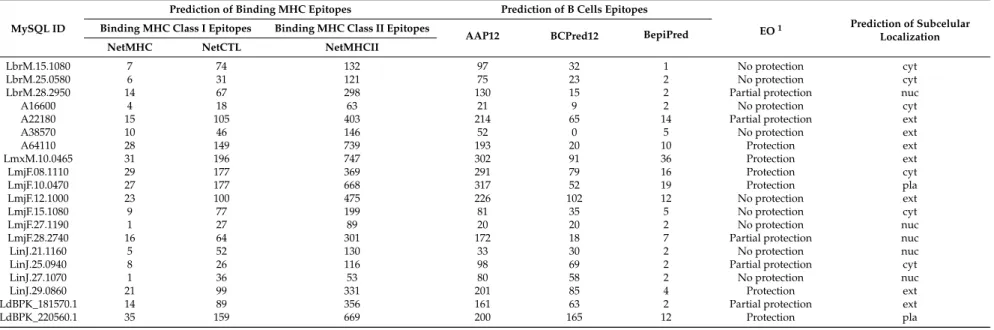
Table 2. Number of binding Major Histocompatibility Complex (MHC) epitopes, B cell epitopes and subcellular localization predicted by different computational programs.
MySQL ID
Prediction of Binding MHC Epitopes Prediction of B Cells Epitopes
EO1 Prediction of Subcelular Localization Binding MHC Class I Epitopes Binding MHC Class II Epitopes
AAP12 BCPred12 BepiPred
NetMHC NetCTL NetMHCII
LbrM.15.1080 7 74 132 97 32 1 No protection cyt
LbrM.25.0580 6 31 121 75 23 2 No protection cyt
LbrM.28.2950 14 67 298 130 15 2 Partial protection nuc
A16600 4 18 63 21 9 2 No protection cyt
A22180 15 105 403 214 65 14 Partial protection ext
A38570 10 46 146 52 0 5 No protection ext
A64110 28 149 739 193 20 10 Protection ext
LmxM.10.0465 31 196 747 302 91 36 Protection ext
LmjF.08.1110 29 177 369 291 79 16 Protection cyt
LmjF.10.0470 27 177 668 317 52 19 Protection pla
LmjF.12.1000 23 100 475 226 102 12 No protection ext
LmjF.15.1080 9 77 199 81 35 5 No protection cyt
LmjF.27.1190 1 27 89 20 20 2 No protection nuc
LmjF.28.2740 16 64 301 172 18 7 Partial protection nuc
LinJ.21.1160 5 52 130 33 30 2 No protection nuc
LinJ.25.0940 8 26 116 98 69 2 Partial protection cyt
LinJ.27.1070 1 36 53 80 58 2 No protection nuc
LinJ.29.0860 21 99 331 201 85 4 Protection ext
LdBPK_181570.1 14 89 356 161 63 2 Partial protection ext
LdBPK_220560.1 35 159 669 200 165 12 Protection pla
Specifically regarding the epitopes capacity to bind MHC class I, MHC class II and epitopes for B cell activation, considering a path from “no protection” to “protection” groups, a gradual increase of the number of predicted epitopes for T cells and B cells was observed.
2.3. Predicted Epitopes and Experimental Outcome Correlation
To evaluate the possible association between the number of predicted epitopes (NPE) for B and T cells, and the EO of selected proteins, the following consensus predictions were produced: (a) prediction for T CD8+epitopes obtained from NetMHC and NetCTL; and (b) prediction for B cell epitopes obtained from AAP12, BCPred12 and BepiPred. The consensus predictions were obtained overlapping identical predictions made by different methodologies.
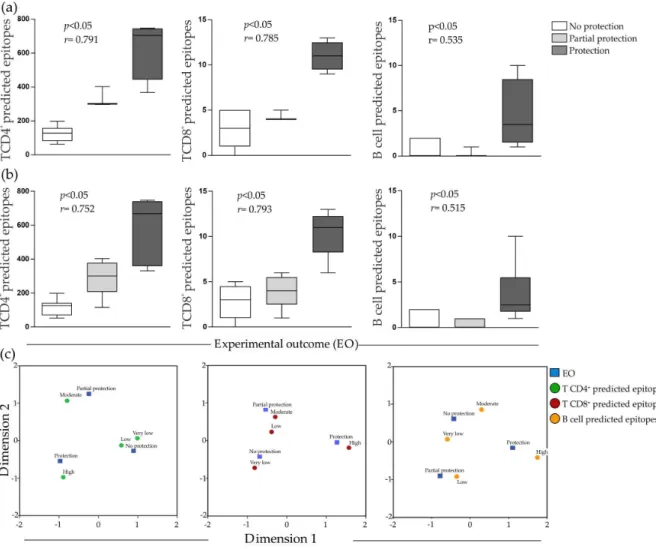
To graphically depict the results, Box Plots and Correspondence Maps (CM) approaches were applied to visualize the potential associations determined through Spearman r and Chi-square distance, respectively. Firstly, the disease (leishmaniasis) was stratified into cutaneous leishmaniasis (CL) and visceral leishmaniasis (VL) and the EO of antigens from Leishmania that cause CL and VL were correlated with NPE (Figure1a). Regarding VL analyses, significant correlation was observed only with EO and predicted epitopes for CD8+T cells (p< 0.05) (data not shown). On the other hand, for CL analyses, it was observed significant correlation between EO and NPE for T CD4+, T CD8+and
B cells, as shown in Figure1a. After that, analyses were performed concerning the disease without any stratification. As can be observed from Figure1b (NPE and EO correlation for T CD4+, T CD8+ and B cells), a significant correlation exists between NPE specific to CD4+ and CD8+ T cells with
r= 0.752/p< 0.05 andr= 0.793/p< 0.05. In addition, a weak association with B cell predicted epitopes (r= 0.515/p< 0.05) was observed. In other words, non-protective antigens have lowest frequency of predicted T CD4+and T CD8+epitopes, compared with protective ones.In regards to CM analysis (Figure1c), considering the adopted variables (antigens EO versus NPE for T and B cells), the grouping outcome, which is related with data correlation, shows the same strong association above mentioned for leishmaniasis with no stratification.
As the last analysis layer used to validate data correlation, the Chi-square results confirmed the significant association between EO and the predicted epitopes for T CD4+and T CD8+,p< 0.05 (Tables S1 and S2) and the weak one between EO and predicted epitopes for B cells (p< 0.05, see Table S3).
2.4. Number of Alleles (NA) and Experimental Outcome (EO) Correlation
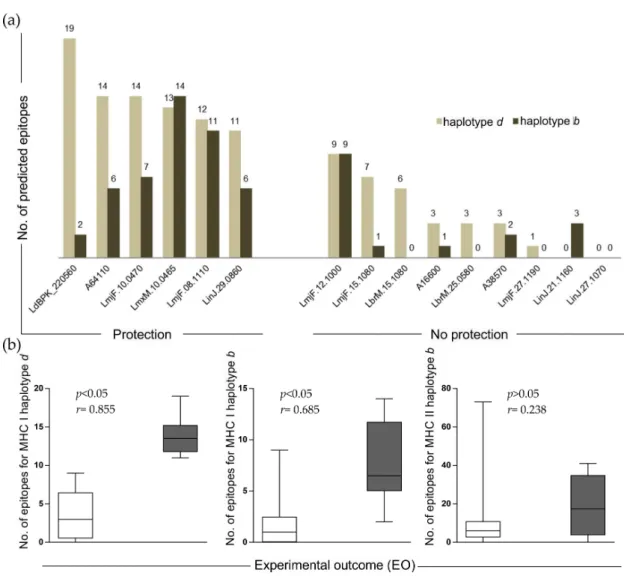
To hypothesize possible reasons linked with vaccine success or failure, an evaluation of allele-specific affinity (MHC I and II) was investigated. As illustrated in Figure2a, the amounts of epitopes binding MHC haplotyped(BALB/c MHC alleles) and haplotypebbinders (C57BL/6 MHC alleles) identified in the “protection” group were superior to those ones identified in the “no protection” group. In summary, our results indicate that epitopes for MHC class I and II haplotypeb
Figure 1.Correlation analysis: (a) Box plots of the relationships between T CD4+, T CD8+and B cell epitopes and experimental outcome of candidate antigens taking into account cutaneous leishmaniasis (CL); (b) box plots of the relationships between T CD4+, T CD8+and B cell epitopes and experimental outcome of candidate
−
Figure 2.Evaluation of epitopes amount and relationship with experimental outcome: (a) bar graph showing number of epitopes for MHC class I and II (haplotypedandb) in the selected antigens classified in “protection” and “no protection” groups; and (b) box plot of the relationships between CD4+and CD8+T cell epitopes and experimental outcome of candidate antigens.
2.5. Mapping Immunogenic Proteins on Protein-Protein Interaction Networks (PPI Networks)
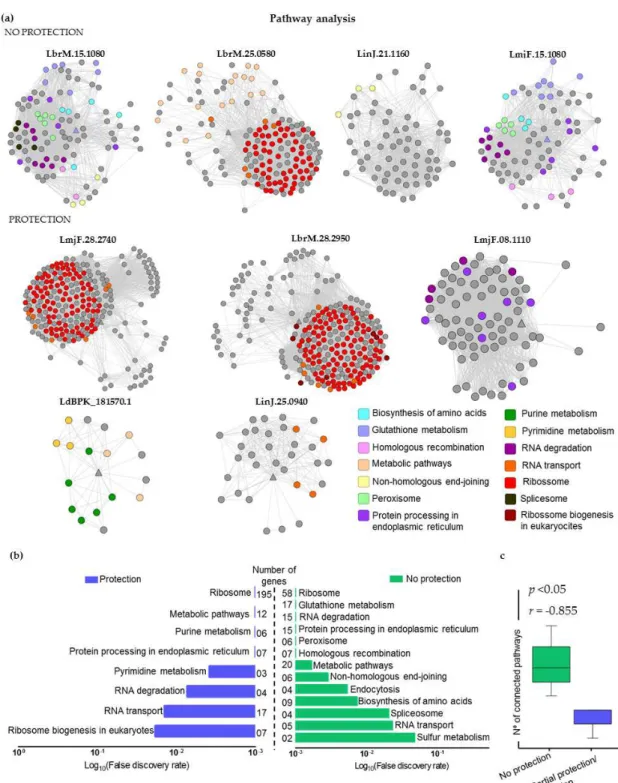
We chose Cytoscape to model PPI networks using data from STRING v.10. Figure3a presents these networks, annotated according to their related KEGG pathways. Analyses of enriched pathways are shown in Figure3b, according to their False Discovery Rate. Considering the “no protection” group, the most common pathways found were: ribosome (58 genes involved), glutathione metabolism (17 genes), RNA degradation (15 genes), protein processing in endoplasmic reticulum (15 genes), peroxisome (sixgenes) and homologous recombination (sevengenes). On the other hand, for “protection” group, we identified pathways as ribosome (195 genes involved), metabolic pathways (12 genes), purine metabolism (sixgenes) and protein processing in endoplasmic reticulum (seven genes). Interestingly, target proteins from “no protection” group are connected with nodes from many different pathways. In contrast, we observed that proteins of the “protection” group are connected to nodes of few pathways. Thus, there is a strong negative correlation (r=−8.55) between the number of connected
3. Discussion
Nowadays, many computational methodologies have been described for epitope predictions of bacterial, fungal and others microorganisms. For protozoan (specificallyLeishmaniaspecies), there are not strong and validated platforms to identify promising antigens forLeishmaniavaccines [23]. Herein, we developed a sturdy and complete platform with potential of identifying candidates for vaccines against leishmaniasis. This platform integrates prediction of B and T cell epitopes, analysis of PPI networks and signaling pathways.
The first step was to select the input antigens to validate the platform. In this concern, we did an extensive search in the literature regarding antigens tested in murine model. It was difficult to categorize the 20 selected antigens for this work because there is a lack of consensus concerning the model, challenge inoculum, mechanisms of protective immunity (response induction, parasite burden reduction), so there is no standardization to appoint if a vaccine indicates protection or not [24]. We tried to choose proteins with no interference of adjuvant since it can entirely modify the antigen response [25].
Regarding the platform validation, we performed the epitope mapping using ad-hoc algorithms. Our results suggest that antigens with more predicted epitopes for T CD4+and T CD8+cells could be associated with protection in EO. In this regard, our results revealed that there are strong correlation and association between predicted epitopes and the EO. The inertia values show the powerful association between the variables. The CM dimension 1 represents the highest inertia allowing the interpretation of the results in the first dimension. T CD4+and T CD8+predicted epitopes versus EO show higher inertia values when compared to B cells predicted epitopes emphasizing that epitopes for CD4+and CD8+T cells are crucial forLeishmaniavaccines success. We used all available human and mouse
alleles to restrict the epitopes allowing enhance the assertive prediction. This analysis is useful to identify conserved epitopes that can bind various alleles of MHC appointing for rare and promising epitopes. The in silico analyses and in vivo validation of epitopes demonstrates that some algorithms may be important tools for the identification of epitopes, and consequently of immunogenic proteins. The algorithm NetCTL version 1.2 makes prediction of peptide–MHC class I binding, proteasomal C terminal cleavage, both using artificial neural networks, and TAP transport efficiency using weight matrix. The tree predictions are then integrated [26]. Another predictor also used for MHC class I binding peptides was NetMHC version 3.0. It predicts binding of peptides to different HLA alleles using artificial neural networks and weight matrices. For peptide–MHC class II binding prediction NetMHCII, version 1.0, was used. It predicts binding of peptides to 14 different HLA-DR alleles, including human and mouse, using position specific weight matrices [27]. To perform B-cell epitopes predictions, we used only methods that predict continuous epitopes. We used first BepiPred, version 1.0, that predicts linear B-cell epitopes using a combination of Hidden Markov model and a propensity scale method [28]. Then we used BCPREDS server comprising the AAP12 and BCPred12 predictors. The first one is based on the finding that B-cell epitopes favor particular amino acid pair, and it was trained using support vector machine classifier. The second uses subsequence kernel trained using support vector machine classifiers with 701 linear B-cell epitopes, extracted from Bcipep database, and 701 non-epitopes, randomly extracted from SwissProt sequences [29–31]. Finally, we used WoLF PSORT predictor, which is an amino acid sequence predictor of subcellular localization sites of proteins. It uses known sorting signal motifs and some correlative sequence features [32]. The integration of these predictors could reveal proteins that are secreted or presented in parasite membrane, capable of eliciting B and T cells responses.
Herrera-Najera et al. [33] performed a large-scale prediction of T cell epitopes in the whole genome ofL. major, obtaining 26 potential epitopes through prediction consensus. Fourteen of them revealed to be immunogenic epitopes that were capable to stimulate T cells to produce IFN-γ. Other studies
epitopes in 63L. braziliensisproteins, demonstrating a cytotoxic activity of some predicted epitopes in
Leishmaniainfected mice. Recently, in silico methods for linear epitope predictions (NetMHC, NetCTL, and NetMHCII) were combined with molecular modeling to identify potential epitopes in the whole
L. braziliensis proteome. Therefore, the pipeline was validated based on stimulation of human peripheral blood mononuclear cells (PBMCs) proliferation. The results obtained after the in vitro assays showed that six of ten selected epitopes could be classified as potentially immunogenic [36].
The role of B cell epitopes still hasroom for discussion since there is no consensus if immunoglobulins could be associated with resistance or susceptibility in leishmaniasis [37,38]. On the other hand, our results demonstrate a correlation between protection and specific B cell epitopes. In this context, we suggest that an effective vaccine should have epitopes capable of eliciting a strong T cell response and B cells too. In addition to the epitopes for B cells and MHC class I and II, another important feature is the subcellular localization of the antigen. It is known that extracellularLeishmania
proteins are more immunogenic and considered better targets for vaccine development [39,40]. This fact is indeed corroborated by our findings that show the majority of the antigens from “protection group” are linked with extracellular compartmentalization. In silico approaches have limitations regarding the proteome annotation (e.g., the data ofL. amazonensisused in this work) and the large number of linear epitopes. Nevertheless, our results of epitope prediction indicate a higher assertive and successful prediction, so it can be a useful approach for vaccine development against leishmaniasis.
To better understand the biological importance of vaccine candidates, we proposed the use of PPI networks enriched with KEGG pathways information. It is well known that some proteins are essential for specific biological processes ofLeishmaniaspp. [41,42]. In this context, we proposed to analyze antigen pathways through modeled PPI and its relation with protection and no protection of vaccine candidates after challenging with infectiveLeishmaniaparasites. Our analyses showed that many of the selected antigens do not have any KEGG pathway associated to them, but, instead, are connected to proteins that are part of some pathway. Pathways associated with ribosome biosynthesis, purine metabolism and metabolic processes are present in “protection” group networks. Ribosome related proteins were considered relevant molecules during infection, since in some circumstances they can modulate cell activities and cytokine release. Many works associated these pathways to immune response [43]. Cordeiro-Da-Silva and collaborators in 2001 characterized aLeishmania majorgene considered to be homologous to the mammalian ribosomal protein S3a. This ribosomal protein can be found in many otherLeishmaniaspecies such asL. infantum,L. amazonensis, andL. mexicana.
The article authors suggested that this protein could participate in the Th1/Th2 immune response balance during leishmaniasis [44]. Soto and collaborators in 1993 using sera from dogs affected by visceral leishmaniasis identified high antigenicLeishmaniaacidic ribosomal proteins, also called P-type proteins [45]. Another work by Soto and collaborators in 2000 showed that intraperitoneal administration in BALB/c mice of the acidic ribosomal protein LiP2a, without adjuvants, elicited a strong humoral response and was capable of stimulating production of IFN-γin cultured splenocytes
from LiP2a-immunized mice [46]. Our findings also match with results obtained in the secretome of
L. donovani, where the majority of virulent proteins (secreted proteins) belong mainly to metabolic and biosynthesis processes [47]. To check the importance of some proteins related to metabolic process,
Leishmaniaknocked-out for protein kinases and phosphatases possible involved in parasite metabolism regulation were generated. After this process, in many cases highly attenuated or completely avirulent parasites could be observed [48]. Naderer and collaborators generated aLeishmania major
mutant lacking the regulatory subunit of the Ca2+/calmodulin-dependent serine/threonine-specific phosphatase. This modifiedLeishmaniagrew normally at 27◦C. However, this parasite lost viability
when exposed to 34◦C [49]. Target of rapamycin (TOR) kinases are involved in some regulatory
McConville and Naderer [48] have shown that metabolic pathways are important to Leishmania
virulence, since down regulation of metabolic genes causes latency of many Leishmania species. One possible application of these attenuated or avirulent parasites could be in whole parasites vaccines. Carter et al. [51] have noticed that purine metabolism is vital forLeishmaniasurvival. Surprisingly, our findings show that proteins associated to protection are connected to few pathways when compared to proteins that are not protective.
In summary, in this work, we proposed and validated a computational approach regarding epitope prediction, topological structure and pathway analyses to drive a rational vaccine design against leishmaniasis.
4. Materials and Methods
4.1. Selection of the Leishmania Antigens
Leishmaniaproteins tested in murine model, with EO published in the literature, were selected. Studies describing vaccine effectiveness after challenge withLeishmaniaspp. were preferentially chosen. Bearing in mind that there is no standardization of the protection concept and that there is variation of results in the literature, it was necessary to create three categories as already described. According to our categorization, “no protection” group includes antigens that promote no or slight reduction of parasite burden or lesions afterLeishmaniachallenge. The “protection” group includes antigens that promoted significantly strong reduction of the parasite burden or lesions showing strong immune response toLeishmaniaantigens. Thus, the term partial protection was used to classify antigens that are between a potential protection and no protection at all. The “partial protection” group comprises proteins that could slightly reduce the parasite burden and/or lesions more than “no protection” group. In addition, these proteins can elicit some immune response which results in ineffective protection. It is important to highlight that the influence of adjuvants was not taken into account for the categorization, thus only the response of antigens tested alone was chosen to categorize the groups. Twenty candidates from Old and New WorldLeishmaniaspecies were categorized according with their experimental results in the following groups: (a) “no protection”; (b) “partial protection”; and (c) “protection”. The selected experimentally validated data included information from proteins of L. amazonensis,
L. braziliensis,L. major,L. mexicana,L. donovaniandL. infantumthat were subsequently used in this study to corroborate the in silico bioinformatics predictions. The selected antigens are described in Table1.
4.2. Leishmania Proteome Data
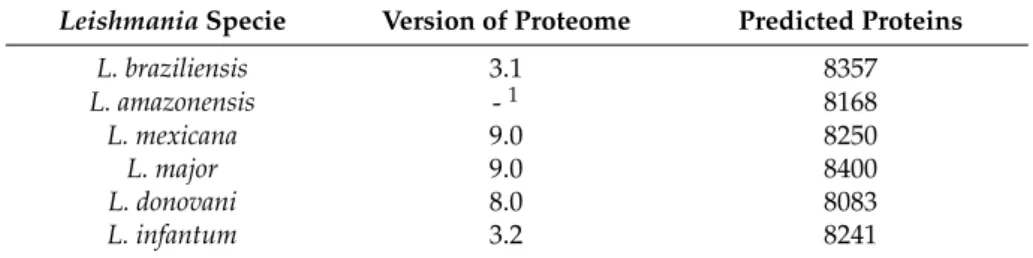
The predicted proteome sequences of dermatotropic and viscerotropicLeishmaniaspecies were obtained from TriTrypDB (Kinetoplastid Genomics Resource) and the sequence ofL. amazonensiswas downloaded from http://bioinfo08.ibi.unicamp.br/leishmania/ [52]. Detailed information about the predicted proteomes versions used in this work can be found in Table3.
Table 3. Leishmaniapredicted proteomes used in the study. The version and number of predicted proteins of each species are shown.
LeishmaniaSpecie Version of Proteome Predicted Proteins
L. braziliensis 3.1 8357
L. amazonensis -1 8168
L. mexicana 9.0 8250
L. major 9.0 8400
L. donovani 8.0 8083
L. infantum 3.2 8241
4.3. Epitope and Subcellular Localization Predictions
All proteomic data used in this work were screened in order to predict T CD4+ and T CD8+ epitopes, B cell epitopes and subcellular localization of proteins.
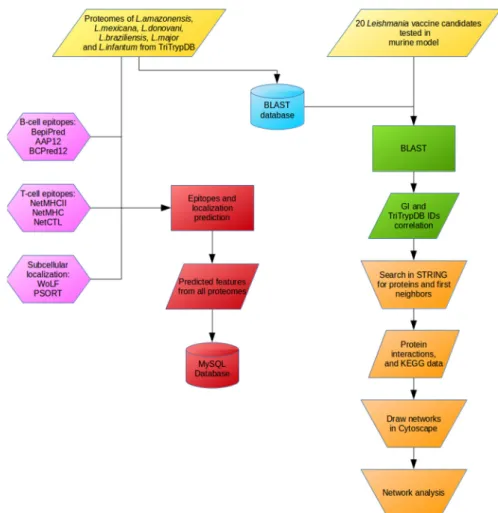
For T CD8+epitope prediction (MHC class I binding epitopes), algorithms NetCTL [26,53,54] and NetMHC [55–57] were used. Regarding T CD4+epitopes, NetMHCII [27,58] was used to predict MHC class II binding epitopes. For B cell epitopes, BepiPred [28] and BCPREDS (AAP12 and BCPred12 models) [29–31] were used to predict epitopes. Finally, the protein subcellular localization was predicted using WoLF PSORT [32,55–57]. The algorithms choice was made taking into account their viability for local stand-alone server installation, the number of citations found in literature, and the results previously published by Resende, Rezende, Oliveira, Batista, Correa-Oliveira, Reis and Ruiz [23] describing algorithms specificity, sensitivity and accuracy with parasite data obtained from UniProt (http://www.uniprot.org/) and IEDB (Immune Epitope Database and Analysis Resourse) (http://www.iedb.org/). The analytical workflow used in this study is presented in Figure4.
Figure 4.Workflow of analysis showing the steps followed along this work.
HLA-DRB1*13:02, HLA-DRB1*15:01, HLA-DRB3*01:01, HLA-DRB4*01:01, HLA-DRB5*01:01, H2-IAs, H2-IAd and H2-IAb.
4.4. Development of Relational Database
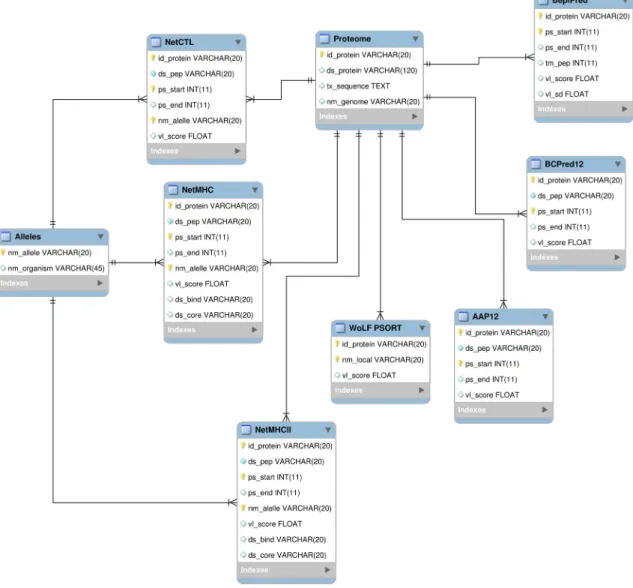
Taking into account the great amount of data generated by the algorithms, we constructed a relational database using MySQL as Relational Database Management System (RDBMS) (http://www.mysql.com). The use of a database system in this work represents a crucial step that allows the integration of the results from all predictors and a way of getting a data receptacle or conceptual repository from which is possible to extract data correlation, helping in the identification of target proteins. The MySQL GUI Tools (http://dev.mysql.com/downloads/gui-tools/5.0.html) were used as a graphical user interface for our MySQL database. The relational model was built in MySQL Workbench (http://wb.mysql.com). To extract, parse and load data into database, specific Perl scripts were developed using DBI (the Perl interface to databases) and BioPerl modules. The relational schema is presented in Figure5.
Figure 5.MySQL relational database scheme developed to integrate data from predictions.
4.5. Mapping Immunogenic Proteins on Protein-Protein Interaction Networks (PPI Networks)
We entered these proteins into STRING v.10 [59] looking for interaction networks associated with them, usingLeishmaniaas reference organism. The active interaction sources used were text mining, experiments, database, co-expression, neighborhood, gene fusion and co-occurrence, with medium confidence score (0.400). The networks were built using the target proteins as central nodes and expanding them with the first neighbors, using 500 as maximum value of interactions. From STRING, we obtained the PPI network data and KEGG [60] pathway functional enrichments (p< 0.05) of proteins involved in these networks. Then we built the protein networks using Cytoscape [61], adding KEGG information over them.
4.6. Statistical Analysis
The analyses were performed using SPSS version 20 (SPSS Inc., Chicago, IL, USA). Association coefficients were determined using Spearman two tailed test and correspondence analysis were determined by Chi-squared, statistical significance was considered whenp< 0.05.
5. Conclusions
In this work, we validated a computational approach regarding epitope prediction, topological structure and pathway analyses to drive a rational vaccine design against leishmaniasis, using antigens tested in murine model described in literature. Our results suggest that CD4+and CD8+T cells are more related to leishmaniasis protection in EO than B cells. For a deeper analysis, we also used PPI networks enriched with KEGG pathways information. According to our results, proteins associated to protection are connected to few pathways when compared to proteins classified as “no protection”. In addition, analysis of PPIs and KEGG pathways associated to proteins from “protection” group corroborate the idea already published in the literature that reverse vaccinology approaches are able to identify proteins related to pathogenicity of infectious agents, helping researchers to understand virulence mechanisms and how immune responses from hosts are able to fight them. Obtained results may be helpful in discovering new potential antigens using computational approaches.
Supplementary Materials:Supplementary materials can be found at www.mdpi.com/1422-0067/18/2/371/s1.
Acknowledgments:The authors acknowledge the Brazilian agencies Conselho Nacional de Desenvolvimento Científico e Tecnológico (CNPq) (MCTI/CNPq/CT-BIOTEC-GENOPROT Nº 21/2010 560943/2010-5–Alexandre B. Reis, MCTI/CNPq/CT-BIOTEC Nº 27/2013 402688/2013-9–Alexandre B. Reis, PQ 2015 301526/2015-0–Jeronimo C. Ruiz MCTI/CNPq Nº 14/2015 301652/2015-0–Jeronimo C. Ruiz and MCTI/CNPq Nº 14/2013 486618/2013-7–Jeronimo C. Ruiz), Fundação de Amparo à Pesquisa do Estado de Minas Gerais (FAPEMIG) (PRONEX APQ-01373-14–Alexandre B. Reis, FAPEMIG 01/2013 APQ-01661-13–Jeronimo C. Ruiz and PPM IX 02/2015 PPM-00710-15–Jeronimo C. Ruiz), Coordenação de Aperfeiçoamento de Pessoal de Nível Superior (CAPES), Universidade Federal de Ouro Preto (UFOP) and Fundação Oswaldo Cruz (FIOCRUZ) for financial support. Rory C. F. Brito, Daniela M. Resende and João P. L. Velloso are grateful for CAPES scholarships, Alexandre B. Reis, Rodrigo Corrêa-Oliveira and Jeronimo C. Ruiz are also grateful for CNPq fellowships.
Author Contributions:Rory C. F. Brito participated with ideas and suggestions linked with the development and implementation of the bioinformatics methodology; also involved in the selection of candidate proteins to vaccine development against leishamaniasis in the literature, epitopes and subcelullar localization predictions and formal analysis of the data. Frederico G. Guimarães was responsable for PPI networks construction and analysis, and in mapping KEGG pathways associated to immunogenic proteins in PPI networks. Rory C. F. Brito, Frederico G. Guimarães and João P. L. Velloso participated in drafting the article and/or revising it critically for important intellectual content, and also created the figures. Rodrigo Corrêa-Oliveira, Jeronimo C. Ruiz, Alexandre B. Reis and Daniela M. Resende contributed materials and analysis tools. Jeronimo C. Ruiz and Daniela M. Resende participated in the design of the bioinformatics work. Jeronimo C. Ruiz, Alexandre B. Reis and Daniela M. Resende participated in the study conception, project administration, critical revision of the article, supervision and funding acquisition.
References
1. Peacock, C.S.; Seeger, K.; Harris, D.; Murphy, L.; Ruiz, J.C.; Quail, M.A.; Peters, N.; Adlem, E.; Tivey, A.; Aslett, M.; et al. Comparative genomic analysis of threeLeishmaniaspecies that cause diverse human disease.
Nat. Genet.2007,39, 839–847. [CrossRef] [PubMed]
2. Gillespie, P.M.; Beaumier, C.M.; Strych, U.; Hayward, T.; Hotez, P.J.; Bottazzi, M.E. Status of vaccine research and development of vaccines for leishmaniasis.Vaccine2016,34, 2992–2995. [CrossRef] [PubMed]
3. Rezende, A.M.; Folador, E.L.; Resende, D.M.; Ruiz, J.C. Computational prediction of protein–protein interactions inLeishmaniapredicted proteomes.PLoS ONE2012,7, e51304. [CrossRef] [PubMed]
4. Xu, C.; Ye, B.; Han, Z.; Huang, M.; Zhu, Y. Comparison of transcriptional profiles between CD4+and CD8+T cells in HIV type 1-infected patients.AIDS Res. Hum. Retrovir.2014,30, 134–141. [CrossRef] [PubMed] 5. Salay, G.; Dorta, M.L.; Santos, N.M.; Mortara, R.A.; Brodskyn, C.; Oliveira, C.I.; Barbieri, C.L.;
Rodrigues, M.M. Testing of fourLeishmaniavaccine candidates in a mouse model of infection with Leishmania (Viannia) braziliensis, the main causative agent of cutaneous leishmaniasis in the New World.Clin. Vaccine Immunol. CVI2007,14, 1173–1181. [CrossRef] [PubMed]
6. Campbell, K.; Diao, H.; Ji, J.; Soong, L. DNA immunization with the gene encoding P4 nuclease of Leishmania amazonensis protects mice against cutaneous Leishmaniasis.Infect. Immun.2003,71, 6270–6278. [CrossRef]
[PubMed]
7. Fedeli, C.E.; Ferreira, J.H.; Mussalem, J.S.; Longo-Maugeri, I.M.; Gentil, L.G.; dos Santos, M.R.; Katz, S.; Barbieri, C.L. Partial protective responses induced by a recombinant cysteine proteinase fromLeishmania
(Leishmania) amazonensis in a murine model of cutaneous leishmaniasis.Exp. Parasitol.2010,124, 153–158.
[CrossRef] [PubMed]
8. Montalvo-Alvarez, A.M.; Folgueira, C.; Carrion, J.; Monzote-Fidalgo, L.; Canavate, C.; Requena, J.M. The Leishmania HSP20 is antigenic during natural infections, but, as DNA vaccine, it does not protect BALB/c mice against experimentalL. amazonensisinfection. J. Biomed. Biotechnol. 2008,2008, 695432. [CrossRef]
[PubMed]
9. Champsi, J.; McMahon-Pratt, D. Membrane glycoprotein M-2 protects against Leishmania amazonensis infection.Infect. Immun.1988,56, 3272–3279. [PubMed]
10. Gonzalez, C.R.; Noriega, F.R.; Huerta, S.; Santiago, A.; Vega, M.; Paniagua, J.; Ortiz-Navarrete, V.; Isibasi, A.; Levine, M.M. Immunogenicity of a Salmonella typhi CVD 908 candidate vaccine strain expressing the major surface protein gp63 of Leishmania mexicana mexicana.Vaccine1998,16, 1043–1052. [CrossRef]
11. Mendez, S.; Gurunathan, S.; Kamhawi, S.; Belkaid, Y.; Moga, M.A.; Skeiky, Y.A.; Campos-Neto, A.; Reed, S.; Seder, R.A.; Sacks, D. The potency and durability of DNA- and protein-based vaccines against Leishmania major evaluated using low-dose, intradermal challenge. J. Immunol. 2001, 166, 5122–5128. [CrossRef]
[PubMed]
12. Rivier, D.; Bovay, P.; Shah, R.; Didisheim, S.; Mauel, J. Vaccination against Leishmania major in a CBA mouse model of infection: Role of adjuvants and mechanism of protection. Parasite Immunol. 1999,21, 461–473.
[CrossRef] [PubMed]
13. Sjolander, A.; Baldwin, T.M.; Curtis, J.M.; Bengtsson, K.L.; Handman, E. Vaccination with recombinant Parasite Surface Antigen 2 from Leishmania major induces a Th1 type of immune response but does not protect against infection.Vaccine1998,16, 2077–2084. [CrossRef]
14. Webb, J.R.; Campos-Neto, A.; Ovendale, P.J.; Martin, T.I.; Stromberg, E.J.; Badaro, R.; Reed, S.G. Human and murine immune responses to a novel Leishmania major recombinant protein encoded by members of a multicopy gene family.Infect. Immun.1998,66, 3279–3289. [PubMed]
15. Solioz, N.; Blum-Tirouvanziam, U.; Jacquet, R.; Rafati, S.; Corradin, G.; Mauel, J.; Fasel, N. The protective capacities of histone H1 against experimental murine cutaneous leishmaniasis.Vaccine1999,18, 850–859.
[CrossRef]
16. Soussi, N.; Milon, G.; Colle, J.H.; Mougneau, E.; Glaichenhaus, N.; Goossens, P.L. Listeria monocytogenes as a short-lived delivery system for the induction of type 1 cell-mediated immunity against the p36/LACK antigen of Leishmania major.Infect. Immun.2000,68, 1498–1506. [CrossRef] [PubMed]
18. Santos-Gomes, G.M.; Rodrigues, A.; Teixeira, F.; Carreira, J.; Alexandre-Pires, G.; Carvalho, S.; Santos-Mateus, D.; Martins, C.; Vale-Gato, I.; Marques, C.; et al. Immunization with the Leishmania infantum recombinant cyclophilin protein 1 confers partial protection to subsequent parasite infection and generates specific memory T cells.Vaccine2014,32, 1247–1253. [CrossRef] [PubMed]
19. Agallou, M.; Smirlis, D.; Soteriadou, K.P.; Karagouni, E. Vaccination with Leishmania histone H1-pulsed dendritic cells confers protection in murine visceral leishmaniasis.Vaccine2012,30, 5086–5093. [CrossRef]
[PubMed]
20. Khoshgoo, N.; Zahedifard, F.; Azizi, H.; Taslimi, Y.; Alonso, M.J.; Rafati, S. Cysteine proteinase type III is protective against Leishmania infantum infection in BALB/c mice and highly antigenic in visceral leishmaniasis individuals.Vaccine2008,26, 5822–5829. [CrossRef] [PubMed]
21. Aguilar-Be, I.; da Silva Zardo, R.; Paraguai de Souza, E.; Borja-Cabrera, G.P.; Rosado-Vallado, M.; Mut-Martin, M.; Garcia-Miss Mdel, R.; Palatnik de Sousa, C.B.; Dumonteil, E. Cross-protective efficacy of a prophylactic Leishmania donovani DNA vaccine against visceral and cutaneous murine leishmaniasis.
Infect. Immun.2005,73, 812–819. [CrossRef]
22. Ghosh, A.; Zhang, W.W.; Matlashewski, G. Immunization with A2 protein results in a mixed Th1/Th2 and a humoral response which protects mice against Leishmania donovani infections.Vaccine2001,20, 59–66.
[CrossRef]
23. Resende, D.M.; Rezende, A.M.; Oliveira, N.J.; Batista, I.C.; Correa-Oliveira, R.; Reis, A.B.; Ruiz, J.C. An assessment on epitope prediction methods for protozoa genomes.BMC Bioinform.2012,13, 309. [CrossRef]
[PubMed]
24. Costa, C.H.; Peters, N.C.; Maruyama, S.R.; de Brito, E.C., Jr.; Santos, I.K. Vaccines for the leishmaniases: Proposals for a research agenda.PLoS Negl. Trop. Dis.2011,5, e943.
25. Reed, S.G.; Coler, R.N.; Campos-Neto, A. Development of a leishmaniasis vaccine: The importance of MPL.
Expert Rev. Vaccines2003,2, 239–252. [CrossRef] [PubMed]
26. Larsen, M.V.; Lundegaard, C.; Lamberth, K.; Buus, S.; Lund, O.; Nielsen, M. Large-scale validation of methods for cytotoxic T-lymphocyte epitope prediction.BMC Bioinform.2007,8, 424. [CrossRef] [PubMed] 27. Nielsen, M.; Lundegaard, C.; Lund, O. Prediction of MHC class II binding affinity using SMM-align, a novel
stabilization matrix alignment method.BMC Bioinform.2007,8, 238. [CrossRef] [PubMed]
28. Larsen, J.E.; Lund, O.; Nielsen, M. Improved method for predicting linear B-cell epitopes.Immun. Res.2006,
2, 2. [CrossRef] [PubMed]
29. Chen, J.; Liu, H.; Yang, J.; Chou, K.C. Prediction of linear B-cell epitopes using amino acid pair antigenicity scale.Amino Acids2007,33, 423–428. [CrossRef] [PubMed]
30. El Manzalawy, Y.; Dobbs, D.; Honavar, V. Predicting linear B-cell epitopes using string kernels.
J. Mol. Recognit.2008,21, 243–255. [CrossRef] [PubMed]
31. El Manzalawy, Y.; Dobbs, D.; Honavar, V. Predicting flexible length linear B-cell epitopes. Comput. Syst. Bioinform. Conf.2008,7, 121–132.
32. Horton, P.; Park, K.J.; Obayashi, T.; Fujita, N.; Harada, H.; Adams-Collier, C.J.; Nakai, K. WoLF PSORT: Protein localization predictor.Nucleic Acids Res.2007,35, W585–W587. [CrossRef] [PubMed]
33. Herrera-Najera, C.; Pina-Aguilar, R.; Xacur-Garcia, F.; Ramirez-Sierra, M.J.; Dumonteil, E. Mining the Leishmania genome for novel antigens and vaccine candidates.Proteomics2009,9, 1293–1301. [CrossRef]
[PubMed]
34. Agallou, M.; Athanasiou, E.; Koutsoni, O.; Dotsika, E.; Karagouni, E. Experimental Validation of Multi-Epitope Peptides Including Promising MHC Class I- and II-Restricted Epitopes of Four Known Leishmania infantum Proteins.Front. Immunol.2014,5, 268. [CrossRef] [PubMed]
35. Duarte, A.; Queiroz, A.T.; Tosta, R.; Carvalho, A.M.; Barbosa, C.H.; Bellio, M.; de Oliveira, C.I.; Barral-Netto, M. Prediction of CD8+Epitopes in Leishmania braziliensis Proteins Using EPIBOT: In Silico Search and In Vivo Validation.PLoS ONE2015,10, e0124786. [CrossRef] [PubMed]
36. Freitas e Silva, R.; Ferreira, L.F.; Hernandes, M.Z.; de Brito, M.E.; de Oliveira, B.C.; da Silva, A.A.; de-Melo-Neto, O.P.; Rezende, A.M.; Pereira, V.R. Combination of In Silico Methods in the Search for Potential CD4(+) and CD8(+) T Cell Epitopes in the Proteome of Leishmania braziliensis.Front. Immunol. 2016,7, 327.
38. De Almeida Silva, L.; Romero, H.D.; Prata, A.; Costa, R.T.; Nascimento, E.; Carvalho, S.F.; Rodrigues, V. Immunologic tests in patients after clinical cure of visceral leishmaniasis.Am. J. Trop. Med. Hyg.2006,75, 739–743. [PubMed]
39. Rosa, R.; Marques, C.; Rodrigues, O.R.; Santos-Gomes, G.M. Immunization with Leishmania infantum released proteins confers partial protection against parasite infection with a predominant Th1 specific immune response.Vaccine2007,25, 4525–4532. [CrossRef] [PubMed]
40. Lemesre, J.L.; Holzmuller, P.; Goncalves, R.B.; Bourdoiseau, G.; Hugnet, C.; Cavaleyra, M.; Papierok, G. Long-lasting protection against canine visceral leishmaniasis using the LiESAp-MDP vaccine in endemic areas of France: Double-blind randomised efficacy field trial. Vaccine2007,25, 4223–4234. [CrossRef]
[PubMed]
41. Alcolea, P.J.; Alonso, A.; Sanchez-Gorostiaga, A.; Moreno-Paz, M.; Gomez, M.J.; Ramos, I.; Parro, V.; Larraga, V. Genome-wide analysis reveals increased levels of transcripts related with infectivity in peanut lectin non-agglutinated promastigotes of Leishmania infantum. Genomics2009,93, 551–564. [CrossRef]
[PubMed]
42. Benitez, D.; Medeiros, A.; Fiestas, L.; Panozzo-Zenere, E.A.; Maiwald, F.; Prousis, K.C.; Roussaki, M.; Calogeropoulou, T.; Detsi, A.; Jaeger, T.; et al. Identification of Novel Chemical Scaffolds Inhibiting Trypanothione Synthetase from Pathogenic Trypanosomatids. PLoS Negl. Trop. Dis. 2016,10, e0004617.
[CrossRef] [PubMed]
43. Iborra, S.; Parody, N.; Abanades, D.R.; Bonay, P.; Prates, D.; Novais, F.O.; Barral-Netto, M.; Alonso, C.; Soto, M. Vaccination with the Leishmania major ribosomal proteins plus CpG oligodeoxynucleotides induces protection against experimental cutaneous leishmaniasis in mice.Microb. Inf. Inst. Pasteur2008,10, 1133–1141.
[CrossRef] [PubMed]
44. Cordeiro-Da-Silva, A.; Borges, M.C.; Guilvard, E.; Ouaissi, A. Dual role of the Leishmania major ribosomal protein S3a homologue in regulation of T- and B-cell activation.Infect. Immun.2001,69, 6588–6596. [CrossRef]
[PubMed]
45. Soto, M.; Requena, J.M.; Garcia, M.; Gomez, L.C.; Navarrete, I.; Alonso, C. Genomic organization and expression of two independent gene arrays coding for two antigenic acidic ribosomal proteins of Leishmania.
J. Biol. Chem.1993,268, 21835–21843. [PubMed]
46. Soto, M.; Alonso, C.; Requena, J.M. The Leishmania infantum acidic ribosomal protein LiP2a induces a prominent humoral response in vivo and stimulates cell proliferation in vitro and interferon-gamma (IFN-γ) production by murine splenocytes.Clin. Exp. Immunol.2000,122, 212–218. [CrossRef] [PubMed]
47. Silverman, J.M.; Chan, S.K.; Robinson, D.P.; Dwyer, D.M.; Nandan, D.; Foster, L.J.; Reiner, N.E. Proteomic analysis of the secretome of Leishmania donovani.Genome Biol.2008,9, R35. [CrossRef] [PubMed] 48. McConville, M.J.; Naderer, T. Metabolic pathways required for the intracellular survival of Leishmania.
Annu. Rev. Microbiol.2011,65, 543–561. [CrossRef] [PubMed]
49. Naderer, T.; Dandash, O.; McConville, M.J. Calcineurin is required for Leishmania major stress response pathways and for virulence in the mammalian host.Mol. Microbiol.2011,80, 471–480. [CrossRef] [PubMed] 50. Madeira da Silva, L.; Beverley, S.M. Expansion of the target of rapamycin (TOR) kinase family and function in Leishmania shows that TOR3 is required for acidocalcisome biogenesis and animal infectivity.Proc. Natl. Acad. Sci. USA2010,107, 11965–11970. [CrossRef] [PubMed]
51. Carter, N.S.; Yates, P.; Arendt, C.S.; Boitz, J.M.; Ullman, B. Purine and pyrimidine metabolism in Leishmania.
Adv. Exp. Med. Biol.2008,625, 141–154. [PubMed]
52. Real, F.; Vidal, R.O.; Carazzolle, M.F.; Mondego, J.M.; Costa, G.G.; Herai, R.H.; Wurtele, M.; de Carvalho, L.M.; Carmona e Ferreira, R.; Mortara, R.A.; et al. The genome sequence ofLeishmania(Leishmania)amazonensis: Functional annotation and extended analysis of gene models. DNA Res. 2013,20, 567–581. [CrossRef]
[PubMed]
53. Peters, B.; Bulik, S.; Tampe, R.; Van Endert, P.M.; Holzhutter, H.G. Identifying MHC class I epitopes by predicting the TAP transport efficiency of epitope precursors.J. Immunol.2003,171, 1741–1749. [CrossRef]
[PubMed]
55. Buus, S.; Lauemoller, S.L.; Worning, P.; Kesmir, C.; Frimurer, T.; Corbet, S.; Fomsgaard, A.; Hilden, J.; Holm, A.; Brunak, S. Sensitive quantitative predictions of peptide-MHC binding by a ‘Query by Committee’ artificial neural network approach.Tissue Antigens2003,62, 378–384. [CrossRef] [PubMed]
56. Nielsen, M.; Lundegaard, C.; Worning, P.; Hvid, C.S.; Lamberth, K.; Buus, S.; Brunak, S.; Lund, O. Improved prediction of MHC class I and class II epitopes using a novel Gibbs sampling approach.Bioinformatics2004,
20, 1388–1397. [CrossRef] [PubMed]
57. Nielsen, M.; Lundegaard, C.; Worning, P.; Lauemoller, S.L.; Lamberth, K.; Buus, S.; Brunak, S.; Lund, O. Reliable prediction of T-cell epitopes using neural networks with novel sequence representations.Protein Sci. 2003,12, 1007–1017. [CrossRef] [PubMed]
58. Nielsen, M.; Lund, O. NN-align. An artificial neural network-based alignment algorithm for MHC class II peptide binding prediction.BMC Bioinform.2009,10, 296. [CrossRef] [PubMed]
59. Szklarczyk, D.; Franceschini, A.; Wyder, S.; Forslund, K.; Heller, D.; Huerta-Cepas, J.; Simonovic, M.; Roth, A.; Santos, A.; Tsafou, K.P.; et al. STRING v10: Protein–protein interaction networks, integrated over the tree of life.Nucleic Acids Res.2015,43, D447–D452. [CrossRef] [PubMed]
60. Kanehisa, M. KEGG Bioinformatics Resource for Plant Genomics and Metabolomics.Methods Mol. Biol.2016,
1374, 55–70. [PubMed]
61. Shannon, P.; Markiel, A.; Ozier, O.; Baliga, N.S.; Wang, J.T.; Ramage, D.; Amin, N.; Schwikowski, B.; Ideker, T. Cytoscape: A software environment for integrated models of biomolecular interaction networks.Genome Res. 2003,13, 2498–2504. [CrossRef] [PubMed]