Article
ISSN 0102-695X
http://dx.doi.org/10.1590/S0102-695X2012005000003 Received 1 Mar 2011 Accepted 30 Aug 2011 Available online 6 Jan 2012
Rafael Garrett,
*,1Maria Teresa V. Romanos,
2Ricardo M.
Borges,
1Marcelo G. Santos,
3Leandro Rocha,
4Antonio Jorge
R. da Silva
11Núcleo de Pesquisas de Produtos Naturais, Centro de Ciências da Saúde, Universidade Federal do Rio de Janeiro, Brazil,
2Departamento de Virologia, Centro de Ciências da Saúde, Universidade Federal do Rio de Janeiro, Brazil,
3Departamento de Ciências, Universidade do Estado do Rio de Janeiro, Brazil, 4Laboratório de Tecnologia de Produtos Naturais, Faculdade de Farmácia, Universidade Federal Fluminense, Brazil.
Abstract:This study describes the isolation of a flavonoid fraction from leaves of Ocotea notata (Nees & Mart.) Mez, Lauraceae, the identification of six major compounds (an A-type proanthocyanidin trimer [3], isoquercitrin [4], reynoutrin [5], miquelianin [6], quercitrin [7], afzelin [8]) and four minor compounds (catechin [1], epicatechin [2], quercetin [9], kaempferol [10]) present in the fraction and its activity against the Herpes simplex virus type 1 (HSV-1) and type 2 (HSV-2). The 50% effective concentrations values (EC50) calculated from the dose-response curve and the selectivity indices (SI) against the virus were: EC50 35.8 µg/mL and SI 5.5 to HSV-1 and EC50 23.5 µg/mL and SI 8.5 to HSV-2. The flavonoid fraction was more active against HSV-2 than HSV-1. The mechanisms of antiviral action of the flavonoid fraction against the virus were also evaluated. The percentage inhibition (PI) obtained for HSV-2 was higher than 90% in the following assays: virucidal, pre-treatment of cells, treatment of cells after viral adsorption and treatment of cells after viral penetration. For HSV-1, the flavonoid fraction had no effect in pre-treatment of cells and showed 60% of inhibition in virucidal assay.
Keywords:
antiherpes flavonoids
Ocotea notata
HSV-1 HSV-2
Introduction
Herpesvirus is one of the most common human pathogen and the infections caused by its different virus types are widely distributed around the world (Brady & Bernstein, 2004; Hill et al., 2008). Among the Herpes simplex virus, the types 1 (HSV-1) and 2 (HSV-2) are the main human pathogens. The HSV-1 infection, also known as labial herpes, usually occurs by the contact with infected saliva during infancy. It causes diseases like gingivostomatitis, keratitis and encephalitis. On the other hand, HSV-2 infection, also known as genital herpes, is commonly associated with the beginning of the sexual activity in adolescence and it is responsible for genital diseases (Sacks et al., 2004; Mehnert & Candeias, 2005). Additionally, HSV infections may result from primary contact with the virus or reactivation of a latent infection (Hook et al., 1992). Several drugs are currently available for the treatment of HSV infections. Acyclovir is a potent drug and shows low cytotoxicity hence it is considered the i rst drug of choice (Kleymann, 2003; De Clercq,
2004). However, the emerging of resistant viral strains has been encouraging the search for new antiherpetic alternatives (Bacon et al., 2003; De Clercq, 2005; Fritz et al., 2007, Mundinger & Efferth, 2008). Different steps of the herpesvirus replication cycle can be chosen as targets for antiherpetic compounds. They could inactivate the virus particle or block its penetration at an early step of the infection, prevent the virus uncoating, inhibit the viral genome replication and others (Gomes et al., 2008).
antiviral activity of lavonoids had increased in the last two decades. The most cited lavonoid classes displaying antiherpes activity are lavonols and lavones (Hayashi et al., 1997; Amaral et al., 1999; Ma et al., 2001; Chiang et al., 2003; Lyu et al., 2005; Fritz et al., 2007; Gomes et al., 2008; Schnitzler et al., 2009; Martins et al., 2011).
Ocotea notata (Nees & Mart.) Mez, Lauraceae, is a medium-sized tree popularly known as “canela-branca”. It is widespread over the Brazilian Atlantic coast and grows mainly in sandy coastal plains, where it is used as timber-tree. The chemodiversity of Ocotea genus is well recognized and several alkaloids, terpenes, lignans and neolignans have been reported (Dias et al., 2003; Zanin & Lordello, 2007; Barbosa-Filho et al., 2008; Funasaki et al., 2009; Cuca et al., 2009). Nevertheless, only a small number of papers describe the presence of lavonoids in this genus (David et al., 1994; Garcez et al., 1995, 2005). The irst published chemical study with O. notata was done by our research group in 2007 (Garrett et al., 2007) and this is the irst report on the lavonoid content of this specie.
In the present study, we investigated the antiherpetic activity of a lavonoid fraction obtained from
O. notata leaves, the viral inhibition mechanism and also the chemical composition of this fraction.
Materials and methods
Plant material
Aerial parts of Ocotea notata (Nees & Mart.) Mez, Lauraceae, were harvested during spring time (December 2007) in the region located between a periodically flooded forest and open Clusia scrub formation of the Restinga de Jurubatiba National Park sandy coastal plains, Rio de Janeiro state, Brazil. The specimen was identified by Dr. Marcelo G. Santos and a voucher sample (RFFP-10067) was deposited at the herbarium of the Faculdade de Formação de Professores-UERJ.
General experimental procedures
All reagents used for the extraction and isolation process were analytical grade and reagents used for chromatography and mass spectrometry were hplc/ spectrum grade. Acyclovir (Sigma) was used as standard compound in the experiments of cytotoxicity and antiviral screening. The lavonoids (+)-catechin and (-)-epicatechin (Fluka); isoquercitrin, quercitrin, quercetin and kaempferol (Aldrich); miquelianin (a gift from LPNBio-NPPN, UFRJ) were used as standards to identify the compounds present in the lavonoid fraction by co-injection in HPLC analyses.
Column chromatography was carried out on Sephadex LH-20 (25-100 μm, Sigma). HPLC-DAD
analysis was performed using a Waters Symmetry Shield reversed phase column (4.6 x 250 mm, 5 μm particle size) with a gradient elution of acid water/acetonitrile (1:9; A) and acid water/acetonitrile (2:8; B) from 0 to 50% of B in 55 min. For preparative HPLC a Waters μ-Bondapak column (7.8 x 300 mm, 10 μm particle size) and UV detection at 280 nm were employed with a gradient elution of acid water (A) and acetonitrile (B) from 0 to 10% of B in 40 min. Mass spectra were recorded on a Micromass quadrupole-time-of-light (Q-TOF) mass spectrometer equipped with an electrospray ion source operating in the negative mode of ionization. Methanol-d4 with TMS as internal standard was used for 1H NMR (400 MHz) and 13C NMR (100 MHz) analyses on a Varian MR-400.
MS analyses were recorded on a Shimadzu QP5000 GC-MS instrument (5% phenylmethyl silicone column, 30 m × 0.25 mm ID, 0.25 μm ilm thickness; programmed column temperature from 110 to 290 oC, 5 oC min-1) (Borges et al.,
2009).
Extraction and isolation
Dried and powdered leaves of O. notata (400 g) were exhaustively extracted by Soxhlet, irst with hexane and then with methanol. The methanol extract obtained was partitioned with ethyl acetate and concentrated using a rotary evaporator to provide the lavonoid fraction (3.2 g). This fraction (400 mg) was chromatographed on Sephadex column using ethanol and then methanol to afford 12 mg of the lavonoid quercetin (9), 24 mg of an A-type proanthocyanidin trimer (3) and a mixture of three lavonoids. This mixture was chromatographed in the same conditions described above to afford the 11 mg of isoquercitrin (4), 4 mg of reynoutrin (5) and 8 mg of quercitrin (7). In addition, 22 mg of the lavonoid afzelin (8) and 5 mg of kaempferol (10) were isolated by preparative HPLC. The lavonoids (+)-catechin (1), (-)-epicatechin (2) and miquelianin (6) were identiied in the fraction by HPLC and MS analysis and were not isolated. Figure 1 shows the HPLC proile of the lavonoid fraction.
Cells and viruses
Vero cells (African green monkey kidney cells) (Rio de Janeiro Cell Bank) were grown in Eagle’s minimum essential medium (EagleMEM) (Cultilab) supplemented with 2 mM L-glutamine (Sigma), 50 μg/mL garamicin, 2.5 μg/mL fungizon (Gibco), 0.25 mM of sodium bicarbonate solution (Merck), 10 mM of HEPES (Sigma) plus 10% of heat-inactivated fetal bovine serum (FBS) (Cultilab) and maintained at 37 oC in atmosphere of 5% of CO
2. Herpes
Viruses were typed by polymerase chain reaction (PCR) using speciic primers for identiication (Markoulatos et al., 2001).
Cytotoxicity assay
The cytotoxicity assay was performed prior to antiviral tests by incubating triplicate Vero cell monolayers cultivated in 96-well microplates with two-fold serial dilutions (3.1 to 200 µg/mL) of the lavonoid fraction and acyclovir for 48 h at 37 oC in a 5% CO
2 atmosphere. The
morphological alterations of the treated cells were observed in an inverted optical microscope and the maximum non-toxic concentrations (MNTC) were determined (Walker et al., 1971). Cellular viability was evaluated by the neutral red dye-uptake method (Borenfreund & Puerner, 1985). The 50% cytotoxic concentration (CC50) was deined as the compound concentration which caused a 50% reduction in the number of viable cells.
Antiviral activity assay
The antiviral activity of lavonoid fraction and acyclovir was evaluated by the titer reduction. The virus titers were calculated using the Reed and Muench statistical method (Reed & Muench, 1938) and expressed as 50% tissue culture infective dose (TCID50) per mL. Vero cell monolayers were treated with the lavonoid fraction and acyclovir at the MNTC and 100 TCID50/ mL of HSV-1 or HSV-2 suspensions were added to treated and untreated cell cultures and incubated at 37 °C for 48 h in a 5% CO2 atmosphere. After incubation, the supernatant was collected and virus titers in treated and untreated cells were determined. The antiviral activity was expressed as percentage inhibition (PI)
(Nishimura et al., 1977) using antilogarithmic TCID50 values as follows: PI = [1-(antilogarithmic test value/ antilogarithmic control value)]x100. The dose-response curve was established starting from the MNTC, and the 50% effective concentration (EC50) was deined as the concentration required for 50% protection against virus-induced cytopathic effects. The selectivity index (SI) was determined as the ratio of CC50 to EC50. The experiment was performed in triplicate and three times repeated.
Mechanism of action studies
Virucidal assay
HSV-1 and HSV-2 suspension (100 μL) (105
TCID50/mL) were added to 900 μL of the lavonoid fraction at the MNTC and MEM-Eagle without serum (virus control), according to Chen et al. (1988) and incubated at 37 °C for 2 h. After incubating, the virus titers were calculated in treated and untreated viral suspensions using the Reed and Muench statistical method (Reed & Muench, 1938) and the activity was expressed as PI.
Pre-treatment of cells
The lavonoid fraction was added to Vero cell monolayers before infection (pre-treatment) in order to evaluate their effect on cell receptors. Vero cell monolayers were pre-treated with the lavonoid fraction for 1 h at 4 °C. After this time, the cells were washed three times with MEM-Eagle for removing sample, and the treated and untreated cells were inoculated with 100 TCID50/mL of HSV-1 or HSV-2. After incubating the cells at 37 °C for 48 h, the supernatant was collected and virus titers in treated and untreated cells were determined and the activity was expressed as PI.
Treatment after viral adsorption
Vero cell monolayers were inoculated with 100 TCID50/mL of HSV-1 or HSV-2 and incubated for 1 h at 4 °C. After this period, the monolayers were washed with culture medium and the lavonoid fraction (at the MNTC) was added. The cultures were immediately shifted to 37 °C to allow the penetration of the particles into the cells for another hour. After incubation, the monolayer was washed, MEM-Eagle was added, and the cultures incubated at 37 °C for 48 h. After incubating, the supernatant was collected and virus titers in treated and untreated cells were determined and the activity was expressed as PI.
Treatment after viral penetration
Vero cell monolayers were inoculated with 100 TCID50/mL of HSV-1 or HSV-2 and incubated at 37 °C
for 2 h. The cells were washed and the lavonoid fraction at concentration of 100 μg/mL or MEM-Eagle (control) was added and the cultures incubated at 37 °C for 16 h. After incubation, the cells were washed to remove the lavonoid fraction before releasing viral particles. Then, MEM-Eagle was added and the cultures incubated for 32 h at 37 °C. After incubating, the supernatant was collected and virus titers in treated and untreated cells were determined and the activity was expressed as PI.
Results and Discussion
Flavonoid fraction
Different methods were used to identify the compounds present in the lavonoid fraction. Compounds
1, 2 and 6 were not isolated. They were directly identiied
in the lavonoid fraction by HPLC co-injection with standards and through the negative ions observed in the direct infusion ESI-MS of the lavonoid fraction. Quasi -molecular ions at m/z 289 (compounds 1 and 2) and m/z 477 (compound 6; MS/MS 477, 301) were observed in the negative ESI mass spectra of the lavonoid fraction (Charrouf et al., 2007; Cavaliere et al., 2008). Compound 3
was isolated from the lavonoid fraction and showed an ion
at m/z 863. The MS/MS study of 3 revealed product ions at m/z 711, 573, 531, 451, 411 and 289. Scheme 1 shows a chemical structure proposed for the compound 3 and the suggested fragmentation pathway. The m/z ion 711 is in agreement with a neutral loss of 152 Da from the A-type proanthocyanidin trimer rings E and F by a retro-Diels-Alder (RDA) ission. The loss of a lower epi (catechin) unit (290 Da) from 3 by a quinone methide (QM) ission generates the m/z ion 573, which corresponds to the upper and middle units of the proanthocyanidin with an A-type ether interlavan linkage. The m/z ion 451 is produced through the A ring loss from m/z 573 by heterocyclic ring (HRF) ission. The presence of the (epi) catechin units is conirmed by the m/z ion 289 (Foo et al., 2000; Zhang et al.,
2003; He et al., 2007, Li & Deinzer, 2007, 2008). A-type proanthocyanidins molecular ions displays two mass units lower regarding the B-types thus providing evidence for the presence of the additional ether linkage between C2 and C7 (Li & Deinzer, 2007, 2008). These considerations allowed the proposal of a A-type proanthocyanidin trimer (epi)catechin-A-(epi)catechin-(epi)catechin structure for compound 3. Additional work is needed to elucidate the structure of this compound. Compounds 4, 5 and 7-10
were isolated from the lavonoid fraction. The co-injection with standards on HPLC (compounds 4, 7, 9 and 10), the
Scheme 1. A chemical structure proposed for the ion at m/z 863 (compound 3) and the suggested fragmentation pathway by negative ESI-MS. O HO HO O OH O O HO OH OH OH OH O O HO HO O OH O O HO OH OH OH OH O O HO HO O OH O OH O OH OH O OH OH OH RDA QM
m/ z711 m/ z863 m/ z573
O HO HO O OH O OH O OH OH O O OH HO OH O OH O OH O OH OH OH OH O O OH OH OH OH OH
m/ z531 m/ z289 m/ z451
HRF A C B A C B A C B A C B D F E G I H G I H D F E
D D F
The flavonoid fraction showed antiherpes activity against both HSV-1 and HSV-2. Moreover, this fraction was more active against HSV-2 than HSV-1. All the compounds identified in the fraction had already demonstrated antiviral properties in literature. For instance, afzelin, quercitrin and kaempferol showed anti-HSV-1 activity (Almeida et al., 1998; Lyu et al., 2005) whereas quercetin and isoquercitrin showed activity against both HSV-1 and HSV-2 (Chiang et al., 2003; Gomes et al., 2008). A medicinal preparation from the plant extract Rhododendron ungernii containing the flavonoids quercetin, isoquercitrin, quercitrin, (+)-catechin, (-)-epicatechin and others received the approval from the Georgia government to treat HSV-1 disorders in the oral cavity (Kemertelidze et al., 2007).
The mechanisms of antiviral action of the lavonoid fraction against the herpesvirus types 1 and 2 were evaluated and the inhibition of different steps of the virus replication cycle was observed (Figure 3). The PIs obtained for HSV-2 were higher than 90% in all performed experiments. Differently, for HSV-1, the lavonoid fraction had no effect in pre-treatment of cells and showed 60% of inhibition in virucidal assay.
Despite the drug acyclovir be the irst choice for treating the HSV infections, new antiviral agents exhibiting different mechanisms of action are urgently needed. The lavonoid fraction had its major compounds and some minor compounds identiied, showed different viral inhibition mechanisms and low toxicity and thus could be used as complement in the HSV-1 and HSV-2 infections treatment.
negative ESI mass spectra at m/z 463 (4; MS/MS 463, 301), m/z 433 (5; MS/MS 433, 301), m/z 447 (7; MS/MS 477, 301), m/z 431 (8; MS/MS 431, 285), m/z 301 9, m/z 285 10 and the comparison of 1H NMR spectra of 4, 5
and 7 (Lu & Foo, 1997; Lee et al., 2004) and 1H NMR,
COSY and HSQC spectra of 8 with literature (Min et al., 2003; Gohar et al., 2009) allowed the identiication of these compounds in the lavonoid fraction. Furthermore, the lavonoid glycosides were acid hydrolyzed and the resulting monosaccharides were reduced and acetylated (Borges et al., 2009). The alditol acetates of glucose, xylose and rhamnose were identiied by direct comparison with authentic samples using GC-MS.
Cytotoxicity
Changes in the cellular morphology were observed when 100 and 200 µg/mL of the lavonoid fraction were used (MNTC 50 µg/mL), although more than 50% of cells remained viable at the highest concentration used (CC50 > 200 mg/mL) (Table 1).
Antiviral activity
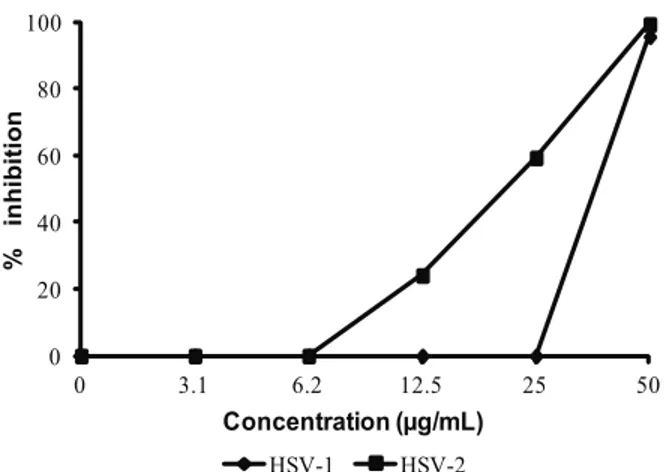
The antiviral experiments were performed with the lavonoid fraction at concentration of 50 µg/mL and acyclovir at 200 µg/mL. The EC50 values calculated from the dose-response curve (Figure 2) and the SI values were: EC50 35.8 µg/mL and SI > 5.5 to HSV-1 and EC50 23.5 µg/mL and SI > 8.5 to HSV-2. Acyclovir presented EC50 0.8 µg/mL and SI > 250 to HSV-1 and EC50 1.38 µg/mL and SI > 144.9 to HSV-2 (Table 1).
O HO
OH
OH
OH
R2
R1
1R1=OH; R2=H
2R1=H; R2=OH
O HO
OH
OH
R2
OR1
O
4R1=glucose; R2=OH
5R1=xylose; R2=OH
6R1=glucuronic acid; R2=OH
7R1=rhamnose; R2=OH
8R1=rhamnose; R2=H
9R1=H; R2=OH
10R1=R2=H
Table 1. Cytotoxicity and inhibitory effect of the lavonoid fraction from Ocotea notata leaves and acyclovir against Herpes simplex virus types 1 and 2.
Fraction and compound MNTC (µg/mL)
CC50 (µg/mL)
EC50 SI
HSV-1 HSV-2 HSV-1 HSV-2
Flavonoid fraction 50 > 200 35.8 23.5 >5,5 > 8.5
Acyclovir* ≥200 > 200 0.8 1.38 > 250 > 144.9
Acknowledgment
The authors thank CNPq and CAPES for their inancial support, ICMBio-MMA and The Restinga de Jurubatiba National Park.
References
Amaral ACF, Kuster RM, Gonçalves JLS, Wigg MD 1999. Antiviral investigation on the lavonoids of Chamaesyce thymifolia. Fitoterapia 70: 293-295.
Almeida AP, Miranda MMFS, Simoni IC, Wigg MD, Lagrota
MHC, Costa SS 1998. Flavonol monoglycosides isolated from the antiviral fractions of Persea americana
(Lauraceae) leaf infusion. Phytother Res 12: 562-567.
Bacon TH, Levin MJ, Leary JJ, Sarisky RT, Sutton D 2003.
Herpes simplex virus resistance to acyclovir and penciclovir after two decades of antiviral therapy.
Clin Microbiol Rev 16: 114-128.
Barbosa-Filho JM, Cunha RM, Dias CS, Athayde-Filho PF,
Silva MS, da Cunha EVL, Machado MIL, Craveiro AA, Medeiros IA 2008. GC-MS Analysis e cardiovascualr activity of the essential oil of Ocotea duckei. Rev Bras Farmacogn 18: 37- 41.
Benencia F, Courreges MC 2000. In vitro and in vivo activity of eugenol on human herpesvirus. Phytother Res 14: 495-500.
Borenfreund E, Puerner J 1985. Toxicity determined in vitro by morphological alterations and neutral red absorption.
Toxicol Lett 24: 119-124.
Bourne KZ, Bourne N, Reising SF and Stanberry LR 1999. Plant
products as topical microbicide candidates: assessment
of in vitro and in vivo activity against herpes simplex virus type 2. Antiviral Res 42: 219-226.
Borges RM, Tinoco LW, Souza Filho JD, Barbic NS, da Silva
AJR 2009. Two new oleanane saponins from Chiococca alba (L.) Hitch. J Braz Chem Soc 20: 1738-1741.
Brady RC, Bernstein, DI 2004. Treatment of herpes simplex
virus infections. Antivir Res 61: 73-81.
Cavaliere C, Foglia P, Gubbiotti R, Sacchetti P, Samperi R, Laganà A 2008. Rapid-resolution liquid chromatography/ mass spectrometry for determination and quantitation of polyphenols in grape berries. Rapid Commun Mass Sp 22: 3089-3099.
Charrouf Z, Hilali M, Jauregui O, Souiaoui M, Guillaume D 2007.
Separation and characterization of phenolic compounds in argan fruit pulp using liquid chromatografy-negative electrospray ionization tandem mass spectroscopy. Food Chem 100: 1398 -1401.
Chen M, Grifith P, Lucia HL, Hsiung GD 1988. Eficacy of
S26308 against guinea pig cytomegalovirus infection.
Antimicrob Agents Chemother 32: 678-683.
Chiang LC, Chiang H, Liu MC, Lin CC 2003. In vitro antiviral activities of Caesalpinia pulcherrima and its related
lavonoids. J Antimicr Chemoth 52: 194-198.
Chiang LC, Chiang W, Chang MY, Ng LT and Lin CC 2002. Antiviral activity of Plantago major extracts and related compounds in vitro. Antiviral Res 55: 53-62.
Cuca LE, Leon P, Coy ED 2009. A bicyclo[3.2.1]octanoid
0 20 40 60 80 100
0 3.1 6.2 12.5 25 50
% inhibition
Concentration (µg/mL)
HSV-1 HSV-2
Figure 2. Dose-response curve of the lavonoid fraction from
Ocotea notata leaves against Herpes simplex virus types 1 and 2. The dose-response curve was established starting from the
MNTC. 100 TCID50/mL of virus suspensions were inoculated in the presence of several concentrations of the lavonoid fraction.
After 48 h of incubation at 37 oC the supernatant was collected and virus titers in treated and untreated cells were calculated using the Reed and Muench statistical method (Reed & Muench, 1938) and the activity was expressed as PI.
Figure 3. Mechanisms of antiviral action for the lavonoid
fraction obtained from Ocotea notata leaves against Herpes simplex virus types 1 and 2. A. Virucidal assay: virus particles
were treated with lavonoid fraction. The viral suspensions
were incubated at 37 oC for 2 h. After incubating, the virus titers were calculated in treated and untreated viral suspensions and the activity was expressed as PI. B. Pre-treatment of cells assay: the lavonoid fraction was added to Vero cells after 1 h
pre-infection. C. Treatment after viral adsorption: the lavonoid
fraction was added to Vero cells after 1 h post-infection. D.
Treatment after viral penetration: the lavonoid fraction was
neolignan e toxicity of the ethanol extract from the fruit of Ocotea heterochroma. Chem Nat Compd 45: 179-181.
David JM, Yoshida IM, Gottlieb OR 1994. The chemistry of
Brazilian Lauraceae 103. Phenylpropanoid-catechins from bark of Ocotea porosa. Phytochemistry 35: 545-546.
De Clercq E 2004. Antiviral drugs in current clinical use. J Clin Virol 30: 115-133.
De Clercq E 2005. Recent highlights in the development of new
antiviral drugs. Curr Opin Microbial 8: 552-560.
Dias CS, Silva IG, Cunha EVL, Silva MS, Braz-Filho R, Barbosa-Filho JM 2003. Isolamento e identiicação de
novos alcalóides de Ocotea duckei Vattimo (Lauraceae).
Rev Bras Farmacogn 13: 62-63.
Foo YL, Lu Y, Howell AB, Vorsa N 2000. A-Type proanthocyanidin trimers from cranberry that inhibit
adherence of uropathogenic P-imbriated Escherichia coli. J Nat Prod 63: 1225-1228.
Fritz D, Venturi CR, Cargnin S, Schripsema J, Roehe PM,
Montanha JA, Poser GLV 2007. Herpes virus inhibitory substances from Hypericum connatum Lam., a plant used in southern Brazil to treat oral lesions. J Ethnopharmacol 113: 517-520.
Funasaki M, Lordello ALL, Viana AM, Santa-Catarina C,
Floh EIS, Yoshida M, Kato MJ 2009. Neolignans and
sesquiterpenes from leaves and embryogenic cultures of
Ocotea catharinensis (Lauraceae). J Braz Chem Soc 20: 853-859.
Garcez WS, Yoshida M, Gottlieb OR 1995. Benzylisoquinoline
alkaloids e lavonols from Ocotea vellosiana. Phytochemistry 39: 815-816.
Garcez WS, Garcez FR, da Silva LMGE, Shimabukuro AA 2005. Indole alkaloid and other constituents from Ocotea minarum. J Braz Chem Soc 16: 1382-1386.
Gomes MMR, Cerqueira DM, Falcão DQ, Menezes FS, Wigg MD, Mendes GS, Martins FO, Silva JFM, Kuster RM,
Romanos MTV 2008. In vitro anti-HSV-2 activity of isoquercetin from Hyptis fasciculata Benth. Virus Rev Res 13: 1-15.
Garrett R, Gattuso M, Santos MG, Rocha L 2007. Atividade antibacteriana do óleo essencial de Ocotea notata guiada pelo ensaio de toxidade sobre Artemia salina Leach. Bol Latinoamer Caribe Pl Med Arom 6: 334-335.
Gohar A, GedarA SR, Baraka HN 2009. New acylated lavonol
glycoside from Ceratonia siliqua L. seeds. J Med Pl Res 3: 424-428.
Grotewold E 2006. The science of lavonoids. New York:
Springer Science, 274p.
He M, Wang P, Xiang Y, Qi Y, Sun H, Phillips J 2007. Proiling and
characterization of polyphenol polymers from cinnamon using an ion trap mass spectrometer. Application note
392 Thermo Fisher Scientiic. <http://www.thermo.com/ eThermo/CMA/PDFs/Articles/articlesFile_2464.pdf>. Hayashi K, Hayashi T, Otsuka H, Takeda Y 1997. Antiviral
activity of 5,6,7-trimethoxylavone and its potentiation of
the antiherpes activity of acyclovir. J Antimicr Chemoth 39: 821-824.
Harborne JB, Williams CA 2000. Advances in lavonoid research
since 1992. Phytochemistry 55: 481-504.
Hill JM, Ball MJ, Neumann DM, Azcuv AM, Bhattacharjee PS, Bouhanik S, Clement C, Lukiw WJ, Foster TP, Kumar M, Kafman HE, Thompson HW 2008. The high prevalence of Herpes Simplex virus type 1 DNA in human trigeminal
Ganglia is not a function of age or gender. J Virol 85: 8230-8234.
Hook EW, Cannon RO, Nahmias AJ, Lee FF, Campbell Jr
CH, Glasser D, Quinn TC 1992. Herpes simplex virus infection as a risk factor for human immunodeiciency
virus infection in heterosexuals. J Infect Dis 165: 251-255.
Kemertelidze EP, Shalashvili KG, Korsantiya BM, Nizharadze
NO, Chipashvili NS 2007. Therapeutic effect of phenolic compounds isolated from Rhododendron ungernii leaves.
Pharm Chem J-USSR 41: 10-13.
Kleymann G 2003. Novel agents and strategies to treat herpes
simplex infections. Expert Opin Inv Drug 12: 165-183.
Kutluay SB, Doroghazi J, Roemer ME, Triezenberg SJ 2008.
Curcumin inhibits Herpes simplex virus immediate-early gene expression by a mechanism independent of p300/ CBP histone acetyltransferase activity. Virology 373: 239-247.
Lee JH, Ku CH, Baek N, Kim S, Park SW, Kim DK 2004. Phytochemical constituents from Diodia teres. Arch Pharm Res 27: 40-43.
Lu Y, Foo LY 1997. Identiication and quantiication of major
polyphenols in apple pomace. Food Chem 59: 187-194.
Li H, Deinzer ML 2007. Tandem mass spectrometry for
sequencing proanthocyanidins. Anal Chem 79: 1739-1748.
Li H, Deinzer ML 2008. The mass spectral analysis of isolated
hops A-type proanthocyanidins by electrospray ionization tandem mass spectrometry. J Mass Spectrom 43: 1353-1363.
Lyu SY, Rhim JY, Park WB 2005. Antiherpetic activities of
lavonoids against Herpes simplex virus type 1 (HSV-1)
and type 2 (HSV-2) in vitro. Arch Pharmacol Res 28: 1293-1301.
Ma SC, But PP, Ooi VE, HE Y, Lee SH, Lee S, Lin R 2001.
Antiviral amentolavone from Selaginella sinensis. Biol Pharm Bull 24: 311-312.
Markoulatos P, Georgopoulou A, Siafakas N, Plakokefalos E,
Tzanakaki G, Kourea-Kremastinou J 2001. Laboratory
diagnosis of common herpes virus infections of the central nervous system by a multiplex PCR assay. J Clin Microbiol 39: 4426-4432.
Martins LRR, Brenzan MA, Nakamura CV, Dias Filho BP, Nakamura TU, Cortez LER, Cortez DAG 2011. In vitro
Mehnert DU, Candeias JAN 2005. Herpesvírus. In: Trabulsi LR,
Alterthum F (org.) Microbiologia, São Paulo: Atheneu, p. 599-606.
Min BS, Lee SY, Kim JH, Lee JK, Kim TJ, Kim DH, Kim YH, Joung H, Lee HK, Nakamura N, Miyashiro H, Hattori M
2003. Anti-complement activity of constituents from the stembark of Juglans mandshurica. Biol Pharm Bull 26: 1042-1044.
Mundinger TA, Efferth T 2008. Herpes simplex virus: drug resistance and new treatment options using natural products (review). Mol Med Rep 1: 611-616.
Nishimura T, Toku K, Fukuyasu H 1977. Antiviral compounds.
XII. Antiviral activity of aminohydrazones of alkoxyphenil substituted carbonyl compounds against
inluenza virus in eggs and mice. Kitasato Arch Exp Med 50: 39-46.
Nohara T 2004. Search for functions of natural oligoglycosides - Solanaceae and Leguminosae origin glycosides.
Yakugaku Zasshi 124: 183-205.
Reed LJ, Muench H 1938. A simple method of estimating ifty
percents endpoints. Am J Hyg 27: 493-497.
Sacks SL, Grifiths PD, Corey L Cohen C, Cunningham A, Dusheiko GM, Self S, Spruance S, Stanberry LR, Wald
A, Whitley RJ 2004. HSV-2 transmission. Antivir Res 63: S27-S35.
Schnitzler P, Neuner A, Nolkemper S, Zundel C, Nowack H, Sensch KH, Reichling J 2009. Antiviral activity and mode
of action of propolis extracts and selected compounds.
Phytother Res 24: S20-S28.
Walker WE, Waisbren BA, Martins RR, Batayias GE 1971. A method for determining sensitivities of antiviral drugs in vitro for possible use as clinical consultation. Am J Clin Pathol 56: 687-692.
Zanin SMW, Lordello ALL 2007. Aporphine alkaloids in Ocotea
species (Lauraceae). Quim Nova 30: 92-98.
Zhang CF, Sun QS, Wang ZT, Hattori M 2003. One new A-type
proanthocyanidin trimer from Lindera aggregate (Sims)
Kosterm. Chinese Chem Lett 14: 1033-1036.
*Correspondence
Rafael Garrett
Núcleo de Pesquisas de Produtos Naturais, Centro de Ciências da Saúde, Universidade Federal do Rio de Janeiro, Bloco H, 21941-590, Rio de Janeiro-RJ, Brazil