Received from the Disciplina de Anestesiologia Faculdade de Medicina da Universidade de São Paulo (USP) – Study performed at Hospital das Clínicas (HC) of Faculdade de Medicina of USP (FM/USP), Brazil.
1. Anesthesiologist
2. Anesthesiologist of HC da FM/USP Submitted on July 13, 2010. Approved on September 9, 2010. Correspondence to:
Dr. Daniel Kishi
Rua Seraim Dias Machado no 171
Vila Maria
12209-240 – São Jose dos Campos, SP, Brazil E-mail: [email protected]
SCIENTIFIC ARTICLE
Description of Nosocomial Infection Prevention Practices by
Anesthesiologists in a University Hospital
Daniel Kishi
1, Rogério Luiz da Rocha Videira, TSA
2Summary: Kishi D; Videira RLR – Description of Nosocomial Infection Prevention Practices by Anesthesiologists in a University Hospital. Background and objectives: Anesthesiologists play an important role in the prevention of nosocomial infections. In anesthetic practice, physiolo-gic barriers are routinely breached, allowing patient contamination with microorganisms and the consequent development of infection. The lack of adhesion to recommended practices can facilitate transmission of microorganisms. It is important to describe prophylactic practices of anesthesia- related nosocomial infections performed by anesthesiologists.
Methods: Structured questionnaires were distributed to be answered voluntarily and anonymously by anesthesiologists.
Results: Among 112 anesthesiologists, 75% answered the questionnaire. Surgical mask is used by 95.2% of anesthesiologists, 96.3% wear gloves frequently, 98.9% wear sterile gloves for neuraxial block, 91.3% use sterile technique for central venous puncture, 95.1% wash their hands between cases, 91.6% try to maintain the endotracheal tube sterile, 96.3% discard the preilled propofol syringe at the end of each anesthesia, 30% clean the vials before using it in the neuraxial blocks, and 19.8% clean the vials before intravenous use.
Conclusions: Respondents showed good adhesion to practices of nosocomial infection prophylaxis and to improve them educational multidisci-plinary campaigns are necessary.
Keywords: Infection Control; Universal Precautions; Asepsis; Anesthesia.
[Rev Bras Anestesiol 2011;61(2): 177-187] ©Elsevier Editora Ltda.
INTRODUCTION
Anesthesiologists play an important role in the prevention of nosocomial infections. In anesthetic practice, invasive pro-cedures that breach physiologic barriers, such as tracheal intubation, venous access, or neuraxial blocks are routinely performed allowing contamination of patients with microorga-nisms and development of infection. Non-adhesion to recom-mended practices can facilitate transmission of microorganis-ms from the anesthesiologist to the patient, from the patient to the anesthesiologist, and between patients 1.
Hygiene practices of professionals, adequate cleaning of equipment, and adequate execution of invasive procedures are among important aspects for the reduction of the risk of transmission of infections 2.
Hygiene practices related to the anesthetic procedures have been investigated in different countries, such as United States, United Kingdom, New Zealand, and France 3-6.
METHODS
After approval by the Institutional Ethics Committee of the Hospital das Clínicas of Faculdade de Medicine of Universi-dade de São Paulo, questionnaires were distributed to anes-thesiologists who work in the operating suite of the Instituto Central of that hospital.
The questionnaire was translated and freely adapted from prior studies on prevention of perioperative infections 4,5 and it was voluntarily and anonymously answered by anesthesiolo-gists (Questionnaire).
One hundred and twelve questionnaires were distributed to anesthesiologists between September 2007 and August 2008.
Anesthesiologists from the Anesthesiology Division of the Hospital das Clínicas de São Paulo were included in this study as, a convenient, non-random population.
Exclusion criteria were: 1. Anesthesiologists who are not routinely involved in intraoperative care of surgeries conduct-ed at the operating suite; 2. Refusal to answer the question-naire or to sign the informed consent.
RESULTS
wa-shing, mask, headwear, sterile gown, and sterile glove was reported by 91.3% of anesthesiologist (Table I).
Ninety-ive per cent of anesthesiologists wash their hands between cases, 89% wash their hands when removing the gloves, and 74.1% wash their hands before a neuraxial block.
The endotracheal tube is maintained sterile by 91.6% of anesthesiologists, and 95.1% change the ilter of the ventila-tion system between patients.
Preilled propofol syringe was discarded at the end of each anesthesia by 98.8% of anesthesiologists; however, 52.4% reill the propofol syringe for the same patient.
A three-way stopcock is used for intravenous infusion of drugs by 96.3%; however, only 30% reported cleaning vials of drugs with alcohol for use in the neuraxial blocks, while 19.8% clean vials before intravenous administration.
DISCUSSION
Compared to other studies, such as that of Tait et al. in the United States 3, with 44% of participation, El Mikatti et al. in the United Kingdom 4, with 68%, and Ryan et al. in New Zea-land 5, with 61%, the participation of anesthesiologists in the present study (75%) can be considered favorably.
The data presented here shows good adhesion to prac-tices of prophylaxis of nosocomial infections, which can be favorably compared to studies in other countries.
In this study, 73.8% of those interviewed never or rarely wear protective goggles. The only study in which this item
was mentioned, performed by Ryan et al. 5 in New Zealand
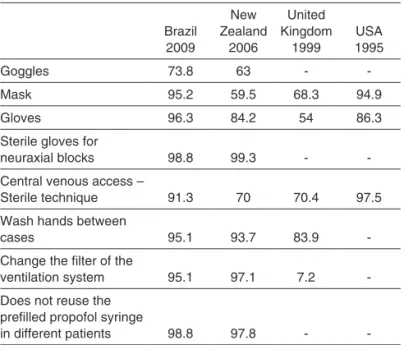
(NZ), reported similar rates, 63%. Regarding the mask, we observed a proportion similar to the American study of Tait et al. 3 (94.9%) and higher than that of the United Kingdom (UK – 68.3%) 4 and New Zealand (59.5%)5. A higher proportion of anesthesiologists reported wearing gloves (96.3%) than that of the studies of Tait et al. 3 (USA – 86.3%), El Mikatti et al.4 (UK – 54%), and Ryan et al. 5 (NZ – 84.2%). Regarding neu-raxial block, a similar proportion to that of the study of Ryan et al. 5 (NZ), i.e., 98.8% vs. 99.3%, reported wearing sterile gloves, indicating a well established practice in both countries, but this data is not available in the other studies. Adhesion in our institution (91.3%) to the sterile technique, with sterile cap, mask, gloves, and gown for central venous access was lower than that reported by Tait et al. 3 (USA), but higher than that reported by El Mikatti et al. 4 (UK) and Ryan et al. 5 (NZ), with 70.4% and 70%, respectively (Table II).
Washing hands between cases, a simple procedure that can prevent transmission of microorganisms with the best cost/beneit relationship 7, was reported by 95.1% of anes-thesiologists in the present study, compared to 83.9%, in the study of El Mikatti et al. 4 (UK), and 93.7%, in the study of Ryan et al. 5 (NZ). Adhesion to this practice is lower before neuraxial blocks (74.1%); despite this, it represented more than double of that observed by Videira et al.7 (32%) in a prior study performed in Brazil. According to a recent recommen-dation of the ASA (American Society of Anesthesiologists), before a neuraxial block, one should wash his/her hands, wear sterile gloves, cap, and mask covering the mouth and nose, besides using individual packages in skin preparation, and remove all jewelry; however, the recommendation of
Table I – Amount and Percentage of Answers of the Questionnaire (n = 84)
Never Rare Always Freq
N % N %
Do you wear goggles? 62 73.8 22 26.2
Do you wear a mask in the operating room? 4 4.8 80 95.2
Do you wear gloves? 3 3.7 79 96.3
Procedure gloves – Venous cannulation 13 15.9 69 84.1
Sterile gloves – Neuraxial blocks 1 1.2 80 98.8
Sterile gloves – Peripheral blocks 10 13.0 67 87.0
Do you wash your hands and wear a cap, mask, sterile
gown and gloves for central venous access? 7 8.8 73 91.3
Do you wash your hands between cases? 4 4.9 78 95.1
Do you wash your hands before neuraxial blocks? 21 25.9 60 74.1
Do you wash your hands after removing your gloves? 9 11.0 73 89.0
Do you try to maintain the endotracheal tube sterile? 7 8.4 76 91.6
Do you change the ilter in the ventilation system between patients? 4 4.9 78 95.1
Do you use a preilled propofol syringe/diprofusor to
administer medication to more than one patient? 81 98.8 1 1.2
Do you reill the preilled propofol syringe/diprofusor for the same patient? 39 47.6 43 52.4
Do you sue a three-way stopcock for IV injection of drugs? 3 3.7 79 96.3
Do you clean the vials of drugs with alcohol before using them?
Intravenous drugs 65 80.2 16 19.8
wearing a sterile gown and changing masks before a new case is uncertain 8.
The results suggest effective care with airways contamina-tion, since 91.6% of anesthesiologists try to maintain the en-dotracheal tube sterile, and 95.1% change the ilter of the ventila-tion system between patients. This care was considerable lower in the study of El Mikatti et al. 4 (UK – 7.2%), while in the study of Ryan et al. 5 (NZ), 97.1% reported this change. This suggests an improvement in practice in the last decade, although the places of the studies were different (Brazil, UK 4, and NZ 5), but this item was not analyzed in the American study.
Similar to the study of Ryan et al. 5 (NZ), the preilled propo-fol syringe was not used in different patients, revealing an ad-equate practice; however, more than half of those interviewed frequently reill the syringe for the same patient, but the stud-ies undertaken in the USA 3 and UK 4 did not report this data. Although Hemingway et al. 9 have shown that cleaning the exterior of vials with alcohol can reduce contamination of the contents, the majority of anesthesiologists does not clean vi-als before using them, which increases the risks of drug con-tamination.
Adhesion to prophylactic practices of nosocomial infection reported in the present study was comparatively better than that observed in prior studies.
Some aspects, such as cleaning drug vials with alcohol, are still well below which is desired, indicating that this prac-tice should be stimulated.
To improve hygiene practices, it is possible to suggest placement of signs and charts in anesthesiologist work sta-tions, besides a procedures manual, available in electronic form and as an easy access booklet. Besides, manufactures of drugs used in our specialty could stimulate good clinical practice by printing on packages the recommendation of cleaning them before using them or adopting a sterile pack-age for drugs used in neuraxial blocks.
Table II – Summary of the Main Data of the Studies on Hygiene Practices and Anesthesia (in percentage)
Brazil 2009
New Zealand
2006
United Kingdom
1999
USA 1995
Goggles 73.8 63 -
-Mask 95.2 59.5 68.3 94.9
Gloves 96.3 84.2 54 86.3
Sterile gloves for
neuraxial blocks 98.8 99.3 -
-Central venous access –
Sterile technique 91.3 70 70.4 97.5
Wash hands between
cases 95.1 93.7 83.9
-Change the ilter of the
ventilation system 95.1 97.1 7.2
-Does not reuse the preilled propofol syringe
in different patients 98.8 97.8 -
-Questionnaire
0.1) Year of graduation from medical school: . . . . 0.2) Title of anesthesiologist a) Yes: b) No:
0.3) Master’s Degree a) Yes: b) No:
0.4) PhD a) Yes: b) No:
1. How long have you been practicing anesthesiology? a) 0 to 5 years
b) 5 to 10 years c) 10 to 15 years d) > 15 years 2. Do you wear goggles?
a) Never b) Rarely c) Frequently d) Always
3. Why do you do not wear it frequently? a) It is not available in the operating room b) I wear glasses
c) fogging of the lenses gets in the way d) It depends on the surgery
e) It does not it on my face
f) Others: . . . . 4. Do you a wear mask in the operating room?
a) Never b) Rarely c) Frequently d) Always
Surgical mask a) Never b) Rarely c) Frequently d) Always
4.1) Tracheal
intubation
4.2) Extubation
4.3) Neuraxial blocks
4.4) Peripheral blocks
4.5) Venous cannulation
4.6) Central venous access
4.7) BPi
5. In which situations do you wear q mask covering your nose? (you can chose more than one answer) a) Never
b) Whenever I am in the operating room c) During tracheal intubation
d) Whenever performing neuraxial blocks e) Whenever performing peripheral blocks f) Whenever performing central venous access g) Whenever the surgeon asks me to
6. Do you wear gloves? a) Never
6.1) Do you change gloves between cases? Yes No
Procedure gloves a) Never b) Rarely c) Frequently d) Always
6.2.1) Tracheal intubation
6.2.2) Extubation
6.2.3) Neuraxial blocks
6.2.4) Peripheral blocks
6.2.5) Venous cannulation
6.2.6) Central venous Access
6.2.7) BPi
Sterile gloves a) Never b) Rarely c) Frequently d) Always
6.3.1) Tracheal intubation
6.3.2) Extubation
6.3.3) Neuraxial blocks
6.3.4) Peripheral blocks
6.3.5) Venous cannulation
6.3.6) Central venous Access
6.3.7) BPi
7. Do you use sterile technique, i.e., washing your hands, wearing a c™ap, mask, sterile gown, and sterile gloves, for central venous puncture? a) Never
b) Rarely c) Frequently d) Always
8. Is alcohol gel available for disinfection of the hands in the OR? a) Yes
b) No
c) I do not know
Wash hands a) Never b) Rarely c) Frequently d) Always
8.1) When beginning
your day at the operating room
8.2) Between cases
8.3) Upon getting in
close contact with secretions/ blood
8.4) Before inducing
general anesthesia
8.5) Neuraxial blocks
8.6) Peripheral blocks
8.7) Venous
cannulation
8.8) Central venous
access
8.9) Upon removing
the gloves
9. Do you try to maintain the tracheal intubation tube sterile? a) Never
b) Rarely c) Frequently d) Always
10. Do you change the ventilation circuit: a) After each patient
b) Only after infected or high-risk patients c) At the end of the day
d) Both b and c
e) Others: . . . . f) I do not know
11. Do you change the ilter in the ventilation system between patients?
a) Never b) Rarely c) Frequently d) Always
12. Laryngoscope blades are sterilized: a) After each patient
b) Only after infected or high risk patients c) At the end of the day
d) Both b e c
e) Others: . . . . f) I do not know
13. What type of processing is done with the laryngoscope blade between patients? a) Wash with water and soap b) Clean with alcohol c) High-level disinfection d) Sterilization
e) Others: . . . . f) I do not know
14. Is a disposable laryngoscope blade available? a) Yes
b) No
c) I do not know
15. After the anesthesia, the anesthesia equipment is cleaned with disinfection/germicide agent? a) Never
b) Rarely c) Frequently d) Always e) I do not know
16. Do you prepare syringes before beginning the day/ period to be used in several patients?
a) Yes b) No
17. Do you use a propofol syringe/diprofusor to administer medications to more than one patient?
a) Never b) Rarely c) Frequently d) Always
18. Do you reill the propofol syringe/diprofusor for the same patient? a) Never
19. If yes, why do you reill the propofol syringe/ diprofusor for the same patient?
a) Price of the syringe
b) Limitations of the number of syringes of “Diprivan PFS” c) Other: . . . . 20. Do you use a syringe to administer medications to
more than one patient? (except the diprofusor) a) Never
b) Rarely c) Frequently d) Always
21. Do you use the three-way stopcock to administer drugs? a) Never
b) Rarely c) Frequently d) Always
22. Do you clean the vials of medications with alcohol before using them?
Sterile gloves a) Never b) Rarely c) Frequently d) Always
22.1) Intravenous medications
22.2) Neuraxial block drugs
22.3) Peripheral blocks drugs
23. Did you have a needle stick-cutting accident with blood in the last 12 months?
a) Yes
b) No. How many times? . . . . 24. Did you notify this accident?
a) Yes b) No
24.1. If not, why?
I. I did not consider the accident to be important II. I did not have time
III. The notiication does not make a difference
IV. I collected the exams of the patient (HIV, HbsAg, HepC) V. Others . . . . 25. Have you been vaccinated against hepatitis B?
a) Yes b) No
26. Do you know your immune status against hepatitis B? a) I do not know
b) Protected against hepatitis B c) Not protected against hepatitis B d) Carrier of hepatitis B
e) I would rather not answer this question
27. Do you recap the needle after collecting blood? (patient contact) a) Never
b) Rarely c) Frequently d) Always
28. Do you recap the needle after applying medications through the infusion tubing?
(without patient contact) a) Never
b) Rarely c) Frequently d) Always
29. Do you usually work when you have:
a) Never b) Rarely c) Frequently d) Always
29.1) Respiratory infection (cold, lu, etc) 29.2) Gastrointestinal
infection? 29.3) Herpes?
29.4) Psoriasis / dermatitis? 29.5) Other:
. . . . . .
30. Do you change your conducts if you know the patient is HIV positive?
Yes No
Comments: . . . . 31. Do you change your conducts if you know
the patients has hepatitis B or C? Yes No
Comments: . . . . 32. On a scale from 0 (none) to 10 (signiicantly), how do
you consider the transmission potential of infectious agents of the anesthetic procedure for the patient?
0 1 2 3 4 5 6 7 8 9 10
33. On a scale of 0 (none) to 10 (signiicant), how do you consider the transmission potential of infectious agents of the anesthetic procedure for the anesthesiologist?
0 1 2 3 4 5 6 7 8 9 10
34. Do you have access to the nosocomial infection control manual? Yes No
35. Have you read the nosocomial infection control manual? Yes No
36. How would you grade the role of the nosocomial infection control commission in the operating room?
0 1 2 3 4 5 6 7 8 9 10
37. Do you have any suggestions to improve patient and physician safety regarding transmission of infections during the anesthetic procedure?