Oliveira BB et al. / Image quality in a direct radiography system
Radiol Bras. 2014 Nov/Dez;47(6):361–367 361
Original Article
Dosimetry and image quality assessment in a direct radiography
system
*
Dosimetria e avaliação da qualidade da imagem em um sistema de radiografia direta
Oliveira BB, Oliveira MA, Paixão L, Teixeira MHA, Nogueira MS. Dosimetry and image quality assessment in a direct radiography system. Radiol Bras. 2014 Nov/Dez;47(6):361–367.
Abstract
R e s u m o
Objective: To evaluate the mean glandular dose with a solid state detector and the image quality in a direct radiography system, utilizing phantoms.
Materials and Methods: Irradiations were performed with automatic exposure control and polymethyl methacrylate slabs with different thicknesses to calculate glandular dose values. The image quality was evaluated by means of the structures visualized on the images of the phantoms.
Results: Considering the uncertainty of the measurements, the mean glandular dose results are in agreement with the values provided by the equipment and with internationally adopted reference levels. Results obtained from images of the phantoms were in agreement with the reference values.
Conclusion: The present study contributes to verify the equipment conformity as regards dose values and image quality.
Keywords: Mean glandular dose; Image; Direct radiography.
Objetivo: Avaliar a dose glandular média utilizando um detector de estado sólido e a qualidade da imagem de um sistema de radiografia direta a partir de objetos simuladores.
Materiais e Métodos: Irradiações foram realizadas utilizando o controle automático de exposição e placas de polimetilmetacrilato com diferentes espessuras para o cálculo da dose glandular média. A qualidade da imagem foi avaliada por meio das estruturas visualizadas nas imagens dos objetos simuladores.
Resultados: Considerando a incerteza das medições, os resultados de dose glandular média estão de acordo com os valores fornecidos pelo equipamento e com os níveis de referência adotados internacionalmente. Os resultados obtidos a partir das imagens dos objetos simuladores estavam em conformidade com os valores de referência.
Conclusão: Este trabalho contribui para verificar a conformidade do equipamento em relação a dose e qualidade da imagem.
Unitermos: Dose glandular média; Imagem; Radiografia direta.
* Study developed in the Program of Post-graduation in Science and Technology of Radiations, Minerals and Materials – Centro de Desenvolvimento da Tecnologia Nuclear (CDTN/CNEN), Belo Horizonte, MG, Brazil.
1. Masters, Fellow PhD degree, Course of Science and Technology of Radiations, Minerals and Materials – Centro de Desenvolvimento da Tecnologia Nuclear (CDTN/ CNEN), Belo Horizonte, MG, Brazil.
2. Master, Teacher, Department of Anatomy and Imaging, School of Medicine – Universidade Federal de Minas Gerais (UFMG), Belo Horizonte, MG, Brazil.
3. MD, Radiologist, Technical Director of Clínica Dra. Maria Helena Araújo Tei-xeira, Belo Horizonte, MG, Brazil.
4. PhD, Titular Researcher-Professor, Centro de Desenvolvimento da Tecnologia Nuclear (CDTN), Belo Horizonte, MG, Brazil.
Mailing Address: Bruno Beraldo Oliveira. Centro de Desenvolvimento da Tecno-logia Nuclear (CDTN/CNEN). Avenida Presidente Antônio Carlos, 6627, Campus UFMG, Pampulha. Belo Horizonte, MG, Brazil, 31270-901. E-mail: [email protected].
Received August 6, 2013. Accepted after revision April 10, 2014.
Two types of mammography are currently available, namely, the conventional type, which utilizes radiographic film cassette and intensifying screens, and the digital type, relying on computed radiography (CR) and direct radiogra-phy (DR). The CR systems are equipped with an image digi-tizer and utilize cassettes containing phosphor imaging plates, while the DR systems rely on digital detectors. Digital mam-mography enables the incorporation of a number of new technologies, such as digital breast tomosynthesis (DBT)(1),
which utilizes a sequence of views acquired along a limited arch around the breast.
Recently, several studies in several areas have been pub-lished in Brazil, aimed at improving the radioprotection methods(2–4) and demonstrating the importance of the
adop-tion of an appropriate dosimetry procedure(5–11).
Particularly in mammography, there is a preoccupation on evaluating the quality of the mammography apparatuses by means of specific performance tests(12–14), with the
pur-pose of providing more accurate and precise diagnosis(15,16).
Breast dosimetry plays a relevant role in the equipment quality
Bruno Beraldo Oliveira1, Marcio Alves de Oliveira2, Lucas Paixão1, Maria Helena Araújo Teixeira3, Maria
do Socorro Nogueira4
INTRODUCTION
control and is an essential element in the optimization of the procedures. The International Commission on Radiation Units and Measurements (ICRU)(17) recommends the
utili-zation of the mean dose for glandular tissues, without utiliz-ing the breast as a whole for dosimetry in mammography. This quantity is referred to in the literature as mean glandu-lar dose (DG). There are several standard protocols for dose estimation that provide conversion factors which correlate the incident air kerma (Ki) with DG
(18).
In the protocols from the Commission of the European Communities (CEC)(13) and from the International Atomic
Energy Agency (IAEA)(14), such factors are based on Monte Carlo calculations developed by Dance(19,20) and are
avail-able for x-ray spectra from different anode-filter combina-tions. The study developed by Dance et al.(20) included
equiva-lent thicknesses of polymethylmethacrylate (PMMA) plates which may be utilized to simulate the typical breasts of dif-ferent thicknesses for dosimetry purposes.
In the protocols from the American College of Radiol-ogy (ACR), the utilized conversion factor is that calculated by Wu et al.(21,22) and Boone(23,24) by means of Monte Carlo
calculations tabulated for different beam qualities, thick-nesses and breast glandularity.
The Health Surveillance Agency from the State of Minas Gerais, Brazil, in a partnership with Centro de Desenvolvi-mento da Tecnologia Nuclear (Center for the Development of Nuclear Technology) (CDTN/CNEN), evaluates digital mammography apparatuses in the State(25) on a yearly ba-sis, by means of performance tests based on the CEC(13) and
IAEA(14) protocols, with the purpose of verifying whether the
obtained results are in compliance with the digital mammog-raphy quality assurance program established by IAEA(14). Performance testing includes collimation system (alignment of the x-ray field with the luminous beam); compression force; alignment of the compression paddle; detector response linearity and uniformity; spatial resolution; contrast noise and signal noise ratios.
The present study was aimed at performing complemen-tary dosimetry tests together with imaging quality assessment, utilizing the same protocol adopted by the Health Surveil-lance Agency in a mammography apparatus equipped with the DR system. Such an apparatus was utilized on account of a partnership established with a mammography clinic located in the city of Belo Horizonte, interested in partici-pating in research projects.
At dosimetry, the DG results obtained for different PMMA plate thicknesses were estimated by utilizing a solid state detector, with the purpose of comparing such results with the values provided by the adopted equipment. The solid state detector was selected instead of a traditional specific ionization chamber for mammography, on account of its many advantages. Such detectors have a specific material in the lower part to avoid the detection of backscattered radiation, are easier to position and are more stable. Additionally, they directly provide the values of the half value layer (HVL) with
a low response time thus allowing swiftness in the experi-ments and, consequently, reducing the idle time of the equip-ment at mammography clinics. The obtained DG results were also compared with internationally established acceptable and desirable reference levels(13,14).
Two different phantoms were utilized for the image quality test: the Phantom Mama, indicated by Colégio Bra-sileiro de Radiologia e Diagnóstico por Imagem, and the CDMAM, specific for digital apparatuses. All the images were analyzed and the results were compared with the estab-lished reference values(13,26).
MATERIALS AND METHODS
The DG values are estimated from the Ki values obtained in the irradiations and conversion coefficients that are tabled and dependent upon the HVL of the x-ray beam. The expo-sures were performed by utilizing the solid state detector Unfors 8202031-H Xi R/F & MAM Detector Platinum and the DR system of the Hologic Selenia Dimensions mammog-raphy apparatus located at a mammogmammog-raphy clinic in the city of Belo Horizonte. The image from the Phantom Mama was only visually evaluated, while the CDMAM images were both visually and automatically analyzed by the cdcom.exe soft-ware.
Exposure parameters determination
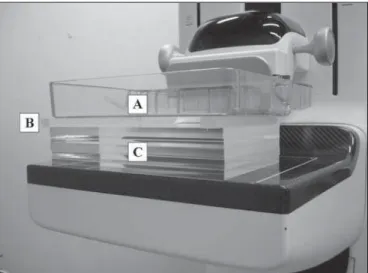
The irradiations for determining exposure parameters were performed by utilizing the automatic exposure control (AEC) of the equipment and PMMA plates with thicknesses ranging from 20 to 70 mm positioned on the compression apparatus. In order to represent breasts with different attenu-ations, PMMA spacers with thicknesses of 1, 2, 5, 10 and 20 mm were placed on the plates (Figure 1). All voltage values (kV), load (mA.sCAE) and anode/filter composition were recorded for each thickness.
Determination of the Ki and HVL values
The distance between the focal point of the x-ray tube and breast compression paddle was 700 mm. The solid state detector was positioned on the breast paddle with its sensi-tive center at 60 mm from the chest wall (Figure 2).
The Ki values were determined by utilizing the readings obtained with the mammography apparatus in the manual exposure mode and the obtained exposure parameters in the irradiations with AEC, according to the equation:
Ki,25 = MCAE N kTP
where: Ki,25 is the Ki value obtained with the sensitive center of the solid state detector positioned at 25 mm from the breast compression paddle; MCAE is the average value of the
three readings; N is the value of the calibration factor; and
kTP is the factor for correction of temperature and pressure(14).
For the measurements with the plates and PMMA spacers, the Ki values were obtained by means of the equation:
where: Ki,t is the Ki value obtained for a t thickness; d is the distance between the focal point of the x-ray tube and the breast compression paddle; and t is the sum of the thicknesses of the PMMA plates and spacers(14).
In case it was not possible to select the same load value, the reading values were estimated by utilizing the load value closer to the value utilized with the AEC, as per the equation:
MCAE = M (mA.sCAE / mA.sM)
where: mA.sCAE is the load value utilized with the AEC; M is
the average value of the three readings utilizing the closest load value, mA.sM(14).
The HVL were obtained by the solid state detector that automatically provides such values after each irradiation. The respective tolerances of such values were obtained accord-ing to the interval:
kV / 100 + 0.03 ≤ HVL ≤ kV / 100 + C
where: C is a constant with the values 0.12; 0.19; 0.22; 0.30; 0.32; 0.25 for the anode/filter combinations Mo/Mo, Mo/ Rh, Rh/Rh, W/Rh, W/Ag, W/Al, respectively(14).
Determination of the DGvalues
The DG values were obtained according to the equation:
DG = gt ct s Ki,t
where: gt is the factor that converts the Ki into DG by
utiliz-ing a breast with 50% of fibroglandular tissue and 50% of fat tissue and a thickness t; ct is the conversion factor that allows the utilization of other breast composition; s is the factor for different anode/filter combinations(14,19,20).
The results were compared with internationally estab-lished, acceptable and desirable reference levels(13,14).
Evaluation of image quality
The irradiations for the first image quality evaluation were performed with the AEC of the equipment, besides the CDMAM phantom inserted between four PMMA plates positioned on the breast paddle (Figure 3). In total, 12 images were obtained without processing, with the purpose of en-abling a reliable result from the cdcom.exe software. A visual analysis of one of the images was performed for comparison with the automated analysis. The evaluation of the images was performed by means of the gold thicknesses with differ-ent diameters presdiffer-ent in the CDMAM phantom. The results were compared with the established reference values(13).
The irradiation for the second image quality evaluation was also performed by utilizing the equipment’s AEC, this time utilizing the Phantom Mama positioned on the breast paddle (Figure 4). The respective non-processed image was obtained and the image evaluation was performed by visual-ization of the different structures present in the Phantom Mama. The anatomical structures simulated by the structures visualized on the Phantom Mama image include tumor masses; microcalcifications; low-contrast areas or lesions and fibrotic calcifications. The number of each structure was compared with the established reference values(13,26).
RESULTS
Determination of the exposure parameters
Voltage, load values and anode/filter combination uti-lized for different thicknesses are shown on Table 1. The proportion of fibroglandular tissue and the equivalent breast thickness was obtained by the sum of the respective PMMA plate and spacer thicknesses(14).
Figure 2. Solid-state detector positioning for measurement of Ki and HVL.
Figure 1. Positioning of materials in the determination of exposure parameters.
Table 1—Voltage, load, anode/filter combination for different thicknesses.
PMMA plate thickness (mm)
20 30 40 50 60 70
Equivalent breast thickness (mm)
21 32 45 60 75 90
Fibroglandular tissue proportion of the breast equivalent (%)
97 67 41 20 9 4
Voltage (kV)
25 26 28 31 31 33
Load (mA.sCAE)
46 70 93 133 165 184
Anode/filter combination
W/Rh W/Rh W/Rh W/Rh W/Ag W/Ag
Table 2—Ki and HVL values for different thicknesses.
PMMA plate thickness (mm)
20 30 40 50 60 70
Equivalent breast thickness (mm)
21 32 45 60 75 90
CSR (mmAl)
Ki (mGy)
1.078 1.900 3.150 5.996 7.675 9.532
Calculated
0.50 0.51 0.54 0.56 0.62 0.65
Tolerance
0.28–0.55 0.29–0.56 0.31–0.58 0.34–0.61 0.34–0.63 0.36–0.65
Determination of Ki and HVL values
The Ki values in mGy, besides the HVL values and their respective tolerances in mmAl obtained for different thick-nesses are shown on Table 2. The calculated relative expanded uncertainty (k = 2) for measurements of Ki and HVL is ap-proximately 7.6%.
Determination of DG values
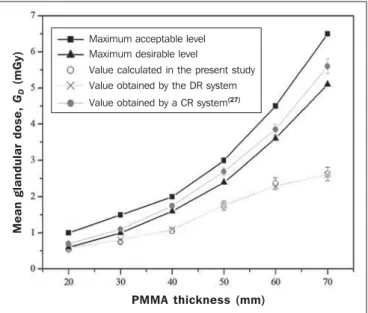
The calculated DG values in mGy with the respective measurement uncertainties for different PMMA thicknesses, and the respective maximum acceptable and desired levels established by CEC(13)and IAEA(14) are shown on Figure
5. The calculated relative expanded uncertainty (k = 2) for the DG measurements is approximately 9.0%. The calculated
Figure 3. CDMAM phantom positioning for evaluation of image quality.
Figure 4. Phantom Mama positioning for evaluation of image quality. Figure 5. Mean glandular dose for different thicknesses.
M
e
a
n
g
la
n
d
u
la
r
d
o
se
,
GD
(
m
G
y
)
PMMA thickness (mm) Maximum acceptable level
Maximum desirable level
Value calculated in the present study Value obtained by the DR system
DG values ranged between 0.54 ± 0.04 and 2.63 ± 0.24 mGy
for the different thicknesses. Figure 5 also indicates the val-ues provided by the DR system, besides the results obtained by Oliveira et al.(27) utilizing a CR system.
Image quality evaluation
The visual and automatic evaluations of the gold thick-ness on the CDMAM images obtained in the present study and by Oliveira et al.(27), besides the respective reference
values(13)in µm for different material diameters, are shown
on Table 3. The number of each visualized structure utiliz-ing the image obtained from the Phantom Mama is shown on Table 3. The number of each visualized structure utiliz-ing the Phantom Mama, besides the respective toler-ances(13,26), are shown on Table 4.
DISCUSSION
The PMMA plates and spacers are easily manipulated and allow for obtaining the correct equivalent breast thick-nesses, besides the respective fibroglandular tissue propor-tions. Such parameters are necessary to allow for determin-ing DG values and verify whether the equipment is correctly providing such values. However, a careful approach is nec-essary in analysis of results obtained with such materials, as they might be different from those obtained at dosimetry on an actual breast. In their studies, Cassola et al.(28) have
con-cluded that homogeneous materials should be utilized for constancy tests and are not indicated to estimate dosimetry in actual patients.
In the present study, DG values increased with the PMMA thickness, and the highest value was found when a 70 mm-thick PMMA plate was utilized, as it has the highest x-ray attenuation. Chen et al.(29) and Chevalier et al.(30) have
observed that DG values are a function of the compressed breast thickness. For that reason, the result obtained in the present study was expected, as greater thicknesses require more energetic beams, besides a higher number of photons, causing an increase in dose values.
Coutinho(31) has collected clinical data from 1,183
mammograms obtained by different systems, namely, screen/ film, CR and DR. From such a sample, DG values for 392
patients were calculated with thermoluminescent (TL) do-simeters and a solid state detector. In the comparison of the two dosimetry methods in the determination of the DG val-ues obtained from Ki and of the tabled conversion factors
were up to 30% higher than the values obtained by direct measurements utilizing the TL dosimeters within a specific phantom.
In the present study, the DG results show that the results
with the solid state detector were in agreement with the val-ues shown by the equipment, and that such valval-ues were be-low the desirable level for all studied different thicknesses and breast glandularities. However, such values may be over-estimated. For this reason, in future studies, it would be interesting to perform measurements utilizing TL dosimeters and a phantom in order to determine the difference between the methods.
Coutinho(31) has also concluded that the utilized DR
systems presented DG values higher than those calculated with the phantom, and that the mean DG values obtained in those apparatuses are 33% lower than in the screen/film sys-tem. However, the CR systems evaluated in that study pre-sented mean DG values 25% higher than the conventional systems.
In the digital imaging systems, both DR and CR, auto-matically adjust the radiation exposure, which contributes to a possible reduction in the number of acquired images. The DR systems also provide a better workflow as they elimi-nate the utilization of film cassettes, and provide greater opportunities to incorporate new technologies such as the DBT system.
In Brazil, one observes an increasing tendency towards adopting digital systems in lieu of conventional ones. For this reason, it is important to compare the obtained DG val-ues between the different digital systems. Oliveira et al.(27)
have published DG values obtained with the same method utilized in the present study, but with a CR system of a labo-ratory in the State of Minas Gerais. All results were within the internationally acceptable and desirable reference lev-els(13,14), but above the results calculated with the DR sys-tem in the present study.
Table 4—Number of visualized structures utilizing the Phantom Mama.
Structures (total)
Fibers (6) Discs (8) Tumor masses (5) Microcalcifications (5) Metal grids (4)
Visualized structures
4 7 4 4 3
Tolerance
≥ 4
≥≥≥≥≥ 7
≥≥≥≥≥ 4
≥≥≥≥≥ 4 3
Table 3—Visual and automatic evaluation for different gold diameters utilizing the CDMAM.
Gold thickness evaluations (µm)
Diameter (mm)
0.10 0.25 0.50 1.00 2.00
Visual in the present study
2.00 0.36 0.16 0.10 0.06
Visual by Oliveira et al.(27)
2.00 0.36 0.16 0.08 0.06
Automatic – present study
0.995 0.142 0.064 0.037 0.040
Automatic by Oliveira et al.(27)
2.00 0.16 0.10 0.03 0.05
Reference value
In general, despite the elevated results presented by the CR systems, there is still room for dose reduction. It is more difficult to identify overexposure in such systems on account of the automatic adjustment of image brightness and con-trast. For this reason, the optimization of the procedures is important to reduce the exposure to acceptable levels while maintaining appropriate image quality.
Cassola et al.(28) have compared dosimetry data between different breast phantoms (homogeneous breast phantom and anthropomorphic breast phantom). They recommended the Dance(19,20) model as the best one to evaluate dose values in
median breasts with glandular tissue in the medial region. This is the same model utilized in the present study, with basis on DG values instead of that utilized by Wu et al.(21,22)
and Boone(23,24), based on the normalized glandular dose.
As the questions related to radiological protection were con-sidered, the model proposed by Dance(19,20) was also
recom-mended, even though such model underestimates all calcu-lated values for normalized glandular dose.
In their study, Oliveira et al.(32) have concluded that the reference dose level is reached when optimum quality im-ages are produced. The image noise is a limiting factor for radiation dose reduction. Thus, the images obtained with DR systems have a greater potential for reducing irradiation because of a better image quality obtained from a lower ex-posure.
Chen et al.(29) have concluded that the DR systems can
provide images with similar quality, from a wide range of dose values. Measurements performed with digital systems utilizing phantoms demonstrated that the image quality is similar when the dose is reduced by up to 50% or 30%, de-pending on the phantom(29,33).
In the present study, considering that the radiation dose in mammography must be kept as low as reasonably achiev-able without decrease in image quality, in addition to the calculation of the DG values, tests were performed to evalu-ate the quality of images acquired with the studied equip-ment with the purpose of assuring a minimum quality for diagnosis.
The first evaluation of image quality with this equipment was performed by means of visual and automatic analysis of the images obtained with the CDMAM phantom. In the automatic analysis performed by the cdcom.exe software, the results were slightly different from those reported by Oliveira et al.(32), but all of such results were below the reference
values(13) established for each gold diameter.
Considering that the visual analysis is not as accurate as the automatic analysis, the visualized results were also con-sidered as being compliant with the reference values, besides being very similar to those found by Oliveira et al.(32).
The second evaluation of image quality was performed by means of visual analysis of the image obtained with the Phantom Mama. The number of each visualized structure is compliant with the tolerances(13,26). From the image of this
phantom, it was also possible to attain the third metal grid,
i.e., one can estimate that the spatial resolution of this equip-ment corresponds to eight pairs of lines per millimeter.
CONCLUSIONS
In the present study, the calculated DG values were
com-pared with reference levels(13,14), in addition to the values
provided by the adopted DR system. Several studies have demonstrated that the DG values increase with the x-ray at-tenuation caused by the compressed breast thickness, or, in the present case, by the addition of PMMA plates and spac-ers(29–31).
As the measurement uncertainties are considered, all DG
values are in compliance with the reference desirable lev-els(13,14) and with thevalues providedby the DR system for
the respective thicknesses. Additionally, the present study allows for the conclusion, by means of the comparison with the results obtained with a specific apparatus and a CR sys-tem(27), that the choice of such mammography equipment
with a DR system did not cause any increase in the DG values. The wearing and metallization of the x-ray tube repre-sent factors that may result in decrease of performance val-ues (mGy.mAs–1
) of the equipment with time. Thus, in or-der to maintain the same image characteristics, the AEC increases the radiographic technique, maintaining a constant
Ki value. Considering that DG values are obtained from Ki
values, these are also invariable, and, therefore, utilized in comparisons with different apparatuses and internationally established reference levels.
For radiological protection, in addition to dosimetry of the equipment, it is necessary to assess image quality. For this reason, in the evaluation of the images acquired from the two phantoms, all the results were in compliance with the reference values and tolerances(13,26). Based on such
re-sults, one concludes that the analyzed images present a cor-rect contrast threshold and appropriate spatial resolution, besides allowing for the differentiation of pertinent anatomi-cal structures for an accurate and precise diagnosis.
Therefore, the present study contributes to evaluate the compliance of the equipment in relation to dose and image quality. However, as the present study evaluated a single mammography apparatus, further studies will be required to perform dosimetry and image assessments in a larger sample, with different equipment and characteristics and from different manufacturers, with the purpose of conclud-ing on the dose and image quality in digital mammography.
Acknowledgements
REFERENCES
1. Chala LF, Barros N. Avaliação das mamas com métodos de ima-gem. Radiol Bras. 2007;40(1):iv–vi.
2. Soares FAP, Pereira AG, Flôr RC. Utilização de vestimentas de proteção radiológica para redução de dose absorvida: uma revisão integrativa da literatura. Radiol. Bras. 2011;44:97–103.
3. Hoff G, Andrade JRM, Fischer ACFS, et al. Ferramenta computa-cional para avaliação de kerma no ar em aplicações de radioprote-ção em áreas de internaradioprote-ção de pacientes: proposiradioprote-ção de um método simples para avaliação experimental. Radiol Bras. 2012;45:71–81. 4. Figueiredo FM, Gama ZAS. Melhoria da proteção radiológica mediante um ciclo de avaliação interna da qualidade. Radiol Bras. 2012;45:87–92.
5. Pina DR, Duarte SB, Ghilardi Netto T, et al. Controle de qualidade e dosimetria em equipamentos de tomografia computadorizada. Radiol Bras. 2009;42:171–7.
6. Dalmazo J, Elias Júnior J, Brocchi MAC, et al. Otimização da dose em exames de rotina em tomografia computadorizada: estudo de viabi-lidade em um hospital universitário. Radiol Bras. 2010;43:241–8. 7. Silva MSR, Khoury HJ, Borrás C, et al. Dosimetria de pacientes e médicos em intervenções coronárias percutâneas em Recife, Per-nambuco, Brasil. Radiol Bras. 2011;44:90–6.
8. Sabino T, Rodrigues LN, Furnari L, et al. Caracterização dosimé-trica de feixes de fótons com detector de diamante. Radiol Bras. 2012;45:35–8.
9. Navarro VCC, Navarro MVT, Maia AF, et al. Avaliação de exposi-ções médicas em procedimentos pediátricos de radiologia interven-cionista. Radiol Bras. 2012;45:210–4.
10. Rodrigues SI, Abrantes AF, Ribeiro LP, et al. Estudo da dose nos exames de tomografia computadorizada abdominal em um equipa-mento de 6 cortes. Radiol Bras. 2012;45:326–33.
11. Oliveira BB, Mourão AP, Silva TA. Estimativa dos valores de MSAD em procedimentos de tomografia computadorizada utilizando fil-mes radiocrômicos. Radiol Bras. 2013;46:96–100.
12. Agência Nacional de Vigilância Sanitária. Radiodiagnóstico médico: segurança e desempenho de equipamentos. Brasília: Editora Anvisa; 2005.
13. Commission of the European Communities. European guidelines for quality assurance in breast cancer screening and diagnosis. Lux-embourg: CEC; 2006.
14. International Atomic Energy Agency. Quality assurance programme for digital mammography. Vienna: IAEA; 2011.
15. Rodrigues DCN, Freitas-Junior R, Corrêa RS, et al. Avaliação do desempenho dos centros de diagnóstico na classificação dos laudos mamográficos em rastreamento oportunista do Sistema Único de Saúde (SUS). Radiol Bras. 2013;46:149–55.
16. Goto RE, Pires SR, Medeiros RB. Identificação de parâmetros de qualidade de impressão para a garantia da detecção de estruturas presentes na mamografia digital. Radiol Bras. 2013;46:156–62. 17. International Commission on Radiation Units and Measurements.
Patient dosimetry for x rays used in medical imaging (Report 74). Bethesda: ICRU; 2006.
18. Dance DR, Young KC, van Engen RE. Further factors for the es-timation of mean glandular dose using the United Kingdom, Euro-pean and IAEA breast dosimetry protocols. Phys Med Biol. 2009; 54:4361–72.
19. Dance DR. Monte Carlo calculation of conversion factors for the estimation of mean glandular breast dose. Phys Med Biol. 1990;35: 1211–9.
20. Dance DR, Skinner CL, Young KC, et al. Additional factors for the estimation of mean glandular breast dose using the UK mammog-raphy dosimetry protocol. Phys Med Biol. 2000;45:3225–40. 21. Wu X, Barnes GT, Tucker DM. Spectral dependence of glandular
tissue dose in screen-film mammography. Radiology. 1991;179:143– 8.
22. Wu X, Gingold EL, Barnes GT, et al. Normalized average glandu-lar dose in molybdenum rhodium filter and rhodium target-rhodium filter mammography. Radiology. 1994;193:83–9. 23. Boone JM. Glandular breast dose for monoenergetic and
high-en-ergy X-ray beams: Monte Carlo assessment. Radiology. 1999;213: 23–37.
24. Boone JM. Normalized glandular dose (DgN) coefficients for arbi-trary X-ray spectra in mammography: computer-fit values of Monte Carlo derived data. Med Phys. 2002;29:869–75.
25. Nogueira MS, Oliveira MA, Joana GS, et al. Avaliação da qualidade e requisitos de proteção radiológica em mamografia digital e moni-toramento dos serviços de mamografia de Minas Gerais. Gerais: Revista de Saúde Pública do SUS/MG. 2013;1:91–2.
26. Brasil. Ministério da Saúde. Instituto Nacional de Câncer. Mamo-grafia: da prática ao controle. Rio de Janeiro: INCA; 2007. 27. Oliveira MA, Dantas MVA, Santana PC, et al. Assessment of
glan-dular dose and image quality in mammography using computerised radiography employing a polymethylmetacrilate breast simulator. Proceedings of the 16th Solid State Dosimetry Conference, 2011 Sep 19–24; Sidney, Australia. Radiat Meas. 2011;46:2081–5. 28. Cassola VF, Hoff G. Estudo comparativo de dosimetria
computa-cional entre modelos homogêneos e um modelo voxel em
mamo-grafia: uma discussão de aplicações em testes de constância e cálculo de dose glandular em pacientes. Radiol Bras. 2010;43:395–400. 29. Chen B, Wang Y, Sun X, et al. Analysis of patient dose in full field
digital mammography. Eur J Radiol. 2012;81:868–72.
30. Chevalier M, Morán P, Ten JI, et al. Patient dose in digital mam-mography. Med Phys. 2004;31:2471–9.
31. Coutinho CMC. Avaliação da dose glandular em sistemas de ma-mografia convencional e digital utilizando um fantoma dosimétrico. [Tese de doutorado]. Rio de Janeiro: Instituto Alberto Luiz Coim-bra de Pós-graduação e Pesquisa de Engenharia (COPPE), Uni-versidade Federal do Rio de Janeiro; 2009.
32. Oliveira M, Nogueira MS, Guedes E, et al. Average glandular dose and phantom image quality in mammography. Nuclear Instruments and Methods in Physics Research – Section A. 2007;580:574–7. 33. Huda W, Sajewicz AM, Ogden KM, et al. How good is the ACR